
Industrial Metal AM Printer Market Demand, Share & Growth by 2034
Coverage: By Product (Powder Bed Fusion (PBF), Material Extrusion (ME), Directed Energy Deposition (DED), Others); Application (Automotive, Aerospace, General Industrial Manufacturing, Others) , and Geography (North America, Europe, Asia Pacific, and South and Central America)
- Status : Data Released
- Report Code : TIPRE00019375
- Category : Electronics and Semiconductor
- No. of Pages : 150
- Available Report Formats :


- Last update date : September 21, 2026


2025 Market Size
US$ 3.77 Bn
Base year value
2034 Forecast
US$ 7.08 Bn
Projected by 2034
CAGR 2026-2034
7.25 %
Growth rate
Addressable Market
US$ 48.94 Bn
(2026-2034)
The global Industrial Metal AM Printer market was valued at US$ 3.77 billion in 2025 and is expected to reach US$ 7.08 billion by 2034; it is estimated to record a CAGR of 7.25% during 2026-2034.
Industrial Metal AM Printer Market Assessment and Insights
- North America: The region is expected to hold a 32–36% share in 2025 and expand at a CAGR of 7.6–8.4% between 2026–2034, supported by aerospace, defense, automotive, and industrial automation investments.
- US: The US is estimated to represent 78–82% of North America's 2025 market, growing at a CAGR of 7.4–8.2% between 2026–2034, driven by aerospace production and reshoring.
- Europe: Europe is estimated to account for 27–31% share in 2025 and grow at a CAGR of 7.4–8.2% between 2026–2034, led by Germany, the UK, France, Italy, and Spain.
- Asia Pacific: Asia Pacific is estimated at 28–32% share in 2025, with a CAGR of 9.0–9.8% between 2026–2034, led by China, Japan, South Korea, and India.
- Largest Segment: Powder Bed Fusion is estimated at a 48–52% market share in 2025, with a CAGR of 7.7–8.5% during 2026–2034, reflecting its established industrial qualification base.
- High Growth Segment: Directed Energy Deposition represents an estimated 18–22% market share in 2025 and is projected to grow at a CAGR of 9.2–10.0% during 2026–2034, supported by large-part manufacturing and repair.
- Key companies analyzed in detail: 3D-Figo, ADDiTEC, Airwolf 3D, Aurora Labs 3D, Coherent Corp., Cytosurge AG, Desktop Metal, Evo-Tech, InssTek Inc., Markforged.
Source: The Insight Partners' analysis based on proprietary research, government publications, company annual reports, investor presentations, industry databases, and expert interviews.
The Industrial Metal AM Printer Market has moved away from prototyping-focused printers that incorporate high laser power, multi-material printing, process monitoring, parameter tuning, and increased build volume capabilities. The Powder Bed Fusion technology segment is critical for precision engineering applications, and the Directed Energy Deposition is more useful for repairing and manufacturing near-net-shape components. Hybrid machines are becoming more common to combine additive deposition with machining technologies.
Growth will expand beyond existing applications in aerospace and automotive segments to include energy, tooling, construction, defense, and decentralized manufacturing. APAC region will see an increased market share due to industrial automation and distributed manufacturing capabilities. Europe will focus on energy efficiency, circular production, and manufacturing. Qualification systems and digital process traceability will have increasing influence on purchasing decisions in regulated production environments involving printing components.
Industrial Metal AM Printer Market Report Scope
| Report Attribute | Details |
|---|---|
| Market size in 2025 | US$ 3.77 Billion |
| Market Size by 2034 | US$ 7.08 Billion |
| Global CAGR (2026 - 2034) | 7.25% |
| Historical Data | 2021-2024 |
| Forecast period | 2026-2034 |
Industrial Metal AM Printer Market Analysis
The growth of the Industrial Metal AM Printer Market is influenced by manufacturers’ search for alternatives to machining, casting, and forging due to the geometrical complexity and economics of the components. This ecosystem includes printer makers, manufacturers of metal powder and wire, developers of software, simulation tools, post-processing solutions, inspection solutions, and contract manufacturing services. There is a demand for alternative manufacturing methods that can provide savings through decreased material wastage, tooling elimination, and part consolidation.
The supply side is becoming more differentiated depending on the process architecture. The competition among suppliers of Powder Bed Fusion is based on the parameters such as laser configuration, build size, productivity, materials, and monitoring features; suppliers of Directed Energy Deposition focus on the deposition rate, the size of the component, repairability, and hybrid manufacturing. Material Extrusion takes a unique position due to simple metal printing, affordable equipment, and process complexity.
Positioning for competition in the Industrial Metal AM Printer Market Report relies ever more heavily on application engineering, material selection, software capability, and customer support beyond printer hardware. ADDiTEC relies on the combination of Liquid Metal Jetting and Laser Directed Energy Deposition technologies, Aurora Labs 3D concentrates on industrial metal printing and multi-laser systems with high power, Coherent Corp. provides laser technology and industrial additive manufacturing solutions, and InssTek specializes in metal deposition systems and processes.
Consolidation strategy is another factor that has become important to shaping the competitive landscape. Desktop Metal has joined forces with Nano Dimension in April 2025, to be followed later by a reorganization of certain Desktop Metal assets, showing the capital intensity and competitiveness of industrial additive manufacturing industry. Markforged's ownership has changed as well, but smaller specialists like 3D-Figo, Cytosurge, Evo-Tech, and Airwolf 3D can compete thanks to specialized architecture, precision, small industrial systems, or customer application solutions.
● REPORT CUSTOMIZATION
Tailor This Report To Align With Your Specific Business Requirements
This report can be customized to align precisely with your business objectives, scope, and target markets. Customization options include tailored segmentation, geography, competitive analysis, and strategic insights to support informed decision-making.
Customize This Report →WHAT YOU CAN ADJUST
- ● Segmentations
- ● Geography
- ● Competitive Analysis
- ● Language Preferences
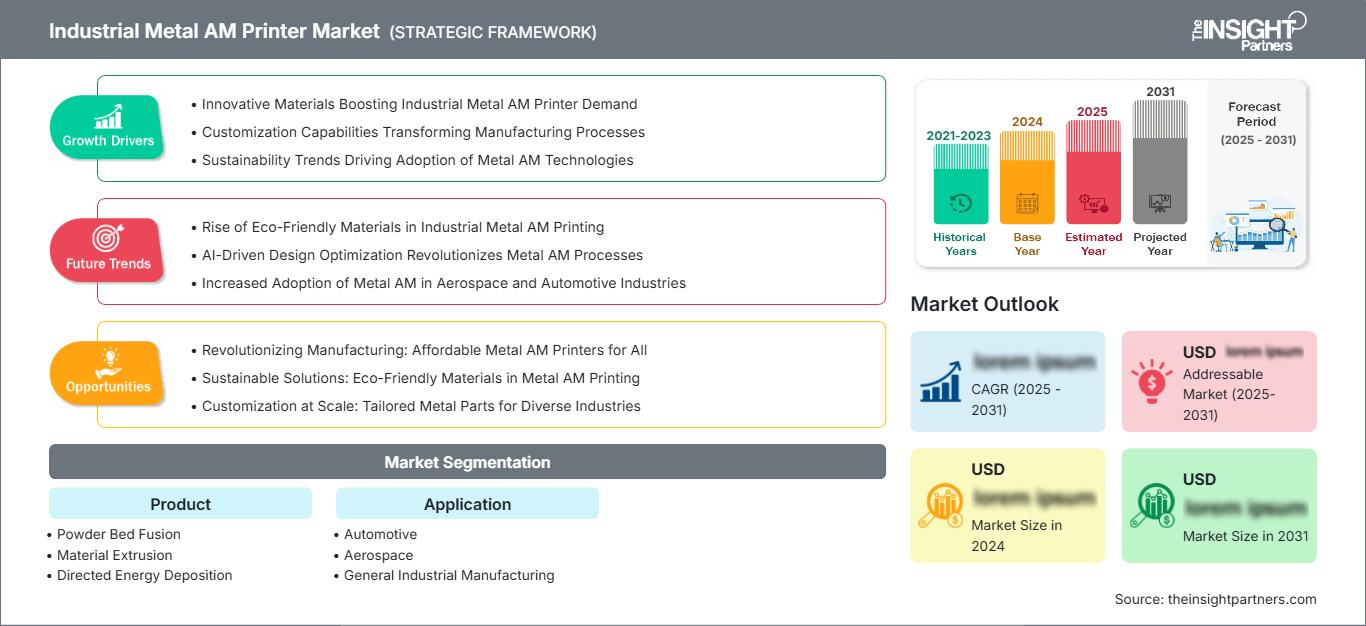
Industrial Metal AM Printer Market: Strategic Insights
Regional Insights
North America Industrial Metal AM Printer Market
North America is estimated to account for 32–36% of the Industrial Metal AM Printer Market Share in 2025 and expand at a CAGR of 7.6–8.4% through 2034. The US dominates regional demand because aerospace, defense, automotive, medical manufacturing, and industrial equipment producers increasingly qualify printed metal parts for production. Government emphasis on domestic manufacturing and resilient supply chains also supports localized additive capacity.
Canada has its role in terms of aerospace, energy, mining, and advanced manufacturing programs. On the other hand, Mexico offers a growing automotive and industrial manufacturing capability. The use of additive manufacturing in the region is changing from being used mainly for prototypes to production, maintenance, tooling, and spare parts applications. Increased build volume, process monitoring, and automation of post-process operations are making the technology more economical.
U.S. Industrial Metal AM Printer Market
The USA accounts for about 78-82% of North America’s 2025 market share and will continue to expand at a CAGR of 7.4-8.2% until 2034. The key applications in aerospace and defense sectors will be driven by the growing demand for lightweight structures, parts replacement, and the need for shortened supply chain. Automotive companies utilize metal AM for special components production, tooling and engineering purposes.
The companies operate within a variety of technological areas. ADDiTEC designs the metal AM systems based on LDED and Liquid Metal Jetting, while Coherent Corp. provides laser equipment necessary for manufacturing processes. The company Markforged has created the metal printing system with the help of the Digital Forge platform, while the company Desktop Metal created an impressive production-oriented portfolio before the ownership change.
Europe Industrial Metal AM Printer Market
The region is expected to have a 27-31% share by 2025 and a CAGR of 7.4-8.2% till 2034. Germany continues to be the key regional market due to its capabilities in automotive engineering, machinery industry, aerospace, and advanced materials. The UK has good activity related to aerospace, defense, and research, while France derives value due to its aircraft manufacture and industrial engineering demand. Italy and Spain get their shares from automotive, machinery, energy, and niche manufacturing.
The German industrial networking system promotes adoption via automation, engineering skills, and additive manufacturing technology research. Metal additive manufacturing in the UK is utilized in the aerospace sector, defense industry, and engineering parts. The country of France has high demands for the production of aircraft and propelling systems, whereas Italy and Spain have promising prospects for automotive, machinery, tools, and energy industries.
APAC Industrial Metal AM Printer Market
The Asia Pacific region is predicted to be around 28% to 32% of the world market in 2025 and is set to grow at a CAGR of 9.0% to 9.8% until 2034. Leading countries in terms of usage within the region are China, Japan, South Korea, India, and Australia. Applications for aerospace, automotive, electronics, tooling, and industrial machinery are growing due to investment into localized manufacturing capabilities.
Manufacturing capacity and machinery equipment in China create an excellent demand basis, whereas in Japan and South Korea, there is a focus on precision manufacturing. India is currently building its capabilities in aerospace, defense, automotive, and industrial AM. Australia enjoys its mining, defense, and aerospace applications.
Middle East & Africa Industrial Metal AM Printer Market
MEA market is expected to grow at a CAGR of 8.5%-9.3% up to 2034, and Saudi Arabia and UAE are seen as potential market leaders in the region. Market adoption is associated with industrial diversification, aerospace, energy, military, construction, and localized manufacturing initiatives. South Africa can be characterized by a solid engineering foundation, whereas other MEA countries have a nascent market.
The industrial diversification initiative of Saudi Arabia and the advanced manufacturing initiative of UAE provide a base for investment in metal AM technology, especially for aerospace, energy, and industrial components. Metal AM in the energy sector is seen as an opportunity for repair and replacement of components. Infrastructure spending in the region will help spur localized manufacturing.
Segmentation Analysis
Product
Product segment in the Industrial Metal AM Printer Market comprises Powder Bed Fusion, Material Extrusion, and Directed Energy Deposition. The segment is expected to expand at a CAGR of 7.8–8.6% during 2026–2034 as industrial users select technologies according to component geometry, production volume, material requirements, and post-processing economics. Process monitoring and hybrid architectures are increasingly important to technology selection.
- Powder Bed Fusion: Powder Bed Fusion maintains the strongest industrial position because it supports intricate geometries, fine features, and established aerospace and engineering workflows. Its mature qualification ecosystem makes it important for high-value production.
- Material Extrusion: Material Extrusion provides a comparatively accessible route to metal part production, particularly where simplified workflows, lower equipment complexity, and tooling applications are prioritized. Adoption is expanding among smaller industrial users.
- Directed Energy Deposition: Directed Energy Deposition is increasingly selected for large components, repair, feature addition, and near-net-shape manufacturing. Its ability to use wire or powder feedstock supports flexible material and component strategies.
Application
Application segment in the Industrial Metal AM Printer Market includes Automotive, Aerospace, and General Industrial Manufacturing and is projected to grow at a CAGR of 8.0–8.8% during 2026–2034. Adoption increasingly depends on whether additive manufacturing can demonstrate measurable cost, lead-time, weight, or performance advantages over conventional production routes.
- Automotive: Automotive users apply metal AM to lightweight components, tooling, prototypes, motorsport parts, thermal-management structures, and selected production applications. Adoption increases as manufacturers integrate additive workflows into digital engineering.
- Aerospace: Aerospace remains strategically important because lightweighting, part consolidation, complex internal geometries, and low-volume production align strongly with additive manufacturing economics. Qualification and traceability remain central procurement considerations.
- General Industrial Manufacturing: General Industrial Manufacturing covers machinery, energy, tooling, mining, defense, and industrial equipment. Demand is supported by replacement parts, repair, customized components, and reduced dependence on conventional tooling.
Opportunity Snapshot
| Application | Revenue Contribution (High/Medium/Low) | Trend Tag (MAX 2 words) | Adoption Stage (Emerging/Scaling/Mature) |
|---|---|---|---|
| Automotive | High | Lightweight Parts | Scaling |
| Aerospace | High | Part Consolidation | Mature |
| General Industrial Manufacturing | Medium | Spare Parts | Scaling |
Industrial Metal AM Printer Market Growth Drivers and Impact Analysis
Expansion of Lightweight and Complex Component Manufacturing
Demand for lightweight structures and geometrically complex components is increasing the addressable production scope for metal additive manufacturing. Aerospace manufacturers can consolidate assemblies, integrate internal channels, and reduce component mass, while automotive producers can apply similar principles to performance parts and thermal-management components. The economic benefit becomes more pronounced when conventional manufacturing requires extensive machining or dedicated tooling. Industrial printers therefore gain relevance where design freedom translates into measurable material, assembly, or lead-time savings. Higher machine productivity and improved process monitoring are also reducing the gap between prototype and production environments. As qualification processes mature, more manufacturers are expected to shift selected high-value components from conventional production toward validated additive workflows.
Increasing Localization of Manufacturing and Spare-Part Production
Manufacturing localization is creating opportunities for additive systems that can produce components closer to the point of consumption. Long supply chains for specialized components can expose manufacturers to inventory risks, transportation delays, minimum-order requirements, and obsolete stock. Metal AM can address selected spare parts and low-volume components through digital inventories and on-demand production. This model is particularly relevant for aerospace, energy, mining, defense, and industrial equipment, where component availability can have disproportionate operational consequences. Printer deployment near manufacturing sites also enables iterative engineering and localized customization. As digital qualification, inspection, and process documentation improve, distributed production models can become more practical for selected component categories without requiring manufacturers to maintain extensive physical inventories.
Advances in Process Monitoring, Automation, and Multi-Laser Platforms
Technological improvements are increasing productivity and process consistency across metal AM systems. Multi-laser configurations can raise throughput within suitable Powder Bed Fusion architectures, while automated powder handling, closed-loop monitoring, melt-pool analysis, and machine-learning-assisted parameter control can reduce operator intervention. Directed Energy Deposition is also benefiting from higher-power lasers, robotic motion systems, and improved material delivery. These advances matter because industrial users evaluate printers based on repeatability, utilization, production economics, and qualification requirements rather than build capability alone. Better monitoring can generate process records that support quality assurance and traceability. Consequently, equipment manufacturers able to combine hardware, software, materials, and application engineering are positioned to capture a larger share of industrial production deployments.
Industrial Metal AM Printer Market Future Trends
Convergence of Additive and Subtractive Manufacturing
Future industrial systems are expected to increasingly combine additive deposition with machining, inspection, and automated finishing within integrated production cells. Hybrid manufacturing can reduce intermediate handling while allowing near-net-shape deposition followed by precision machining of critical surfaces. This Industrial Metal AM Printer Market Trends is particularly relevant to large metal components where conventional machining from billet or forging creates substantial material removal. Integration with robotics and digital process planning can also enable flexible production cells that switch between repair, feature addition, and complete part fabrication. As industrial users prioritize throughput and floor-space efficiency, equipment suppliers are likely to develop more modular architectures capable of integrating additive processes with established CNC and inspection infrastructure.
Digital Qualification and Closed-Loop Production Control
Digital qualification is likely to become a central differentiator as metal AM moves deeper into regulated production. Future platforms should combine machine telemetry, material batch information, environmental conditions, process parameters, inspection results, and part genealogy within a unified digital record. Artificial intelligence can support anomaly detection and parameter optimization, but industrial adoption will depend on validation and traceability rather than algorithmic sophistication alone. Closed-loop control can reduce process variability by adjusting parameters during printing when deviations are detected. Such capabilities should improve repeatability across machines and production sites. Over time, standardized digital records may facilitate qualification transfer between facilities, supporting distributed manufacturing and reducing the administrative burden associated with new production programs.
Industrial Metal AM Printer Market Opportunities
Localized Production for Energy and Heavy Industrial Components
Energy, mining, and heavy industrial equipment offer attractive opportunities because these industries frequently require specialized components with long procurement cycles or limited production volumes. Metal AM can support redesign, repair, and replacement of selected components while reducing reliance on discontinued tooling or geographically concentrated suppliers. Directed Energy Deposition is particularly relevant for large components and repair operations because it can deposit material onto existing substrates and produce near-net-shape structures. Suppliers can pursue partnerships with equipment manufacturers, energy operators, mining companies, and service bureaus to validate component-specific business cases. Investments should prioritize material qualification, inspection capabilities, field-service support, and integration with machining rather than focusing solely on printer capacity.
Production Platforms for Aerospace and Defense Supply Chains
Aerospace and defense supply chains in the Industrial Metal AM Printer Market Forecast provide opportunities for suppliers capable of meeting demanding qualification, documentation, and repeatability requirements. The market can benefit from programs involving lightweight structures, legacy-part replacement, tooling, propulsion components, and maintenance applications. Strategic investments should focus on validated process windows, secure digital workflows, material traceability, and integration with non-destructive testing. Suppliers can also develop application centers that allow customers to evaluate parts before committing to production equipment. This reduces adoption barriers and creates pathways from prototyping to serial manufacturing. Companies with strong partnerships across materials, software, inspection, and machining can build differentiated offerings around complete production workflows rather than standalone printer sales.
Recent Developments
- September 2025: Arc Impact Acquisition Corporation acquired selected assets of Desktop Metal out of Chapter 11 and relaunched the business around binder-jet metal and ceramic additive manufacturing, production-grade polymers, and AI-assisted materials research. The strategy emphasized domestic production for defense, automotive, aerospace, medical, and energy applications.
- April 2025: Nano Dimension Ltd. completed its acquisition of Desktop Metal for approximately US$179.3 million, combining advanced manufacturing systems, materials, and software under a broader digital manufacturing platform. The transaction expanded Nano Dimension's exposure to industrial metal additive manufacturing and related production applications.
- April 2025: Nano Dimension Ltd. also completed the acquisition of Markforged, adding its industrial additive manufacturing portfolio and Digital Forge capabilities. The transaction strengthened access to distributed manufacturing workflows and production-oriented metal and composite printing applications.
Frequently Asked Questions

- Comprehensive Market Sizing and Forecast Analysis
- Detailed Segmentation Analysis
- In-Depth Market Dynamics Assessment
- Regional and Country-Level Insights
- Competitive Landscape and Company Benchmarking
- Strategic Business Intelligence
Recent Reports
Testimonials

The Insight Partners provided valuable market intelligence that supported our global go-to-market strategy. Their team was professional, responsive, and attentive to our feedback, providing thoughtful analysis and helpful methodological clarifications throughout the project.
Junmo Kim Chief Financial Officer (CFO), Enertech Co., Ltd.
The Insight Partners' SCADA System Market report is comprehensive, with valuable insights on current trends and future forecasts. The team was highly professional, responsive, and supportive throughout. We are very satisfied and highly recommend their services.
RAN KEDEM Partner, Reali Technologies LTDs
I requested a report on a very specific software market and the team produced the report in a few days. The information was very relevant and well presented. I then requested some changes and additions to the report. The team was again very responsive and I got the final report in less than a week.
JEAN-HERVE JENN Chairman, Future Analytica
We worked with The Insight Partners for an important market study and forecast. They gave us clear insights into opportunities and risks, which helped shape our plans. Their research was easy to use and based on solid data. It helped us make smart, confident decisions. We highly recommend them.
PIYUSH NAGPAL Sr. Vice President, High Beam Global
The Insight Partners delivered insightful, well-structured market research with strong domain expertise. Their team was professional and responsive throughout. The user-friendly website made accessing industry reports seamless. We highly recommend them for reliable, high-quality research services
YUKIHIKO ADACHI CEO, Deep Blue, LLC.
This is the first time I have purchased a market report from The Insight Partners.While I was unsure at first, I visited their web site and felt more comfortable to take the risk and purchase a market report.I am completely satisfied with the quality of the report and customer service. I had several questions and comments with the initial report, but after a couple of dialogs over email with their analyst I believe I have a report that I can use as input to our strategic planning process.Thank you so much for taking the extra time and making this a positive experience.I will definitely recommend your service to others and you will be my first call when we need further market data.
JOHN SUZUKI President and Chief Executive Officer, Board Director, BK Technologies
I wish to appreciate your support and the professionalism you displayed in the course of attending to my request for information regarding to infectious disease IVD market in Nigeria. I appreciate your patience, your guidance, and the fact that you were willing to offer a discount, which eventually made it possible for us to close a deal. I look forward to engaging The Insight Partners in the future, all thanks to the impression you have created in me as a result of this first encounter.
DR CHIJIOKE ONYIA MANAGING DIRECTOR, PineCrest Healthcare Ltd.Reason to Buy
- Informed Decision-Making
- Understanding Market Dynamics
- Competitive Analysis
- Identifying Emerging Markets
- Customer Insights
- Market Forecasts
- Risk Mitigation
- Boosting Operational Efficiency
- Strategic Planning
- Investment Justification
- Tracking Industry Innovations
- Aligning with Regulatory Trends





 Get Free Sample for