
Industrial Portable Calibrators Market Size, Share & Forecast by 2034
Coverage: by Type (Portable Temperature Calibrators, Portable Pressure Calibrators, Portable Multifunction Calibrators, Portable Loop Calibrators); End-user (Pharmaceuticals, Power, Chemical and Petrochemical, Manufacturing, Food and Beverages, Oil and Gas, Others) , and Geography (North America, Europe, Asia Pacific, and South and Central America)
- Status : Data Released
- Report Code : TIPRE00010546
- Category : Electronics and Semiconductor
- No. of Pages : 150
- Available Report Formats :


- Last update date : September 21, 2026


2025 Market Size
US$ 764.11 Mn
Base year value
2034 Forecast
US$ 932.34 Mn
Projected by 2034
CAGR 2026-2034
2.24 %
Growth rate
Addressable Market
US$ 7,695.07 Mn
(2026-2034)
The Industrial Portable Calibrators Market stands at US$ 764.11 Million in 2025 and is projected to reach US$ 932.34 Million by 2034, registering a CAGR of 2.24% from 2026 to 2034. Demand is anchored in recurring field verification of pressure, temperature, and process signals across regulated and asset-intensive industries, while portability reduces intervention time and supports decentralized maintenance programs.
North America remains a structurally important arena, with the Industrial Portable Calibrators Market size supported by mature process instrumentation, stringent quality systems, and established calibration laboratories. Regional expansion is expected at 2.8–3.4% CAGR through 2034, as pharmaceutical, energy, chemical, and advanced manufacturing facilities increasingly prioritize traceable, on-site measurement assurance.
Industrial Portable Calibrators Market Assessment and Insights
- North America: The region is expected to hold a 29–32% share in 2025 and expand at a 2.8–3.4% CAGR between 2026–2034, supported by regulated manufacturing and mature calibration infrastructure.
- US: The US is expected to represent 68–72% of North America in 2025 and grow at a 2.7–3.3% CAGR between 2026–2034, led by pharmaceuticals, energy, and process industries.
- Europe: Europe is projected to command a 24–27% share in 2025 and advance at a 2.1–2.7% CAGR between 2026–2034, with Germany, the UK, France, Italy, and Spain supporting demand through quality-led industrial operations.
- Asia Pacific: Asia Pacific is estimated at a 29–32% share in 2025 and is positioned for a 3.0–3.8% CAGR between 2026–2034, led by China, Japan, India, South Korea, and expanding manufacturing capacity.
- Largest Segment: Portable Multifunction Calibrators are expected to hold a 31–35% market share in 2025 and expand at a 2.7–3.3% CAGR between 2026–2034, reflecting workload consolidation.
- High Growth Segment: Pharmaceuticals is expected to account for a 12–16% market share in 2025 and grow at a 3.5–4.2% CAGR between 2026–2034, supported by validation intensity.
- Key companies analyzed in detail: Additel Corporation; AMETEK, Inc.; Baker Hughes Company; Beamex Oy Ab; Dwyer Instruments, Inc.; Fluke Corporation; OMEGA Engineering, Inc.; SIKA Dr. Siebert and Kühn GmbH & Co. KG; WIKA Group; Yokogawa Electric Corporation; TSS.
Source: The Insight Partners' analysis based on proprietary research, government publications, company annual reports, investor presentations, industry databases, and expert interviews.
The market has progressed from one function portable tools to integrated systems that combine source, measurement, documentation, and communication capabilities. Advancements in digital electronics, battery management technology, sensor miniaturization, and durable housing have increased field versatility. Manufacturing economics now prefer modular designs that can accommodate pressure, temperature, and electrical calibrations, and software solutions are increasingly being utilized to link calibration records to maintenance systems.
For the forecast period, the market is expected to diversify into new manufacturing centers and process plants. Energy generation, food processing, and automation plants should be reliable sources for periodic recalibrations. Requirements for traceability, quality documentation, and worker safety standards will provide additional incentive for purchases, while distribution and calibration service providers will play significant roles in accessing small-scale industries.
Industrial Portable Calibrators Market Report Scope
| Report Attribute | Details |
|---|---|
| Market size in 2025 | US$ 764.11 Million |
| Market Size by 2034 | US$ 932.34 Million |
| Global CAGR (2026 - 2034) | 2.24% |
| Historical Data | 2021-2024 |
| Forecast period | 2026-2034 |
Industrial Portable Calibrators Market Analysis
The Industrial Portable Calibrators market will depend on the need for periodic testing of measurements, since any instrument inaccuracy in the plants can impact the quality of products, process stability, energy consumption, and even safety. The industrial portable calibrators ecosystem involves instrumentation vendors, calibration vendors, laboratories, plant engineers, distributors, and service providers. The demand is linked to the presence of instrumentation and its maintenance schedule.
The main value drivers will be accuracy, portability, documentation, and interoperability, not the measurement capacity anymore. The competitive advantage will involve sensors’ quality, battery life, durability, user interfaces, and communication systems. The supply chain will be built around electronics, reference sensors, pressure modules, thermal parts, and special manufacturing processes.
According to the analysis of the Industrial Portable Calibrators Market, the competition is characterized by diversity among diversified test-and-measurement firms and specialist calibration providers. The major rivals Fluke Corporation and Yokogawa Electric Corporation compete in wide-ranging field solutions, and Beamex Oy Ab concentrates on documented calibration procedures. Additel Corporation and WIKA Group enhance their specialty in pressure and process, and AMETEK, Inc. and OMEGA Engineering, Inc. provide wider technologies of measurements.
In addition, Baker Hughes Company, Dwyer Instruments, Inc., and SIKA Dr. Siebert and Kühn GmbH & Co. KG provide solutions for industrial segments, where durability, traceability, and performance become essential. And TSS provides yet another specialty. Strategic positioning becomes more and more dependent on decreasing the time of the technicians and working in hazardous areas.
● REPORT CUSTOMIZATION
Tailor This Report To Align With Your Specific Business Requirements
This report can be customized to align precisely with your business objectives, scope, and target markets. Customization options include tailored segmentation, geography, competitive analysis, and strategic insights to support informed decision-making.
Customize This Report →WHAT YOU CAN ADJUST
- ● Segmentations
- ● Geography
- ● Competitive Analysis
- ● Language Preferences
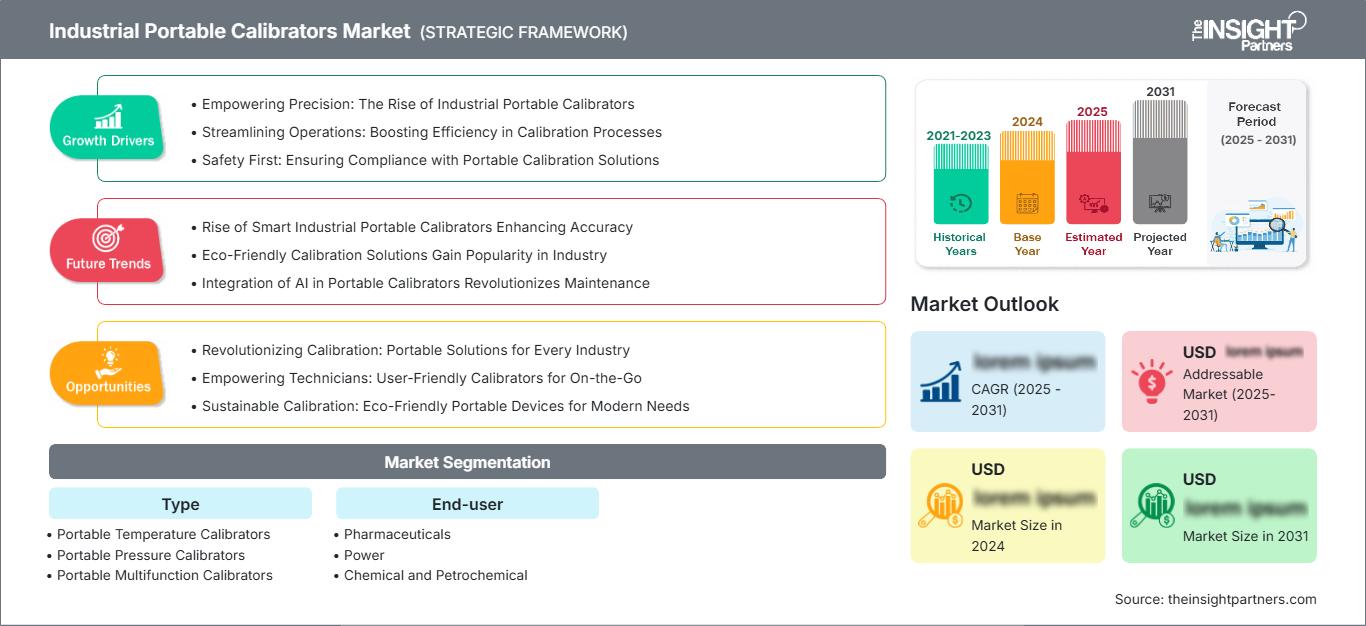
Industrial Portable Calibrators Market: Strategic Insights
Regional Insights
North America Industrial Portable Calibrators Market
North America is expected to retain a 29–32% Industrial Portable Calibrators Market share in 2025, with a 2.8–3.4% CAGR through 2034. The region benefits from a dense installed base of process instrumentation across pharmaceuticals, chemicals, refining, power generation, food processing, and advanced manufacturing. NIST traceability practices and ISO/IEC 17025 laboratory accreditation reinforce recurring verification and documentation requirements.
The US accounts for 68–72% of North American demand in 2025. Canada contributes through mining, energy, food processing, and industrial automation. Portable instruments are preferred where technicians must verify transmitters, sensors, loops, and control devices without removing equipment from service. The region benefits from established technical service providers and mature replacement cycles.
U.S. Industrial Portable Calibrators Market
The US represents 68–72% of North American demand in 2025 and is expected to grow at a 2.7–3.3% CAGR through 2034. This is evident from the fact that there is process instrumentation and controlled production involved. The need arises from industries such as pharmaceuticals, oil & gas, chemicals, utilities and manufacturing for calibration due to quality assurance, safety and asset reliability.
Companies such as Fluke Corporation, AMETEK, Inc. and Additel Corporation among others have very wide range of applications in pressure, temperature, electrical and process calibrators. There is increasing preference for calibration of equipment which will document as-found and as-left readings, facilitate field communication and make work easier for the technician.
Europe Industrial Portable Calibrators Market
Europe is projected to hold a 24–27% share in 2025 and expand at a 2.1–2.7% CAGR through 2034. Germany forms the largest national market, backed by precision engineering, chemical, machinery, and auto manufacturing industry sectors. The United Kingdom, France, Italy, and Spain offer supplementary demand via regulated manufacturing and well-developed maintenance ecosystems.
In the United Kingdom, there are strict calibration needs for the pharmaceutical, aerospace, energy, and food processing industries. In Germany, there is the combination of high-level instrumentation and stringent quality management in process and discrete manufacturing operations. France gets advantages from aerospace, pharmaceuticals, utilities, and chemical sectors, whereas Italy and Spain have additional demand from machinery, food, energy, and industrial processing sectors.
APAC Industrial Portable Calibrators Market
Asia Pacific is expected to represent a 29–32% share in 2025 and achieve a 3.0–3.8% CAGR through 2034. China, followed by Japan, South Korea, India, and Australia, are the key markets. An increase in the capacity of electronics, chemical, pharmaceutical, power, and food-processing industries results in increased need for field testing.
Industrial investments and manufacturing policies of nations result in increased use of portable calibration instruments. The markets of China and South Korea gain because of electronics and process manufacturing, Japan due to precision industries, India due to capacity expansion, and Australia due to availability of resources and energy.
Middle East & Africa Industrial Portable Calibrators Market
MEA is expected to expand at a 2.6–3.2% CAGR through 2034, with Saudi Arabia leading regional demand. However, there are contributions from projects in the UAE and industrial projects in South Africa, while the other MEA region is still focused on projects. Projects related to energy, utilities, chemicals, mining, and water infrastructure bring in the requirements for calibration.
With the diversification of energy sources and the development of industrial infrastructure programs, the customer base will not be limited to hydrocarbon-based clients only. Reliability of processes and high-end facilities are important considerations for Saudi Arabia and the UAE, whereas mining, power, and manufacturing applications are considered in South Africa.
Segmentation Analysis
Type
The Type segment is expected to grow at a 2.4–2.9% CAGR from 2026–2034. Product selection depends on measurement range, accuracy, workload diversity, portability, and frequency of field intervention. Multifunction platforms increasingly appeal to teams seeking fewer devices, while dedicated temperature and pressure units remain important where procedures are standardized.
- Portable Temperature Calibrators: These instruments serve thermocouples, RTDs, temperature transmitters, and sensors across process and manufacturing environments. Compact dry-block and related formats support field verification where thermal stability and repeatability are critical.
- Portable Pressure Calibrators: Pressure units address transmitters, gauges, switches, and process equipment. Their strategic importance is strongest in oil and gas, chemicals, utilities, and manufacturing, where pressure accuracy directly influences process control and safety.
- Portable Multifunction Calibrators: Multifunction devices combine several source and measurement functions, reducing equipment count for technicians. They are valuable for complex plants with varied instrumentation and support faster troubleshooting during planned and unplanned maintenance.
- Portable Loop Calibrators: Loop calibrators target current, voltage, and process-loop verification. Their simple workflows make them useful for commissioning and maintenance teams that need rapid checks of transmitters and control loops.
End-user
The End-user segment is projected to advance at a 2.6–3.2% CAGR from 2026–2034. Industrial Portable Calibrators Market scope covers regulated and asset-intensive facilities. Measurement accuracy is linked directly to production, hazardous operations, process continuity, or product quality. Pharmaceutical and energy-intensive facilities therefore maintain recurring requirements.
- Pharmaceuticals: Calibration supports validated manufacturing, controlled environments, utilities, and laboratory processes. Documented traceability is strategically important because instrument performance can influence batch quality and compliance decisions.
- Power: Generation and grid-support facilities use calibration equipment for pressure, temperature, electrical, and process instrumentation. Portable tools help maintenance teams verify equipment during outages and routine reliability programs.
- Chemical and Petrochemical: These facilities require rugged calibration equipment for transmitters, loops, temperature devices, and pressure systems. Hazardous-area compatibility and measurement traceability strongly influence procurement.
- Manufacturing: Discrete and process manufacturers use portable instruments during commissioning, preventive maintenance, quality checks, and troubleshooting. Demand is supported by automation and the growing installed base of sensors.
- Food and Beverages: Calibration supports temperature, pressure, flow-related instrumentation, and hygienic process controls. Portable devices help technicians verify equipment without disrupting production for extended periods.
- Oil and Gas: Exploration, processing, pipelines, terminals, and custody-transfer operations require accurate field verification. Rugged pressure and multifunction calibrators are important where equipment operates in demanding environments.
Opportunity Snapshot
| End-user | Revenue Contribution (High/Medium/Low) | Trend Tag | Adoption Stage |
|---|---|---|---|
| Pharmaceuticals | Medium | Validation | Scaling |
| Power | High | Asset Reliability | Mature |
| Chemical and Petrochemical | High | Process Safety | Mature |
| Manufacturing | High | Smart Maintenance | Scaling |
| Food and Beverages | Medium | Hygienic Control | Scaling |
| Oil and Gas | High | Custody Transfer | Mature |
Industrial Portable Calibrators Market Growth Drivers and Impact Analysis
Expansion of regulated manufacturing and quality assurance
In regulated production environments, there is a need for evidence showing that the measuring devices function within specific tolerances. It means that pharmaceuticals, food processing plants, chemicals production companies and energy producers must have their calibration schedules aligned with validation, quality management, and risk management. The change is structural in nature since calibration will be incorporated into routine maintenance instead of being an enhancement option for technologies. Portability helps to ensure a faster response by enabling technicians to check their measuring devices in place rather than removing and transporting them. This also means that suppliers will have to compete through traceability characteristics, safe records, repeatability and integration into maintenance work flow. Multi-line production plants will benefit from devices capable of measuring different parameters.
Industrial automation increases measurement density
Automation involves installation of sensors, transmitters, controllers and points of measurement on production facilities. The increased number of measuring points increases the number of devices that have to be calibrated at regular intervals. Increased instrumentation leads to increased maintenance needs regardless of increased reliability of individual instruments. Calibration becomes a part of operation that can be addressed using portable calibrators which allow testing of devices in situ. The effect on the market is most pronounced in those plants where distributed control systems, condition monitoring and digitally based maintenance are implemented. From the perspective of plant operators, the economic gain depends less on the cost of calibrator and more on shorter troubleshooting and maintenance periods.
Workforce constraints favor easier field calibration
In maintenance organizations in industry, the problem becomes even more real when experienced workers retire or when skilled workers become hard to attract. Calibration procedures that rely heavily on manual calculations, use several tools and are labor-intensive due to extensive paperwork are not simple to learn and take longer to execute. A portable calibrator with a guidance interface, stored procedures, automation of documentation and diagnostics helps to simplify the procedure. The resulting impact on the market will be the greater tendency towards the equipment supporting standardized work rather than just highly accurate work. For the service organization it means more tasks that can be verified by one technician during one visit. This means that vendors can reinforce customer loyalty through more than just product differentiation.
Industrial Portable Calibrators Market Future Trends
Connected calibration records will become operational data
Industrial Portable Calibrators Market trends are heading towards calibrations becoming operational data rather than being individual certificates. Future devices will communicate calibration results with computerized maintenance management systems, enterprise asset management applications, and laboratory information systems. This will automatically trigger instruments out of tolerance notifications, actions, and traceability across asset history. Cloud-supported processes may also support centralized control of geographically dispersed facilities while maintaining controlled local processes. Security and user authentication will play an increasing role with calibration data going into wider operational technology systems. Providers will probably compete not only by measurement capabilities but also by interoperability, auditability, and configurability of work processes. Industrial Portable Calibrators Market long-term value proposition is expected to be shifting towards administration savings and transformation of calibration data into maintenance decisions, reliability metrics, and compliance documentation.
Miniaturization will expand multi-parameter field capability
Portable instruments are sure to get even smaller but will have a wider array of measurement and communication capabilities. Innovations in electronics, sensors, batteries, and displays could enable multifunctionality without a proportional increase in weight or complexity. The next generation of such products might incorporate pressure, temperature, electrical, and loop functionality along with wireless communications, step-by-step operation guidance, and increased on-board memory. The result would be an enhancement to the ability to serve technicians working in cramped industrial plants, far-flung installations, and short maintenance intervals. Hazardous area approvals would still be essential design criteria for oil and gas, chemical, and petrochemical industry users. Companies that manage to develop small units without sacrificing stability, robustness, and traceability would have a competitive edge when it comes to mobile servicing.
Industrial Portable Calibrators Market Opportunities
Calibration-as-a-service for distributed industrial assets
Industrial Portable Calibrators Market Forecasts point toward opportunities for service providers that combine mobile calibration, digital records, and recurring maintenance contracts. Smaller factories and geographically dispersed facilities may prefer outsourced verification when maintaining specialist personnel is uneconomic. Providers can use portable multifunction equipment to cover several instrument categories during scheduled site visits, while software can preserve certificates and maintenance histories. The opportunity extends beyond equipment ownership because customers increasingly value predictable compliance and reduced administrative burden. Investors and suppliers can target industries with high instrumentation density, frequent audits, or remote assets. Partnerships between equipment manufacturers, accredited laboratories, and regional service companies could improve coverage without requiring every provider to build a complete technical infrastructure independently.
Application-specific calibration platforms for high-risk industries
These opportunities also indicate a need to develop application-specific packages for pharmaceuticals, energy, chemicals, and oil and gas. Instead of selling generic hardware alone, suppliers can configure instruments, accessories, procedures, documentation templates, and training around defined workflows. Pharmaceutical packages could emphasize validation records, while oil and gas solutions could prioritize hazardous-area certification and pressure performance. Such specialization can reduce customer selection complexity and shorten technician training. Manufacturers can also use modular architecture to address multiple applications without creating entirely separate product platforms. Localized application engineering and after-sales support can further improve adoption in emerging industrial regions.
Recent Developments
- April 2026: Micro Quality Calibration (MQC) and Technical Maintenance Inc. (TMI) unite to form TruMetric, a national calibration platform delivering accredited calibration solutions across the U.S. TruMetric brings together MQC’s laboratory expertise and TMI’s field and embedded service models. This creates a broader and more flexible delivery approach. Services include in-house, on-site, embedded, and mobile calibration solutions.
- October 2025: Yokogawa Test & Measurement Corporation announces that its LS3300 Precision AC Power Calibrator now comes with the added option of Harmonic Output Capability for reliable and comprehensive calibration of power meters, delivering a unique value to the market. The LS3300 Precision AC Power Calibrator outputs highly accurate and stable power calibration signals now including harmonics for greater efficiency and productivity of power meter calibration workflows, making it the most versatile and user-friendly precision AC power calibrator in its class.
- December 2023: A global leader in industrial health and safety solutions, Sensidyne proudly announces the official launch of the Gilian Go-CalTM Pro, an advanced portable air flow calibrator designed to revolutionize precision calibration on the jobsite.
Frequently Asked Questions

- Comprehensive Market Sizing and Forecast Analysis
- Detailed Segmentation Analysis
- In-Depth Market Dynamics Assessment
- Regional and Country-Level Insights
- Competitive Landscape and Company Benchmarking
- Strategic Business Intelligence
Recent Reports
Testimonials

The Insight Partners provided valuable market intelligence that supported our global go-to-market strategy. Their team was professional, responsive, and attentive to our feedback, providing thoughtful analysis and helpful methodological clarifications throughout the project.
Junmo Kim Chief Financial Officer (CFO), Enertech Co., Ltd.
The Insight Partners' SCADA System Market report is comprehensive, with valuable insights on current trends and future forecasts. The team was highly professional, responsive, and supportive throughout. We are very satisfied and highly recommend their services.
RAN KEDEM Partner, Reali Technologies LTDs
I requested a report on a very specific software market and the team produced the report in a few days. The information was very relevant and well presented. I then requested some changes and additions to the report. The team was again very responsive and I got the final report in less than a week.
JEAN-HERVE JENN Chairman, Future Analytica
We worked with The Insight Partners for an important market study and forecast. They gave us clear insights into opportunities and risks, which helped shape our plans. Their research was easy to use and based on solid data. It helped us make smart, confident decisions. We highly recommend them.
PIYUSH NAGPAL Sr. Vice President, High Beam Global
The Insight Partners delivered insightful, well-structured market research with strong domain expertise. Their team was professional and responsive throughout. The user-friendly website made accessing industry reports seamless. We highly recommend them for reliable, high-quality research services
YUKIHIKO ADACHI CEO, Deep Blue, LLC.
This is the first time I have purchased a market report from The Insight Partners.While I was unsure at first, I visited their web site and felt more comfortable to take the risk and purchase a market report.I am completely satisfied with the quality of the report and customer service. I had several questions and comments with the initial report, but after a couple of dialogs over email with their analyst I believe I have a report that I can use as input to our strategic planning process.Thank you so much for taking the extra time and making this a positive experience.I will definitely recommend your service to others and you will be my first call when we need further market data.
JOHN SUZUKI President and Chief Executive Officer, Board Director, BK Technologies
I wish to appreciate your support and the professionalism you displayed in the course of attending to my request for information regarding to infectious disease IVD market in Nigeria. I appreciate your patience, your guidance, and the fact that you were willing to offer a discount, which eventually made it possible for us to close a deal. I look forward to engaging The Insight Partners in the future, all thanks to the impression you have created in me as a result of this first encounter.
DR CHIJIOKE ONYIA MANAGING DIRECTOR, PineCrest Healthcare Ltd.Reason to Buy
- Informed Decision-Making
- Understanding Market Dynamics
- Competitive Analysis
- Identifying Emerging Markets
- Customer Insights
- Market Forecasts
- Risk Mitigation
- Boosting Operational Efficiency
- Strategic Planning
- Investment Justification
- Tracking Industry Innovations
- Aligning with Regulatory Trends





 Get Free Sample for