
Industrial Power Supply Market Trends, Size & Growth by 2034
Coverage: by Product Type (AC-DC Converter, DC-AC Inverter, DC-DC Converter); Output Power (Up to 1000 W, 1000 W-10 kW, 10-75 kW, 75-150 kW); Industry Vertical (Consumer Electronics, Transportation, Food and Beverages, Aerospace and Defense, Telecom, Healthcare, Others) , and Geography (North America, Europe, Asia Pacific, and South and Central America)
- Status : Data Released
- Report Code : TIPRE00008830
- Category : Electronics and Semiconductor
- No. of Pages : 150
- Available Report Formats :


- Last update date : October 16, 2026


2025 Market Size
US$ 17.77 Bn
Base year value
2034 Forecast
US$ 27.64 Bn
Projected by 2034
CAGR 2026-2034
5.03 %
Growth rate
Addressable Market
US$ 206.05 Bn
(2026-2034)
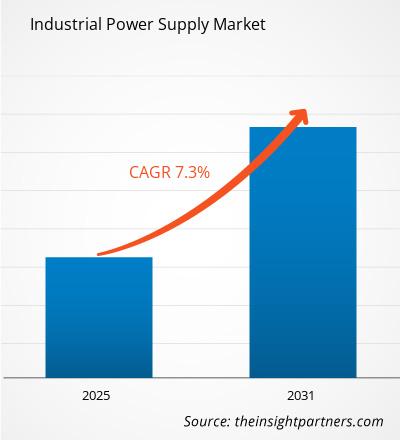
The Industrial Power Supply Market was valued at US$ 17.77 Billion in 2025 and is projected to reach US$ 27.64 Billion by 2034, registering a CAGR of 5.03% during 2026–2034. Efficiency considerations, compact design, better power density, and robustness of electrical supply infrastructure characterize the demand in different industrial applications. There is growth in the market due to higher requirements for reliable power conversion because of automation of industrial processes, increased electrification and digitalization of equipment.
North America continues to be strategically significant as the development of advanced manufacturing facilities, semiconductor fabs, electrified transport, and data centers requires reliable conversion and protection equipment. The Industrial Power Supply Market Size in North America will be driven by system replacements, automation initiatives, and higher power consumption. Expected regional growth rate is 5.7%-6.1% CAGR between 2026 and 2034.
Industrial Power Supply Market Assessment and Insights
- North America: The region commands a 30–33% share in 2025 and is expected to grow at a 5.7–6.1% CAGR between 2026–2034, supported by automation, semiconductor facilities, data centers, and resilient industrial infrastructure.
- US: The US represents 78–82% of North American demand in 2025 and is expected to expand at a 5.8–6.2% CAGR between 2026–2034, led by manufacturing and digital infrastructure.
- Europe: Europe holds a 24–27% share in 2025 and is projected to register a 5.2–5.6% CAGR between 2026–2034. Germany, the UK, France, Italy, and Spain support demand through automation, transportation, energy efficiency, and industrial modernization.
- Asia Pacific: Asia Pacific accounts for a 36–40% share in 2025 and is forecast to grow at a 6.4–7.0% CAGR between 2026–2034. China, Japan, South Korea, India, and Australia underpin regional expansion through manufacturing and infrastructure investment.
- Largest Segment: AC-DC Converter holds a 40–44% market share in 2025 and is expected to expand at a 5.5–5.9% CAGR during 2026–2034, reflecting broad equipment compatibility.
- High Growth Segment: DC-DC Converter represents a 27–30% market share in 2025 and is expected to grow at a 6.3–6.9% CAGR during 2026–2034, supported by electrification and distributed architectures.
- Key companies analyzed in detail: ABB Ltd., Amara Raja Power Systems Limited, COSEL Co., Ltd., CUI Inc., Delta Electronics, Inc., Magna-Power Electronics, Inc., MEAN WELL Enterprises Co., Ltd., Siemens AG, TDK-Lambda Corporation, XP Power Ltd.
Source: The Insight Partners' analysis based on proprietary research, government publications, company annual reports, investor presentations, industry databases, and expert interviews.
It has progressed from traditional output-based devices to smaller switching topologies, greater efficiency, better heat dissipation, and programmability. Manufacturers of industrial machinery now prefer to consider the demands of the systems in relation to power supplies rather than merely on the basis of cost of components. Digitally controlled power supplies, modular designs, broad voltage input range, and greater electromagnetic compatibility have affected the manufacturing process while semiconductor and magnet technology still matter.
During the forecast period, manufacturers are expected to invest in localized manufacturing, reliable sourcing of components, and equipment that can run efficiently in different electrical environments. Manufacturing centers in emerging markets like India and Southeast Asia will attract suppliers who want access to electronics, transportation, and automation applications. Regulations relating to energy efficiency, electrical safety, electromagnetic compatibility, and industrial cybersecurity will drive improvements especially when the power supplies are connected with the control systems.
Industrial Power Supply Market Report Scope
| Report Attribute | Details |
|---|---|
| Market size in 2025 | US$ 17.77 Billion |
| Market Size by 2034 | US$ 27.64 Billion |
| Global CAGR (2026 - 2034) | 5.03% |
| Historical Data | 2021-2024 |
| Forecast period | 2026-2034 |
Industrial Power Supply Market Analysis
Demand is varied and comprises applications in industrial electrification, factory automation, semiconductor production, transportation infrastructure, and communication infrastructure. Growth in the Industrial Power Supply Market is directly proportional to the increase in electricity consumption and the need for conversion of electricity or battery into stable operating voltages. The International Energy Agency predicts global electricity demand to grow strongly until 2027, led by industrial production, electrification, and data centers.
The industry ecosystem consists of semiconductor manufacturers, magnetics manufacturers, power device manufacturers, converter manufacturers, contract manufacturers, distributors, system integrators, and industrial original equipment manufacturers. The AC-DC converter operates close to the infrastructure of the grid, while the DC-DC and DC-AC designs enable greater control over the voltages and the electrical energy transformation. In this respect, the competition in the supply market becomes dependent on aspects like efficiency, thermal management, certifications, customizability, and shipping services, but not wattage.
The Competitive Landscape of the Industrial Power Supply Market Report highlights a fragmented market landscape comprising diversified electrical equipment firms as well as power conversion equipment suppliers. Both ABB Ltd. and Siemens AG have advantages due to diversified industrial networks while Delta Electronics, Inc., TDK-Lambda Corporation, MEAN WELL Enterprises Co., Ltd., COSEL Co., Ltd., and XP Power Ltd. concentrate on power conversion product lines. CUI Inc., Magna-Power Electronics, Inc., and Amara Raja Power Systems Limited cater to special requirements.
Power density, efficiency, ruggedness, digital programmability, and application engineering increasingly become the focus of competitive positioning. Thus, TDK-Lambda Corporation keeps growing its industrial AC-DC and DC-DC product portfolio, whereas Delta Electronics, Inc. adds to its power management skills and smart manufacturing solutions. ABB Ltd. and Siemens AG have an advantage in offering their power equipment together with automation and electrification solutions.
● REPORT CUSTOMIZATION
Tailor This Report To Align With Your Specific Business Requirements
This report can be customized to align precisely with your business objectives, scope, and target markets. Customization options include tailored segmentation, geography, competitive analysis, and strategic insights to support informed decision-making.
Customize This Report →WHAT YOU CAN ADJUST
- ● Segmentations
- ● Geography
- ● Competitive Analysis
- ● Language Preferences
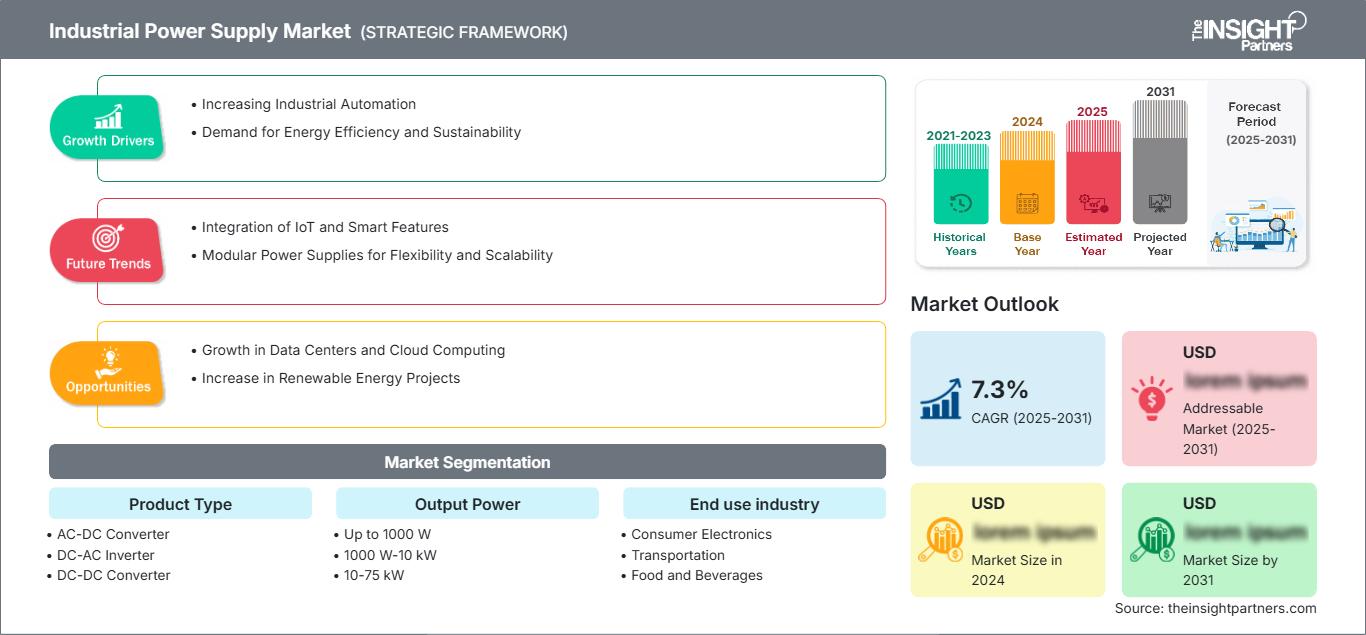
Industrial Power Supply Market: Strategic Insights
Regional Insights
North America Industrial Power Supply Market
North America accounted for a market share of 30-33% in 2025 and is forecast to register a growth rate of 5.7-6.1% during the forecast period till 2034. The US leads regional demand; Canada, on the other hand, makes its contribution via energy, mining, manufacturing, and infrastructure projects. Automation, semi-conductor fabrication, data centers development, and transport electrification help ensure sustained demand for reliable conversion equipment.
Growing preference among industrial clients for compact size, efficiency, fault tolerance, and fast availability of replacement helps sustain regional market share. In addition, domestic manufacturing drives are helping create local equipment supply chains. Regional Industrial Power Supply Market share benefits from an established distribution network and large installed base of industrial equipment. Growth in demand is especially strong in the presence of potential disruptions due to power outages.
U.S. Industrial Power Supply Market
The US represents 78–82% of North American demand in 2025 and is expected to register a 5.8–6.2% CAGR through 2034. Semiconductor plants, advanced manufacturing, aerospace facilities, telecom infrastructure, and data centers are strengthening requirements for dependable power conversion systems.
The other key driving factor in the market is the industrial automation, with the vendors providing support for both new systems and replacements. Among these companies are Siemens AG, ABB Ltd., Delta Electronics, Inc., TDK-Lambda Corporation, CUI Inc., and XP Power Ltd. With respect to the US market, the IEA stated that the electricity consumption grew by 2.1% in 2024 and pointed out data centers and new industrial loads.
Europe Industrial Power Supply Market
In Europe, market penetration has been 24–27% in 2025 and is anticipated to grow with a CAGR of 5.2–5.6% from 2025 to 2034. Germany is the leading country in terms of demand because of automation and advanced manufacturing, followed by the UK, France, Italy, and Spain.
Germany enjoys the advantage of its production base, which consists of automobiles, machinery, and processes industries and results in a continuous demand for power conversion and automation solutions. The UK takes advantage of the modernization of industries along with investments into infrastructures and data centers. France has a market potential in aviation, transport, and power systems, whereas Italy and Spain can take advantage of manufacturing modernization, renewables integration, food processing, and electrification projects.
APAC Industrial Power Supply Market
In 2025, APAC has a share of 36-40%, and a growth rate of 6.4-7.0% CAGR up to 2034 makes it the biggest regional market, with China leading, then Japan, South Korea, India, and Australia. Manufacturing and electronics fabrication are responsible for the high demand.
China still has an electricity-hungry manufacturing sector, while India is going through industrial and infrastructural development very quickly. In Japan and South Korea, there is focus on automation, electronics, and precision manufacturing, and mining and infrastructure in Australia. Political support in industrial development, localization of electronics, electrification, and integration of renewables make the region attractive. The IEA expects that China and India together will provide a big chunk of the global growth of electricity demand until 2026.
Middle East & Africa Industrial Power Supply Market
Demand from MEA and Africa is forecast to grow at 4.6% to 5.2% CAGR until 2034, with investments spearheaded by Saudi Arabia in the region. The UAE invests through infrastructure and digital infrastructure, while South Africa through its mining and manufacturing sectors and power infrastructure modernization.
Diversification in Saudi industrial infrastructure creates demand for reliable conversion solutions within industries and utilities. Logistics, telecom, construction, and data centers activities in the UAE form the second source of demand. Mining and industrial activities of South Africa need ruggedized solutions, whereas other parts of MEA represent areas for opportunities related to energy, water, transportation, and infrastructure.
Segmentation Analysis
Product Type
Product Type remains central to system architecture because each converter performs a distinct electrical transformation. AC-DC Converter leads adoption due to its role at the mains interface, while DC-DC Converter demand benefits from distributed power architectures. The Industrial Power Supply Market scope across product types is expected to expand at differentiated rates, with the overall segment growing at a 5.3–5.8% CAGR during 2026–2034.
- AC-DC Converter: The largest product category serves factory automation, telecom, healthcare, transportation, and general industrial equipment, where stable conversion from utility AC to regulated DC remains fundamental.
- DC-AC Inverter: Demand is concentrated in systems requiring controlled AC output from DC sources, including energy storage, backup architectures, testing, and specialized industrial equipment.
- DC-DC Converter: Increasingly important in distributed architectures, battery-powered systems, transportation electronics, and embedded equipment, supporting voltage conditioning and efficient downstream power management.
Output Power
Output Power segment in the Industrial Power Supply Market determines thermal architecture, component selection, enclosure requirements, and application suitability. Lower-power units serve embedded and control equipment, while higher-output systems support industrial machinery, testing, transportation, and energy-intensive installations. This segment is expected to expand at a 5.1–5.7% CAGR during 2026–2034 as industrial equipment becomes more electrified and power-dense.
- Up to 1 W: Primarily supports compact electronics, sensors, control interfaces, and specialized embedded circuits where miniature dimensions and low standby consumption are important.
- 1 W-1 kW: Serves the broadest range of industrial electronics, automation controllers, communications equipment, instrumentation, and auxiliary systems requiring standardized and dependable power conversion.
- 1-75 kW: Addresses machinery, testing, transportation, charging, automation, and industrial processing applications where higher output, programmability, and thermal performance become increasingly important.
- 75-15 kW: Supports specialized high-output industrial requirements where system integration, robust thermal design, and scalable power architecture influence purchasing decisions.
End use industry
End use industry segment in the Industrial Power Supply Market determines certification requirements, operating environments, redundancy expectations, and preferred power architectures. Manufacturing and telecom remain structurally important, while transportation, healthcare, and aerospace require highly dependable systems. The segment is expected to grow at a 5.4–6.0% CAGR during 2026–2034 as industrial electrification broadens application requirements.
- Consumer Electronics: Requires compact, efficient, cost-sensitive power conversion for production equipment, testing systems, and manufacturing infrastructure supporting high-volume electronics operations.
- Transportation: Demand is shaped by electrification, railway systems, charging infrastructure, onboard electronics, and manufacturing equipment requiring reliable conversion across variable operating conditions.
- Food and Beverages: Processing and packaging facilities prioritize dependable power, hygiene-compatible equipment integration, automation, and resistance to demanding continuous-production environments.
- Aerospace and Defense: Mission-critical systems require stringent reliability, ruggedization, thermal control, electromagnetic compatibility, and specialized qualification across demanding operating environments.
- Telecom: Network infrastructure depends on continuous DC power, backup architectures, compact rectification, and efficient equipment capable of supporting increasingly dense communications loads.
- Healthcare: Medical equipment requires dependable, low-noise, safety-compliant power conversion, with compact designs supporting diagnostic, monitoring, laboratory, and treatment equipment.
- Others: Industrial applications across specialized machinery, energy infrastructure, research systems, and commercial equipment create diversified demand for configurable and application-specific power solutions.
Opportunity Snapshot
| End use industry | Revenue Contribution | Trend Tag | Adoption Stage |
|---|---|---|---|
| Consumer Electronics | High | Factory Automation | Mature |
| Transportation | High | Vehicle Electrification | Scaling |
| Food and Beverages | Medium | Process Automation | Scaling |
| Aerospace and Defense | Medium | Mission Power | Mature |
| Telecom | High | Network Density | Mature |
| Healthcare | Medium | Medical Digitization | Scaling |
| Others | Medium | Industrial Controls | Scaling |
Industrial Power Supply Market Growth Drivers and Impact Analysis
Industrial automation raises demand for dependable distributed power
With automation, there are more sensors, controllers, drives, communication interfaces, safety circuits, and edge devices involved in each manufacturing setting. The more electrical nodes, the more needs to be satisfied when it comes to reliable, isolated, and adequately powered connections. There is an increased need for modular solutions that can be installed close to loads and serviced without long downtimes. Market opportunities go beyond just the new plants since existing factories turn to distributed systems instead of centralized or outdated ones. Multiple output voltages, wide ranges of input voltage, communication, and diagnostics help serve the needs of both machinery manufacturers and plant managers. Automation thus changes purchasing considerations from simple transformation to availability and efficiency. The opportunity space thus broadens into many different manufacturing applications.
Electrification expands power-conversion requirements across industrial systems
The trend of electrification within industries results in the formation of many new points of energy conversion between utility grids, batteries, motor drives, charging stations, controls and electronic loads. As AC/DC solutions become more prevalent within transportation, energy storage, manufacturing and process industries, the need emerges for converters designed for variable input parameters and precisely regulated output. According to the International Energy Agency, electricity demand will grow significantly during electrification of various industries and transport. For suppliers, there is a potential market in those cases when legacy electric systems are redesigned in order to achieve better efficiency and controllability. This trend is especially important for DC/DC converters, industrial rectifiers, programmable power supplies and systems allowing the connection of batteries or renewables to standard systems.
Data-center and semiconductor investment strengthens high-reliability demand
The expansion of data centers and semiconductor manufacturing creates industrial loads where power quality, continuity, thermal efficiency, and compact installation are critical. Although these facilities are not identical to conventional factories, their electrical requirements overlap substantially with industrial power-supply applications, including conversion, backup, monitoring, and controlled DC distribution. The IEA estimates that US data centers consumed about 180 TWh of electricity in 2024 and expects their consumption to increase materially through 2030. Semiconductor fabrication also requires specialized equipment with tightly controlled electrical characteristics. These investments encourage suppliers to develop higher-density, programmable, low-noise, and thermally optimized solutions. Consequently, high-performance power supplies can gain share in equipment manufacturing, testing, cleanroom systems, networking, and facility-level support infrastructure.
Industrial Power Supply Market Future Trends
Digital power supplies become increasingly software-defined
Future architectures will increasingly combine power conversion hardware with embedded sensing, digital control, communications, and predictive diagnostics. Industrial customers are likely to specify supplies capable of reporting voltage, current, temperature, alarms, efficiency, and operating history into supervisory systems. This will allow maintenance teams to identify abnormal loading and thermal conditions before failures interrupt production. The Industrial Power Supply Market trends are therefore likely to move toward software-enabled lifecycle management rather than isolated component monitoring. Digital interfaces should also simplify configuration across standardized equipment platforms, reducing engineering effort when machines are deployed across multiple countries. Suppliers that expose reliable data without compromising electrical safety or cybersecurity will have an advantage. Over time, power supplies may function as intelligent nodes within broader industrial energy-management systems, connecting electrical performance with production and maintenance decisions.
Wide-range architectures support globally standardized equipment
Industrial OEMs increasingly seek equipment that can be shipped across markets without extensive electrical redesign. Future power supplies are consequently expected to accommodate broader AC and DC input ranges, multiple output configurations, and selectable operating parameters. This approach reduces inventory complexity and enables machine builders to use common designs across regions with different grid characteristics. Wide-range architectures also support equipment exposed to battery buses, renewable sources, charging systems, and unstable industrial networks. Greater use of digital configuration will make these platforms easier to adapt during commissioning. Manufacturers are likely to combine broader electrical compatibility with stronger isolation, improved surge protection, and enhanced environmental resistance. Such developments can reduce system redesign costs while allowing suppliers to serve a wider application base with fewer core product families.
Industrial Power Supply Market Opportunities
Localized production creates strategic opportunities in emerging manufacturing hubs
India, Southeast Asia, and selected Central and Eastern European markets offer opportunities for suppliers seeking shorter supply chains and closer relationships with industrial OEMs. Local production can reduce logistics exposure, improve service response, and support customer requirements for regionally available products. ABB Ltd.'s investment in Indian manufacturing and R&D illustrates the broader localization direction, including capacity serving renewable energy, metro rail, and data-center applications. ABB Group Industrial Power Supply Market Forecasts should therefore be assessed alongside localization strategies rather than only aggregate demand. Investors and manufacturers can prioritize assembly, testing, application engineering, and distribution capabilities near fast-growing manufacturing clusters. Partnerships with automation integrators and machine builders may further improve market access while reducing the need to build complete direct-sales organizations in every emerging geography.
High-efficiency power platforms can capture premium industrial applications
Energy efficiency provides a commercially relevant opportunity because power losses translate into heat, cooling requirements, operating expense, and equipment stress. Buyers increasingly evaluate total cost of ownership rather than initial purchase price when supplies operate continuously or at high utilization. This favors products with efficient conversion across broad load ranges, optimized thermal paths, long component life, and intelligent load management. Suppliers can target semiconductor equipment, telecom infrastructure, transportation systems, testing platforms, and automated factories where efficiency improvements have measurable operational value. Premium platforms can also incorporate programmable functions and remote monitoring, creating additional differentiation beyond conversion efficiency. Investment should focus on architectures that combine semiconductor advances, magnetics optimization, thermal engineering, and digital control. Such integrated development can improve performance while supporting higher power density and smaller equipment footprints.
Recent Developments
- July 2026: L&T Semiconductor Technologies (LTSCT) signed an MoU with Taiwan-based Azuremoto Technologies to advance Silicon Carbide (SiC) power semiconductor products for AI data centres, along with rectifiers and MOS-based devices for industrial and consumer applications. The collaboration covers SiC MOSFETs, diodes and modules for data-centre power supplies, server power architectures and UPS systems, as well as products for energy metering, HVAC controls, solar inverters, BLDC motor drives and consumer electronics.
- March 2026: Rittal and PULS entered a technology partnership to accelerate and simplify machine and plant engineering by combining Rittal’s RiLineX busbar platform with PULS’ industrial power supplies. PULS, the first technology partner in RiLineX’s “Power Supplies” functional group, plans to develop modified power supplies that can connect directly to the RiLineX board, eliminating conventional DIN-rail wiring. The solution enables tool-free installation, reduced wiring and engineering effort, more compact panel designs and power supplies with up to 97% efficiency, targeting applications including building technology and battery energy storage systems. The first products across multiple power classes are planned for 2026.
- March 2026: Vertiv launched the PowerUPS 6000 Industrial, an industrial-grade uninterruptible power supply (UPS) designed to provide reliable power protection for mission-critical operations across manufacturing, transportation, oil and gas, pharmaceuticals, food and beverage, packaging and steel industries. The system features an IP42 rating and operates in ambient temperatures up to 50°C, protecting PLCs, SCADA systems, industrial networking equipment and production-line automation from power disruptions and harsh environments.
Frequently Asked Questions

- Comprehensive Market Sizing and Forecast Analysis
- Detailed Segmentation Analysis
- In-Depth Market Dynamics Assessment
- Regional and Country-Level Insights
- Competitive Landscape and Company Benchmarking
- Strategic Business Intelligence
Recent Reports
Testimonials

The Insight Partners provided valuable market intelligence that supported our global go-to-market strategy. Their team was professional, responsive, and attentive to our feedback, providing thoughtful analysis and helpful methodological clarifications throughout the project.
Junmo Kim Chief Financial Officer (CFO), Enertech Co., Ltd.
The Insight Partners' SCADA System Market report is comprehensive, with valuable insights on current trends and future forecasts. The team was highly professional, responsive, and supportive throughout. We are very satisfied and highly recommend their services.
RAN KEDEM Partner, Reali Technologies LTDs
I requested a report on a very specific software market and the team produced the report in a few days. The information was very relevant and well presented. I then requested some changes and additions to the report. The team was again very responsive and I got the final report in less than a week.
JEAN-HERVE JENN Chairman, Future Analytica
We worked with The Insight Partners for an important market study and forecast. They gave us clear insights into opportunities and risks, which helped shape our plans. Their research was easy to use and based on solid data. It helped us make smart, confident decisions. We highly recommend them.
PIYUSH NAGPAL Sr. Vice President, High Beam Global
The Insight Partners delivered insightful, well-structured market research with strong domain expertise. Their team was professional and responsive throughout. The user-friendly website made accessing industry reports seamless. We highly recommend them for reliable, high-quality research services
YUKIHIKO ADACHI CEO, Deep Blue, LLC.
This is the first time I have purchased a market report from The Insight Partners.While I was unsure at first, I visited their web site and felt more comfortable to take the risk and purchase a market report.I am completely satisfied with the quality of the report and customer service. I had several questions and comments with the initial report, but after a couple of dialogs over email with their analyst I believe I have a report that I can use as input to our strategic planning process.Thank you so much for taking the extra time and making this a positive experience.I will definitely recommend your service to others and you will be my first call when we need further market data.
JOHN SUZUKI President and Chief Executive Officer, Board Director, BK Technologies
I wish to appreciate your support and the professionalism you displayed in the course of attending to my request for information regarding to infectious disease IVD market in Nigeria. I appreciate your patience, your guidance, and the fact that you were willing to offer a discount, which eventually made it possible for us to close a deal. I look forward to engaging The Insight Partners in the future, all thanks to the impression you have created in me as a result of this first encounter.
DR CHIJIOKE ONYIA MANAGING DIRECTOR, PineCrest Healthcare Ltd.Reason to Buy
- Informed Decision-Making
- Understanding Market Dynamics
- Competitive Analysis
- Identifying Emerging Markets
- Customer Insights
- Market Forecasts
- Risk Mitigation
- Boosting Operational Efficiency
- Strategic Planning
- Investment Justification
- Tracking Industry Innovations
- Aligning with Regulatory Trends





 Get Free Sample for