
Industrial Transmitters Market Share, Growth & Forecast by 2034
Coverage: By Product (Pressure Transmitters, Level Transmitters, Temperature Transmitters, Flow Transmitters, General-purpose Transmitters); End-user (Oil and Gas, Energy and Power, Chemical and Petrochemical, Water and Wastewater Treatment, Others), and Geography (North America, Europe, Asia Pacific, and South and Central America)
- Status : Data Released
- Report Code : TIPRE00019014
- Category : Electronics and Semiconductor
- No. of Pages : 150
- Available Report Formats :


- Last update date : October 16, 2026


2025 Market Size
US$ 18.18 Bn
Base year value
2034 Forecast
US$ 24.37 Bn
Projected by 2034
CAGR 2026-2034
3.31 %
Growth rate
Addressable Market
US$ 193.23 Bn
(2026-2034)
The Industrial Transmitters market is valued at US$ 18.18 Billion in 2025 and is projected to reach US$ 24.37 Billion by 2034, registering a CAGR of 3.31% from 2026 to 2034. Need continues to be driven by measurement of pressure, flow, temperature, and level. The Market is geared for growth as process industries value precise measurement, automation, and dependability.
North America stands for an opportunity that is mature yet technically advanced, backed by technological upgradation in refining, chemical, utilities, and water infrastructure sectors. The Industrial Transmitters Market Size in the region depends on replacement needs, adoption of digital instrumentation, cybersecurity needs, and greater adoption of smart field devices. Expected investments in industrial automation will drive a regional CAGR of 3.6–4.2% from 2026 to 2034.
Industrial Transmitters Market Assessment and Insights
- North America: North America is estimated to account for 28–32% share in 2025, supported by process automation and brownfield modernization. The region is expected to expand at a 3.6–4.2% CAGR between 2026–2034, with replacement cycles sustaining demand.
- US: The US represents approximately 23–27% share in 2025 of global demand and is expected to grow at a 3.7–4.3% CAGR between 2026–2034, supported by refinery, chemical, and utility modernization.
- Europe: Europe is estimated at 24–28% share in 2025, led by Germany, the UK, France, Italy, and Spain. Industrial decarbonization, process efficiency, and automation investments should support a 3.1–3.7% CAGR between 2026–2034.
- Asia Pacific: Asia Pacific is estimated at 31–35% share in 2025, with China, Japan, South Korea, and India leading regional consumption. Manufacturing expansion and infrastructure investment should support a 3.8–4.5% CAGR between 2026–2034.
- Largest Segment: Pressure Transmitters represent the largest product category, with a market share of 31–35% in 2025 and a 3.2–3.8% CAGR between 2026–2034, reflecting broad process applications.
- High Growth Segment: Water and Wastewater Treatment is the high-growth end-user category, supported by monitoring requirements and infrastructure upgrades, with a 3.9–4.6% CAGR between 2026–2034.
- Key companies analyzed in detail: ABB, AMETEK, Inc., Danfoss, Dwyer Instruments, Emerson Electric Co., Fuji Electric Co., Ltd., General Electric Company, Honeywell International Inc., Schneider Electric, and Siemens AG.
Source: The Insight Partners' analysis based on proprietary research, government publications, company annual reports, investor presentations, industry databases, and expert interviews.
From analog-based industrial measuring instrumentation has developed into the digital configuration type, which is now equipped with diagnostics, communications, increased accuracy, and specialized sensors. Modern pressure, temperature, flow, and level transmitters have turned from measuring units into information providers in distributed control systems. This trend is resulting in changes in the way purchasing decisions are made, shifting away from first-time cost consideration toward the criteria of reliability, ease of installation, diagnostics, and interfacing with automation systems.
The future adoption of the technology will be dictated by the needs of industrial electrification, upgrading of water systems, process optimization, and emission reductions in manufacturing. The development of industrial centers in Asia and the Middle East is going to create new demand for industrial instrumentation, whereas the developed countries are going to focus on replacements and upgrades. Process safety, energy efficiency, environmental monitoring, and explosive area operation regulations will continue pushing users to upgrade their instrumentation systems.
Industrial Transmitters Market Report Scope
| Report Attribute | Details |
|---|---|
| Market size in 2025 | US$ 18.18 Billion |
| Market Size by 2034 | US$ 24.37 Billion |
| Global CAGR (2026 - 2034) | 3.31% |
| Historical Data | 2021-2024 |
| Forecast period | 2026-2034 |
Industrial Transmitters Market Analysis
Growth in the Industrial Transmitters Market is linked to the intensity of automation, process safety needs, and continuous measurement needs. Demand starts from process personnel and engineering contractors who specify the need for measurement precision, range, communication capabilities, hazardous area approvals, and installation requirements. Original equipment manufacturers, instrumentation distributors, sensor providers, and system integrators are part of the downstream value chain. Thus, the value chain includes sensing elements, electronics, enclosures, software, communication components, calibration, and after-sale support.
The supply side is affected by the availability of semiconductors, stainless steel and alloy prices, electronic component availability, and regional manufacturing bases. The most prominent suppliers have begun to adopt modular designs that cater to pressure, temperature, flow, and level transmitters. This helps in reducing the engineering effort required by the supplier and allows him to cater to various industries through electronics and software platform. Regional availability of service facilities is important since calibration, commissioning, maintenance, and replacement are dependent on site-specific expertise.
The Industrial Transmitters Market Report reveals competition in the form of global automation firms, measurement specialists, and sensor makers with an emphasis on application. Emerson Electric Co., ABB, Siemens AG, Honeywell International Inc., and Schneider Electric compete using automation solutions with field instruments as well as controllers and industrial communication systems in their product line-ups. AMETEK, Inc., Dwyer Instruments, Danfoss, Fuji Electric Co., Ltd., and General Electric Company make the difference through advanced measuring devices and industry-specific solutions.
Competition moves from basic sensing to connectivity, diagnostic, security, interoperability, and ease of lifecycle management. Thus, Emerson still continues extending its Rosemount range of sensors for pressure, level, temperature, and flow applications. ABB offers digital pressure transmitters, Honeywell offers field instruments as well as connected monitoring. Danfoss specializes in application-oriented pressure sensing especially for harsh conditions. Investment is thus increasingly targeted at smart instruments, wireless communication, diagnostic, and service.
● REPORT CUSTOMIZATION
Tailor This Report To Align With Your Specific Business Requirements
This report can be customized to align precisely with your business objectives, scope, and target markets. Customization options include tailored segmentation, geography, competitive analysis, and strategic insights to support informed decision-making.
Customize This Report →WHAT YOU CAN ADJUST
- ● Segmentations
- ● Geography
- ● Competitive Analysis
- ● Language Preferences
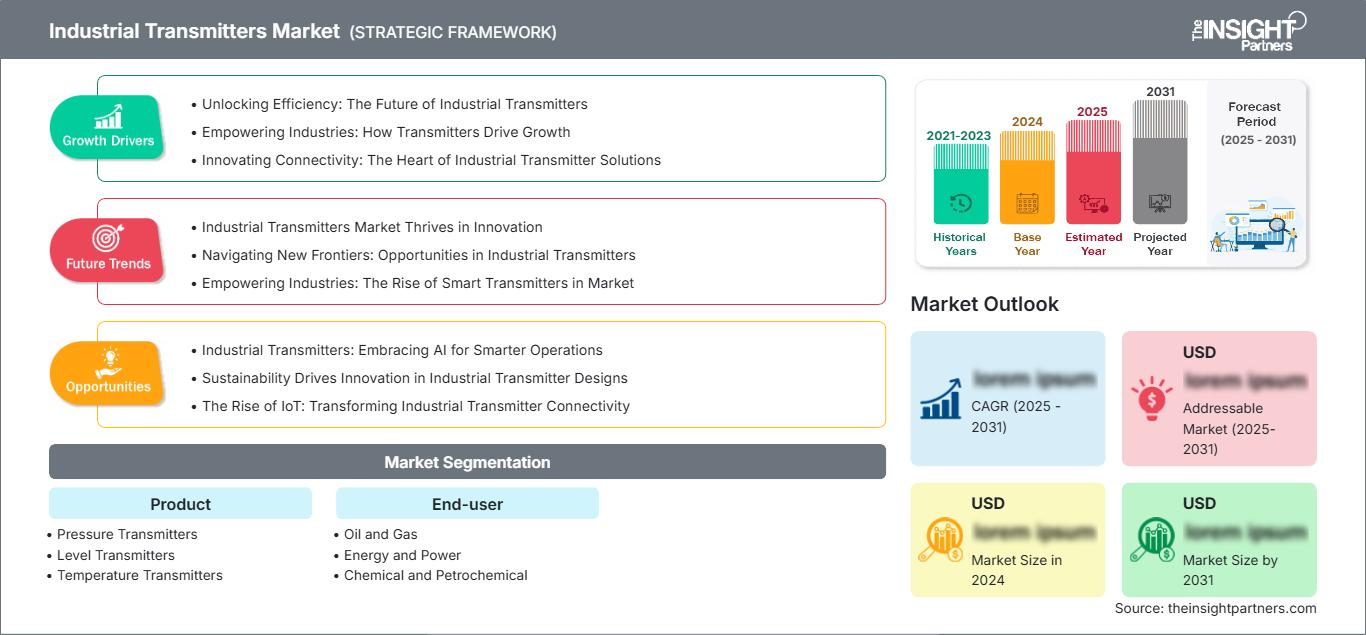
Industrial Transmitters Market: Strategic Insights
Regional Insights
North America Industrial Transmitters Market
North America is anticipated to have The Industrial Transmitters market share of 28-32% in 2025 and is forecasted to experience a 3.6-4.2% CAGR through 2034. The U.S. is expected to be the key regional market driven by the growth in modernization of refineries, chemical processing, power generation, and municipal water infrastructure. Canada will drive the market through its oil and gas, mining, utilities, and process manufacturing applications where field instruments are required to be robust.
Replacement markets will have considerable potential as installed plants would increasingly need diagnostics, configurability from a distance, and compatibility with control systems. Measurement devices will be selected on the basis of factors such as cyber security, hazardous area certification, lifetime management, and cost of ownership. There will be steady growth from brownfield projects, while digital transmitters will be sought after in the greenfield projects.
U.S. Industrial Transmitters Market
The US has an approximate market share of 23–27% of the world's share in 2025, equating to around eight-ninths of the demand in North America, and is projected to have a CAGR growth of 3.7–4.3% during 2026 and 2034. The process industries continue to be the leading buyers for industrial instruments, especially refineries, chemicals, natural gas, electricity, and water treatment.
Major instrument companies have a significant commercial and technological footprint in the region. Major vendors like Emerson Electric Co., Honeywell International Inc., ABB, Siemens AG, and Schneider Electric cater to major process industries through integrated automation products. Measurement of pressure and flow continues to be essential in hydrocarbons and chemicals, while temperature and level gauges are common in storage facilities, utilities, and manufacturing.
Europe Industrial Transmitters Market
Estimated market share for Europe stands at 24-28%, with growth expected at a CAGR of 3.1-3.7% through 2034. Germany is the top country market in Europe, followed by the UK, France, Italy, and Spain. Efficiency of industrial programs, process electrification, environmental needs, and automation upgrades drive replacement demand for existing production facilities.
The UK continues to drive demand from energy, chemicals, utilities, and water infrastructure, whereas Germany gets its demand through advanced manufacturing and process automation technologies. Opportunities for France exist in energy, chemicals, pharmaceuticals, and urban infrastructure. For Italy and Spain, sources of demand are machinery, food processing, chemicals, water infrastructure, and energy projects. Buyers in Europe continue to demand reliable measurements, interoperability, energy efficiency, and lifecycle services. It plays into the hands of suppliers with integrated transmitters with industrial control and asset management systems.
APAC Industrial Transmitters Market
Share of APAC is about 31-35% in 2025 and the region is forecasted to have a CAGR of 3.8-4.5% up to 2034, thus becoming the top performing region. The largest market contribution comes from China, while Japan, South Korea, India and Australia offer considerable demand for instruments in manufacturing, energy, chemicals and utilities.
Industrial growth, investments in water infrastructures, chip making and automation are driving instrumentations adoption. China is benefiting from massive manufacturing and energy projects, Japan – from advanced automation, South Korea – from electronics and chemicals, India – from infrastructural and industrial development and Australia – from mining and energy applications.
Middle East & Africa Industrial Transmitters Market
MEA and African demand growth is anticipated to follow a 3.4–4.0% CAGR up to 2034, with Saudi Arabia being the primary market. In UAE, demand will be driven by energy, chemicals, utilities, and industrial infrastructure, whereas South Africa will drive its demand via mining, power generation, water and process manufacturing applications.
The instrumentation market demand in the region is linked to energy production and development of the infrastructure. Refining, chemical industry expansion, desalination, wastewater treatment, and gas processing plants will need reliable pressure, flow, temperature, and level measurement instruments. Industrial diversification in Saudi Arabia and investment in infrastructure in UAE will open doors for advanced instrumentation, whereas South Africa and the rest of MEA will provide replacement opportunities.
Segmentation Analysis
Product
Product selection depends on process characteristics, required measurement accuracy, installation environment, and control strategy. Pressure instruments maintain broad utilization because a single measurement architecture can support pressure, flow, level, and density-related applications. The product segment is expected to expand at a 3.0–3.6% CAGR between 2026 and 2034. The Industrial Transmitters Market scope increasingly includes connected electronics, diagnostics, and digital communication alongside sensing functionality.
- Pressure Transmitters: Pressure transmitters hold the broadest industrial application base across oil and gas, chemicals, power, and water. Their ability to support differential, gauge, and absolute measurement makes them central to process control.
- Level Transmitters: Level transmitters are essential for tanks, vessels, silos, and treatment systems. Radar and other non-contact technologies are gaining importance where corrosion, contamination, or maintenance access makes conventional measurement difficult.
- Temperature Transmitters: Temperature transmitters provide stable process feedback for furnaces, reactors, heat exchangers, turbines, and storage systems. Digital diagnostics and sensor compatibility increasingly influence procurement decisions.
- Flow Transmitters: Flow transmitters support custody transfer, process balancing, utility monitoring, and production optimization. Demand is strengthened by the need for accurate material and energy accounting across continuous operations.
- General-purpose Transmitters: General-purpose transmitters serve less demanding measurement environments where cost, compact design, simple installation, and compatibility with standard control interfaces are primary purchasing considerations.
End-user
End-user requirements vary significantly according to process complexity, safety requirements, environmental conditions, and infrastructure age. Oil and gas and chemical operations typically demand certified, durable instruments, whereas water utilities emphasize reliability, corrosion resistance, remote monitoring, and low maintenance. The end-user segment is expected to register a 3.4–4.0% CAGR between 2026 and 2034, supporting broader Industrial Transmitters Market growth.
- Oil and Gas: Oil and gas remains a major instrumentation user because pressure, flow, level, and temperature measurements are integral to production, transportation, refining, storage, and safety systems.
- Energy and Power: Power plants require continuous monitoring across boilers, turbines, cooling systems, steam circuits, and auxiliary equipment, creating recurring demand for accurate and durable transmitters.
- Chemical and Petrochemical: Chemical and petrochemical facilities require measurement devices capable of operating with corrosive, hazardous, high-pressure, and high-temperature media while maintaining process safety and repeatability.
- Water and Wastewater Treatment: Water and wastewater applications increasingly use transmitters for pump control, tank management, flow monitoring, treatment optimization, and infrastructure diagnostics, making this an attractive modernization category.
Opportunity Snapshot
| End-user | Revenue Contribution | Trend Tag | Adoption Stage |
|---|---|---|---|
| Oil and Gas | High | Process Safety | Mature |
| Energy and Power | High | Grid Modernization | Mature |
| Chemical and Petrochemical | High | Process Digitization | Scaling |
| Water and Wastewater Treatment | Medium | Smart Water | Scaling |
Industrial Transmitters Market Growth Drivers and Impact Analysis
Expansion of Industrial Automation and Process Digitization
The increasing integration of distributed control systems, supervisory platforms, industrial Ethernet, and asset-management software is raising the value of digitally capable field instruments. Transmitters now contribute measurement data used for control, alarms, diagnostics, maintenance planning, and process optimization. This changes purchasing criteria because plant operators increasingly assess devices according to communication capabilities, configuration simplicity, diagnostic depth, and interoperability. The impact is strongest in large process plants where thousands of measurement points create substantial maintenance exposure. A small improvement in calibration stability or diagnostic coverage can reduce intervention frequency across extensive installations. Consequently, suppliers are incorporating Bluetooth, WirelessHART, IO-Link, advanced diagnostics, and digital configuration into established transmitter platforms, increasing the replacement potential for legacy instruments.
Modernization of Aging Process Infrastructure
A substantial portion of industrial infrastructure in mature economies was designed around earlier generations of instrumentation and control systems. Replacement projects therefore provide a recurring demand base even when overall industrial production grows slowly. Aging transmitters can create calibration problems, limited spare-part availability, communication constraints, and higher maintenance requirements. Modern replacement programs allow operators to improve measurement performance without replacing complete control architectures. The commercial impact is particularly relevant for refineries, chemical plants, power stations, water facilities, and manufacturing sites where downtime is expensive. Suppliers that provide drop-in replacements, compatible communication protocols, and simplified commissioning can capture retrofit spending. This driver also encourages modular product families because customers prefer standardized device architectures across multiple process units.
Water, Energy, and Environmental Infrastructure Investment
Investment in water treatment, energy efficiency, emissions management, and infrastructure resilience is broadening the application base for industrial measurement equipment. Water systems require dependable monitoring of pressure, level, and flow to manage pumping, treatment, storage, and distribution. Energy facilities similarly depend on accurate process measurement for efficiency and equipment protection. Environmental requirements can increase monitoring intensity where industrial operators need better process visibility and control. The commercial effect is especially meaningful in developing markets where new treatment plants and industrial facilities are being commissioned alongside infrastructure upgrades. Transmitter suppliers can benefit from these projects by offering corrosion-resistant designs, remote communication, low-maintenance sensing, and diagnostics. The resulting demand extends beyond traditional hydrocarbons into utilities and infrastructure-oriented applications.
Industrial Transmitters Market Future Trends
Greater Adoption of Wireless and Self-Diagnostic Instrumentation
Industrial transmitters trends increasingly point toward wireless measurement and embedded diagnostic capabilities as operators seek to reduce installation complexity and improve asset visibility. WirelessHART, Bluetooth, LoRaWAN, and related technologies can support measurement points where conventional cabling is expensive, inaccessible, or disruptive to operations. Future devices are likely to combine sensing, local analytics, device health monitoring, and secure communication within compact architectures. This Industrial Transmitters market trends will encourage instrumentation vendors to compete on data quality rather than measurement alone. Plants may increasingly deploy supplementary wireless instruments around rotating equipment, storage assets, utilities, and remote process areas. Integration with asset-management platforms can also turn transmitter diagnostics into maintenance workflows, improving the economic case for connected instrumentation.
Convergence of Measurement and Industrial Analytics
Future architectures will increasingly connect transmitters with edge computing, industrial analytics, digital twins, and centralized asset-management platforms. Rather than transmitting only a process value, advanced devices can provide status information, diagnostic indicators, configuration data, and contextual measurements. This enables control engineers and maintenance teams to distinguish sensor degradation from genuine process changes. Artificial intelligence can further support anomaly detection when sufficient historical information is available. The trend will favor open communication architectures and software ecosystems capable of integrating instruments from multiple suppliers. Over time, transmitter specifications may increasingly emphasize cybersecurity, data structures, device identity, remote configuration, and lifecycle support alongside conventional accuracy and range characteristics.
Industrial Transmitters Market Opportunities
Smart Instrumentation for Water and Desalination Projects
Water scarcity and infrastructure modernization create opportunities for instrumentation suppliers to develop specialized solutions for treatment plants, desalination facilities, pumping stations, and distribution networks. Industrial Transmitters Market Forecasts indicate that suppliers can capture additional value by combining corrosion-resistant construction with remote monitoring and diagnostics. Desalination environments particularly require materials and sensing architectures capable of handling saline water, pressure variation, vibration, and aggressive operating conditions. Vendors can strengthen their position through packaged measurement solutions rather than standalone devices, integrating transmitters with controllers, communication gateways, and maintenance software. Partnerships with engineering contractors and water-technology providers can improve access to project specifications and recurring service opportunities while reducing dependence on individual equipment sales.
Lifecycle Services and Retrofit-Oriented Instrument Platforms
A second opportunity lies in lifecycle services for installed transmitter populations. Many operators require calibration, replacement, configuration, documentation, and compatibility support long after original equipment installation. Vendors can develop retrofit programs that map legacy devices to current product families, simplify migration, and minimize shutdown requirements. Remote diagnostics can support condition-based service contracts, while standardized configuration tools can reduce commissioning time. Suppliers with extensive installed bases can use service relationships to identify replacement opportunities before failures occur. Investment in regional calibration centers, technical support networks, digital documentation, and asset databases can therefore generate recurring revenue while strengthening customer retention. This approach is particularly relevant in mature industrial markets with extensive brownfield infrastructure.
Recent Developments
- October 2025: Emerson Electric Co. launched the Rosemount 3408 Wireless Level Transmitter, described as its first native WirelessHART non-contacting radar level transmitter. The 80 GHz FMCW device targets liquid and solid applications in energy, chemical, metals, mining, pulp and paper, and other industries, reducing cabling requirements while supporting continuous remote level monitoring and diagnostics.
- October 2025: Emerson Electric Co. introduced the Rosemount 4051S Pressure Transmitter with a 20-year warranty and stability specification. The device includes local real-time control through configurable relay switches and supports pressure, flow, level, volume, and temperature alerts. Emerson positioned the transmitter for demanding industrial applications requiring diagnostics, faster response, and simplified operational control.
- September 2025: ABB introduced its P-300 pressure transmitter series to the US market. The series targets petrochemical, chemical, power, pulp and paper, and other industrial applications, offering accuracy of 0.055% and a pressure range extending from 0.05 kPa differential pressure to 105 MPa high gauge pressure. The products also incorporate a backlit HMI and QR-enabled digital diagnostics.
Frequently Asked Questions

- Comprehensive Market Sizing and Forecast Analysis
- Detailed Segmentation Analysis
- In-Depth Market Dynamics Assessment
- Regional and Country-Level Insights
- Competitive Landscape and Company Benchmarking
- Strategic Business Intelligence
Recent Reports
Testimonials

The Insight Partners provided valuable market intelligence that supported our global go-to-market strategy. Their team was professional, responsive, and attentive to our feedback, providing thoughtful analysis and helpful methodological clarifications throughout the project.
Junmo Kim Chief Financial Officer (CFO), Enertech Co., Ltd.
The Insight Partners' SCADA System Market report is comprehensive, with valuable insights on current trends and future forecasts. The team was highly professional, responsive, and supportive throughout. We are very satisfied and highly recommend their services.
RAN KEDEM Partner, Reali Technologies LTDs
I requested a report on a very specific software market and the team produced the report in a few days. The information was very relevant and well presented. I then requested some changes and additions to the report. The team was again very responsive and I got the final report in less than a week.
JEAN-HERVE JENN Chairman, Future Analytica
We worked with The Insight Partners for an important market study and forecast. They gave us clear insights into opportunities and risks, which helped shape our plans. Their research was easy to use and based on solid data. It helped us make smart, confident decisions. We highly recommend them.
PIYUSH NAGPAL Sr. Vice President, High Beam Global
The Insight Partners delivered insightful, well-structured market research with strong domain expertise. Their team was professional and responsive throughout. The user-friendly website made accessing industry reports seamless. We highly recommend them for reliable, high-quality research services
YUKIHIKO ADACHI CEO, Deep Blue, LLC.
This is the first time I have purchased a market report from The Insight Partners.While I was unsure at first, I visited their web site and felt more comfortable to take the risk and purchase a market report.I am completely satisfied with the quality of the report and customer service. I had several questions and comments with the initial report, but after a couple of dialogs over email with their analyst I believe I have a report that I can use as input to our strategic planning process.Thank you so much for taking the extra time and making this a positive experience.I will definitely recommend your service to others and you will be my first call when we need further market data.
JOHN SUZUKI President and Chief Executive Officer, Board Director, BK Technologies
I wish to appreciate your support and the professionalism you displayed in the course of attending to my request for information regarding to infectious disease IVD market in Nigeria. I appreciate your patience, your guidance, and the fact that you were willing to offer a discount, which eventually made it possible for us to close a deal. I look forward to engaging The Insight Partners in the future, all thanks to the impression you have created in me as a result of this first encounter.
DR CHIJIOKE ONYIA MANAGING DIRECTOR, PineCrest Healthcare Ltd.Reason to Buy
- Informed Decision-Making
- Understanding Market Dynamics
- Competitive Analysis
- Identifying Emerging Markets
- Customer Insights
- Market Forecasts
- Risk Mitigation
- Boosting Operational Efficiency
- Strategic Planning
- Investment Justification
- Tracking Industry Innovations
- Aligning with Regulatory Trends





 Get Free Sample for