
Industrial Vending Machine Market Size, Share & Trends by 2034
Coverage: by Type (Vertical Lift Machines, Coil Vending Machines, Carousel Vending Machines, Scale Vending Machines, Others); Product (MRO, PPE, Others); End-user Industry (Aerospace, Healthcare, Manufacturing, Oil and Gas, Construction, Others), and Geography (North America, Europe, Asia Pacific, and South and Central America)
- Status : Data Released
- Report Code : TIPRE00010115
- Category : Electronics and Semiconductor
- No. of Pages : 150
- Available Report Formats :


- Last update date : October 16, 2026


2025 Market Size
US$ 3.67 Bn
Base year value
2034 Forecast
US$ 8.25 Bn
Projected by 2034
CAGR 2026-2034
9.42 %
Growth rate
Addressable Market
US$ 53.22 Bn
(2026-2034)
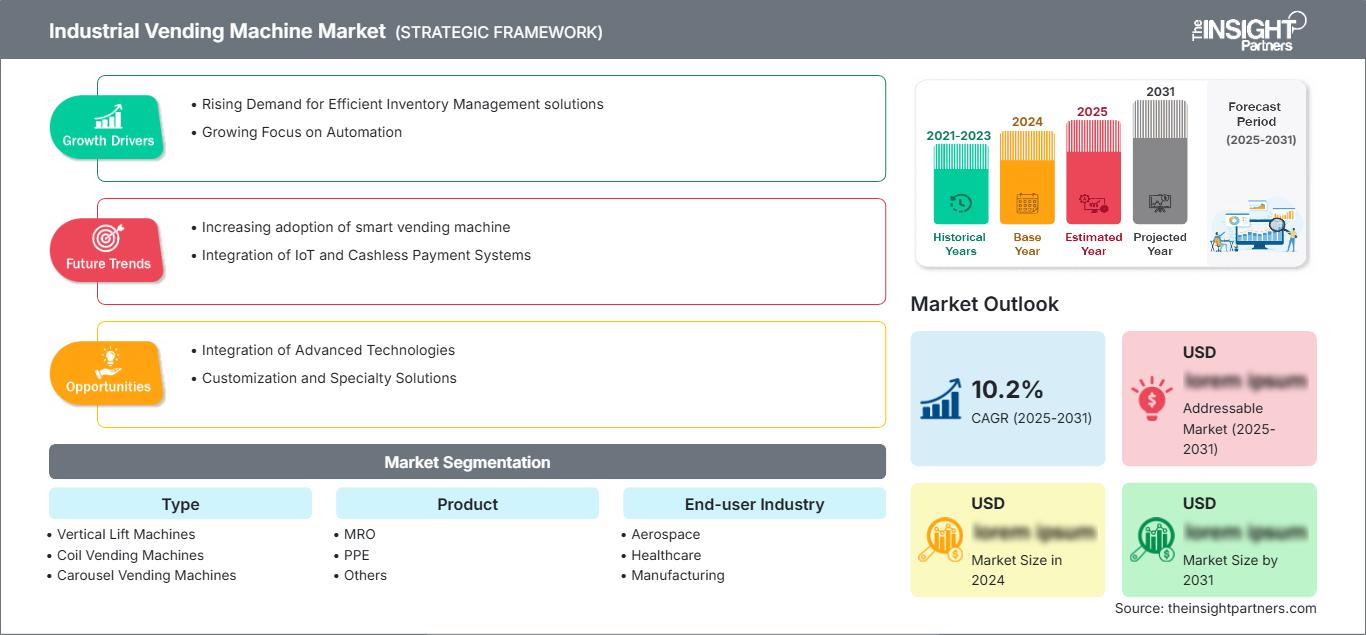
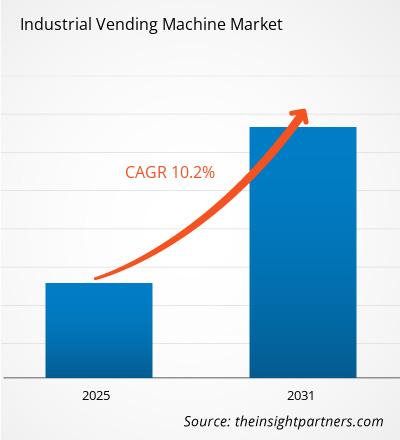
The Industrial Vending Machine Market is valued at US$ 3.67 Billion in 2025 and is projected to reach US$ 8.25 Billion by 2034, expanding at a CAGR of 9.42% during 2026–2034. The market is being shaped by automated inventory dispensing, point-of-use access, consumption tracking, and integration with digital procurement systems. Adoption is particularly relevant where MRO and PPE availability, inventory accountability, labor productivity, and workplace safety directly influence operating performance.
North America Industrial Vending Machine Market Size is expected to expand at a 9.5–10.0% CAGR during 2026–2034. Its established industrial distribution networks and high penetration of automated inventory programs provide a strong installed base, while manufacturing modernization and tighter control of MRO and PPE consumption continue to encourage deployment of connected dispensing equipment across production facilities.
Industrial Vending Machine Market Assessment and Insights
- North America is estimated to hold a 34–36% share in 2025 and grow at a 9.5–10.0% CAGR between 2026–2034, supported by mature industrial automation, inventory digitization, and widespread MRO and PPE vending adoption.
- US accounts for 90–92% of North America's 2025 market and is expected to expand at a 9.5–10.0% CAGR during 2026–2034, supported by manufacturing, aerospace, construction, and industrial distribution.
- Europe is estimated at a 21–23% share in 2025 and is projected to grow at a 9.0–9.7% CAGR during 2026–2034, led by Germany, the UK, France, Italy, and Spain.
- Asia Pacific represents a 22–24% share in 2025 and is projected to grow at a 10.5–11.2% CAGR during 2026–2034, with China, Japan, South Korea, and India supporting industrial adoption.
- Largest Segment is Coil Vending Machines, estimated at a 43–47% market share in 2025 and projected to grow at a 9.0–9.5% CAGR during 2026–2034.
- High Growth Segment is Carousel Vending Machines, estimated at a 16–20% market share in 2025 and projected to grow at a 10.5–11.2% CAGR during 2026–2034.
- Key companies analyzed in detail: 1sourcevend, AutoCrib, Inc., Apex Industrial Technologies, LLC, Brammer, CribMaster, Fastenal Company, Silkron, SupplyPoint, W.W. Grainger, Inc., and MSC Industrial Direct Co., Inc.
Source: The Insight Partners' analysis based on proprietary research, government publications, company annual reports, investor presentations, industry databases, and expert interviews.
Industrial Vending Machine Market has evolved from mechanical dispensing machines to an integrated inventory-control system that uses cloud software, authentication, RFID, barcode scanning, sensors, locker technology, and automation for replenishment. More of these systems have been used in production facilities, especially at the point of usage, to link the consumption process with employees, cost centers, and replenishment systems. This has enabled better control of the indirect materials frequently consumed without having a fully manned storeroom.
In the future, there should be more adoption in the industrialized manufacturing facilities and infrastructure development where there is a strategic need to improve labor, inventory accuracy, and compliance with safety rules. Investment in smart manufacturing facilities, aircraft manufacturing, electronics assembly plants, and infrastructure development sites will help facilitate such investments. Compliance by regulatory bodies on personal protective equipment and increased procurement process digitization will further help.
Industrial Vending Machine Market Report Scope
| Report Attribute | Details |
|---|---|
| Market size in 2025 | US$ 3.67 Billion |
| Market Size by 2034 | US$ 8.25 Billion |
| Global CAGR (2026 - 2034) | 9.42% |
| Historical Data | 2021-2024 |
| Forecast period | 2026-2034 |
Industrial Vending Machine Market Analysis
The growth of Industrial Vending Machine Market comes from the necessity to regulate indirect material usage while having immediate access to them. Manufacturing facilities, aerospace facilities, construction locations, oil and gas operations and health care settings may rely on vending solutions for establishing controlled access to MRO and PPE products. The demand will be highest where stock-outs may lead to production delays or withdrawals may lead to increased cost of inventory management, thus making traceability a necessity rather than a possibility.
The ecosystem consists of machine vendors, inventory software providers, industrial distributors, PPE and MRO vendors, system integrators and end-users. The hardware varies from coil dispensers to carousels, lockers, and sensor-operated cabinets. The software connects the transactions with purchasing and ERP systems, while distributors more and more take on the function of stocking and replenishment. Such an integrated approach makes the market compete not on the equipment availability but on the results of inventory management.
Market Structure and Dynamics of Competitive Industrial Vending Machine market Report reveal fragmentation, which is the result of the presence of both specialized technology vendors as well as major industrial distributors. Fastenal Company maintains a significant vending network, while AutoCrib, Inc., Apex Industrial Technologies, LLC, CribMaster, SupplyPoint, and 1sourcevend focus on automation features. Brammer provides vending services using industrial distribution capabilities, while W.W. Grainger, Inc. and MSC Industrial Direct Co., Inc. have broad MRO connections.
Growing investment focus has shifted to cloud connection, machine-independent software, RFID, sensors, and managed inventory. Fastenal Company digital inventory technology represents the magnitude of deployment by reporting 25,892 weighted FASTBin and FASTVend device signings for 2025. The strategic positioning must rely on network installations, software integration, inventory replenishment, and capability to cover different industrial categories on one platform.
● REPORT CUSTOMIZATION
Tailor This Report To Align With Your Specific Business Requirements
This report can be customized to align precisely with your business objectives, scope, and target markets. Customization options include tailored segmentation, geography, competitive analysis, and strategic insights to support informed decision-making.
Customize This Report →WHAT YOU CAN ADJUST
- ● Segmentations
- ● Geography
- ● Competitive Analysis
- ● Language Preferences
Industrial Vending Machine Market: Strategic Insights
Regional Insights
North America Industrial Vending Machine Market
North America is estimated to account for 34–36% of the 2025 Industrial Vending Machine Market Share and is projected to grow at a 9.5–10.0% CAGR through 2034. The region benefits from extensive industrial distribution networks, established vending programs, and high adoption of automated inventory practices. Manufacturing, aerospace, construction, and oil and gas remain important demand centers.
Demand is mainly driven by the US, while Canada and Mexico present new opportunities in manufacturing, mining, energy, and construction. Connected machines are being used increasingly to manage PPE, cutters, fasteners, maintenance items, and other items that have high turnover rate. The developed supply base in this region makes it possible to use vendor managed inventory systems in which distributors can replenish equipment based on transaction-level usage data.
U.S. Industrial Vending Machine Market
The U.S. constitutes 90–92% of North America's 2025 market share and is estimated to grow at a CAGR of 9.5–10.0% through 2034. Well-developed infrastructure of industrial distribution, safety in work environments, and manufacturing automation drive the use. Leading players include Fastenal Company, AutoCrib, Inc., Apex Industrial Technologies, LLC, and CribMaster.
The uses range from PPE, MRO tools, cutting consumables, maintenance items, and controlled material management. Manufacturing continues to play the most important role, whereas aerospace and construction drive the need for point-of-use secure dispensing. Increasingly, industrial consumers want identity management, reporting transactions, automatic replenishment, and ERP integration. In addition, the market for the U.S. is facilitated by supplier-managed systems, when dispensers can be deployed alongside local inventory and service capability rather than buying the equipment as capital item.
Europe Industrial Vending Machine Market
Europe is expected to capture a market share of 21-23% in 2025 and is forecasted to grow at a 9.0-9.7% CAGR until 2034. Germany dominates the regional demand owing to its high manufacturing and engineering capabilities, followed by the UK, France, Italy, and Spain. Automated inventory management is relevant to the concerns of European countries regarding production efficiency, labor productivity, and controlled material consumption.
The UK will get a boost from aerospace, automotive, engineering, and general manufacturing industries that have applications for the Brammer's Invend offering to facilitate the provision of line-side industrial consumables. The German economy's vast industrial sector will aid the demand for tool and PPE dispensing in the manufacturing of automotive and machinery. Aerospace and manufacturing can be identified as growth drivers in France, whereas the machinery and automotive sectors in Italy present growth prospects.
APAC Industrial Vending Machine Market
The APAC region makes up 22%–24% of the 2025 market and is expected to register CAGR of 10.5%–11.2%. China holds leadership, followed by Japan, South Korea, India, and Australia, all representing major markets. The main end-users include semiconductors, electronics, automotive industries, and precision manufacturing.
Manufacturing capacity of China allows automated part storage, Japan and South Korea are concentrating on precision manufacturing and manufacturing systems, India is thriving through investments in manufacturing and digitization of industry, and Australia has potential in mining, energy, and infrastructure sectors. Rising cost of labor and Industry 4.0 lead to demand for automated access to inventory, especially in cases where manufacturing plants require regular access to tools and parts.
Middle East & Africa Industrial Vending Machine Market
MEA demand is based on energy, construction, diversification of industries and infrastructure projects. Saudi Arabia is the largest market, whereas UAE and South Africa offer great prospects for industrial vending implementation. The application is mostly popular in places that require safe access to equipment and other supplies at a remote location.
Industrial growth in Saudi Arabia favors industrial vending systems in the energy and construction sectors. The demand in UAE is associated with infrastructure development, logistics and manufacturing, as well as large-scale plants. South Africa is the place where there are opportunities in mining, manufacturing and utilities segments. Project-based deployment affects the demand in the RoMEA. Vending technology helps reduce the need for employee-operated stores in remote locations.
Segmentation Analysis
Type
Type segment in the Industrial Vending Machine Market is projected to expand at a 9.3–9.9% CAGR during 2026–2034. Coil systems remain widely used for standardized, high-volume consumables because their mechanical configuration is relatively simple and space efficient. Carousel and vertical lift formats are gaining attention for higher-value or varied inventory, where controlled access, product protection, and greater storage density justify more sophisticated equipment.
- Vertical Lift Machines: Vertical lift formats provide high-density storage and controlled access for varied inventory. Their strategic value increases where floor space is constrained and organizations need to manage multiple SKUs through a centralized automated dispensing point.
- Coil Vending Machines: Coil machines remain central to high-volume dispensing because they efficiently handle standardized consumables such as gloves, abrasives, batteries, and small MRO products. Their straightforward architecture supports broad deployment.
- Carousel Vending Machines: Carousel machines support organized dispensing of multiple product categories while improving access control and inventory visibility. They are particularly relevant where diverse consumables require reliable point-of-use availability.
- Scale Vending Machines: Scale systems use weight-based monitoring to identify consumption and remaining inventory. They are useful for bulk or irregularly shaped materials where conventional item-by-item dispensing mechanisms are less practical.
- Others: Other formats include lockers, cabinets, drawers, and hybrid dispensing units. Their importance is increasing for large, high-value, returnable, or unusually shaped assets requiring controlled access and traceability.
Product
Product segment in the Industrial Vending Machine Market is expected to grow at a 9.1–9.7% CAGR through 2034. MRO remains fundamental because industrial operations require continuous access to maintenance materials, tools, and consumables. PPE provides a strong parallel application because automated dispensing can associate safety-product usage with employees and departments, improving accountability. Combined machines increasingly accommodate both categories.
- MRO: MRO products form a core inventory category because production continuity depends on timely access to maintenance materials. Automated dispensing can connect consumption with replenishment requirements while reducing uncontrolled withdrawals and emergency purchasing.
- PPE: PPE vending supports controlled distribution of gloves, safety glasses, hearing protection, respirators, and related equipment. Its strategic role is reinforced by workplace safety programs requiring documented availability and appropriate employee access.
End-user Industry
End-user Industry segment in the Industrial Vending Machine Market is projected to grow at a 9.6–10.2% CAGR during 2026–2034. Manufacturing represents the principal demand base because factories consume substantial volumes of indirect materials. Aerospace, healthcare, oil and gas, and construction add applications where secure access, traceability, and uninterrupted availability are important. Large, distributed workforces are particularly suitable for automated dispensing.
- Aerospace: Aerospace facilities require traceability for tools, components, PPE, and maintenance supplies. Automated dispensing supports controlled access in environments where production precision, compliance, and asset accountability are closely linked.
- Healthcare: Healthcare applications extend industrial vending concepts into controlled supply distribution for facilities and technical operations. Secure dispensing can improve availability and visibility of frequently used supplies while supporting standardized access policies.
- Manufacturing: Manufacturing is the principal use environment because production lines require continuous access to MRO and PPE materials. Point-of-use dispensing reduces unnecessary movement and provides transaction data for replenishment and purchasing decisions.
- Oil and Gas: Oil and gas sites require reliable access to PPE, tools, and maintenance products, often in remote locations. Secure vending can provide controlled availability while reducing dependence on continuously staffed storerooms.
- Construction: Construction sites benefit from mobile or jobsite-oriented dispensing because workers need immediate access to safety products, tools, and consumables. Automated access can improve accountability across temporary or distributed project locations.
Opportunity Snapshot
| End-user Industry | Revenue Contribution (High/Medium/Low) | Trend Tag (MAX 2 words) | Adoption Stage (Emerging/Scaling/Mature) |
|---|---|---|---|
| Aerospace | Medium | Tool Traceability | Scaling |
| Healthcare | Medium | Secure Supplies | Emerging |
| Manufacturing | High | Factory Automation | Mature |
| Oil and Gas | Medium | Remote Access | Scaling |
| Construction | Medium | Jobsite Vending | Scaling |
| Others | Low | Asset Control | Emerging |
Industrial Vending Machine Market Growth Drivers and Impact Analysis
Increasing Control Over MRO and PPE Consumption
Industrial organizations are placing greater emphasis on controlling indirect-material expenditure because small, frequent withdrawals can accumulate into significant operating costs. Automated vending creates a transaction record for each dispensing event and can associate usage with an employee, department, project, or cost center. This improves purchasing visibility and helps organizations identify abnormal consumption patterns. The market impact is particularly strong for gloves, abrasives, fasteners, cutting tools, batteries, and maintenance products that are consumed continuously. Distributors can also use transaction data to establish replenishment thresholds and optimize stock levels. As procurement organizations seek measurable inventory savings without compromising availability, vending becomes an operational-control mechanism rather than simply an automated storage device. This supports wider adoption in facilities with large workforces and high-frequency indirect-material requirements.
Expansion of Smart Manufacturing and Digital Procurement
The growth of smart manufacturing is increasing demand for inventory systems capable of exchanging data with broader digital infrastructure. Industrial vending machines can connect point-of-use consumption with ERP, procurement, warehouse, and supplier-managed inventory workflows. This enables organizations to replace manual stock checks with event-driven replenishment and more precise purchasing information. The impact extends beyond labor savings because digital transaction histories can support supplier negotiations, demand forecasting, SKU rationalization, and production planning. Manufacturing facilities adopting connected machinery are also more receptive to connected inventory equipment because both technologies contribute to a common data architecture. As factories become increasingly automated, material availability becomes a digital process requirement. Suppliers that offer application programming interfaces, cloud dashboards, remote monitoring, and configurable access controls are therefore positioned to benefit from broader industrial digitalization.
Stronger Workplace Safety and Accountability Requirements
Workplace safety requirements are strengthening the rationale for automated PPE distribution. Organizations need to ensure that appropriate protective equipment is available at the point of use while maintaining sufficient control over consumption and replenishment. Vending systems can restrict access according to employee permissions, record transactions, and provide managers with usage information. This creates a documented distribution process that complements safety programs and internal compliance procedures. The market impact is particularly relevant in manufacturing, construction, aerospace, and energy operations where workforce exposure to operational hazards can be substantial. Automated dispensing can also reduce shortages by generating replenishment alerts when inventory approaches defined thresholds. As employers increasingly connect safety management with operational data, PPE vending becomes part of a broader accountability architecture rather than a standalone equipment purchase.
Industrial Vending Machine Market Future Trends
Machine-Learning-Based Inventory Forecasting
Industrial Vending Machine Market trends are expected to increasingly incorporate machine learning into inventory forecasting and replenishment. Future platforms can analyze transaction frequency, employee usage patterns, production schedules, seasonality, and historical stockouts to recommend more precise inventory thresholds. Instead of relying primarily on fixed minimum and maximum levels, systems could dynamically adjust stocking parameters according to changing operational conditions. This capability may reduce excess inventory while protecting availability for critical products. Machine learning can also identify unusual consumption patterns that indicate process changes, misplaced materials, or potential misuse. As cloud platforms become more capable, vendors may package forecasting tools with automated replenishment workflows and supplier notifications. The result would be a shift from reactive vending management toward predictive inventory orchestration, increasing the strategic value of transaction data generated at every dispensing point.
Convergence of Vending, Lockers, and Asset Tracking
Industrial vending is likely to converge with intelligent lockers, RFID cabinets, sensor bins, and returnable-asset systems. Customers increasingly require one platform to manage consumables alongside tools, equipment, tablets, scanners, and other high-value items. Future systems can combine different dispensing mechanisms while maintaining a common identity, authorization, and reporting layer. This convergence will allow industrial sites to select the appropriate hardware according to item characteristics rather than adopting separate platforms for every inventory category. Mobile authentication and touch-free interaction may also expand, especially where users need rapid access without lengthy transaction steps. Suppliers that can unify dispensing, returns, asset tracking, and inventory reporting will be better positioned to serve complex facilities. The trend should increase the average scope of deployments and strengthen the role of vending platforms within industrial asset-management strategies.
Industrial Vending Machine Market Opportunities
Expanding Managed Inventory Models
Industrial Vending Machine Market Forecasts should account for growing opportunities in supplier-managed inventory models that combine machines, software, replenishment, and analytics. Many industrial customers prefer to outsource day-to-day inventory administration rather than invest in specialized internal resources. Suppliers can use transaction data to manage stocking levels, schedule replenishment, consolidate purchasing, and identify underperforming SKUs. This model creates recurring service relationships and can expand vending deployments beyond individual machines into broader inventory programs. Investment opportunities exist in cloud platforms, route optimization, distributor integration, and automated replenishment technologies. Providers can also build differentiated offerings around guaranteed availability for critical items or category-specific management for PPE, cutting tools, and maintenance products. The strongest models will align commercial incentives with inventory accuracy, availability, consumption control, and customer operating outcomes.
Greenfield Deployment Across Emerging Industrial Hubs
New manufacturing campuses and large infrastructure projects provide opportunities to embed automated inventory distribution during facility design rather than retrofit existing storerooms. Emerging industrial hubs across Asia Pacific, the Middle East, and selected Latin American markets are developing facilities where digital procurement and automated material access can be specified from the outset. Vendors can partner with engineering contractors, industrial distributors, and equipment integrators to make vending part of broader factory or jobsite infrastructure. This approach can simplify network connectivity, access-control design, machine placement, and replenishment logistics. Investment should prioritize modular equipment capable of supporting changing SKU profiles as production expands. Local service networks will remain important because customers require rapid maintenance and replenishment support. Early integration also creates opportunities to standardize vending platforms across multiple sites operated by the same industrial group.
Recent Developments
- March 2026: BuyBuyCart entered the automated retail market with the launch of smart vending machines designed to provide convenient, 24/7 access to everyday groceries and FMCG products. The machines feature interactive touchscreen interfaces and support multiple digital payment options, including UPI, QR codes, debit and credit cards, and digital wallets. They will offer products such as snacks, beverages, healthy foods, ready-to-eat items, confectionery, personal-care essentials and selected groceries, while also providing brands with opportunities for product promotion.
- January 2025: Vendekin Technologies strengthened its position in automated retail with AI-driven smart vending solutions designed to provide brands with efficient, data-led and 24/7 retail channels. Its vending machines use AI-powered consumer insights, customizable configurations for products ranging from snacks and beverages to groceries and frozen items, and multiple digital payment options.
- May 2026: Seaga Manufacturing acquired Three Square Market to expand its capabilities in micromarkets and strengthen its integrated unattended-retail technology platform. The acquisition adds Three Square Market’s micromarket kiosks, software platforms, secure payment technologies and market design/build services, enabling operators to deploy scalable self-service retail environments across workplaces, campuses, healthcare facilities, hospitality venues and other high-traffic locations.
Frequently Asked Questions

- Comprehensive Market Sizing and Forecast Analysis
- Detailed Segmentation Analysis
- In-Depth Market Dynamics Assessment
- Regional and Country-Level Insights
- Competitive Landscape and Company Benchmarking
- Strategic Business Intelligence
Recent Reports
Testimonials

The Insight Partners provided valuable market intelligence that supported our global go-to-market strategy. Their team was professional, responsive, and attentive to our feedback, providing thoughtful analysis and helpful methodological clarifications throughout the project.
Junmo Kim Chief Financial Officer (CFO), Enertech Co., Ltd.
The Insight Partners' SCADA System Market report is comprehensive, with valuable insights on current trends and future forecasts. The team was highly professional, responsive, and supportive throughout. We are very satisfied and highly recommend their services.
RAN KEDEM Partner, Reali Technologies LTDs
I requested a report on a very specific software market and the team produced the report in a few days. The information was very relevant and well presented. I then requested some changes and additions to the report. The team was again very responsive and I got the final report in less than a week.
JEAN-HERVE JENN Chairman, Future Analytica
We worked with The Insight Partners for an important market study and forecast. They gave us clear insights into opportunities and risks, which helped shape our plans. Their research was easy to use and based on solid data. It helped us make smart, confident decisions. We highly recommend them.
PIYUSH NAGPAL Sr. Vice President, High Beam Global
The Insight Partners delivered insightful, well-structured market research with strong domain expertise. Their team was professional and responsive throughout. The user-friendly website made accessing industry reports seamless. We highly recommend them for reliable, high-quality research services
YUKIHIKO ADACHI CEO, Deep Blue, LLC.
This is the first time I have purchased a market report from The Insight Partners.While I was unsure at first, I visited their web site and felt more comfortable to take the risk and purchase a market report.I am completely satisfied with the quality of the report and customer service. I had several questions and comments with the initial report, but after a couple of dialogs over email with their analyst I believe I have a report that I can use as input to our strategic planning process.Thank you so much for taking the extra time and making this a positive experience.I will definitely recommend your service to others and you will be my first call when we need further market data.
JOHN SUZUKI President and Chief Executive Officer, Board Director, BK Technologies
I wish to appreciate your support and the professionalism you displayed in the course of attending to my request for information regarding to infectious disease IVD market in Nigeria. I appreciate your patience, your guidance, and the fact that you were willing to offer a discount, which eventually made it possible for us to close a deal. I look forward to engaging The Insight Partners in the future, all thanks to the impression you have created in me as a result of this first encounter.
DR CHIJIOKE ONYIA MANAGING DIRECTOR, PineCrest Healthcare Ltd.Reason to Buy
- Informed Decision-Making
- Understanding Market Dynamics
- Competitive Analysis
- Identifying Emerging Markets
- Customer Insights
- Market Forecasts
- Risk Mitigation
- Boosting Operational Efficiency
- Strategic Planning
- Investment Justification
- Tracking Industry Innovations
- Aligning with Regulatory Trends





 Get Free Sample for