
Injection Molded Plastics Market Demand, Share & Growth by 2034
Coverage: By Type (Acrylonitrile Butadiene Styrene, Nylon, Polyethylene, Polypropylene, Polystyrene, Polycarbonate, Thermoplastic Polyurethane); End-Use Industry (Packaging, Automotive, Building and Construction, Consumer Goods, Medical, Sports) , and Geography (North America, Europe, Asia Pacific, and South and Central America)
- Status : Data Released
- Report Code : TIPRE00020161
- Category : Chemicals and Materials
- No. of Pages : 150
- Available Report Formats :


- Last update date : September 02, 2026


2025 Market Size
US$ 329.21 Bn
Base year value
2034 Forecast
US$ 456.34 Bn
Projected by 2034
CAGR 2026-2034
3.70 %
Growth rate
Addressable Market
US$ 3,568.77 Bn
(2026-2034)
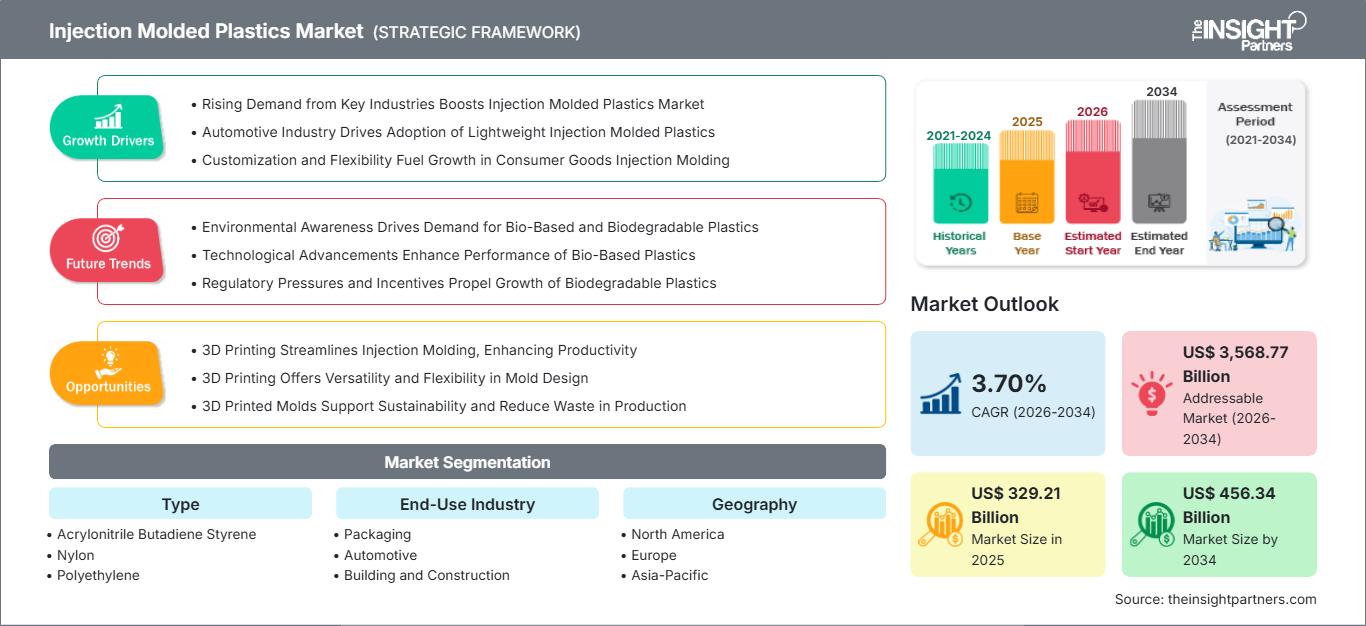
The Injection Molded Plastics Market size is valued at US$ 329.21 Billion in 2025 and will grow to reach US$ 456.34 Billion by 2034 at a CAGR of 3.70% during 2026–2034. This market consists of the utilization of thermoplastics materials processed into precise components using injection molding technique for packaging, automotive, construction, consumer, medical, and sports applications.
North America still retains its position as a prominent manufacturing base on account of manufacturing operations related to the automobile industry, manufacture of medical devices, food & beverage packaging, and reshoring of certain industrial supply chains. The North American market is forecasted to expand at a CAGR of 3.20%–4.00% during 2026–2034 on the back of automation, nearshoring, advanced engineering polymers, and investments in efficient molding machinery.
Injection Molded Plastics Market Assessment and Insights
- North America: North America represented a 13–16% Injection Molded Plastics Market share in 2025 and is expected to grow at a 3.20–4.00% CAGR during 2026–2034, supported by automotive, medical, packaging, and reshoring-led manufacturing investments.
- US: The US accounted for 82–86% of North America's 2025 share and is projected to grow at a 3.20–4.00% CAGR during 2026–2034, supported by advanced manufacturing and healthcare applications.
- Europe: Europe held a 15–18% share in 2025 and is projected to expand at a 2.80–3.60% CAGR during 2026–2034, with Germany, Italy, France, the UK, and Spain remaining important manufacturing centers.
- Asia Pacific: Asia Pacific represented a 40–43% share in 2025 and is expected to record a 4.00–4.80% CAGR during 2026–2034, led by China, Japan, South Korea, India, and Australia.
- Largest Segment: Packaging represented a 30–33% market share in 2025 and is estimated to grow at a 3.40–4.20% CAGR during 2026–2034, reflecting high-volume rigid packaging demand.
- High Growth Segment: Medical represented a 7–10% market share in 2025 and is expected to achieve a 4.50–5.50% CAGR during 2026–2034, supported by healthcare component requirements.
- Key companies analyzed in detail: LANXESS AG, BASF SE, Dow, Inc., DuPont de Nemours, Inc., Eastman Chemical Company, Exxon Mobil Corporation, LG Chem, Ltd., LyondellBasell Industries Holdings B.V., Saudi Basic Industries Corporation (SABIC), Huntsman International LLC.
Source: The Insight Partners' analysis based on proprietary research, government publications, company annual reports, investor presentations, industry databases, and expert interviews.
Manufacturing has become more and more oriented towards increased automation, process control, light weight and engineered resins. Injection Molding has been gaining favor in situations where repeatability and high output volumes have been needed, while monitoring and improved cooling systems contribute to more reliable cycles. Resin choices will be made on the basis of material stiffness, heat resistance, toughness, processability and recycling content.
The Injection Molded Plastics Market forecasts indicate that investments will likely focus on flexible manufacturing capabilities, energy-efficient molding systems, recycled and mass balanced resins, and regional manufacturing facilities near end-users. New Asian manufacturing hubs will profit from growth in electronics, automotive, packaging and consumer goods sectors, while European environmental regulations are forcing more design for recycling. North American manufacturers will increasingly consider regional suppliers to avoid logistics risks.
Injection Molded Plastics Market Report Scope
| Report Attribute | Details |
|---|---|
| Market size in 2025 | US$ 329.21 Billion |
| Market Size by 2034 | US$ 456.34 Billion |
| Global CAGR (2026 - 2034) | 3.70% |
| Historical Data | 2021-2024 |
| Forecast period | 2026-2034 |
Injection Molded Plastics Market Analysis
Injection molded plastics growth is underpinned by an extensive value chain involving polymer producers, compounders, mold designers, machinery suppliers, injection molding facilities, parts manufacturers, OEMs, and recyclers. Packaging accounts for high recurrent volume, whereas automotive and medical industry usage creates demand for greater variety, precision, and trackability in the production process. Hence, the demand fluctuates greatly depending on resin cost, part geometry, cycle time, regulations, and usage needs.
The Injection Molded Plastics Market report indicates that supply side is highly susceptible to the petrochemical raw materials pricing and availability, electricity prices, and regional manufacturing capabilities. Polypropylene, polyethylene, polystyrene, ABS, nylon, polycarbonate, and TPU all perform different processing and application roles. The manufacturers strive to maximize the efficiency of their machines and molds, recycling, and automated inspection. In addition, the increasing recycled content requirements have been motivating the suppliers to produce compounds that could preserve stability and functionality despite containing recycled components.
In the case of the injection molded plastics industry analysis, the competition is diverse, with resin makers competing based on the quality of the material, applications, geographic reach, and technical expertise. BASF SE and LANXESS AG are known for their engineering materials and specialties, whereas Dow, Inc., Exxon Mobil Corporation, and LyondellBasell Industries Holdings B.V. have gained advantage owing to their diverse polymer range. DuPont de Nemours, Inc., Eastman Chemical Company, LG Chem, Ltd., Saudi Basic Industries Corporation (SABIC), and Huntsman International LLC add diversity to the competitive space.
The Injection Molded Plastics Market trends are inclined towards integrating sustainability and capacity considerations into the investment strategy, with producers introducing recyclable, biodegradable, low emission feedstock along with traditional materials, and processors making investments in automation and robotics, monitoring, and tooling. The ability to satisfy specific application needs without increasing the cycle time, scrap rate, energy usage, and component costs constitutes an important competitive advantage today.
● REPORT CUSTOMIZATION
Tailor This Report To Align With Your Specific Business Requirements
This report can be customized to align precisely with your business objectives, scope, and target markets. Customization options include tailored segmentation, geography, competitive analysis, and strategic insights to support informed decision-making.
Customize This Report →WHAT YOU CAN ADJUST
- ● Segmentations
- ● Geography
- ● Competitive Analysis
- ● Language Preferences
Injection Molded Plastics Market: Strategic Insights
Regional Insights
North America Injection Molded Plastics Market
North America has a 13–16% share in 2025 and is expected to grow at a 3.20–4.00% CAGR from 2026 to 2034. The main driving forces are automotive production, packaging, medical applications, appliances, and industrial equipment. The role of Mexico is rising as companies seek to build regional supply chains, and the contributions of Canada come from the manufacture of automotive parts, healthcare and industrial equipment.
Drivers of the growth in the Injection Molded Plastics Market include reshoring and nearshoring, when shorter time to market and security of supply prevail over higher cost of production. There is increasing demand for lightweight automotive parts to optimize fuel consumption and design related to electric vehicles. Consistency in dimension and certified materials is required for the applications in the medical industry. Packaging remains important because molded closures, containers, caps, and rigid forms facilitate mass consumer and food products.
U.S. Injection Molded Plastics Market Market
The U.S. constituted 82-86% of North America's 2025 share and is projected to have a 3.20-4.00% CAGR over 2026-2034. This is due to large-scale presence in the automotive, healthcare, packaging, appliance, electronics, and industrial manufacturing sectors. Polymer providers possess substantial technological and commercial presence in the U.S., helping molders who need engineering grade materials and application development capabilities.
Automotive molders focus on lightweight structures, battery-related parts, and high-temperature materials, and medical molders benefit from demand for precision housings, diagnostic components, and disposables. Packaging molders continue to focus on throughput and efficient use of materials. Automation and local production capacity investment can be highly pertinent when companies want more supply chain resilience. Thus, the U.S. is the largest North American center of high-value injection molding applications and advanced material development.
Europe Injection Molded Plastics Market
In 2025, Europe's Injection Molded Plastics Market share was 15% to 18%, and is projected to grow at a rate of 2.80% to 3.60% CAGR between 2026 and 2034. Germany accounts for the largest market share, which is attributed to automotive engineering and industrial manufacturing, while Italy, France, the UK, and Spain provide large shares from packaging, consumer goods, medical, and machinery demands.
The UK molding market is driven by food packaging, healthcare products, household appliances, and industrial parts, where the processing units are increasingly looking for designs that are recyclable and use the least material possible. Germany, on the other hand, accounts for demand for injection molded components that are automotive and engineering plastics and industrially applied. France, Italy, and Spain account for diverse applications including packaging, consumer goods, automobiles, appliances, and medical products.
APAC Injection Molded Plastics Market
The share of APAC was 40-43% in 2025 and is expected to register a CAGR of 4.00-4.80% between 2026 and 2034, making it the most prominent regional market. The prominent players include China, followed by Japan, South Korea, India, and Australia, backed by manufacturing capabilities and domestic consumption.
The Chinese market is buoyed by automotive, electronic, packaging, and appliance manufacturing. On the other hand, India is bolstering its manufacturing capability. Manufacturing of engineering applications and electronics drives the Japanese and Korean markets. Australia is contributing through packaging, construction, consumer, and industrial use. Growth in EV production is another structural driver, with global sales of EVs crossing 20 million in 2025 as per IEA.
Middle East & Africa Injection Molded Plastics Market
Middle East and Africa demand will be driven by packaging, construction, consumer goods, automotive parts, and healthcare uses. Saudi Arabia continues to be a major market, whereas the UAE and South Africa represent important manufacturing and distribution centers for the region. It is forecasted that the Middle East and Africa will grow at a 3.00-4.00% CAGR between 2026 and 2034.
Petroleum refining and production of end-use products make Saudi Arabia competitive, while the UAE develops its diversified industrial capabilities. South Africa represents a relatively developed plastics-processing network, whereas Rest of MEA creates potential for growth thanks to infrastructure, population, and demand for consumer products. Polymer availability, investments in industrial facilities, and logistics capabilities affect competition in the region. Demand in the regions is especially attractive for those who can supply locally converted packaging and consumer goods.
Segmentation Analysis
Type
The Type segment is expected to grow at a 3.50–4.30% CAGR during 2026–2034. Resin selection depends on stiffness, impact strength, chemical resistance, thermal performance, appearance, cost, and processing behavior. Packaging favors high-volume commodity polymers, while automotive, medical, and consumer applications increasingly use engineering grades for demanding functional requirements.
- Acrylonitrile Butadiene Styrene: ABS remains important for housings, automotive interiors, appliances, and consumer products because of its impact strength, surface finish, dimensional stability, and relatively straightforward processing characteristics.
- Nylon: Nylon serves automotive, electrical, industrial, and consumer applications requiring strength, abrasion resistance, and thermal performance, making it strategically important for components exposed to mechanical or temperature stresses.
- Polyethylene: Polyethylene supports high-volume molded packaging, household products, industrial containers, and selected automotive applications because of chemical resistance, toughness, processability, and broad grade availability.
- Polypropylene: Polypropylene maintains a strong position in packaging, automotive interiors, appliances, and consumer products because of low density, chemical resistance, fatigue performance, and favorable processing economics.
- Polystyrene: Polystyrene remains relevant for consumer products, packaging components, housings, and selected disposable applications where rigidity, ease of molding, and cost competitiveness are important purchasing considerations.
- Polycarbonate: Polycarbonate addresses applications requiring transparency, impact resistance, dimensional stability, and heat performance, including automotive components, electrical housings, protective products, and selected medical applications.
- Thermoplastic Polyurethane: TPU serves specialized applications requiring elasticity, abrasion resistance, flexibility, and surface quality, including consumer products, medical components, sports goods, and selected automotive parts.
End-Use Industry
The End-Use Industry segment is projected to expand at a 3.60–4.40% CAGR during 2026–2034. Demand diversification reduces reliance on any single application, while medical and automotive requirements increasingly favor precision molding, engineered polymers, process monitoring, and customized material formulations.
- Packaging: Packaging remains the largest application area, supported by rigid containers, closures, caps, trays, and household formats where high throughput, repeatability, lightweighting, and material efficiency determine supplier competitiveness.
- Automotive: Automotive demand centers on interior, exterior, under-hood, electrical, and battery-related components, with lightweighting, thermal resistance, dimensional accuracy, and design freedom shaping material and process selection.
- Building and Construction: Construction applications include fittings, housings, hardware, insulation-related components, and functional products, where durability, moisture resistance, repeatability, and cost efficiency support molded plastic adoption.
- Consumer Goods: Consumer products use injection molding for appliances, electronics housings, household products, toys, and personal items, emphasizing aesthetics, tactile quality, color consistency, and scalable production.
- Medical: Medical applications require precision, cleanliness, dimensional control, biocompatibility, and process validation, supporting demand for molded diagnostic components, housings, disposable products, and healthcare equipment parts.
- Sports: Sports applications use molded plastics for protective equipment, footwear components, equipment housings, handles, and accessories where impact resistance, flexibility, low weight, and ergonomic design are important.
Opportunity Snapshot
| End-Use Industry | Revenue Contribution | Trend Tag | Adoption Stage |
|---|---|---|---|
| Packaging | High | Rigid Packaging | Mature |
| Automotive | High | EV Components | Scaling |
| Building and Construction | Medium | Modular Components | Mature |
| Consumer Goods | Medium | Smart Appliances | Mature |
| Medical | Medium | Precision Devices | Scaling |
| Sports | Low | Lightweight Gear | Scaling |
Injection Molded Plastics Market Growth Drivers and Impact Analysis
Expansion of Lightweight and Electrified Vehicle Components
Automotive lightweighting is increasing the role of molded polymers in interior structures, housings, connectors, covers, and selected under-hood components. Electrification further changes material requirements because battery systems, charging components, thermal-management systems, and electrical architectures require combinations of dimensional stability, insulation, flame performance, and chemical resistance. The IEA reported that electric car sales exceeded 20 million globally in 2025, representing approximately one-quarter of new car sales, demonstrating the scale of the vehicle-platform transition. For molding suppliers, the impact extends beyond vehicle volume because each new platform can introduce redesigned polymer components. Material suppliers able to provide validated engineering grades and processors capable of maintaining tight tolerances can capture higher-value programs.
Increasing Demand for High-Volume Rigid Packaging
Packaging continues to create large recurring molding volumes because caps, closures, containers, trays, and dispensing components require consistent dimensions at high production rates. E-commerce, convenience foods, personal care, and household products reinforce demand for lightweight rigid formats. At the same time, sustainability requirements are changing product specifications rather than eliminating molded plastics outright. The European Union's Packaging and Packaging Waste Regulation entered into force in February 2025 and generally applies from August 2026, placing greater emphasis on recyclable packaging and increased recycled-plastic use. This environment encourages processors to redesign molds, reduce material usage, improve recyclability, and qualify recycled or mass-balanced feedstocks without compromising productivity or package functionality.
Automation and Data-Driven Process Optimization
Automation is improving the economics of injection molding by reducing manual handling, stabilizing process parameters, and supporting continuous quality monitoring. Sensors can track pressure, temperature, cycle behavior, and mold conditions, allowing processors to identify deviations before large quantities of defective parts are produced. Research published in 2025 demonstrated machine-learning approaches for injection-molding quality classification, reducing reported defect rates substantially in a controlled industrial dataset. The commercial impact is strongest in applications where scrap costs are high or dimensional tolerances are narrow. Robotics, automated inspection, predictive maintenance, and closed-loop process control can also improve machine utilization, enabling manufacturers to increase output without proportionally expanding labor requirements.
Injection Molded Plastics Market Future Trends
Integration of Recycled and Lower-Carbon Feedstocks
Future molding strategies will increasingly combine recycled polymers, chemically recycled feedstocks, bio-attributed materials, and mass-balance approaches with conventional virgin resins. The shift will be application-specific because medical, food-contact, automotive, and safety-critical products impose different qualification requirements. Europe is likely to move fastest as packaging rules increase pressure on recyclability and recycled content. Material suppliers will therefore compete on traceability, consistency, certification, and processing performance rather than sustainability claims alone. Processors will also redesign components and molds to accommodate variable recycled-material characteristics. Over time, recycled feedstock quality, availability, and regulatory acceptance should become procurement criteria alongside price and mechanical properties, creating stronger links between polymer producers, recyclers, compounders, molders, and brand owners across the value chain.
Smarter Molding Through Artificial Intelligence
Artificial intelligence is likely to move from experimental process optimization toward routine production support, particularly for defect prediction, cycle optimization, predictive maintenance, and real-time parameter adjustment. Digital models can combine machine settings, resin characteristics, mold geometry, historical quality results, and environmental conditions to identify operating windows. Research published in 2025 demonstrated reinforcement-learning methods capable of rapidly optimizing molding parameters against quality and profitability objectives. Commercial adoption will depend on reliable sensor infrastructure, sufficient historical datasets, integration with manufacturing execution systems, and clear economic returns. As these requirements mature, AI-enabled molding should become particularly relevant for complex geometries, multi-cavity molds, high-value engineering components, and production environments where minimizing scrap is strategically important.
Injection Molded Plastics Market Opportunities
Regionalized Production for Resilient Supply Chains
Regional manufacturing presents an opportunity for molders and resin suppliers to position production closer to automotive, medical, packaging, and consumer-product customers. North American nearshoring and Asian manufacturing expansion create opportunities for strategically located plants with flexible tooling and multi-material capabilities. Companies can strengthen resilience by combining regional production with standardized molds, common material specifications, digital production monitoring, and localized technical support. Mexico, India, Southeast Asia, and selected Middle Eastern locations can benefit from manufacturing diversification where labor availability, infrastructure, polymer supply, and customer proximity align. Investment decisions should prioritize application clusters rather than simply low production costs. Facilities serving multiple industries can also reduce utilization risk and provide greater flexibility when individual end-use sectors experience cyclical demand.
High-Performance Materials for Medical and Advanced Components
Medical, electrical, and specialized industrial applications provide opportunities to move beyond commodity-volume competition toward engineered, specification-driven products. Suppliers can develop compounds with enhanced heat resistance, dimensional stability, flame performance, chemical resistance, and sterilization compatibility for applications requiring higher qualification barriers. Medical molding is particularly attractive because product consistency and regulatory compliance can support longer customer relationships once materials and processes are validated. Similar opportunities exist in electrical housings, connectors, battery-related components, and industrial equipment. Investment in application laboratories, mold-flow simulation, validation capabilities, and technical service can help material suppliers and molders participate earlier in product development. This strategy can improve differentiation while reducing exposure to purely price-driven commodity molding contracts.
Recent Developments
- January 2026: BASF SE announced its participation in PlastIndia 2026, highlighting sustainable performance materials, advanced recycling technologies, and solutions for automotive, eMobility, packaging, consumer electronics, medical, footwear, and industrial applications.
- January 2026: The ENGEL Group presented innovative manufacturing solutions at Plastindia 2026 in New Delhi from 5 to 10 February, specifically tailored to the dynamic requirements of the Indian market. Visitors to the ENGEL stand can experience two product launches developed exclusively for India – a fully electric injection moulding machine and a new two-platen solution from Electronica Plastic Machines (Electronica), a member of the ENGEL Group since 2024.
Frequently Asked Questions

- Comprehensive Market Sizing and Forecast Analysis
- Detailed Segmentation Analysis
- In-Depth Market Dynamics Assessment
- Regional and Country-Level Insights
- Competitive Landscape and Company Benchmarking
- Strategic Business Intelligence
Recent Reports
Testimonials

The Insight Partners' SCADA System Market report is comprehensive, with valuable insights on current trends and future forecasts. The team was highly professional, responsive, and supportive throughout. We are very satisfied and highly recommend their services.
RAN KEDEM Partner, Reali Technologies LTDs
I requested a report on a very specific software market and the team produced the report in a few days. The information was very relevant and well presented. I then requested some changes and additions to the report. The team was again very responsive and I got the final report in less than a week.
JEAN-HERVE JENN Chairman, Future Analytica
We worked with The Insight Partners for an important market study and forecast. They gave us clear insights into opportunities and risks, which helped shape our plans. Their research was easy to use and based on solid data. It helped us make smart, confident decisions. We highly recommend them.
PIYUSH NAGPAL Sr. Vice President, High Beam Global
The Insight Partners delivered insightful, well-structured market research with strong domain expertise. Their team was professional and responsive throughout. The user-friendly website made accessing industry reports seamless. We highly recommend them for reliable, high-quality research services
YUKIHIKO ADACHI CEO, Deep Blue, LLC.
This is the first time I have purchased a market report from The Insight Partners.While I was unsure at first, I visited their web site and felt more comfortable to take the risk and purchase a market report.I am completely satisfied with the quality of the report and customer service. I had several questions and comments with the initial report, but after a couple of dialogs over email with their analyst I believe I have a report that I can use as input to our strategic planning process.Thank you so much for taking the extra time and making this a positive experience.I will definitely recommend your service to others and you will be my first call when we need further market data.
JOHN SUZUKI President and Chief Executive Officer, Board Director, BK Technologies
I wish to appreciate your support and the professionalism you displayed in the course of attending to my request for information regarding to infectious disease IVD market in Nigeria. I appreciate your patience, your guidance, and the fact that you were willing to offer a discount, which eventually made it possible for us to close a deal. I look forward to engaging The Insight Partners in the future, all thanks to the impression you have created in me as a result of this first encounter.
DR CHIJIOKE ONYIA MANAGING DIRECTOR, PineCrest Healthcare Ltd.Reason to Buy
- Informed Decision-Making
- Understanding Market Dynamics
- Competitive Analysis
- Identifying Emerging Markets
- Customer Insights
- Market Forecasts
- Risk Mitigation
- Boosting Operational Efficiency
- Strategic Planning
- Investment Justification
- Tracking Industry Innovations
- Aligning with Regulatory Trends





 Get Free Sample for