
Inorganic Metal Finishing Market Size, Trends & Demand by 2034
Coverage: By Product Type (Pre-treatment/Surface Preparation, Inorganic Metal Finishing Process, Consumables and Spares, Others); Application (Automotive, Electrical and Electronics, Industrial, Hardware, Defense, Others) , and Geography (North America, Europe, Asia Pacific, and South and Central America)
- Status : Data Released
- Report Code : TIPRE00023353
- Category : Chemicals and Materials
- No. of Pages : 150
- Available Report Formats :


- Last update date : August 28, 2026


2025 Market Size
US$ 137.88 Bn
Base year value
2034 Forecast
US$ 191.87 Bn
Projected by 2034
CAGR 2026-2034
3.74 %
Growth rate
Addressable Market
US$ 1,497.70 Bn
(2026-2034)
The inorganic metal finishing market was valued at US$ 137.88 billion in 2025 and is projected to reach US$ 191.87 billion by 2034, registering a CAGR of 3.74% during 2026–2034. The market encompasses inorganic surface preparation, conversion, electroplating, electroless deposition, passivation, and related consumables used to improve corrosion resistance, conductivity, adhesion, wear performance, and appearance across automotive, electronics, industrial, hardware, and defense applications.
North America is expected to maintain a technologically advanced position, expanding at an estimated 3.2–3.6% CAGR during 2026–2034. Replacement of hexavalent chromium processes, increasing electrification of transportation, and demand for corrosion-resistant components in aerospace, defense, electronics, and industrial equipment support regional investment. The inorganic metal finishing market size in the region is also supported by process automation and tighter wastewater-management requirements.
Inorganic Metal Finishing Market Assessment and Insights
- North America accounted for an estimated 24–28% share in 2025 and is expected to grow at a 3.2–3.6% CAGR between 2026–2034, supported by automotive electrification, aerospace manufacturing, defense procurement, and replacement of legacy finishing chemistries with lower-emission processes.
- US represented approximately 78–82% of the North American market in 2025 and is projected to expand at a 3.3–3.7% CAGR during 2026–2034, driven by electronics, transportation, industrial equipment, and defense component finishing.
- Europe held an estimated 25–29% share in 2025 and is anticipated to record a 3.1–3.5% CAGR during 2026–2034. Germany, the UK, France, Italy, and Spain remain important manufacturing centers, particularly for automotive, industrial machinery, aerospace, and engineered hardware.
- Asia Pacific accounted for an estimated 38–42% share in 2025 and is projected to grow at a 4.2–4.6% CAGR during 2026–2034. China, Japan, South Korea, and India benefit from large electronics, automotive, semiconductor, machinery, and infrastructure manufacturing ecosystems.
- Largest Segment: Industrial applications represented an estimated 29–33% market share in 2025 and are expected to expand at a 3.5–3.9% CAGR during 2026–2034, supported by machinery, fabricated metals, energy equipment, and corrosion-control requirements.
- High Growth Segment: Electrical and Electronics accounted for approximately 20–24% market share in 2025 and is projected to advance at a 4.5–4.9% CAGR during 2026–2034, supported by advanced packaging, connectors, PCBs, batteries, and high-performance electronic components.
- Key companies analyzed in detail: MacDermid Enthone Industrial Solutions; MKS Instruments, Inc.; Atotech Deutschland GmbH; TIB Chemicals AG; Elementis plc; Honeywell International Inc.; Chemetall GmbH; Henkel AG & Co. KGaA; BASF SE; and Quaker Houghton Company.
Source: The Insight Partners' analysis based on proprietary research, government publications, company annual reports, investor presentations, industry databases, and expert interviews.
Manufacturing requirements have progressively shifted from conventional decorative finishing toward engineered surface performance. Automation, closed-loop chemical management, low-temperature cleaning, trivalent chromium systems, zirconium-based pretreatments, and selective deposition technologies are becoming more relevant as manufacturers seek higher throughput and lower environmental burdens. The inorganic metal finishing market therefore, increasingly combines process chemistry with equipment, analytical control, filtration, recovery, and digital monitoring. Recent industry activity also demonstrates greater emphasis on battery components, electronics, corrosion protection, and chromium-free technologies.
In the future, capacity build-out will center mainly around growth in electronics/electrified vehicles supply chains in the Asia Pacific, North America, and specific European manufacturing hubs. Increased regulatory demands related to handling of dangerous chemicals and wastewater emissions are driving increased spending on environmentally friendly chemistries and more efficient process lines. Regional technical centers can also help accelerate the qualification process and provide better customer service. Expansion by MKS in Spain until 2025 is an example of this kind of investment.
Inorganic Metal Finishing Market Report Scope
| Report Attribute | Details |
|---|---|
| Market size in 2025 | US$ 137.88 Billion |
| Market Size by 2034 | US$ 191.87 Billion |
| Global CAGR (2026 - 2034) | 3.74% |
| Historical Data | 2021-2024 |
| Forecast period | 2026-2034 |
Inorganic Metal Finishing Market Analysis
The inorganic metal finishing market growth is closely linked to demand for longer component life, improved electrical performance, corrosion resistance, and compatibility with increasingly complex substrates. Car manufacturers need protective coatings for fasteners, structural parts, joints, and batteries, whereas electronics manufacturers need controlled copper, nickel, tin, silver, and other deposits. Preparation is important since cleaning, activation, and conversion processes affect adherence and deposits.
Value chain includes inorganic salts, special additives, acids, bases, catalysts, and conversion chemicals, as well as processing equipment, analytical instruments, water treatment facilities, and coating services. Supply environment is affected by the price volatility of metals, the cost of energy, expenses on environmental compliance, and qualifications. Increasingly large clients require integrated suppliers who can provide chemistry, process know-how, equipment, and support, not separate chemicals.
The inorganic metal finishing market analysis indicates a competitive environment where technological differentiation is increasingly based on sustainability, bath stability, resource efficiency, and application-specific performance. MKS Instruments, Inc. uses its Atotech brand for plating chemistry and equipment, whereas MacDermid Enthone Industrial Solutions caters to various electronics and industrial finishing applications. Atotech’s 2025 product activity covered chromium-free, PFAS-aware, closed-loop, battery, and advanced electronics.
Competitive positioning is also determined by formulation knowledge and geographic technical support. Companies like Henkel AG & Co. KGaA, BASF SE, Chemetall GmbH, TIB Chemicals AG, Elementis plc, Honeywell International Inc., and Quaker Houghton Company have operations in specialty chemicals and related surface treatment needs. The Surface Technologies operation of BASF shows the significance of battery and metal-related surface technologies, though different suppliers have varying portfolios based on finishing applications.
● REPORT CUSTOMIZATION
Tailor This Report To Align With Your Specific Business Requirements
This report can be customized to align precisely with your business objectives, scope, and target markets. Customization options include tailored segmentation, geography, competitive analysis, and strategic insights to support informed decision-making.
Customize This Report →WHAT YOU CAN ADJUST
- ● Segmentations
- ● Geography
- ● Competitive Analysis
- ● Language Preferences
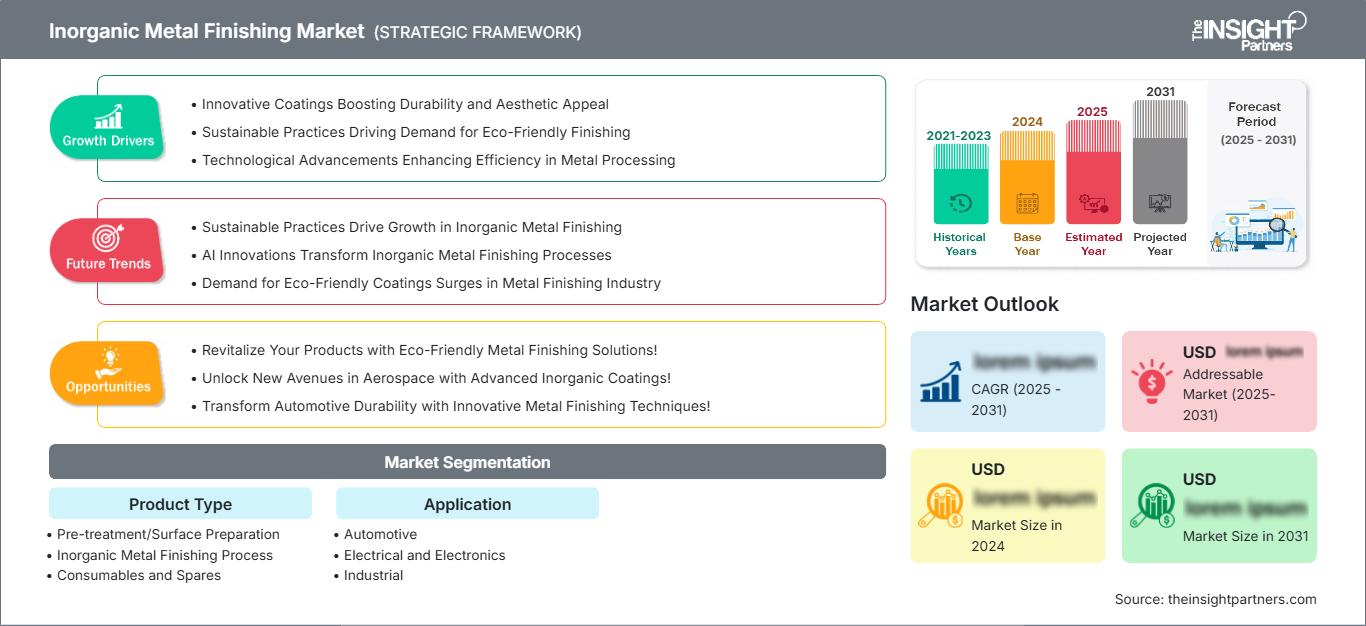
Inorganic Metal Finishing Market: Strategic Insights
Regional Insights
North America inorganic metal finishing market
North America represented an estimated 24–28% of the Inorganic Metal Finishing Market share in 2025 and is projected to expand at a 3.2–3.6% CAGR during 2026–2034. Automotive production, aerospace and defense requirements, industrial machinery, electronics assembly, and replacement demand for corrosion-resistant components provide a diversified consumption base. Regulatory requirements affecting hazardous chemicals and wastewater encourage investment in trivalent chromium, phosphate-free pretreatments, improved filtration, and chemical-recovery systems.
The area also stands to gain from increasing investment into batteries, electrified transport, and semiconductor fabrication. Such industries have high demands for conductivity, adhesion, corrosion resistance, and surface cleanliness. Service provision, automation of dosing, process analysis, and equipment integration have become a point of differentiation among suppliers. The 2025 MKS initiatives in North America covered finishing solutions for battery housings, bus bars, current collectors, terminals, and other components of electric vehicles.
U.S. inorganic metal finishing market
The U.S. accounted for approximately 78–82% of the North American Inorganic Metal Finishing Market demand in 2025 and is expected to register a 3.3–3.7% CAGR during 2026–2034. The nation has advantages in the aerospace, defense, automotive, industrial equipment, electronics, and energy industries. The production needs in the domestic market are increasingly calling for finish chemistries that can provide corrosion resistance along with low-emission processing and chemical efficiency.
Leading technology suppliers have commercial, lab, production, or customer support capabilities that cater to finishing operations in the United States. There is a growing trend of applications moving beyond traditional hardware to include EV batteries, electronics interconnects, electronics packaging, connectors, and high-performance industrial parts. MKS's Atotech offered battery application surface treatment technologies in Detroit in 2025, covering copper, corrosion resistance, adhesion, and electromagnetic shielding.
Europe inorganic metal finishing market
Europe held an estimated 25–29% of the Inorganic Metal Finishing Market share in 2025 and is projected to grow at a 3.1–3.5% CAGR during 2026–2034. Germany remains the leading regional market because of its extensive automotive, machinery, electrical engineering, chemicals, and industrial manufacturing base. The UK also supports demand through aerospace, defense, transportation, electronics, and specialized engineering applications, where high-reliability finishes and strict qualification requirements remain important.
France, Italy, and Spain contribute through aerospace, automotive, machinery, hardware, consumer products, and infrastructure supply chains. European regulations continue to accelerate the substitution of hazardous chemistries and encourage lower-waste finishing operations. MKS opened a more than 2,000-square-meter facility in Derio, Spain, in 2025 to strengthen technical and commercial support across Iberia and Southern Europe.
APAC inorganic metal finishing market
Asia Pacific accounted for an estimated 38–42% of the Inorganic Metal Finishing Market share in 2025 and is anticipated to record a 4.2–4.6% CAGR during 2026–2034, making China the leading regional market. China, Japan, South Korea, India, and Australia support demand through electronics, automotive, machinery, batteries, mining equipment, and infrastructure.
Localization of industries and policies for semiconductors and advanced manufacturing is creating increased demand for high-quality surface processing. India has emerged as one of the critical geographies, while Japan and South Korea continue to be among the technologically advanced electronic markets. In 2025, MKS’ Atotech emphasized its advancements in semiconductor packaging and surface finishing technologies in India and Asia.
Middle East & Africa inorganic metal finishing market
The Middle East & Africa Inorganic Metal Finishing Market is expected to expand at a 3.8–4.2% CAGR during 2026–2034. Saudi Arabia and the UAE lead regional investment through industrial diversification, construction, transportation, energy, and infrastructure programs, while South Africa remains important for mining, automotive, and industrial equipment.
Energy infrastructure creates sustained requirements for corrosion-resistant metallic components, fasteners, fabricated structures, and process equipment. Local finishing capacity is also gradually expanding alongside manufacturing localization initiatives. However, dependence on imported specialty chemicals and advanced process equipment can increase supply-chain costs and qualification times, creating opportunities for regional technical partnerships and localized chemical blending.
Segmentation Analysis
Product Type
The Product Type segment is expected to grow at a 3.6–4.0% CAGR during 2026–2034. Demand spans the full finishing workflow, from substrate cleaning and activation to deposition and maintenance. Customers increasingly evaluate total process performance rather than individual chemical prices, supporting integrated solutions that reduce rejects, improve bath longevity, minimize wastewater generation, and maintain consistent coating quality. This broad value-chain role defines the inorganic metal finishing market scope.
- Pre-treatment/Surface Preparation supports cleaning, activation, descaling, and conversion processes that determine coating adhesion and durability. Demand is increasingly influenced by low-temperature operation, reduced sludge generation, and compatibility with mixed-metal manufacturing lines.
- Inorganic Metal Finishing Process represents the core deposition and conversion stage, including plating, passivation, and related protective treatments. Strategic importance is rising as manufacturers require application-specific conductivity, corrosion resistance, wear properties, and dimensional consistency.
- Consumables and Spares include materials and replacement components necessary for maintaining process continuity. Their recurring demand provides operational stability, particularly where automated lines require predictable filtration, dosing, anode, membrane, and equipment performance.
Application
The Inorganic Metal Finishing Market Report indicates that the Application segment is projected to expand at a 3.7–4.1% CAGR during 2026–2034. End-use requirements vary significantly according to electrical conductivity, corrosion exposure, cosmetic appearance, mechanical wear, and regulatory specifications. Electrification and electronics miniaturization are increasing process complexity, while conventional industrial and hardware applications continue to provide a large installed base for replacement and maintenance demand.
- Automotive applications require corrosion-resistant finishes for fasteners, structural parts, connectors, thermal-management components, and battery systems. Electrified vehicles are expanding requirements for conductivity, shielding, lightweight-substrate treatment, and durable protective layers.
- Electrical and Electronics applications depend on precise surface characteristics for PCBs, package substrates, connectors, contacts, shielding, and battery components. Miniaturization increases demand for controlled deposition thickness, adhesion, uniformity, and reliable high-frequency performance.
- Industrial applications form the largest application base, supported by machinery, energy equipment, fabricated metals, process equipment, and heavy-duty components requiring extended service life under corrosive or abrasive operating conditions.
- Hardware demand includes architectural fittings, fasteners, tools, household components, and engineered fixtures. Manufacturers balance decorative appearance with corrosion protection, cost efficiency, throughput, and compliance with increasingly restrictive chemical-management requirements.
- Defense applications prioritize reliability, corrosion protection, electrical performance, and compliance with demanding qualification specifications. Long product lifecycles and stringent performance requirements make validated process control particularly important for suppliers and finishing service providers.
Opportunity Snapshot
| Application | Revenue Contribution | Trend Tag | Adoption Stage |
| Automotive | High | Battery Components | Scaling |
| Electrical and Electronics | High | Advanced Packaging | Scaling |
| Industrial | High | Corrosion Control | Mature |
| Hardware | Medium | Chromium Substitution | Scaling |
| Defense | Medium | High Reliability | Mature |
Inorganic Metal Finishing Market Growth Drivers and Impact Analysis
Electrification Expands Requirements for Conductive and Protective Surfaces
As electrification increases the need for controlled surface characteristics in batteries, power electronics, connectors, busbars, current collectors, enclosures, and thermal management, this need often entails an improvement in conductivity, corrosion resistance, adhesion, and thermal cycling reliability. The solution to this comes in the form of specific surface chemistry products for copper, nickel, tin, and conversion applications. Atotech, an MKS company, presented several battery finishing solutions at 2025, including current collectors, terminals, enclosures, and electromagnetic shielding applications. The effect of this on the market goes beyond increased use of chemicals as customers increasingly allocate budget to process control, analytical measurement, automation, and technical expertise.
Stricter Environmental Requirements Accelerate Process Substitution
The environmental regulations are changing the face of finishing by making the economic relevance of non-hazardous chemical alternatives and water-efficient processes a reality. Substitution of hexavalent chromium, decreased usage of PFAS chemicals, lower temperature cleaning, phosphate-free pre-treatment, and closed-loop processing are some technology areas that have started gaining significance. Such a transition may involve reformulation, equipment modifications, process qualification, and customer trials, providing an advantage to suppliers who have an integrated approach to chemistry and engineering solutions. The 2025 portfolio by Atotech featured Cr(VI) free processes, non-PFAS systems, low temperature cleaners, and closed-loop processing of zinc-nickel alloy.
Advanced Electronics Raise Demand for Precision Metallization
Metallization and surface preparation become more demanding because of advanced AI hardware infrastructures, high-performance computing applications, advanced packaging, and more densely packed electronics. Fine-line circuitry and advanced packaging substrates rely on uniform deposition, good adhesion, controlled roughness, and process repeatability. Supplier competition moves from low-volume processes to more volume-oriented, but also less defective processes. In 2025, MKS Atotech and ESI successfully implemented a portfolio of technologies that includes advanced chemistry, plating systems, lasers, and production of advanced printed circuit boards and package substrates. This is especially significant for the Asia Pacific region, which is currently experiencing growing semiconductor and electronics value chain investment.
Inorganic Metal Finishing Market Future Trends
Closed-Loop and Digitally Controlled Finishing Lines
The inorganic metal finishing market trends increasingly point toward closed-loop operations that combine chemical recovery, automated dosing, bath analytics, filtration, and real-time process monitoring. Future investments are expected to focus on reducing water consumption, energy intensity, chemical losses, and operator-dependent variation. Digitally connected equipment can support predictive maintenance and faster identification of process drift. This transition will favor suppliers capable of combining specialty chemistry with equipment and service capabilities. Smaller finishing companies may adopt modular automation where full line replacement is uneconomic. Over time, traceability requirements from automotive, electronics, aerospace, and defense customers are expected to make data-supported process documentation a more important competitive requirement.
Application-Specific Finishes for New Energy and Electronics
Future product development will increasingly target specific component challenges rather than broad, standardized finishing categories. Battery systems require protection against contact corrosion and electrical losses, while high-frequency electronics need controlled surface roughness and signal integrity. Advanced materials such as aluminum alloys and polymer composites will require compatible pretreatment and metallization routes. Manufacturers are therefore expected to expand collaborative development with OEMs and tier suppliers during component design rather than after production specifications are finalized. This shift can increase qualification periods but strengthen supplier relationships. Companies able to demonstrate performance, environmental compatibility, and scalable production will be better positioned as advanced manufacturing applications expand globally.
Inorganic Metal Finishing Market Opportunities
Localized Technical Centers in Emerging Manufacturing Clusters
The inorganic metal finishing market Forecasts indicate meaningful opportunities for suppliers to establish laboratories, application centers, and technical-service capabilities near emerging manufacturing clusters. Localized support can reduce qualification time, improve troubleshooting, and help customers adapt global chemistries to local substrates, water conditions, equipment, and regulations. India, Southeast Asia, selected Middle Eastern industrial zones, and Southern Europe offer potential locations where manufacturing investment is expanding. MKS' opening of its Derio facility illustrates the strategic value of regional laboratories and customer support infrastructure. Investors can target facilities combining application testing, training, pilot processing, and small-batch chemical supply, creating closer integration with local OEM and tier supplier ecosystems.
Retrofit Solutions for Sustainable Compliance Upgrades
A substantial opportunity exists in retrofitting existing finishing lines rather than replacing complete installations. Many manufacturers operate qualified production equipment with long useful lives but require lower-emission chemistries, improved wastewater performance, and greater process efficiency. Suppliers can develop modular packages incorporating new cleaners, chromium alternatives, conversion coatings, membranes, filtration, automated dosing, and recovery systems. This approach can lower capital requirements and shorten production disruption compared with greenfield replacement. Strategic investment should therefore focus on compatibility testing and standardized retrofit architectures. Service providers can combine equipment upgrades with recurring chemistry, monitoring, maintenance, and compliance support, creating longer-term customer relationships and more resilient revenue streams.
Recent Developments
- October 2025: MKS Inc. announced that its strategic brands Atotech (process chemicals, equipment, software, and services) and ESI (laser systems) will showcase their latest range of leading manufacturing solutions for printed circuit board (PCB) and package substrate manufacturing at the upcoming 26th TPCA Show 2025 to be held at the Taipei Nangang Exhibition Center from 22-24 October 2025.
- January 2025: Metal Finishing Technologies in Bristol, Connecticut, launched its new automated zinc/zinc nickel production line. The advanced line offers rack and barrel plating, supported by PLC controls that run multiple custom jobs simultaneously tailored to unique customer requirements.
Frequently Asked Questions

- Comprehensive Market Sizing and Forecast Analysis
- Detailed Segmentation Analysis
- In-Depth Market Dynamics Assessment
- Regional and Country-Level Insights
- Competitive Landscape and Company Benchmarking
- Strategic Business Intelligence
Recent Reports
Testimonials

The Insight Partners' SCADA System Market report is comprehensive, with valuable insights on current trends and future forecasts. The team was highly professional, responsive, and supportive throughout. We are very satisfied and highly recommend their services.
RAN KEDEM Partner, Reali Technologies LTDs
I requested a report on a very specific software market and the team produced the report in a few days. The information was very relevant and well presented. I then requested some changes and additions to the report. The team was again very responsive and I got the final report in less than a week.
JEAN-HERVE JENN Chairman, Future Analytica
We worked with The Insight Partners for an important market study and forecast. They gave us clear insights into opportunities and risks, which helped shape our plans. Their research was easy to use and based on solid data. It helped us make smart, confident decisions. We highly recommend them.
PIYUSH NAGPAL Sr. Vice President, High Beam Global
The Insight Partners delivered insightful, well-structured market research with strong domain expertise. Their team was professional and responsive throughout. The user-friendly website made accessing industry reports seamless. We highly recommend them for reliable, high-quality research services
YUKIHIKO ADACHI CEO, Deep Blue, LLC.
This is the first time I have purchased a market report from The Insight Partners.While I was unsure at first, I visited their web site and felt more comfortable to take the risk and purchase a market report.I am completely satisfied with the quality of the report and customer service. I had several questions and comments with the initial report, but after a couple of dialogs over email with their analyst I believe I have a report that I can use as input to our strategic planning process.Thank you so much for taking the extra time and making this a positive experience.I will definitely recommend your service to others and you will be my first call when we need further market data.
JOHN SUZUKI President and Chief Executive Officer, Board Director, BK Technologies
I wish to appreciate your support and the professionalism you displayed in the course of attending to my request for information regarding to infectious disease IVD market in Nigeria. I appreciate your patience, your guidance, and the fact that you were willing to offer a discount, which eventually made it possible for us to close a deal. I look forward to engaging The Insight Partners in the future, all thanks to the impression you have created in me as a result of this first encounter.
DR CHIJIOKE ONYIA MANAGING DIRECTOR, PineCrest Healthcare Ltd.Reason to Buy
- Informed Decision-Making
- Understanding Market Dynamics
- Competitive Analysis
- Identifying Emerging Markets
- Customer Insights
- Market Forecasts
- Risk Mitigation
- Boosting Operational Efficiency
- Strategic Planning
- Investment Justification
- Tracking Industry Innovations
- Aligning with Regulatory Trends





 Get Free Sample for