
Intelligent Electronic Devices Market Growth, Trends & Demand by 2034
Coverage: By Type (Protective Relaying Device, On-Load Tap Changer Controller, Circuit Breaker Controller, Others); End User (Oil and Gas, Food and Beverage, Automotive, Others), and Geography (North America, Europe, Asia Pacific, and South and Central America)
- Status : Data Released
- Report Code : TIPRE00013797
- Category : Electronics and Semiconductor
- No. of Pages : 150
- Available Report Formats :


- Last update date : October 16, 2026


2025 Market Size
US$ 13.92 Bn
Base year value
2034 Forecast
US$ 29.60 Bn
Projected by 2034
CAGR 2026-2034
8.74 %
Growth rate
Addressable Market
US$ 194.96 Bn
(2026-2034)
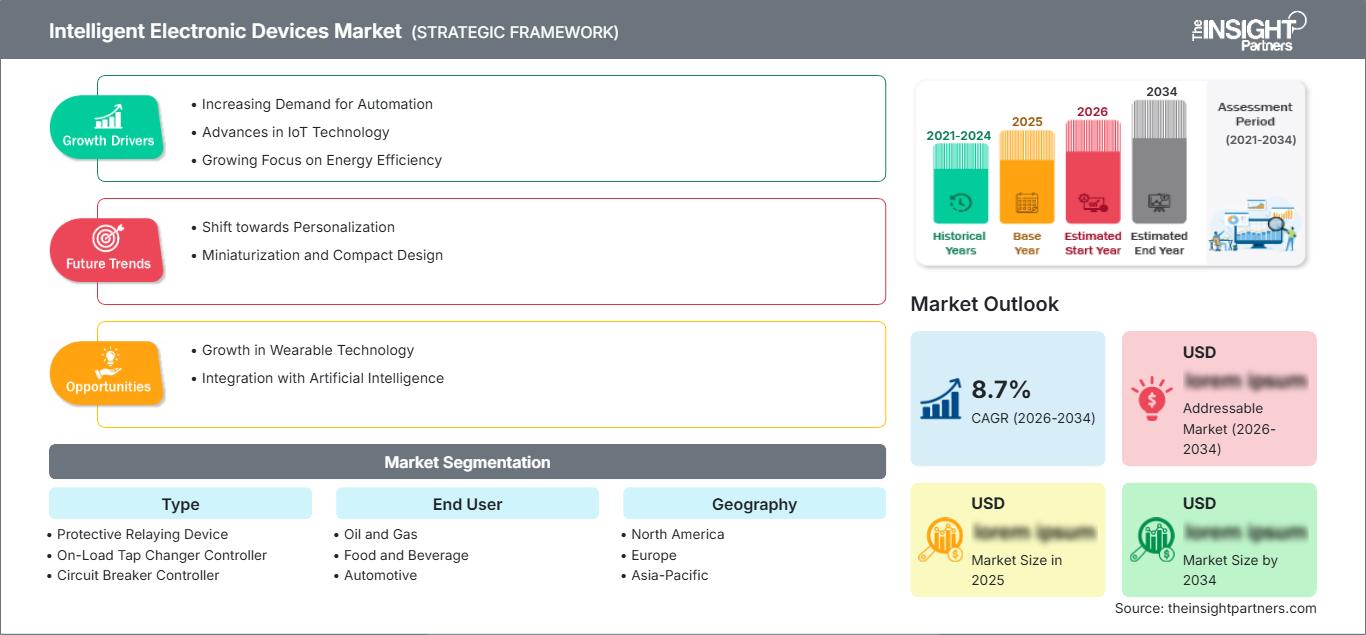
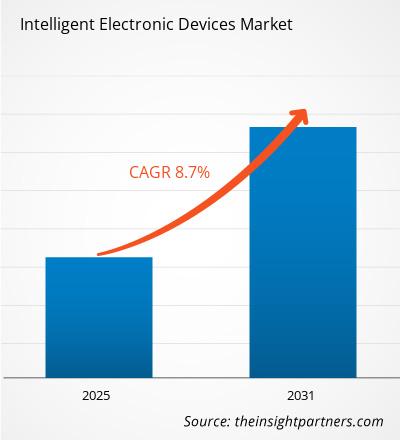
The Intelligent Electronic Devices Market size is expanding as utilities and industrial operators modernize protection, control, automation, and monitoring architectures. The market was valued at US$ 13.92 Billion in 2025 and is projected to reach US$ 29.60 Billion by 2034, registering a CAGR of 8.74% during 2026–2034. Increasing digital-substation deployments, distributed energy resources, and requirements for faster fault detection are strengthening demand for interoperable, communication-enabled protection and control equipment.
North America remains a technologically advanced market, supported by grid modernization programs, replacement of aging protection infrastructure, and increasing electricity demand from data centers and electrified transportation. The regional outlook indicates a 7.80–8.60% CAGR between 2026 and 2034, with cybersecurity requirements, IEC 61850 adoption, and utility investments in automation creating sustained opportunities. The Intelligent Electronic Devices size is also influenced by replacement cycles and increasing deployment of digital substations.
Intelligent Electronic Devices Market Assessment and Insights
- North America: North America is expected to account for a 31–35% Intelligent Electronic Devices Market share in 2025, expanding at a 7.80–8.60% CAGR between 2026–2034, supported by transmission modernization, utility automation, data-center load growth, and replacement of aging protection systems.
- US: The US is estimated to represent 82–86% of North America's 2025 market, growing at a 7.90–8.70% CAGR between 2026–2034, driven by grid resilience programs and digital substation investment.
- Europe: Europe is projected to hold a 24–28% share in 2025 and expand at a 7.20–8.10% CAGR between 2026–2034, with Germany, the UK, France, Italy, and Spain supporting digital-grid investment and renewable integration.
- Asia Pacific: Asia Pacific is estimated at a 27–31% share in 2025, growing at a 9.10–10.00% CAGR between 2026–2034, led by China, Japan, South Korea, and India through grid expansion, industrial automation, and renewable deployment.
- Largest Segment: Protective Relaying Device is estimated to hold a 42–46% market share in 2025, advancing at a 8.20–9.00% CAGR between 2026–2034, reflecting its essential role in power-system protection.
- High Growth Segment: Automotive is estimated to represent a 10–14% market share in 2025, expanding at a 9.20–10.10% CAGR between 2026–2034, supported by increasingly automated electrical architectures.
- Key companies analyzed in detail: ABB Ltd, Cisco Systems, Inc., Eaton Corporation plc, Honeywell International Inc., Open Systems International, Inc., Schneider Electric SE, Schweitzer Engineering Laboratories, Inc., Siemens AG, SUBNET Solutions Inc., TOSHIBA ELECTRONIC DEVICES & STORAGE CORPORATION.
Source: The Insight Partners' analysis based on proprietary research, government publications, company annual reports, investor presentations, industry databases, and expert interviews.
Growth in the Intelligent Electronic Devices Market has progressed from electromechanical and basic microprocessor-based protection to networking solutions that can measure, communicate, record events, diagnose faults, and provide programmable control. While IEC 61850 has driven compatibility, process-bus technologies have reduced the wiring needed in traditional configurations. Manufacturing is increasingly moving towards an approach involving modular hardware, embedded software, Ethernet networking, cybersecurity functions, and remote configuration. These trends are changing procurement in favor of integrated protection and automation architectures instead of standalone devices.
During the forecast period, spending is likely to move from the well-established area of transmission network automation into distribution automation, renewable energy interfacing, industrial microgrids, and high-load sites. Digital protection systems are likely to be used more widely in emerging markets that will find it easier to develop new substations that don't require the older architectures. Standards on cybersecurity, interoperability, and asset management at utilities may support spending.
Intelligent Electronic Devices Market Report Scope
| Report Attribute | Details |
|---|---|
| Market size in 2025 | US$ 13.92 Billion |
| Market Size by 2034 | US$ 29.60 Billion |
| Global CAGR (2026 - 2034) | 8.74% |
| Historical Data | 2021-2024 |
| Forecast period | 2026-2034 |
Intelligent Electronic Devices Market Analysis
Modernization of the electricity grid is the main driver of demand, as utilities need fast fault detection, selectivity in protection schemes, remote monitoring, and asset visibility. The opportunity in Intelligent Electronic Devices includes not only device manufacturers but also engineers specializing in protection systems, providers of communication infrastructure, system integration specialists, and utilities. The manufacturers are adding more and more functions such as measurement, automation, diagnosis, and communication to the modular construction, but the clients require interoperability with supervisory control systems. Therefore, the dynamics of the market depends on semiconductors, computers, sensors, communication modules, and engineering know-how.
The clients from the industrial sector are extending their use of the products beyond substations. The remote devices require protection in oil and gas industry, but connectivity in electrical infrastructure is becoming a common practice in automotive manufacturing plants and food-processing industries, where the system cannot afford any stoppage time. Along with hardware, the selection criteria comprise the other factors.
According to the Intelligent Electronic Devices Market report, competitive positioning is characterized by the ability to combine installed base power, protection knowledge, communication, software, and regional service network advantages. In particular, companies such as ABB Ltd, Siemens AG, Schneider Electric SE, Eaton Corporation plc, and Honeywell International Inc., compete in the markets by their wide range of electrification and automation products. In contrast, Schweitzer Engineering Laboratories, Inc. competes by its strong specialization in protection and automation, while Cisco Systems, Inc. provides the market with networking know-how. Finally, Open Systems International, Inc. specializes in energy management and control system integration.
Analysis of the Intelligent Electronic Devices Market reveals increased strategic focus on software protection, cybersecurity, digital substations, and lifecycle services. SUBNET Solutions Inc. enhances the ecosystem of utility integration, and TOSHIBA ELECTRONIC DEVICES & STORAGE CORPORATION supplies power system electronics and semiconductors. Increasingly, strategic investments go into interoperability and digitization. For instance, Siemens launched virtual protection that enables consolidation of the functionality of several hardware protection devices.
● REPORT CUSTOMIZATION
Tailor This Report To Align With Your Specific Business Requirements
This report can be customized to align precisely with your business objectives, scope, and target markets. Customization options include tailored segmentation, geography, competitive analysis, and strategic insights to support informed decision-making.
Customize This Report →WHAT YOU CAN ADJUST
- ● Segmentations
- ● Geography
- ● Competitive Analysis
- ● Language Preferences
Intelligent Electronic Devices Market: Strategic Insights
Regional Insights
North America Intelligent Electronic Devices Market
North America is estimated to account for a 31–35% share in 2025, with the regional Intelligent Electronic Devices Market expanding at a 7.80–8.60% CAGR through 2034. North America will see demand driven largely by the US, owing to transmission upgrades, distribution automation, needs of data centers, renewables integration, and aging protection device replacement. Canada will come into play through utilities' modernization and grid investments in renewables.
More utilities are beginning to assess devices based on factors such as interoperability, cybersecurity, communication capabilities, and overall lifecycle economics. In addition, digital substations will enable utilities to combine their protection, control, monitoring, and communication in a more streamlined manner. Electrification of transportation and industrial loads will further drive the need for effective protection architectures. All these factors should underpin the Intelligent Electronic Devices Market share in North America.
U.S. Intelligent Electronic Devices Market
The US represents approximately 82–86% of North America's 2025 market and is projected to grow at a 7.90–8.70% CAGR through 2034. Modernization, aging equipment, distributed generation, and increasing loads on data centers facilitate adoption. Providers such as ABB Ltd., Siemens AG, Eaton Corporation plc, Schneider Electric SE, and Schweitzer Engineering Laboratories, Inc., have already established application footprints.
There is a trend towards network protection, centralized control, remote diagnostics, and cybersecurity-enabled devices. Increasingly, data centers, manufacturing plants, and renewable energy systems need reliable electrical protection that will isolate faults quickly. Infrastructure development at federal and state levels, along with utilities' capital expenditure, helps replace old equipment. This means the United States is still an important center for the development and implementation of advanced protection and control solutions.
Europe Intelligent Electronic Devices Market
Europe is projected to hold a 24–28% Intelligent Electronic Devices Market in 2025 and grow at a 7.20–8.10% CAGR through 2034, with Germany serving as a leading market. Integration of renewables, interconnection of grids, digitalization of industries, and strict reliability standards are fueling demand in leading economies in Europe.
The United Kingdom and Germany continue to be significant centers of adoption. The United Kingdom, with growing renewable integration in its network, is focusing on network flexibility and digitization, which is driving demand for advanced protection, communication, and automation equipment. Germany's industry base, along with high levels of renewable integration, will drive demand for digital substations and advanced protection and control of grids. France, Italy, and Spain will continue to grow their grid automation due to changing power flow.
APAC Intelligent Electronic Devices Market
APAC is estimated to represent a 27–31% share in 2025 and expand at a 9.10–10.00% CAGR, led by China. Industrial automation is the contribution from Japan and South Korea. In addition to the demand created by grid expansion, renewables, and infrastructure modernization, India and Australia offer their contributions.
The combination of large-scale transmission investment, renewable installation, and industrial automation takes place in China. Digital grid infrastructure expansion in addition to electrification and renewable generation capacity installations takes place in India. Reliability and industrial systems are the focus areas of Japan and South Korea, whereas automation is a necessity in Australia due to its dispersed geography and renewables.
Middle East & Africa Intelligent Electronic Devices Market
Middle East and Africa demand is supported by electricity infrastructure expansion, industrial projects, and modernization of oil and gas facilities. Saudi Arabia leads regional adoption, followed by the UAE and South Africa. The regional market is projected to expand at a 6.80–7.60% CAGR through 2034.
Smart infrastructure, power generation from renewable energy sources, and industrial diversification is taking place in Saudi Arabia and the UAE, thus necessitating the need for advanced security and automation. There is a need for South Africa to improve grid reliability and modernize its assets, while projects dominate in Rest of MEA. Oil & gas plants constitute a key application domain due to the critical nature of their assets.
Segmentation Analysis
Type
The Type segment in the Intelligent Electronic Devices Market is projected to grow at a 8.40–9.20% CAGR between 2026–2034. Protective relaying remains the principal category because fault detection and isolation are fundamental requirements across transmission, distribution, and industrial systems. On-load tap changer controllers and circuit breaker controllers gain importance as utilities pursue coordinated voltage regulation and automated switching. The segment defines a substantial portion of the Intelligent Electronic Devices scope, particularly as devices combine protection, control, communications, and diagnostics.
- Protective Relaying Device: Protective relays remain the core equipment category for detecting abnormal electrical conditions and initiating selective isolation. Demand is strongest in substations, industrial networks, renewable interconnections, and critical infrastructure requiring high protection availability.
- On-Load Tap Changer Controller: These controllers support automated voltage regulation by coordinating transformer tap operations. Their strategic importance increases where variable renewable generation and changing load profiles create more frequent voltage-management requirements.
- Circuit Breaker Controller: Circuit breaker controllers provide coordinated switching and protection functions, supporting faster fault isolation and improved substation automation. Adoption is strengthened by digital communications and integrated control architectures.
- Others: This category includes specialized intelligent control and protection functions supporting particular utility and industrial configurations. Demand depends on application complexity, system architecture, interoperability requirements, and modernization priorities.
End User
The End User segment in the Intelligent Electronic Devices Market is forecast to expand at a 8.90–9.70% CAGR between 2026–2034. Power utilities represent the dominant demand base because substations require protection, control, monitoring, and communication. Industrial customers are increasingly adopting similar architectures to improve electrical reliability and reduce unplanned downtime. Automotive manufacturing, oil and gas, and food-processing operations provide additional opportunities as connected electrical systems become more sophisticated.
- Oil and Gas: Oil and gas operators require highly dependable protection across refineries, pipelines, offshore facilities, and processing assets. Intelligent devices support remote monitoring, fault isolation, and integration with industrial control systems.
- Food and Beverage: Continuous-process and temperature-sensitive production environments depend on stable electricity. Intelligent protection supports equipment safety, production continuity, and coordinated response to electrical disturbances.
- Automotive: Automotive manufacturing plants use increasingly automated production lines with complex electrical loads. Intelligent protection helps coordinate equipment, minimize interruptions, and support digitally managed factory infrastructure.
- Others: Other users encompass infrastructure and industrial facilities with specialized electrical requirements. Adoption varies according to asset criticality, automation maturity, network complexity, and requirements for centralized monitoring.
Opportunity Snapshot
| End User | Revenue Contribution (High/Medium/Low) | Trend Tag | Adoption Stage |
|---|---|---|---|
| Oil and Gas | High | Remote Protection | Mature |
| Food and Beverage | Medium | Process Reliability | Scaling |
| Automotive | Medium | Factory Automation | Scaling |
| Others | Low | Asset Monitoring | Emerging |
Intelligent Electronic Devices Market Growth Drivers and Impact Analysis
Grid Modernization and Digital Substation Deployment
The Intelligent Electronic Devices Market forecast shows that utilities are replacing aging protection equipment with networked devices capable of high-speed measurement, automated control, event recording, and remote diagnostics. Digital substations reduce dependence on conventional copper wiring and enable information sharing across protection, control, and asset-management systems. This changes procurement from standalone relays toward integrated platforms with communication and cybersecurity capabilities. Increasing renewable generation further strengthens the requirement because variable power flows can complicate conventional protection coordination. Digital architectures allow utilities to modify settings and functions more efficiently as network configurations change. The commercial impact extends across device manufacturers, engineering contractors, communications providers, and software vendors. As modernization programs expand, suppliers with interoperable products and established utility certification are better positioned to participate in multiyear infrastructure programs.
Rising Electricity Demand from Data Centers and Electrification
Rapid growth in data centers, electric transportation, industrial electrification, and high-density computing is increasing requirements for dependable power infrastructure. Large facilities cannot tolerate prolonged electrical interruptions, making selective protection and rapid fault isolation increasingly important. Intelligent devices can provide granular measurements, event records, and communication with supervisory systems, improving operational visibility. Data-center operators also require scalable electrical architectures capable of supporting changing load profiles and redundant power paths. Industrial electrification produces similar requirements across manufacturing facilities, where production losses can exceed the equipment cost associated with an electrical disturbance. Consequently, demand is shifting toward devices that combine protection with monitoring and communications. This trend expands the addressable customer base beyond utilities and supports higher-value applications.
Increasing Cybersecurity and Interoperability Requirements
Connected electrical devices increasingly operate within communication-rich operational-technology environments, making cybersecurity and interoperability central procurement considerations. Utilities and industrial operators require authenticated access, secure communications, configuration control, and event logging alongside conventional protection performance. Standards such as IEC 61850 facilitate structured communication between devices from different suppliers, while cybersecurity frameworks encourage stronger network segmentation and access management. These requirements increase engineering complexity but also create opportunities for suppliers offering secure device architectures, lifecycle software, and integration support. Customers increasingly evaluate total lifecycle risk rather than initial hardware price alone. Vendors able to demonstrate compatibility, secure firmware management, and long-term support can therefore gain an advantage in modernization projects where operational continuity and regulatory compliance are critical purchasing criteria.
Intelligent Electronic Devices Market Future Trends
Virtualized Protection and Software-Defined Substations
The Intelligent Electronic Devices Market trends outlook is increasingly shaped by virtualization, where protection and control functions can run on standardized computing platforms rather than remaining permanently tied to dedicated hardware. This architecture could reduce physical equipment requirements, simplify testing, and accelerate functional upgrades. Utilities may progressively separate application software from hardware, enabling more flexible deployment across substations. Siemens has already demonstrated this direction through a virtualized protection solution capable of consolidating numerous protection functions within a server-based architecture. Over time, software-defined protection may encourage subscription-based lifecycle models, centralized engineering, automated configuration, and AI-assisted diagnostics. Adoption will depend on deterministic performance, cybersecurity, certification, and utility confidence in software-based protection.
AI-Assisted Diagnostics and Predictive Protection Management
Artificial intelligence is expected to become increasingly embedded around protection and control workflows rather than replacing core deterministic protection functions. Future systems may analyze event records, waveform information, equipment condition data, and historical faults to identify abnormal patterns before failures occur. This can support predictive maintenance, reduce unnecessary inspections, and prioritize asset replacement. AI-enabled analytics may also help engineers evaluate complex network events following disturbances, shortening investigation time. The strongest adoption is likely in large utilities, data centers, and industrial facilities with extensive connected assets and substantial outage costs. Vendors will increasingly differentiate through analytics, secure edge computing, and integration with enterprise asset-management systems. Regulatory validation and explainability will remain important before AI recommendations influence protection settings directly.
Intelligent Electronic Devices Market Opportunities
Expansion of Centralized and Virtualized Protection Architectures
Investors and technology suppliers can target centralized protection architectures where multiple conventional functions are consolidated into fewer intelligent platforms. Such systems reduce physical panels, simplify engineering, and create opportunities for software-based upgrades. The commercial opportunity extends beyond device sales into engineering, cybersecurity, commissioning, and lifecycle services. Vendors with installed protection platforms can use centralized architectures to create migration pathways for existing customers rather than requiring complete system replacement. Utilities undertaking distribution modernization represent a particularly attractive customer group because standardized architectures can be replicated across substations. Intelligent Electronic Devices Forecasts should therefore consider a gradual shift from individual hardware purchases toward integrated protection platforms, software modules, communications infrastructure, and recurring support. This transition can improve supplier revenue diversity while lowering customers' long-term engineering complexity.
Localized Manufacturing and Regional Grid Automation
Regional manufacturing represents another opportunity as governments seek resilient supply chains for critical electrical infrastructure. India, Southeast Asia, the Middle East, and selected Latin American markets are expanding electricity networks while encouraging domestic production and technology localization. Suppliers can respond through regional assembly, engineering centers, testing facilities, and partnerships with utilities and system integrators. Localization can shorten delivery cycles and improve adaptation to national grid standards, procurement requirements, and environmental conditions. It can also reduce exposure to international logistics disruptions for strategically important equipment. Companies entering these markets should prioritize certification, local service capability, interoperability, and workforce development rather than relying exclusively on imported hardware. Regional partnerships can accelerate customer qualification and improve long-term project participation.
Recent Developments
- February 2026: Siemens AG introduced Siprotec V, a server-based virtualized protection solution designed to consolidate the functionality of up to 60 hardware-based protection devices. The company stated that the architecture can reduce protection-panel capital expenditure by up to 25% and substation-building space requirements by approximately 45%, reinforcing the shift toward software-defined digital substations.
- November 2025: Schneider Electric SE announced the availability of its One Digital Grid Platform, an AI-enabled platform integrating planning, operations, and asset management. The platform is designed to support utility modernization without requiring complete replacement of existing systems and provides real-time outage restoration estimates for improved grid resilience and operational visibility.
- March 2026: ABB Ltd announced an additional investment of approximately US$75 million in India during 2026 to expand manufacturing and R&D capabilities across critical electrification and automation segments. The program includes capacity expansion across multiple locations and new R&D and testing laboratories, supporting localized technology development and manufacturing for infrastructure applications.
Frequently Asked Questions

- Comprehensive Market Sizing and Forecast Analysis
- Detailed Segmentation Analysis
- In-Depth Market Dynamics Assessment
- Regional and Country-Level Insights
- Competitive Landscape and Company Benchmarking
- Strategic Business Intelligence
Recent Reports
Testimonials

The Insight Partners provided valuable market intelligence that supported our global go-to-market strategy. Their team was professional, responsive, and attentive to our feedback, providing thoughtful analysis and helpful methodological clarifications throughout the project.
Junmo Kim Chief Financial Officer (CFO), Enertech Co., Ltd.
The Insight Partners' SCADA System Market report is comprehensive, with valuable insights on current trends and future forecasts. The team was highly professional, responsive, and supportive throughout. We are very satisfied and highly recommend their services.
RAN KEDEM Partner, Reali Technologies LTDs
I requested a report on a very specific software market and the team produced the report in a few days. The information was very relevant and well presented. I then requested some changes and additions to the report. The team was again very responsive and I got the final report in less than a week.
JEAN-HERVE JENN Chairman, Future Analytica
We worked with The Insight Partners for an important market study and forecast. They gave us clear insights into opportunities and risks, which helped shape our plans. Their research was easy to use and based on solid data. It helped us make smart, confident decisions. We highly recommend them.
PIYUSH NAGPAL Sr. Vice President, High Beam Global
The Insight Partners delivered insightful, well-structured market research with strong domain expertise. Their team was professional and responsive throughout. The user-friendly website made accessing industry reports seamless. We highly recommend them for reliable, high-quality research services
YUKIHIKO ADACHI CEO, Deep Blue, LLC.
This is the first time I have purchased a market report from The Insight Partners.While I was unsure at first, I visited their web site and felt more comfortable to take the risk and purchase a market report.I am completely satisfied with the quality of the report and customer service. I had several questions and comments with the initial report, but after a couple of dialogs over email with their analyst I believe I have a report that I can use as input to our strategic planning process.Thank you so much for taking the extra time and making this a positive experience.I will definitely recommend your service to others and you will be my first call when we need further market data.
JOHN SUZUKI President and Chief Executive Officer, Board Director, BK Technologies
I wish to appreciate your support and the professionalism you displayed in the course of attending to my request for information regarding to infectious disease IVD market in Nigeria. I appreciate your patience, your guidance, and the fact that you were willing to offer a discount, which eventually made it possible for us to close a deal. I look forward to engaging The Insight Partners in the future, all thanks to the impression you have created in me as a result of this first encounter.
DR CHIJIOKE ONYIA MANAGING DIRECTOR, PineCrest Healthcare Ltd.Reason to Buy
- Informed Decision-Making
- Understanding Market Dynamics
- Competitive Analysis
- Identifying Emerging Markets
- Customer Insights
- Market Forecasts
- Risk Mitigation
- Boosting Operational Efficiency
- Strategic Planning
- Investment Justification
- Tracking Industry Innovations
- Aligning with Regulatory Trends





 Get Free Sample for