
IoT Gateway Market Trends, Demand & Growth by 2034
Coverage: by Component (Processor, Sensor, FPGA, Memory, Others); Node (Smart Watch, RADAR, Camera, Thermostat, Smart TV, Actuator, Others); Connectivity (Wi-Fi, Bluetooth, Ethernet, Zigbee, Z-Wave, Others); Application (Healthcare, Consumer Electronics, Building Automation, Automotive and Transportation, Industrial, Others) , and Geography (North America, Europe, Asia Pacific, and South and Central America)
- Status : Data Released
- Report Code : TIPRE00006640
- Category : Electronics and Semiconductor
- No. of Pages : 150
- Available Report Formats :


- Last update date : September 21, 2026


2025 Market Size
US$ 1.97 Bn
Base year value
2034 Forecast
US$ 5.41 Bn
Projected by 2034
CAGR 2026-2034
11.88 %
Growth rate
Addressable Market
US$ 32.40 Bn
(2026-2034)
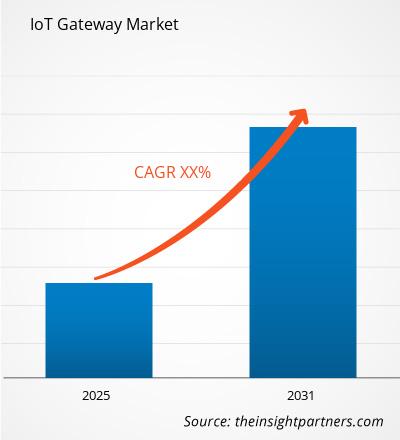
The global IoT Gateway market was valued at US$ 1.97 billion in 2025 and is expected to reach US$ 5.41 billion by 2034; it is estimated to record a CAGR of 11.88% during 2026-2034.
IoT Gateway Market Assessment and Insights
- North America: North America is estimated to hold a 38–40% share in 2025 and expand at a 10–12% CAGR between 2026–2034. Industrial digitization, edge infrastructure, and connected transportation underpin regional demand.
- US: The US is estimated to represent 78–82% of North America in 2025, growing at a 10–12% CAGR between 2026–2034, supported by industrial IoT and smart infrastructure.
- Europe: Europe is estimated at a 25–29% share in 2025 and a 11–12% CAGR between 2026–2034. Germany, the UK, France, Italy, and Spain support adoption through manufacturing automation, smart buildings, and connected mobility.
- Asia Pacific: Asia Pacific is estimated at a 23–27% share in 2025 and a 13–14% CAGR between 2026–2034. China, Japan, South Korea, India, and Australia provide broad industrial and consumer deployment opportunities.
- Largest Segment: Processor is estimated to command a 30–34% market share in 2025, with a 12–14% CAGR during 2026–2034, reflecting its central role in edge processing.
- High Growth Segment: Healthcare is estimated at a 12–16% share in 2025, expanding at a 12.5–13.5% CAGR during 2026–2034, driven by connected medical infrastructure.
- Key companies analyzed in detail: AAEON Technology Inc., ADLINK Technology Inc., Advantech Co., Ltd., Cisco Systems, Inc., Dell Technologies Inc., Eurotech S.p.A., Hewlett Packard Enterprise Company, Huawei Technologies Co., Ltd., NEXCOM International Co., Ltd., NXP Semiconductors N.V.
Source: The Insight Partners' analysis based on proprietary research, government publications, company annual reports, investor presentations, industry databases, and expert interviews.
The industry has shifted from merely providing protocol translators to delivering intelligent edge gateways that process the data locally, work with a variety of interfaces, and enforce security policies. There is a tendency for processors to be designed in a way where they integrate the computing capacity, networking capacity, memory, and acceleration capability. Rugged gateways have been created to provide support with respect to temperature and vibrations, and also network connections.
In terms of future investments, gateways that are focused on artificial intelligence, deterministic networking, cybersecurity, and energy-efficient edge processing are expected to be favored. In terms of deployments, emerging deployments in Southeast Asia, India, the Middle East, and Eastern Europe will increase the number of opportunities as more smart manufacturing, transportation, and building programs become mature.
IoT Gateway Market Report Scope
| Report Attribute | Details |
|---|---|
| Market size in 2025 | US$ 1.97 Billion |
| Market Size by 2034 | US$ 5.41 Billion |
| Global CAGR (2026 - 2034) | 11.88% |
| Historical Data | 2021-2024 |
| Forecast period | 2026-2034 |
IoT Gateway Market Analysis
Growth in the IoT Gateway Market is highly dependent on the growing need for communication between sensors, controllers, edge applications, and cloud computing. Need for gateways grows as enterprises deal with heterogeneous devices that do not have direct communication capability. Gateways deliver capabilities such as protocol translation, data filtering, local analysis, device management, and security services to create value among connected devices and enterprise systems.
The market ecosystem includes semiconductor vendors, embedded-computing vendors, connectivity vendors, gateway vendors, software vendors, system integrators, and end users. Availability of processors, memory, FPGA, and sensors affects the hardware architecture, while wireless modules and Ethernet modules affect the connectivity. The supply dynamic of gateways is increasingly focused on modular solutions as flexibility in hardware configuration is needed.
Factors influencing competitive positioning in the IoT Gateway Market Report include processing, connectivity, ruggedness, cybersecurity, software compatibility, and lifecycle management capabilities. Companies such as AAEON, ADLINK, Advantech, Eurotech, and NEXCOM have positioning strategies based on embedded and industrial gateways. On the other hand, Cisco, Dell Technologies, and Hewlett Packard Enterprise Company have competitive advantage in network and edge computing. Also, Huawei Technologies Co., Ltd. and NXP Semiconductors N.V. have networking and semiconductor-enabled edge architectures.
More investments are made in AI-powered edge computing and secure device orchestration, rather than just connectivity. ADLINK's gateway platform provides support for fieldbus connections, Wi-Fi, LTE, data aggregation, and edge-to-cloud communication. Similarly, Eurotech's ReliaGATE products provide industrial connectivity, edge computing, and security capabilities. Thus, strategic positioning in the IoT market depends on differentiating hardware capabilities through software and device management.
● REPORT CUSTOMIZATION
Tailor This Report To Align With Your Specific Business Requirements
This report can be customized to align precisely with your business objectives, scope, and target markets. Customization options include tailored segmentation, geography, competitive analysis, and strategic insights to support informed decision-making.
Customize This Report →WHAT YOU CAN ADJUST
- ● Segmentations
- ● Geography
- ● Competitive Analysis
- ● Language Preferences
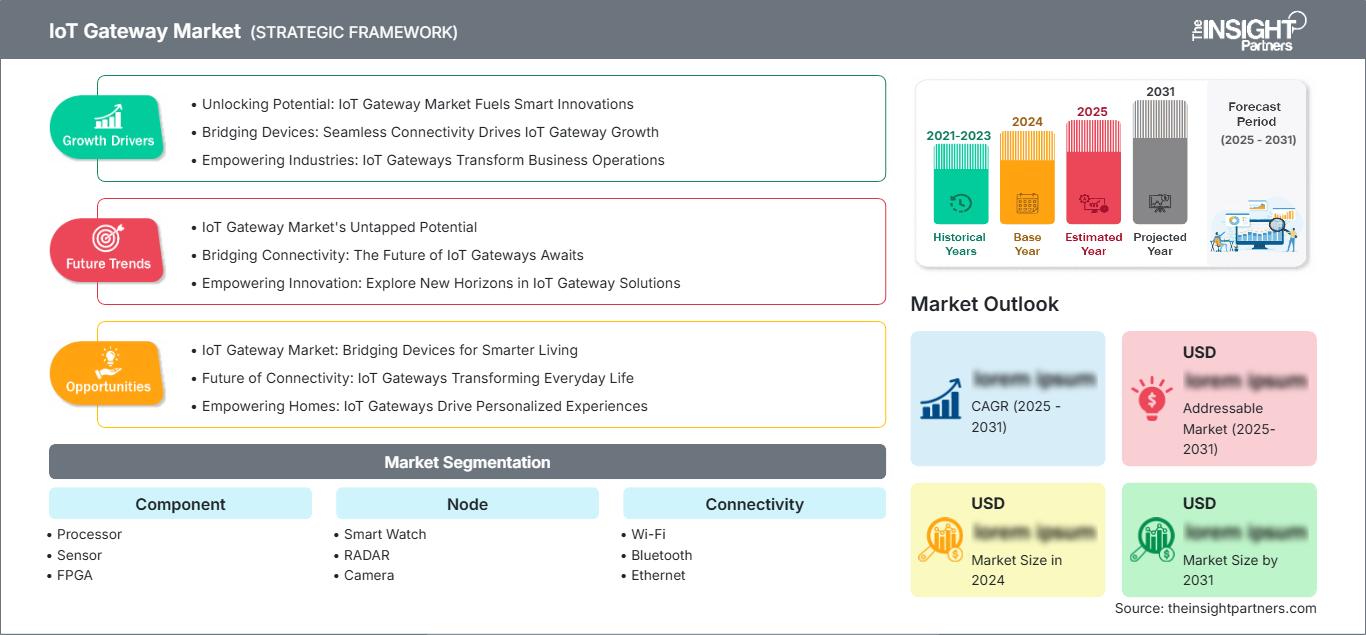
IoT Gateway Market: Strategic Insights
Regional Insights
North America IoT Gateway Market
North America is expected to capture a IoT Gateway Market share of 38-40% by 2025, at a 10-12% CAGR until 2034. The region has mature cloud infrastructure, industrial automation, connected cars, smart healthcare, and cybersecurity investments for enterprises. While the US serves as the main market driver, Canada makes its contributions in terms of energy, transportation, manufacturing, and smart buildings deployments.
Gateway installations will be more and more associated with edge computing and analytics. There is the need for local processing in the case of industrial customers to overcome problems with latency and dependence on bandwidth, and the communication in case of connected transportation use cases will have to be reliable across cameras, RADARs, controllers, and cloud services.
U.S. IoT Gateway Market
It is believed that the USA holds 78–82% of the total market of North America in 2025 and has a CAGR of 10–12% until 2034. Modernizing industries, connected healthcare, smart buildings, and automotive electronics contribute to the long-term adoption of gateways in the enterprise environment.
Such adoption is driven by key technology providers and an extensive ecosystem of cloud, network, semiconductor, and edge computing companies. Gateway applications tend to incorporate analytics in conjunction with secure cloud connectivity in cases when quick action is required regarding video, machine data, or operational technologies. It is expected that strong industrial sector and edge computing investments will favor processor-based gateways.
Europe IoT Gateway Market
The share of Europe in 2025 will be 25-29%, and its CAGR will be 11-12%. The largest demand in the region will come from Germany due to its highly advanced industry and Industry 4.0 implementation. The UK is the source of demand because of the connected infrastructure, healthcare, and smart buildings needs. Meanwhile, France, Italy, and Spain will contribute through their industrial modernization, transport, energy efficiency, and building automation. European demand is impacted by the need for cybersecurity and data governance that makes local processing more appealing.
APAC IoT Gateway Market
The market in APAC is projected to have a 23-27% share in 2025 and a CAGR of 13-14%, indicating that it is one of the markets having potential for growth. China is taking the lead with digitization of its manufacturing facilities. Japan and South Korea have been contributing automation and electronics expertise. India is developing its infrastructure, while Australia is providing opportunities in the mining sector and remote asset management.
Middle East & Africa IoT Gateway Market
MEA is anticipated to witness a 10-12% CAGR up to 2034. Saudi Arabia and UAE dominate the region’s adoption through their initiatives on smart cities, energy, transportation, and infrastructure, while South Africa offers use cases for industries and utilities. Opportunities for other countries in MEA include using gateways for remote monitoring of energy, water, logistics, and industry assets. Extreme environments create need for robust platforms with secured connectivity and processing capabilities.
Segmentation Analysis
Component
The IoT Gateway Market scope spans processors, sensors, FPGAs, and memory components that determine gateway computing, sensing, acceleration, and storage capabilities. Processor-based architectures remain central as edge workloads become more demanding, while sensors and FPGAs support application-specific processing. The segment is projected to expand at a 12–14% CAGR during 2026–2034, reflecting increasing requirements for localized analytics, protocol conversion, and secure application execution.
- Processor: Processor components provide the computational foundation for protocol conversion, analytics, security, and application execution, making processing performance central to gateway selection across industrial, automotive, and building environments.
- Sensor: Sensor components support direct environmental and equipment data acquisition, enabling gateways to interpret operational conditions and connect physical assets with edge applications and cloud platforms.
- FPGA: FPGA components provide configurable acceleration and deterministic processing, supporting applications requiring specialized workloads, rapid signal handling, or adaptable hardware architectures.
- Memory: Memory components support local buffering, application execution, analytics, and data retention, becoming increasingly important as gateways process larger datasets before transmitting selected information.
Node
The Node segment comprises Smart Watch, RADAR, Camera, Thermostat, Smart TV, Actuator. Demand is supported by expanding connected-device populations and the need to consolidate heterogeneous endpoints. The segment is expected to grow at a 13–15% CAGR during 2026–2034, as gateways increasingly manage device communication and localized intelligence.
- Smart Watch: Smart Watch connectivity supports wearable ecosystems requiring efficient aggregation, synchronization, and secure communication between personal devices, mobile platforms, healthcare applications, and cloud services.
- RADAR: RADAR nodes generate high-value sensing data for transportation and automotive applications, increasing the need for gateways capable of handling fast data flows and localized processing.
- Camera: Camera nodes generate bandwidth-intensive visual information, encouraging gateway-based filtering and edge analytics that can reduce unnecessary transmission and accelerate event detection.
- Thermostat: Thermostat nodes support connected building and home automation, where gateways coordinate temperature information, control signals, and multiple communication protocols across distributed systems.
- Smart TV: Smart TV nodes expand connected-home ecosystems, creating gateway requirements for device interoperability, network management, content-related connectivity, and integration with other smart devices.
- Actuator: Actuator nodes translate digital instructions into physical actions, making dependable gateway communication important for automation, machinery, building controls, and transportation systems.
Connectivity
The Connectivity segment consists of Wi-Fi, Bluetooth, Ethernet, Zigbee, Z-Wave. Gateway architectures increasingly combine wired and wireless interfaces to accommodate heterogeneous deployments. Connectivity is forecast to grow at a 12–14% CAGR during 2026–2034, supported by multi-protocol requirements and edge-to-cloud integration.
- Wi-Fi: Wi-Fi provides high-throughput wireless connectivity for consumer, commercial, and industrial environments, supporting gateways that aggregate nearby devices while maintaining flexible installation options.
- Bluetooth: Bluetooth supports short-range device communication and is important for wearables, healthcare equipment, smart-building devices, and consumer electronics requiring low-complexity wireless links.
- Ethernet: Ethernet remains strategically important for industrial gateways because wired connections provide predictable throughput, low latency, and reliable integration with existing automation and enterprise networks.
- Zigbee: Zigbee enables low-power mesh communication across distributed devices, supporting smart-building, lighting, sensing, and automation applications where interoperability and energy efficiency are important.
- Z-Wave: Z-Wave supports low-power connected-home applications and provides gateway manufacturers with an additional protocol for integrating thermostats, sensors, locks, and other smart-home devices.
Application
The Application segment includes Healthcare, Consumer Electronics, Building Automation, Automotive and Transportation, Industrial. It is projected to grow at a 13–14% CAGR during 2026–2034 as gateways become embedded within distributed digital systems. Healthcare is expected to represent the high-growth application category, while industrial deployments provide substantial recurring demand.
- Healthcare: Healthcare gateways consolidate data from connected medical equipment and monitoring devices, supporting interoperability, localized analytics, and controlled transfer of sensitive information.
- Consumer Electronics: Consumer Electronics applications rely on gateways to coordinate connected devices, improve interoperability, and provide a central interface between household endpoints and cloud services.
- Building Automation: Building Automation uses gateways to integrate sensors, thermostats, lighting, security, and HVAC systems, enabling centralized management and localized responses to changing conditions.
- Automotive and Transportation: Automotive and Transportation applications require gateways to coordinate vehicle sensors, cameras, connectivity systems, and transportation infrastructure while supporting increasingly software-defined architectures.
- Industrial: Industrial applications use gateways for machine connectivity, asset monitoring, predictive maintenance, automation, and secure data exchange between operational technology and enterprise systems.
Opportunity Snapshot
| Application | Revenue Contribution | Trend Tag | Adoption Stage |
| Healthcare | Medium | Remote Monitoring | Scaling |
| Consumer Electronics | High | Smart Home | Mature |
| Building Automation | High | Energy Optimization | Scaling |
| Automotive and Transportation | High | Vehicle Connectivity | Scaling |
| Industrial | High | Edge Automation | Mature |
IoT Gateway Market Growth Drivers and Impact Analysis
Expansion of Edge Computing for Real-Time Operational Decisions
This transition from centralization within clouds to a more decentralized edge model increases the importance of gateways. Businesses dealing with industrial machines, cameras, cars, and medical devices need faster reactions that are not always possible with cloud-only solutions. Gateways minimize the amount of unnecessary information transfer by processing data near the point where it comes from. This may lead to savings in bandwidth usage and more efficiency. The effect is most noticeable in manufacturing, transportation, medicine, and building automation industries where fast reactions on the local level affect the performance of systems. As a result, gateway manufacturers develop gateways with high-performance processors, AI accelerators, secure storage, and containers.
Proliferation of Heterogeneous Connected Devices
The persistent growth of connected devices is creating greater requirements for interoperability across digital environments. Companies typically work with devices that have been purchased in different eras, use a variety of communication protocols, architectures, and file types. Gateways serve as an effective layer that can link older technologies to newer wireless and cloud-ready devices without replacing the whole existing infrastructure. This need applies to factories, buildings, vehicles, hospitals, and personal environments. From a business standpoint, there is more to the sale of gateways than hardware itself since their deployment needs configuration, security updates, monitoring, and maintenance. Manufacturers that can support a variety of interfaces can cater to more diverse application needs of customers.
Increasing Cybersecurity Requirements at the Edge
Cybersecurity is becoming a fundamental gateway selection criterion as more operational and consumer devices connect to enterprise networks. Gateways occupy a strategic position because they aggregate information from multiple endpoints and provide pathways toward cloud and corporate systems. Security capabilities such as secure boot, hardware-based key storage, device authentication, encrypted communications, access controls, and remote patching can reduce exposure across distributed deployments. The requirement is particularly important for industrial and healthcare environments, where compromised devices can affect operational continuity or sensitive information. Suppliers are consequently integrating security functions into processors, connectivity modules, operating systems, and gateway management software. This convergence can increase gateway value while encouraging customers to replace basic connectivity devices with managed platforms capable of supporting long-term security policies.
IoT Gateway Market Future Trends
AI-Enabled Gateways Will Shift Intelligence Closer to Devices
AI-enabled gateways are expected to become more common as organizations seek localized inference without continuously transferring raw data to cloud platforms. Edge AI can support image analysis, anomaly detection, predictive maintenance, occupancy management, and vehicle intelligence while reducing latency. Processor vendors are integrating neural acceleration and heterogeneous computing into embedded platforms, allowing gateways to handle increasingly sophisticated workloads. This IoT Gateway Market trend will encourage modular hardware designs that can scale processing capacity according to application requirements. It will also increase the importance of software frameworks capable of deploying, monitoring, and updating AI models remotely. Over time, purchasing decisions are likely to consider inference performance, model-management capabilities, thermal efficiency, and cybersecurity alongside conventional connectivity specifications.
Gateway Architectures Will Become More Software-Defined
Software-defined gateway architectures are expected to gain importance as customers demand greater flexibility after deployment. Containerized applications, remote provisioning, over-the-air updates, and cloud-based lifecycle management allow a single hardware platform to support changing workloads. This reduces dependence on fixed-function firmware and can extend equipment usefulness as applications evolve. Industrial deployments are particularly suited to this model because customers may need to add analytics, cybersecurity, or protocol capabilities without replacing installed hardware. Eurotech's gateway architecture illustrates this transition by combining container support, secure hardware, edge software, and cloud lifecycle management. The broader trend should encourage suppliers to differentiate through software ecosystems, development tools, interoperability, and serviceability rather than hardware specifications alone.
IoT Gateway Market Opportunities
Healthcare Infrastructure Modernization
Healthcare represents an attractive opportunity for suppliers that can combine interoperability, cybersecurity, and reliable local processing. IoT Gateway Market Forecasts indicate that healthcare-oriented deployments can benefit from connected monitoring equipment, medical devices, and distributed clinical infrastructure requiring controlled data transfer. Suppliers can target this opportunity through secure device onboarding, healthcare-specific reference architectures, long-term software maintenance, and partnerships with medical-device manufacturers and healthcare integrators. Products designed for demanding environments should emphasize reliability, data protection, remote diagnostics, and interoperability. Vendors that address these requirements can expand beyond generic connectivity into higher-value gateway deployments supporting continuous healthcare operations.
Industrial Retrofit and Legacy Equipment Connectivity
Industrial retrofit projects offer an attractive opportunity because many factories contain machines that remain operational but lack modern connectivity. Replacing these assets can require significant capital expenditure, whereas gateway-based modernization can create digital interfaces without removing productive equipment. Suppliers can develop compact gateways supporting industrial Ethernet, serial interfaces, fieldbus protocols, and wireless connectivity alongside edge analytics. System integrators can use these platforms to connect machine data with manufacturing execution, maintenance, and enterprise applications. Investment should focus on interoperability, ruggedness, cybersecurity, and simple commissioning because retrofit environments vary widely. A modular architecture can further allow customers to add processing or connectivity capabilities as digitalization programs expand. This opportunity aligns gateway suppliers with incremental modernization rather than one-time infrastructure replacement.
Recent Developments
- December 2026: InHand Networks launches the new EC312 LoRaWAN Gateway to build a secure, trusted, flexible, and intelligent LoRaWAN edge network. As distributed IoT applications continue to deepen, LoRaWAN is evolving from a low-power wide-area access technology into a core network foundation for multi-industry sensing systems.
- September 2025: The Industrial IoT sector is undergoing a rapid evolution, demanding software-defined edge nodes capable of running containerized workloads on cost-effective platforms. This transformation is driven by the need for greater flexibility, reusability, security, and the ability to deploy intelligent applications directly at the edge: where data is generated.
- November 2024: Zenner International GmbH & Co. KG is launching its new Zenner IoT Gateway outdoor 16, an innovative solution that ushers in the next level of networking for LoRaWAN applications. The gateway, which can be used throughout Europe, combines state-of-the-art technology with maximum efficiency and reliability, making it ideal for use in urban and industrial applications.
Frequently Asked Questions

- Comprehensive Market Sizing and Forecast Analysis
- Detailed Segmentation Analysis
- In-Depth Market Dynamics Assessment
- Regional and Country-Level Insights
- Competitive Landscape and Company Benchmarking
- Strategic Business Intelligence
Recent Reports
Testimonials

The Insight Partners' SCADA System Market report is comprehensive, with valuable insights on current trends and future forecasts. The team was highly professional, responsive, and supportive throughout. We are very satisfied and highly recommend their services.
RAN KEDEM Partner, Reali Technologies LTDs
I requested a report on a very specific software market and the team produced the report in a few days. The information was very relevant and well presented. I then requested some changes and additions to the report. The team was again very responsive and I got the final report in less than a week.
JEAN-HERVE JENN Chairman, Future Analytica
We worked with The Insight Partners for an important market study and forecast. They gave us clear insights into opportunities and risks, which helped shape our plans. Their research was easy to use and based on solid data. It helped us make smart, confident decisions. We highly recommend them.
PIYUSH NAGPAL Sr. Vice President, High Beam Global
The Insight Partners delivered insightful, well-structured market research with strong domain expertise. Their team was professional and responsive throughout. The user-friendly website made accessing industry reports seamless. We highly recommend them for reliable, high-quality research services
YUKIHIKO ADACHI CEO, Deep Blue, LLC.
This is the first time I have purchased a market report from The Insight Partners.While I was unsure at first, I visited their web site and felt more comfortable to take the risk and purchase a market report.I am completely satisfied with the quality of the report and customer service. I had several questions and comments with the initial report, but after a couple of dialogs over email with their analyst I believe I have a report that I can use as input to our strategic planning process.Thank you so much for taking the extra time and making this a positive experience.I will definitely recommend your service to others and you will be my first call when we need further market data.
JOHN SUZUKI President and Chief Executive Officer, Board Director, BK Technologies
I wish to appreciate your support and the professionalism you displayed in the course of attending to my request for information regarding to infectious disease IVD market in Nigeria. I appreciate your patience, your guidance, and the fact that you were willing to offer a discount, which eventually made it possible for us to close a deal. I look forward to engaging The Insight Partners in the future, all thanks to the impression you have created in me as a result of this first encounter.
DR CHIJIOKE ONYIA MANAGING DIRECTOR, PineCrest Healthcare Ltd.Reason to Buy
- Informed Decision-Making
- Understanding Market Dynamics
- Competitive Analysis
- Identifying Emerging Markets
- Customer Insights
- Market Forecasts
- Risk Mitigation
- Boosting Operational Efficiency
- Strategic Planning
- Investment Justification
- Tracking Industry Innovations
- Aligning with Regulatory Trends





 Get Free Sample for