
Isolation Amplifier Market Growth, Size & Forecast by 2034
Coverage: By Type (Analog, Digital); Application (Medical, Industrial, Telecommunication, Others), and Geography (North America, Europe, Asia Pacific, and South and Central America)
- Status : Data Released
- Report Code : TIPRE00014534
- Category : Electronics and Semiconductor
- No. of Pages : 150
- Available Report Formats :


- Last update date : September 23, 2026


2025 Market Size
US$ 1.54 Bn
Base year value
2034 Forecast
US$ 2.12 Bn
Projected by 2034
CAGR 2026-2034
3.62 %
Growth rate
Addressable Market
US$ 16.63 Bn
(2026-2034)
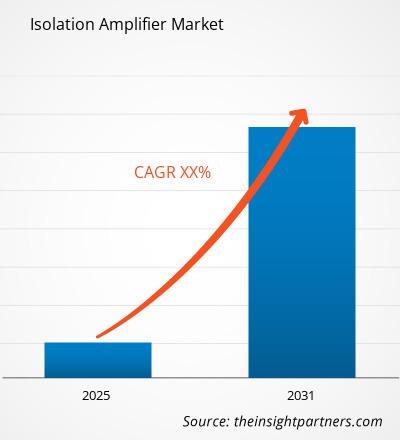
The isolation amplifier market is driven by expanding requirements for galvanic isolation, precision signal measurement, and electrical safety across industrial and electronic systems, the market was valued at US$ 1.54 Billion in 2025 and is projected to reach US$ 2.12 Billion by 2034, registering a CAGR of 3.62% during 2026–2034. Growth reflects continued adoption of isolated measurement architectures in power conversion, motor control, medical equipment, instrumentation, and telecommunications infrastructure.
North America represents a mature but technically advanced demand center, supported by industrial automation, electrification, medical electronics, and high-performance instrumentation. The region isolation amplifier market size is expected to expand at an estimated 3.8–4.4% CAGR from 2026–2034, with demand reinforced by replacement of legacy isolation components, higher voltage requirements, and increased deployment of digitally controlled power systems.
Isolation Amplifier Market Assessment and Insights
- North America: The region is expected to account for 28–32% share in 2025 and grow at a 3.8–4.4% CAGR between 2026–2034, supported by industrial automation, electrification, medical electronics, and advanced instrumentation.
- US: The US represents approximately 70–74% of North America share in 2025, with growth of 3.7–4.3% CAGR between 2026–2034, supported by semiconductor, healthcare, defense, and power-electronics applications.
- Europe: Europe is estimated at 24–28% share in 2025 and is projected to grow at 3.3–3.9% CAGR between 2026–2034, led by Germany, the UK, France, Italy, and Spain.
- Asia Pacific: Asia Pacific is estimated to hold 31–35% share in 2025 and expand at 4.2–4.8% CAGR between 2026–2034, led by China, Japan, South Korea, India, and Australia.
- Largest Segment: Analog products are estimated to represent 58–62% market share in 2025, expanding at a 3.4–3.9% CAGR during 2026–2034 due to established sensing architectures.
- High Growth Segment: Digital products are expected to hold 38–42% market share in 2025, advancing at a 4.0–4.6% CAGR during 2026–2034 as digital control architectures expand.
- Key companies analyzed in detail: Analog Devices, Inc., Broadcom Inc., DEWETRON GmbH, DRAGO Automation GmbH, M-System Co., Ltd., ROHM Co., Ltd., Silicon Laboratories Inc., Texas Instruments Incorporated, Toshiba Electronic Devices & Storage Corporation, WAGO Verwaltungsgesellschaft mbH, and Infineon Technologies AG.
Source: The Insight Partners' analysis based on proprietary research, government publications, company annual reports, investor presentations, industry databases, and expert interviews.
The Isolation Amplifier Market has undergone development from classic transformers or optocoupler-based configurations to semiconductor-based systems providing enhanced common-mode transient immunity, performance, accuracy, bandwidth and thermal stability. Manufacturers include additional functions such as isolation barrier in conjunction with amplification, modulation, diagnostics, digital interfaces into their products. At the same time, production trends point toward small form factors and automotive-qualified products on one hand, and long operational lifetime, safety approval, and easy circuit integration on the other. Portfolios of Broadcom, Analog Devices and Texas Instruments comprise isolated current and voltage sensing technologies, which reflect current trends towards integration of measurement technologies.
On the outlook, the Isolation Amplifier Market will see growth due to investments into electric mobility, renewable energy conversion, factory automation and monitoring of power distribution systems. Growing manufacturing centers in Asia are providing greater local capacity of electronics, whereas North American and European customers care about reliable sourcing and qualified alternatives. Legislation issues concerning electrical safety will continue supporting use of isolation technology when high-voltage and low-voltage control electronics domains meet. Automotive approval, increased creepage and clearance, increased working voltages and transient immunity become crucial criteria for new generation devices.
Isolation Amplifier Market Report Scope
| Report Attribute | Details |
|---|---|
| Market size in 2025 | US$ 1.54 Billion |
| Market Size by 2034 | US$ 2.12 Billion |
| Global CAGR (2026 - 2034) | 3.62% |
| Historical Data | 2021-2024 |
| Forecast period | 2026-2034 |
Isolation Amplifier Market Analysis
The isolation amplifier market is directly dependent on the need for safe measurements across isolated circuits. Power converters, motor drives, battery packs, medical devices, and industrial control systems need to measure safely without transferring the dangerous common-mode voltage to the control circuitry. The eco-system consists of semiconductor companies, package manufacturers, distributors, equipment makers, system integrators, and industrial end-users. The value proposition is now increasingly dependent on factors such as precision, isolation rating, speed, heat management, and integration. Device selection now also depends on standards certifications and the operating environment. Increasing voltages in systems are resulting in increased customer interest in common mode rejection ratio and creepage besides precision.
Still, supply continues to be affected by the capabilities for semiconductor fabrication, packaging, qualifying processes, and design wins by customers. There are standard parts for volume production whereas automotive and medical uses demand extended qualifying processes. Suppliers with diverse portfolios in analog devices, isolation devices, and power devices have the opportunity to sell additional compatible devices, and cut down on the time involved in the customer’s process. Distributors will be important for prototyping and smaller industrial uses whereas direct channels will be used for strategic initiatives. The combination of older technology in optocouplers and the newer IC-based isolation is a diversified competitive landscape.
Positioning within the Isolation Amplifier Market Report involves such factors as semiconductor technology, application engineering, product portfolio, qualification and customer support. Analog Devices, Broadcom and Texas Instruments offer competitive positioning based on precision isolated measurement and power management applications, whereas ROHM and Toshiba focus on semiconductor technologies related to automotive and industrial electronics. Silicon Laboratories offers isolation technology along with connectivity and mixed signal technologies. DEWETRON, DRAGO Automation, M-System and WAGO provide measurement, signal conditioning and industrial interfaces, forming a complementary specialist layer among large semiconductor companies.
Priorities in investment are becoming more and more aligned with greater integration, automobile qualification, small packaging, better isolation barriers, and energy-efficient signal processing. Product marketing by suppliers is increasingly being done based on electric vehicle power trains, renewable energy inverters, industrial motors and battery monitoring solutions. Isolation amplifiers from Broadcom cater to motor drives and renewable energy inverters whereas isolated amplifiers from Analog Devices provide the architecture for voltage sensing and power conversion. Differentiation therefore needs to be more about accuracy, performance, reliability, certification, and integration rather than just isolation.
● REPORT CUSTOMIZATION
Tailor This Report To Align With Your Specific Business Requirements
This report can be customized to align precisely with your business objectives, scope, and target markets. Customization options include tailored segmentation, geography, competitive analysis, and strategic insights to support informed decision-making.
Customize This Report →WHAT YOU CAN ADJUST
- ● Segmentations
- ● Geography
- ● Competitive Analysis
- ● Language Preferences
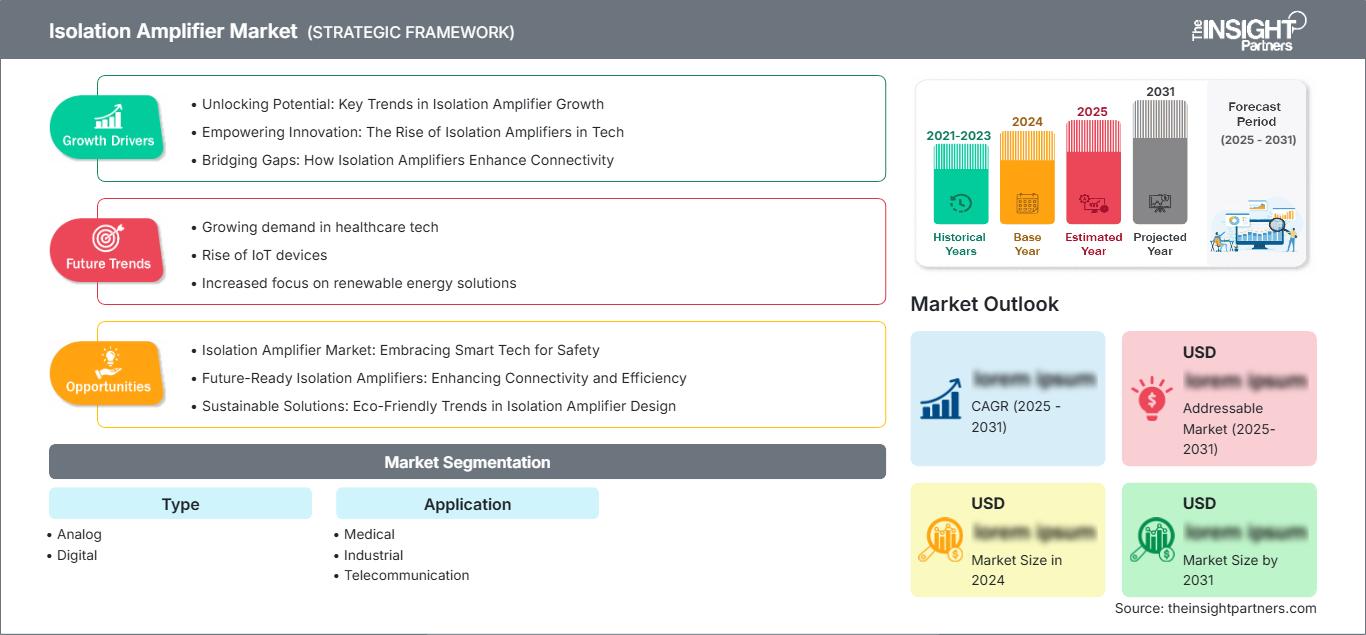
Isolation Amplifier Market: Strategic Insights
Regional Insights
North America Isolation Amplifier Market
North America is projected to have a isolation amplifier market share ranging from 28–32% in 2025 with a CAGR of 3.8–4.4% from 2026 to 2034. It is dominated by US demand due to advanced semiconductor production, industrial automation, medical instruments, aerospace electronics, and electrification. Canada has contributions in terms of energy infrastructure and industrial controls. Consumers have growing preferences for reinforced isolation, high common-mode transient rejection capability, small size, and longer lifespans of products. These demands are consistent with high-quality components used in critical applications.
There are industrial drives, batteries, power supplies, and medical equipment among the main demand segments. There are advantages from investments in semiconductors produced domestically and stable electronics supply chains. Suppliers that have well-established engineering ecosystems and extensive qualification capabilities enjoy competitive advantages. There is an increasing influence on demand from digital conversion of power where sensing is isolated between power circuits and control circuits operating at low voltages. The US is the top country in the North American region.
U.S. Isolation Amplifier Market
The United States is expected to account for 70-74% of the North American market share in 2025 and grow at a rate of 3.7-4.3% CAGR from 2025 to 2034. Some of the important applications are industrial automation, medical electronics, aerospace, defense, telecommunication, and energy conversion. The key vendors are already having design and distribution capabilities in North America; this will facilitate the fast qualification and replacement of the components.
Recent trends can be attributed to the requirement of isolated voltage and current sensors for power supplies, motor drivers, battery management, and renewable energy systems. The other application area is automotive electronics because there is the necessity of monitoring the high-voltage systems used in electric powertrains. The availability of the products, safety requirements, thermal behavior, and lifecycle of the product influence the purchase decision process. Therefore, the market in the US provides opportunities for both technical and relatively mature purchasing.
Europe Isolation Amplifier Market
Estimated Europe share for 2025 is 24-28%, with a growth rate of 3.3-3.9% CAGR till 2034. German demand will be driven by industrial automation and automotive manufacturing. UK demand will come from instrumentation and advanced electronics while France, Italy, and Spain are contributing through demand from energy, transportation, manufacturing, and process sectors. Germany continues to be the leading country.
Adoption in Europe is increasingly being driven by electric cars, factory upgrades, renewable energy, and functional safety systems. German demand is strong for industrial automation while UK is maintaining its demand in instrumentation and energy sector. France is benefiting from its demand from industrial and transportation electronics; Italy from machinery and automation and Spain from renewable energy. Isolation ratings, certifications, longevity, and resilience of components become more important when selecting components for industrial and energy markets.
APAC Isolation Amplifier Market
APAC market size is expected to be 31-35% in 2025 with a forecasted CAGR of 4.2-4.8% until 2034. The region's major markets include China, Japan, South Korea, India, and Australia, driven by industrial electronics, vehicle manufacturing, semiconductors manufacturing and renewable energy adoption. China is the dominant nation in the region.
Sustained government support for electronics manufacturing and power infrastructure development drives demand in the region. Japan and South Korea focus on automotive and precision electronics, while India is scaling up its electronics manufacturing. Australia offers growth avenues via energy infrastructure developments. Adoption of digital power equipment enhances the need for current and voltage isolation.
Middle East & Africa Isolation Amplifier Market
MEA and Africa's need is relatively low but driven by energy infrastructure, industrial automation, utility systems, and telecommunication industry. Leading countries adopting isolation technologies in the region include Saudi Arabia and UAE, whereas South Africa participates by way of industrial as well as energy sector applications. In this region, growth rates of up to 3.0% to 3.6% CAGR will be recorded, with the country of Saudi Arabia leading the pack.
Infrastructure investments and energy modernization in the energy industry present opportunities for isolated measurements in power conversion and industrial control applications. Countries such as Saudi Arabia and UAE are putting in efforts towards the creation of infrastructure and energy diversification, whereas South Africa needs reliable solutions in industrial and utility sectors.
Segmentation Analysis
Type
Type segmentation comprises Analog and Digital products. The Isolation Amplifier Market scope is increasingly influenced by the transition toward digitally controlled power systems, although analog architectures remain important because of their established position in precision measurement. The Type segment is projected to expand at a 3.5–4.0% CAGR during 2026–2034, supported by replacement demand and new electronics designs.
- Analog: Analog isolation amplifiers remain widely used for direct current and voltage measurement where low latency, predictable signal conditioning, and straightforward integration are priorities. Industrial drives, instrumentation, medical systems, and power supplies sustain demand.
- Digital: Digital isolation amplifiers benefit from increasing integration with ADCs, microcontrollers, and digitally managed power converters. Their ability to support high-speed signal processing and robust isolation makes them increasingly relevant for advanced automotive and industrial designs.
Application
Application segmentation comprises Medical, Industrial, and Telecommunication applications. The segment is projected to register a 3.7–4.2% CAGR during 2026–2034, supported by increasing electronic monitoring, higher system voltages, and stricter requirements for safe signal transfer between isolated domains.
- Medical: Medical applications require reliable isolation to protect patients and operators while maintaining measurement accuracy. Demand is concentrated in monitoring, diagnostic, imaging, and therapeutic equipment where electrical safety and low-noise signal transmission are essential.
- Industrial: Industrial applications represent a broad demand base spanning motor drives, process control, automation, power supplies, renewable-energy equipment, and instrumentation. Higher automation intensity and electrification reinforce the need for isolated feedback.
- Telecommunication: Telecommunication equipment uses isolated signal-conditioning components within power systems, monitoring circuits, and infrastructure electronics. Growth in network modernization and distributed power architectures supports continued requirements for compact, reliable isolation solutions.
Opportunity Snapshot
| Application | Revenue Contribution | Trend Tag | Adoption Stage |
|---|---|---|---|
| Medical | Medium | Patient Safety | Mature |
| Industrial | High | Power Monitoring | Scaling |
| Telecommunication | Medium | Network Power | Scaling |
Isolation Amplifier Market Growth Drivers and Impact Analysis
Electrification of Power Conversion and Energy Systems
The isolation amplifier market forecast towards higher levels of electrification in transport, generation, energy storage, and industrial machinery is resulting in an increase in the number of circuits with elevated voltage operation. An isolation amplifier allows the electronics that controls such circuits to monitor the current and voltage in these circuits without the danger of exposure of the low-voltage circuitry to the hazardous electrical environment. Such designs will be more prevalent in traction inverters, onboard chargers, solar inverters, batteries, and industrial motor drives. In addition, increased frequencies of operation of converters have meant that there is a need for higher immunity to transients and predictable response from the signals.
Expansion of Industrial Automation and Precision Measurement
As factory automation continues to increase, there will be an increase in the number of sensors, controllers, drives, and measurement points that should have communication between electrically isolated domains. The use of isolation amplifiers offers a useful interface between the signals from the field and the control electronics especially when there is a ground potential difference or a common mode voltage that might affect the accuracy of measurement. There is increased demand for small size modules, configurable signal range, low drift, and temperature range from industrial clients.
Rising Requirements for Electrical Safety and System Reliability
Increasing electrical safety needs are elevating the importance of isolation in systems that integrate high-voltage power supplies with critical control electronics. Electrical engineers are now considering working voltage, creepage and clearance distances, isolation certification, common-mode transient immunity, and temperature performance while selecting components. All these considerations make it difficult to substitute components at lower cost due to the design effort involved in qualifying the new isolation component. Texas Instruments has isolated amplifiers with basic and reinforced isolation. Analog Devices have products that conform to safety standards and also have high isolation rating. This situation gives an advantage to suppliers who are able to prove their electrical performance, qualification, and availability for extended lifetimes.
Isolation Amplifier Market Future Trends
Greater Integration of Isolation and Signal Processing
The Isolation Amplifier Market trends are increasingly moving toward integrated devices that combine isolation, amplification, modulation, diagnostics, and interfaces within smaller packages. This direction can reduce external component counts while improving board utilization and simplifying system qualification. Future products are likely to incorporate more diagnostic functions, improved common-mode transient immunity, and higher-resolution signal paths. Automotive and industrial applications will remain important testing grounds because designers require accurate sensing across increasingly complex power architectures. Integration is also expected to extend into isolated ADC and digital feedback solutions, enabling more direct interaction with microcontrollers and power-management processors. Suppliers able to combine precision analog design with isolation technology will have stronger opportunities to capture system-level design wins.
Higher Performance Requirements for Electrified Architectures
Future product development will increasingly emphasize higher working voltages, faster switching environments, improved thermal robustness, and smaller package footprints. Electrified vehicles, renewable-energy converters, energy storage systems, and high-density industrial power supplies create operating conditions in which isolation components must withstand rapid voltage transitions without compromising measurement accuracy. Wider creepage and clearance, reinforced insulation, and improved package materials will therefore become important differentiators. Digital control will also increase demand for isolation devices with predictable latency and high-speed signal transfer. Automotive qualification is likely to remain a major development priority, while industrial customers will seek products that support longer operating lifecycles and increasingly demanding environmental conditions.
Isolation Amplifier Market Opportunities
Expansion of High-Voltage Sensing in Electric Mobility
Electric mobility provides an important investment opportunity because traction batteries, inverters, onboard chargers, and auxiliary converters require accurate measurement across isolated high-voltage domains. Component suppliers can target this opportunity through automotive-qualified products offering high common-mode transient immunity, reinforced insulation, compact packages, and stable performance across temperature extremes. Broadcom's automotive isolation amplifiers demonstrate how voltage sensing can be integrated into traction inverter, onboard charger, and battery monitoring applications. Manufacturers can strengthen positioning by developing reference designs with microcontrollers, ADCs, power modules, and gate drivers. These combinations can shorten customer development cycles and increase the likelihood of platform-level adoption across vehicle programs.
Localized Supply and Application Engineering in Emerging Markets
Emerging electronics manufacturing centers create opportunities for suppliers that combine component availability with local engineering support. India, Southeast Asia, and selected Middle Eastern markets are expanding industrial automation, energy infrastructure, and electronics production, increasing demand for reliable signal isolation. Suppliers can pursue these opportunities through regional design centers, technical distribution partnerships, evaluation platforms, and application-specific reference designs. Localized support is particularly valuable where customers require assistance with isolation ratings, thermal constraints, signal conditioning, and certification. Companies that align product portfolios with industrial drives, renewable-energy equipment, instrumentation, and telecommunications power systems can diversify revenue beyond mature markets while building relationships earlier in customer design cycles. Regional technical engagement can also improve qualification success and reduce dependence on spot purchasing.
Recent Developments
- June 2026: Texas Instruments Incorporated announced new battery-management technology through its BQ79826Z-Q1 battery monitor, extending its automotive battery electronics portfolio. The development reflects continuing investment in higher-cell-count monitoring and electrified vehicle architectures, where isolated measurement and reliable signal interfaces are important for managing high-voltage battery systems and associated power electronics.
- December 2025: Broadcom Inc. updated documentation for its ACNT-H79 series optical isolation amplifiers, including the ACNT-H790 family. The devices target current and voltage sensing in power converters, motor drives, renewable-energy systems, and industrial process control. The updated documentation reinforces the product family's active lifecycle and electrical performance specifications for high-voltage isolation applications.
- September 2025: ROHM Co., Ltd. introduced the TLR1901GXZ ultra-compact CMOS operational amplifier, targeting measurement and sensing applications in space-constrained equipment. The development reflects broader investment in low-power signal amplification for handheld measurement instruments and sensor-driven electronics, supporting applications where compact analog signal chains and energy efficiency are increasingly important.
Frequently Asked Questions

- Comprehensive Market Sizing and Forecast Analysis
- Detailed Segmentation Analysis
- In-Depth Market Dynamics Assessment
- Regional and Country-Level Insights
- Competitive Landscape and Company Benchmarking
- Strategic Business Intelligence
Recent Reports
Testimonials

The Insight Partners' SCADA System Market report is comprehensive, with valuable insights on current trends and future forecasts. The team was highly professional, responsive, and supportive throughout. We are very satisfied and highly recommend their services.
RAN KEDEM Partner, Reali Technologies LTDs
I requested a report on a very specific software market and the team produced the report in a few days. The information was very relevant and well presented. I then requested some changes and additions to the report. The team was again very responsive and I got the final report in less than a week.
JEAN-HERVE JENN Chairman, Future Analytica
We worked with The Insight Partners for an important market study and forecast. They gave us clear insights into opportunities and risks, which helped shape our plans. Their research was easy to use and based on solid data. It helped us make smart, confident decisions. We highly recommend them.
PIYUSH NAGPAL Sr. Vice President, High Beam Global
The Insight Partners delivered insightful, well-structured market research with strong domain expertise. Their team was professional and responsive throughout. The user-friendly website made accessing industry reports seamless. We highly recommend them for reliable, high-quality research services
YUKIHIKO ADACHI CEO, Deep Blue, LLC.
This is the first time I have purchased a market report from The Insight Partners.While I was unsure at first, I visited their web site and felt more comfortable to take the risk and purchase a market report.I am completely satisfied with the quality of the report and customer service. I had several questions and comments with the initial report, but after a couple of dialogs over email with their analyst I believe I have a report that I can use as input to our strategic planning process.Thank you so much for taking the extra time and making this a positive experience.I will definitely recommend your service to others and you will be my first call when we need further market data.
JOHN SUZUKI President and Chief Executive Officer, Board Director, BK Technologies
I wish to appreciate your support and the professionalism you displayed in the course of attending to my request for information regarding to infectious disease IVD market in Nigeria. I appreciate your patience, your guidance, and the fact that you were willing to offer a discount, which eventually made it possible for us to close a deal. I look forward to engaging The Insight Partners in the future, all thanks to the impression you have created in me as a result of this first encounter.
DR CHIJIOKE ONYIA MANAGING DIRECTOR, PineCrest Healthcare Ltd.Reason to Buy
- Informed Decision-Making
- Understanding Market Dynamics
- Competitive Analysis
- Identifying Emerging Markets
- Customer Insights
- Market Forecasts
- Risk Mitigation
- Boosting Operational Efficiency
- Strategic Planning
- Investment Justification
- Tracking Industry Innovations
- Aligning with Regulatory Trends





 Get Free Sample for