
Laser Distance Meter Market Growth, Demand & Size by 2034
Coverage: by Application (Plumbing, Construction, HVAC, Others); End User (Architects, Engineers, Construction Employees, Interior Designer, Others) , and Geography (North America, Europe, Asia Pacific, and South and Central America)
- Status : Data Released
- Report Code : TIPRE00010280
- Category : Electronics and Semiconductor
- No. of Pages : 150
- Available Report Formats :


- Last update date : September 23, 2026


2025 Market Size
US$ 1.63 Bn
Base year value
2034 Forecast
US$ 1.9 Bn
Projected by 2034
CAGR 2026-2034
1.68 %
Growth rate
Addressable Market
US$ 15.96 Bn
(2026-2034)
The Laser Distance Meter Market was valued at US$ 1.63 Billion in 2025 and is projected to reach US$ 1.9 Billion by 2034, expanding at a CAGR of 1.68% during 2026–2034. Demand reflects the steady replacement of manual measuring methods across plumbing, construction, and HVAC workflows, while architects, engineers, construction employees, and interior designers increasingly require fast, repeatable dimensional data for planning, installation, documentation, and quality assurance.
Across North America, the Laser Distance Meter Market size is expected to advance at a modelled 1.4–1.8% CAGR through 2034. Renovation activity, digital jobsite adoption, and the need to document measurements without repeated site visits support replacement purchases. Contractors also favor rugged, connected devices that transfer readings into estimating and layout applications, improving traceability while reducing errors in labor-constrained building and mechanical trades.
Laser Distance Meter Market Assessment and Insights
- North America: Accounted for a modelled 31–34% Laser Distance Meter Market share in 2025 and is expected to grow at 1.4–1.8% CAGR during 2026–2034, supported by renovation, digital documentation, and professional tool replacement.
- US: Represented 78–82% of North American revenue in 2025, with a projected 1.5–1.9% CAGR through 2034 as contractors adopt connected measurement workflows.
- Europe: Held a modelled 27–30% share in 2025 and may expand at 1.2–1.6% CAGR, led by Germany and the UK, alongside France, Italy, and Spain.
- Asia Pacific: Captured a modelled 25–28% share in 2025 and is forecast to grow at 2.1–2.6% CAGR, with China leading and India delivering strong incremental demand.
- Largest Segment: Construction application held 58–62% share in 2025 and is estimated to grow at 1.5–1.9% CAGR through 2034.
- High Growth Segment: Interior designers represented 9–12% share in 2025 and may grow at 2.2–2.7% CAGR as digital renovation planning expands.
- Key companies analyzed in detail: Danaher Corporation, Teledyne FLIR LLC, Fluke Corporation, Hexagon AB, Hilti Aktiengesellschaft, Makita Corporation, Robert Bosch Tool Corporation, STABILA Messgeräte Gustav Ullrich GmbH, Stanley Black & Decker, Inc., and Trimble Inc.
Source: The Insight Partners' analysis based on proprietary research, government publications, company annual reports, investor presentations, industry databases, and expert interviews.
There have been product innovations in the Laser Distance Meter Market from single-reading tools to more compact designs that include area, volume, indirect height, slope, memory, and wireless capability. Lasers in green color enhance visibility under bright light conditions, whereas IP ratings and drop-resistant enclosures increase longevity when used on dynamic construction sites. Products still remain manufactured by diversified tool & measurement manufacturers who can leverage optics, batteries, displays, electronics, and sales/distribution of each other. This results in reduced development risk, though there are challenges such as sensor calibration, component supply, and regional laser safety regulation.
There would be more demand in the coming years till 2034 in India, Southeast Asia, the Gulf nations, and the cities of Europe needing repeated renovation work. Applications for the creation of public infrastructure, improvement of energy efficiency, and management of buildings via digitization would lead to the generation of a need for measurement rather than just a single-use application. Interoperable solutions, local servicing capacity, and professional quality yet affordable solutions would be key requirements. The brands would have to adhere to IEC laser standards and contractor documentation procedures, and robust solutions having lower total cost of operation than disposables would prevail.
Laser Distance Meter Market Report Scope
| Report Attribute | Details |
|---|---|
| Market size in 2025 | US$ 1.63 Billion |
| Market Size by 2034 | US$ 1.9 Billion |
| Global CAGR (2026 - 2034) | 1.68% |
| Historical Data | 2021-2024 |
| Forecast period | 2026-2034 |
Laser Distance Meter Market Analysis
Growth of Laser Distance Meter Market relies on continuous efficiency improvements in measuring-related occupations. Handheld devices help construction companies speed up measurements of room take-offs, material estimation, ceiling height, and as-built dimensions. The value proposition also applies to plumbing and HVAC companies whose employees need to measure difficult distances without ladders or the assistance of another person. Optical component manufacturers, electronics companies, branded tools makers, channel partners, software vendors, and end-users make up an ecosystem. Supply tends to be scalable; however, calibrated, rugged, and serviced professional devices cannot be easily replicated.
The nature of replacement purchases relies more on usability rather than ranging performance. High contrast screens, mobile application synchronization capabilities, battery charging ability, and automatic calculation of geometry contribute to vendor pricing power. Channels play a critical role as most potential buyers try to evaluate distance meters relative to other tools that they may purchase. Hence, manufacturers must develop both low-end products for infrequent usage and high-end items with extended measuring ranges, electronic viewfinders, inclination detection, memory, and higher IP ratings.
Laser Distance Meter Market forecast shows a competitive landscape dominated by diversified measurement and power tool firms. Competitors Robert Bosch Tool Corporation, Hilti Aktiengesellschaft, Stanley Black & Decker, Inc., Makita Corporation, Fluke Corporation, and STABILA Messgeräte Gustav Ullrich GmbH use contractor knowledge, broad distribution channels, and wide product lines to win. The presence of Hexagon AB and Trimble Inc. adds digital workflow expertise to the mix, while Teledyne FLIR LLC and Danaher Corporation offer complementary sensing and instrument technology.
Firms invest in connected workflows, strong product platforms, and geographic expansion in their channels, but not in disruptive product redesigns. Strategic positioning relies more and more on turning the measurement into project-relevant data. Companies with connectivity between the measurement and mobile documentation or layout systems can benefit from improved information retention, while specialists remain relevant due to accuracy, ergonomics, and calibration credibility. Diverse portfolios also help mitigate risks associated with the business cycle.
● REPORT CUSTOMIZATION
Tailor This Report To Align With Your Specific Business Requirements
This report can be customized to align precisely with your business objectives, scope, and target markets. Customization options include tailored segmentation, geography, competitive analysis, and strategic insights to support informed decision-making.
Customize This Report →WHAT YOU CAN ADJUST
- ● Segmentations
- ● Geography
- ● Competitive Analysis
- ● Language Preferences
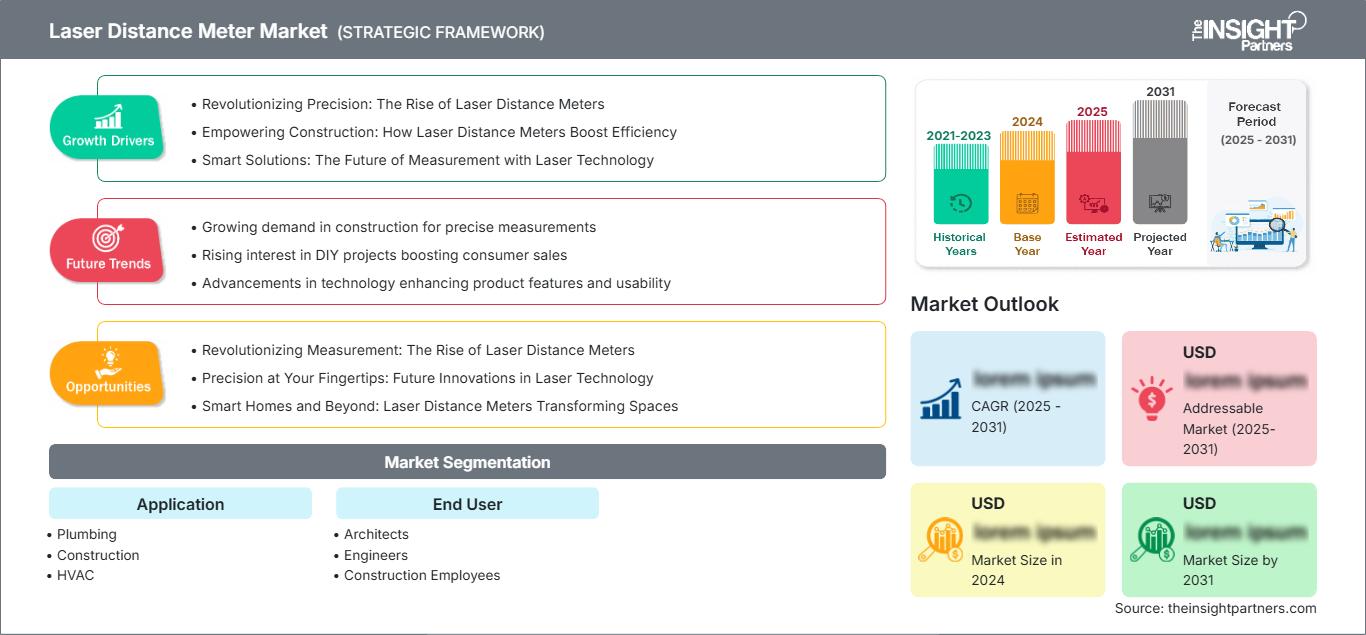
Laser Distance Meter Market: Strategic Insights
Regional Insights
North America Laser Distance Meter Market
North America held a modelled 31–34% Laser Distance Meter Market share in 2025 and is projected to expand at a 1.4–1.8% CAGR through 2034. Renovation projects of commercial properties, data centers, residential housing, and other institutions help sustain measuring process despite reduced construction activities. Modern contractors choose to use connected devices since they help to record the measuring information into cost calculation, images, drawings, and quality control systems without further need for measuring.
Geographically, the purchasing takes place in tool wholesalers, large retailers, and through contractors directly. While the USA provides volume for sales, Canada has the advantage of infrastructure, energy, and efficiency programs. Customer demand durable and easily readable devices, which can be used by one hand. So, competitive advantage will belong to companies, which have service capabilities, brand name, and offer a variety of products from indoor measuring devices to outdoor measuring cameras.
U.S. Laser Distance Meter Market
The US represented a modelled 78–82% of North American revenue in 2025 and is forecast to grow at 1.5–1.9% CAGR through 2034. High volumes of renovation works, digitization of contractors, shortage of skilled labor, and decentralized procurement ensure adoption. Meter use among construction workers includes framing, estimation, and verification purposes; while the use of connected meters is seen among engineers and architects for surveys, punch lists, and refurbishment purposes.
Commercial viability of Robert Bosch Tool Corporation, Stanley Black & Decker, Inc., Fluke Corporation, Hilti Aktiengesellschaft, and Trimble Inc. is high through professional sales and complementary products range. The demand for application is highest in construction sector, followed by HVAC and plumbing. Premium meters find their applications where outdoor visibility, indirect metering, digital viewfinder, or application logs are required to increase accountability.
Europe Laser Distance Meter Market
Europe accounted for a modelled 27–30% share in 2025 and is expected to grow at 1.2–1.6% CAGR through 2034. Germany is driven by its professional tools offering, tradesmen, and renovation demands, while the UK offers strong demand for retrofits, surveying, and facilities maintenance. Consumers prefer durable and calibrated products that can handle regulated construction projects as well as document the project.
Demand from France, Italy, and Spain comes from energy renovations, hotel renovations, urban housing renovations, and small contractors. Germany still holds the top place, thanks to domestic brands and extensive specialty distribution. Maturity of installed base in Europe restricts units’ growth, while connectivity, visibility, and replacement of old meters help to drive value. Compliance requirements and repairability also favor established players over budget offerings.
APAC Laser Distance Meter Market
APAC represented a modelled 25–28% share in 2025 and should record a 2.1–2.6% CAGR through 2034. China excels in large-scale construction, advanced manufacturing capabilities, and wide range pricing; Japan and South Korea focus on small, high-end equipment. India offers faster incremental demand via infrastructure, office interiors, and systematized contractor behavior.
Australia caters to professional premium demand in construction and maintenance. Throughout the region, infrastructure projects, renovations, and design processes contribute to addressable demand, albeit constrained by fragmented distribution and price sensitivity.
Middle East & Africa Laser Distance Meter Market
The region is forecast to expand at a modelled 1.8–2.3% CAGR through 2034. Saudi Arabia leads as urban megaprojects, tourism assets, and industrial facilities require rapid site measurement. The UAE sustains demand through commercial fit-outs, logistics properties, and high-rise maintenance, while South Africa anchors the sub-Saharan professional-tool channel.
Rest of MEA demand follows energy, transport, utility, and housing investment. Harsh-site durability and distributor support are especially important, creating opportunities for rugged devices with simple data capture and reliable servicing.
Segmentation Analysis
Application
The application segment is projected to grow at 1.5–1.9% CAGR during 2026–2034. Laser Distance Meter Market scope across plumbing, construction, and HVAC reflects different range, ruggedness, and documentation needs. Construction supplies the broadest installed base, while plumbing and HVAC reward compact devices that measure inaccessible runs and support material planning. Connected models should gain gradually as contractors standardize digital estimating and handover records.
- Plumbing: Demand centers on pipe-run estimation, fixture spacing, shafts, and retrofit surveys where one-person measurement reduces access constraints and supports faster material calculations before installation.
- Construction: The largest application uses meters for take-offs, layout checks, area calculations, ceiling heights, and as-built verification across residential, commercial, institutional, and infrastructure projects.
- HVAC: Installers apply compact meters to duct routing, equipment clearances, room dimensions, and commissioning records, making accuracy and one-handed operation strategically important in constrained spaces.
End User
The end-user segment is expected to expand at 1.7–2.1% CAGR during 2026–2034. Adoption varies by workflow: architects and interior designers prioritize captured dimensions and visual documentation, engineers require repeatability, and construction employees emphasize speed and ruggedness. Vendors can address these needs through tiered interfaces, range capabilities, and mobile connectivity without fragmenting core hardware platforms.
- Architects: Architects value rapid existing-condition surveys, room dimensions, and app-linked records that support concept design, renovation scoping, and communication with clients or contractors.
- Engineers: Engineers prioritize measurement repeatability, range, inclination functions, and dependable calibration for inspections, equipment placement, field verification, and technically defensible project documentation.
- Construction Employees: Field personnel form the largest practical user pool, using meters for everyday take-offs, layout checks, material planning, and verification where durability and simple controls determine adoption.
- Interior Designer: Interior designers represent the higher-growth cohort as digital room planning, custom fit-outs, furniture specification, and renovation visualization increase the value of quickly captured dimensions.
Opportunity Snapshot
| End Users | Revenue Contribution | Trend Tag | Adoption Stage |
| Architects | Medium | Site Capture | Scaling |
| Engineers | Medium | Field Verification | Mature |
| Construction Employees | High | Digital Takeoff | Mature |
| Interior Designer | Low | Room Planning | Scaling |
Laser Distance Meter Market Growth Drivers and Impact Analysis
Digital documentation reduces rework
Measurements that could be saved, transferred, and incorporated into project documents have become more critical for construction and renovation project groups. The connected meter reduces the distance from data gathering to estimation, design modification, purchasing, and verification processes. Its commercial benefit includes fewer errors in data transfer, no repetition in taking measurements, quick data transfers, and the ability to trace changes in measurements. Connected products via Bluetooth or through mobile applications do not fight range but efficiency and workflow. This driver is advantageous for companies that already have an ecosystem of software but also creates room for companies that offer easy export features.
Labor scarcity favors one-person measurement
Distance meters enable one person to measure distances, heights, and hard-to-reach places that might otherwise necessitate a tape, a ladder, or an extra person. It gains importance as qualified people in the field of construction, plumbing, and heating/air conditioning are increasingly rare. However, it is not just about quicker readings. Crews have less setup time, do more estimates in a day, and stay away from areas that pose risks either at heights or where access is impossible. Purchase considerations, thus, tend to favor ease-of-use, clarity of readouts, and durability, as there is no use of saving time on something that is hard to use.
Renovation and retrofit sustain recurring demand
This is a challenge that arises in pre-existing structures, since original drawings can be outdated, modified or simply unavailable. Energy renovation, renovations, installations of new machinery, improvements for accessability reasons and maintenance activities all require accurate measurements before work can start. Laser metering equipment is appropriate for this kind of work, since it is easy to carry around, fast and multi-functional. Moreover, this activity provides replacement opportunities for professionals, who constantly subject equipment to dust exposure, accidental drops, varying temperature and transportation. This market demand will persist even in case when the amount of greenfield constructions reduces. Vendors can capitalize on this by promoting IP protection, ruggedness, support services and application packages for HVAC, interior, plumbing and facilities departments.
Laser Distance Meter Market Future Trends
Measurement data will become context-rich
Laser Distance Meter Market trends will progressively focus on connecting every measurement to images, time stamps, remarks, project location data, and tasks defined by the user. It will transform a single-dimensional feature into auditable field data that may be used for estimating, coordination of design, progress, and handing over. Companies will progressively make it easier to pair up with mobile devices, enable automated conversion, and facilitate export into common construction software tools. Widespread adoption does not necessarily entail making every device a highly sophisticated scanning tool. The winning strategy would be retaining instant point and measure capability while providing an option for more contextual information.
Green lasers and visual targeting will broaden
The improvements in visibility and targeting need to be extended further away from the premium devices and toward mid-level professional devices. The green laser is useful in locating the target within the brighter environment, whereas the digital viewfinder is helpful when trying to locate the target at a distance or the spot is not visible easily. The suppliers will weigh the advantages of the technology against battery usage, optics price, and device weight. The use of camera for documentations could even be merged with the measurements process so that the user can link the measurements with images without any extra steps involved.
Laser Distance Meter Market Opportunities
Build trade-specific connected bundles
Value can be derived through incrementally bundling meter devices, their cases, a mobile process and specific task instructions to help plumbing, HVAC, fit-out, and renovation teams. This is not an aesthetic but operational opportunity. Pre-configured tasks, standard naming conventions, photo attachments, and export templates may help reduce time to on-board as well as ensure that collected data can be actionable for estimators/supervisors. Value-added services can include bundling products with trainings, calibrations and fleet replacements. This strategy makes the cost of switching higher without locking customers into costly enterprise systems. It also allows differentiation within mid-tier devices that become indistinguishable based on accuracy and range specs alone.
Expand service-backed access in emerging cities
Fast-growing cities in India, Southeast Asia, Saudi Arabia, and certain parts of Africa need low-cost professional tools, but there may be difficulties due to fragmented distribution channels, lack of demonstrations, and confusion regarding repairing or calibrating the tools. The suppliers need to concentrate on the local distributors, training in multiple languages, spare parts, and tiering the product lines rather than competing only on the Internet through pricing. Rentals and fleet programs for contractors will make high-end tools available to people who have erratic project demands. Working with vocational institutes and trade organizations will facilitate the right use of the products.
Recent Developments
- June 2026: MILESEEY TOOLS has announced pre-orders for its new S50C, a high-end outdoor laser distance meter designed to deliver greater accuracy and easier targeting in challenging outdoor environments. The S50C can measure distances of up to 670 feet (200 meters) with accuracy of up to ±1 mm. It combines a green laser with camera-assisted targeting, making it easier for users to identify measurement points that can be difficult to see in bright sunlight or at long distances.
- April 2024: Leica Geosystems, a Hexagon company, has expanded its handheld measurement portfolio with two new laser distance meters, the DISTO D5 and DISTO X6. The new models are designed to make distance measurement faster, more accurate and easier to perform, particularly in demanding outdoor environments. A major feature of both devices is a new gesture-based measurement function. Instead of pressing a button to take a reading, users can simply interrupt the laser beam with their hand. This approach helps reduce unwanted movement of the measuring device and can improve accuracy when working over longer distances.
- April 2026: Nikon Corporation has introduced the APDIS MV5X, a new laser radar designed to provide fast, accurate and non-contact measurement for manufacturing applications. Announced on April 20, 2026, the APDIS MV5X is the latest addition to Nikon’s APDIS laser radar range. The system builds on the company’s previous laser radar technology while introducing a more compact and lightweight design aimed at improving flexibility on the factory floor.
Frequently Asked Questions

- Comprehensive Market Sizing and Forecast Analysis
- Detailed Segmentation Analysis
- In-Depth Market Dynamics Assessment
- Regional and Country-Level Insights
- Competitive Landscape and Company Benchmarking
- Strategic Business Intelligence
Recent Reports
Testimonials

The Insight Partners provided valuable market intelligence that supported our global go-to-market strategy. Their team was professional, responsive, and attentive to our feedback, providing thoughtful analysis and helpful methodological clarifications throughout the project.
Junmo Kim Chief Financial Officer (CFO), Enertech Co., Ltd.
The Insight Partners' SCADA System Market report is comprehensive, with valuable insights on current trends and future forecasts. The team was highly professional, responsive, and supportive throughout. We are very satisfied and highly recommend their services.
RAN KEDEM Partner, Reali Technologies LTDs
I requested a report on a very specific software market and the team produced the report in a few days. The information was very relevant and well presented. I then requested some changes and additions to the report. The team was again very responsive and I got the final report in less than a week.
JEAN-HERVE JENN Chairman, Future Analytica
We worked with The Insight Partners for an important market study and forecast. They gave us clear insights into opportunities and risks, which helped shape our plans. Their research was easy to use and based on solid data. It helped us make smart, confident decisions. We highly recommend them.
PIYUSH NAGPAL Sr. Vice President, High Beam Global
The Insight Partners delivered insightful, well-structured market research with strong domain expertise. Their team was professional and responsive throughout. The user-friendly website made accessing industry reports seamless. We highly recommend them for reliable, high-quality research services
YUKIHIKO ADACHI CEO, Deep Blue, LLC.
This is the first time I have purchased a market report from The Insight Partners.While I was unsure at first, I visited their web site and felt more comfortable to take the risk and purchase a market report.I am completely satisfied with the quality of the report and customer service. I had several questions and comments with the initial report, but after a couple of dialogs over email with their analyst I believe I have a report that I can use as input to our strategic planning process.Thank you so much for taking the extra time and making this a positive experience.I will definitely recommend your service to others and you will be my first call when we need further market data.
JOHN SUZUKI President and Chief Executive Officer, Board Director, BK Technologies
I wish to appreciate your support and the professionalism you displayed in the course of attending to my request for information regarding to infectious disease IVD market in Nigeria. I appreciate your patience, your guidance, and the fact that you were willing to offer a discount, which eventually made it possible for us to close a deal. I look forward to engaging The Insight Partners in the future, all thanks to the impression you have created in me as a result of this first encounter.
DR CHIJIOKE ONYIA MANAGING DIRECTOR, PineCrest Healthcare Ltd.Reason to Buy
- Informed Decision-Making
- Understanding Market Dynamics
- Competitive Analysis
- Identifying Emerging Markets
- Customer Insights
- Market Forecasts
- Risk Mitigation
- Boosting Operational Efficiency
- Strategic Planning
- Investment Justification
- Tracking Industry Innovations
- Aligning with Regulatory Trends





 Get Free Sample for