
Laser Level Transmitters Market Demand, Trends & Forecast by 2034
Coverage: by Type (Below 100 M, 100-150 M, Above 200 M); End-user (Oil and Gas, Food and Beverage, Chemicals and Petrochemicals, Power, Waste and Wastewater, Manufacturing, Others) , and Geography (North America, Europe, Asia Pacific, and South and Central America)
- Status : Data Released
- Report Code : TIPRE00010548
- Category : Electronics and Semiconductor
- No. of Pages : 150
- Available Report Formats :


- Last update date : September 28, 2026


2025 Market Size
US$ 109.8 Mn
Base year value
2034 Forecast
US$ 153.68 Mn
Projected by 2034
CAGR 2026-2034
3.81 %
Growth rate
Addressable Market
US$ 1,196.91 Mn
(2026-2034)
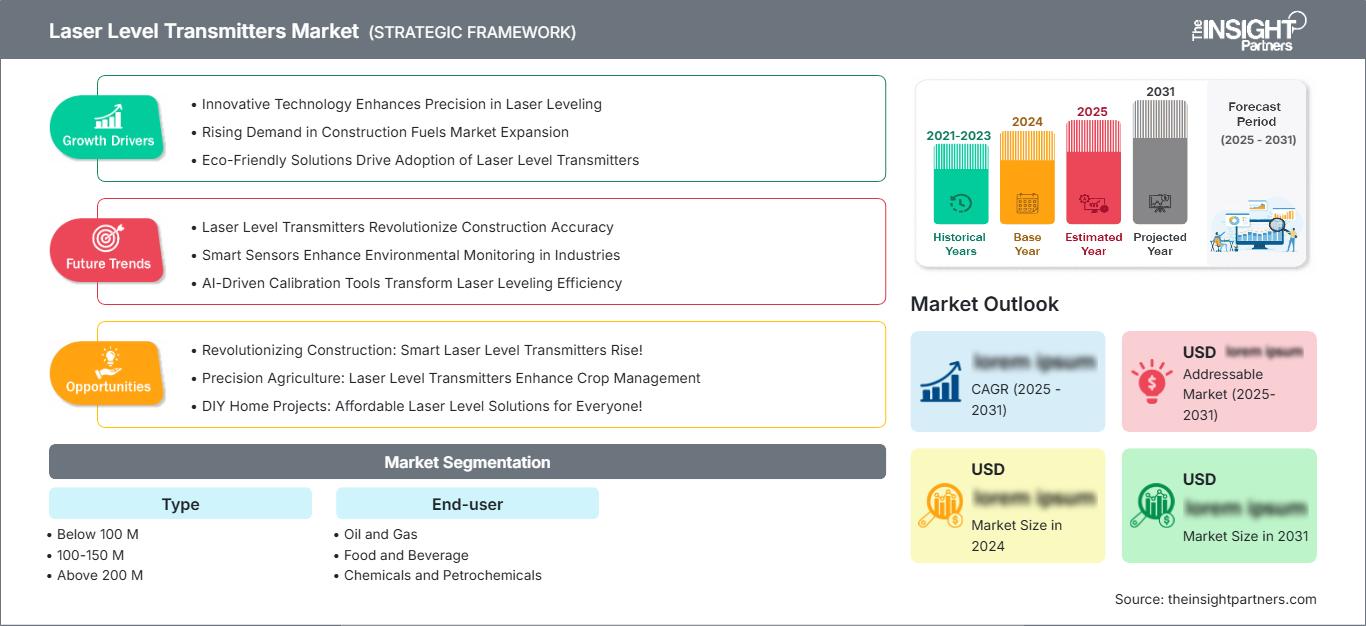
The Laser Level Transmitters Market represents a specialized segment of non-contact level measurement used where direct contact with process media is undesirable. The market was valued at US$ 109.8 Million in 2025 and is projected to reach US$ 153.68 Million by 2034, registering a CAGR of 3.81% during 2026–2034. Adoption is supported by measurement accuracy, remote sensing capability, reduced maintenance requirements, and suitability for demanding industrial environments involving liquids, solids, storage vessels, and open spaces.
North America is expected to maintain a meaningful position, with an estimated CAGR of 4–5% through 2034. The Laser Level Transmitters Market size is supported by process automation, replacement of aging instrumentation, and demand for non-contact measurement across oil and gas, chemicals, power, and water infrastructure. Increasing integration with industrial control systems is also strengthening the value proposition for digitally connected measurement devices.
Laser Level Transmitters Market Assessment and Insights
- North America: North America is estimated to hold a 29–33% share in 2025 and expand at a CAGR of 4–5% between 2026–2034, supported by process automation, industrial modernization, energy infrastructure, and replacement of legacy measurement equipment.
- US: The US is estimated to represent 78–82% of North American demand in 2025 and grow at a CAGR of 4–5% during 2026–2034, driven by oil and gas, chemicals, power, and wastewater applications.
- Europe: Europe is estimated to account for a 24–28% share in 2025 and grow at a CAGR of 3–5% during 2026–2034, with Germany, the UK, France, Italy, and Spain supporting industrial instrumentation demand.
- Asia Pacific: Asia Pacific is estimated to hold a 27–31% share in 2025 and expand at a CAGR of 5–6% during 2026–2034, led by China, Japan, South Korea, India, and Australia.
- Largest Segment: Below 100 M is assessed as the largest segment, representing a 55–60% market share in 2025 and growing at a CAGR of 3–4% through 2034.
- High Growth Segment: Above 200 M is expected to be the high-growth segment, with a 10–14% market share in 2025 and a CAGR of 5–7% through 2034.
- Key companies analyzed in detail: ABB, Banner Engineering Corp., Benewake (Beijing) Co., Ltd., BinMaster (Garner Industries, Inc.), Fluke Corporation, HiTECH Technologies, Inc., Jogler LLC, KEYENCE Corporation, Laser Technology, Inc., Rockwell Automation, Inc.
Source: The Insight Partners' analysis based on proprietary research, government publications, company annual reports, investor presentations, industry databases, and expert interviews.
There has been an evolution in technology from basic point distance measurement to more complex sensing system designs which allow for continuous monitoring, remote configuration, and process automation. Advancements in optics, signal processing, beam focusing, and electronics have improved reliability in environments where dust, varying surfaces, and varying conditions impact accuracy. Design approaches tend to focus more on miniaturization, digital output, diagnostics, and automation system integration.
Future growth will rely on modernization in industry of emerging manufacturing countries and investment in energy, water, chemical and bulk material transport systems. The buyer consideration now tends to be more towards lifecycle costs as opposed to initial system cost and hence, there exists room for solutions which lower calibration and intervention costs. Regulations which mandate operational safety, process efficiency and environment monitoring will further aid adoption in cases where accurate level data is necessary in order to avoid overflows, underfills and inefficient inventories.
Laser Level Transmitters Market Report Scope
| Report Attribute | Details |
|---|---|
| Market size in 2025 | US$ 109.8 Million |
| Market Size by 2034 | US$ 153.68 Million |
| Global CAGR (2026 - 2034) | 3.81% |
| Historical Data | 2021-2024 |
| Forecast period | 2026-2034 |
Laser Level Transmitters Market Analysis
The Growth of the Laser Level Transmitters Market is driven by the demand for non-intrusive measurement for tanks, silos, reservoirs, stockpiles, and process vessels where mechanical level probes may be subject to wear, build-up, corrosion, or contamination. The supply chain comprises laser sources, optical components, receivers, electronic circuitry, enclosure, communication ports, controls, distribution channel, and system integrators. Customers are increasingly demanding solutions for continuous measurement with low maintenance requirements.
Supply-side factors include the accuracy of components used, protection from the environment, calibrability, and interface with the control system within the plant. Suppliers have to consider the reflectance of the material measured, the geometry of the vessel, the environment, presence of dust, vapor, and movement on the surface. Hence application engineering is necessary because the technologically competent transmitter may require proper placement and setup for accurate measurements.
According to the market analysis of Laser Level Transmitters Market Report, the competitive scenario includes a variety of automation players, sensor companies, and measurement technology companies. ABB provides an array of process instrumentation solutions, while Banner Engineering Corp. and KEYENCE Corporation offer competition based on laser-based sensing and measurement technologies for industries. BinMaster and HiTECH Technologies, Inc. cater to industrial measuring solutions, and Benewake (Beijing) Co., Ltd. specializes in laser-based ranging solutions.
In terms of competitive differentiation, the factors involved now include measurement stability, operational range, installation flexibility, communication capability, and applications. Fluke Corporation offers a portfolio of portable laser measurement technologies, while Rockwell Automation, Inc. focuses on the complete solution in terms of industrial automation. Jogler LLC and Laser Technology, Inc. focus on specific solutions in terms of measurement technologies.
● REPORT CUSTOMIZATION
Tailor This Report To Align With Your Specific Business Requirements
This report can be customized to align precisely with your business objectives, scope, and target markets. Customization options include tailored segmentation, geography, competitive analysis, and strategic insights to support informed decision-making.
Customize This Report →WHAT YOU CAN ADJUST
- ● Segmentations
- ● Geography
- ● Competitive Analysis
- ● Language Preferences
Laser Level Transmitters Market: Strategic Insights
Regional Insights
North America Laser Level Transmitters Market
North America is estimated to account for 29–33% of global demand in 2025 and is projected to grow at a CAGR of 4–5% through 2034. The US represents the dominant regional market because of extensive oil and gas infrastructure, chemical processing capacity, power generation assets, water treatment facilities, and advanced manufacturing. Canada contributes through energy, mining, chemicals, and resource-processing operations.
Purchasing in regional markets is leaning more toward solutions with non-contact measurement capabilities, lower maintenance, better control system integration, and dependable operation in large storage vessels. The Laser Level Transmitters Market share gets boosted due to the modernization of process instrumentation and upgrading of old systems. Ease of installation and the capability to integrate into existing communication systems are other considerations of industrial customers. Demand is highest in areas that require continuous level visibility.
U.S. Laser Level Transmitters Market
The United States will account for roughly 78-82% of demand in North America in 2025 and is predicted to post a 4-5% CAGR until 2034. Oil & Gas is still a key end-use application; however, chemicals, power generation, wastewater, food processing, and manufacturing generate some additional demand. Industrial companies seek measurement solutions that have minimal mechanical contact with materials being processed.
Among the companies with measurement/automation solutions to serve the industrial customers are ABB, Banner Engineering Corp., Fluke Corporation, KEYENCE Corporation, and Rockwell Automation, Inc. Possible applications include tank level sensing, material handling, process control, and asset measurement. Connectivity, diagnostic needs, calibration, environmental safety, and system compatibility are becoming more prominent among buyers' criteria. Replacement purchases are likely to be important due to a need for upgrade of already operating facilities with no major changes in existing processes.
Europe Laser Level Transmitters Market
Europe is estimated to hold a 24–28% share in 2025 and grow at a CAGR of 3–5% through 2034. Germany is the leading market, supported by process industries and advanced manufacturing, while the UK, France, Italy, and Spain provide additional demand.
There is potential for the United Kingdom to participate in oil and gas, water, chemical, and industrial processing applications, where non-contact measuring could minimize maintenance risks. In Germany, there are automation-focused manufacturing, chemicals, energy, and industrial machines. France, Italy, and Spain play their role in food processing, chemicals, energy, wastewater management, and manufacturing. Efficiency of resources, upgrade of the facilities, instruments, and system integration are the issues that become more and more important for European customers.
APAC Laser Level Transmitters Market
It is predicted that APAC will be contributing 27–31% of total demand in 2025 and registering a CAGR of 5–6%. China is leading demand in the region, followed by Japan, South Korea, India, and Australia. Manufacturing growth and infrastructure developments help in adopting such transmitters widely.
China gains advantage through high capacity of manufacturing industries, Japan and South Korea through precise manufacturing and automation, India through chemicals, power, water, and manufacturing growth, and Australia through mining and resource processing. Industrial digitization and infrastructure development are improving the demand for continuous measurements. It is predicted that regional market for Laser Level Transmitters will gain an advantage from plant modernization and adoption of connected instruments.
Middle East & Africa Laser Level Transmitters Market
The demand for Middle East and Africa is forecast to increase at a rate of 4-6% CAGR up to 2034. Leading the charge in terms of adoption within the region are Saudi Arabia and UAE, owing to oil and gas, petrochemicals, utilities, industrial diversification, and infrastructure development. South Africa will be driving adoption via mining, manufacturing, and water-related applications.
Energy and infrastructure continue to be crucial in demand, whereas wastewater management and industrial localization will bring about more demand potential. The non-contact measurement can help lower maintenance needs in the cases of storage facilities, bulk materials handling, and process plants. Saudi Arabia is forecast to be the top regional market owing to energy assets and industrialization investments.
Segmentation Analysis
Type
Type is an important determinant of equipment selection because measurement distance affects optical requirements, installation location, signal reliability, and application economics. The segment is projected to grow at a CAGR of 3–5% during 2026–2034. The Laser Level Transmitters Market scope increasingly includes applications requiring longer measurement distances and remote monitoring.
- Below 100 M: This category represents the largest demand pool because many industrial tanks, vessels, treatment facilities, and production environments operate within shorter measurement distances. Its broad applicability supports steady replacement and new-installation demand.
- 100-150 M: Mid-range measurement supports larger vessels, storage structures, and selected bulk-material applications. Customers prioritize dependable targeting, installation flexibility, and stable measurement where conventional contact devices are difficult to maintain.
- Above 200 M: Long-distance applications serve specialized requirements involving large stockpiles, reservoirs, open areas, and extensive infrastructure. Demand is more specialized but strategically important where remote measurement reduces installation and maintenance challenges.
End-user
End-user segmentation reflects differences in process conditions, measurement criticality, regulatory requirements, and installation environments. The segment is expected to expand at a CAGR of 3–5% during 2026–2034. Buyers increasingly seek dependable measurement with minimal process interruption and compatibility with automated control architectures.
- Oil and Gas: Oil and gas operators require reliable tank and storage measurement across upstream, midstream, refining, and petrochemical environments. Non-contact sensing can reduce exposure to corrosive or difficult process conditions.
- Food and Beverage: Hygienic production requires measurement solutions that support clean operations and minimize contamination risks. Laser-based measurement can provide non-contact monitoring for selected vessels, materials, and production processes.
- Chemicals and Petrochemicals: Chemical facilities require measurement systems capable of operating around corrosive materials, process vapors, and complex storage conditions. Non-contact technologies can reduce mechanical exposure and maintenance requirements.
- Power: Power facilities use level measurement across fuel, water, chemical, ash, and auxiliary systems. Reliable instrumentation supports process continuity, inventory management, and operational monitoring across generation assets.
- Waste and Wastewater: Wastewater facilities require continuous monitoring across tanks, channels, sludge systems, and storage structures. Laser sensing can support remote measurement where contact devices face fouling, corrosion, or maintenance challenges.
- Manufacturing: Manufacturing plants use level measurement for raw materials, liquids, powders, and production inputs. Automation compatibility and integration with plant controls are increasingly important for process visibility and inventory management.
Opportunity Snapshot
| End-user | Revenue Contribution (High/Medium/Low) | Trend Tag | Adoption Stage |
| Oil and Gas | High | Tank Monitoring | Mature |
| Food and Beverage | Medium | Hygienic Sensing | Scaling |
| Chemicals and Petrochemicals | High | Process Safety | Scaling |
| Power | Medium | Asset Monitoring | Mature |
| Waste and Wastewater | High | Remote Monitoring | Scaling |
| Manufacturing | High | Smart Factory | Scaling |
Laser Level Transmitters Market Growth Drivers and Impact Analysis
Increasing Preference for Non-Contact Measurement
Non-contact measurement is gaining importance where direct sensor contact can create maintenance, reliability, or contamination concerns. Laser-based systems can measure distance to a material surface without inserting mechanical components into the vessel, making them relevant for selected liquids, solids, storage applications, and difficult-access locations. This characteristic can reduce exposure to corrosion, abrasion, buildup, and mechanical wear. Industrial operators can also benefit from simplified inspection requirements when measurement devices remain outside the process media. The impact is strongest in facilities where downtime is costly and equipment accessibility is limited. As plants modernize instrumentation, procurement teams increasingly compare non-contact technologies according to maintenance frequency, installation requirements, signal stability, and integration capability rather than acquisition price alone.
Expansion of Industrial Automation and Remote Monitoring
Industrial automation is increasing the value of continuous and remotely accessible level information. Plants are connecting field instruments with distributed control systems, programmable controllers, supervisory software, and industrial communication networks to improve process visibility. Laser measurement devices can participate in these architectures when equipped with suitable outputs and interfaces. The resulting data can support inventory management, process control, alarms, and maintenance decisions. Automation also reduces reliance on manual readings, particularly in facilities with large storage areas or difficult-to-access vessels. The impact extends beyond measurement accuracy because connected instrumentation can improve response time and operational consistency. Suppliers that provide configuration tools, diagnostics, networking options, and integration support can therefore strengthen their position as customers move from standalone instruments toward connected measurement architectures.
Modernization of Aging Industrial Instrumentation
A substantial installed base of industrial plants continues to operate with legacy measurement equipment that requires periodic maintenance, manual calibration, or mechanical inspection. Modernization programs create opportunities to replace these systems with non-contact instruments that provide easier integration and improved monitoring capabilities. Replacement decisions are often triggered by equipment failure, rising maintenance costs, process expansion, or changes in control architecture. The impact is particularly relevant in oil and gas, chemicals, utilities, water treatment, and manufacturing, where instrumentation reliability directly influences operational continuity. Suppliers can capture replacement demand by providing retrofit-friendly products, installation support, communication compatibility, and application-specific configuration. This driver also encourages customers to standardize measurement platforms across multiple sites, potentially increasing recurring demand for compatible sensors and associated service capabilities.
Laser Level Transmitters Market Future Trends
Greater Integration of Intelligent Measurement and Diagnostics
Future Laser Level Transmitters Market trends will increasingly involve intelligent diagnostics, remote configuration, and condition-based measurement support. Sensor electronics are becoming more capable of processing measurement signals locally, identifying abnormal readings, and communicating operational information to higher-level control platforms. This can help maintenance teams distinguish between actual process changes and measurement anomalies. Over time, buyers are likely to prioritize instruments that provide richer diagnostic information without requiring frequent field intervention. Integration with industrial Ethernet, digital communication protocols, and cloud-connected monitoring platforms can further increase the usefulness of level data. Suppliers that combine reliable optical measurement with intuitive configuration software and standardized communication interfaces will be better positioned for plants pursuing broader digital transformation strategies.
Application-Specific Measurement and Adaptive Signal Processing
Measurement performance will increasingly be optimized for application-specific conditions rather than treated as a generic distance function. Adaptive signal processing can help address changing surface characteristics, reflectivity, environmental interference, and complex vessel geometries. Manufacturers are likely to develop more configurable instruments capable of adjusting measurement parameters according to operating conditions. This approach can reduce false readings and improve confidence in applications involving variable materials or difficult targets. The trend also supports wider use in remote locations, large storage areas, and automated facilities where manual verification is inconvenient. Over the forecast period, product differentiation is expected to move toward software-enabled measurement quality, easier commissioning, and application libraries that shorten deployment time while maintaining reliable process performance.
Laser Level Transmitters Market Opportunities
Retrofit Programs Across Energy and Process Industries
Retrofit projects represent a practical investment opportunity because many industrial facilities need to modernize instrumentation without rebuilding complete process systems. Laser-based measurement can be evaluated for selected tanks, vessels, stockpiles, and open-area applications where contact measurement creates maintenance challenges. Laser Level Transmitters Market Forecasts can support investment planning by separating replacement demand from greenfield installations and identifying industries with aging instrumentation. Vendors can target retrofit opportunities through compact designs, flexible mounting, standardized communication interfaces, and application engineering. Partnerships with system integrators can further improve access to brownfield projects. The strongest opportunities are likely to emerge where maintenance costs are high, equipment access is difficult, and plant operators are already upgrading control systems or implementing broader digitalization programs.
Long-Range Monitoring for Infrastructure and Bulk Materials
Long-distance measurement creates an opportunity in applications involving large reservoirs, stockpiles, storage yards, mining infrastructure, and extensive industrial facilities. These environments can be difficult to monitor using conventional contact devices because installation may require structures, cables, or mechanical components exposed to harsh conditions. Laser-based measurement offers an alternative where line-of-sight conditions are suitable. Investment opportunities can focus on ruggedized systems, remote diagnostics, solar-compatible power architectures, and wireless communication for locations without extensive infrastructure. Application developers can also combine level measurement with inventory software and centralized monitoring platforms. This approach can create value beyond the transmitter itself by converting distance measurements into actionable information for material planning, maintenance scheduling, and operational control across geographically dispersed assets.
Recent Developments
- January 2026: Banner Engineering Corp. introduced the RSio Remote Safe I/O as part of its expanding industrial connectivity portfolio. The product supports remote I/O architectures and complements the company’s broader sensor ecosystem, reflecting continued development toward distributed monitoring and easier integration of field devices with industrial control systems.
- October 2025: Benewake (Beijing) Co., Ltd. highlighted applications of small LiDAR sensors for automated material-level monitoring in industrial environments. The company described how laser-based distance measurement can provide automated visibility of material quantity, location, and movement, linking sensing technology with Industry 4.0-oriented inventory management and production coordination.
- June 2026: KEYENCE Corporation announced the BZ-XLC1 confocal laser scanning unit as a new product, extending its laser-based measurement portfolio toward high-precision industrial inspection applications. The development reflects continued investment in compact optical measurement technologies and supports the broader movement toward higher-resolution, software-assisted sensing in automated production environments.
Frequently Asked Questions

- Comprehensive Market Sizing and Forecast Analysis
- Detailed Segmentation Analysis
- In-Depth Market Dynamics Assessment
- Regional and Country-Level Insights
- Competitive Landscape and Company Benchmarking
- Strategic Business Intelligence
Recent Reports
Testimonials

The Insight Partners' SCADA System Market report is comprehensive, with valuable insights on current trends and future forecasts. The team was highly professional, responsive, and supportive throughout. We are very satisfied and highly recommend their services.
RAN KEDEM Partner, Reali Technologies LTDs
I requested a report on a very specific software market and the team produced the report in a few days. The information was very relevant and well presented. I then requested some changes and additions to the report. The team was again very responsive and I got the final report in less than a week.
JEAN-HERVE JENN Chairman, Future Analytica
We worked with The Insight Partners for an important market study and forecast. They gave us clear insights into opportunities and risks, which helped shape our plans. Their research was easy to use and based on solid data. It helped us make smart, confident decisions. We highly recommend them.
PIYUSH NAGPAL Sr. Vice President, High Beam Global
The Insight Partners delivered insightful, well-structured market research with strong domain expertise. Their team was professional and responsive throughout. The user-friendly website made accessing industry reports seamless. We highly recommend them for reliable, high-quality research services
YUKIHIKO ADACHI CEO, Deep Blue, LLC.
This is the first time I have purchased a market report from The Insight Partners.While I was unsure at first, I visited their web site and felt more comfortable to take the risk and purchase a market report.I am completely satisfied with the quality of the report and customer service. I had several questions and comments with the initial report, but after a couple of dialogs over email with their analyst I believe I have a report that I can use as input to our strategic planning process.Thank you so much for taking the extra time and making this a positive experience.I will definitely recommend your service to others and you will be my first call when we need further market data.
JOHN SUZUKI President and Chief Executive Officer, Board Director, BK Technologies
I wish to appreciate your support and the professionalism you displayed in the course of attending to my request for information regarding to infectious disease IVD market in Nigeria. I appreciate your patience, your guidance, and the fact that you were willing to offer a discount, which eventually made it possible for us to close a deal. I look forward to engaging The Insight Partners in the future, all thanks to the impression you have created in me as a result of this first encounter.
DR CHIJIOKE ONYIA MANAGING DIRECTOR, PineCrest Healthcare Ltd.Reason to Buy
- Informed Decision-Making
- Understanding Market Dynamics
- Competitive Analysis
- Identifying Emerging Markets
- Customer Insights
- Market Forecasts
- Risk Mitigation
- Boosting Operational Efficiency
- Strategic Planning
- Investment Justification
- Tracking Industry Innovations
- Aligning with Regulatory Trends





 Get Free Sample for