
Laser Tracker Market Demand, Size & Forecast by 2034
Coverage: By Offering (Hardware, Software, Services); Application (Quality Control and Inspection, Alignment, Reverse Engineering, Calibration); Industry (Automotive, Aerospace and Defense, Manufacturing, Energy and Power, Architecture and Construction, Transportation, Others), and Geography (North America, Europe, Asia Pacific, and South and Central America)
- Status : Data Released
- Report Code : TIPRE00015820
- Category : Electronics and Semiconductor
- No. of Pages : 150
- Available Report Formats :


- Last update date : September 28, 2026


2025 Market Size
US$ 2.4 Bn
Base year value
2034 Forecast
US$ 4.17 Bn
Projected by 2034
CAGR 2026-2034
6.31 %
Growth rate
Addressable Market
US$ 29.70 Bn
(2026-2034)
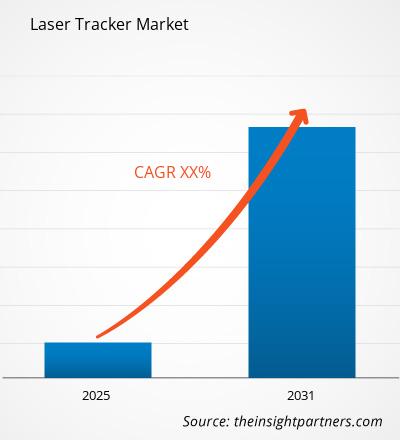
The Laser Tracker Market is valued at US$ 2.4 Billion in 2025 and is projected to reach US$ 4.17 Billion by 2034, expanding at a CAGR of 6.31% during 2026–2034. Demand is supported by increasing use of portable dimensional metrology for large assemblies, tighter manufacturing tolerances, automated inspection, and digital production workflows across aerospace, automotive, industrial machinery, energy, and transportation applications.
North America remains a major adoption center, supported by aerospace production, defense manufacturing, automotive automation, and established precision-metrology infrastructure. The Laser Tracker Market size in the region is expected to expand at a 6.0–6.6% CAGR during 2026–2034 as manufacturers invest in portable inspection, robotic calibration, and real-time alignment to improve throughput, traceability, and production accuracy.
Laser Tracker Market Assessment and Insights
- North America: The region is estimated to hold a 31–35% share in 2025 and expand at a 6.0–6.6% CAGR between 2026–2034. Aerospace manufacturing, defense programs, automotive plants, and industrial machinery support recurring demand for large-volume dimensional measurement.
- US: The US represents 68–72% of North America's 2025 market and is projected to grow at a 6.1–6.7% CAGR during 2026–2034, supported by aerospace, defense, automotive, and precision engineering.
- Europe: Europe accounts for a 27–31% share in 2025 and is expected to grow at a 5.7–6.3% CAGR through 2034, led by Germany, France, the UK, Italy, and Spain, where advanced manufacturing and industrial automation sustain metrology investment.
- Asia Pacific: Asia Pacific represents a 24–28% share in 2025 and is projected to register a 7.0–7.8% CAGR during 2026–2034. China, Japan, South Korea, and India benefit from expanding automotive, aerospace, electronics, machinery, and smart-factory production.
- Largest Segment: Hardware holds a 48–54% market share in 2025 and is expected to expand at a 5.8–6.4% CAGR, reflecting continuing demand for high-accuracy tracking equipment.
- High Growth Segment: Services hold a 16–20% market share in 2025 and are projected to grow at a 7.0–8.0% CAGR as calibration, inspection, training, and lifecycle support expand.
- Key companies analyzed in detail: Automated Precision, Inc.; Brunson Instrument Company; FARO Technologies, Inc.; Hexagon AB; Hubbs Machine and Manufacturing Inc.; KEYENCE CORPORATION; On-Trak Photonics Inc.; PLX Inc.; SGS SA; VMT GmbH.
Source: The Insight Partners' analysis based on proprietary research, government publications, company annual reports, investor presentations, industry databases, and expert interviews.
Technology has advanced from the use of stand-alone reflectors as a way of measuring towards a system that involves the use of absolute distance measurement, interferometry, cameras, scanning accessories, software and robotics interface systems. It is more common in production environments to have portable systems that allow for inspection of large structures without the need of relocating them to fixed CMMs. The development increases the areas of application including alignment, calibration, reverse engineering, machine verification, and in-process control.
Investments in metrology are changing direction towards connected metrology, software connectivity, and automated inspection solutions. The development of manufacturing centers in India, Southeast Asia, Eastern Europe and Mexico will add to the demands as manufacturers seek to offer local servicing and training. Requirements for traceability, aerospace quality and manufacturing process documentation further facilitate the adoption especially where there is a requirement for integration of measurements with CAD, MES, Digital-Twin and Quality Management processes.
Laser Tracker Market Report Scope
| Report Attribute | Details |
|---|---|
| Market size in 2025 | US$ 2.4 Billion |
| Market Size by 2034 | US$ 4.17 Billion |
| Global CAGR (2026 - 2034) | 6.31% |
| Historical Data | 2021-2024 |
| Forecast period | 2026-2034 |
Laser Tracker Market Analysis
Demand trends are increasingly related to large-part fabrication, accuracy of robotic systems, and quality assurance, and hence Laser Tracker Market development will be determined by capital equipment purchases and production complexity. In the supply chain there are tracker producers, optical components suppliers, software vendors, calibration companies, system integrators, distribution channels, and users. The supply chain depends on optical components, motion devices, lasers, electronics, software engineering, and qualified application assistance.
Manufacturers use more precise angle resolution, distance measurements, portability, target tracking, scanning features, and multi-sensor fusion as means of differentiation. Consumers evaluate more the workflow performance than the accuracy of the device, including such aspects as the time required for installation, compatibility with the software, training, the period of time between calibrations, and service support. Hence, the value chain is oriented at suppliers that provide hardware along with application software and support services.
This competitive configuration in the Laser Tracker Market Report includes diversified metrology companies together with specialists in tracker manufacturing. Hexagon AB and FARO Technologies, Inc. possess a wide position based on integrated systems, while Automated Precision, Inc. specializes in mobile tracker design and calibration. KEYENCE CORPORATION, VMT GmbH, Brunson Instrument Company, and On-Trak Photonics Inc. cover specific measurement needs, and PLX Inc. provides components and accessories for optical trackers.
The strategic investments are increasingly oriented towards direct scanning, AI-based feature recognition, robotic guidance, and software. Tracker offering of Hexagon AB includes direct scanning, while in 2025 FARO Technologies, Inc. was acquired by AMETEK. Such examples show that the trends of precision measurement, automation, and digital inspection converge, and the suppliers become competitors providing workflow solutions instead of just trackers.
● REPORT CUSTOMIZATION
Tailor This Report To Align With Your Specific Business Requirements
This report can be customized to align precisely with your business objectives, scope, and target markets. Customization options include tailored segmentation, geography, competitive analysis, and strategic insights to support informed decision-making.
Customize This Report →WHAT YOU CAN ADJUST
- ● Segmentations
- ● Geography
- ● Competitive Analysis
- ● Language Preferences
Laser Tracker Market: Strategic Insights

Regional Insights
North America Laser Tracker Market
North America had an approximate market share of 31–35% in 2025 and is expected to witness a 6.0–6.6% CAGR during the period from 2025 to 2034. The United States takes the lead in regional demand, thanks to its aerospace assembly, defense applications, automotive manufacturing plants, machine tool making, and large energy equipment production. Canada offers demand via its aerospace industry, transportation, mining equipment, and industrial manufacturing where dimensional inspection is required.
Regional demand will also depend on the existing precision metrology infrastructure and the presence of specialized calibration services. Increasingly, trackers are being used in factories for reducing movement of the fixture and to hasten first article inspections, alignment, and machine verification processes. Thus, the Laser Tracker Market share in North America depends on high-value applications that have a significant impact on the production economics because of the accuracy, traceability, portability, and integration of measurement in digital manufacturing systems.
U.S. Laser Tracker Market
North America is estimated to have the US occupy 68-72% of the 2025 market share, growing at a 6.1-6.7% CAGR in 2026-2034. The applications include aerospace and defense, which are using tracker systems for assembling aircraft, checking the accuracy of tools, calibration, and inspection of large parts.
FARO Technologies Inc. and Automated Precision Inc. are the leading metrology companies in the US with presence through devices, software, calibration, and other technical services. The technology is currently evolving to operate wirelessly, scanning directly, robotically measuring, and automating data collection. There is reshoring of certain manufacturing operations, needs of the defense industry, and construction of advanced manufacturing facilities that will benefit from the portable metrology.
Europe Laser Tracker Market
Europe had been a 27–31% share in 2025 and was forecast to be growing at a 5.7–6.3% CAGR till 2034, with Germany emerging as the dominant country. This region is fueled by demand from aerospace, automotive, machinery, industrial automation, energy equipment, and precision engineering sectors. Germany and France represent strong demand for the industry, whereas the UK, Italy, and Spain contribute via aerospace, automotive, transport, and advanced manufacturing programs.
In the UK market, the applications include aerospace, defense, and high-value engineering, where portable measurement is useful in assembling and inspecting large structures. Germany is fueled by demand for automotive, machine tools, and industrial automation, in addition to a rich metrology ecosystem. France includes applications for aerospace and transportation, while Italy and Spain represent applications in automotive, aerospace, machinery, and renewable energy equipment manufacturing.
APAC Laser Tracker Market
APAC captured a market share of 24–28% in 2025 and will grow at a CAGR of 7.0–7.8% during 2026–2034, becoming the fastest growing major region. The leading countries in APAC are China, Japan, South Korea, India, and Australia. Automotive, aerospace, ships, machinery, electronic systems, and energy projects generate various metrology needs.
The policies on industrial automation and smart manufacturing investments aid in implementation in production plants. Both China and Japan have a high-level precision engineering tradition, while India has an expanding aerospace, automotive, defense, and industrial manufacturing sector. South Korea introduces semiconductor, automotive, and machinery projects, while Australia introduces mining and heavy equipment applications.
Middle East & Africa Laser Tracker Market
The Middle East & Africa market is expected to see growth at a CAGR of 6.2% to 7.0% until 2034, wherein the UAE and Saudi Arabia would be prominent markets in the region. The need would arise out of aerospace maintenance, energy sector, defense manufacturing, construction, industrial diversification, and heavy equipment industry. The South African market would contribute from the automotive and mining industries.
In case of Saudi Arabia, the need would arise out of industrial diversification and the UAE would benefit from its investments in aerospace and infrastructure. The South African market would be prominent for automotive and mining equipment. The rest of the MEA would have more of project-based needs for the product.
Segmentation Analysis
Offering
Hardware remains the largest offering category, while software and services are gaining strategic importance as customers seek complete measurement workflows. The segment is projected to grow at a 5.8–6.4% CAGR during 2026–2034. The Laser Tracker Market scope increasingly includes integrated equipment, analysis software, calibration, training, and application support rather than standalone instruments.
- Hardware: Tracker heads, laser sources, angular measurement systems, cameras, targets, and accessories form the equipment foundation. Demand is strongest where large structures require portable, high-accuracy measurement and robust field operation.
- Software: Measurement, alignment, inspection, scanning, reporting, and CAD comparison applications convert tracker readings into actionable quality data. Interoperability and automation increasingly influence software selection.
- Services: Calibration, installation, training, inspection, maintenance, and application engineering reduce implementation risk. Service models are increasingly important for customers with limited internal metrology expertise.
Application
Application demand is concentrated in inspection-intensive workflows where large components, tooling, machines, or assemblies cannot be efficiently moved to fixed measurement equipment. The segment is projected to grow at a 6.1–6.8% CAGR through 2034, supported by quality assurance and production automation.
- Quality Control and Inspection: Supports dimensional verification, first-article inspection, assembly checks, and process validation, helping manufacturers detect deviations before defects propagate through production.
- Alignment: Enables accurate positioning of components, fixtures, machines, and assemblies over large working volumes, reducing setup errors and improving assembly consistency.
- Reverse Engineering: Captures dimensional information from existing components for CAD reconstruction, legacy-part replication, redesign, and manufacturing recovery programs.
- Calibration: Verifies machine tools, robots, fixtures, and measurement systems, supporting accuracy maintenance and documented performance across production assets.
Industry
Industry demand is led by sectors combining large structures, tight tolerances, and expensive production assets. The segment is projected to expand at a 6.3–7.0% CAGR during 2026–2034 as manufacturers integrate portable metrology into quality and automation programs.
- Automotive: Body-in-white, tooling, powertrain, battery structures, and robotic alignment applications support recurring measurement requirements across vehicle production.
- Aerospace and Defense: Aircraft structures, tooling, assembly alignment, and defense equipment require traceable large-volume measurement where conventional fixed systems can be impractical.
- Manufacturing: Machinery, industrial equipment, machine tools, and fabricated structures use trackers for inspection, calibration, and production alignment.
- Energy and Power: Turbines, generators, large equipment, and infrastructure components require field-based dimensional verification during manufacture, installation, and maintenance.
- Architecture and Construction: Large structural assemblies and complex installations benefit from precise positioning, verification, and digital comparison during construction workflows.
- Transportation: Rail, shipbuilding, and specialized transport equipment require large-scale alignment and inspection across long structures and complex assemblies.
Opportunity Snapshot
| Industry | Revenue Contribution | Trend Tag | Adoption Stage |
| Automotive | High | Body Alignment | Mature |
| Aerospace and Defense | High | Aircraft Inspection | Mature |
| Manufacturing | High | Robot Calibration | Scaling |
| Energy and Power | Medium | Turbine Alignment | Scaling |
| Architecture and Construction | Medium | Field Layout | Emerging |
| Transportation | Medium | Rail Alignment | Scaling |
Laser Tracker Market Growth Drivers and Impact Analysis
Expansion of Automated and Metrology-Assisted Manufacturing
There are efforts ongoing in the Laser Tracker Market to interconnect measuring machines with robots, machine tools, CAD workbenches and production systems. Laser measuring devices can be used for position feedback during assembly and calibration. The significance of this lies in the fact that any manufacturer will be able to pinpoint flaws without the need to remove bulky parts from the shop floor. It is important to remember that it applies especially to aerospace, automotive and heavy industry, where flaws caused by fixtures or assembly may lead to rework. The significance goes beyond the mere ability to perform inspection since measurement results can be used in adaptive manufacturing and machine compensation. With growing industrial automation, software interfaces, robot control and real time data processing become ever more important, which means there are growing possibilities to benefit financially from metrology projects.
Rising Need for Traceable Large-Volume Dimensional Measurement
The manufacturers of aircrafts, cars, machines, turbines, and transportation equipment are demanding more and more precise measurements in the dimensions that are beyond the typical fixed CMM capacity in terms of size. They overcome this limitation using the advantages of portability and wide measuring volume of laser trackers which enable inspections to be conducted around the object. Their importance becomes even greater when it comes to documented quality systems and calibrations with traceability in manufacturing processes with high safety requirements. This is especially true when the movement of the part would take a lot of effort or could lead to misalignment of the component.
Industrial Investment in Aerospace, Defense, and Advanced Manufacturing
Investment in aerospace production, defense capacity, automotive electrification, industrial machinery, and advanced manufacturing creates additional demand for large-scale metrology. New factories and production lines require installation verification, machine alignment, tooling qualification, and ongoing quality control. Laser Tracker Market are particularly valuable during commissioning because the same equipment can later support maintenance, calibration, reverse engineering, and inspection. This improves asset utilization over the equipment lifecycle and strengthens purchasing justification. Expansion of manufacturing capacity in North America, Europe, China, India, and other industrial hubs also creates opportunities for local metrology services and training. Suppliers that combine equipment with application engineering can participate in both initial capital projects and recurring service activities, reducing dependence on individual equipment replacement cycles.
Laser Tracker Market Future Trends
AI-Assisted Feature Recognition and Autonomous Inspection
Future Laser Tracker Market trends are likely to center on AI-assisted recognition of holes, edges, mating points, and other inspection features directly from cameras or CAD references. Such capabilities can reduce manual setup and help operators select measurement locations more consistently. As computer vision improves, trackers may increasingly identify inspection targets, guide scanning paths, and flag deviations without extensive programming. Integration with digital twins could allow measurement results to update production models in near real time. This direction is especially relevant for high-mix manufacturing, where conventional programming can consume substantial engineering time. Suppliers that combine AI, CAD intelligence, scanning, and measurement traceability can create systems capable of supporting semi-autonomous inspection while preserving human oversight for critical acceptance decisions.
Convergence of Laser Tracking With Multisensor Metrology
The next stage of product development is likely to combine laser tracking with scanning, probing, photogrammetry, machine vision, and robotic sensing within unified workflows. Customers increasingly need measurement systems that can address both discrete reference points and continuous surface geometry without changing platforms. Multisensor architectures can reduce duplicate setups and improve the efficiency of large-part inspection. Software will become increasingly important because users must register different data types, maintain coordinate systems, compare results with CAD, and document uncertainty. This convergence can also expand applications beyond traditional inspection into adaptive machining, robotic guidance, construction layout, and energy maintenance. As sensor fusion matures, competitive differentiation will depend increasingly on workflow orchestration and interoperability rather than tracker hardware specifications alone.
Laser Tracker Market Opportunities
Regional Service Networks for Emerging Manufacturing Hubs
Companies can pursue opportunities by expanding calibration, application engineering, rental, training, and inspection services in India, Southeast Asia, Mexico, Eastern Europe, and selected Middle Eastern markets. Equipment adoption can be constrained when customers lack local specialists capable of validating accuracy, configuring software, or integrating trackers with production systems. Local service capacity reduces downtime and improves confidence in capital investment. Partnerships with machine-tool builders, aerospace suppliers, automotive plants, and technical institutes can create recurring channels for demonstrations and workforce development. Suppliers can also use regional service centers to support refurbished equipment, preventive maintenance, and periodic certification. The Laser Tracker Forecasts therefore favor business models that combine hardware placement with lifecycle support, especially in markets where industrial capacity is expanding faster than specialist metrology expertise.
Integrated Metrology Platforms for Robotic Production
A second opportunity in the Laser Tracker Market Forecast lies in integrating trackers with robots, machine tools, scanning systems, and manufacturing execution environments. Such platforms can shift equipment from standalone inspection toward active production control, enabling automated alignment, machine calibration, adaptive positioning, and closed-loop correction. Demand is strongest where manufacturers operate expensive automated assets and cannot tolerate extended setup or rework. Vendors can develop standardized interfaces, software development kits, and application templates that simplify deployment across different robots and controllers. System integrators also have an opportunity to package tracker hardware with engineering services and automation software for specific production cells. This approach can expand the addressable customer base because value is measured by production improvement rather than instrument ownership alone.
Recent Developments
- April 2025: (API), a global leader in advanced metrology solutions, is excited to announce the launch of their 6th generation Laser Tracker: the Integrated Laser Tracker (iLT). iLT represents the pinnacle of Laser Tracker technology refinement, engineered to be the most portable, user-friendly Laser Tracker ever designed and featuring several improvements over the previous generation.
- May 2025: Hexagon’s Manufacturing Intelligence division has launched the Leica Absolute Tracker ATS800 – a next-generation laser tracker for high-mix, large-structure production environments. The system represents an entirely new quality inspection solution in large-scale manufacturing areas such as aerospace and wind energy, delivering direct scanning accuracy comparable to reflector measurement systems, packaged within a highly portable lightweight design.
- September 2023: API has announced the launch of its latest Radian line of laser trackers. The updated series of Radian trackers offer the lightest, most compact, and highest accuracy trackers in the industry. The line includes three models: Radian Core, Radian Plus and Radian Pro.
Frequently Asked Questions

- Comprehensive Market Sizing and Forecast Analysis
- Detailed Segmentation Analysis
- In-Depth Market Dynamics Assessment
- Regional and Country-Level Insights
- Competitive Landscape and Company Benchmarking
- Strategic Business Intelligence
Recent Reports
Testimonials

The Insight Partners provided valuable market intelligence that supported our global go-to-market strategy. Their team was professional, responsive, and attentive to our feedback, providing thoughtful analysis and helpful methodological clarifications throughout the project.
Junmo Kim Chief Financial Officer (CFO), Enertech Co., Ltd.
The Insight Partners' SCADA System Market report is comprehensive, with valuable insights on current trends and future forecasts. The team was highly professional, responsive, and supportive throughout. We are very satisfied and highly recommend their services.
RAN KEDEM Partner, Reali Technologies LTDs
I requested a report on a very specific software market and the team produced the report in a few days. The information was very relevant and well presented. I then requested some changes and additions to the report. The team was again very responsive and I got the final report in less than a week.
JEAN-HERVE JENN Chairman, Future Analytica
We worked with The Insight Partners for an important market study and forecast. They gave us clear insights into opportunities and risks, which helped shape our plans. Their research was easy to use and based on solid data. It helped us make smart, confident decisions. We highly recommend them.
PIYUSH NAGPAL Sr. Vice President, High Beam Global
The Insight Partners delivered insightful, well-structured market research with strong domain expertise. Their team was professional and responsive throughout. The user-friendly website made accessing industry reports seamless. We highly recommend them for reliable, high-quality research services
YUKIHIKO ADACHI CEO, Deep Blue, LLC.
This is the first time I have purchased a market report from The Insight Partners.While I was unsure at first, I visited their web site and felt more comfortable to take the risk and purchase a market report.I am completely satisfied with the quality of the report and customer service. I had several questions and comments with the initial report, but after a couple of dialogs over email with their analyst I believe I have a report that I can use as input to our strategic planning process.Thank you so much for taking the extra time and making this a positive experience.I will definitely recommend your service to others and you will be my first call when we need further market data.
JOHN SUZUKI President and Chief Executive Officer, Board Director, BK Technologies
I wish to appreciate your support and the professionalism you displayed in the course of attending to my request for information regarding to infectious disease IVD market in Nigeria. I appreciate your patience, your guidance, and the fact that you were willing to offer a discount, which eventually made it possible for us to close a deal. I look forward to engaging The Insight Partners in the future, all thanks to the impression you have created in me as a result of this first encounter.
DR CHIJIOKE ONYIA MANAGING DIRECTOR, PineCrest Healthcare Ltd.Reason to Buy
- Informed Decision-Making
- Understanding Market Dynamics
- Competitive Analysis
- Identifying Emerging Markets
- Customer Insights
- Market Forecasts
- Risk Mitigation
- Boosting Operational Efficiency
- Strategic Planning
- Investment Justification
- Tracking Industry Innovations
- Aligning with Regulatory Trends





 Get Free Sample for