
Leak Detection And Repair (LDAR) Market Size, Growth & Demand by 2034
Coverage: By Product (Handheld Gas Detectors, UAV-Based Detectors, Vehicle-based Detectors, Manned Aircraft Detectors); Technology (Volatile Organic Compounds (VOC) Analyzer, Optical Gas Imaging (OGI), Laser Absorption Spectroscopy, Ambient/Mobile Leak Monitoring, Acoustic Leak Detection, Audio-Visual-Olfactory Inspection) , and Geography (North America, Europe, Asia Pacific, and South and Central America)
- Status : Data Released
- Report Code : TIPRE00019456
- Category : Electronics and Semiconductor
- No. of Pages : 150
- Available Report Formats :


- Last update date : October 26, 2026


2025 Market Size
US$ 287.36 Mn
Base year value
2034 Forecast
US$ 442.18 Mn
Projected by 2034
CAGR 2026-2034
4.91 %
Growth rate
Addressable Market
US$ 3,311.88 Mn
(2026-2034)
The Leak Detection and Repair Market size was valued at US$ 287.36 Million in 2025 and is projected to reach US$ 442.18 Million by 2034, registering a CAGR of 4.91% during 2026–2034. Expansion is supported by stricter methane-emission controls, increasing industrial safety requirements, modernization of oil and gas infrastructure, and greater adoption of technologies that can identify, localize, quantify, and document fugitive emissions across distributed assets.
North America remains a structurally attractive market, supported by extensive natural gas transmission and distribution infrastructure, mature environmental compliance frameworks, and continued investment in methane-emission monitoring. The region is estimated to expand at a 4.4–4.9% CAGR during 2026–2034, with demand increasingly shifting toward automated, mobile, aerial, and data-enabled inspection models that reduce field workload while improving detection coverage and repair prioritization.
Leak Detection And Repair (LDAR) Market Assessment and Insights
- North America: North America is expected to account for 34–38% Leak Detection and Repair Market share in 2025 and grow at a 4.4–4.9% CAGR between 2026–2034, supported by extensive gas infrastructure, regulatory enforcement, methane monitoring, and replacement of manual inspection practices.
- US: The US is estimated to represent 82–86% of North America's 2025 market and expand at a 4.3–4.8% CAGR during 2026–2034, supported by pipeline modernization, methane regulations, and industrial safety programs.
- Europe: Europe is estimated to hold 26–30% share in 2025 and grow at a 5.0–5.5% CAGR through 2034. Germany, the UK, France, Italy, and Spain are key demand centers as methane measurement and repair obligations become more structured.
- Asia Pacific: Asia Pacific is estimated to command 22–26% share in 2025 and register a 5.4–5.9% CAGR through 2034. China, Japan, South Korea, India, and Australia are driving adoption through industrial expansion, pipeline investment, and environmental initiatives.
- Largest Segment: Handheld Gas Detectors are estimated to represent 48–52% market share in 2025 and grow at a 4.5–5.0% CAGR between 2026–2034, reflecting broad field deployment and established inspection workflows.
- High Growth Segment: Ambient/Mobile Leak Monitoring is estimated to represent 12–16% market share in 2025 and expand at a 7.0–7.6% CAGR during 2026–2034 as operators adopt continuous and mobile monitoring.
- Key companies analyzed in detail: Aeris Technologies, Inc., Atmos International, Bridger Photonics, Inc., Clampon AS, Teledyne FLIR LLC, Fluke Corporation, Honeywell International Inc., KROHNE Messtechnik GmbH, Picarro, Inc., and TTK Leak Detection System.
Source: The Insight Partners' analysis based on proprietary research, government publications, company annual reports, investor presentations, industry databases, and expert interviews.
The evolution of the Leak Detection and Repair Market shows a movement from scheduled and manually done inspections towards an integrated detection architecture, which includes sensors, imagery, analytics, and location information. The handheld devices are still used to verify and validate the repairs, whereas optical gas imagery, laser spectroscopy, acoustic, and aerial technologies expand the areas of detection. Operators of production and pipelines tend to use different technologies together, as none of the technologies can guarantee perfect sensitivity, range, mobility, and quantification.
During the forecast period, the investments into the Leak Detection and Repair Market will be directed towards connected monitoring, remote inspection, and systems that would link the detection of leaks to the maintenance process. The emerging markets of Asia Pacific and Middle East will expand their adoption of the technologies in line with the development of the gas infrastructure and matching the environmental performance with the reliability of operations.
Leak Detection And Repair (LDAR) Market Report Scope
| Report Attribute | Details |
|---|---|
| Market size in 2025 | US$ 287.36 Million |
| Market Size by 2034 | US$ 442.18 Million |
| Global CAGR (2026 - 2034) | 4.91% |
| Historical Data | 2021-2024 |
| Forecast period | 2026-2034 |
Leak Detection And Repair (LDAR) Market Analysis
Growth of the Leak Detection and Repair Market is driven by the necessity to minimize product loss, ensure worker safety, minimize the degradation of equipment, and to meet increasing environmental regulations. Applications are found throughout the value chain of production, from upstream to pipelines, tanks, refineries, petrochemical plants, utility, and industrial processes. Components include sensors, imagers, spectrometers, mobile equipment, software for analytics and for integration, and the repair process itself.
As far as suppliers are concerned, the Leak Detection and Repair Market supply is becoming increasingly technology-oriented due to the rising demand for equipment capable of working under conditions of danger, remoteness, outdoors, and around-the-clock operation. Handheld detectors may be employed for easy validation, and aircraft-, UAV-, or vehicle-based detection units increase the geographic scope. The main issues of interest for the suppliers include the threshold level of detection, localization accuracy, reducing false alarms, data integration, and maintenance.
The competitive positioning in the Leak Detection and Repair Market becomes more and more dependent on the integration of the detection with operations intelligence. In turn, Aeris Technologies, Inc. provides innovative gas analysis, Atmos International concentrates on the pipeline monitoring and operations intelligence, and Bridger Photonics, Inc. expands aerial methane detection through Gas Mapping LiDAR. Clampon AS provides solutions in accordance with the needs of industrial monitoring.
In turn, Teledyne FLIR LLC still remains relevant in optical gas imaging, and Fluke Corporation improves acoustic inspections. Moreover, Honeywell International Inc. integrates gas sensing, industrial automation, and emissions management, while KROHNE Messtechnik GmbH provides technologies for measuring in industrial processes. At the same time, Picarro, Inc. provides a lot of innovations in mobile leak detection and network intelligence, and TTK Leak Detection System is concerned with infrastructure monitoring.
● REPORT CUSTOMIZATION
Tailor This Report To Align With Your Specific Business Requirements
This report can be customized to align precisely with your business objectives, scope, and target markets. Customization options include tailored segmentation, geography, competitive analysis, and strategic insights to support informed decision-making.
Customize This Report →WHAT YOU CAN ADJUST
- ● Segmentations
- ● Geography
- ● Competitive Analysis
- ● Language Preferences
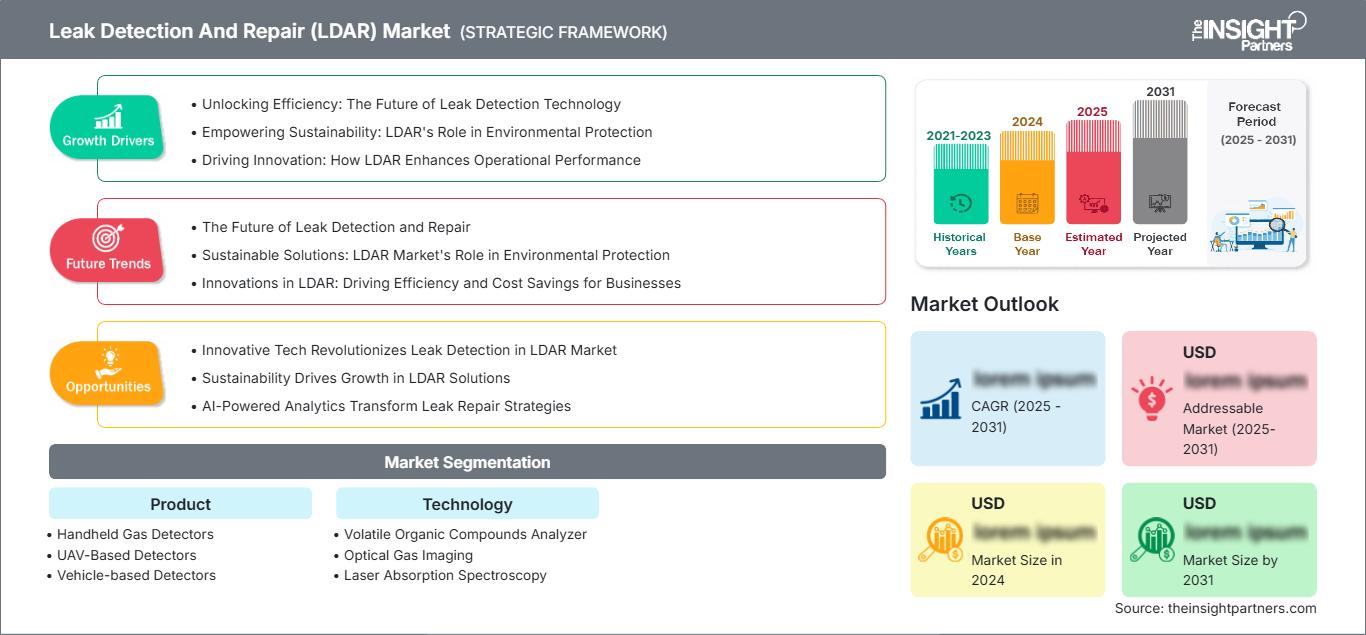
Leak Detection And Repair (LDAR) Market: Strategic Insights
Regional Insights
North America Leak Detection and Repair Market
North America is estimated to hold 34–38% Leak Detection and Repair Market in 2025 and expand at a 4.4–4.9% CAGR through 2034, making it the largest regional market. There is good oil and gas infrastructure, mature utilities systems, sound environmental compliance protocols, and high awareness about fugitive emissions in the area. There is a growing trend to integrate handheld leak detection devices, optical cameras, mobile and aerial monitoring.
Demand in the United States constitutes about 82-86% of total regional demand and is driven by existing pipeline, processing, refining, and natural gas transmission and distribution networks. In Canada, demand is driven by oil sands, transmission infrastructure, and industrial operations. The main driver behind the growth of demand is the need to detect the source of methane leaks and perform repairs as well as minimize unnecessary field visits.
U.S. Leak Detection and Repair Market
The Leak Detection and Repair Market forecast shows that the U.S. represents an estimated 82–86% share of North America's 2025 market and is projected to grow at a 4.3–4.8% CAGR through 2034. The presence of vast gas infrastructure, controls on methane emissions, industrial safety norms, and pipeline integrity program will drive continuous inspection needs. The operators are now blending conventional portable instruments with imaging, mobile surveys, and analytics.
Use cases span all aspects including upstream production facilities, gathering systems, transmission pipelines, storage systems, refineries, chemical processing units, and distribution system. Some of the companies with technology or solution exposure in the region are Aeris Technologies, Inc., Bridger Photonics, Inc., Teledyne FLIR LLC, Fluke Corporation, Honeywell International Inc., and Picarro, Inc.
Europe Leak Detection and Repair Market
The Leak Detection and Repair Market report shows that Europe is estimated to represent 26–30% share in 2025 and grow at a 5.0–5.5% CAGR through 2034. The reason for Germany being a leading market is due to their industry, gas infrastructure, and monitoring of emissions. The UK has a large demand for their offshore energy, gas distribution, refining, and industrial plants. In France, there are opportunities in utilities and industrial processing. Italy has an advantage because of their extensive gas distribution system. Spain has support from LNG, gas distribution, and industrial markets. Methane regulations from the EU make it very beneficial to have documentation of surveys, repair confirmation, and advanced technology for detecting. This regulatory framework mandates the operators to have an LDAR program in place and repair monitoring, making measurement based inspections more valuable.
APAC Leak Detection and Repair Market
APAC is estimated to hold 22–26% share in 2025 and grow at a 5.4–5.9% CAGR through 2034. China leads regional demand, followed by Japan, South Korea, India, and Australia. Industrial expansion, gas-network development, refinery investment, and modernization of process facilities support adoption.
China and India provide substantial long-term potential because of expanding industrial infrastructure, while Japan and South Korea emphasize reliability and process safety. Australia presents opportunities across LNG and upstream assets. Policy attention to methane emissions, worker safety, and infrastructure efficiency is encouraging operators to supplement manual inspection with mobile, optical, acoustic, and automated monitoring technologies.
Middle East & Africa Leak Detection and Repair Market Market
Middle East and Africa demand is expected to grow at a 5.8–6.3% CAGR through 2034, led by Saudi Arabia and the UAE. Large hydrocarbon facilities, export infrastructure, refineries, petrochemical complexes, and gas-processing projects create recurring requirements for reliable detection.
South Africa contributes through mining, industrial processing, and energy infrastructure, while the Rest of MEA provides opportunities across LNG, pipelines, utilities, and industrial facilities. Operators increasingly prioritize remote monitoring and robust equipment capable of functioning under high temperatures, dust, hazardous-area constraints, and geographically dispersed assets.
Segmentation Analysis
Product
Product selection is shaped by asset geography, inspection frequency, detection range, operator mobility requirements, and the need for quantification. The product segment is estimated to expand at a 4.6–5.1% CAGR during 2026–2034. Handheld systems retain broad adoption, while UAV and aircraft platforms increasingly complement ground-level inspection.
- Handheld Gas Detectors: These systems remain central to field verification because technicians can carry them into processing areas, pipelines, storage sites, and maintenance zones. Their portability supports routine inspections and post-repair confirmation.
- UAV-Based Detectors: UAV platforms extend inspection capabilities across difficult-to-access infrastructure, remote facilities, and large industrial sites. Their flexibility can reduce inspection time and improve coverage without requiring full-scale aircraft operations.
- Vehicle-based Detectors: Vehicle-mounted systems are valuable for surveying extensive gas distribution networks and roadside infrastructure. They enable repeated coverage across large geographic areas while integrating leak locations with mapping and maintenance workflows.
- Manned Aircraft Detectors: Aircraft-based detection is strategically important for large upstream, midstream, and geographically dispersed assets. High-area coverage enables operators to identify emission sources that would be difficult to discover through ground inspection alone.
Technology
Technology adoption is increasingly determined by detection sensitivity, localization accuracy, survey speed, quantification capability, operating environment, and data integration. The technology segment is projected to grow at a 5.1–5.6% CAGR during 2026–2034 as operators combine multiple methods to improve coverage.
- Volatile Organic Compounds Analyzer: VOC analyzers support chemical identification and concentration measurement where hydrocarbon characterization is important. Their analytical capability is particularly relevant for industrial facilities requiring detailed gas composition information.
- Optical Gas Imaging: Optical gas imaging enables inspectors to visualize otherwise invisible gas plumes remotely. It is particularly valuable for rapid surveys of complex equipment where conventional contact measurements would be slower or less practical.
- Laser Absorption Spectroscopy: Laser-based systems provide sensitive gas measurement and can support quantitative monitoring. Their precision makes them relevant for applications requiring reliable methane concentration data and improved source characterization.
- Ambient/Mobile Leak Monitoring: Ambient and mobile approaches extend detection beyond individual components by surveying broader areas continuously or during vehicle movement. Integration with analytics and mapping strengthens network-level prioritization and maintenance planning.
- Acoustic Leak Detection: Acoustic systems identify characteristic sound signatures associated with pressurized gas escaping through equipment or piping. They are useful for rapid maintenance screening and can complement visual and chemical detection methods.
- Audio-Visual-Olfactory Inspection: Combined inspection approaches use multiple observable indicators to identify potential leaks. They remain relevant for technician-led workflows, particularly where immediate physical verification is required before repair decisions.
Opportunity Snapshot
| Product | Revenue Contribution | Trend Tag | Adoption Stage |
| Handheld Gas Detectors | High | Field Verification | Mature |
| UAV-Based Detectors | Medium | Remote Surveying | Scaling |
| Vehicle-based Detectors | Medium | Network Mapping | Scaling |
| Manned Aircraft Detectors | Medium | Aerial Coverage | Scaling |
Leak Detection And Repair (LDAR) Market Growth Drivers and Impact Analysis
Stricter Methane Measurement and Repair Requirements
Leak detection will evolve from periodic inspection toward measurement-driven procedures as regulatory standards are tightening up. As part of EU methane regulations, for instance, operators must put into place an LDAR program and meet certain regulations for detection, repair, monitoring, and reporting. Post-repair testing and record keeping of leaks is also required by such regulations. This makes more necessary for technologies that can provide audit-proof data rather than mere detection. In North America, similar regulations for methane require operators to improve their detection abilities and reaction time. This effect is felt commercially, not just in terms of the purchase of equipment, since operators need more than just detection devices.
Aging Infrastructure and Increasing Asset Integrity Priorities
The aging of pipelines, valves, compressors, storage facilities, and industrial equipment presents ongoing challenges in terms of inspections due to the need to minimize any unforeseen discharges or breakdowns. Aging facilities present more opportunities for leaks through joints, seals, fittings, and mechanical equipment. This, in turn, creates greater opportunities for leak detection to meet up with asset integrity and predictive maintenance efforts. Remote and mobile systems can spot these problems early on to help maintenance personnel make their priorities. Utilities benefit from the ability to quickly pinpoint the source of a problem to avoid unnecessary digging or emergency calls. Industrial facilities can employ remote and acoustic inspection to do their maintenance without having to shut down the production processes.
Digitalization of Inspection and Maintenance Workflows
There are changes in the way detection results are translated into maintenance. Geographic mapping, cloud-based analytics, geographic information systems, mobile software applications, and asset databases can link detection results with equipment information and history of maintenance. It will lead to the better way of leak prioritization depending on location, severity, frequency, criticality of assets, and implications for operations. The use of digital technologies will help generate evidence needed for regulatory reporting and corporate environmental initiatives. The mobile providers of leak detection services add geospatial data to the results of sensor measurements, while fixed systems can continuously transmit data to industrial control and analytical environments. In the context of enterprise-level asset management initiatives, detection technology becomes valuable as part of a bigger system, including cybersecurity, among other things.
Leak Detection And Repair (LDAR) Market Future Trends
Convergence of Aerial, Mobile, and Continuous Monitoring
The future generation of inspection programs is likely to utilize a combination of different technologies rather than relying on a single technology. For instance, airborne platforms will help detect emissions from a large facility; mobile systems will be used for monitoring networks as well as roadways, while portable tools will enable one to inspect individual components. Continuous sensors can help monitor an area in between scheduled inspections. This kind of structure will make it possible to utilize appropriate technologies based on the physical size and risk of different assets. Data platforms will integrate information generated from different inspection tools in one map and maintenance schedule. Such integration will ensure that there is no duplicate inspection or unnecessary efforts at source localization. Technology selection will increasingly adopt a portfolio approach.
Measurement-Based Emissions Intelligence
According to the Leak Detection and Repair Market trends, future innovations are anticipated to progress from leak detection to continuous enhancement in emissions inventory and decision making. The use of advanced analytics, which will leverage information about concentrations, wind direction, asset data, historical information, and repairs, could enhance source apportionment as well as help in prioritizing actions. The use of measurement methods for reporting would provide more verifiable data than inventory created using generic emissions factors. Artificial Intelligence and machine learning may aid in anomaly classification, suppression of false positives, identification of recurrent equipment issues, and forecasting of areas that need inspections. Linking of emissions intelligence with maintenance using enterprise asset management systems is also an area that can be explored. As regulators and investors place more emphasis on emissions measurements, operators will be attracted to systems offering verifiable data from detection through repair and monitoring.
Leak Detection And Repair (LDAR) Market Opportunities
Integrated Compliance and Maintenance Platforms
An important investment opportunity lies in platforms that combine detection hardware, geospatial mapping, analytics, maintenance workflows, and compliance documentation. Operators often use different technologies across production sites, pipelines, distribution networks, and processing facilities, creating fragmented datasets and inconsistent inspection records. A unified platform can consolidate detection events, assign repair tasks, document completion, and generate evidence for regulatory reporting. Vendors can strengthen this opportunity by supporting multiple sensor types rather than locking customers into a single detection technology. Integration with enterprise asset-management and industrial software can also increase switching costs and create recurring software revenue. The opportunity is particularly relevant in regions where regulations require formal LDAR programs, documented repair schedules, post-repair verification, and periodic reporting.
Scalable Monitoring for Emerging Gas Infrastructure
Emerging gas infrastructure in Asia Pacific, the Middle East, and selected Latin American markets creates opportunities for scalable monitoring architectures. New pipelines, LNG facilities, processing plants, and distribution networks can incorporate digital leak detection during initial design rather than retrofitting fragmented inspection systems later. Suppliers can target these projects with combinations of fixed sensors, mobile surveying, optical imaging, and remote analytics. Design-stage integration can improve sensor placement, communications coverage, data architecture, and maintenance planning. Local service capabilities will also become important because operators require calibration, inspection, repair verification, and technical support over long asset lifecycles. Vendors that provide flexible deployment models and adapt technologies to climatic, geographic, and hazardous-area conditions can capture demand from new infrastructure while reducing dependence on mature replacement markets.
Recent Developments
- September 2026: Fluke Corporation expanded its iSee Mobile Imaging Series with the new ii01 Acoustic Camera, targeting rapid identification of hidden compressed-air and gas leaks. The product extends acoustic imaging capabilities for maintenance teams by helping locate abnormal sound sources and visualize inspection targets. The launch strengthens Fluke's positioning in non-contact leak inspection and supports broader use of acoustic methods within routine maintenance workflows.
- November 2025: Picarro, Inc. announced completion of a large-scale methane emissions inspection project with Netz Niederösterreich in response to the EU methane regulation. The project used Picarro technology for measurement-based inspection of gas infrastructure and demonstrated how advanced mobile leak detection can support regulatory surveys, monitoring, and reporting requirements across distribution networks.
- October 2025: Bridger Photonics, Inc. launched GML for Snow, extending its aerial methane detection capability to snowy and cold conditions. The company reported testing across more than 1,000 facilities during the 2024–2025 winter season, positioning the technology for year-round emissions monitoring in operating environments where weather can limit conventional inspection approaches
Frequently Asked Questions

- Comprehensive Market Sizing and Forecast Analysis
- Detailed Segmentation Analysis
- In-Depth Market Dynamics Assessment
- Regional and Country-Level Insights
- Competitive Landscape and Company Benchmarking
- Strategic Business Intelligence
Recent Reports
Testimonials

The Insight Partners provided valuable market intelligence that supported our global go-to-market strategy. Their team was professional, responsive, and attentive to our feedback, providing thoughtful analysis and helpful methodological clarifications throughout the project.
Junmo Kim Chief Financial Officer (CFO), Enertech Co., Ltd.
The Insight Partners' SCADA System Market report is comprehensive, with valuable insights on current trends and future forecasts. The team was highly professional, responsive, and supportive throughout. We are very satisfied and highly recommend their services.
RAN KEDEM Partner, Reali Technologies LTDs
I requested a report on a very specific software market and the team produced the report in a few days. The information was very relevant and well presented. I then requested some changes and additions to the report. The team was again very responsive and I got the final report in less than a week.
JEAN-HERVE JENN Chairman, Future Analytica
We worked with The Insight Partners for an important market study and forecast. They gave us clear insights into opportunities and risks, which helped shape our plans. Their research was easy to use and based on solid data. It helped us make smart, confident decisions. We highly recommend them.
PIYUSH NAGPAL Sr. Vice President, High Beam Global
The Insight Partners delivered insightful, well-structured market research with strong domain expertise. Their team was professional and responsive throughout. The user-friendly website made accessing industry reports seamless. We highly recommend them for reliable, high-quality research services
YUKIHIKO ADACHI CEO, Deep Blue, LLC.
This is the first time I have purchased a market report from The Insight Partners.While I was unsure at first, I visited their web site and felt more comfortable to take the risk and purchase a market report.I am completely satisfied with the quality of the report and customer service. I had several questions and comments with the initial report, but after a couple of dialogs over email with their analyst I believe I have a report that I can use as input to our strategic planning process.Thank you so much for taking the extra time and making this a positive experience.I will definitely recommend your service to others and you will be my first call when we need further market data.
JOHN SUZUKI President and Chief Executive Officer, Board Director, BK Technologies
I wish to appreciate your support and the professionalism you displayed in the course of attending to my request for information regarding to infectious disease IVD market in Nigeria. I appreciate your patience, your guidance, and the fact that you were willing to offer a discount, which eventually made it possible for us to close a deal. I look forward to engaging The Insight Partners in the future, all thanks to the impression you have created in me as a result of this first encounter.
DR CHIJIOKE ONYIA MANAGING DIRECTOR, PineCrest Healthcare Ltd.Reason to Buy
- Informed Decision-Making
- Understanding Market Dynamics
- Competitive Analysis
- Identifying Emerging Markets
- Customer Insights
- Market Forecasts
- Risk Mitigation
- Boosting Operational Efficiency
- Strategic Planning
- Investment Justification
- Tracking Industry Innovations
- Aligning with Regulatory Trends





 Get Free Sample for