
Leak Testing Market Size, Share & Demand by 2034
Leak Testing Market Size and Forecasts (2021–2034), Global and Regional Share, Trends, and Growth Opportunity Analysis Report Coverage : By Offering (Hardware, Software, Services), Equipment Type (Fixed, Portable), Vertical (Medical Devices, Pharmaceuticals, Automotive, Oil & Gas, Food & beverages, Consumer Electronics)
- Status : Data Released
- Report Code : TIPRE00039836
- Category : Electronics and Semiconductor
- No. of Pages : 150
- Available Report Formats :


- Last update date : September 23, 2026


2025 Market Size
US$ 21.57 Bn
Base year value
2034 Forecast
US$ 31.57 Bn
Projected by 2034
CAGR 2026-2034
4.88 %
Growth rate
Addressable Market
US$ 248.22 Bn
(2026-2034)
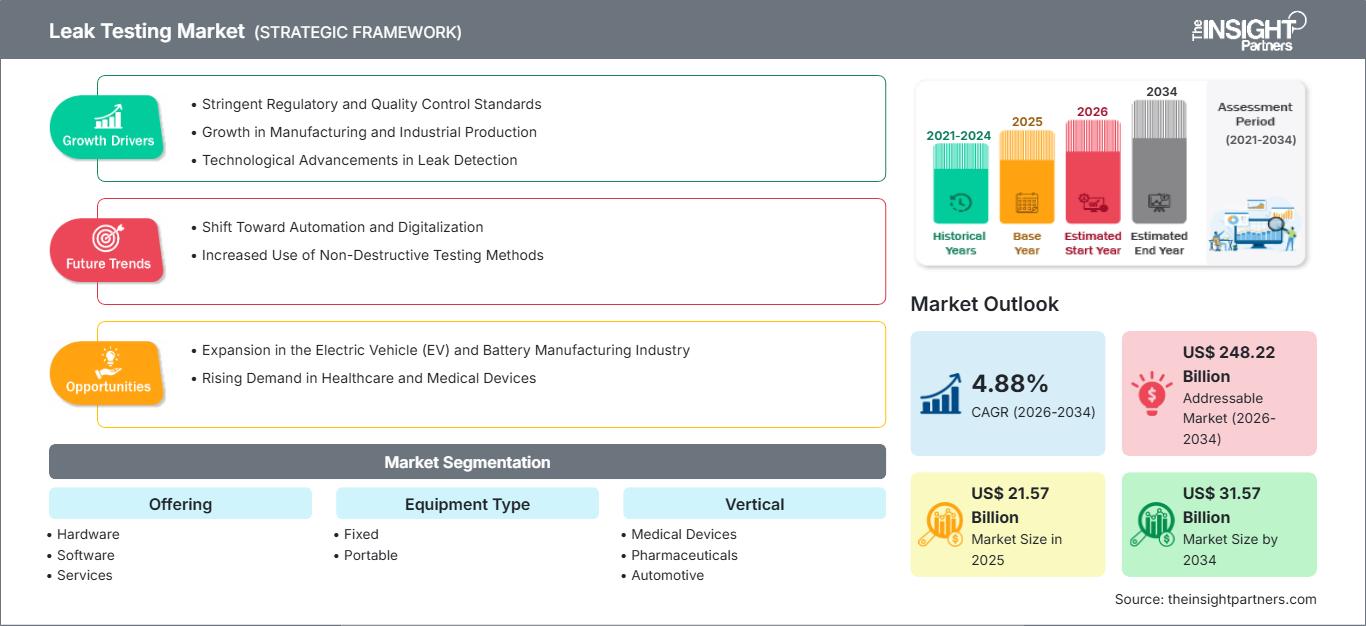
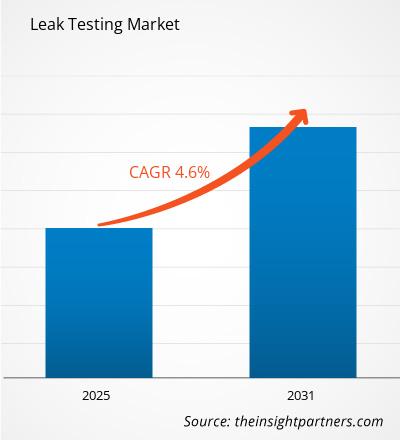
The Leak Testing Market was valued at US$ 21.57 Billion in 2025 and is projected to reach US$ 31.57 Billion by 2034, expanding at a CAGR of 4.88% during 2026–2034. Demand reflects the increasingly critical role of non-destructive integrity verification across regulated and high-throughput industries, where escaped defects can trigger recalls, process losses, emissions, contamination, or safety failures. The market includes hardware, software, and services deployed through fixed and portable equipment.
North America is expected to expand at a modelled 4.4–4.9% CAGR, supported by automated quality assurance and tighter validation requirements for medical devices, electric-vehicle components, energy infrastructure, and food packaging. The Leak Testing Market size in the region benefits from extensive installed manufacturing capacity, mature calibration networks, and early adoption of connected instruments that centralize recipes, audit trails, and maintenance diagnostics. Replacement demand also favors higher-sensitivity, lower-cycle-time platforms.
Leak Testing Market Assessment and Insights
- North America: Accounted for 29–32% share in 2025 and is forecast to grow at 4.4–4.9% CAGR between 2026–2034, as regulated manufacturing, EV battery production, and refinery maintenance sustain instrument replacement.
- US: Represented 73–77% of North America in 2025 and is projected to advance at 4.3–4.8% CAGR between 2026–2034, supported by medical-device validation and automotive automation.
- Europe: Held 25–28% share in 2025 and is expected to expand at 4.2–4.7% CAGR between 2026–2034, led by Germany, the UK, France, Italy, and Spain.
- Asia Pacific: Captured 31–35% share in 2025 and is projected to rise at 5.4–6.0% CAGR between 2026–2034, with China, Japan, South Korea, and India leading industrial adoption.
- Largest Segment: Hardware held 61–65% market share in 2025 and is forecast to grow at 4.3–4.8% CAGR during 2026–2034, reflecting installed-system and sensor demand.
- High Growth Segment: Software represented 12–16% market share in 2025 and is forecast to expand at 6.4–7.1% CAGR during 2026–2034 as traceability becomes standard.
- Key companies analyzed in detail: Vacuum Instruments Corporation, Uson, L.P., CETA Testsysteme GmbH, LACO Technologies, Pfeiffer Vacuum GmbH, ATEQ, InterTech Development Company, INFICON Holding AG, TASI Group, and COSMO Instruments Co., Ltd.
Source: The Insight Partners' analysis based on proprietary research, government publications, company annual reports, investor presentations, industry databases, and expert interviews.
Technology development from manual immersion test technique to automated pressure decay, mass flow, helium, hydrogen forming gas, acoustic, and optical leak detection connected to production control systems has been achieved. Volume increase resulted in buying specific detectors that became part of test stations including fixtures, sensors, test specifications, calibration, and data collection. Miniaturization of the components and porosity material increased complexity in selecting testing methods, while helium shortage promoted recycling and use of other trace gases. All these trends are typical for the digital manufacturing revolution when standard test procedures and serial identification are required.
Up to 2034, expansion in Asia of electronics, batteries, pharmaceuticals, and medical technology production is expected to expand the customer base, whereas Gulf energy projects and African food processing investments will offer targeted opportunities for portable equipment. Harmonization of regulations, such as the US medical device quality system conversion, increases the need for validated methods and auditable data. Investments will increasingly favor modular systems allowing reconfiguration among product variations, remote serviceability, and application engineering locally.
Leak Testing Market Report Scope
| Report Attribute | Details |
|---|---|
| Market size in 2025 | US$ 21.57 Billion |
| Market Size by 2034 | US$ 31.57 Billion |
| Global CAGR (2026 - 2034) | 4.88% |
| Historical Data | 2021-2024 |
| Forecast period | 2026-2034 |
Leak Testing Market Analysis
Market Growth in Leak Testing industry is driven by the growing costs associated with defects that escape detection in battery packs, catheter assemblies, pharmaceutical packaging, refrigeration loops, valves, and enclosed electronics. Buyers consider sensitivity, cycle time, false rejection rate, fixture repeatability and traceability in concert, which makes application engineering equally crucial to test system specifications. Value chain includes sensors, vacuum pumps, gas handling equipment, controls, fixtures, calibration standards, software, integration and support.
The supply situation depends on the testing technology used. In case of pressure decay, the supply chain is based on commonly available elements competing in the algorithms and the thermal management, while in helium mass spectrometer the proprietary analyzers, vacuum technologies and tracers are the key elements of the supply chain. The trend towards the usage of different testing technologies together within one cell, in order to save gases and decrease bottle necks in the detection process is growing.
According to Leak Testing Market analysis, the competition is fragmented and includes global vacuum specialists, specialized instrument providers and automation solutions providers. In particular, companies INFICON Holding AG and Pfeiffer Vacuum GmbH focus on vacuum technologies and the high sensitivity of the tracer gases, while ATEQ, Uson, L.P., CETA Testsysteme GmbH and COSMO Instruments Co., Ltd specialize in pressure, flow and line testing technologies. Other market players include InterTech Development Company, LACO Technologies, TASI Group and Vacuum Instruments Corporation.
Investments are being made in software-driven installed base solutions, regional support centers, and acquisitions to expand test method capabilities. Strategic positioning involves the coupling of standardized tools with fixtures, compliance, connectivity, and quick start-up. Suppliers to the medical/pharmaceutical industry focus on compliance evidence; those in the automotive industry on takt time and automated interface; and the energy industry on portability, intrinsically safe, and robust in-the-field operation. Regular calibration, preventative maintenance, and software services can increase revenue visibility and enhance customer loyalty.
● REPORT CUSTOMIZATION
Tailor This Report To Align With Your Specific Business Requirements
This report can be customized to align precisely with your business objectives, scope, and target markets. Customization options include tailored segmentation, geography, competitive analysis, and strategic insights to support informed decision-making.
Customize This Report →WHAT YOU CAN ADJUST
- ● Segmentations
- ● Geography
- ● Competitive Analysis
- ● Language Preferences
Leak Testing Market: Strategic Insights
Regional Insights
North America Leak Testing Market
North America held 29–32% of global revenue in 2025 and should record a 4.4–4.9% CAGR through 2034. Leak Testing Market share consists of concentrated automotive, aerospace, medical device, refrigeration, semiconductor, and energy facilities, which need proven tests for integrity. Quality-system modernization efforts by US Food and Drug Administration, automotive battery localization, and methane control initiatives drive the demand for an auditible manufacturing and field testing.
Regionally, customers in the Leak Testing Market prefer manufacturers who have accredited calibration services, quick access to replacement parts, and laboratory that is able to test unique geometries. Stationary equipment prevails at assembly lines, while portable detectors are used at pipelines, refineries, HVAC service, laboratories, and during plant shutdown maintenance. Canada provides energy, aerospace, and food packaging applications; Mexico is involved in automotive and appliance manufacturing processes. Connectivity becomes increasingly important due to unified recipe management and serial number tracking capabilities.
U.S. Leak Testing Market
The US represented 73–77% of North American Leak Testing Market in 2025 and is forecast to expand at 4.3–4.8% CAGR. Installed base sizes in medical technology, automotive manufacturing, aircraft manufacturing, refrigeration, semiconductor machinery, and oil and gas industries lead to diversified needs. The transition to the Quality Management System Regulation in the field of medical device production in 2026 adds value to the use of validated procedures, electronic records, calibration of standards and reproducible acceptance limits.
The domestic presence of ATEQ, Uson, L.P., InterTech Development Company, LACO Technologies, Vacuum Instruments Corporation, and other experts helps shorten the commissioning and service cycles. The application area includes battery cases and cooling plates, catheters and filters assemblies, integrity testing of pharmaceutical packages, heat exchangers, fuel systems, and sealed consumer products. Pressure-decay pre-screening combined with tracer-gas follow-up confirmation is becoming a common practice for manufacturers.
Europe Leak Testing Market
Europe accounted for 25–28% of 2025 Leak Testing Market and is projected to grow at 4.2–4.7% CAGR, with Germany leading. Clusters including automotive, machinery, chemical, pharmaceutical, and refrigeration enable integrated test-cell facilities and highly sensitive detectors to be employed in German factories. Strong manufacturing sector of Germany, valued at 17.6% of its GDP in 2025, supports battery, thermal management, fuel system, and industrial valve validation. The United Kingdom requires aerospace, life science, and energy service applications, with customers preferring flexible instrumentation and certified calibration.
France gains in the Leak Testing Market from pharmaceutical packaging, aerospace, and nuclear servicing; Italy from machinery, appliances, automotive parts, and food processing plants; and Spain from vehicle assembly, renewable energy machinery, and packaged food manufacturing. European buyers are increasingly looking for capabilities of refrigerant containment, emissions reduction, energy conservation, and electronic documentation of products. Such needs make instruments providing alternative tracer materials, automation of calibration processes, and transferable audit trails favorable, whereas local integrators play an important role in fixture design and line upgrades.
APAC Leak Testing Market
Asia Pacific led with 31–35% Leak Testing Market share in 2025 and is expected to grow at 5.4–6.0% CAGR, the fastest regional pace. China anchors demand through electronics, batteries, machinery, and pharmaceuticals, while Japan and South Korea require high-precision verification for semiconductors, vehicles, and consumer devices.
India’s expanding automotive and pharmaceutical capacity broadens adoption, and Australia supports mining, energy, refrigeration, and infrastructure maintenance. Policy-led manufacturing localization and export-quality requirements favor automated fixed systems, while geographically dispersed assets sustain portable demand. Suppliers able to localize fixtures, service, and operator training should outperform equipment-only vendors.
Middle East & Africa Leak Testing Market
The Leak Testing Market forecast shows that Middle East and Africa is set to expand at 4.6–5.2% CAGR, led by Saudi Arabia. Hydrocarbon processing, hydrogen projects, pipelines, desalination, district cooling, and new manufacturing investments create demand for portable tracer-gas and acoustic systems, alongside fixed valve and vessel test stations.
The UAE emphasizes aviation, energy, refrigeration, and food logistics; South Africa contributes mining, automotive, and process-industry applications. Rest-of-MEA demand remains project-led and service-sensitive. Ruggedization, local calibration partnerships, rental models, and technician training are therefore decisive for converting infrastructure spending into recurring equipment and service revenue.
Segmentation Analysis
Offering
Offering is projected to grow at 4.8–5.3% CAGR during 2026–2034. The Leak Testing Market scope spans capital equipment, embedded software, validation, calibration, integration, and maintenance. Hardware remains foundational, but connected analytics and lifecycle services gain strategic weight as factories standardize recipes across lines, document measurement capability, and reduce unplanned downtime. Buyers increasingly assess total cost of ownership rather than instrument price alone.
- Hardware: Holds the leading position because detectors, sensors, pumps, gas controls, fixtures, and calibration standards remain essential for every installation and represent the largest initial expenditure.
- Software: Gains strategic importance through recipe control, statistical process monitoring, electronic records, remote diagnostics, and plant-level integration, particularly where manufacturers operate multiple product variants.
- Services: Demand is recurring across installation, method development, validation, calibration, preventive maintenance, repair, and training, with responsiveness becoming a major differentiator in regulated production.
Equipment Type
Equipment Type is forecast to advance at 4.6–5.1% CAGR during 2026–2034. Fixed platforms benefit from automation, repeatable fixturing, and production-system connectivity, whereas portable units address maintenance, commissioning, troubleshooting, and dispersed infrastructure. Hybrid purchasing is common: factories employ fixed stations for release testing and handheld or cart-based detectors for root-cause analysis, utilities, and scheduled asset inspections.
- Fixed: Dominates high-volume manufacturing where automated loading, stable fixtures, short cycle times, and manufacturing-execution-system connectivity support consistent release decisions and comprehensive traceability.
- Portable: Serves field maintenance, line troubleshooting, installation checks, and low-volume production, with battery operation, rugged enclosures, rapid startup, and intuitive interfaces influencing selection.
Vertical
Vertical demand is expected to increase at 4.9–5.4% CAGR during 2026–2034. Adoption intensity depends on defect consequence, permissible leak rate, throughput, part geometry, and documentation requirements. Medical devices and pharmaceuticals prioritize validated package or component integrity, automotive users emphasize cycle time, and energy operators require sensitive field detection. Food, beverage, and electronics applications balance speed, non-destructive testing, and cost.
- Medical Devices: Critical applications include catheters, filters, pumps, reservoirs, and sterile barriers, where validated sensitivity, low false rejects, and complete documentation protect patient safety.
- Pharmaceuticals: Container-closure integrity for vials, syringes, cartridges, blister packs, and flexible packages supports sterile assurance, shelf-life validation, and migration from destructive sampling.
- Automotive: Battery trays, cooling circuits, fuel systems, air-conditioning modules, lamps, and power electronics require fast automated tests compatible with high-volume assembly and variant control.
- Oil & Gas: Pipelines, valves, tanks, compressors, and process equipment sustain portable and fixed demand, driven by safety, emissions reduction, shutdown efficiency, and asset integrity.
- Food & beverages: Package integrity testing helps detect seal defects in cans, pouches, trays, bottles, and modified-atmosphere packs while reducing waste and preserving shelf life.
- Consumer Electronics: Miniaturized wearables, phones, speakers, sensors, and sealed assemblies require precise, non-destructive verification of water resistance, enclosure integrity, and production consistency.
Opportunity Snapshot
| Vertical | Revenue Contribution | Trend Tag | Adoption Stage |
| Medical Devices | High | Sterile Integrity | Mature |
| Pharmaceuticals | High | CCI Validation | Scaling |
| Automotive | High | Battery Sealing | Scaling |
| Oil & Gas | High | Methane Control | Mature |
| Food & beverages | Medium | Seal Assurance | Scaling |
| Consumer Electronics | Medium | Waterproofing | Scaling |
Leak Testing Market Growth Drivers and Impact Analysis
Stricter Integrity Requirements in Regulated Manufacturing
The trend towards showing that testing procedures are valid, repeatable, calibrated and relevant to the risk level of the products is growing. The Quality Management System Regulation of the United States on medical devices went into effect in February 2026 and is aligned with ISO 13485:2016. In the case of sterile packaging, the accepted pressure decay methods can identify leaks equal to or larger than 1 × 10⁻⁴ standard cubic centimeters per second. These conditions lead to higher expenditures on calibration instruments, traceable calibration standards, recipe protection and electronic records. The commercial aspect goes beyond just hardware; application, gauge repeatability studies, installation qualification, training and recalibration all become part of the purchase program.
Electrification Expands Sealed-Component Testing
There is an increased number of critical components in electric vehicles, such as batteries, housing, thermal management circuits, power electronics, connectors, and hydrogen system components. Unlike normal parts, a large battery housing has large sealing areas along with strict standards concerning water or coolant fluid intrusion, resulting in complicated fixtures and high volume considerations. The tests conducted are generally carried out in phases where initial failures are screened and then exact pressure decay or tracer gas tests are conducted. The commercial effect includes higher equipment content per line, increased automation and recipe management demand, and increased engineering revenue per program launch. Battery manufacturing plants tend to be localized throughout North America, Europe, and Asia, creating opportunities for reuse of modular stations for the suppliers with regional installation teams.
Emissions and Resource Loss Elevate Field Detection
The need to avoid methane, refrigerants, process gases, compressed air, and water leaks presents challenges of safety, environment, and cost, making the field leak detection process become an asset performance management tool. Oil refineries, pipelines, chemicals processing facilities, power companies, refrigeration companies, and data centers require portables that help in isolating faults without extended periods of shutdowns. The more frequent surveys mean that there is greater need for rugged instruments, quick recovery of sensors, geotagging, and digitalization of work order creation processes. On a commercial front, the trend opens up a bigger market base from production quality testing laboratories to maintenance departments and service contractors. It facilitates rentals, replacement of sensors, calibration, and certification of technicians.
Leak Testing Market Future Trends
Adaptive Test Algorithms and Closed-Loop Quality
Leak Testing Market Trends will focus more and more on algorithmic solutions to identify real leaks from thermal effects, creep in the material, motion of the fixture, and variations in ambient pressure. The testing team will use the knowledge gained from past data about components to create dynamic stabilization limits, end known good and bad passes earlier, and detect any process variations before they cross certain limits. As the test results integrate with the manufacturing execution system, maintenance system, and quality management system, closed loop actions such as adjusting the dispensing processes upstream and repairing fixtures will be carried out. There will be governance problems too, which include controlled model updating, decision criteria justification, and raw data storage.
Lower-Helium and Multi-Tracer Architectures
Availability and fluctuating prices of helium will increase efforts towards instrument designs that conserve tracer gases, reclaim helium, or use alternative gases such as helium and hydrogen-forming gas as possible substitutes based on safety and sensitivity considerations. Future systems will incorporate the features of gross leak detection, improved vacuum preparation, partial flow operation, and automated adjustment of tracer gas concentrations. This trend will not affect the application of mass spectrometry helium in high-sensitivity applications like semiconductors, cryogenics, and critical component testing. However, the efficient use of gas will become another criterion for purchase besides sensitivity and speed of testing. Portable units with exchangeable sensors and standardized calibration procedures will be increasingly attractive to multinational customers.
Leak Testing Market Opportunities
Modular Validation Platforms for Emerging Manufacturers
Increased manufacturing activity in India, Southeast Asia, Mexico, the Gulf, and specific African nations makes it possible to consider developing modular test stations that would be ready for transition from pilot production into automation. In the majority of cases, the new enterprises lack knowledge about performing internal leak testing, so the package of services including method development, fixturing, acceptance criteria, documentation of validation, and training is a more profitable business. Suppliers need to standardize the reusable pneumatic, vacuum, and software components but develop a contacting and handling component differently. Financing and calibration could solve the problem of high start-up costs. Channel partner needs to have an application laboratory, not just sales skills. It is especially interesting in the markets of medical devices, pharmaceutical packaging, batteries, electronics, food processing, and refrigeration.
Installed-Base Software and Service Monetization
Thousands of installed testers operate as isolated assets with inconsistent recipes, manual logs, and reactive maintenance. Vendors can create recurring revenue by offering secure connectivity, fleet dashboards, calibration scheduling, remote diagnostics, and statistical process monitoring across mixed equipment generations. A phased commercial model should begin with read-only data capture, then add recipe governance and predictive service once customers establish cybersecurity and validation controls. Open interfaces are essential because factories rarely use one supplier exclusively. Partnerships with system integrators and quality-software providers can accelerate deployment. Success depends on demonstrating fewer false rejects, shorter troubleshooting, improved audit readiness, and higher uptime rather than selling connectivity as an abstract digital upgrade.
Recent Developments
- March 2026: ABB has introduced EmissionVision, a cloud-based workflow management platform designed to help natural gas operators automate and simplify advanced gas leak detection and repair processes. The new platform brings together emission detection, field investigations and data management in a single digital environment. By connecting these stages, ABB aims to help operators move away from manual leak surveys toward more efficient, traceable and auditable workflows.
- June 2026: Digimarc is completing the rollout of its Leak Detection solution for a global technology company seeking to identify the source of confidential information captured from internal computer screens. The technology company had been experiencing incidents in which photographs and screenshots of sensitive internal information appeared on social media and news websites. An investigation determined that authorized users with legitimate access to the information were using mobile phones to photograph their screens and then sharing the images externally.
- June 2025: ANYbotics has introduced a new Gas Leak and Presence Detection solution for its ANYmal autonomous inspection robot, giving industrial operators a way to automate the detection, localization and monitoring of hazardous gas leaks. The solution combines modular gas sensors with a 360-degree acoustic imaging system, enabling ANYmal to identify leaks while also measuring gas concentrations in its surroundings. The technology is designed for industrial environments where conventional inspection methods or fixed sensors may have limited coverage.
Frequently Asked Questions

- Comprehensive Market Sizing and Forecast Analysis
- Detailed Segmentation Analysis
- In-Depth Market Dynamics Assessment
- Regional and Country-Level Insights
- Competitive Landscape and Company Benchmarking
- Strategic Business Intelligence
Recent Reports
Testimonials

The Insight Partners' SCADA System Market report is comprehensive, with valuable insights on current trends and future forecasts. The team was highly professional, responsive, and supportive throughout. We are very satisfied and highly recommend their services.
RAN KEDEM Partner, Reali Technologies LTDs
I requested a report on a very specific software market and the team produced the report in a few days. The information was very relevant and well presented. I then requested some changes and additions to the report. The team was again very responsive and I got the final report in less than a week.
JEAN-HERVE JENN Chairman, Future Analytica
We worked with The Insight Partners for an important market study and forecast. They gave us clear insights into opportunities and risks, which helped shape our plans. Their research was easy to use and based on solid data. It helped us make smart, confident decisions. We highly recommend them.
PIYUSH NAGPAL Sr. Vice President, High Beam Global
The Insight Partners delivered insightful, well-structured market research with strong domain expertise. Their team was professional and responsive throughout. The user-friendly website made accessing industry reports seamless. We highly recommend them for reliable, high-quality research services
YUKIHIKO ADACHI CEO, Deep Blue, LLC.
This is the first time I have purchased a market report from The Insight Partners.While I was unsure at first, I visited their web site and felt more comfortable to take the risk and purchase a market report.I am completely satisfied with the quality of the report and customer service. I had several questions and comments with the initial report, but after a couple of dialogs over email with their analyst I believe I have a report that I can use as input to our strategic planning process.Thank you so much for taking the extra time and making this a positive experience.I will definitely recommend your service to others and you will be my first call when we need further market data.
JOHN SUZUKI President and Chief Executive Officer, Board Director, BK Technologies
I wish to appreciate your support and the professionalism you displayed in the course of attending to my request for information regarding to infectious disease IVD market in Nigeria. I appreciate your patience, your guidance, and the fact that you were willing to offer a discount, which eventually made it possible for us to close a deal. I look forward to engaging The Insight Partners in the future, all thanks to the impression you have created in me as a result of this first encounter.
DR CHIJIOKE ONYIA MANAGING DIRECTOR, PineCrest Healthcare Ltd.Reason to Buy
- Informed Decision-Making
- Understanding Market Dynamics
- Competitive Analysis
- Identifying Emerging Markets
- Customer Insights
- Market Forecasts
- Risk Mitigation
- Boosting Operational Efficiency
- Strategic Planning
- Investment Justification
- Tracking Industry Innovations
- Aligning with Regulatory Trends





 Get Free Sample for