
LED Emergency Driver Market Growth, Trends & Demand by 2034
Coverage: By Type (External DC fuse, No-external DC fuse); End-User (Linear Indoor Fixtures, High Bay Fixtures, Recessed Downlight Fixtures, Others) , and Geography (North America, Europe, Asia Pacific, and South and Central America)
- Status : Data Released
- Report Code : TIPRE00017507
- Category : Electronics and Semiconductor
- No. of Pages : 150
- Available Report Formats :


- Last update date : September 28, 2026


2025 Market Size
US$ 2.09 Bn
Base year value
2034 Forecast
US$ 3.15 Bn
Projected by 2034
CAGR 2026-2034
4.65 %
Growth rate
Addressable Market
US$ 23.77 Bn
(2026-2034)
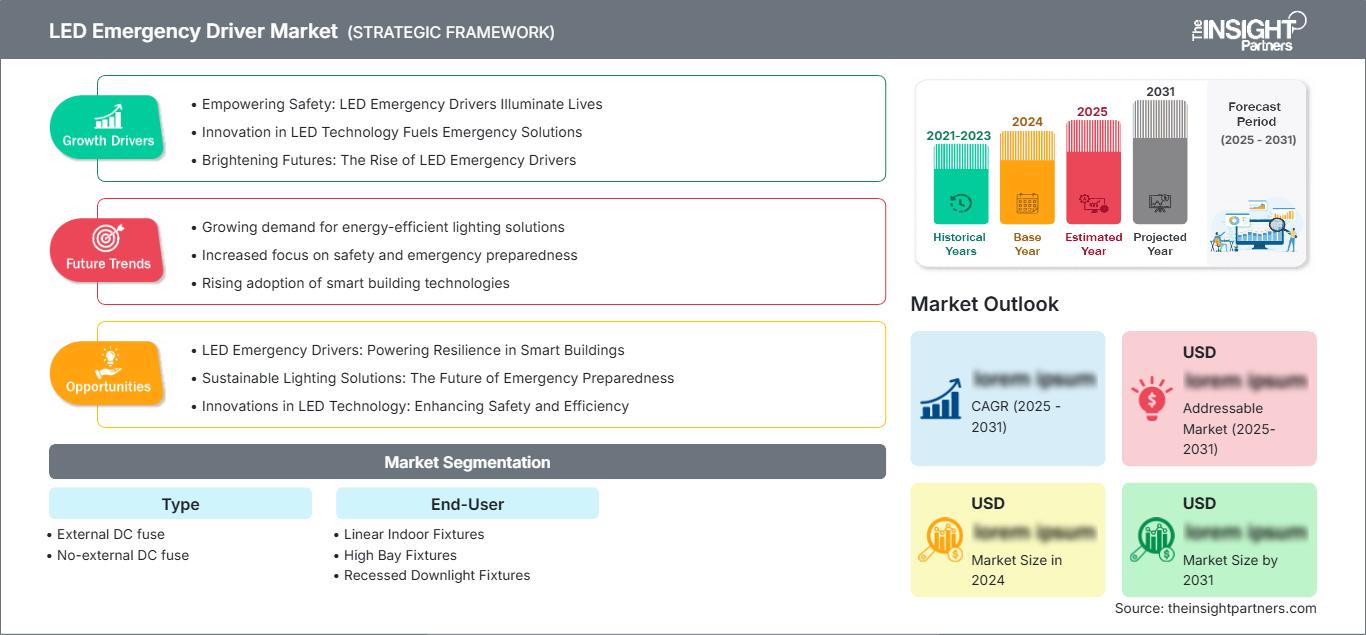
The LED Emergency Driver Market was valued at US$ 2.09 Billion in 2025 and is projected to reach US$ 3.15 Billion by 2034, registering a CAGR of 4.65% during 2026–2034. The market covers emergency drivers that transfer LED fixtures from normal mains operation to battery-supported illumination during power interruptions. Demand is shaped by life-safety requirements, LED retrofit activity, fixture compatibility, battery technology, testing provisions, and installation constraints across commercial, industrial, institutional, and public buildings.
North America remains an established market because emergency illumination is embedded in building safety requirements and because large commercial facilities continue replacing legacy fluorescent systems with LED fixtures. The LED Emergency Driver Market size in the region is expected to expand at an estimated 4.8–5.3% CAGR during 2026–2034, supported by retrofit projects, code compliance, and demand for compact field-installable emergency power solutions.
LED Emergency Driver Market Assessment and Insights
- North America represented an estimated 30–34% share in 2025 and is projected to grow at a 4.8–5.3% CAGR between 2026–2034, supported by building-code compliance, commercial retrofits, and replacement of fluorescent emergency systems with LED-compatible solutions.
- US accounted for approximately 73–77% of North America's 2025 demand and is expected to register a 4.9–5.4% CAGR between 2026–2034, supported by UL-listed equipment, renovation activity, and emergency-lighting requirements.
- Europe held approximately 22–25% share in 2025 and is expected to expand at a 4.4–4.9% CAGR between 2026–2034, with Germany, the UK, France, Italy, and Spain supported by safety regulations and energy-efficiency retrofits.
- Asia Pacific represented approximately 31–35% share in 2025 and is projected to grow at a 5.3–5.8% CAGR between 2026–2034, led by China, Japan, South Korea, India, and Australia through construction and modernization.
- Largest Segment: External DC fuse accounted for an estimated 58–62% market share in 2025 and is projected to grow at a 4.3–4.8% CAGR during 2026–2034, reflecting established protection architectures.
- High Growth Segment: Recessed Downlight Fixtures represented approximately 24–28% market share in 2025 and is expected to grow at a 5.2–5.7% CAGR during 2026–2034, supported by compact commercial installations.
- Key companies analyzed in detail: AC Electronics, Bodine, Dengfeng Ltd., Fulham, Hatch Lighting, IOTA Engineering, Jialinghang Electronic, KinaLED, Koninklijke Philips N.V., and Shenzhen ATA Technology.
Source: The Insight Partners' analysis based on proprietary research, government publications, company annual reports, investor presentations, industry databases, and expert interviews.
From emergency ballasts tailored to fluorescent lamps, the market now includes compact LED drivers that incorporate batteries, charging circuitry, power conversion circuitry, sensing and compatibility with the fixtures. Constant power configurations are becoming common in ensuring stable output of LEDs as the battery voltage reduces. Present day products include features such as ease of installation, thermal management, reduction in enclosure sizes, and compatibility with various loads. In the US, guidance is provided for emergency lighting systems that should start within 10 seconds and continue running for at least 90 minutes hence enhancing the driver performance as an essential safety requirement.
Further developments in the future will be in the area of lithium batteries, automatic testing, remote monitoring, and small luminaire oriented driver systems. The IEC 60598-2-22:2021 included requirements for lithium batteries, electric double-layer capacitors, heat resistance, fire, tracking, and self-contained emergency luminaires.
LED Emergency Driver Market Report Scope
| Report Attribute | Details |
|---|---|
| Market size in 2025 | US$ 2.09 Billion |
| Market Size by 2034 | US$ 3.15 Billion |
| Global CAGR (2026 - 2034) | 4.65% |
| Historical Data | 2021-2024 |
| Forecast period | 2026-2034 |
LED Emergency Driver Market Analysis
The demand for reliable emergency lighting will be driving the LED Emergency Driver market as building owners change existing fixtures to LED with reliable backup in place. The value chain comprises LED fixture makers, drivers, battery makers, electrical contractors, test facilities, distribution companies, building owners, and safety agencies. UL 924 in the United States and IEC 60598-2-22 internationally are key standards related to emergency lighting equipment.
Supply chains are based on battery technology, power conversion technologies, printed circuit boards, thermal materials, casings, connectors, and protection devices. Manufacturers are making universal input and self-sensing products that minimize the SKUs across different fixtures like downlight, strip light, troffer and other types of fixtures. For instance, IOTA Engineering has the CP series with constant power design and self-sensing output voltage.
LED Emergency Driver Market Report focuses on electrical compatibility, form factor, runtime uniformity, certification, ease of installation, and battery type. Fulham has added to their emergency driver lineup, whereas IOTA Engineering via Acuity Brands provides an extensive range of constant-power and field-installable products. Hatch Lighting and Bodine have competition in the market based on emergency power, and Koninklijke Philips N.V. has competition through their professional lighting offering.
Investment trends are moving towards lithium batteries, small form factors, automated testing, and connectivity. Acuity Brands provides emergency drivers for field installation and testing within the STAR ecosystem, while Fulham has introduced field-installable constant-power emergency LED drivers in July 2025. These indicate the move from backup components to serviceable application specific systems.
● REPORT CUSTOMIZATION
Tailor This Report To Align With Your Specific Business Requirements
This report can be customized to align precisely with your business objectives, scope, and target markets. Customization options include tailored segmentation, geography, competitive analysis, and strategic insights to support informed decision-making.
Customize This Report →WHAT YOU CAN ADJUST
- ● Segmentations
- ● Geography
- ● Competitive Analysis
- ● Language Preferences
LED Emergency Driver Market: Strategic Insights
Regional Insights
North America LED Emergency Driver Market
North America accounted for a 30–34% LED Emergency Driver Market share in 2025 and is expected to expand at a 4.8–5.3% CAGR until 2034. North America enjoys well-established life-safety codes, presence of numerous commercial buildings, and ongoing LED lighting retrofits. The transfer function of emergency drivers and their capability of providing consistent lighting is key, while manufacturers supply ever more products that allow installation on-site into existing fixtures. UL 924 and NFPA standards will continue to influence purchasing decisions.
In North America, the US accounts for the lion’s share of regional sales, while Canada participates via commercial construction, institutional, industrial, and infrastructure upgrade projects. Economics of retrofitting call for compact drivers capable of utilizing existing LED light sources without replacing entire fixture. Automatic testing and remote control features are gaining importance as well; this trend is evident in the Acuity Brands' STAR solution for testing of emergency lighting.
U.S. LED Emergency Driver Market
The United States contributed around 73–77% of the demand from North America in 2025, and the country will experience a 4.9–5.4% CAGR up to 2034. Applications include commercial offices, healthcare centers, educational buildings, retail spaces, warehouses, hospitality locations, and industrial buildings. Emergency lighting applications involve quick deployment and continuous illumination, implying that driver performance and battery efficiency become key factors when selecting emergency lighting products.
Competition includes companies like Bodine, Fulham, Hatch Lighting, IOTA Engineering, among others. The demand for applications comes largely from linear fixtures, recessed downlights, and high-bay lights since these are common lighting fixtures used in both commercial and industrial buildings. IOTA's offering can be configured for 90 minutes of operations and uses lithium batteries in its more recent products, and automatic test systems.
Europe LED Emergency Driver Market
Europe represented approximately 22–25% share in 2025 and is projected to grow at a 4.4–4.9% CAGR through 2034, with Germany positioned as a leading country. The UK and Germany have mature emergency-lighting practices, while France, Italy, and Spain provide additional demand through commercial construction, public buildings, hospitality, transportation, and retrofit activity.
The UK has a well-developed installed base that needs regular testing and renewal of emergency lighting systems. Germany has very high safety standards as well as a significant number of industrial and commercial buildings. France gets its share of modernization from both public infrastructure as well as commercial buildings. Italy sees replacement opportunities coming from its hospitality, retail and industrial infrastructure, whereas Spain has commercial buildings, tourism infrastructure and public installations to offer. IEC 60598-2-22:2021 is an important technical specification on emergency lighting systems.
APAC LED Emergency Driver Market
In 2025, APAC held about 31-35% market share and expected to experience growth with a 5.3-5.8% CAGR, thus becoming one of the prominent regions. China contributes to manufacturing, Japan and South Korea have developed electronics systems, India develops with constructions and modernization of buildings, Australia benefits from matured demand owing to emergency lighting needs.
Manufacturing, shopping centers, offices, hotels, transportation infrastructure, and public infrastructure provide for the demand in the region. China's electronics industry is contributing to components, whereas India's expansion of constructions is increasing the base of addressable installations. The preference in Japan and South Korea is related to technologically advanced control and compact architecture systems. Australia cares about compliance and testing. Increasing number of regional manufacturers integrate batteries and automatic tests in luminaires.
Middle East & Africa LED Emergency Driver Market
Middle East & Africa is projected to expand at a 4.0–4.5% CAGR through 2034, with Saudi Arabia representing a leading market. UAE construction, hospitality, airports, commercial developments, and smart-building projects create demand for emergency systems. South Africa provides a mature base of commercial, industrial, retail, and public-building applications.
Large-scale urban and infrastructural programs in Saudi Arabia cater to the installation of emergency lighting, whereas UAE projects focus on premium commercial and hospitality facilities. South Africa and the Rest of MEA still depend more on projects and replacements. The high temperature and tough operating conditions raise the significance of thermal management, battery performance, enclosures, and maintainability in the selection of emergency drivers.
Segmentation Analysis
Type
Type selection influences protection architecture, installation requirements, serviceability, and compatibility with LED luminaires. The type segment is projected to grow at a 4.4–4.9% CAGR during 2026–2034. External protection arrangements remain widely adopted, while compact integrated designs gain relevance where enclosure space and simplified installation are priorities. The segment therefore reflects a balance between established electrical architectures and fixture miniaturization.
- External DC fuse solutions provide established protection against abnormal DC conditions and remain relevant where designers prioritize accessible protection components, straightforward servicing, and compatibility with conventional emergency-driver architectures.
- No-external DC fuse designs reduce external components and can simplify fixture integration. Their strategic importance increases in compact luminaires where enclosure space, installation time, and aesthetic requirements influence driver selection.
End-User
End-user demand varies according to fixture geometry, ceiling height, lumen requirements, installation access, and emergency illumination objectives. The end-user segment is expected to expand at a 4.8–5.3% CAGR during 2026–2034. The LED Emergency Driver Market scope is therefore shaped by fixture-specific power requirements and the growing preference for retrofit-compatible drivers.
- Linear Indoor Fixtures require slim emergency drivers that can fit within elongated housings while maintaining reliable battery backup. Offices, schools, retail facilities, and commercial interiors provide recurring retrofit demand.
- High Bay Fixtures require higher-output emergency operation and robust thermal performance. Warehouses, factories, distribution centers, and industrial buildings create demand where high mounting heights increase the importance of dependable emergency illumination.
- Recessed Downlight Fixtures require compact drivers capable of fitting within restricted ceiling cavities. Hotels, offices, healthcare facilities, retail stores, and residential-commercial developments support adoption where visual integration and installation flexibility matter.
Opportunity Snapshot
| End-User | Revenue Contribution | Trend Tag | Adoption Stage |
| Linear Indoor Fixtures | High | Slim Drivers | Mature |
| High Bay Fixtures | Medium | High Output | Scaling |
| Recessed Downlight Fixtures | High | Compact Backup | Scaling |
LED Emergency Driver Market Growth Drivers and Impact Analysis
Expansion of LED Retrofit Activity in Existing Buildings
The conversion of fluorescent and other legacy luminaires to LED creates a recurring opportunity for emergency-driver replacement and integration. Building owners increasingly seek solutions that preserve existing fixture layouts while improving energy performance and maintenance economics. Emergency drivers are particularly relevant because replacing a normal LED fixture without addressing backup illumination can create compliance gaps. US federal guidance recommends emergency drivers when appropriate for LED fixture retrofits and requires emergency lighting to activate within 10 seconds and operate for at least 90 minutes. This creates demand for field-installable products that can accommodate existing luminaires. Suppliers that offer flexible voltage ranges, multiple mounting configurations, and simplified wiring can reduce retrofit complexity and support contractor adoption.
Stronger Emphasis on Emergency Lighting Compliance and Testing
Regulatory compliance directly influences product selection because emergency lighting is part of building life-safety infrastructure rather than discretionary illumination. IEC 60598-2-22:2021 specifies requirements for emergency luminaires and addresses lithium batteries, electric double-layer capacitors, thermal resistance, fire, tracking, and testing. In North America, UL 924 provides a major certification framework for emergency lighting equipment. These requirements increase the importance of validated electrical performance, battery endurance, transfer behavior, and testing functionality. As building portfolios become larger and more distributed, automated testing can further reduce inspection effort. This favors manufacturers capable of combining certified hardware with diagnostics, test switches, status indicators, and connected monitoring.
Growing Demand for Compact and Fixture-Compatible Emergency Systems
Modern luminaires increasingly use compact housings, integrated optics, and application-specific geometries, creating space constraints for emergency backup components. Driver suppliers are responding with slim profiles, flexible mounting arrangements, quick-disconnect harnesses, and lithium battery architectures. Acuity Brands' emergency products include linear-profile solutions for space-constrained fixtures, while newer IOTA products use lithium batteries to reduce form factor. This trend changes competitive priorities from electrical functionality alone toward mechanical integration. Manufacturers that can offer consistent performance across downlights, linear fixtures, and high bays can simplify procurement for lighting OEMs and electrical contractors. The resulting standardization can reduce inventory requirements and shorten installation time while maintaining required emergency runtime.
LED Emergency Driver Market Future Trends
Shift Toward Automated Emergency Testing and Connected Monitoring
The LED Emergency Driver Market trends are increasingly centered on automatic testing, digital status reporting, and centralized monitoring. Connected emergency systems can record test results, identify failed units, and provide compliance documentation without requiring facility personnel to inspect every luminaire manually. Signify launched an Interact emergency-lighting system in June 2025 that combines wireless emergency lighting with cloud-based control, monitoring, testing, and compliance reporting. Similar capabilities from Acuity Brands connect emergency-testing data to mobile or gateway-based platforms. This direction should encourage driver manufacturers to include communication interfaces, diagnostic logic, self-test capabilities, and interoperable controls. Over time, emergency drivers are likely to become connected components within broader building-management ecosystems rather than isolated backup devices.
Increasing Adoption of Lithium-Based Emergency Power Architectures
Lithium battery technology is likely to gain further traction as manufacturers seek smaller emergency-driver packages, lower weight, and improved energy density. IEC 60598-2-22:2021 specifically introduced requirements addressing lithium batteries used in emergency luminaires, providing a stronger technical framework for their deployment. Acuity Brands' IOTA portfolio already includes lithium-based emergency drivers, demonstrating movement toward compact architectures. Future designs are expected to place greater emphasis on battery-management circuitry, thermal protection, charging algorithms, service diagnostics, and lifecycle monitoring. The trend could be particularly important for recessed downlights and other compact luminaires where conventional battery packs impose significant space constraints.
LED Emergency Driver Market Opportunities
Retrofit Platforms for Multi-Fixture Commercial Portfolios
Suppliers can create significant value by developing retrofit platforms capable of supporting several fixture geometries with common emergency-driver families. Facility owners managing offices, retail chains, schools, healthcare sites, or warehouses benefit when the same certified platform can serve linear fixtures, downlights, and high bays. This approach reduces SKU complexity, simplifies contractor training, and improves spare-parts availability. Products with universal input, self-sensing output, multiple mounting options, and quick-disconnect wiring can further reduce installation effort. Acuity Brands demonstrates this approach through emergency drivers designed for different LED loads and field-installation configurations. Manufacturers can use LED Emergency Driver Market Forecasts to prioritize retrofit-intensive building segments and develop partnerships with electrical distributors, lighting OEMs, and facility-management companies.
Connected Emergency Infrastructure for Large Building Portfolios
Large facilities offer an attractive opportunity for suppliers combining emergency drivers with automatic testing, wireless connectivity, dashboards, and compliance reporting. Airports, hospitals, universities, hotels, shopping centers, logistics campuses, and corporate estates contain large numbers of emergency luminaires, making manual inspection costly and difficult to document. Cloud-based monitoring can identify failed batteries, testing exceptions, or communication problems while creating auditable records. Signify's Interact Emergency Lighting System demonstrates how wireless monitoring can integrate emergency testing and reporting into building-management workflows. Suppliers can differentiate through interoperable communication, cybersecurity, battery-health diagnostics, and subscription-based monitoring services. Such systems can generate recurring revenue beyond the initial driver sale while strengthening customer retention.
Recent Developments
- June 2026: Inventronics, a global leader in LED driver technology and lighting solutions, announced the launch of four new indoor linear LED driver SKUs manufactured in Mexico, providing customers across North and South America with a reliable, high-quality solution tailored for commercial and industrial lighting applications. Designed to support the growing demand for dependable indoor lighting infrastructure, the new linear driver offering reinforces Inventronics’ continued commitment to supply chain stability, regional manufacturing, and customer-focused partnerships.
- March 2026: Maxic has recently launched the automotive-grade LED driver MTQ60124, featuring a UART interface and utilizing the industry-standard CAN physical layer. This architecture enables reliable long-distance off-board communication while maintaining robust EMC performance.
- August 2025: Diodes Incorporated (Diodes) (Nasdaq: DIOD) announces the launch of its new automotive-compliant AL5958Q matrix LED driver. With its 48-channel constant current source, capable of up to 32 scans, the AL5958Q enables the automotive dynamic lighting revolution—bringing improved safety, personalization, and aesthetics to new vehicle platforms.
Frequently Asked Questions

- Comprehensive Market Sizing and Forecast Analysis
- Detailed Segmentation Analysis
- In-Depth Market Dynamics Assessment
- Regional and Country-Level Insights
- Competitive Landscape and Company Benchmarking
- Strategic Business Intelligence
Recent Reports
Testimonials

The Insight Partners provided valuable market intelligence that supported our global go-to-market strategy. Their team was professional, responsive, and attentive to our feedback, providing thoughtful analysis and helpful methodological clarifications throughout the project.
Junmo Kim Chief Financial Officer (CFO), Enertech Co., Ltd.
The Insight Partners' SCADA System Market report is comprehensive, with valuable insights on current trends and future forecasts. The team was highly professional, responsive, and supportive throughout. We are very satisfied and highly recommend their services.
RAN KEDEM Partner, Reali Technologies LTDs
I requested a report on a very specific software market and the team produced the report in a few days. The information was very relevant and well presented. I then requested some changes and additions to the report. The team was again very responsive and I got the final report in less than a week.
JEAN-HERVE JENN Chairman, Future Analytica
We worked with The Insight Partners for an important market study and forecast. They gave us clear insights into opportunities and risks, which helped shape our plans. Their research was easy to use and based on solid data. It helped us make smart, confident decisions. We highly recommend them.
PIYUSH NAGPAL Sr. Vice President, High Beam Global
The Insight Partners delivered insightful, well-structured market research with strong domain expertise. Their team was professional and responsive throughout. The user-friendly website made accessing industry reports seamless. We highly recommend them for reliable, high-quality research services
YUKIHIKO ADACHI CEO, Deep Blue, LLC.
This is the first time I have purchased a market report from The Insight Partners.While I was unsure at first, I visited their web site and felt more comfortable to take the risk and purchase a market report.I am completely satisfied with the quality of the report and customer service. I had several questions and comments with the initial report, but after a couple of dialogs over email with their analyst I believe I have a report that I can use as input to our strategic planning process.Thank you so much for taking the extra time and making this a positive experience.I will definitely recommend your service to others and you will be my first call when we need further market data.
JOHN SUZUKI President and Chief Executive Officer, Board Director, BK Technologies
I wish to appreciate your support and the professionalism you displayed in the course of attending to my request for information regarding to infectious disease IVD market in Nigeria. I appreciate your patience, your guidance, and the fact that you were willing to offer a discount, which eventually made it possible for us to close a deal. I look forward to engaging The Insight Partners in the future, all thanks to the impression you have created in me as a result of this first encounter.
DR CHIJIOKE ONYIA MANAGING DIRECTOR, PineCrest Healthcare Ltd.Reason to Buy
- Informed Decision-Making
- Understanding Market Dynamics
- Competitive Analysis
- Identifying Emerging Markets
- Customer Insights
- Market Forecasts
- Risk Mitigation
- Boosting Operational Efficiency
- Strategic Planning
- Investment Justification
- Tracking Industry Innovations
- Aligning with Regulatory Trends





 Get Free Sample for