
LED Light Engine Market Share, Growth & Forecast by 2034
Coverage: by Product Type (Lamp, Luminaire); Installation (New, Retrofit); Application Area (Indoor Lighting, Outdoor Lighting) , and Geography (North America, Europe, Asia Pacific, and South and Central America)
- Status : Data Released
- Report Code : TIPRE00005584
- Category : Electronics and Semiconductor
- No. of Pages : 150
- Available Report Formats :


- Last update date : October 26, 2026


2025 Market Size
US$ 10.06 Bn
Base year value
2034 Forecast
US$ 18.86 Bn
Projected by 2034
CAGR 2026-2034
7.23 %
Growth rate
Addressable Market
US$ 130.45 Bn
(2026-2034)
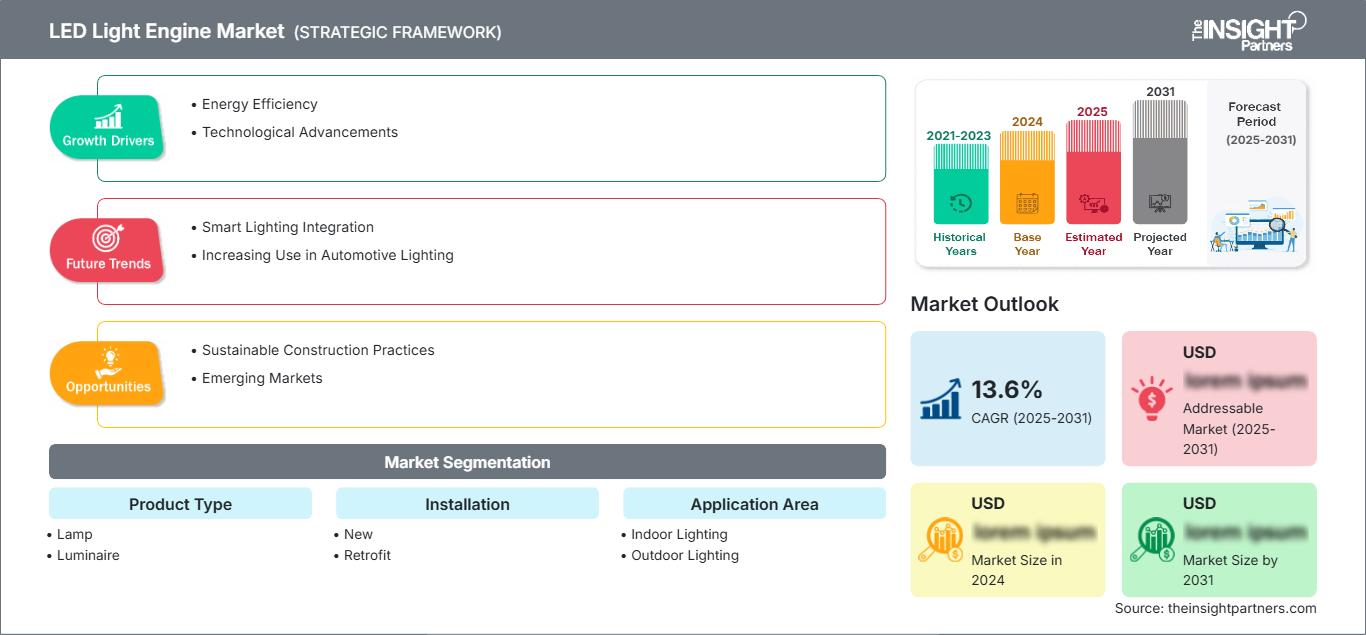
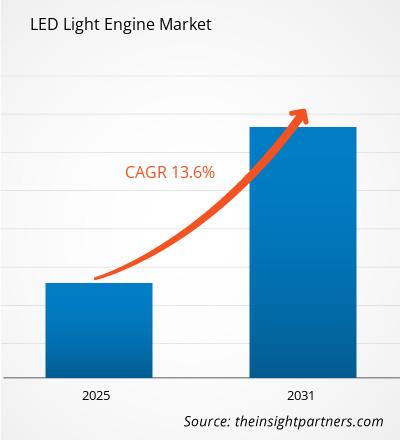
The LED Light Engine Market size was valued at US$ 10.06 Billion in 2025 and is projected to reach US$ 18.86 Billion by 2034, registering a CAGR of 7.23% during 2026–2034. The assessment covers product configuration, installation activity, application-area demand, regional development, technology evolution, competitive positioning, and strategic opportunities across lamps, luminaires, new installations, retrofit projects, indoor lighting, and outdoor lighting.
North America is expected to expand at an estimated CAGR of 6.8–7.6% during 2026–2034, supported by commercial renovation and increasing deployment of connected, energy-efficient lighting. Aging installed systems, tighter building-performance requirements, and demand for controllable luminaires are creating sustained opportunities for LED light-engine replacement and system upgrades across offices, healthcare, retail, and public infrastructure.
LED Light Engine Market Assessment and Insights
- North America is estimated to hold a 28–31% LED Light Engine Market share in 2025 and grow at a CAGR of 6.8–7.6% between 2026–2034, supported by commercial renovation, connected lighting, and energy-efficiency requirements.
- US represents 82–86% of North American demand in 2025 and is expected to grow at a CAGR of 6.7–7.5% during 2026–2034, supported by retrofit activity and smart-building investment.
- Europe accounts for 27–30% share in 2025 and is forecast to expand at a CAGR of 6.4–7.2% during 2026–2034, led by Germany, the UK, France, Italy, and Spain.
- Asia Pacific represents 31–34% share in 2025 and is projected to grow at a CAGR of 8.2–9.1% through 2034, with China, Japan, South Korea, and India providing major demand.
- Largest Segment is Luminaire, representing a 2025 market share of 64–68% and a CAGR of 6.9–7.5% during 2026–2034, reflecting integrated commercial and architectural deployments.
- High Growth Segment is Retrofit, representing a 2025 market share of 34–38% and a CAGR of 8.0–8.8% during 2026–2034, driven by installed-base modernization.
- Key companies analyzed in detail: Acuity Brands, Inc.; General Electric Company; Glamox AS; Hubbell Incorporated; IDEAL Industries, Inc.; Lutron Electronics Co., Inc.; OSRAM GmbH; Samsung Electronics Co., Ltd.; Signify Holding; Zumtobel Lighting GmbH.
Source: The Insight Partners' analysis based on proprietary research, government publications, company annual reports, investor presentations, industry databases, and expert interviews.
In the LED Light Engine Market, innovation has moved beyond the concept of replacing traditional lamps with a shift towards the creation of systems where lighting elements, thermal management, optics, drivers, controls, and connectivity features are designed as a single system. Luminaire designs are getting more modular, allowing manufacturers to create standardized light engines and vary only optics, housing, controls, and mounting systems. This strategy allows saving on redesign costs and improves the serviceability of luminaire systems. Efficacy has also been significantly increased, and according to IEA, the average efficacy of LEDs has almost doubled since 2015 reaching 230 lm/W in the best-available products.
Further innovation in the LED Light Engine Market will be associated with the development of connected lighting, module-based systems that can be used in retrofits, circularity and more value-added controls. New opportunities may be found in emerging markets due to building and infrastructure renovations with outdated lighting equipment. Lighting systems in commercial buildings and outdoors have consumed about 8% of the global electricity consumption, or roughly 2,200 TWh, according to IEA.
LED Light Engine Market Report Scope
| Report Attribute | Details |
|---|---|
| Market size in 2025 | US$ 10.06 Billion |
| Market Size by 2034 | US$ 18.86 Billion |
| Global CAGR (2026 - 2034) | 7.23% |
| Historical Data | 2021-2024 |
| Forecast period | 2026-2034 |
LED Light Engine Market Analysis
Growing demand for the LED Light Engine is driven by cycles of building renovations, performance-based energy requirements, connected buildings, and simpler manufacture of luminaires. The development of the LED Light Engine market is driven by standard modules which help manufacturers integrate light sources, optics, drivers, and heat sinks into the product while customizing it according to particular application. Ecosystem includes LED chip makers, package manufacturers, engine makers, luminaire makers, lighting designers, control system providers, distributors, installers, and end users of facilities. The key driver for retrofitting is demand for upgrading of existing fixtures.
Suppliers are affected by availability of LED packages, driver electronics, thermal materials, optics, electronics, and manufacturing process automation. Suppliers with large-scale production and diverse portfolios use their advantages to increase economies of scale, while specialists compete with flexible configurations of engine, high color quality, thermal performance, and compatibility with control systems. Standardization decreases assembly complexity, however, it makes pricing information more transparent. That is why suppliers differentiate on application engineering, modular approach, digital controls, maintenance services, and compatibility with existing infrastructure rather than lumens or efficiency.
Positioning in the LED Light Engine Market analysis is becoming more dependent upon the capability to integrate light engines with luminaires, controls, software, and project services. Acuity Brands, Inc. offers a wide portfolio of professional lighting solutions, and Signify Holding combines Philips branded lighting with connectivity. Zumtobel Lighting GmbH and Glamox AS have professional applications focus and special environments focus. Hubbell Incorporated is well positioned in commercial and industrial lighting, and Lutron Electronics Co., Inc. offers advanced controls capability.
General Electric Company, OSRAM GmbH, Samsung Electronics Co., Ltd., and IDEAL Industries, Inc. offer complementary competencies in lighting, components, electronics, and installation ecosystem. Investments are being made in modular architectures, connectivity controls, retrofit solutions, and application specific product design. Positioning strategy must include efficient manufacturing along with flexibility, so that common engine platform serves multiple luminaires, environments, and control requirements.
● REPORT CUSTOMIZATION
Tailor This Report To Align With Your Specific Business Requirements
This report can be customized to align precisely with your business objectives, scope, and target markets. Customization options include tailored segmentation, geography, competitive analysis, and strategic insights to support informed decision-making.
Customize This Report →WHAT YOU CAN ADJUST
- ● Segmentations
- ● Geography
- ● Competitive Analysis
- ● Language Preferences
LED Light Engine Market: Strategic Insights
Regional Insights
North America LED Light Engine Market
North America is estimated to represent 28–31% LED Light Engine Market in 2025 and is forecast to grow at a CAGR of 6.8–7.6% during 2026–2034. Strengths for the region include developed commercial real estate markets, developed networks for distributing lighting products, sophisticated controls adoption, and lighting installation infrastructure. Demand arises due to renovation projects, which involve old fluorescent or first-generation LED installations that need replacement or improvement. The United States is the main regional market, while Canada acts through commercial, industrial, and infrastructure projects.
The energy savings, controllability, lower maintenance cost, and compatibility with electrical infrastructure are becoming key considerations during purchases in the region. The use of smart buildings technology pushes the development of integration of luminaires, sensors, control systems, and building management systems. Retrofit projects offer good economics as an option for energy savings without any architectural remodeling projects. The share of the US market in regional demand is estimated at 82–86% in 2025, while the growth rate will be 6.7–7.5% up to 2034.
U.S. LED Light Engine Market
The U.S. accounts for 82–86% of North American LED Light Engine Market in 2025 and is expected to grow at a CAGR of 6.7–7.5% during 2026–2034. This market enjoys many commercial structures, professional lighting contractors, experienced use of controls, and high demand for energy-saving modernization. Large office space, warehouses, healthcare institutions, schools, retailers, and public structures offer varied replacement needs.
Acuity Brands, Inc., Hubbell Incorporated, General Electric Company, and Lutron Electronics Co., Inc. back distinct segments of the domestic lighting environment. Trending applications are focused on networked luminaires, occupancy-based control, tunable light, and retrofittable engines. Facility managers are also more likely to assess lighting systems based on their total operational costs than simply the cost of the fixtures themselves.
Europe LED Light Engine Market
Europe is estimated to hold 27–30% LED Light Engine Market in 2025 and is projected to grow at a CAGR of 6.4–7.2% through 2034. Germany is the leading one due to its industrial, commercial and lighting capabilities. The UK, France, Italy and Spain invest in the lighting retrofitting of their renovation, public, retail, hospitality and energy efficient projects. More and more, the demand is motivated by circular performance.
The UK offers good opportunities for the light-engine platforms retrofitting in office buildings, education, healthcare buildings and others where such platforms can be implemented without any construction activities. Germany offers the market with industrial, architectural and professional lighting sophistication. France specializes in public properties and commercial renovations; Italy – in hospitality, retail and architectural segments; Spain – in commercial buildings, tourism infrastructure and outdoor renovations. Nowdays, European customers evaluate more the durability, maintainability, material efficiency, controls compatibility and energy performance of light-engine platforms.
APAC LED Light Engine Market
Asia Pacific is estimated to represent 31–34% share in 2025 and is forecast to grow at a CAGR of 8.2–9.1% through 2034. China is the largest market, followed by Japan, South Korea, India, and Australia. The factors contributing to the regional demand include manufacturing scale, construction, urbanization, infrastructure development, and growing commercial constructions.
China enjoys both high levels of lighting manufacturing and large infrastructure needs. Japan and South Korea pay more attention to quality, controls, and electronics. India presents good prospects due to commercial construction and infrastructure upgrading. Australia features a demand for all kinds of lighting applications, including commercial, institutional, and outdoor. Increasing electricity consumption adds to the emphasis on energy efficiency. The IEA noted that 58% of the global growth in electricity demand in 2025 was due to China.
Middle East & Africa LED Light Engine Market
Middle East and Africa are projected to expand at a CAGR of 7.0–8.2% during 2026–2034. Regional activity is led by Saudi Arabia and UAE through large-scale urban developments, hospitality, transport, and smart city projects. South Africa represents a large sub-regional market, while Rest of MEA is fragmented with a project-based approach. Efficient solutions are now being sought after, in line with challenging operation environment.
Consumption patterns of energy, infrastructure development, and climate conditions impact the purchasing process. The large-scale building activities in Saudi Arabia offer possibilities in both indoor and outdoor markets, while UAE focuses on quality architecture and connected lighting. South Africa offers commercial and industrial market demands along with public infrastructure demands. Rest of MEA offers airport, road, port, hospitality, and institutional infrastructure opportunities. Products that have a long-life cycle, thermal efficiency, controllability, and easy maintenance are poised to be successful in the projects.
Segmentation Analysis
Product Type
Product Type segment in the LED Light Engine Market is projected to grow at a CAGR of 6.9–7.6% during 2026–2034. Product selection increasingly depends on application-specific lumen requirements, optical configuration, thermal conditions, maintenance strategy, and integration with controls. Luminaires are expected to retain the stronger position because complete fixtures provide greater design flexibility, system integration, and project-level differentiation.
- Lamp: Lamp-based engines remain relevant for applications requiring familiar form factors and relatively straightforward replacement. Their strategic importance is strongest where users prioritize installation simplicity, broad compatibility, and lower disruption across distributed lighting points.
- Luminaire: Luminaire-based engines support integrated optics, thermal management, controls, and mechanical design. Their importance is increasing in professional applications where performance, appearance, connectivity, and application-specific light distribution influence purchasing decisions.
Installation
Installation is projected to grow at a CAGR of 7.4–8.2% during 2026–2034. New projects enable optimized lighting architecture from the design stage, while retrofit projects benefit from the large installed base of older fixtures and first-generation LED products. The balance increasingly favors solutions that minimize labor, downtime, and electrical modifications.
- New: New installations allow lighting designers to optimize fixture geometry, optics, controls, wiring, and thermal management from project inception. Demand is linked to commercial construction, infrastructure development, industrial expansion, and new institutional facilities.
- Retrofit: Retrofit activity is strategically important because existing buildings offer a large replacement base. Customers increasingly seek higher efficacy, improved controls, reduced maintenance, and minimal installation disruption while retaining usable electrical and mechanical infrastructure.
Application Area
Application Area segment in the LED Light Engine Market is projected to grow at a CAGR of 7.1–7.8% during 2026–2034. Indoor applications remain important because offices, retail, healthcare, education, hospitality, and industrial buildings contain extensive installed lighting. Outdoor demand benefits from roadway, public-space, sports, logistics, and infrastructure modernization. Connected control adoption increasingly links both application environments.
- Indoor Lighting: Indoor applications require uniform illumination, glare management, color quality, controllability, and occupant comfort. Professional buildings increasingly combine luminaires with sensors and digital controls to improve operating efficiency and support flexible space management.
- Outdoor Lighting: Outdoor applications require durability, optical precision, thermal resilience, weather resistance, and efficient maintenance. Roadways, parking areas, logistics facilities, sports venues, and public spaces increasingly favor connected systems capable of remote monitoring and adaptive control.
Opportunity Snapshot
| Application Area | Revenue Contribution | Trend Tag | Adoption Stage |
|---|---|---|---|
| Indoor Lighting | High | Smart Controls | Scaling |
| Outdoor Lighting | Medium | Adaptive Lighting | Scaling |
LED Light Engine Market Growth Drivers and Impact Analysis
Retrofit economics are strengthening demand for modular lighting systems
The economics of retrofits are generating a lasting demand pathway, as property owners have the ability to increase the effectiveness of their lighting system without having to completely change out their electrical system and make other major modifications. Since LEDs come in engine form, installers have the opportunity to boost their performance in terms of efficacy, light quality, controllability, and ease of maintenance without having to touch up the existing infrastructure in place. This can save both time and effort for construction work in facilities like hospitals, schools, offices, warehouses, and retail buildings. There is more to the economic impact on commercial operations beyond the energy efficiency, as new lighting systems are capable of offering features like occupancy sensors, daylighting, scheduling, and remote monitoring. With lifecycle cost increasingly becoming an evaluation criterion for facilities, modular replacement makes more sense compared to constantly repairing old systems.
Connected controls are increasing the value of integrated light engines
Interconnected lighting is redefining the economic significance of light engines from merely a means of illumination to becoming an integral part of a much larger building management solution. Automation in terms of dimming, occupant sensing, scheduling, fault detection and energy reporting is possible through the use of sensors, wireless technology, digital controls and software. This makes it very important to have compatibility of light engines and control systems. Connected lighting enables building managers to control energy usage and at the same time obtain information on the usage from the devices. Signify’s Interact rollout to 2026 provides examples of how this can be done through interconnected solutions such as intelligent buildings and city lighting. The effect of this trend is a slow move from lumens and device prices to interoperability, data, cybersecurity, ease of installation and software support among others.
Higher LED efficacy is extending the replacement and upgrade cycle
Better LED efficacies have resulted in a second wave of replacements as some early LEDs are nearing the end of their useful lives and newer technology provides better efficacy for more efficient operations. According to IEA, efficacy of LED lighting has doubled since 2015 and can even go as high as 230 lm/W. In such cases, property owners may be able to replace fixtures not because of wear and tear but because new technologies will make them operate more efficiently. This is particularly important in large facilities and outdoors where little gains in efficacy can add up to hundreds of lights. Manufacturers will get an advantage from developing engines with better efficacy, life span, thermal stability, color constancy, and controls compatibility.
LED Light Engine Market Future Trends
Connected light engines will evolve toward data-enabled building infrastructure
The next generation of light engines is likely to become increasingly more integrated with building management systems, occupancy sensors, environmental controls, and digital facilities management systems. In future architecture, there should be greater emphasis on standardization of communications, wireless connectivity, remote diagnostics, and adaptive behavior. In this way, it would be possible for lighting systems to respond to occupancy, daylight, traffic, temperature, and scheduling as opposed to being static. It follows that the LED Light Engine Market trends point to systems where the lighting infrastructure not only delivers light but also provides information regarding operations. The effect of integration would also be evident in procurement where the facility owner must consider software compatibility, cybersecurity, device management, and upgradeability among other factors. For suppliers, open architecture will ensure improved interoperability across all buildings. Over time, the boundary between the luminaire and a smart building device will continue fading out.
Circular design will influence future engine and luminaire architectures
Circularity is likely to influence how future light engines are designed, supplied, serviced, and replaced. Manufacturers can reduce lifecycle waste through replaceable modules, standardized interfaces, repairable components, recyclable materials, and longer service availability. This approach can also lower maintenance costs because a failed engine may be replaced without discarding the entire luminaire. Professional customers increasingly have incentives to document material use, operating performance, and end-of-life treatment as sustainability requirements become more important in procurement. The transition will require suppliers to balance modularity with product reliability, sealing, thermal performance, and manufacturing economics. Standardized interfaces could improve aftermarket competition while also extending the useful life of installed housings. As a result, future product differentiation may depend increasingly on total lifecycle performance, serviceability, resource efficiency, and upgrade pathways rather than only initial efficacy.
LED Light Engine Market Opportunities
Large installed building portfolios create scalable retrofit opportunities
Large portfolios of offices, schools, hospitals, warehouses, retail properties, hotels, and public facilities offer scalable opportunities for suppliers capable of standardizing retrofit solutions across different building types. Investors and facility operators can prioritize products that minimize downtime, fit existing mounting arrangements, simplify commissioning, and integrate with established controls. Suppliers can create modular product families with configurable optics, color temperatures, power levels, and communication options while retaining common mechanical interfaces. This can reduce inventory complexity and accelerate project deployment. LED Light Engine Market Forecasts point toward continued expansion through 2034, making portfolio-level retrofit programs strategically important. Companies that combine equipment supply with auditing, controls integration, commissioning, and lifecycle support can capture a broader portion of project value. The opportunity is especially relevant where building owners are seeking measurable energy savings without major capital-intensive reconstruction.
Smart outdoor networks offer opportunities beyond illumination
Outdoor lighting networks present an opportunity to combine efficient illumination with connectivity, adaptive operation, maintenance monitoring, and infrastructure intelligence. Municipalities and infrastructure operators can deploy connected luminaires across roads, parking areas, public spaces, ports, airports, and logistics facilities. Central management platforms can provide visibility into operating status and enable light levels to respond to traffic, weather, or scheduled activity. Signify's 2026 Interact additions demonstrate the direction of this opportunity through connected outdoor management, centralized monitoring, and traffic- and weather-adaptive lighting. Suppliers can differentiate through interoperable controls, durable outdoor engines, simplified installation, and long-term service models. Partnerships with municipalities, utilities, engineering firms, and infrastructure operators can create recurring opportunities because outdoor networks require monitoring, maintenance, replacement, and periodic technology upgrades over extended operating lifecycles.
Recent Developments
- September 2026: Mphasis partnered with TechnoPro Holdings to bring its AI-powered Mphasis Modernize™ and Mphasis Optimize™ product lines, built on the Mphasis Tria™ Enterprise Agency platform, to the Japanese market. The collaboration will initially target financial services and manufacturing, helping organizations modernize legacy systems, optimize business operations and adopt AI-driven decision-making, while also providing cybersecurity, compliance and cloud-security solutions.
- June 2026: Inventronics expanded its North American manufacturing capabilities with the launch of four new indoor linear LED driver SKUs manufactured in Mexico for commercial and industrial lighting applications. The new drivers are designed to provide reliable performance and long-term dependability while bringing production closer to customers across North and South America, helping reduce supply-chain uncertainty and improve responsiveness.
- June 2025: Bridgelux expanded its Chip-on-Board (COB) portfolio with the launch of the DriveLux series of integrated light engines, combining COB technology with an advanced driver in a compact, replaceable design. The DX1 single-channel static-white series delivers up to 5,000 lumens, typical system efficacy of 138 lm/W and a 2700K–6500K CCT range, with compatibility with phase-cut and 0–10V dimming. The four-channel DX4 RGBW series enables dynamic white tuning and colour lighting for architectural, entertainment and specialty applications, incorporating Bridgelux’s phosphor-converted red LED technology for improved thermal performance and high-purity red output.
Frequently Asked Questions

- Comprehensive Market Sizing and Forecast Analysis
- Detailed Segmentation Analysis
- In-Depth Market Dynamics Assessment
- Regional and Country-Level Insights
- Competitive Landscape and Company Benchmarking
- Strategic Business Intelligence
Recent Reports
Testimonials

The Insight Partners provided valuable market intelligence that supported our global go-to-market strategy. Their team was professional, responsive, and attentive to our feedback, providing thoughtful analysis and helpful methodological clarifications throughout the project.
Junmo Kim Chief Financial Officer (CFO), Enertech Co., Ltd.
The Insight Partners' SCADA System Market report is comprehensive, with valuable insights on current trends and future forecasts. The team was highly professional, responsive, and supportive throughout. We are very satisfied and highly recommend their services.
RAN KEDEM Partner, Reali Technologies LTDs
I requested a report on a very specific software market and the team produced the report in a few days. The information was very relevant and well presented. I then requested some changes and additions to the report. The team was again very responsive and I got the final report in less than a week.
JEAN-HERVE JENN Chairman, Future Analytica
We worked with The Insight Partners for an important market study and forecast. They gave us clear insights into opportunities and risks, which helped shape our plans. Their research was easy to use and based on solid data. It helped us make smart, confident decisions. We highly recommend them.
PIYUSH NAGPAL Sr. Vice President, High Beam Global
The Insight Partners delivered insightful, well-structured market research with strong domain expertise. Their team was professional and responsive throughout. The user-friendly website made accessing industry reports seamless. We highly recommend them for reliable, high-quality research services
YUKIHIKO ADACHI CEO, Deep Blue, LLC.
This is the first time I have purchased a market report from The Insight Partners.While I was unsure at first, I visited their web site and felt more comfortable to take the risk and purchase a market report.I am completely satisfied with the quality of the report and customer service. I had several questions and comments with the initial report, but after a couple of dialogs over email with their analyst I believe I have a report that I can use as input to our strategic planning process.Thank you so much for taking the extra time and making this a positive experience.I will definitely recommend your service to others and you will be my first call when we need further market data.
JOHN SUZUKI President and Chief Executive Officer, Board Director, BK Technologies
I wish to appreciate your support and the professionalism you displayed in the course of attending to my request for information regarding to infectious disease IVD market in Nigeria. I appreciate your patience, your guidance, and the fact that you were willing to offer a discount, which eventually made it possible for us to close a deal. I look forward to engaging The Insight Partners in the future, all thanks to the impression you have created in me as a result of this first encounter.
DR CHIJIOKE ONYIA MANAGING DIRECTOR, PineCrest Healthcare Ltd.Reason to Buy
- Informed Decision-Making
- Understanding Market Dynamics
- Competitive Analysis
- Identifying Emerging Markets
- Customer Insights
- Market Forecasts
- Risk Mitigation
- Boosting Operational Efficiency
- Strategic Planning
- Investment Justification
- Tracking Industry Innovations
- Aligning with Regulatory Trends





 Get Free Sample for