
Level Transmitter Market Size, Share & Demand by 2034
Coverage: by Type (Capacitive, Ultrasonic, Radar, Differential Pressure/Hydrostatic, Magnetostrictive, Radiometric, and Others); Technology (Contact and Non-Contact); Industry (Oil & Gas, Chemicals, Water & Wastewater, Food & Beverages, Pharmaceuticals, Power, Metals & Mining, and Others), and Geography (North America, Europe, Asia Pacific, and South and Central America)
- Status : Data Released
- Report Code : TIPEL00002499
- Category : Electronics and Semiconductor
- No. of Pages : 150
- Available Report Formats :


- Last update date : October 16, 2026


2025 Market Size
US$ 4.33 Bn
Base year value
2034 Forecast
US$ 7.75 Bn
Projected by 2034
CAGR 2026-2034
6.67 %
Growth rate
Addressable Market
US$ 54.57 Bn
(2026-2034)
The Level Transmitter Market was valued at US$ 4.33 Billion in 2025 and is projected to reach US$ 7.75 Billion by 2034, registering a CAGR of 6.67% during 2026–2034. The market covers continuous measurement instruments used to monitor liquid, slurry, and bulk-solid levels in tanks, vessels, silos, reservoirs, and process equipment. Demand spans process industries where accurate level measurement supports process control, inventory management, safety, environmental compliance, and operational efficiency.
North America is a mature demand center supported by process automation, replacement of aging instrumentation, and modernization of water, chemical, energy, and manufacturing assets. The Level Transmitter Market size in the region is supported by a modeled CAGR of ~6% through 2034. Increasing use of digital transmitters, wireless measurement, and non-contact technologies is strengthening retrofit opportunities, particularly where wiring costs or difficult access make conventional measurement approaches less economical.
Level Transmitter Market Assessment and Insights
Regional Outlook
- North America: ~27% of the global market in 2025 | ~6% CAGR through 2034. Market position: North America is a major mature market supported by process automation, extensive oil and gas infrastructure, water utility modernization, chemical production, and replacement of installed instrumentation with digitally enabled measurement solutions.
- US: ~80% of North American market revenue in 2025 | ~6% CAGR through 2034. Market position: The US represents the principal demand base within North America, supported by sophisticated process industries, automation investment, water infrastructure requirements, and broad adoption of radar, differential-pressure, ultrasonic, and wireless measurement technologies.
- Europe: ~24% of the global market in 2025 | ~6% CAGR through 2034. Market position: Europe combines a mature installed base with continuing automation and replacement demand. Germany is the leading country in Europe, while the UK, France, Italy, and Spain provide significant requirements across process manufacturing, utilities, energy, and pharmaceuticals.
- Asia Pacific: ~37% of the global market in 2025 | ~8% CAGR through 2034. Market position: Asia Pacific is the largest and fastest-growing region, supported by industrial expansion, water infrastructure, petrochemical capacity, manufacturing investment, and increasing automation. China leads the region, with Japan, South Korea, India, and Australia adding diverse demand.
Segment Outlook
- Radar: ~32% Share in 2025 | ~8% CAGR through 2034. Market position: Radar leads technology demand because non-contact measurement performs effectively across challenging process conditions involving vapor, pressure, temperature, foam, dust, and corrosive media, while digital configuration increasingly improves installation and diagnostics.
- Water & Wastewater: ~23% Share in 2025 | ~8% CAGR through 2034. Market position: Water and wastewater represents the high-growth industry opportunity as utilities expand treatment capacity, modernize pumping and storage infrastructure, improve process monitoring, and deploy connected instrumentation for remote operational management.
Competitive Coverage
Emerson Electric Co., ABB Ltd., Siemens AG, Yokogawa Electric Corporation, Honeywell International Inc., GE, SAPCON INSTRUMENTS, Dwyer Instruments, Inc., Jaycee Technologies Private Limited, Semrad Pty Ltd.
Methodology
The Insight Partners follows Data Collection & Secondary Research, Primary Research, Data Analysis, and Data Triangulation & Final Review to validate market estimates and insights.
Source: The Insight Partners' analysis based on proprietary research, government publications, company annual reports, investor presentations, industry databases, and expert interviews.
Level measurement techniques have developed from fairly straightforward pressure gauges, floats and contact sensors to become intelligent systems able to perform constant monitoring, communicate digitally, provide diagnostics, and be configured remotely. The development of radar and ultrasonic techniques has increased the use of non-contact measurement methods, especially those situations where contacting with the process medium may pose maintenance or reliability problems. Differential pressure and hydrostatic measurement techniques still play an important part because of the existing base of installations and applicability to liquids, tanks, vessels and utility systems.
Changing dynamics of production and procurement are evident as users look at measuring devices as parts of automation systems rather than independent instruments. Instruments are now offered as combinations of sensing equipment, digital communication interfaces, configuration software, diagnostic capabilities and even wireless communication capabilities. This enables level measurement to take on the role of process and equipment monitoring and optimization, while decreasing the engineering needed for instrument integration with distributed control and supervisory systems.
The future prospects are more and more connected with investments in industrial automation in Asia Pacific, water infrastructure development, process industry automation and instrumentation replacement. Environmental protection, process safety and reliability regulation are among drivers for upgrading measurement.
Level Transmitter Market Report Scope
| Report Attribute | Details |
|---|---|
| Market size in 2025 | US$ 4.33 Billion |
| Market Size by 2034 | US$ 7.75 Billion |
| Global CAGR (2026 - 2034) | 6.67% |
| Historical Data | 2021-2024 |
| Forecast period | 2026-2034 |
Level Transmitter Market Analysis
The Level Transmitter Market growth is being shaped by industrial automation, process safety, infrastructure replacement, and the need for continuous visibility into tanks and process vessels. Oil and gas facilities use level transmitters for storage, separators, process vessels, and inventory management, while chemicals, pharmaceuticals, food and beverages, and power facilities require accurate measurement under different temperature, pressure, hygiene, and material conditions. Water and wastewater applications add demand through reservoirs, treatment tanks, pumping stations, and open-channel monitoring.
The value chain extends from sensing components and electronics to complete transmitters, engineering services, distributors, system integrators, and plant operators. Supply dynamics increasingly favor manufacturers capable of supporting multiple measurement principles because application conditions vary substantially. Radar is suited to difficult process environments, ultrasonic supports many non-contact liquid and solids applications, while differential pressure and hydrostatic instruments remain practical for established installations. Wireless options can further reduce infrastructure requirements in remote or difficult-to-wire measurement points.
The Level Transmitter Market analysis also indicates increasing competition around digitalization rather than sensing technology alone. Emerson Electric Co. offers radar, guided-wave radar, differential-pressure, magnetostrictive, and wireless solutions, while ABB Ltd. maintains portfolios spanning radar, guided-wave radar, ultrasonic, and submersible technologies. Siemens AG, Yokogawa Electric Corporation, and Honeywell International Inc. similarly participate in process measurement and automation ecosystems. These suppliers compete through measurement reliability, application expertise, communication protocols, diagnostics, safety certifications, and lifecycle support.
Investment strategies have been shifting towards miniaturized radars, wireless instruments, enhanced signal processing, and specialized measurements. The competitive strength of GE, SAPCON INSTRUMENTS, Dwyer Instruments, Inc., Jaycee Technologies Private Limited, and Semrad Pty Ltd. comes from the diversified offering in different regional markets and specializations. Consequently, strategic alignment requires a balance between the market share of the Level Transmitter Market and specialized engineering. Specialized suppliers to the difficult industries can leverage reliability and certifications, while regional suppliers can leverage custom solutions.
● REPORT CUSTOMIZATION
Tailor This Report To Align With Your Specific Business Requirements
This report can be customized to align precisely with your business objectives, scope, and target markets. Customization options include tailored segmentation, geography, competitive analysis, and strategic insights to support informed decision-making.
Customize This Report →WHAT YOU CAN ADJUST
- ● Segmentations
- ● Geography
- ● Competitive Analysis
- ● Language Preferences
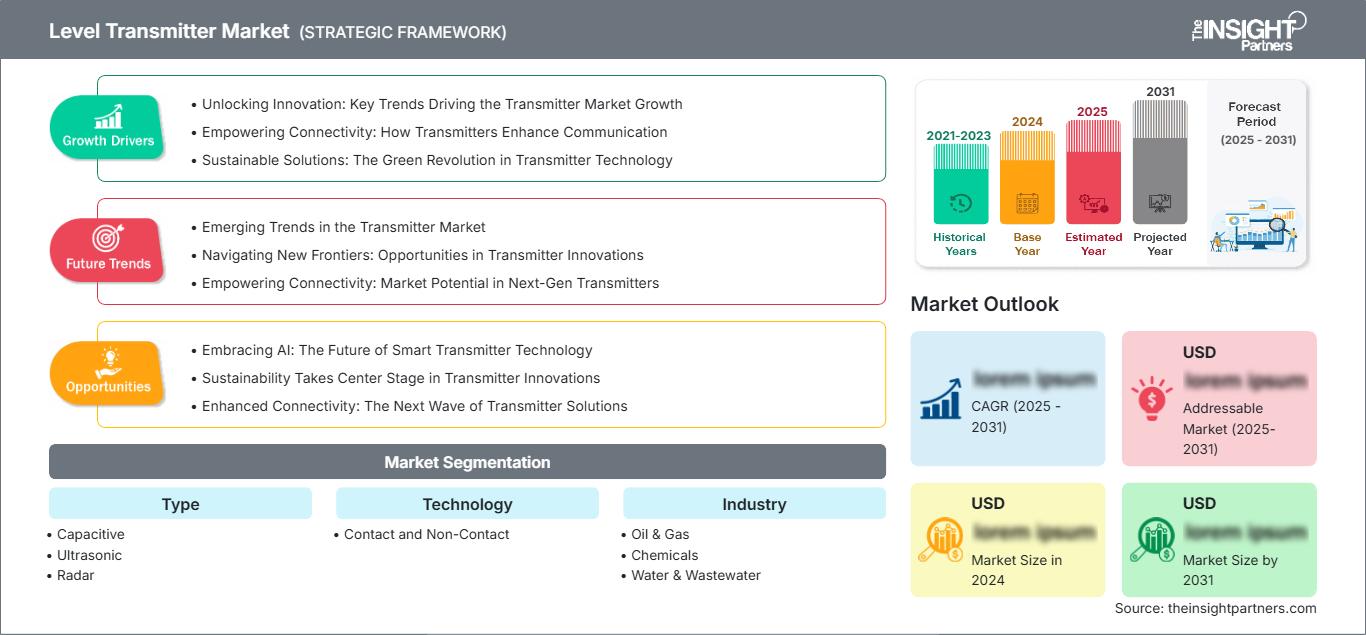
Level Transmitter Market: Strategic Insights
Regional Insights
North America Level Transmitter Market
North America represents ~27% of global Level Transmitter Market revenue in 2025 and is projected to expand at a CAGR of ~6% through 2034. There are many installations across various sectors including oil & gas, refining, chemical, power generation, food processing, mining, and municipal water systems. The replacement market is significant since operators now require superior diagnostics, ease of installation and the capability to integrate with current automation technology.
North America forms the majority of demand from this region, with contributions from Canada from sectors like energy, mining, chemicals, and utilities. The radar and wireless level measuring techniques are especially important where there is the need for constant measurement without the installation of extra cabling. Utilities also have to measure constantly to keep track of reservoirs, pump stations, treatment processes and storage systems.
U.S. Level Transmitter Market
The US represents ~80% of North American Level Transmitter Market revenue in 2025 and is expected to grow at a CAGR of ~6% through 2034. The demand is spread across oil and gas, chemicals, power, food and beverages, pharmaceuticals, metals and mining, and water infrastructure. In the replacement of installed transmitters, the operators now give consideration to remote diagnostics, digital communications, and accuracy of measurement.
Instruments such as Emerson Electric Co., Honeywell International Inc., GE, and Siemens AG, among others cater to the large number of process industries in the country. The need for radar is increasing as some tanks and vessels face issues due to vapor and pressure in process variations that make measurements difficult using traditional methods. The wireless transmitter becomes another way of measuring remote tanks and minimizing the difficulties of installation.
Europe Level Transmitter Market
Europe accounts for ~24% of the global Level Transmitter Market in 2025 and is expected to register a CAGR of ~6% through 2034. Germany is the leading country in Europe, supported by its large industrial base, process engineering capabilities, chemicals production, manufacturing infrastructure, and strong automation ecosystem. The UK has substantial demand across energy, water, chemicals, food processing, and industrial facilities, with the replacement of legacy instrumentation supporting ongoing sales.
France contributes through chemicals, pharmaceuticals, food processing, energy, and water infrastructure, while Italy has demand across manufacturing, chemicals, food and beverages, and municipal utilities. Spain combines industrial applications with water-management requirements and infrastructure modernization. Across these countries, buyers increasingly prioritize measurement reliability, integration with automation platforms, lifecycle support, and lower maintenance requirements rather than simply replacing instruments on a like-for-like basis.
European suppliers and global vendors compete through high-performance radar, guided-wave radar, differential-pressure, ultrasonic, and specialized technologies. Regulatory attention to industrial safety, environmental performance, and resource efficiency provides a supportive framework for instrumentation investment. The mature installed base means growth is increasingly dependent on modernization and technology substitution, particularly where intelligent transmitters can improve process visibility or reduce field-service requirements.
APAC Level Transmitter Market
Asia Pacific Level Transmitter Market represents ~37% of global revenue in 2025 and is projected to grow at a CAGR of ~8% through 2034, making it the fastest-growing region. China is the leading country in Asia Pacific, supported by manufacturing, chemicals, petrochemicals, power, water infrastructure, and industrial automation. Japan and South Korea contribute through advanced manufacturing and process technology.
India is generating additional demand through industrial expansion, water infrastructure, pharmaceuticals, chemicals, and manufacturing investment, while Australia provides requirements from mining, energy, utilities, and processing. Regional growth is supported by new facilities as well as modernization of existing plants. Increasing use of radar, ultrasonic, and digitally connected instruments is allowing operators to improve process visibility while integrating measurement devices into wider automation architectures.
Middle East & Africa Level Transmitter Market
The Middle East & Africa Level Transmitter Market is projected to grow at a CAGR of ~7% through 2034. Saudi Arabia is the leading country in the Middle East & Africa market where the available evidence supports that position, reflecting substantial oil and gas, refining, petrochemical, water, and infrastructure activity. The UAE also represents a significant demand center through energy, desalination, industrial, and commercial projects.
South Africa provides an important African base across mining, water, chemicals, power, and industrial processing, while the rest of MEA presents opportunities linked to municipal infrastructure and energy projects. Harsh operating environments increase the importance of reliable measurement, while desalination and water-management investments create requirements for continuous level monitoring. Radar and ultrasonic systems are relevant where non-contact measurement can simplify maintenance or withstand demanding process conditions.
Segmentation Analysis
Type
The Type segment consists of Contact and Non-Contact technologies. Contact instruments remain important where established process configurations and direct measurement methods provide reliable performance, but non-contact solutions are gaining strategic importance in demanding applications. The Type segment is expected to grow at a CAGR of ~7% through 2034, supported by modernization and increasing preference for reduced-maintenance measurement.
- Contact: Contact transmitters directly interact with the measured medium or use an inserted sensing element. They remain relevant in applications where vessel geometry, process characteristics, installation requirements, and established maintenance practices favor direct measurement.
- Non-Contact: Non-contact transmitters measure without direct process interaction and are increasingly selected for corrosive, high-temperature, high-pressure, dusty, or hygienically sensitive environments. Their ability to simplify maintenance supports adoption across industrial and utility applications.
Technology
The Technology segment includes Capacitive, Ultrasonic, Radar, Differential Pressure/Hydrostatic, Magnetostrictive, and Radiometric solutions. Technology selection depends on medium characteristics, vessel geometry, temperature, pressure, dielectric properties, accuracy requirements, safety conditions, and maintenance considerations. The Technology segment is projected to grow at a CAGR of ~7% through 2034.
- Capacitive: Capacitive transmitters are suited to applications where changes in dielectric properties can be reliably correlated with level. They remain relevant for selected liquid and solid measurements where simple installation and established operating practices are advantageous.
- Ultrasonic: Ultrasonic instruments provide non-contact measurement for many liquid and solids applications. They are particularly useful where users require straightforward installation, open-channel measurement, or monitoring of tanks without inserting components into the process.
- Radar: Radar is increasingly selected for demanding applications because microwave measurement is less affected by temperature, pressure, vapor, and many process disturbances. It supports high-value applications in oil and gas, chemicals, water, power, and industrial storage.
- Differential Pressure/Hydrostatic: These technologies remain important across established liquid-level installations because they are well understood, widely supported, and compatible with many process vessels. Their installed base creates recurring replacement and modernization demand.
- Magnetostrictive: Magnetostrictive transmitters provide precise measurement for applications requiring dependable point-to-continuous level information. They are relevant where high accuracy, external mounting, or compatibility with magnetic level indicators supports the installation requirement.
- Radiometric: Radiometric transmitters are used for specialized process environments where conventional sensing is difficult because of extreme conditions, vessel configuration, or process constraints. Their strategic importance is concentrated in demanding industrial applications requiring measurement without process penetration.
Industry
The Industry segment covers Oil & Gas, Chemicals, Water & Wastewater, Food & Beverages, Pharmaceuticals, Power, and Metals & Mining. Oil and gas remains a major revenue contributor because level measurement is embedded across production, processing, storage, and transportation operations. The Industry segment is projected to grow at a CAGR of ~7% through 2034.
- Oil & Gas: Level transmitters support separators, storage tanks, process vessels, terminals, and refinery operations. Measurement reliability is strategically important because level information influences inventory control, process stability, safety systems, and
- Chemicals: Chemical processing requires measurement across corrosive, reactive, volatile, and temperature-sensitive materials. Radar, differential pressure, capacitive, and other technologies are selected according to process compatibility and vessel conditions.
- Water & Wastewater: Utilities use transmitters across reservoirs, treatment tanks, pumping stations, and process stages. Demand is supported by infrastructure modernization, remote monitoring, treatment expansion, and the need for dependable measurement in continuously operated facilities.
- Food & Beverages: Hygienic processing requirements influence transmitter selection in tanks and process vessels. Manufacturers prioritize cleanability, material compatibility, measurement stability, and integration with automated production and quality-control systems.
- Pharmaceuticals: Pharmaceutical manufacturing requires reliable level measurement under controlled and hygienic conditions. Instrument selection emphasizes cleanable designs, process compatibility, repeatability, and integration with automated production systems.
- Power: Power facilities use level measurement across water, fuel, chemical, and process systems. Reliability is critical because measurement supports continuous plant operation, equipment protection, inventory management, and process-control functions.
- Metals & Mining: Mining and metals operations require measurement in storage, slurry, processing, and water-management applications. Robust instruments are valued where dust, solids, corrosive materials, vibration, and difficult access increase maintenance requirements.
Opportunity Snapshot
| Industry | Revenue Contribution | Trend Tag | Adoption Stage |
|---|---|---|---|
| Oil & Gas | High | Process Safety | Mature |
| Chemicals | High | Smart Processing | Scaling |
| Water & Wastewater | High | Utility Digitization | Scaling |
| Food & Beverages | Medium | Hygienic Control | Scaling |
| Pharmaceuticals | Medium | Clean Processing | Scaling |
| Power | High | Plant Automation | Mature |
| Metals & Mining | Medium | Remote Monitoring | Scaling |
Level Transmitter Market Growth Drivers and Impact Analysis
Industrial Automation and Continuous Process Monitoring
Industrial facilities increasingly require continuous measurement to maintain stable processes, improve productivity, and detect deviations before they become operational problems. Level transmitters provide a direct measurement input for control systems, enabling automated regulation of tanks, vessels, pumps, and process stages. As plants move toward more integrated automation architectures, measurement instruments become important data sources rather than standalone field devices. This raises demand for transmitters that provide stable signals, diagnostics, digital communication, and remote configuration. The impact is particularly strong in oil and gas, chemicals, power, pharmaceuticals, and food processing, where process interruptions can generate substantial operational costs. Manufacturers that combine accurate sensing with automation compatibility can therefore capture replacement demand as facilities modernize control systems.
Water Infrastructure Expansion and Asset Modernization
Water and wastewater facilities require dependable level measurement across reservoirs, treatment tanks, pump stations, channels, and storage infrastructure. Infrastructure expansion in developing economies and modernization in mature markets create two complementary demand streams. New facilities require instrumentation as part of automated process design, while existing facilities increasingly replace aging devices with instruments that provide better reliability and remote visibility. Level transmitters can help operators manage pump operation, avoid overflow conditions, monitor treatment stages, and improve asset utilization. Non-contact ultrasonic and radar systems are particularly relevant in applications where corrosion, contamination, or difficult access makes frequent physical intervention undesirable. The combination of infrastructure investment and digital utility management therefore supports sustained demand beyond traditional industrial applications.
Shift Toward Wireless and Non-Contact Measurement
Wireless communication and non-contact sensing are changing the economics of level measurement in remote or difficult-to-access installations. Traditional wired instrumentation can require engineering, conduit, cabling, commissioning, and physical access that add project complexity. Wireless transmitters can reduce these requirements, while radar and ultrasonic instruments can avoid direct process contact. Emerson's Rosemount 3408, for example, demonstrates how native WirelessHART connectivity can extend automated level measurement to remote locations and reduce cabling complexity. The commercial impact is strongest where measurement points are numerous, geographically dispersed, difficult to reach, or expensive to wire. This creates opportunities for suppliers to compete on total installation cost and lifecycle efficiency rather than transmitter hardware alone.
Level Transmitter Market Future Trends
Edge Diagnostics and Measurement Intelligence
Level transmitters are likely to incorporate progressively stronger diagnostic capabilities that help operators distinguish genuine process changes from measurement disturbances. Signal-quality assessment, echo analysis, device-health information, and remote configuration can reduce troubleshooting time and improve confidence in automated control inputs. Advanced radar products already demonstrate the direction of this development through embedded algorithms designed to interpret difficult measurement conditions. As plants become more connected, measurement intelligence can also support maintenance planning by identifying instruments that require attention before failures affect operations. The Level Transmitter Market trends therefore point toward a shift from instruments that simply communicate a level value to devices that explain measurement quality, operating conditions, and potential maintenance requirements.
Integration with Industrial Data Architectures
Future level measurement deployments are expected to become more tightly integrated with plantwide data architectures, including distributed control systems, asset-management platforms, supervisory systems, and industrial analytics. Standardized communication and digital interfaces can make field data easier to access and use across engineering and operations teams. This development is particularly important for large process facilities where thousands of measurement points may contribute to operational decisions. Wireless and Ethernet-enabled instruments can further reduce the barriers to collecting data from remote assets. The resulting architecture may enable organizations to combine level information with pressure, flow, temperature, and equipment-health data, creating a more complete view of process performance and supporting data-driven maintenance and optimization.
Level Transmitter Market Opportunities
Digital Retrofit Programs for Aging Process Assets
A large installed base of conventional level instruments creates an opportunity for suppliers that can offer retrofit products without requiring extensive modifications to tanks, vessels, or control infrastructure. Customers can prioritize assets where measurement failures, maintenance costs, wiring limitations, or outdated communication interfaces create operational disadvantages. Retrofit packages combining transmitters, configuration tools, installation services, and communication gateways can simplify purchasing and reduce engineering requirements. Vendors with broad technology portfolios can address different process conditions within the same facility, while specialists can focus on high-value niches such as hazardous environments, hygienic applications, or difficult solids measurement. The Level Transmitter Market Forecasts are therefore influenced not only by new industrial construction but also by the scale and timing of replacement investment across existing assets.
Application-Specific Solutions for Difficult Measurement Conditions
Demand for specialized measurement provides opportunities for suppliers to develop products around particular process challenges rather than competing solely through general-purpose specifications. High-pressure vessels, corrosive chemicals, dusty silos, foaming liquids, extreme temperatures, hygienic processes, and remote reservoirs each create different requirements. Radar platforms with advanced signal processing can address difficult vessel conditions, while ultrasonic and hydrostatic systems remain relevant where their measurement principles match the application. Suppliers can create value through engineering support, application selection, commissioning, and lifecycle services around these products. The opportunity is particularly relevant in chemicals, oil and gas, mining, pharmaceuticals, and water infrastructure, where the cost of an unreliable measurement point can exceed the purchase price of the instrument itself.
Recent Developments
- October 2025: Emerson launched the Rosemount 3408, the world's first native WirelessHART non-contacting radar level transmitter, using 80 GHz FMCW technology to reliably measure liquid/solid levels in remote or hard-to-access locations across industries like energy, chemical, mining, and marine, with built-in diagnostics for improved reliability and reduced downtime.
- September 2025: NOVUS launched the WL320, a slim (19 mm diameter) submersible level transmitter built in 316L stainless steel with IP68 sealing, designed for wells and narrow guide tubes to measure water and mildly corrosive liquids, compatible with PLCs, indicators, and data loggers for local or remote monitoring.
Frequently Asked Questions

- Comprehensive Market Sizing and Forecast Analysis
- Detailed Segmentation Analysis
- In-Depth Market Dynamics Assessment
- Regional and Country-Level Insights
- Competitive Landscape and Company Benchmarking
- Strategic Business Intelligence
Recent Reports
Testimonials

The Insight Partners provided valuable market intelligence that supported our global go-to-market strategy. Their team was professional, responsive, and attentive to our feedback, providing thoughtful analysis and helpful methodological clarifications throughout the project.
Junmo Kim Chief Financial Officer (CFO), Enertech Co., Ltd.
The Insight Partners' SCADA System Market report is comprehensive, with valuable insights on current trends and future forecasts. The team was highly professional, responsive, and supportive throughout. We are very satisfied and highly recommend their services.
RAN KEDEM Partner, Reali Technologies LTDs
I requested a report on a very specific software market and the team produced the report in a few days. The information was very relevant and well presented. I then requested some changes and additions to the report. The team was again very responsive and I got the final report in less than a week.
JEAN-HERVE JENN Chairman, Future Analytica
We worked with The Insight Partners for an important market study and forecast. They gave us clear insights into opportunities and risks, which helped shape our plans. Their research was easy to use and based on solid data. It helped us make smart, confident decisions. We highly recommend them.
PIYUSH NAGPAL Sr. Vice President, High Beam Global
The Insight Partners delivered insightful, well-structured market research with strong domain expertise. Their team was professional and responsive throughout. The user-friendly website made accessing industry reports seamless. We highly recommend them for reliable, high-quality research services
YUKIHIKO ADACHI CEO, Deep Blue, LLC.
This is the first time I have purchased a market report from The Insight Partners.While I was unsure at first, I visited their web site and felt more comfortable to take the risk and purchase a market report.I am completely satisfied with the quality of the report and customer service. I had several questions and comments with the initial report, but after a couple of dialogs over email with their analyst I believe I have a report that I can use as input to our strategic planning process.Thank you so much for taking the extra time and making this a positive experience.I will definitely recommend your service to others and you will be my first call when we need further market data.
JOHN SUZUKI President and Chief Executive Officer, Board Director, BK Technologies
I wish to appreciate your support and the professionalism you displayed in the course of attending to my request for information regarding to infectious disease IVD market in Nigeria. I appreciate your patience, your guidance, and the fact that you were willing to offer a discount, which eventually made it possible for us to close a deal. I look forward to engaging The Insight Partners in the future, all thanks to the impression you have created in me as a result of this first encounter.
DR CHIJIOKE ONYIA MANAGING DIRECTOR, PineCrest Healthcare Ltd.Reason to Buy
- Informed Decision-Making
- Understanding Market Dynamics
- Competitive Analysis
- Identifying Emerging Markets
- Customer Insights
- Market Forecasts
- Risk Mitigation
- Boosting Operational Efficiency
- Strategic Planning
- Investment Justification
- Tracking Industry Innovations
- Aligning with Regulatory Trends





 Get Free Sample for