
Lithium-Sulfur (Li-S) Battery Market Demand, Size & Forecast by 2034
Coverage: By Type (Low Energy Density, High Energy Density); Power Capacity (0-500mAh, 501-1000mAh, More than 1000mAh); End-Use Industry (Aerospace, Automotive, Electronic Device, Power and Energy, Others) , and Geography (North America, Europe, Asia Pacific, and South and Central America)
- Status : Data Released
- Report Code : TIPRE00029309
- Category : Electronics and Semiconductor
- No. of Pages : 150
- Available Report Formats :


- Last update date : October 13, 2026


2025 Market Size
US$ 318.31 Bn
Base year value
2034 Forecast
US$ 1,168.78 Bn
Projected by 2034
CAGR 2026-2034
15.55 %
Growth rate
Addressable Market
US$ 6,320.67 Bn
(2026-2034)
The lithium-sulfur battery market was valued at US$ 318.31 Billion in 2025 and is projected to reach US$ 1,168.78 Billion by 2034, expanding at a CAGR of 15.55% during 2026–2034. Growing emphasis on lightweight, high-energy-density energy storage solutions across transportation, aerospace, and advanced electronics continues to strengthen commercialization efforts. Ongoing material innovations, improvements in sulfur cathode stability, and expanding industrial collaborations are expected to support long-term market expansion while accelerating adoption across multiple high-value applications.
Across North America, research commercialization, government-backed battery innovation programs, and increasing investment in next-generation energy storage technologies continue to reinforce industry development. The lithium-sulfur battery market size is supported by growing demand from aerospace and electric mobility applications, while manufacturing partnerships and pilot-scale production facilities improve supply capabilities. The regional market is anticipated to expand at a CAGR ranging between 14.8% and 16.2% through 2034 as commercialization activities continue to accelerate.
Lithium-Sulfur (Li-S) Battery Market Assessment and Insights
- North America: Strong investments in advanced battery research, expanding domestic manufacturing capabilities, and increasing aerospace demand position the region as a leading revenue contributor, accounting for 34–38% share in 2025 and expanding at a CAGR between 14.8–16.2% during 2026–2034.
- US: Extensive research funding, established battery technology developers, and increasing defense and aerospace applications support regional leadership, representing 74–78% of the North American market in 2025 while registering a CAGR between 14.9–16.1% during 2026–2034.
- Europe: Sustainability regulations, battery manufacturing initiatives, and automotive electrification continue to stimulate demand across Germany, France, the UK, Italy, and Spain, contributing 26–30% share in 2025 with a CAGR between 15.2–16.5% during 2026–2034.
- Asia Pacific: Large-scale battery manufacturing ecosystems, supportive government policies, and expanding electric vehicle production across China, Japan, South Korea, and India drive regional growth, accounting for 28–32% share in 2025 and recording a CAGR between 16.2–17.6% during 2026–2034.
- Largest Segment: Automotive remains the leading end-use industry owing to increasing electric vehicle development and demand for lightweight batteries, contributing 39–43% market share in 2025 while advancing at a CAGR between 15.8–17.0% during 2026–2034.
- High Growth Segment: High Energy Density batteries continue to witness the strongest momentum as manufacturers prioritize extended driving range and weight reduction, accounting for 54–58% market share in 2025 and growing at a CAGR between 16.5–17.9% during 2026–2034.
- Key companies analyzed in detail: OXIS Energy Ltd., PolyPlus Battery Company, Sion Power Corporation, LG Chem Ltd., Morrow Batteries AS, Williams Advanced Engineering Limited, Giner Inc., Lyten Inc., NexTech Batteries, Inc., Li-S Energy Limited.
Source: The Insight Partners' analysis based on proprietary research, government publications, company annual reports, investor presentations, industry databases, and expert interviews.
Advancements in sulfur cathode engineering, electrolyte optimization, and lithium metal anode protection have significantly influenced the commercial evolution of the lithium-sulfur battery market. Continuous improvements in cycle life, energy density, and manufacturing scalability have encouraged wider participation from battery developers, automotive suppliers, and aerospace manufacturers. Strategic collaborations between technology innovators and research institutions are accelerating pilot-scale production, while increasing emphasis on sustainable battery chemistries and reduced dependence on critical minerals continues to reshape production strategies and strengthen global supply chains.
Looking ahead, commercialization is expected to expand beyond established markets into emerging manufacturing hubs across the Asia Pacific and selected European economies. Favorable policy support for advanced battery technologies, increasing investments in domestic battery production, and expanding public-private partnerships are expected to improve manufacturing capacity and technology readiness. As performance reliability continues to improve, the lithium-sulfur battery market growth trajectory is anticipated to benefit from broader adoption across electric mobility, aviation, and stationary energy storage applications.
Lithium-Sulfur (Li-S) Battery Market Report Scope
| Report Attribute | Details |
|---|---|
| Market size in 2025 | US$ 318.31 Billion |
| Market Size by 2034 | US$ 1,168.78 Billion |
| Global CAGR (2026 - 2034) | 15.55% |
| Historical Data | 2021-2024 |
| Forecast period | 2026-2034 |
Lithium-Sulfur (Li-S) Battery Market Analysis
The lithium-sulfur battery market continues to benefit from increasing demand for lightweight, high-capacity energy storage solutions across automotive, aerospace, and portable electronics industries. The lithium-sulfur battery market growth is supported by continuous research into sulfur-based cathode materials, improved electrolyte formulations, and protective lithium metal technologies that enhance battery longevity. Strengthening collaboration among raw material suppliers, battery manufacturers, research institutions, and end-use industries is creating a more resilient value chain while reducing commercialization barriers.
Supply chain development remains a key priority within the Lithium-Sulfur Battery Market report as manufacturers expand pilot production facilities and establish strategic partnerships to secure critical materials and improve manufacturing efficiency. Rising investment in sustainable battery technologies, coupled with regulatory initiatives promoting low-carbon transportation and energy storage, is encouraging commercialization at a faster pace. These factors are expected to improve production economics while supporting broader adoption across multiple industrial applications.
The lithium-sulfur battery market analysis indicates that competition is increasingly centered on proprietary material technologies, intellectual property portfolios, and commercialization capabilities rather than manufacturing scale alone. Companies such as Lyten Inc., Sion Power Corporation, LG Chem Ltd., PolyPlus Battery Company, Li-S Energy Limited, Morrow Batteries AS, Giner Inc., Williams Advanced Engineering Limited, NexTech Batteries, Inc., and OXIS Energy Ltd. are still impacting technology development by engaging in partnerships, pilot manufacturing programs, and innovative product development efforts.
Investments in capital are being made into scaling up manufacturing capabilities, increasing cycle stability, and qualifying products in aerospace, electric vehicle, and defense markets. Companies have been putting efforts into collaborating, licensing, and expanding manufacturing operations on a regional basis to build their competitive edge. As commercialization efforts move ahead, differentiation in terms of performance, safety, manufacturing efficiency, and lifecycle sustainability will be the key.
● REPORT CUSTOMIZATION
Tailor This Report To Align With Your Specific Business Requirements
This report can be customized to align precisely with your business objectives, scope, and target markets. Customization options include tailored segmentation, geography, competitive analysis, and strategic insights to support informed decision-making.
Customize This Report →WHAT YOU CAN ADJUST
- ● Segmentations
- ● Geography
- ● Competitive Analysis
- ● Language Preferences
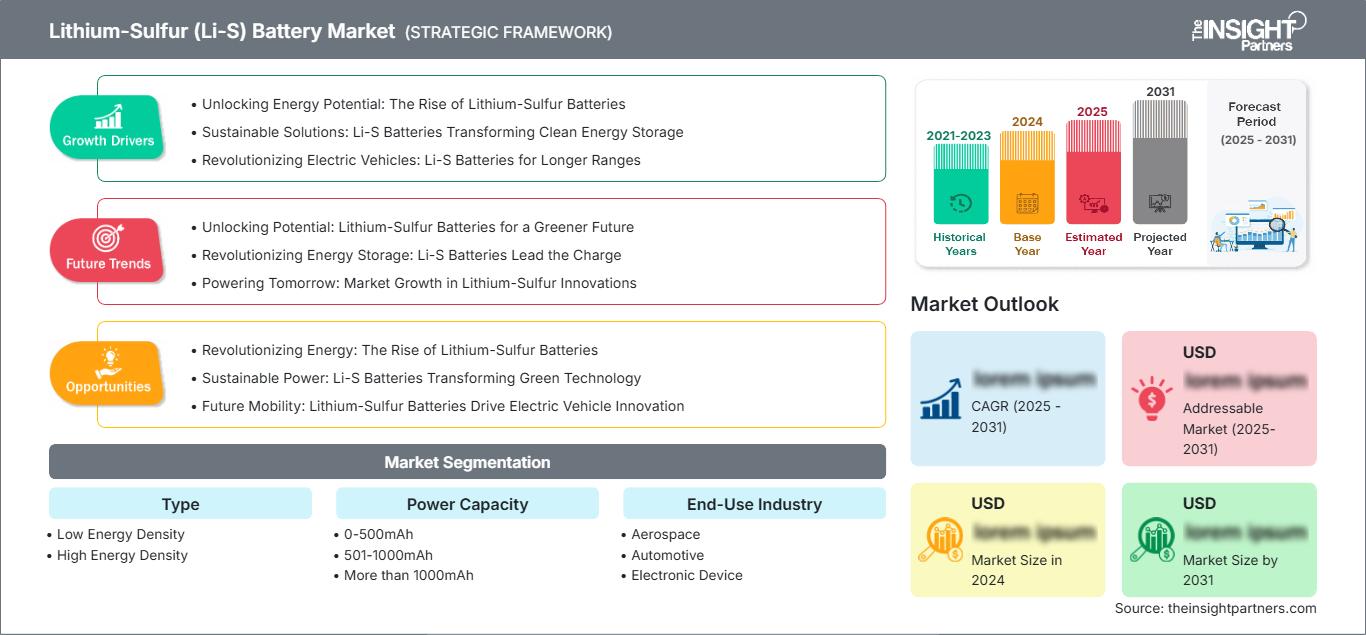
Lithium-Sulfur (Li-S) Battery Market: Strategic Insights
Regional Insights
North America Lithium-Sulfur Battery Market
North America accounted for 34–38% of the global lithium-sulfur battery market share in 2025 and is projected to expand at a CAGR between 14.8–16.2% during 2026–2034. Well-funded programs for innovative battery solutions, innovation ecosystem maturity, and higher investments in battery manufacturing at home ensure commercialization. The region will benefit from growing interest in energy-efficient storage systems in applications in aerospace, defense, and electrified mobility industries due to cooperation between technology vendors, universities, and industry players.
The United States is still the leading country contributing to the regional revenues, whereas Canada gains momentum through investments in critical minerals processing and battery materials. Growing focus on local supply chains, clean energy, and innovation in batteries will ensure continued growth. More involvement of battery companies and chemical players will provide technological innovation as well.
U.S. Lithium-Sulfur Battery Market
The U.S. represented 74–78% of the North American market in 2025 and is anticipated to register a CAGR between 14.9–16.1% during 2026–2034. The government’s massive backing for the development and research on batteries, alongside the investment by venture capitalists, together with the contribution of technology innovators, will make the nation a key player in the development of this technology. Research to continue on lithium metal protection, sulfur cathode, and higher density batteries will make sure there is development of products in automobiles, aircraft, and defense.
There will be increased cooperation between domestic firms and research organizations to make processes scalable and cost-efficient while at the same time ensuring durability of batteries. The growing demand for applications in electric flights, unmanned aerial vehicles, and long-range electric vehicles will create new application opportunities. Investment in the supply chain, manufacturing operations, and materials of the nation will consolidate its position as a leader in next-generation batteries.
Europe Lithium-Sulfur Battery Market
Europe held 26–30% of the global market in 2025 and is forecast to grow at a CAGR between 15.2–16.5% during 2026–2034. Germany takes the lead in regional development due to its highly developed automotive sector, battery manufacturing projects, and research efforts on sustainable energy storage. Environmental laws and value chain projects for batteries keep stimulating commercial activities within a variety of industrial segments.
The UK is another hub for innovations backed up by advanced battery research centers and aerospace technologies developers. Germany retains its leadership in regional manufacturing investments through the expansion of electric vehicle production and industrial battery research. France, Italy, and Spain boost their presence in the markets by implementing more renewable energy projects, battery manufacturing collaborations, and clean mobility programs sponsored by governments. The efforts should contribute to the competitiveness of the region in advanced batteries.
APAC Lithium-Sulfur Battery Market
Asia Pacific accounted for 28–32% of the global Lithium-Sulfur Battery Market in 2025 and is expected to record a CAGR between 16.2–17.6% during 2026–2034. China leads regional expansion through its extensive battery manufacturing ecosystem, while Japan and South Korea continue to advance material innovation and high-performance battery research.
India and Australia are emerging as important contributors through supportive government policies, expanding electric mobility initiatives, and growing investments in battery materials and manufacturing. Strong industrial capabilities, increasing production capacity, and favorable policy frameworks are expected to sustain the region's long-term competitiveness.
Middle East & Africa Lithium-Sulfur Battery Market
The Middle East & Africa Lithium-Sulfur Battery Market is projected to expand at a CAGR between 13.6–14.9% during 2026–2034. Saudi Arabia and the United Arab Emirates continue to increase investments in clean energy infrastructure and advanced technology development, creating opportunities for next-generation battery applications across industrial and utility sectors.
South Africa remains an important market due to its mining capabilities and expanding renewable energy projects, while the Rest of the Middle East & Africa is gradually adopting advanced energy storage technologies. Rising investments in grid modernization, sustainable infrastructure, and energy diversification are expected to support regional market development over the forecast period.

Segmentation Analysis
Type
The Type segment plays a decisive role in determining performance characteristics and commercial adoption across end-use industries. Advances in sulfur cathode materials, electrolyte chemistry, and lithium metal protection continue to improve battery efficiency while extending operational life. The lithium-sulfur battery market scope continues to expand as manufacturers prioritize differentiated battery configurations for automotive, aerospace, and advanced electronics applications. This segment is projected to register a CAGR between 15.4–16.6% during 2026–2034.
- Low Energy Density: Primarily adopted in cost-sensitive applications where affordability and moderate performance are prioritized. Continued improvements in manufacturing processes and material optimization support stable demand across selected industrial and electronic device applications.
- High Energy Density: Increasingly preferred for electric vehicles, aerospace platforms, and advanced portable electronics due to its superior energy storage capability, reduced weight, and ability to support extended operational duration under demanding performance requirements.
Power Capacity
The Power Capacity segment reflects diverse performance requirements across portable electronics, transportation, aerospace, and energy storage applications. Continuous innovation in cell architecture and battery management systems enables manufacturers to optimize capacity while improving safety and operational efficiency. The Lithium-Sulfur Battery Market forecast is supported by growing demand for high-performance batteries, with the segment anticipated to record a CAGR between 15.7–16.9% during 2026–2034.
- 0–500mAh: Commonly utilized in compact electronic devices requiring lightweight power sources and moderate operating durations. Demand remains supported by miniaturized consumer electronics and specialized sensing devices.
- 501–1000mAh: Widely adopted in medium-power portable equipment where balanced energy capacity, compact size, and operational efficiency are essential. Manufacturers continue introducing optimized designs to improve reliability and lifecycle performance.
- More than 1000mAh: Represents the fastest-expanding capacity category for electric mobility, aerospace systems, and industrial equipment requiring extended runtime, higher energy output, and enhanced operational reliability under intensive usage conditions.
End-Use Industry
The End-Use Industry segment continues to drive commercialization by aligning battery technologies with industry-specific performance requirements. Increasing investment in electrification, lightweight mobility solutions, and renewable energy integration is accelerating demand across multiple industries. Supported by expanding pilot-scale production and technology validation, this segment is forecast to achieve a CAGR between 15.8–17.0% during 2026–2034.
- Aerospace: High energy density and lightweight construction make lithium-sulfur batteries increasingly attractive for satellites, unmanned aerial vehicles, and electric aviation platforms seeking improved endurance and payload efficiency.
- Automotive: The largest application segment benefits from accelerating electric vehicle development, demand for extended driving range, and ongoing research into next-generation battery chemistries capable of reducing vehicle weight and improving overall efficiency.
- Electronic Device: Consumer electronics manufacturers continue evaluating lithium-sulfur technology to support thinner, lighter, and longer-lasting portable devices while enhancing operational performance and battery lifecycle characteristics.
- Power and Energy: Utility operators and renewable energy developers are exploring lithium-sulfur batteries for stationary energy storage applications, supported by increasing investments in grid modernization, renewable integration, and sustainable long-duration energy storage systems.
Opportunity Snapshot
| End-Use Industry | Revenue Contribution | Trend Tag | Adoption Stage |
|---|---|---|---|
| Aerospace | Medium | Electric Aviation | Scaling |
| Automotive | High | Long Range | Mature |
| Electronic Device | Medium | Ultra Lightweight | Scaling |
| Power and Energy | Medium | Grid Storage | Emerging |
Lithium-Sulfur (Li-S) Battery Market Growth Drivers and Impact Analysis
Expansion of Electric Mobility Accelerates Demand for High-Energy Batteries
The growing need for electric mobility worldwide means that there will be an ongoing need for batteries that can generate higher energy density, all the while minimizing the weight of the automobile. The use of lithium-sulfur batteries can help make vehicles more efficient when it comes to their driving range and energy consumption as compared to other types of batteries, and this makes them suitable for the next generation of vehicles. It has become increasingly important to explore other battery technologies aside from lithium-ion due to government subsidies, emission restrictions, and research in the field of batteries. Automakers have begun to cooperate with battery providers to test lithium-sulfur battery technology for future cars.
Continuous Material Innovation Improves Commercial Viability
Advancements in technology pertaining to sulfur cathode, electrolyte, lithium metal protection, and battery management systems are substantially boosting the commercial viability of lithium-sulfur batteries. Technological advances in mitigating the impact of polysulfide shuttling, increasing cycling durability, and improving charge efficiency are helping to overcome the technical drawbacks that have been there for a very long time. Educational institutions, research organizations, and manufacturing companies are still working on joint developmental efforts to improve scalability and reliability in manufacturing. Such advancements in technology are paving the way for new applications in aerospace, defense, industrial, and consumer electronics sectors, along with building the confidence of investors.
Growing Investment in Sustainable Energy Storage Infrastructure
The rising level of global investment in renewable energy integration and grid development is raising the demand for sustainable energy storage technology. Lithium-sulfur battery uses sulfur, which is abundant and relatively cheap compared to many other metals and minerals used in the production of lithium-ion batteries, helping to reduce the reliance on rare earth elements and increase sustainability. There have been investments made by governments and businesses in pilot factories, testing, and commercialization of the technology in order to promote its adoption. Moreover, utilities have started looking into long-duration energy storage that can help to integrate renewable energy and improve grid resilience.
Lithium-Sulfur (Li-S) Battery Market Future Trends
Commercialization of Next-Generation High-Energy Battery Platforms
Research efforts are increasingly transitioning from laboratory validation to commercial-scale production, marking a significant shift in the evolution of advanced battery technologies. The lithium-sulfur battery market trends indicate that manufacturers are prioritizing scalable production methods, improved electrode architectures, and advanced electrolyte systems to enhance battery durability and performance. Strategic partnerships between battery developers, automotive manufacturers, aerospace companies, and research organizations are accelerating technology qualification for commercial deployment. Growing emphasis on lightweight energy storage solutions for electric aviation, long-range electric vehicles, and defense applications is expected to expand addressable markets. As manufacturing yields improve and production costs decline, commercialization is likely to accelerate across multiple industrial sectors, supporting broader adoption throughout the forecast period.
Regional Manufacturing Ecosystems Strengthen Supply Chain Resilience
Manufacturers of batteries are now making attempts to create local manufacturing plants and supply chains to decrease their reliance on imported materials and to increase the flexibility of their manufacturing process. With government incentives for battery manufacturing in the region and investments in advanced material processing and recycling systems, there is an increasing self-reliance of regions. There are also efforts being made in the use of digital manufacturing, automation, and quality management systems that will help to enhance efficiency and consistency of the manufacturing process. All these are expected to shorten the time to market while increasing the reliability of products in terms of performance.
Lithium-Sulfur (Li-S) Battery Market Opportunities
Expanding Commercial Prospects in Aerospace and Advanced Aviation
One of the most promising industries for lithium-sulfur batteries from an investment perspective is the aerospace sector, since the reduction of weight, along with high-energy density, increases the efficiency of the aircraft. The further development of electric airplanes, UAVs, HAPs, and satellites will lead to an increased need for batteries with specific energy advantages. The forecast for the use of lithium-sulfur batteries in the aerospace sector will rise due to the increased stability of the batteries and their compliance with certification criteria. Strategic collaboration of battery makers, aerospace companies, research facilities, and governments will generate new revenue opportunities, as well as promote the production and implementation of lithium-sulfur batteries.
Scaling Long-Duration Energy Storage for Renewable Power Integration
Rising investments in the production of renewable electricity have led to significant opportunities for innovative battery solutions, which can enable long-duration storage and increased flexibility of the grid. With the potential to benefit from lower costs and higher theoretical energy density, lithium-sulfur batteries have become one of the battery innovations being considered by utilities and independent power producers for the integration of renewable energy, peak load balancing, and distributed energy generation. Further government support for clean energy infrastructure and increased private funding into battery development are likely to drive the commercialization of these batteries. Companies that improve manufacturing capacity, secure supply chain alliances, and prove themselves through large-scale performance can take advantage of the upcoming demand.
Frequently Asked Questions

- Comprehensive Market Sizing and Forecast Analysis
- Detailed Segmentation Analysis
- In-Depth Market Dynamics Assessment
- Regional and Country-Level Insights
- Competitive Landscape and Company Benchmarking
- Strategic Business Intelligence
Recent Reports
Testimonials

The Insight Partners provided valuable market intelligence that supported our global go-to-market strategy. Their team was professional, responsive, and attentive to our feedback, providing thoughtful analysis and helpful methodological clarifications throughout the project.
Junmo Kim Chief Financial Officer (CFO), Enertech Co., Ltd.
The Insight Partners' SCADA System Market report is comprehensive, with valuable insights on current trends and future forecasts. The team was highly professional, responsive, and supportive throughout. We are very satisfied and highly recommend their services.
RAN KEDEM Partner, Reali Technologies LTDs
I requested a report on a very specific software market and the team produced the report in a few days. The information was very relevant and well presented. I then requested some changes and additions to the report. The team was again very responsive and I got the final report in less than a week.
JEAN-HERVE JENN Chairman, Future Analytica
We worked with The Insight Partners for an important market study and forecast. They gave us clear insights into opportunities and risks, which helped shape our plans. Their research was easy to use and based on solid data. It helped us make smart, confident decisions. We highly recommend them.
PIYUSH NAGPAL Sr. Vice President, High Beam Global
The Insight Partners delivered insightful, well-structured market research with strong domain expertise. Their team was professional and responsive throughout. The user-friendly website made accessing industry reports seamless. We highly recommend them for reliable, high-quality research services
YUKIHIKO ADACHI CEO, Deep Blue, LLC.
This is the first time I have purchased a market report from The Insight Partners.While I was unsure at first, I visited their web site and felt more comfortable to take the risk and purchase a market report.I am completely satisfied with the quality of the report and customer service. I had several questions and comments with the initial report, but after a couple of dialogs over email with their analyst I believe I have a report that I can use as input to our strategic planning process.Thank you so much for taking the extra time and making this a positive experience.I will definitely recommend your service to others and you will be my first call when we need further market data.
JOHN SUZUKI President and Chief Executive Officer, Board Director, BK Technologies
I wish to appreciate your support and the professionalism you displayed in the course of attending to my request for information regarding to infectious disease IVD market in Nigeria. I appreciate your patience, your guidance, and the fact that you were willing to offer a discount, which eventually made it possible for us to close a deal. I look forward to engaging The Insight Partners in the future, all thanks to the impression you have created in me as a result of this first encounter.
DR CHIJIOKE ONYIA MANAGING DIRECTOR, PineCrest Healthcare Ltd.Reason to Buy
- Informed Decision-Making
- Understanding Market Dynamics
- Competitive Analysis
- Identifying Emerging Markets
- Customer Insights
- Market Forecasts
- Risk Mitigation
- Boosting Operational Efficiency
- Strategic Planning
- Investment Justification
- Tracking Industry Innovations
- Aligning with Regulatory Trends





 Get Free Sample for