
Logic Gate Market Share, Size & Demand by 2034
Coverage: By Type (BICMOS, Bipolar, CMS, ECL); Application (3-state, Open Collector, Open Drain, Others) , and Geography (North America, Europe, Asia Pacific, and South and Central America)
- Status : Data Released
- Report Code : TIPRE00016989
- Category : Electronics and Semiconductor
- No. of Pages : 150
- Available Report Formats :


- Last update date : September 30, 2026


2025 Market Size
US$ 5.5 Bn
Base year value
2034 Forecast
US$ 10.36 Bn
Projected by 2034
CAGR 2026-2034
7.28 %
Growth rate
Addressable Market
US$ 71.50 Bn
(2026-2034)
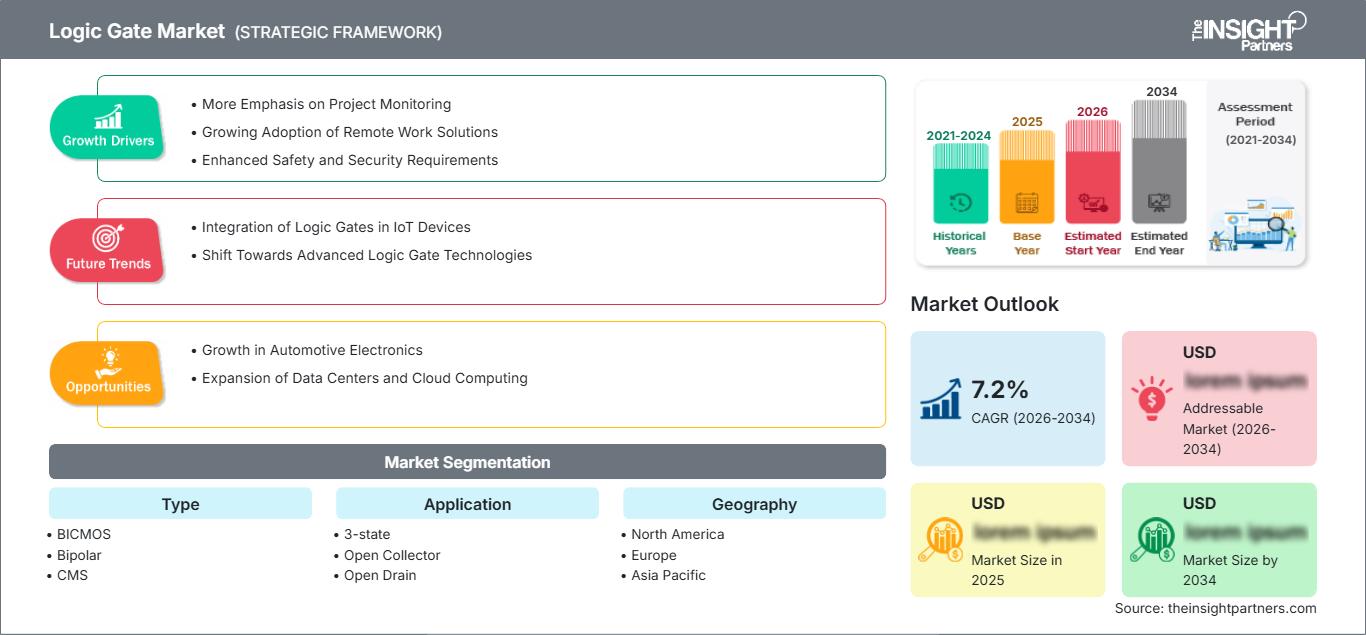
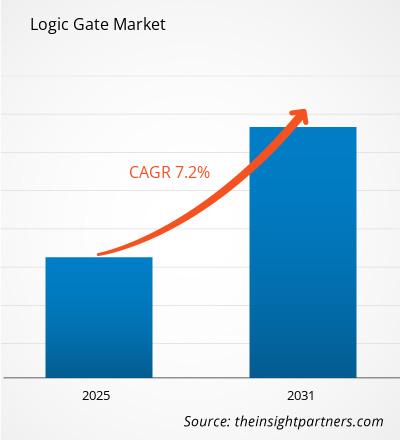
The global Logic Gate Market reached a valuation of US$ 5.5 Billion in 2025 and is projected to advance to US$ 10.36 Billion by 2034, expanding at a CAGR of 7.28% between 2026 and 2034. This growth trajectory reflects rising integration of digital logic components across consumer electronics, automotive systems, and industrial automation, where miniaturized switching elements underpin increasingly complex circuit architectures demanding higher reliability, faster switching speeds, and lower power consumption across diverse end-use applications.
North America is estimated to expand at a CAGR range of 6.8-7.4% through 2034, supported by robust semiconductor manufacturing investment and strong demand from automotive electrification programs. The region's Logic Gate Market size continues to benefit from reshoring initiatives under domestic chip incentive programs, alongside sustained demand from data center infrastructure and defense electronics, both of which require dependable, high-speed switching components for mission-critical operations.
Logic Gate Market Assessment and Insights
- North America: North America held a share of approximately 28-32% of the Logic Gate Market in 2025, driven by strong automotive and industrial automation demand, growing at a CAGR of 6.8-7.4% between 2026 and 2034.
- US: The United States accounted for nearly 78-82% of North America's share in 2025, expanding at a CAGR of 6.7-7.2% through 2034 on semiconductor fabrication expansion.
- Europe: Europe captured around 22-26% share in 2025 and is projected to grow at a CAGR of 6.5-7.0% between 2026 and 2034, led by Germany and the United Kingdom's automotive and industrial electronics manufacturing base.
- Asia Pacific: Asia Pacific commanded roughly 34-38% share in 2025, growing at a CAGR of 7.8-8.4% between 2026 and 2034, led by China, Japan, and South Korea's expansive consumer electronics and semiconductor fabrication capacity.
- Largest Segment: The BICMOS type segment led with a market share of 38-42% in 2025, growing at a CAGR of 7.3-7.9% between 2026 and 2034 due to balanced speed-power performance.
- High Growth Segment: The Open Drain application segment is the fastest-growing, holding 18-22% share in 2025 and advancing at a CAGR of 8.0-8.6% between 2026 and 2034.
- Key companies analyzed in detail: Analog Devices, Inc., Diodes Incorporated, Inphi Corporation, Microchip Technology Inc., Nexperia B.V., NXP Semiconductors N.V., Renesas Electronics Corporation, ROHM CO., LTD., TE Connectivity Ltd., and Texas Instruments Incorporated.
Source: The Insight Partners' analysis based on proprietary research, government publications, company annual reports, investor presentations, industry databases, and expert interviews.
From discrete bipolar transistor technology, logic gates have evolved to more integrated CMOS and BICMOS technologies, which provide faster switching and less power consumption. In terms of production, the dynamics of manufacturing logic gates have moved towards advanced wafer fabrication and packaging lines that allow for high-volume manufacturing of automotive and consumer electronics producers. Fab facilities have gradually shifted to finer geometries and multi-die packaging in order to meet the requirements for small and temperature-efficient semiconductors. Semiconductor supply chains have moved their fab facilities to several regions in order to minimize the risks of disruptions associated with dependence on a certain region for component production.
The future developments in the logic gate manufacturing industry will involve the rise of new manufacturing clusters in Southeast Asia and India where companies are looking to increase the number of locations for their fab facilities. Governments are launching new programs to attract investments into domestic semiconductor manufacturing and at the same time increase reliability standards for automotive semiconductors, which is expected to increase the pace of qualifications.
Logic Gate Market Report Scope
| Report Attribute | Details |
|---|---|
| Market size in 2025 | US$ 5.5 Billion |
| Market Size by 2034 | US$ 10.36 Billion |
| Global CAGR (2026 - 2034) | 7.28% |
| Historical Data | 2021-2024 |
| Forecast period | 2026-2034 |
Logic Gate Market Analysis
Factors fueling Logic Gate Market expansion include widespread use of digital circuitry in automotive electrification, industrial automation, and consumer electronics applications where reliable switching functionality is needed for signal processing and control functions. Increased automotive electrification and the application of ADAS have boosted the need for automotive-grade logic gate components that can withstand high temperatures and vibrations.
Value Chain analysis shows that the value chain includes wafer manufacturing, discrete packaging, and distribution through authorized component partners that serve contract manufacturers and original equipment producers. Supply conditions are still determined by the allocation policy at major foundries, with lead times for components affecting the inventory management policies of distributors. Component manufacturers are increasingly making sure that long-term supply contracts are in place amid changing demands for analog and digital logic devices in electronics assembly globally.
Market Analysis of Logic Gates Market highlights the competitive environment dominated by major semiconductor companies looking to diversify their product portfolios via latest process technology nodes and specific form factors. Texas Instruments Incorporated and NXP Semiconductors N.V. offer a wide range of products covering both automotive and industrial variants. The competition is formed by Nexperia B.V. and Diodes Incorporated in the realm of high-volume discrete logic gates used in consumer electronics that require efficient switching devices.
Renesas Electronics Corporation, Microchip Technology Inc., and Analog Devices, Inc. keep developing in the direction of integrated mixed-signal functionality, ROHM CO., LTD. and TE Connectivity Ltd. are building their position through automotive-grade certifications and logic gates with integrated connectors. High-speed interfaces from Inphi Corporation enable applications in data infrastructures; thus highlighting the general trends towards reliability certification, capacity increase, and partnership programs for securing component supply.
● REPORT CUSTOMIZATION
Tailor This Report To Align With Your Specific Business Requirements
This report can be customized to align precisely with your business objectives, scope, and target markets. Customization options include tailored segmentation, geography, competitive analysis, and strategic insights to support informed decision-making.
Customize This Report →WHAT YOU CAN ADJUST
- ● Segmentations
- ● Geography
- ● Competitive Analysis
- ● Language Preferences
Logic Gate Market: Strategic Insights
Regional Insights
North America Logic Gate Market
The North American region had captured about 28-32% Logic Gate Market share in 2025 to become an important region in terms of generating revenues globally following the APAC region, considering component consumption trends in the region. Further growth in the region can be attributed to the CAGR of 6.8-7.4% in the period 2026-2034, driven by continued investments in regional semiconductor fab facilities, increased production of automobile electronics, and the continued procurement of telecommunications infrastructure providers in the United States, Canada, and Mexico.
These structural growth factors comprise federal incentives for onshoring chip manufacturing, higher requirement of Advanced Driver Assistance Systems, as well as growth in the data center industry requiring reliable logic gate components for their power management and signal distribution. Increased adoption of industrial automation in manufacturing plants is another factor adding to component consumption, besides continued procurement requirements from defense electronics as well as aerospace programs.
U.S. Logic Gate Market
In 2025, the United States made up almost 78-82% of North America's Logic Gate market share because of its concentration in semiconductor design and manufacturing capabilities. The United States is predicted to grow at a CAGR of 6.7-7.2% from 2026-2034 due to the continued investment in manufacturing chips under government-supported incentive programs for chip production and increased usage of electronics per car among both internal combustion vehicles and EVs.
Texas Instruments Incorporated, Analog Devices, Inc. and Microchip Technology Inc. possess significant domestic manufacturing capacity and design capabilities, which ensure good supply locally for industrial and automotive customers. Open-drain and three-state logic application cases are seen in data communication applications while renewable energy inverter and power grid applications are increasingly being designed to use logic gates as well, where reliability of switching action and heat resistance continue to be key factors of consideration by original equipment manufacturers in North America, especially in the Midwest and Southwest manufacturing regions.
Europe Logic Gate Market
Europe held an estimated 22-26% Logic Gate Market share in 2025 and is projected to grow at a CAGR of 6.5-7.0% between 2026 and 2034, driven by automotive electronics manufacturing and industrial automation investment across the region. Germany continues to lead regional revenue generation, supported by its established automotive supply base and precision engineering sector, followed closely by the United Kingdom's semiconductor design and industrial electronics activity.
There is a good level of demand for automotive-grade and industrial logic switching components due to the presence of the automotive and industrial machinery segments in Germany, with local firms utilizing the latest switching devices in their electric drivetrain control units and factory automation systems. Germany's focus on precision manufacturing and export-oriented automotive manufacturing keeps its component purchasing stable from regional and global component suppliers who cater to Tier-1 automotive clients.
In the UK, the logic component demand comes from semiconductor design capabilities of the country as well as increasing investment in renewable energy infrastructure. The government's continued support for domestic semiconductor design capabilities and expansion in telecommunications networks keeps up the component demand in electronics clusters based in Cambridge and other electronics corridors.
Automotive component manufacturing, industrial machinery manufacturing, and renewable energy infrastructure investments together make France, Italy, and Spain significant contributors to regional revenues. Demand comes from the country's aerospace electronics sector in France and industrial automation sector in Italy, whereas increasing demand comes from automotive assembly plants and renewable energy infrastructure in Spain.
APAC Logic Gate Market
The Asia Pacific region dominated the revenues with an estimated market share of 34-38% of Logic Gates in 2025, recording the highest regional CAGR of 7.8-8.4% from 2026 to 2034. This is mainly due to the robust consumer electronics manufacturing industry and the growing trend towards semiconductor self-reliance.
On the other hand, Japan and South Korea are major contributors due to their advanced semiconductor fabrication and automotive electronics manufacturing capabilities, India's growth in electronics manufacturing industry, and Australia's investments in renewable energy infrastructure.
Middle East & Africa Logic Gate Market
The MEA region is expected to grow at a rate of CAGR 7.0-7.6% from 2026 to 2034 on the basis of Saudi Arabia increasing electronics assembly and renewables infrastructure development in line with national diversification strategies. UAE follows with growth in data center developments and telecommunications network upgrading initiatives.
South Africa provides stable demand for logic components via industrial automation and grid upgrade projects, while Rest of MEA countries add stable growth due to increasing component usage in electricity supply infrastructure expansion and telecommunications developments in emerging nations.
Segmentation Analysis
Type
The Type segment defines the fundamental Logic Gate Market scope, encompassing BICMOS, Bipolar, CMS, and ECL configurations that differ in switching speed, power consumption, and noise immunity characteristics. This segment is projected to grow at a CAGR of 7.1-7.6% between 2026 and 2034, driven by increasing adoption of BICMOS architectures that balance high switching speed with reduced power draw across automotive and industrial control applications.
- BICMOS: Combines bipolar and CMOS transistor characteristics to deliver high switching speed alongside low power consumption, making it the preferred choice for automotive control units and high-performance industrial circuitry.
- Bipolar: Retains relevance in high-speed signal processing applications requiring strong current-driving capability, particularly within legacy industrial systems and specific telecommunications interface circuits demanding robust noise tolerance.
- CMS: Serves cost-sensitive consumer electronics applications where moderate switching performance and low manufacturing complexity support high-volume production for mainstream digital device assembly lines.
- ECL: Supports ultra-high-speed signal processing requirements within specialized telecommunications and data infrastructure equipment demanding minimal propagation delay despite comparatively higher power consumption levels.
Application
The Application segment spans 3-state, Open Collector, and Open Drain configurations, each addressing distinct interfacing and bus-sharing requirements within digital circuit design. This segment is projected to grow at a CAGR of 7.4-7.9% between 2026 and 2034, propelled by expanding use of open drain and three-state logic in data communication buses, microcontroller interfacing, and multi-device signal sharing architectures.
- 3-State: Enables multiple devices to share common data bus lines by providing a high-impedance output state, widely used in memory interfacing and microprocessor communication systems.
- Open Collector: Supports wired-AND logic configurations for driving external loads and interfacing circuits operating at different voltage levels, commonly applied in industrial control signaling.
- Open Drain: Facilitates flexible voltage-level interfacing and bus communication protocols such as I2C, increasingly favored in mixed-signal microcontroller and sensor interfacing applications.
Opportunity Snapshot
| Application | Revenue Contribution | Trend Tag | Adoption Stage |
|---|---|---|---|
| 3-State | High | Bus Interfacing | Mature |
| Open Collector | Medium | Wired-AND Logic | Mature |
| Open Drain | Medium | I2C Communication | Scaling |
Logic Gate Market Growth Drivers and Impact Analysis
Rising Automotive Electrification Accelerating Component Demand
Expanding vehicle electrification programs across major automotive manufacturing regions are substantially increasing electronic content per vehicle, driving sustained demand for reliable digital switching components within battery management, powertrain control, and advanced driver assistance systems. As electric and hybrid vehicle production volumes climb, automotive suppliers require logic components capable of withstanding extended temperature ranges, vibration exposure, and long operational lifespans without performance degradation. This shift has prompted component manufacturers to expand automotive-qualified product portfolios meeting stringent reliability certification standards such as AEC-Q100. Tier-one suppliers increasingly favor multi-sourced procurement strategies to secure consistent component availability, reinforcing long-term demand visibility. Consequently, automotive electrification stands as a structural growth pillar supporting sustained component consumption across regional manufacturing ecosystems through the coming decade.
Expanding Industrial Automation and Factory Digitization
Manufacturing facilities worldwide are increasingly deploying automated control systems, programmable logic controllers, and sensor networks that rely heavily on dependable digital switching components for signal processing and device interfacing. This transition toward smart factory operations, supported by Industry 4.0 initiatives, has elevated procurement of logic components capable of operating reliably within demanding industrial environments characterized by electrical noise, temperature fluctuation, and continuous operation cycles. Equipment manufacturers are integrating logic devices within motor control, robotics, and process monitoring systems to enable real-time data exchange and precise operational control. As automation adoption accelerates across discrete and process manufacturing sectors, component suppliers are correspondingly expanding production capacity and application-specific product development to meet rising industrial procurement volumes globally.
Growing Data Infrastructure and Telecommunications Network Expansion
Sustained investment in data center construction, cloud computing infrastructure, and telecommunications network modernization is generating consistent demand for high-speed logic components supporting signal routing, bus interfacing, and power management functions. As data traffic volumes continue expanding globally, infrastructure operators require components capable of supporting higher data throughput while maintaining thermal efficiency within densely packed server and networking equipment. Telecommunications providers upgrading network infrastructure to support broader connectivity coverage similarly require dependable switching components for interface and control circuitry. This convergence of data infrastructure expansion and network modernization initiatives continues generating steady procurement demand, positioning component manufacturers to benefit from long-term infrastructure investment cycles across both developed and emerging telecommunications markets.
Logic Gate Market Future Trends
Migration Toward Miniaturized, Low-Power Logic Architectures
Emerging Logic Gate Market trends point toward continued miniaturization of packaging formats alongside progressive reduction in operating voltage requirements, enabling integration within increasingly compact electronic assemblies. Component manufacturers are advancing chip-scale and wafer-level packaging techniques that reduce footprint while maintaining thermal performance suitable for densely populated circuit boards. This shift responds to persistent demand from portable consumer electronics, wearable devices, and space-constrained automotive control modules requiring efficient board-level integration. As power efficiency requirements intensify across battery-operated and energy-conscious applications, manufacturers are prioritizing ultra-low-power design architectures that extend operational lifespans without compromising switching reliability, gradually reshaping product development priorities across the broader semiconductor component landscape.
Increasing Adoption of Application-Specific Logic Integration
Component manufacturers are progressively shifting toward application-specific integration, combining multiple logic functions within single packages to reduce board space and simplify system design for original equipment manufacturers. This trend reflects growing customer preference for pre-integrated solutions that streamline procurement while improving overall system reliability through reduced interconnection points. Semiconductor suppliers are correspondingly investing in flexible manufacturing platforms capable of supporting customized product configurations at scale, particularly for automotive and industrial customers with specialized interfacing requirements. As electronic system complexity continues increasing across end-use industries, this movement toward tailored logic integration is expected to reshape competitive positioning among established component suppliers over the coming years.
Logic Gate Market Opportunities
Expansion into Emerging Semiconductor Manufacturing Hubs
Component manufacturers have a meaningful opportunity to expand production footprint across emerging semiconductor manufacturing hubs in Southeast Asia and India, where favorable government incentive programs and growing domestic electronics assembly capacity are attracting fresh capital investment. Establishing regional fabrication and packaging facilities within these developing hubs could reduce logistics costs while improving proximity to expanding consumer electronics and automotive assembly operations. Companies that strategically position manufacturing capacity within these emerging regions stand to capture incremental demand from local original equipment manufacturers seeking shorter supply chains and reduced dependency on established fabrication centers, strengthening long-term competitive positioning within increasingly diversified global semiconductor supply networks.
Development of Automotive-Grade Component Portfolios
Growing electric vehicle production presents a substantial opportunity for component suppliers to expand automotive-qualified logic portfolios meeting stringent reliability and temperature tolerance certification requirements. Manufacturers investing in dedicated automotive-grade production lines and extended qualification testing capabilities can capture increasing procurement volumes from tier-one automotive suppliers transitioning toward electrified and software-defined vehicle platforms. This opportunity extends toward battery management, powertrain control, and advanced driver assistance applications, where dependable switching performance directly influences vehicle safety and operational reliability, positioning early investors in automotive-grade capability favorably against competitors slower to expand certified product offerings.
Frequently Asked Questions

- Comprehensive Market Sizing and Forecast Analysis
- Detailed Segmentation Analysis
- In-Depth Market Dynamics Assessment
- Regional and Country-Level Insights
- Competitive Landscape and Company Benchmarking
- Strategic Business Intelligence
Recent Reports
Testimonials

The Insight Partners provided valuable market intelligence that supported our global go-to-market strategy. Their team was professional, responsive, and attentive to our feedback, providing thoughtful analysis and helpful methodological clarifications throughout the project.
Junmo Kim Chief Financial Officer (CFO), Enertech Co., Ltd.
The Insight Partners' SCADA System Market report is comprehensive, with valuable insights on current trends and future forecasts. The team was highly professional, responsive, and supportive throughout. We are very satisfied and highly recommend their services.
RAN KEDEM Partner, Reali Technologies LTDs
I requested a report on a very specific software market and the team produced the report in a few days. The information was very relevant and well presented. I then requested some changes and additions to the report. The team was again very responsive and I got the final report in less than a week.
JEAN-HERVE JENN Chairman, Future Analytica
We worked with The Insight Partners for an important market study and forecast. They gave us clear insights into opportunities and risks, which helped shape our plans. Their research was easy to use and based on solid data. It helped us make smart, confident decisions. We highly recommend them.
PIYUSH NAGPAL Sr. Vice President, High Beam Global
The Insight Partners delivered insightful, well-structured market research with strong domain expertise. Their team was professional and responsive throughout. The user-friendly website made accessing industry reports seamless. We highly recommend them for reliable, high-quality research services
YUKIHIKO ADACHI CEO, Deep Blue, LLC.
This is the first time I have purchased a market report from The Insight Partners.While I was unsure at first, I visited their web site and felt more comfortable to take the risk and purchase a market report.I am completely satisfied with the quality of the report and customer service. I had several questions and comments with the initial report, but after a couple of dialogs over email with their analyst I believe I have a report that I can use as input to our strategic planning process.Thank you so much for taking the extra time and making this a positive experience.I will definitely recommend your service to others and you will be my first call when we need further market data.
JOHN SUZUKI President and Chief Executive Officer, Board Director, BK Technologies
I wish to appreciate your support and the professionalism you displayed in the course of attending to my request for information regarding to infectious disease IVD market in Nigeria. I appreciate your patience, your guidance, and the fact that you were willing to offer a discount, which eventually made it possible for us to close a deal. I look forward to engaging The Insight Partners in the future, all thanks to the impression you have created in me as a result of this first encounter.
DR CHIJIOKE ONYIA MANAGING DIRECTOR, PineCrest Healthcare Ltd.Reason to Buy
- Informed Decision-Making
- Understanding Market Dynamics
- Competitive Analysis
- Identifying Emerging Markets
- Customer Insights
- Market Forecasts
- Risk Mitigation
- Boosting Operational Efficiency
- Strategic Planning
- Investment Justification
- Tracking Industry Innovations
- Aligning with Regulatory Trends





 Get Free Sample for