
Low Voltage AC Drives Market Demand, Size & Forecast by 2034
Coverage: By Application (Pump, Fan, Conveyor, Compressor, Others); End User (Oil and Gas, Power Generation, Food Processing, Mining and Metals, Automotive, Others) , and Geography (North America, Europe, Asia Pacific, and South and Central America)
- Status : Data Released
- Report Code : TIPRE00027283
- Category : Electronics and Semiconductor
- No. of Pages : 150
- Available Report Formats :


- Last update date : September 29, 2026


2025 Market Size
US$ 15.96 Bn
Base year value
2034 Forecast
US$ 24.85 Bn
Projected by 2034
CAGR 2026-2034
5.69 %
Growth rate
Addressable Market
US$ 191.37 Bn
(2026-2034)
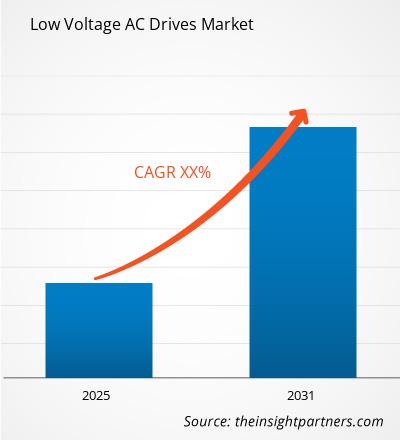
The low voltage ac drives market size was valued at US$ 15.96 Billion in 2025 and is projected to reach US$ 24.85 Billion by 2034, registering a CAGR of 5.69% during 2026–2034. Demand is closely associated with efficient motor control, industrial automation, variable-speed operation, process optimization, and replacement of conventional fixed-speed motor systems across manufacturing and infrastructure-intensive industries.
North America low voltage ac drives market is expected to advance at an estimated 3.70–4.10% CAGR during 2026–2034, supported by modernization of industrial equipment and increasing deployment of digitally connected motor-control systems. Energy-efficiency requirements, automation investment, and upgrades across water, food processing, power, and manufacturing facilities are creating structural demand for efficient low-voltage drive solutions.
Low Voltage AC Drives Market Assessment and Insights
- North America: North America held an estimated 20–24% low voltage ac drives market share in 2025 and is expected to expand at a 3.70–4.10% CAGR during 2026–2034, supported by industrial modernization, energy-efficiency programs, smart manufacturing, and replacement of aging motor-control equipment.
- US: The US represented approximately 73–77% of North America in 2025 and is projected to grow at a 3.80–4.20% CAGR during 2026–2034, driven by manufacturing automation, infrastructure upgrades, and connected industrial equipment.
- Europe: Europe accounted for approximately 24–28% share in 2025 and is projected to grow at a 4.10–4.50% CAGR during 2026–2034, with Germany, the UK, France, Italy, and Spain supported by industrial automation, energy-efficiency initiatives, and machinery modernization.
- Asia Pacific: Asia Pacific represented approximately 38–42% share in 2025 and is expected to register a 6.00–6.40% CAGR during 2026–2034, led by China, Japan, India, and South Korea through manufacturing expansion and automation investment.
- Largest Segment: Pumps represented approximately 30–34% market share in 2025 and are expected to grow at a 5.80–6.20% CAGR during 2026–2034, reflecting extensive variable-speed applications.
- High Growth Segment: Automotive represented approximately 14–18% share in 2025 and is projected to expand at a 6.20–6.60% CAGR during 2026–2034, supported by automated assembly and electrified vehicle production.
- Key companies analyzed in detail: ABB Ltd.; Emerson Electric Co.; Fuji Electric Co., Ltd.; Hitachi, Ltd.; Mitsubishi Electric Corporation; Parker-Hannifin Corporation; Rockwell Automation, Inc.; Siemens AG; Schneider Electric SE; Toshiba International Corporation.
Source: The Insight Partners' analysis based on proprietary research, government publications, company annual reports, investor presentations, industry databases, and expert interviews.
The development of the low voltage ac drives market has gone from separate frequency-control equipment to motor control devices that have the ability to communicate with plant automation. The latest drives offer a combination of speed control, diagnostics, safety features, energy measurement, and industrial communication, thus providing better visibility and maintenance decisions and enabling operators to control the speed of the motor in accordance with the process rather than keeping its constant speed.
Further developments in the low voltage ac drives market will likely see more investment going into drives that are digitally enabled, retrofitting equipment, smaller equipment, and those where the electricity consumed by the motor is an important operating cost. Manufacturing capacity in India and Southeast Asia is a further potential area, and efficiency policy encourages the replacement of old-fashioned motor control. There is also more expected emphasis on the use of diagnostics, industrial Ethernet, and cloud-enabled asset monitoring.
Low Voltage AC Drives Market Report Scope
| Report Attribute | Details |
|---|---|
| Market size in 2025 | US$ 15.96 Billion |
| Market Size by 2034 | US$ 24.85 Billion |
| Global CAGR (2026 - 2034) | 5.69% |
| Historical Data | 2021-2024 |
| Forecast period | 2026-2034 |
Low Voltage AC Drives Market Analysis
The demand in the low voltage ac drives market will be driven by the necessity to control the speed of the motors in accordance with the real needs of processes. Growth of the market is especially important for pumps, fans, conveyors, and compressors that require variable speed operation to eliminate unnecessary energy usage and mechanical loads. The ecosystem consists of suppliers of semiconductors, manufacturers of power electronics, motors, drives, controls, machinery, system integrators, and end users of the industry.
Supply situation in the low voltage ac drives market depends on supply of power semiconductors, capabilities of embedded software, thermal management, control algorithms, and regional manufacturing capabilities. The presence of standardized platforms increases efficiency of production, while customized solutions are suitable for challenging conditions. Vendors are increasingly offering drives along with motors, controllers, monitoring systems and engineering services thus simplifying integration. Retrofit demand is another significant avenue due to the possibility to improve motor control without replacement of whole production lines.
The low voltage ac drives market report shows that competitiveness is determined by the size and coherence of the portfolio offered rather than just the drive itself. ABB Ltd., Siemens AG, Schneider Electric SE, Mitsubishi Electric Corporation, Rockwell Automation, Inc., and Fuji Electric Co., Ltd. offer a combination of drives and wider automation systems. Emerson Electric Co., Parker-Hannifin Corporation, Hitachi, Ltd., and Toshiba International Corporation increase competition with solutions for industrial controls, electrification, motion, and processes.
According to the low voltage ac drives market forecast, investment trends are now moving towards connectivity of the drives, software-driven diagnostics, energy efficiency, and specific applications. Vendor investment in regional engineering and services for retrofits is also increasing. Competitiveness, in consequence, is determined by suppliers able to handle full motor control needs ranging from selection and commissioning to monitoring and maintenance.
● REPORT CUSTOMIZATION
Tailor This Report To Align With Your Specific Business Requirements
This report can be customized to align precisely with your business objectives, scope, and target markets. Customization options include tailored segmentation, geography, competitive analysis, and strategic insights to support informed decision-making.
Customize This Report →WHAT YOU CAN ADJUST
- ● Segmentations
- ● Geography
- ● Competitive Analysis
- ● Language Preferences
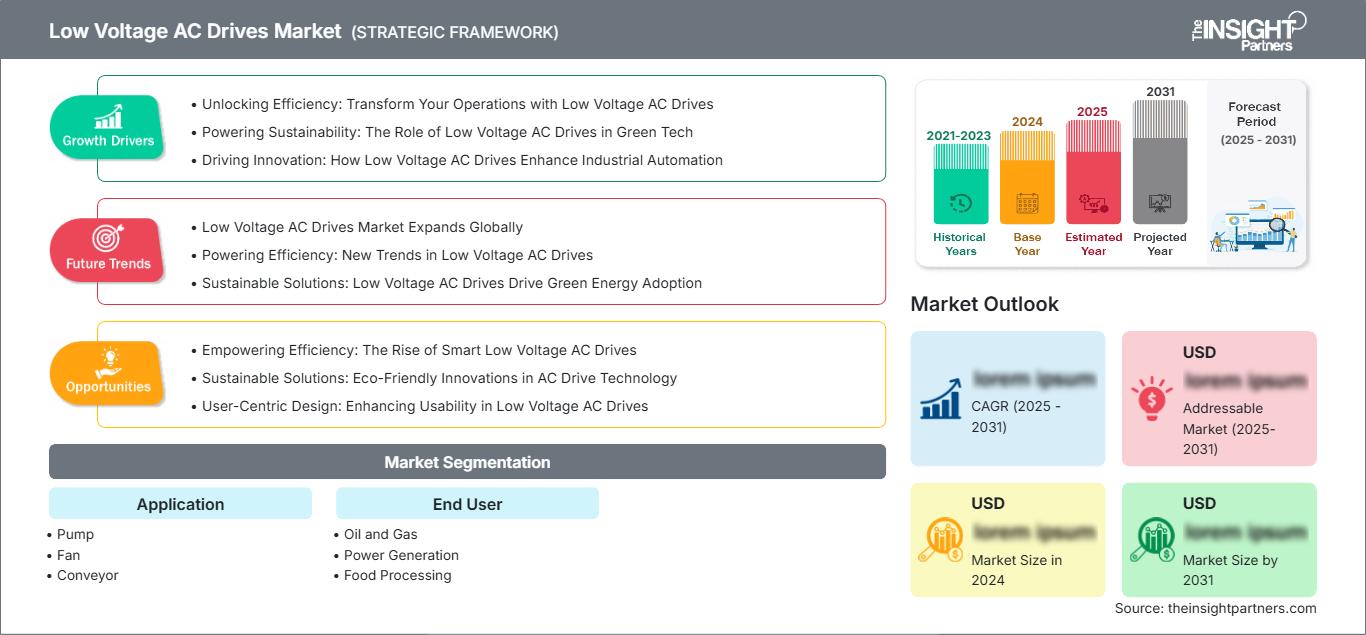
Low Voltage AC Drives Market: Strategic Insights
Regional Insights
North America low voltage ac drives market
North America is estimated to hold 20–24% share in 2025 and is projected to register a 3.70–4.10% CAGR during 2026–2034. The US accounts for the majority of regional demand, supported by advanced manufacturing, food processing, water infrastructure, power generation, and oil and gas applications. Replacement of aging motor-control equipment remains an important source of demand as industrial operators seek higher reliability and controllability.
The Canadian contribution involves mining, petroleum and gas exploration, food processing, and infrastructure uses. Manufacturers have been increasingly adopting drives that are connected to industrial communication and energy monitoring systems. Modernization efforts involve small machinery with built-in safety and diagnostic capabilities. Applications that will be in high demand include those where the motors work continuously or under varying conditions, which justifies their speed control.
U.S. low voltage ac drives market Market
The US represented approximately 73–77% of North America in 2025 and is projected to grow at a 3.80–4.20% CAGR during 2026–2034. Manufacturing automation, water infrastructure, food processing, power generation, oil and gas, and automotive production remain major application areas. ABB Ltd., Rockwell Automation, Inc., Emerson Electric Co., Siemens AG, and Schneider Electric SE maintain strong technology and service capabilities across industrial automation environments.
The application trend is moving towards the use of drives that are capable of communicating operational information to the controllers and to plant software. The retrofittability feature plays an important role, as plants have an option to upgrade their motor control technology without having to change their motors or machinery.
Europe low voltage ac drives market Market
Europe is estimated at 24–28% share in 2025 and is expected to expand at a 4.10–4.50% CAGR during 2026–2034. Germany remains the leading country, supported by machinery, automotive, process industries, and factory automation. The UK contributes through food processing, water infrastructure, manufacturing, and building services. France benefits from aerospace, industrial equipment, and energy-intensive processing applications.
A well-developed environment of equipment exists in Germany and is driving the need for drive systems that deliver higher machine availability and precision in process control. Other market openings exist in France and Italy in terms of machines, automobiles, packaging, and food processing. Opportunities for Spain lie in the development of its manufacturing industry and industrial efficiency drives.
APAC low voltage ac drives market Market
APAC is estimated to account for 38–42% share in 2025 and is projected to grow at a 6.00–6.40% CAGR during 2026–2034. China remains the leading market, followed by Japan, South Korea, India, and Australia. Large manufacturing bases, electronics production, automotive investment, mining, and process industries support demand.
Variable speed motor controls find applications because of the industrial automation projects and energy efficiency campaigns. China enjoys large-scale industrialization, but India is making investments in industries and infrastructure. Japan and South Korea are focused on automation and high performance, while Australia offers opportunities through mining and resources processing.
Middle East & Africa low voltage ac drives market Market
Middle East and Africa is projected to register a 4.20–4.60% CAGR during 2026–2034. Saudi Arabia and the UAE are leading Middle Eastern opportunities, while South Africa represents an important African market. Oil and gas, water infrastructure, power generation, mining, and industrial diversification provide the primary application base.
Investment in industrial infrastructure and energy projects supports demand for efficient motor-control equipment. Saudi Arabia and the UAE are expanding manufacturing and infrastructure capabilities, while South Africa benefits from mining and processing requirements. The Rest of MEA provides emerging opportunities through water treatment, utilities, food processing, and industrial modernization.
Segmentation Analysis
Application
The Application segment in the low voltage ac drives market is projected to grow at a 5.40–5.90% CAGR during 2026–2034. Pumping, ventilation, conveying, and compression systems represent major demand centers because variable-speed operation allows motor output to correspond more closely with process requirements. Adoption is influenced by energy consumption, operating cycles, equipment replacement schedules, and the need for smoother starting and stopping.
- Pump: Pumps represent the largest application base because water movement, process circulation, irrigation, cooling, and industrial fluid handling frequently require adjustable speed and controlled flow.
- Fan: Fans use drives to regulate airflow in industrial ventilation, HVAC, cooling, and process systems, helping equipment operators match output with changing thermal or ventilation requirements.
- Conveyor: Conveyors require controlled acceleration, speed synchronization, and soft starting, making drives strategically important in manufacturing, mining, logistics, packaging, and material-handling systems.
- Compressor: Compressors benefit from adjustable motor operation where pressure and flow vary, supporting process efficiency across oil and gas, refrigeration, manufacturing, and industrial utility systems.
End User
The End User segment is expected to expand at a 5.60–6.00% CAGR during 2026–2034 as industrial sectors prioritize energy optimization, automation, process reliability, and equipment modernization. Oil and gas and power generation maintain significant installed bases, while automotive and food processing are increasingly influenced by automated production and digital control.
- Oil and Gas: Oil and gas facilities use drives across pumping, compression, ventilation, and material-handling operations, where controlled motor speed supports process stability and equipment protection.
- Power Generation: Power-generation facilities deploy drives for pumps, fans, cooling systems, conveyors, and auxiliary equipment where reliable variable-speed control supports operational efficiency.
- Food Processing: Food-processing plants increasingly require controlled conveying, pumping, mixing, refrigeration, and packaging, creating demand for reliable and hygienically appropriate motor-control systems.
- Mining and Metals: Mining and metals applications require robust drive systems for conveyors, pumps, fans, crushers, and processing equipment operating under demanding environmental and load conditions.
- Automotive: Automotive plants increasingly deploy drives across assembly, material handling, machining, paint systems, battery production, and automated production cells requiring synchronized motor operation.
Opportunity Snapshot
| End User | Revenue Contribution (High/Medium/Low) | Trend Tag | Adoption Stage |
| Oil and Gas | High | Process Control | Mature |
| Power Generation | High | Grid Modernization | Mature |
| Food Processing | Medium | Hygienic Automation | Scaling |
| Mining and Metals | Medium | Smart Conveyors | Scaling |
| Automotive | High | Battery Automation | Scaling |
Low Voltage AC Drives Market Growth Drivers and Impact Analysis
Industrial energy optimization is strengthening variable-speed adoption
Energy-intensive facilities increasingly examine motor systems as part of broader operating-cost optimization programs. Pumps, fans, and compressors often operate under changing load conditions, creating opportunities for variable-speed control to reduce unnecessary motor output. Drives can regulate speed according to pressure, flow, temperature, or production requirements instead of maintaining constant operation. This improves process matching while reducing mechanical stress associated with frequent direct-on-line starting. The impact is particularly relevant for facilities with large installed motor populations because retrofit programs can address individual equipment assets without requiring complete plant reconstruction. As industrial energy-management practices mature, procurement decisions increasingly incorporate lifecycle cost, monitoring capability, and efficiency rather than initial purchase price alone. This supports recurring demand from both new equipment and retrofit projects.
Factory automation is increasing demand for digitally connected motor control
Modern production environments require motor-control equipment to communicate with programmable controllers, supervisory systems, safety platforms, and maintenance software. Connected drives provide operating information such as current, speed, temperature, faults, and diagnostic indicators, allowing plant personnel to identify abnormal conditions earlier. Integration with industrial networks also simplifies centralized configuration and monitoring across multiple production assets. The commercial impact is strongest in factories pursuing standardized automation architectures because compatible drives can be deployed across production lines with common engineering practices. Digital connectivity is also changing supplier competition by making software, communication protocols, cybersecurity, and diagnostics important purchasing criteria. Vendors that integrate drive hardware with broader automation ecosystems can strengthen customer retention because equipment configuration, commissioning, monitoring, and maintenance become interconnected throughout the asset lifecycle.
Industrial modernization is expanding replacement and retrofit opportunities
A large installed base of conventional motor starters and older variable-speed systems provides an ongoing replacement opportunity. Industrial operators increasingly consider modernization when legacy equipment becomes difficult to maintain, lacks communication capability, or operates inefficiently under variable loads. New drives can provide improved control, embedded safety functions, diagnostic information, and compatibility with contemporary automation networks. Retrofit projects can also be staged around individual machines, reducing the need for major production-line shutdowns. This creates a different demand profile from greenfield automation because suppliers must account for existing motors, control panels, wiring, harmonic conditions, and mechanical loads. Companies offering sizing assistance, installation support, commissioning, and lifecycle service can therefore capture value throughout the modernization process. Retrofit demand should remain relevant across manufacturing, utilities, food processing, mining, and process industries.
Low Voltage AC Drives Market Future Trends
Software-defined drive platforms will become more important in equipment selection
The low voltage ac drives market trends show that future drive platforms are likely to place greater emphasis on software configurability, remote diagnostics, digital commissioning, and lifecycle analytics. Manufacturers can increasingly modify control functions through firmware and application libraries rather than relying solely on hardware changes. This flexibility can shorten machine-development cycles and allow common drive platforms to serve multiple applications. Cybersecurity will also become more important as connected drives communicate across plant networks and remote service environments. Suppliers may increasingly provide secure firmware management, role-based access, encrypted communication, and event logging alongside traditional motor-control functions. Digital twins and simulation tools can further support virtual commissioning before equipment reaches the factory floor. These developments will shift purchasing decisions toward platforms that combine reliable power electronics with adaptable software and long-term digital support.
Higher efficiency motor-drive combinations will shape future procurement
Motor and drive selection is increasingly being considered as a combined energy-performance decision rather than two independent component purchases. Improved motor technologies, optimized control algorithms, and better sizing can reduce losses across operating cycles. This trend is expected to encourage suppliers to offer matched motor-drive packages, application calculators, and digital sizing tools. Procurement teams may increasingly compare systems using lifecycle electricity consumption, maintenance requirements, operating profiles, and carbon objectives. Pumps and fans are particularly suitable for such optimization because their loads often vary significantly during operation. Industrial users may also seek automated recommendations that identify oversized motors or inefficient operating points. As energy-management programs become more sophisticated, suppliers that can demonstrate measurable system-level performance should gain greater relevance in engineering specifications and retrofit planning.
Low Voltage AC Drives Market Opportunities
Regional manufacturing expansion creates localized service opportunities
Manufacturing investment in India, Southeast Asia, the Middle East, and selected Latin American economies is creating opportunities for suppliers to expand local engineering, distribution, commissioning, and maintenance capabilities. Drive selection often requires application-specific sizing and integration, making technical support an important purchasing consideration. Regional service centers can shorten response times, improve retrofit execution, and help machine builders adapt global products to local operating conditions. Suppliers can also develop partnerships with panel builders, automation integrators, OEMs, and electrical contractors to increase specification influence. The low voltage ac drives Forecasts should therefore be assessed not only through equipment demand but also through the expansion of aftermarket services, digital monitoring, spare-parts programs, and application engineering. Localized capabilities may become especially valuable in fast-growing manufacturing clusters where customers prioritize installation support and rapid troubleshooting.
Integrated packages can capture higher-value industrial modernization projects
An important opportunity lies in combining drives with motors, controllers, sensors, software, and service agreements into application-specific packages. Customers undertaking modernization increasingly seek solutions that minimize engineering effort and reduce integration risk. A packaged architecture can provide preconfigured communication, protection, monitoring, and control functions for pumps, fans, conveyors, or compressors. Suppliers can also develop vertical packages for food processing, mining, water infrastructure, automotive, and power applications, incorporating environmental and process requirements into the design. The approach creates opportunities for recurring software and service revenue while improving customer engagement beyond the initial hardware transaction. Companies can strengthen this model by offering remote diagnostics, performance monitoring, lifecycle assessments, and replacement planning. Such capabilities can make integrated solutions more attractive for large industrial operators managing extensive motor fleets.
Recent Developments
- May 2026: ABB Ltd. released an updated DriveSize software version incorporating Q1 2026 motor and drive data, including updated low-voltage motor information and new IE5+ synchronous-reluctance motor data. The tool supports AC drive, motor, and transformer selection and can calculate network harmonics and generate dimensioning documentation for industrial, HVAC, water, machinery, and motion applications.
- March 2026: Schneider Electric SE introduced its next-generation Altivar HVAC Drive family, including ATH200 and ATH600 models. The products were designed for HVAC applications across commercial buildings, OEM equipment, hospitals, airports, and data centers, with integrated communications, cybersecurity features, motor protection, and compatibility with modern refrigerants. Schneider Electric stated that the drives can deliver more than 30% energy savings in suitable applications.
- October 2025: Siemens AG launched the SINAMICS S220 drive system as part of its Siemens Xcelerator portfolio. The system introduced the CU320-3 control unit and software version 6.6, emphasizing high-performance motion, flexible application options, safety, cybersecurity, connectivity, simulation, and integration into digital workflows for industrial applications.
Frequently Asked Questions

- Comprehensive Market Sizing and Forecast Analysis
- Detailed Segmentation Analysis
- In-Depth Market Dynamics Assessment
- Regional and Country-Level Insights
- Competitive Landscape and Company Benchmarking
- Strategic Business Intelligence
Recent Reports
Testimonials

The Insight Partners provided valuable market intelligence that supported our global go-to-market strategy. Their team was professional, responsive, and attentive to our feedback, providing thoughtful analysis and helpful methodological clarifications throughout the project.
Junmo Kim Chief Financial Officer (CFO), Enertech Co., Ltd.
The Insight Partners' SCADA System Market report is comprehensive, with valuable insights on current trends and future forecasts. The team was highly professional, responsive, and supportive throughout. We are very satisfied and highly recommend their services.
RAN KEDEM Partner, Reali Technologies LTDs
I requested a report on a very specific software market and the team produced the report in a few days. The information was very relevant and well presented. I then requested some changes and additions to the report. The team was again very responsive and I got the final report in less than a week.
JEAN-HERVE JENN Chairman, Future Analytica
We worked with The Insight Partners for an important market study and forecast. They gave us clear insights into opportunities and risks, which helped shape our plans. Their research was easy to use and based on solid data. It helped us make smart, confident decisions. We highly recommend them.
PIYUSH NAGPAL Sr. Vice President, High Beam Global
The Insight Partners delivered insightful, well-structured market research with strong domain expertise. Their team was professional and responsive throughout. The user-friendly website made accessing industry reports seamless. We highly recommend them for reliable, high-quality research services
YUKIHIKO ADACHI CEO, Deep Blue, LLC.
This is the first time I have purchased a market report from The Insight Partners.While I was unsure at first, I visited their web site and felt more comfortable to take the risk and purchase a market report.I am completely satisfied with the quality of the report and customer service. I had several questions and comments with the initial report, but after a couple of dialogs over email with their analyst I believe I have a report that I can use as input to our strategic planning process.Thank you so much for taking the extra time and making this a positive experience.I will definitely recommend your service to others and you will be my first call when we need further market data.
JOHN SUZUKI President and Chief Executive Officer, Board Director, BK Technologies
I wish to appreciate your support and the professionalism you displayed in the course of attending to my request for information regarding to infectious disease IVD market in Nigeria. I appreciate your patience, your guidance, and the fact that you were willing to offer a discount, which eventually made it possible for us to close a deal. I look forward to engaging The Insight Partners in the future, all thanks to the impression you have created in me as a result of this first encounter.
DR CHIJIOKE ONYIA MANAGING DIRECTOR, PineCrest Healthcare Ltd.Reason to Buy
- Informed Decision-Making
- Understanding Market Dynamics
- Competitive Analysis
- Identifying Emerging Markets
- Customer Insights
- Market Forecasts
- Risk Mitigation
- Boosting Operational Efficiency
- Strategic Planning
- Investment Justification
- Tracking Industry Innovations
- Aligning with Regulatory Trends





 Get Free Sample for