
Machine-to-machine (M2M) Services Market Growth, Size & Forecast by 2034
Coverage: by Technology (Cellular, Wi-Fi, Ethernet, Zigbee, Satellite and Power-Line); End Users (Telecom & IT Industry, Healthcare, Automotive, Transportation, Oil & Gas, Retail Sector, Banking & Finance, Utilities and Security & Surveillance) , and Geography (North America, Europe, Asia Pacific, and South and Central America)
- Status : Data Released
- Report Code : TIPTE100001305
- Category : Electronics and Semiconductor
- No. of Pages : 150
- Available Report Formats :


- Last update date : November 20, 2026


2025 Market Size
US$ 58.32 Bn
Base year value
2034 Forecast
US$ 133.79 Bn
Projected by 2034
CAGR 2026-2034
9.66 %
Growth rate
Addressable Market
US$ 856.13 Bn
(2026-2034)
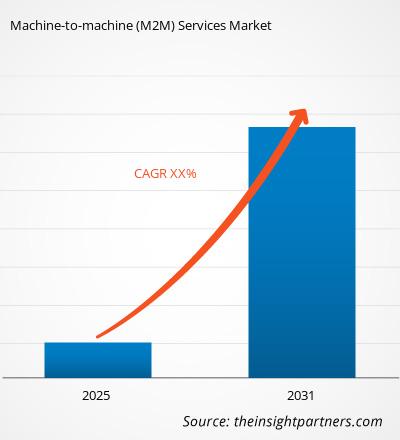
The machine-to-machine services market was valued at US$ 58.32 billion in 2025 and is projected to reach US$ 133.79 billion by 2034, registering a CAGR of 9.66% during 2026–2034. The market continues to expand as enterprises accelerate digital transformation, industrial automation, and connected device deployment. Increasing adoption of IoT-enabled communication, remote asset monitoring, and intelligent data exchange across multiple industries is strengthening long-term demand for machine-to-machine service platforms and managed connectivity solutions.
North America continues to represent one of the most established markets owing to its mature telecommunications infrastructure and widespread adoption of connected enterprise technologies. The machine-to-machine services market size in the region is supported by the rapid deployment of 5G networks, increasing industrial IoT implementation, and growing investments in connected transportation and smart utility infrastructure. The regional market is expected to expand at a CAGR ranging between 9.1% and 9.8% during 2026–2034, supported by continued digitalization across telecom, healthcare, automotive, financial services, and industrial sectors.
Machine-to-machine (M2M) Services Market Assessment and Insights
- North America: North America accounted for an estimated 35–39% share in 2025 and is expected to register a CAGR of 9.1–9.8% during 2026–2034. Strong 5G deployment, advanced IoT infrastructure, enterprise digitalization, and increasing investments in connected mobility and industrial automation continue to reinforce regional market expansion.
- US: The United States represented approximately 79–83% of the North American market in 2025 and is projected to grow at a CAGR of 9.2–9.9% during 2026–2034. Widespread adoption of connected devices, cloud-based enterprise platforms, and intelligent communication networks continues to support sustained market demand.
- Europe: Europe held an estimated 25–29% share in 2025 and is anticipated to expand at a CAGR of 8.8–9.5% during 2026–2034. Germany, the United Kingdom, France, Italy, and the Netherlands remain leading contributors through Industry 4.0 adoption, smart manufacturing, and connected mobility initiatives.
- Asia Pacific: Asia Pacific accounted for approximately 27–31% share in 2025 and is forecast to record the fastest regional growth with a CAGR of 10.6–11.3% during 2026–2034. China, India, Japan, South Korea, and Australia continue investing heavily in IoT infrastructure, smart cities, intelligent transportation, and digital industrial ecosystems.
- Largest Segment: Cellular technology represented an estimated 43–47% market share in 2025 and is projected to expand at a CAGR of 9.8–10.4% during 2026–2034, driven by broad deployment of LTE, NB-IoT, LTE-M, and 5G connectivity for enterprise and industrial applications.
- High Growth Segment: Healthcare is expected to emerge as the fastest-growing end-user, accounting for approximately 11–15% market share in 2025 while advancing at a CAGR of 11.2–11.9% during 2026–2034, supported by remote patient monitoring, connected medical devices, and digital healthcare infrastructure.
- Key companies analyzed in detail: AT&T Intellectual Property, Vodafone Group Plc, Verizon Communications Inc., International Business Machines Corporation (IBM), Aeris Communications, Inc., Cisco Systems, Inc., Rogers Communications Inc., Huawei Technologies Co., Ltd., Gemalto N.V., and Deutsche Telekom AG.
Source: The Insight Partners' analysis based on proprietary research, government publications, company annual reports, investor presentations, industry databases, and expert interviews.
With rapid developments in wireless communication, cloud computing, edge computing, and embedded connectivity, there is an essential change in machine-to-machine communications in various sectors. Ongoing development in connectivity with the use of 4G, 5G, LPWAN, and satellite connectivity has made real-time information sharing between connected machines possible, with lower deployment costs. Intelligent communication modules have been increasingly used by various sectors such as manufacturing, logistics, healthcare, and utilities to enhance their visibility, predictive maintenance ability, and automation processes within digital ecosystems.
In the future, more investment in smart cities, connected transportation, digital healthcare, and industrial automation will help ensure growth for a long time to come. Digital infrastructure, spectrum renewal, cybersecurity policies, and intelligent manufacturing initiatives supported by the government ensure positive market dynamics. In addition, connectivity initiatives in emerging countries will drive providers and technology vendors to enhance managed connectivity, analysis, and secure device life cycle management.
Machine-to-machine (M2M) Services Market Report Scope
| Report Attribute | Details |
|---|---|
| Market size in 2025 | US$ 58.32 Billion |
| Market Size by 2034 | US$ 133.79 Billion |
| Global CAGR (2026 - 2034) | 9.66% |
| Historical Data | 2021-2024 |
| Forecast period | 2026-2034 |
Machine-to-machine (M2M) Services Market Analysis
The machine-to-machine services market growth is being driven by the rapid expansion of industrial IoT deployments, enterprise digital transformation, and increasing adoption of connected assets across manufacturing, transportation, healthcare, utilities, and financial services. Intelligent communications have become vital for increasing efficiency, decreasing operational time outages, performing preventive maintenance, and optimizing field operations. Rising needs for secure data transfer, remote diagnostics, automatic monitoring, and real-time analytics are helping to boost demand in the ecosystem.
Key ecosystem participants include network operators, connectivity service providers, cloud platform providers, hardware vendors, semiconductor companies, cybersecurity companies, and systems integrators. The deployment of 5G technology, edge computing, embedded SIM, and low-power communication technology has boosted scalability and reliability in industrial mission-critical applications.
The competitive machine-to-machine services market analysis indicates that leading companies continue strengthening their portfolios through cloud integration, managed connectivity services, AI-enabled analytics, and strategic partnerships. AT&T Intellectual Property, Vodafone Group Plc, Verizon Communications Inc., International Business Machines Corporation (IBM), Cisco Systems, Inc., Huawei Technologies Co., Ltd., Deutsche Telekom AG, Aeris Communications, Inc., Rogers Communications Inc., and Gemalto N.V. maintain strong positions by expanding global IoT connectivity platforms and enterprise service offerings.
Investment activity increasingly focuses on intelligent connectivity management, private 5G networks, cybersecurity solutions, embedded connectivity platforms, and edge intelligence. Strategic collaborations between telecommunications providers, cloud vendors, and industrial technology companies are accelerating commercial deployment while enabling customized solutions for automotive, healthcare, manufacturing, logistics, utilities, and smart infrastructure applications.
● REPORT CUSTOMIZATION
Tailor This Report To Align With Your Specific Business Requirements
This report can be customized to align precisely with your business objectives, scope, and target markets. Customization options include tailored segmentation, geography, competitive analysis, and strategic insights to support informed decision-making.
Customize This Report →WHAT YOU CAN ADJUST
- ● Segmentations
- ● Geography
- ● Competitive Analysis
- ● Language Preferences
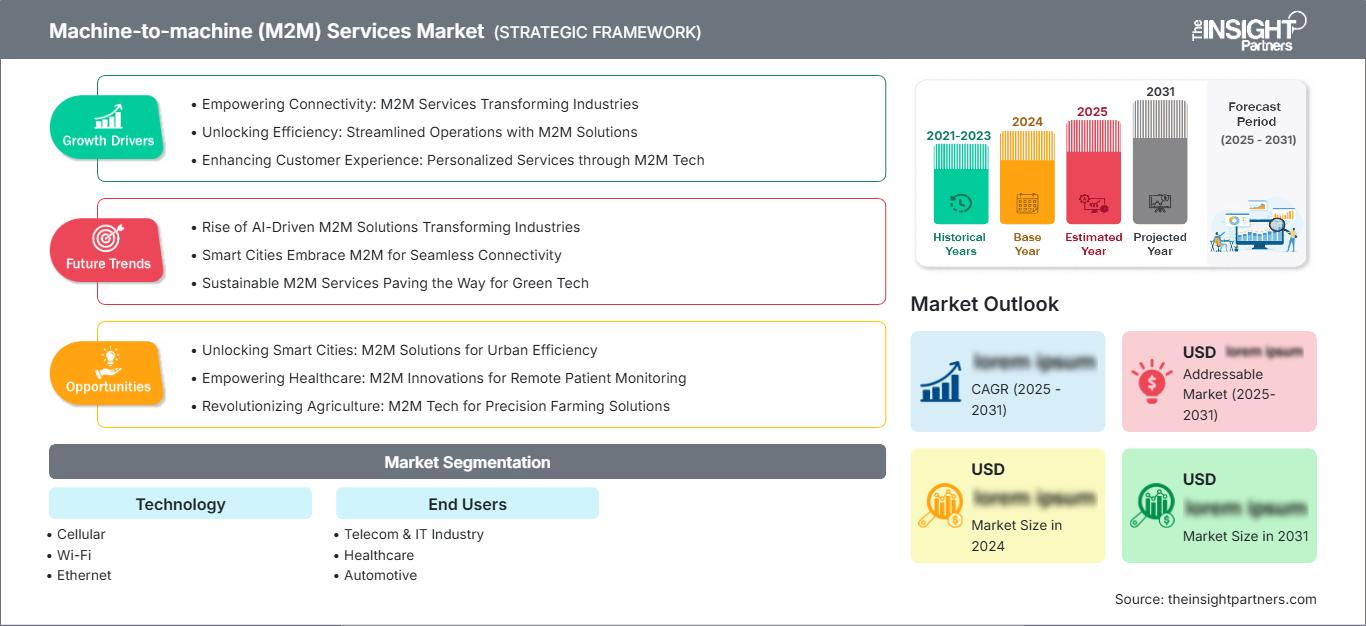
Machine-to-machine (M2M) Services Market: Strategic Insights
Regional Insights
North America Machine-to-Machine Services Market
North America accounted for 35–39% of the global market in 2025 and is anticipated to register a CAGR of 9.1–9.8% during 2026–2034. The machine-to-machine services market share in the region is supported by widespread deployment of 5G infrastructure, mature cloud ecosystems, and rapid enterprise adoption of Industrial Internet of Things (IIoT) technologies. Strong investments in connected vehicles, intelligent manufacturing, digital healthcare, and smart utility networks continue to accelerate adoption across both public and private sectors.
The United States and Canada remain the principal contributors due to advanced telecommunications infrastructure, extensive IoT deployments, and favorable digital transformation initiatives. Service providers continue investing in edge computing, private wireless networks, cybersecurity, and intelligent connectivity platforms to meet growing enterprise requirements. Increasing implementation of predictive maintenance, remote asset monitoring, fleet management, and smart city projects is expected to sustain regional market leadership throughout the forecast period.
U.S. Machine-to-Machine Services Market
The United States represented approximately 79–83% of the North American Machine-to-Machine Services Market in 2025 and is expected to record a CAGR of 9.2–9.9% during 2026–2034. The country's leadership is supported by early commercialization of 5G services, widespread enterprise cloud adoption, and continuous investment in connected industrial infrastructure. Telecommunications providers and technology companies are expanding managed IoT connectivity services to support digital transformation across manufacturing, logistics, healthcare, and financial services.
Major industry participants, including AT&T Intellectual Property, Verizon Communications Inc., Cisco Systems, Inc., International Business Machines Corporation (IBM), and Aeris Communications, Inc., maintain significant operational presence within the country. The growing implementation of connected medical devices, intelligent transportation systems, automated warehouses, and industrial monitoring platforms continues to strengthen demand. Regulatory support for critical infrastructure modernization and increasing enterprise spending on cybersecurity further reinforces long-term market expansion.
Europe Machine-to-Machine Services Market
Europe accounted for an estimated 25–29% share in 2025 and is projected to expand at a CAGR of 8.8–9.5% during 2026–2034. Germany remains the regional leader, supported by Industry 4.0 initiatives, advanced manufacturing capabilities, and widespread industrial automation. Strong adoption of intelligent logistics, connected production facilities, and industrial IoT solutions continues to create sustained demand for machine-to-machine communication services.
The United Kingdom demonstrates steady expansion through investments in smart transportation, financial technology, healthcare digitalization, and intelligent utility infrastructure. France, Italy, and Spain continue strengthening regional demand through manufacturing modernization, smart energy deployment, and connected public infrastructure projects. Additionally, companies including Vodafone Group Plc, Deutsche Telekom AG, and Gemalto N.V. continue expanding managed connectivity platforms, enterprise IoT services, and secure communication technologies across European industries.
APAC Machine-to-Machine Services Market
Asia Pacific accounted for approximately 27–31% of the global Machine-to-Machine Services Market in 2025 and is projected to register the fastest regional expansion with a CAGR of 10.6–11.3% during 2026–2034. China leads regional demand, supported by large-scale smart manufacturing, industrial IoT adoption, and extensive 5G deployment. Japan, South Korea, India, and Australia continue investing in connected transportation, digital healthcare, smart utilities, and industrial automation to improve productivity and operational efficiency.
Government-backed digital infrastructure programs and rapid enterprise cloud adoption continue strengthening regional growth. Expanding telecommunications networks, rising connected device penetration, and increasing deployment of intelligent logistics and smart city initiatives are expected to reinforce Asia Pacific's position as the fastest-growing regional market throughout the forecast period.
Middle East & Africa Machine-to-Machine Services Market
The Middle East & Africa Machine-to-Machine Services Market is expected to expand at a CAGR of 8.7–9.4% during 2026–2034, supported by accelerating investments in digital infrastructure and industrial modernization. Saudi Arabia and the United Arab Emirates continue implementing smart city initiatives, intelligent transportation systems, and connected utility networks under national digital transformation programs, while South Africa remains a key contributor through industrial automation and telecommunications modernization.
Growing investments in oil and gas digitalization, remote asset monitoring, utility automation, and intelligent security systems are increasing demand for managed connectivity services across the region. Expansion of 5G coverage, cloud data centers, and enterprise IoT deployments is expected to create additional opportunities for machine-to-machine service providers over the forecast period.
Segmentation Analysis
Technology
The Technology segment represents the core foundation of the market and is projected to expand at a CAGR of 9.8–10.4% during 2026–2034. The machine-to-machine services market scope continues to broaden as enterprises adopt multiple communication technologies based on application requirements, network availability, latency, security, and power consumption. Continuous deployment of 5G infrastructure, low-power wide-area networks, and hybrid connectivity solutions is improving communication reliability across industrial automation, transportation, healthcare, utilities, and smart city applications.
- Cellular – Cellular connectivity maintains the leading position owing to widespread LTE, NB-IoT, LTE-M, and emerging 5G deployments. Its scalability, mobility support, and secure connectivity make it the preferred technology for enterprise-grade machine-to-machine communications.
- Wi-Fi – Wi-Fi technology is widely deployed in manufacturing facilities, healthcare institutions, commercial buildings, and retail environments where high-speed local connectivity supports real-time device communication and operational monitoring within controlled network environments.
- Ethernet – Ethernet remains critical for industrial facilities requiring highly reliable, low-latency, and secure wired communication between production equipment, controllers, and automation systems operating in mission-critical manufacturing environments.
- Zigbee – Zigbee supports low-power sensor networks deployed in building automation, energy management, environmental monitoring, and smart lighting applications where extended battery life and mesh networking capabilities are important.
- Satellite – Satellite communication enables connectivity for remote industrial assets, offshore energy facilities, mining operations, maritime transportation, and rural infrastructure where conventional terrestrial communication networks remain unavailable.
- Power-Line – Power-line communication supports utility automation and smart grid deployments by transmitting operational data through existing electrical infrastructure, reducing communication deployment costs while enhancing monitoring capabilities.
End Users
The End Users segment is anticipated to record a CAGR of 10.1–10.8% during 2026–2034, driven by increasing adoption of connected devices across diverse industries. Growing investments in digital transformation, industrial automation, predictive maintenance, intelligent logistics, remote healthcare, and connected infrastructure continue to strengthen demand for secure, scalable, and real-time communication services across enterprise operations.
- Telecom & IT Industry – Telecom operators and IT providers utilize machine-to-machine services to manage connected infrastructure, optimize network performance, automate operations, and deliver scalable enterprise IoT connectivity solutions.
- Healthcare – Healthcare organizations increasingly deploy connected medical devices, remote patient monitoring systems, hospital asset tracking, and digital diagnostics to improve clinical efficiency, patient outcomes, and regulatory compliance.
- Automotive – Automotive manufacturers integrate connected vehicle platforms supporting telematics, predictive maintenance, fleet management, over-the-air software updates, and intelligent mobility services across commercial and passenger vehicles.
- Transportation – Transportation providers implement machine-to-machine communication for fleet monitoring, intelligent traffic management, logistics optimization, cargo tracking, and infrastructure management to improve operational efficiency and safety.
- Oil & Gas – Oil and gas operators deploy connected sensors, remote monitoring platforms, pipeline surveillance systems, and predictive maintenance technologies to improve operational reliability while reducing maintenance costs.
- Retail Sector – Retail enterprises utilize connected payment terminals, inventory monitoring systems, smart vending equipment, and digital asset management solutions to enhance customer experience and supply chain visibility.
- Banking & Finance – Financial institutions adopt connected ATMs, intelligent payment infrastructure, branch monitoring systems, and security solutions to strengthen operational continuity and transaction reliability.
- Utilities – Utility providers deploy smart metering, grid automation, remote equipment diagnostics, and energy management platforms to improve operational efficiency, network resilience, and customer service quality.
- Security & Surveillance – Security organizations increasingly implement connected surveillance cameras, intelligent access control, environmental monitoring sensors, and real-time threat detection systems to strengthen public and private security infrastructure.
Opportunity Snapshot
| End Users | Revenue Contribution | Trend Tag | Adoption Stage |
| Telecom & IT Industry | High | Private 5G | Mature |
| Healthcare | High | Remote Care | Scaling |
| Automotive | High | Connected Cars | Scaling |
| Transportation | High | Fleet IoT | Scaling |
| Oil & Gas | Medium | Remote Assets | Scaling |
| Retail Sector | Medium | Smart Retail | Scaling |
| Banking & Finance | Medium | Connected Banking | Mature |
| Utilities | High | Smart Grid | Mature |
| Security & Surveillance | Medium | AI Surveillance | Emerging |
Machine-to-machine (M2M) Services Market Growth Drivers and Impact Analysis
Expansion of Industrial IoT and Smart Manufacturing
The manufacturing industry is implementing connected sensors, smart controllers, automated manufacturing equipment, and predictive maintenance solutions to increase operational efficiency and decrease the occurrence of unexpected machine downtimes. Communication between machines allows for the constant surveillance of manufacturing devices; therefore, businesses can plan maintenance better and use equipment more often. More manufacturing plants implement connected solutions together with cloud computing and edge computing to facilitate instant business decisions. Investments in Industry 4.0 solutions in such industries as automotive, electronics, pharmaceuticals, and process manufacturing keep increasing the requirements for managed connectivity solutions. Such transformation towards the intelligent manufacturing environment is expected to be one of the major factors contributing to the future growth of the industry.
Global Expansion of 5G and Advanced Communication Networks
The commercial introduction of 5G networks is making significant contributions towards speeding up communication, increasing reliability, and raising the capacity of networks for connected devices in both industrial and commercial settings. With low latencies and higher device density, machine-to-machine operations can make it possible to have autonomous vehicles, smart factories, connected healthcare, intelligent transport, and utility automation. Telecom providers have not stopped investing in wireless private networks, network slicing, and edge computing, which makes it easier to adopt the technology within enterprises. This improves communication and helps in mission-critical applications that require consistent data communication.
Increasing Digital Transformation Across Enterprise Operations
Various organizations working in different sectors, such as healthcare, banking, logistics, utility, retail, and energy, are fast embracing digital transformation processes in order to enhance visibility and resilience in business operations. Connected devices provide information about the actual state of operations that can be used in predictive analytics, monitoring of operations remotely, automation of work processes, and asset optimization. In this regard, there is an increasing need for communication platforms that ensure secure communication even when thousands of connected devices are involved to maintain cybersecurity and compliance with legal requirements.
Machine-to-machine (M2M) Services Market Future Trends
Integration of Artificial Intelligence with Connected Device Platforms
Artificial intelligence is becoming an essential component of connected communication ecosystems by enabling predictive analytics, autonomous decision-making, and intelligent device management. The machine-to-machine services market trends indicate increasing adoption of AI-powered analytics platforms capable of identifying equipment anomalies, optimizing network performance, and automating maintenance workflows. Enterprises have been combining machine learning systems with edge computing and cloud-IoT platforms to increase efficiency while decreasing their response times. The combination of artificial intelligence, edge intelligence, and connectivity in real-time is likely to increase productivity in industries and increase automation in enterprises and make the infrastructure more resilient.
Growing Adoption of Edge Computing for Real-Time Connectivity
Companies are now implementing edge computing solutions to compute their operational data closer to the connected devices, which helps reduce latency and improve response time for critical applications. The use of edge computing will facilitate autonomous manufacturing systems, connected cars, intelligent healthcare devices, and other forms of industrial automation where real-time decision-making is essential. Moreover, machine-to-machine communication with the help of edge computing will help minimize the requirement for bandwidth and increase the cybersecurity level since unnecessary cloud data transmission can be avoided.
Machine-to-machine (M2M) Services Market Opportunities
Expansion of Smart City Infrastructure Projects
Governments worldwide continue investing in intelligent transportation systems, connected street lighting, smart parking, digital utilities, environmental monitoring, and public safety infrastructure. Machine-to-machine services market Forecasts indicate that these large-scale digital infrastructure initiatives will create long-term opportunities for telecommunications providers, IoT platform vendors, cloud service providers, and managed connectivity specialists. Vendors capable of delivering secure, scalable, and interoperable communication platforms will benefit from increasing public-sector investment. Integration of artificial intelligence, edge computing, and 5G-enabled connectivity into smart city ecosystems is expected to strengthen long-term commercial opportunities while supporting sustainable urban development.
Growing Enterprise Demand for Industry-Specific Managed Connectivity
Organizations increasingly require customized connectivity solutions designed for specific operational environments rather than standardized communication services. Healthcare providers require highly secure connected medical devices, manufacturers prioritize predictive maintenance capabilities, while logistics companies seek intelligent fleet monitoring platforms. Service providers expanding vertical-specific offerings, managed IoT platforms, cybersecurity services, and lifecycle management solutions can strengthen competitive positioning. Continued investment in industry-focused connectivity ecosystems, cloud integration, embedded SIM technologies, and advanced analytics will create attractive opportunities for solution providers serving diverse enterprise customers across global markets.
Frequently Asked Questions

- Comprehensive Market Sizing and Forecast Analysis
- Detailed Segmentation Analysis
- In-Depth Market Dynamics Assessment
- Regional and Country-Level Insights
- Competitive Landscape and Company Benchmarking
- Strategic Business Intelligence
Recent Reports
Testimonials

The Insight Partners provided valuable market intelligence that supported our global go-to-market strategy. Their team was professional, responsive, and attentive to our feedback, providing thoughtful analysis and helpful methodological clarifications throughout the project.
Junmo Kim Chief Financial Officer (CFO), Enertech Co., Ltd.
The Insight Partners' SCADA System Market report is comprehensive, with valuable insights on current trends and future forecasts. The team was highly professional, responsive, and supportive throughout. We are very satisfied and highly recommend their services.
RAN KEDEM Partner, Reali Technologies LTDs
I requested a report on a very specific software market and the team produced the report in a few days. The information was very relevant and well presented. I then requested some changes and additions to the report. The team was again very responsive and I got the final report in less than a week.
JEAN-HERVE JENN Chairman, Future Analytica
We worked with The Insight Partners for an important market study and forecast. They gave us clear insights into opportunities and risks, which helped shape our plans. Their research was easy to use and based on solid data. It helped us make smart, confident decisions. We highly recommend them.
PIYUSH NAGPAL Sr. Vice President, High Beam Global
The Insight Partners delivered insightful, well-structured market research with strong domain expertise. Their team was professional and responsive throughout. The user-friendly website made accessing industry reports seamless. We highly recommend them for reliable, high-quality research services
YUKIHIKO ADACHI CEO, Deep Blue, LLC.
This is the first time I have purchased a market report from The Insight Partners.While I was unsure at first, I visited their web site and felt more comfortable to take the risk and purchase a market report.I am completely satisfied with the quality of the report and customer service. I had several questions and comments with the initial report, but after a couple of dialogs over email with their analyst I believe I have a report that I can use as input to our strategic planning process.Thank you so much for taking the extra time and making this a positive experience.I will definitely recommend your service to others and you will be my first call when we need further market data.
JOHN SUZUKI President and Chief Executive Officer, Board Director, BK Technologies
I wish to appreciate your support and the professionalism you displayed in the course of attending to my request for information regarding to infectious disease IVD market in Nigeria. I appreciate your patience, your guidance, and the fact that you were willing to offer a discount, which eventually made it possible for us to close a deal. I look forward to engaging The Insight Partners in the future, all thanks to the impression you have created in me as a result of this first encounter.
DR CHIJIOKE ONYIA MANAGING DIRECTOR, PineCrest Healthcare Ltd.Reason to Buy
- Informed Decision-Making
- Understanding Market Dynamics
- Competitive Analysis
- Identifying Emerging Markets
- Customer Insights
- Market Forecasts
- Risk Mitigation
- Boosting Operational Efficiency
- Strategic Planning
- Investment Justification
- Tracking Industry Innovations
- Aligning with Regulatory Trends





 Get Free Sample for