
Marine Electronics Market Trends, Size & Growth by 2034
Coverage: By Product Type (GPS and Radar Systems, SONAR Modules, Communication Devices, Autonomous Identification Systems (AIS), Thermal and Visible Cameras, Multi-function Navigation, Others); Application (Merchant Marine, Fishing Vessel, Yachts/Recreation, Military Naval, Others) , and Geography (North America, Europe, Asia Pacific, and South and Central America)
- Status : Data Released
- Report Code : TIPRE00006130
- Category : Electronics and Semiconductor
- No. of Pages : 150
- Available Report Formats :


- Last update date : September 30, 2026


2025 Market Size
US$ 14.8 Bn
Base year value
2034 Forecast
US$ 25.54 Bn
Projected by 2034
CAGR 2026-2034
6.25 %
Growth rate
Addressable Market
US$ 182.58 Bn
(2026-2034)
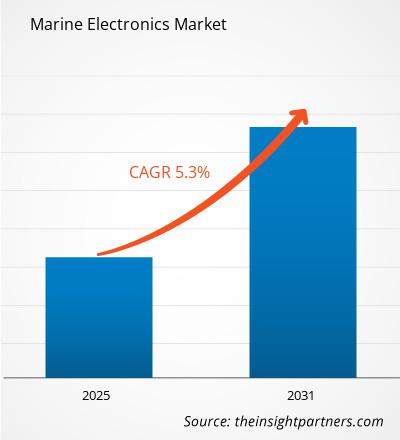
The Marine electronics market was valued at US$ 14.8 Billion in 2025 and is projected to reach US$ 25.54 Billion by 2034, expanding at a CAGR of 6.25% during 2026–2034. Growing investments in maritime digitalization, vessel safety, autonomous navigation technologies, and naval modernization programs continue to support long-term demand. Increasing commercial shipping activity and stricter international maritime safety requirements are also encouraging adoption of advanced onboard electronic systems.
North America remains an important regional hub for maritime technology innovation, supported by commercial shipping, offshore energy activities, naval modernization, and recreational boating. The marine electronics market size across the region is expected to expand at a CAGR of 5.8–6.5% through 2034. Continued investments in vessel automation, integrated bridge systems, and maritime surveillance technologies are expected to strengthen demand for advanced marine electronic equipment.
Marine Electronics Market Assessment and Insights
- North America: Accounted for an estimated 24–28% share in 2025 and is expected to expand at a CAGR of 5.8–6.5% during 2026–2034. Growth is supported by naval modernization, commercial shipping, offshore operations, and increasing demand for integrated navigation technologies.
- US: Represented approximately 79–83% of the North American market in 2025 and is projected to grow at a CAGR of 5.9–6.6% during 2026–2034, supported by strong defense spending, marine technology innovation, and recreational boating demand.
- Europe: Held an estimated 26–30% share in 2025 and is anticipated to register a CAGR of 5.9–6.6% during 2026–2034. Norway, Germany, the UK, France, and Italy continue leading regional demand through commercial shipping and naval technology investments.
- Asia Pacific: Accounted for approximately 34–38% share in 2025 and is projected to register a CAGR of 6.8–7.5% during 2026–2034. China, Japan, South Korea, Singapore, and India remain major contributors through shipbuilding, naval expansion, and port modernization.
- Largest Segment: Application – Merchant Marine accounted for approximately 39–43% market share in 2025 and is expected to expand at a CAGR of 6.3–7.0% during 2026–2034, supported by fleet modernization and global shipping activity.
- High Growth Segment: Product Type – Multi-function Navigation represented approximately 18–22% market share in 2025 and is projected to register a CAGR of 7.1–7.8% during 2026–2034, driven by demand for integrated navigation and digital bridge systems.
- Key companies analyzed in detail: Teledyne FLIR LLC, Furuno Electric Co., Ltd., Garmin Ltd., Icom Inc., Japan Radio Co., Ltd., Kongsberg Maritime AS, Navico Group, Northrop Grumman Sperry Marine B.V., SRT Marine Systems plc, Wärtsilä Voyage Limited (formerly Transas).
Source: The Insight Partners' analysis based on proprietary research, government publications, company annual reports, investor presentations, industry databases, and expert interviews.
The fast pace of digitalization of the entire maritime sector has led to the development of integrated electronic systems for vessel management that integrates navigation, communications, surveillance, and automated technologies. The further development of technologies such as radar systems, satellite communication, electronic chart display systems, and autonomous navigation will allow to increase efficiency while complying with international maritime regulations. These advances will ensure continued growth in the market for marine electronics, including commercial vessels, naval, offshore energy, and recreational segments.
Further growth in the market is forecasted to be driven by smart port solutions, autonomous ships, and increased expenditure on cybersecurity of the maritime sector. Newly established shipbuilding regions are developing production capacities and governments continue their efforts to improve their naval fleets. Increased use of artificial intelligence, cloud-based vessel management, and satellite communications is predicted to generate additional opportunities for growth in this market.
Marine Electronics Market Report Scope
| Report Attribute | Details |
|---|---|
| Market size in 2025 | US$ 14.8 Billion |
| Market Size by 2034 | US$ 25.54 Billion |
| Global CAGR (2026 - 2034) | 6.25% |
| Historical Data | 2021-2024 |
| Forecast period | 2026-2034 |
Marine Electronics Market Analysis
Increasing international seaborne cargo transportation, growing naval equipment manufacturing activities, and offshore oil and gas extraction activities continue pushing up the demand for advanced marine electronics systems. Contemporary ships need advanced navigation, communication, surveillance, and safety systems that will help increase the operational effectiveness of ships in compliance with contemporary regulatory requirements. Advanced digital bridges, satellite communications, and radar systems become an inherent part of the shipbuilding process, helping to ensure further market development and prompting companies to engage in advanced products research and development.
The marine electronics industry is continuing evolving through increased cooperation between equipment vendors, shipbuilders, software companies, satellite communication services suppliers, and maritime services providers. Increased investment into vessel automation, predictive maintenance, and digital fleet management systems increases operational efficiency of ships while providing integrated technology vendors with new business opportunities in the maritime sector.
Competitive forces are driven by constant development in navigation technology, communication technologies in the seas, and autonomous ships. The analysis of the market for marine electronics is based on the competitive strategy of Furuno Electric Co., Ltd., Garmin Ltd., Kongsberg Maritime AS, Teledyne FLIR LLC, Japan Radio Co., Ltd., Icom Inc., Northrop Grumman Sperry Marine B.V., and SRT Marine Systems plc, all of which keep on growing their product portfolio by developing new innovations and cooperating with maritime technology companies.
Manufacturers build up their competitive positions with the help of the combination of hardware and software, artificial intelligence navigation systems, cybersecurity technologies, and cloud-based solutions for the management of fleets. Strategic alliances with shipbuilders, defense departments, and commercial fleets are contributing to the accelerated adoption of intelligent technologies in maritime industries.
● REPORT CUSTOMIZATION
Tailor This Report To Align With Your Specific Business Requirements
This report can be customized to align precisely with your business objectives, scope, and target markets. Customization options include tailored segmentation, geography, competitive analysis, and strategic insights to support informed decision-making.
Customize This Report →WHAT YOU CAN ADJUST
- ● Segmentations
- ● Geography
- ● Competitive Analysis
- ● Language Preferences
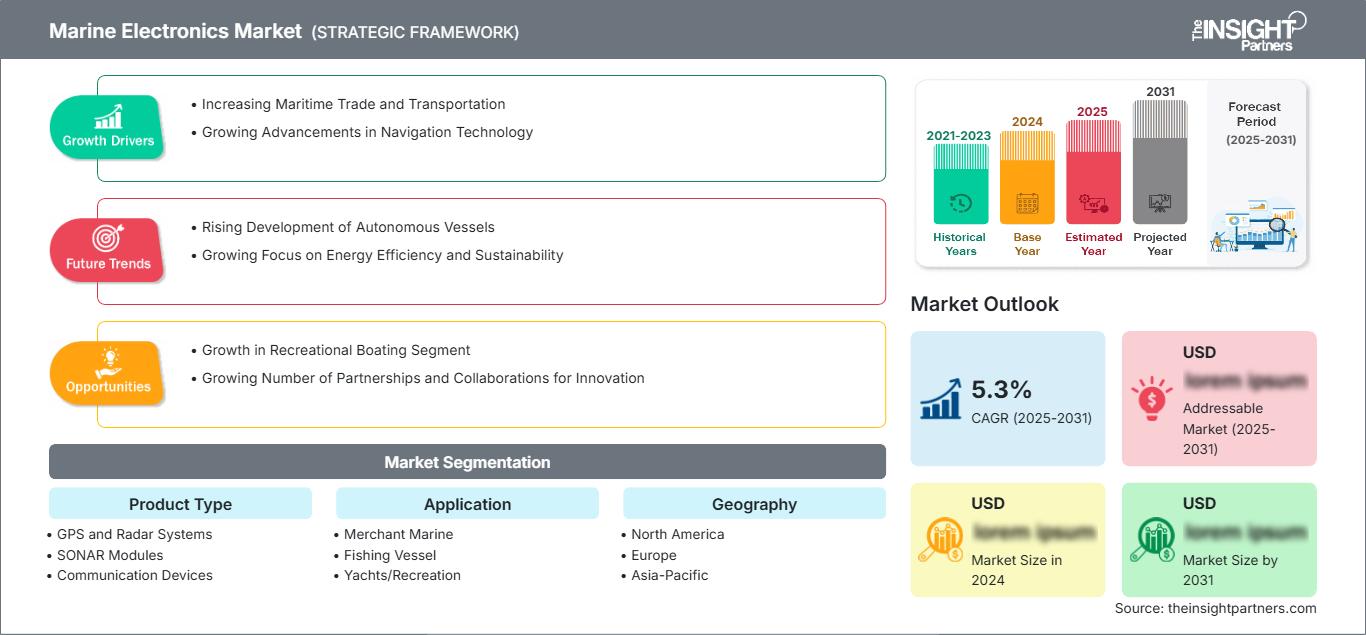
Marine Electronics Market: Strategic Insights
Regional Insights
North America Marine Electronics Market
North America accounted for an estimated 24–28% marine electronics market share in 2025 and is projected to expand at a CAGR of 5.8–6.5% during 2026–2034. The area is fortunate in having well-developed naval capabilities, well-developed commercial shipping industry, offshore oil & gas operations, and the largest in the world recreational boating industry. The continued investment in the advancement of the vessels, navigational equipment, and surveillance equipment is aiding the proliferation of advanced marine electronics technology among the commercial and defense fleets.
The governmental measures being taken towards the improvement of maritime security, port facilities, and coastal infrastructures have been fueling the installation of integrated bridge system, radar systems, satellite communication, and vessel monitoring systems. The rising usage of autonomous navigation system along with the rising investments in smart maritime infrastructure would aid the growth in the future.
U.S. Marine Electronics Market
The United States represented approximately 79–83% of the North American market in 2025 and is anticipated to expand at a CAGR of 5.9–6.6% during 2026–2034. The country is one of the key hubs in the development of technologies in the naval industry, development of maritime defense projects, commercial shipping services, and recreational boats. Investments into upgrading ship fleets, advanced navigation systems, and maritime communications are contributing to the market development in all ship types.
The involvement of top technology developers, defense contractors, and marine equipment manufacturers is improving the local market ecosystem. Leading players, including Garmin Ltd., Teledyne FLIR LLC, Northrop Grumman Sperry Marine B.V., and SRT Marine Systems plc, provide advanced technologies for navigation, surveillance, and communications for both commercial and military vessels and coast guard ships.
Europe Marine Electronics Market
Europe accounted for approximately 26–30% of the global market in 2025 and is expected to register a CAGR of 5.9–6.6% during 2026–2034. Norway dominates in the regional market owing to its sophisticated marine industry, offshore energy services, and autonomous shipping technology innovations. Germany continues enhancing its market status due to its experience in shipbuilding, marine engineering, and vessel electronics innovations.
The United Kingdom continues demonstrating high demand in terms of naval innovation, commercial shipping, and marine research projects. France, Italy, and Spain are continuing their investment in naval fleets, port innovation, commercial shipping infrastructure, and marine safety technology. These countries have become major contributors to the European dominance in intelligent navigation systems, bridge technologies, and digital vessel management solutions.
APAC Marine Electronics Market
Asia Pacific represented approximately 34–38% of the global Marine Electronics Market in 2025 and is forecast to expand at a CAGR of 6.8–7.5% during 2026–2034. China remains the largest regional market through extensive shipbuilding activity and naval modernization, while Japan and South Korea continue leading in advanced marine electronics manufacturing and maritime technology innovation.
India is strengthening naval capabilities and commercial port infrastructure through sustained government investment, while Singapore continues serving as a major maritime technology and shipping hub. Increasing vessel production, offshore energy projects, and smart port initiatives continue driving regional demand for advanced marine electronic systems.
Middle East & Africa Marine Electronics Market
The Middle East & Africa Marine Electronics Market is projected to register a CAGR of 5.4–6.1% during 2026–2034, supported by expanding port infrastructure, offshore energy development, and maritime security investments. Both Saudi Arabia and the UAE are modernizing their commercial ports by using innovative technologies such as surveillance, navigation, and ship communication systems.
South Africa is still considered a major maritime entry point for commercial shipping and coast surveillance operations. RoMEA continues deploying marine electronics within the fishing fleets, offshore boats, naval fleets, and commercial shipping segments, leading to market growth.
Segmentation Analysis
Product Type
The Product Type segment represents the technological foundation of modern vessel operations by integrating navigation, communication, surveillance, and situational awareness systems. It is projected to expand at a CAGR of 6.4–7.1% during 2026–2034, supported by increasing vessel digitalization, autonomous navigation initiatives, and fleet modernization programs. The marine electronics market scope continues expanding as ship operators adopt integrated electronic systems to improve operational safety, efficiency, and regulatory compliance.
- GPS and Radar Systems – Remain essential for navigation, collision avoidance, route optimization, and vessel positioning across commercial shipping, naval fleets, offshore platforms, and recreational vessels.
- SONAR Modules – Widely utilized for underwater navigation, seabed mapping, fishing operations, obstacle detection, and naval surveillance requiring high-precision acoustic sensing capabilities.
- Communication Devices – Support reliable ship-to-ship, ship-to-shore, and satellite communications, enabling operational coordination, emergency response, and regulatory compliance across maritime operations.
- Autonomous Identification Systems – Increasingly adopted for vessel tracking, collision prevention, maritime traffic management, and regulatory reporting through continuous exchange of navigational information.
- Thermal and Visible Cameras – Enhance maritime surveillance, nighttime navigation, search and rescue missions, and onboard security through advanced imaging technologies operating in challenging environmental conditions.
- Multi-function Navigation – The fastest-growing product category integrates radar, GPS, electronic charts, sonar, weather data, and communication systems into centralized bridge management platforms.
Application
Application remains the primary demand driver for marine electronics and is projected to register a CAGR of 6.5–7.2% during 2026–2034. Growing international trade, naval modernization, offshore energy investments, and recreational boating continue increasing demand across multiple vessel categories, with merchant marine maintaining the largest market contribution.
- Merchant Marine – The dominant application segment benefits from expanding international trade, fleet modernization, digital navigation adoption, and increasing investments in intelligent vessel management systems.
- Fishing Vessel – Modern fishing fleets increasingly deploy sonar, navigation, communication, and vessel monitoring technologies to improve operational efficiency, catch optimization, and maritime safety.
- Yachts/Recreation – Rising recreational boating activity encourages adoption of premium navigation displays, multifunction bridge systems, satellite communications, and onboard entertainment integration.
- Military Naval – Continuous investments in naval modernization, maritime surveillance, electronic warfare, and integrated combat management systems support sustained demand for advanced marine electronics.
- Others – Specialized commercial vessels, research ships, coast guard fleets, offshore support vessels, and harbor service boats continue adopting integrated navigation and communication technologies to improve operational performance and safety.
Opportunity Snapshot
| Application | Revenue Contribution | Trend Tag | Adoption Stage |
|---|---|---|---|
| Merchant Marine | High | Smart Shipping | Mature |
| Fishing Vessel | Medium | Fish Finding | Scaling |
| Yachts/Recreation | Medium | Connected Helm | Scaling |
| Military Naval | High | Fleet Digitalization | Mature |
| Others | Low | Harbor Safety | Emerging |
Marine Electronics Market Growth Drivers and Impact Analysis
Expansion of Smart Shipping and Fleet Digitalization
The Marine Electronics Market forecast shows that commercial shipping companies are increasingly investing in digital bridge systems, connected navigation platforms, and fleet performance monitoring solutions to improve operational efficiency and reduce fuel consumption. Advanced marine electronics enable real-time vessel tracking, route optimization, predictive maintenance, and regulatory compliance through integrated onboard systems. Fleet operators are also adopting cloud-connected technologies that enhance decision-making and minimize operational risks. As international shipping companies continue modernizing aging fleets, demand for integrated navigation, communication, and monitoring systems is expected to strengthen across both new vessel construction and retrofit projects, creating long-term opportunities for marine electronics manufacturers and technology providers.
Rising Naval Modernization and Maritime Security Investments
Governments worldwide continue expanding naval modernization programs to strengthen maritime security, coastal surveillance, and defense preparedness. Modern naval vessels require sophisticated radar systems, electronic navigation, secure communication platforms, sonar technologies, and thermal imaging equipment to support mission-critical operations. Maritime border protection, search and rescue capabilities, and offshore asset monitoring are also driving procurement of advanced electronic systems. Continued investments in intelligent surveillance technologies and integrated combat management platforms are expected to sustain demand for high-performance marine electronics across defense organizations throughout the forecast period.
Increasing Adoption of Integrated Navigation Technologies
Ship operators are increasingly replacing standalone navigation equipment with integrated multifunction bridge systems that combine radar, GPS, sonar, electronic chart displays, communication devices, and automated monitoring capabilities. These integrated platforms improve navigational awareness while simplifying vessel operations and enhancing crew efficiency. Advances in digital displays, satellite communications, and sensor fusion technologies continue improving operational performance across commercial, offshore, naval, and recreational vessels. Growing regulatory emphasis on maritime safety and operational reliability is expected to accelerate adoption of integrated navigation solutions across global fleets.
Marine Electronics Market Future Trends
Artificial Intelligence Supporting Autonomous Navigation
Artificial intelligence is becoming increasingly important for intelligent route planning, collision avoidance, predictive maintenance, and automated vessel operations. Advanced algorithms process navigation, radar, weather, and sensor information in real time to improve operational efficiency and maritime safety. As autonomous vessel development progresses, marine electronics market trends are expected to increasingly focus on AI-enabled navigation platforms, intelligent decision-support systems, and connected fleet management technologies that improve operational reliability while reducing human intervention.
Satellite Connectivity and Cloud-Based Vessel Management
Marine operators are adopting satellite-enabled communications and cloud-connected management platforms to improve fleet visibility, operational efficiency, and maintenance planning. Continuous vessel connectivity enables remote diagnostics, performance monitoring, digital reporting, and cybersecurity management regardless of vessel location. These technologies support smarter shipping operations while enabling shipowners to optimize fuel consumption, reduce downtime, and improve regulatory compliance through centralized digital fleet management systems.
Marine Electronics Market Opportunities
Growth in Autonomous and Uncrewed Maritime Platforms
Autonomous surface vessels and remotely operated maritime platforms are creating new opportunities for advanced navigation, communication, imaging, and sensor technologies. Governments, research organizations, offshore operators, and commercial shipping companies continue investing in intelligent vessel technologies capable of improving operational safety while reducing labor requirements. Long-term marine electronics Forecasts indicate that suppliers offering integrated autonomous navigation platforms, advanced situational awareness systems, and secure communication technologies will be well positioned to benefit from increasing commercialization of autonomous maritime operations.
Modernization of Ports and Coastal Infrastructure
Global investments in smart ports, digital harbor management, vessel traffic services, and coastal surveillance continue creating opportunities for marine electronics suppliers. Port authorities increasingly require integrated communication systems, navigation aids, thermal imaging, and intelligent monitoring solutions to improve operational efficiency and maritime safety. Companies developing interoperable marine electronics capable of supporting connected port ecosystems, real-time vessel monitoring, and digital maritime operations are expected to benefit from expanding infrastructure investments across both developed and emerging economies.
Frequently Asked Questions

- Comprehensive Market Sizing and Forecast Analysis
- Detailed Segmentation Analysis
- In-Depth Market Dynamics Assessment
- Regional and Country-Level Insights
- Competitive Landscape and Company Benchmarking
- Strategic Business Intelligence
Recent Reports
Testimonials

The Insight Partners provided valuable market intelligence that supported our global go-to-market strategy. Their team was professional, responsive, and attentive to our feedback, providing thoughtful analysis and helpful methodological clarifications throughout the project.
Junmo Kim Chief Financial Officer (CFO), Enertech Co., Ltd.
The Insight Partners' SCADA System Market report is comprehensive, with valuable insights on current trends and future forecasts. The team was highly professional, responsive, and supportive throughout. We are very satisfied and highly recommend their services.
RAN KEDEM Partner, Reali Technologies LTDs
I requested a report on a very specific software market and the team produced the report in a few days. The information was very relevant and well presented. I then requested some changes and additions to the report. The team was again very responsive and I got the final report in less than a week.
JEAN-HERVE JENN Chairman, Future Analytica
We worked with The Insight Partners for an important market study and forecast. They gave us clear insights into opportunities and risks, which helped shape our plans. Their research was easy to use and based on solid data. It helped us make smart, confident decisions. We highly recommend them.
PIYUSH NAGPAL Sr. Vice President, High Beam Global
The Insight Partners delivered insightful, well-structured market research with strong domain expertise. Their team was professional and responsive throughout. The user-friendly website made accessing industry reports seamless. We highly recommend them for reliable, high-quality research services
YUKIHIKO ADACHI CEO, Deep Blue, LLC.
This is the first time I have purchased a market report from The Insight Partners.While I was unsure at first, I visited their web site and felt more comfortable to take the risk and purchase a market report.I am completely satisfied with the quality of the report and customer service. I had several questions and comments with the initial report, but after a couple of dialogs over email with their analyst I believe I have a report that I can use as input to our strategic planning process.Thank you so much for taking the extra time and making this a positive experience.I will definitely recommend your service to others and you will be my first call when we need further market data.
JOHN SUZUKI President and Chief Executive Officer, Board Director, BK Technologies
I wish to appreciate your support and the professionalism you displayed in the course of attending to my request for information regarding to infectious disease IVD market in Nigeria. I appreciate your patience, your guidance, and the fact that you were willing to offer a discount, which eventually made it possible for us to close a deal. I look forward to engaging The Insight Partners in the future, all thanks to the impression you have created in me as a result of this first encounter.
DR CHIJIOKE ONYIA MANAGING DIRECTOR, PineCrest Healthcare Ltd.Reason to Buy
- Informed Decision-Making
- Understanding Market Dynamics
- Competitive Analysis
- Identifying Emerging Markets
- Customer Insights
- Market Forecasts
- Risk Mitigation
- Boosting Operational Efficiency
- Strategic Planning
- Investment Justification
- Tracking Industry Innovations
- Aligning with Regulatory Trends





 Get Free Sample for