
Mechanical Time Switches Market Size, Trends & Demand by 2034
Coverage: By Type (Digital Time Switches, Analogue Time Switches); Application (Lightings, Appliances, Industrial Devices, Others) , and Geography (North America, Europe, Asia Pacific, and South and Central America)
- Status : Data Released
- Report Code : TIPRE00022502
- Category : Electronics and Semiconductor
- No. of Pages : 150
- Available Report Formats :


- Last update date : October 13, 2026


2025 Market Size
US$ 1.62 Bn
Base year value
2034 Forecast
US$ 2.54 Bn
Projected by 2034
CAGR 2026-2034
5.78 %
Growth rate
Addressable Market
US$ 19.51 Bn
(2026-2034)
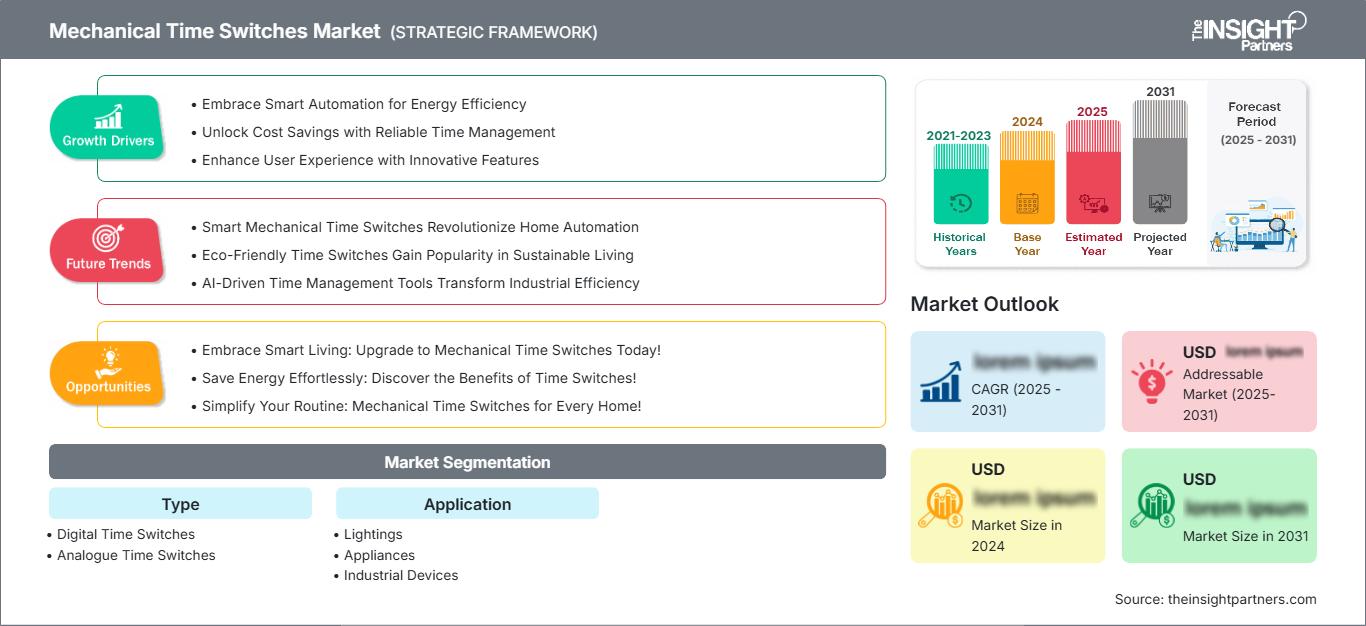
The Mechanical Time Switches Market was valued at US$ 1.62 Billion in 2025 and is projected to reach US$ 2.54 Billion by 2034, expanding at a CAGR of 5.78% during 2026–2034. Demand continues to be supported by increasing emphasis on energy-efficient electrical systems, automated lighting control, and scheduled operation of industrial equipment. Growing investments in commercial infrastructure, residential modernization, and smart building upgrades are encouraging wider deployment of time-controlled switching devices across both developed and developing economies.
Across North America, the Mechanical Time Switches Market size is expected to witness stable expansion through the forecast period, supported by replacement demand from aging electrical infrastructure and rising adoption of energy management solutions. Commercial buildings, manufacturing facilities, educational institutions, and public infrastructure projects continue to integrate programmable switching technologies to optimize electricity consumption. Increasing renovation activities and stricter building energy standards are expected to support regional growth over the coming years.
Mechanical Time Switches Market Assessment and Insights
- North America: The region represents a mature market driven by commercial construction, industrial automation, and building modernization initiatives. Share in 2025: 31–34%. Expected to expand at a CAGR between 5.2–5.6% during 2026–2034.
- US: Strong investments in commercial facilities, industrial automation, and energy-efficient building systems continue to support demand. Share of North America in 2025: 74–77%. Growing at a CAGR between 5.3–5.7% during 2026–2034.
- Europe: Germany, the UK, France, and Italy remain key contributors owing to stringent energy-efficiency regulations and industrial modernization programs. Share in 2025: 27–30%. Expected CAGR between 5.5–5.9% during 2026–2034.
- Asia Pacific: China, Japan, India, and South Korea continue to strengthen regional demand through expanding manufacturing capacity, urban infrastructure, and smart building deployment. Share in 2025: 28–31%. Expected CAGR between 6.3–6.8% during 2026–2034.
- Largest Segment: Industrial Devices accounted for the leading position in 2025 with an estimated market share of 40–44%, supported by extensive use in process automation and equipment scheduling. Expected CAGR between 5.9–6.3%.
- High Growth Segment: Digital Time Switches are expected to register the fastest expansion owing to improved programmability, precision, and compatibility with modern electrical systems. Estimated market share of 47–50% in 2025, growing at a CAGR between 6.4–6.9%.
- Key companies analyzed in detail: Siemens AG, Intermatic Incorporated, Finder S.p.A., GEYA Electrical Co., Ltd., Honeywell International Inc., Hager Group, Havells India Limited, Theben AG, Hugo Müller GmbH & Co. KG, Bachmann GmbH, Legrand SA, Schneider Electric SE.
Source: The Insight Partners' analysis based on proprietary research, government publications, company annual reports, investor presentations, industry databases, and expert interviews.
Increasingly strong focus on energy efficiency and automatic control of electricity has gradually changed the dynamics of the worldwide market for mechanical time switches and programmable switches. Manufacturers are launching new products that demonstrate better accuracy of switching operations, higher quality and durability, as well as ease of installation to cater to the needs of customers in residential, commercial and industrial sectors. Implementation of advanced manufacturing technologies, higher quality of components and adherence to international electrical safety norms are increasing the competitive advantages of the products. Ongoing investments in building automation and factory automation are creating positive demand conditions and motivating manufacturers to develop production capacities.
In the long-term perspective, demand is expected to diversify to cover Southeast Asia, the Middle East, Latin America and some African countries due to the intensification of the industrialization process and development of infrastructure projects. Growing investments into transportation facilities, smart cities, hospitals and educational institutions will stimulate the use of programmable time switches. Legislative encouragement of the development of energy-efficient electrical equipment and the digitization of building infrastructure are likely to motivate manufacturers to develop more intelligent and user-friendly products throughout the forecast period.
Mechanical Time Switches Market Report Scope
| Report Attribute | Details |
|---|---|
| Market size in 2025 | US$ 1.62 Billion |
| Market Size by 2034 | US$ 2.54 Billion |
| Global CAGR (2026 - 2034) | 5.78% |
| Historical Data | 2021-2024 |
| Forecast period | 2026-2034 |
Mechanical Time Switches Market Analysis
Growing awareness regarding electricity conservation remains one of the primary factors supporting the Mechanical Time Switches Market growth. Automated scheduling helps conserve unnecessary electricity use through lighting, HVAC systems, water pumping machines, and industry machinery that can be scheduled in advance during certain time periods. The above is what makes automated scheduling helpful for reducing expenses and promoting the sustainability agenda. Building energy management systems have also been increasingly adopted, contributing to the creation of demand.
Supply chains are still gaining from the increased availability of electronics parts, gears, and enclosures. Product modularity and fast installation have become major concerns for many manufacturers to gain an advantage in the market economy.
The Mechanical Time Switches Market analysis indicates that competition remains characterized by a combination of established multinational manufacturers and regional electrical equipment suppliers. The organizations are still continuing investments in product innovation, channel expansion, and partnerships for enhancing their market presence. Programmable digital products are increasingly used alongside mechanical products to help suppliers cater to wider customer needs in the commercial and industrial segments.
Some of the key players such as Siemens AG, Honeywell International Inc., Schneider Electric SE, Legrand SA, Theben AG, Finder S.p.A., Hager Group, Havells India Limited, Intermatic Incorporated, Hugo Müller GmbH & Co. KG, GEYA Electrical Co., Ltd., and Bachmann GmbH are further consolidating their offerings through product innovation, channel expansion, and adherence to international standards for electrical products. The emphasis on efficient use of energy and compatibility with smart buildings will help them remain competitive in the market until 2034.
● REPORT CUSTOMIZATION
Tailor This Report To Align With Your Specific Business Requirements
This report can be customized to align precisely with your business objectives, scope, and target markets. Customization options include tailored segmentation, geography, competitive analysis, and strategic insights to support informed decision-making.
Customize This Report →WHAT YOU CAN ADJUST
- ● Segmentations
- ● Geography
- ● Competitive Analysis
- ● Language Preferences
Mechanical Time Switches Market: Strategic Insights
Regional Insights
North America Mechanical Time Switches Market
North America represents one of the most established regional markets owing to the widespread adoption of energy-efficient electrical systems across commercial buildings, industrial facilities, educational institutions, and public infrastructure. The region accounted for 31–34% of the global market in 2025 and is projected to expand at a CAGR of 5.2–5.6% during 2026–2034. Increasing investments in smart commercial buildings, modernization of aging electrical infrastructure, and stringent energy management regulations continue to strengthen product demand across the region.
The United States and Canada are investing significantly in sustainable infrastructure, manufacturing automation, and intelligent building management systems. Commercial offices, warehouses, healthcare facilities, and educational campuses increasingly deploy programmable switching solutions to optimize electricity consumption and reduce operational costs. Rising renovation activities and the replacement of conventional electrical control systems with automated scheduling technologies are expected to create long-term opportunities for manufacturers operating throughout North America.
U.S. Mechanical Time Switches Market
The United States accounts for approximately 74–77% of the North American Mechanical Time Switches Market and is expected to register a CAGR of 5.3–5.7% through 2034. Strong demand originates from commercial buildings, manufacturing plants, municipal infrastructure, and institutional facilities seeking energy-efficient electrical control solutions. The growing adoption of intelligent lighting systems and building automation technologies continues to support steady market expansion across the country.
Major manufacturers and electrical component suppliers maintain extensive sales and distribution networks throughout the United States, ensuring broad product availability across residential, commercial, and industrial sectors. The increasing emphasis on reducing electricity consumption, coupled with stricter building energy codes and modernization of aging infrastructure, is encouraging end users to adopt programmable time switches that improve operational efficiency while lowering maintenance and energy expenses.
Europe Mechanical Time Switches Market
Europe held an estimated 27–30% of the Mechanical Time Switches Market share in 2025 and is anticipated to grow at a CAGR of 5.5–5.9% during 2026–2034. Germany remains the regional leader due to its advanced manufacturing sector, extensive industrial automation, and strong focus on energy-efficient electrical systems. The country continues investing in Industry 4.0 initiatives that encourage wider deployment of automated electrical control equipment.
The United Kingdom continues to experience stable demand through commercial building renovations, public infrastructure upgrades, and smart energy initiatives aimed at improving electricity efficiency. France, Italy, and Spain are witnessing increasing installation of automated lighting and equipment scheduling systems across industrial facilities, healthcare institutions, and transportation infrastructure. Supportive regulatory frameworks promoting energy conservation and sustainable construction practices continue to strengthen regional demand for programmable switching solutions.
APAC Mechanical Time Switches Market
Asia Pacific accounted for 28–31% of the global market in 2025 and is expected to record the fastest regional expansion with a CAGR of 6.3–6.8% during 2026–2034. China remains the largest contributor due to its extensive manufacturing base, while Japan and South Korea continue investing in industrial automation and advanced electrical systems.
India and Australia are also experiencing rising adoption of programmable switching devices across commercial buildings, industrial facilities, and public infrastructure projects. Government support for smart cities, energy-efficient construction, and manufacturing expansion is expected to create favorable growth opportunities throughout the forecast period.
Middle East & Africa Mechanical Time Switches Market
The Middle East & Africa market is projected to witness steady expansion at a CAGR of 5.6–6.0% during 2026–2034. Saudi Arabia and the United Arab Emirates continue investing in commercial infrastructure, smart city developments, and industrial diversification initiatives that require reliable electrical control systems.
South Africa remains an important regional market driven by industrial modernization and commercial construction activities, while the Rest of MEA is gradually adopting automated electrical technologies across public infrastructure and industrial facilities. Continued investment in energy management and infrastructure development is expected to support regional demand over the forecast period.
Segmentation Analysis
Type
The Type segment plays a significant role in determining product adoption across residential, commercial, and industrial applications. Manufacturers continue focusing on enhanced programming flexibility, operational reliability, and improved energy efficiency to meet evolving customer requirements. The segment is projected to expand at a CAGR of 5.9–6.3% during 2026–2034, supported by increasing investments in intelligent electrical control systems. The Mechanical Time Switches Market scope continues to broaden as programmable solutions become more accessible across multiple end-use industries.
- Digital Time Switches: Digital products provide greater scheduling flexibility, multiple programming options, higher switching precision, and compatibility with modern electrical systems, making them increasingly preferred across commercial buildings and industrial automation applications.
- Analogue Time Switches: Analog switches continue to maintain demand because of their cost-effectiveness, simple operation, durability, and suitability for basic lighting, pumping, and equipment scheduling requirements across residential and small commercial installations.
Application
The Application segment reflects the diverse deployment of time switches across infrastructure, manufacturing, and residential environments. Increasing adoption of energy-efficient lighting systems and automated industrial equipment continues to support demand. The segment is expected to register a CAGR of 5.8–6.2% during 2026–2034, driven by the modernization of commercial facilities and expanding industrial automation worldwide.
- Lightings: Time switches automate indoor and outdoor lighting schedules, reducing electricity consumption while improving operational efficiency across residential buildings, offices, educational campuses, and public infrastructure.
- Appliances: Household and commercial appliances increasingly integrate programmable switching functions to improve convenience, optimize energy usage, and support scheduled operation during off-peak electricity periods.
- Industrial Devices: Industrial equipment represents the largest application owing to extensive utilization in manufacturing plants, processing facilities, warehouses, and utilities where scheduled equipment operation improves productivity while minimizing energy costs.
Opportunity Snapshot
| Application | Revenue Contribution | Trend Tag | Adoption Stage |
|---|---|---|---|
| Lightings | High | Smart Lighting | Mature |
| Appliances | Medium | Energy Saving | Scaling |
| Industrial Devices | High | Factory Automation | Mature |
Mechanical Time Switches Market Growth Drivers and Impact Analysis
Growing Focus on Energy Efficiency Across Commercial and Industrial Buildings
The rising importance of cutting down electricity usage is one of the primary driving forces that will drive the demand for mechanical time switches in the coming years. The use of scheduled electrical control systems is being adopted by business establishments in order to reduce electricity wastage and enhance efficiency. Time switches can help in controlling the light, ventilation system, pumps, heating, and industrial machines without manual effort. Stringent rules and regulations related to energy efficiency are being followed by governments around the world, which promote the use of automated electrical control products. Increased funding for green building constructions would also support product implementation in the market.
Expansion of Industrial Automation and Smart Manufacturing
Automation electrical control is rapidly gaining popularity among industrial plants to enhance productivity, minimize downtime, and maximize energy consumption. Mechanical time switches remain popular scheduling devices for machinery, conveyors, compressors, lighting systems, and secondary machinery that functions in a defined production schedule. The swift growth in the number of smart factories and digital production environments has led to increased demand by manufacturers for timing technologies to be incorporated in their automatic systems. Industrial sectors like the automotive industry, food industry, pharmaceutical sector, chemical industry, and consumer goods sector have been continuously investing in production modernization, offering good chances to producers. Growth in industrial investments in developing nations will boost machinery demand and encourage manufacturers to produce robust switchgear products.
Infrastructure Development and Commercial Construction Activities
Fast-growing commercial infrastructure development is yet another crucial aspect that affects the growth of the market. Office complexes, hospitals, airports, educational institutions, shopping centers, hotels, and transport terminals are progressively demanding automation of their lighting and electricity control systems. Mechanically timed switches allow for saving operational costs and provide reliable performance of devices. The government keeps investing considerable amounts of money into the development of infrastructure and smart cities development, providing further proliferation of electric programmable devices. Construction works in the Asia Pacific region, the Middle East, and certain European countries will maintain the steady demand for the installations. Companies capable of producing certified and specialized devices will be able to profit from the growing infrastructure investment in the forecast period.
Mechanical Time Switches Market Future Trends
Integration with Smart Building and Connected Energy Management Systems
Building owners are increasingly combining traditional electrical control equipment with digital energy management platforms to improve operational visibility and reduce energy consumption. Although conventional mechanical switches remain widely deployed because of their reliability and affordability, manufacturers are introducing hybrid and programmable solutions capable of supporting broader automation requirements. The Mechanical Time Switches Market trends indicate that future product development will increasingly emphasize interoperability with building management systems, enhanced programming flexibility, compact product design, and simplified installation. Continued investment in intelligent commercial infrastructure is expected to reshape product portfolios and encourage innovation throughout the industry.
Development of Compact and User-Friendly Switching Solutions
Compact designs that make it easier to install a product without sacrificing durability during operation are currently the primary objective for manufacturers. Superior enclosure material, increased precision in switching, and easy-to-use programming interfaces are some of the factors that will soon become very important for competitiveness in the market. Future innovations in the area should revolve around reliability, low maintenance, extended lifetime of service, and adherence to the new standards of electricity safety. The high demand created by renovations and infrastructure construction is prompting more product variations.
Mechanical Time Switches Market Opportunities
Expansion Opportunities Across Emerging Industrial Economies
Rapid industrialization throughout Asia Pacific, the Middle East, Africa, and parts of Latin America presents significant opportunities for manufacturers of mechanical time switches. Expanding manufacturing facilities, logistics parks, commercial buildings, and public infrastructure require dependable electrical control systems that improve operational efficiency and reduce energy consumption. The Mechanical Time Switches Market Forecasts indicate sustained investment potential in these regions as governments continue supporting industrial development, urbanization, and smart infrastructure initiatives. Companies that strengthen regional distribution networks, establish local manufacturing capabilities, and introduce cost-effective products tailored to regional requirements are expected to improve market penetration while building long-term customer relationships. Strategic partnerships with electrical contractors and industrial automation integrators can further enhance market access and create new revenue streams.
Product Innovation Supporting Building Modernization
The modernization of both commercial and residential properties is still providing good prospects for manufacturers of time-related devices. There is an increased demand for small-sized, reliable, and convenient products that would be able to provide efficient electrical services and maintenance. It seems reasonable to invest in the development of hybrid switchers, better programming, and durable products in order to set oneself apart from other manufacturers in the increasingly competitive market. The growth in renovations in developed countries and investments in new constructions in emerging countries is expected to ensure steady demand for replacement.
Frequently Asked Questions

- Comprehensive Market Sizing and Forecast Analysis
- Detailed Segmentation Analysis
- In-Depth Market Dynamics Assessment
- Regional and Country-Level Insights
- Competitive Landscape and Company Benchmarking
- Strategic Business Intelligence
Recent Reports
Testimonials

The Insight Partners provided valuable market intelligence that supported our global go-to-market strategy. Their team was professional, responsive, and attentive to our feedback, providing thoughtful analysis and helpful methodological clarifications throughout the project.
Junmo Kim Chief Financial Officer (CFO), Enertech Co., Ltd.
The Insight Partners' SCADA System Market report is comprehensive, with valuable insights on current trends and future forecasts. The team was highly professional, responsive, and supportive throughout. We are very satisfied and highly recommend their services.
RAN KEDEM Partner, Reali Technologies LTDs
I requested a report on a very specific software market and the team produced the report in a few days. The information was very relevant and well presented. I then requested some changes and additions to the report. The team was again very responsive and I got the final report in less than a week.
JEAN-HERVE JENN Chairman, Future Analytica
We worked with The Insight Partners for an important market study and forecast. They gave us clear insights into opportunities and risks, which helped shape our plans. Their research was easy to use and based on solid data. It helped us make smart, confident decisions. We highly recommend them.
PIYUSH NAGPAL Sr. Vice President, High Beam Global
The Insight Partners delivered insightful, well-structured market research with strong domain expertise. Their team was professional and responsive throughout. The user-friendly website made accessing industry reports seamless. We highly recommend them for reliable, high-quality research services
YUKIHIKO ADACHI CEO, Deep Blue, LLC.
This is the first time I have purchased a market report from The Insight Partners.While I was unsure at first, I visited their web site and felt more comfortable to take the risk and purchase a market report.I am completely satisfied with the quality of the report and customer service. I had several questions and comments with the initial report, but after a couple of dialogs over email with their analyst I believe I have a report that I can use as input to our strategic planning process.Thank you so much for taking the extra time and making this a positive experience.I will definitely recommend your service to others and you will be my first call when we need further market data.
JOHN SUZUKI President and Chief Executive Officer, Board Director, BK Technologies
I wish to appreciate your support and the professionalism you displayed in the course of attending to my request for information regarding to infectious disease IVD market in Nigeria. I appreciate your patience, your guidance, and the fact that you were willing to offer a discount, which eventually made it possible for us to close a deal. I look forward to engaging The Insight Partners in the future, all thanks to the impression you have created in me as a result of this first encounter.
DR CHIJIOKE ONYIA MANAGING DIRECTOR, PineCrest Healthcare Ltd.Reason to Buy
- Informed Decision-Making
- Understanding Market Dynamics
- Competitive Analysis
- Identifying Emerging Markets
- Customer Insights
- Market Forecasts
- Risk Mitigation
- Boosting Operational Efficiency
- Strategic Planning
- Investment Justification
- Tracking Industry Innovations
- Aligning with Regulatory Trends





 Get Free Sample for