
Microbial Control Chemicals Market Growth, Trends & Forecast by 2034
Coverage: By Type (Phenolic, Halogens, Alcohol, Heavy Metals, Others); Application (Water Treatment, Paint and Coatings, Wood Preservation, Personal Care, Food and Beverages, Oil and Gas, Others) , and Geography (North America, Europe, Asia Pacific, and South and Central America)
- Status : Data Released
- Report Code : TIPRE00017583
- Category : Chemicals and Materials
- No. of Pages : 150
- Available Report Formats :


- Last update date : August 06, 2026


2025 Market Size
US$ 20.06 Bn
Base year value
2034 Forecast
US$ 32.94 Bn
Projected by 2034
CAGR 2026-2034
5.67 %
Growth rate
Addressable Market
US$ 240.28 Bn
(2026-2034)
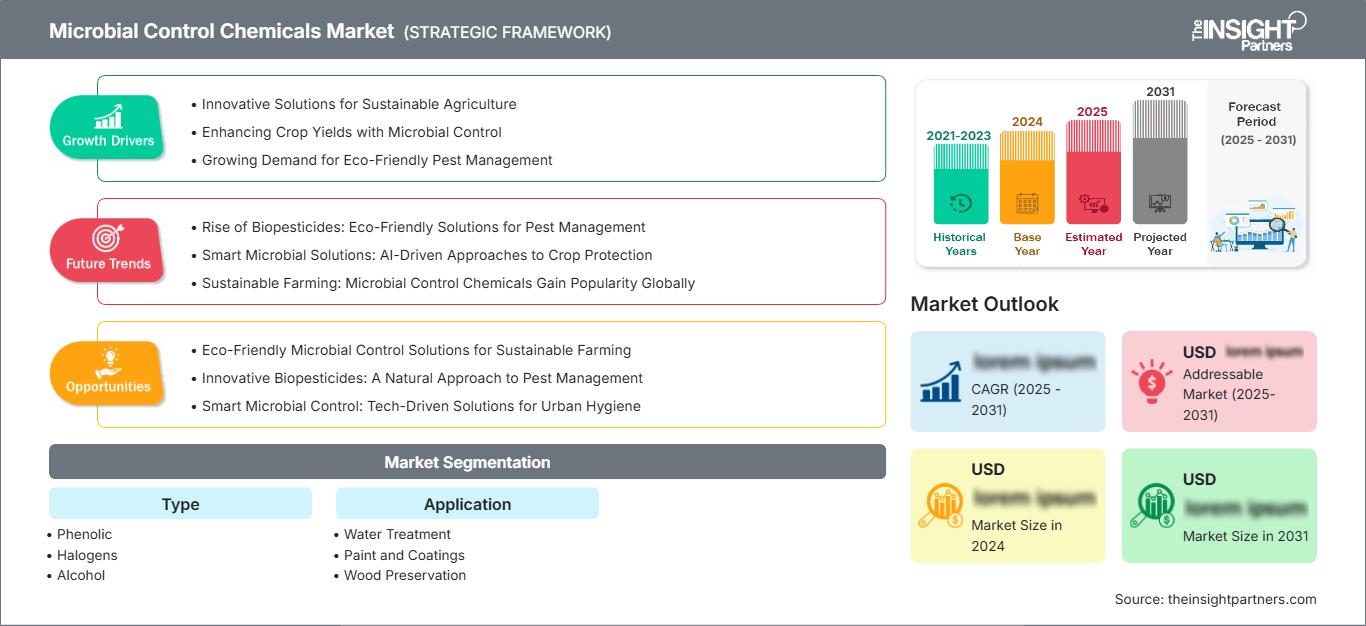
The microbial control chemicals market was valued at US$ 20.06 billion in 2025 and is projected to reach US$ 32.94 billion by 2034, registering a CAGR of 5.67% during 2026–2034. Growing emphasis on industrial hygiene, water quality management, food safety, and asset protection continues to support market expansion. Increasing demand for effective antimicrobial solutions across municipal water treatment, oil and gas operations, personal care products, paints and coatings, and food processing industries remains a key factor driving long-term market development.
North America continues to represent one of the largest consumers of industrial biocides owing to stringent environmental regulations, advanced industrial infrastructure, and widespread adoption across water treatment and energy sectors. The microbial control chemicals market size in the region is expected to register a CAGR of 5.2–5.9% through 2034. Rising investments in wastewater reuse and stricter microbial control requirements in industrial processing continue to strengthen regional demand.
Microbial Control Chemicals Market Assessment and Insights
- North America: Accounted for 34–37% share in 2025 and is projected to expand at a CAGR of 5.2–5.9% during 2026–2034, supported by advanced water treatment infrastructure, industrial hygiene standards, and robust oil and gas operations.
- US: Represented approximately 79–83% of North American revenue in 2025 and is anticipated to grow at a CAGR of 5.3–6.0%, driven by stringent environmental regulations and strong industrial chemical consumption.
- Europe: Held nearly 26–29% share in 2025 and is expected to register a CAGR of 5.0–5.6%, with Germany, France, the UK, Italy, and the Netherlands serving as leading markets due to mature industrial and water treatment sectors.
- Asia Pacific: Accounted for a 29–32% share in 2025 and is forecast to witness the fastest regional expansion at a CAGR of 6.1–6.8%, led by China, India, Japan, and South Korea through rapid industrialization and expanding municipal water treatment capacity.
- Largest Segment: Water Treatment accounted for 34–38% market share in 2025 and is projected to grow at a CAGR of 5.8–6.4%, supported by increasing wastewater recycling and stricter microbial quality standards.
- High Growth Segment: Personal Care represented approximately 11–14% market share in 2025 and is anticipated to expand at a CAGR of 6.5–7.2%, driven by increasing hygiene awareness and demand for preservative systems in cosmetics.
- Key companies analyzed in detail: Albemarle Corporation, BASF SE, DuPont de Nemours, Inc., Ecolab Inc., FMC Corporation, Kemira Oyj, LANXESS AG, Lonza Group AG, Thor GmbH, Troy Corporation.
Source: The Insight Partners' analysis based on proprietary research, government publications, company annual reports, investor presentations, industry databases, and expert interviews.
Advances in industrial biocide formulations, regulatory-driven product innovation, and improved application technologies have transformed microbial control strategies across multiple industries. Manufacturers continue developing broad-spectrum antimicrobial chemistries that offer higher efficacy, longer service life, and improved environmental profiles. Increasing investments in water reuse infrastructure, industrial process optimization, and preservation technologies continue to strengthen demand for microbial control chemicals across both developed and emerging economies.
Looking ahead, sustained industrial expansion across Asia Pacific, modernization of municipal water treatment systems, and increasing adoption of sustainable antimicrobial technologies are expected to support long-term market development. Regulatory emphasis on safe chemical handling, environmental compliance, and public health protection will continue encouraging innovation in lower-toxicity formulations and application-specific microbial control solutions across global industrial sectors.
Microbial Control Chemicals Market Report Scope
| Report Attribute | Details |
|---|---|
| Market size in 2025 | US$ 20.06 Billion |
| Market Size by 2034 | US$ 32.94 Billion |
| Global CAGR (2026 - 2034) | 5.67% |
| Historical Data | 2021-2024 |
| Forecast period | 2026-2034 |
Microbial Control Chemicals Market Analysis
Increasing industrialization, urban population growth, and tightening environmental regulations continue to strengthen demand across water treatment, industrial processing, food manufacturing, and energy production. The microbial control chemicals market growth is supported by rising investments in wastewater treatment plants, cooling water systems, food preservation, and oilfield production, where microbial contamination can reduce operational efficiency, damage infrastructure, and compromise product quality. Guidelines issued by organizations such as the World Health Organization and environmental regulatory agencies continue encouraging effective microbial management across essential industrial operations.
The industry value chain includes raw material suppliers, specialty chemical manufacturers, formulation developers, distributors, and industrial end users. Demand is reinforced by increasing investments in industrial water recycling, enhanced oil recovery operations, and preservation technologies for paints, coatings, cosmetics, and packaged food products. Manufacturers are also focusing on improving product performance while complying with evolving environmental and occupational safety regulations.
Competition remains concentrated among multinational specialty chemical companies that emphasize product innovation, regulatory compliance, and global distribution capabilities. The microbial control chemicals market analysis indicates that BASF SE, Ecolab Inc., LANXESS AG, Lonza Group AG, Kemira Oyj, and DuPont de Nemours, Inc. continue strengthening market positions through portfolio expansion, research investments, and strategic partnerships. Companies are increasingly developing application-specific antimicrobial solutions that address changing customer requirements while meeting increasingly stringent regulatory standards.
Investment priorities continue shifting toward environmentally compatible formulations, digital water management solutions, and advanced preservation technologies. Leading manufacturers are expanding production capacity while strengthening technical service capabilities to support industrial customers operating in highly regulated environments. Continued innovation in broad-spectrum antimicrobial chemistries and sustainable formulation technologies is expected to improve competitive differentiation and create long-term opportunities across diverse industrial applications.
● REPORT CUSTOMIZATION
Tailor This Report To Align With Your Specific Business Requirements
This report can be customized to align precisely with your business objectives, scope, and target markets. Customization options include tailored segmentation, geography, competitive analysis, and strategic insights to support informed decision-making.
Customize This Report →WHAT YOU CAN ADJUST
- ● Segmentations
- ● Geography
- ● Competitive Analysis
- ● Language Preferences
Microbial Control Chemicals Market: Strategic Insights
Regional Insights
North America Microbial Control Chemicals Market
North America accounted for 34–37% of the global microbial control chemicals market share in 2025 and is expected to register a CAGR of 5.2–5.9% during 2026–2034. The region benefits from stringent regulations governing industrial water quality, food safety, and workplace hygiene. Strong demand from municipal water treatment, cooling water systems, healthcare facilities, and the oil and gas industry continues to support market expansion. Ongoing investments in wastewater reuse infrastructure and industrial process optimization further contribute to sustained consumption of antimicrobial chemicals.
The United States and Canada continue modernizing aging water infrastructure while expanding industrial production across chemicals, food processing, and energy sectors. Demand is reinforced by stricter microbial contamination standards and increased adoption of integrated water treatment programs. Growing emphasis on sustainable biocide formulations and digital monitoring technologies is expected to improve treatment efficiency while supporting long-term regional market development.
U.S. Microbial Control Chemicals Market
The United States represented 79–83% of North American revenue in 2025 and is projected to expand at a CAGR of 5.3–6.0% through 2034. The country remains the largest regional consumer due to its extensive industrial manufacturing base, advanced municipal water treatment systems, and significant oil and gas production. Continuous regulatory oversight from environmental and public health authorities supports consistent demand for effective microbial control solutions across multiple industries.
Major vendors, including Ecolab Inc., DuPont de Nemours, Inc., Albemarle Corporation, FMC Corporation, and Lonza Group AG, have established significant production and technical support infrastructure within the country. With increasing investments in industrial wastewater treatment plants, data center cooling facilities, and food processing facilities, there will be further opportunities for specialty antimicrobial formulations during the forecast period.
Europe Microbial Control Chemicals Market
Europe is estimated to have a microbial control chemicals market share of 26-29% in the global microbial control chemicals industry in 2025 and is projected to grow at a CAGR of 5.0-5.6% from 2026 to 2034. The rise of Germany as a dominant region is attributed to its specialty chemicals industry, industrial plants, and strict environmental regulations. The UK has been showing high demand for municipal water treatment, healthcare, and industrial maintenance applications, whereas France is investing in sustainable water treatment technology.
Italy and the Netherlands involve painting and coating plants, food manufacturing, and industrial preservation. Europe's sustainable chemicals management efforts have inspired manufacturers to produce low-impact yet efficient antimicrobial products. Future investments in modernizing industries and water treatment plants are expected to contribute to the region's growth.
APAC Microbial Control Chemicals Market
Asia Pacific region contributed 29-32% of total global revenue in 2025 and is estimated to have the highest growth rate during 2022-2034, at a CAGR of 6.1-6.8%. China is expected to remain the leading regional market owing to industrialization, chemical production, and increasing municipal wastewater treatment. Meanwhile, Japan and South Korea continue to focus on advanced technologies to preserve industry.
India is witnessing rising demand in sectors such as water treatment, food processing, and personal care products, driven by industrial development and stringent environmental regulations. Australia continues to develop its water reuse and mining projects, creating additional opportunities for specialty microbial control chemicals across industrial applications.
Middle East & Africa Microbial Control Chemicals Market
The Middle East & Africa market is anticipated to expand at a CAGR of 4.8–5.5% during 2026–2034, supported by increasing investments in desalination plants, municipal water treatment, and oil and gas production. Saudi Arabia and the United Arab Emirates continue strengthening industrial water management infrastructure to improve operational efficiency and resource sustainability.
South Africa remains an important market for mining, food processing, and municipal water treatment chemicals, while the Rest of MEA is gradually increasing adoption of industrial antimicrobial solutions. Long-term demand is expected to benefit from infrastructure development, population growth, and industrial diversification initiatives.
Segmentation Analysis
Type
The Type segment is projected to achieve a CAGR of 5.5–6.1% for 2026–2034. The microbial control chemicals market scope is steadily growing due to the need for efficient products that can control bacteria, fungi, algae, and other microbes across various conditions. The choice of products depends on efficacy, environmental friendliness, regulatory compliance, and operating expenses.
- Phenolic – Widely used in industrial disinfectants and preservation systems because of broad-spectrum antimicrobial activity, chemical stability, and effectiveness across healthcare, institutional cleaning, and industrial processing applications.
- Halogens – Extensively utilized in water treatment, swimming pools, cooling towers, and industrial sanitation due to rapid microbial inactivation, cost-effectiveness, and established regulatory acceptance.
- Alcohol – Commonly applied in healthcare, pharmaceutical manufacturing, and personal care products where rapid disinfection, fast evaporation, and residue-free performance are essential for maintaining hygiene standards.
- Heavy Metals – Used in specialized industrial preservation applications where long-term microbial resistance and extended protection are required, although regulatory restrictions continue influencing usage patterns in several regions.
Application
The Applications segment is expected to grow at a CAGR of 5.8% to 6.4% from 2026 to 2034. The rising need for microbial contamination prevention across various industries, such as urban infrastructure, manufacturing, consumer goods, and energy generation, is driving market growth. There is an increased focus on regulatory measures and reliable operations.
- Water Treatment – Represents the largest application because microbial control is essential for municipal drinking water, wastewater treatment, cooling towers, boilers, desalination plants, and industrial recycling systems to maintain operational efficiency and public health.
- Paint and Coatings – Preservatives help prevent microbial degradation during storage and application, extending product shelf life while maintaining coating performance across construction, marine, and industrial markets.
- Wood Preservation – Antimicrobial chemicals protect timber products from bacterial and fungal deterioration, improving durability and extending service life in construction, utility, and outdoor applications.
- Personal Care – Increasing demand for cosmetic preservatives and hygiene formulations supports strong growth as manufacturers comply with product safety regulations while extending product stability and shelf life.
- Food and Beverages – Microbial control chemicals support sanitation programs, equipment cleaning, and processing hygiene to maintain food safety, regulatory compliance, and product quality throughout manufacturing operations.
- Oil and Gas – Used extensively in drilling fluids, production systems, pipelines, and storage facilities to control microbial-induced corrosion, biofouling, and operational losses caused by bacterial contamination.
Opportunity Snapshot
| Application | Revenue Contribution | Trend Tag | Adoption Stage |
| Water Treatment | High | Water Reuse | Mature |
| Paint and Coatings | Medium | Dry Film | Mature |
| Wood Preservation | Medium | Timber Protection | Mature |
| Personal Care | Medium | Clean Beauty | Scaling |
| Food and Beverages | High | Food Hygiene | Mature |
| Oil and Gas | Medium | Asset Integrity | Scaling |
Microbial Control Chemicals Market Growth Drivers and Impact Analysis
Expansion of Industrial and Municipal Water Treatment Infrastructure
Growing investments in municipal wastewater treatment facilities, industrial water recycling facilities, and desalination facilities continue to drive demand for microbial control chemicals in the global market. Increasing urbanization, rising industrialization, and stricter effluent discharge regulations call for an effective microbial control treatment system to prevent biofilm formation, microbial contamination, and equipment corrosion. Government bodies in North America, Europe, and the Asia-Pacific region have been increasingly investing in water infrastructure and water recycling programs. At the same time, industries in power generation, chemicals, mining, and manufacturing have been investing in cooling water treatment systems to improve efficiency and reduce maintenance costs. These developments continue to strengthen long-term consumption of specialty microbial control chemicals across both public utilities and private industrial operations.
Increasing Regulatory Focus on Hygiene, Food Safety, and Public Health
The increasing microbial control requirements in food processing, the healthcare sector, pharmaceutical production, and consumer goods have been driving market growth. Regulatory bodies ask manufacturers to validate sanitation and preservation processes that reduce microbial contamination while ensuring product quality and consumer safety. The rising incidence of healthcare-associated infections and foodborne diseases has prompted the industry to adopt highly effective antimicrobial formulations in its processes. The ongoing changes in environmental protection and chemical safety laws are also motivating manufacturers to develop better formulations with favorable toxicology profiles.
Growing Need to Prevent Industrial Biofouling and Microbial Corrosion
Microbial contamination remains a major operational challenge across oil and gas production, marine infrastructure, cooling towers, pulp and paper manufacturing, and industrial processing plants. Microbial growth leads to corrosion, reduced heat-transfer efficiency, fouling of machinery, and lost production, thereby raising operating costs. Therefore, companies have started looking towards methods of microbial control that extend equipment lifespan and improve reliability. With new developments in monitoring systems, dosing of biocides has become more efficient, reducing chemical use without compromising effectiveness. Increased attention to reliability and asset management in the industry has helped maintain demand for microbial control chemicals.
Microbial Control Chemicals Market Future Trends
Growing Adoption of Sustainable and Low-Toxicity Antimicrobial Formulations
Environmental regulations and customers' sustainability concerns have motivated companies to develop biodegradable, antimicrobial products with low toxicity without compromising performance. The microbial control chemicals market trends segment indicates greater attention to environmentally friendly chemicals, dosing methods, and formulations that effectively control microbes without harming the environment. Additionally, there is research on multifunctional preservatives that help extend product shelf life with minimal chemical use. This trend is expected to affect the product development approaches of the water treatment, personal care, food processing, and coatings industries in the coming years.
Integration of Digital Monitoring with Industrial Water Treatment Programs
Industrial facilities are increasingly using digital sensors, remote monitoring systems, predictive analytics, and automation in dosing systems to enhance the efficiency of microbial control. Real-time monitoring allows the operator to optimize chemical usage, minimize operational downtime, and reduce maintenance costs without compromising compliance. The use of artificial intelligence is expected to enhance the accuracy and reliability of industrial water treatment systems. Equipment providers and chemical specialists continue to offer more digital services alongside their chemical products, strengthening their customer relationships.
Microbial Control Chemicals Market Opportunities
Expanding Water Reuse Projects Across Emerging Economies
Rapid urbanization, freshwater scarcity, and industrial expansion are driving investments in wastewater recycling projects across Asia Pacific, Latin America, and the Middle East. Microbial control chemicals market forecasts indicate growth potential for companies that produce sophisticated antimicrobial products, as well as for municipal utilities, industrial water recycling facilities, and water desalination plants. The government will focus on securing its water sources and promoting industrial water reuse to reduce demand for fresh water. Businesses that can offer microbial control solutions, along with technical support and digital monitoring, will benefit from infrastructure projects in developing countries.
High-Performance Preservation Solutions for Consumer and Industrial Products
The need for extended product shelf life, material longevity, and increased microbial resistance continues to offer many opportunities in paints & coatings, personal care, wood treatment, and industrial specialty products. Antimicrobial formulations tailored to meet current regulatory requirements without compromising product efficacy are increasingly demanded by manufacturers. Investment in R&D to develop multifunctional preservatives, environmentally friendly technologies, and application-specific preservatives should create competitive advantages. Companies that can offer both formulation know-how and regulatory and global distribution capabilities will benefit from these opportunities.
Recent Developments
- March 2026: Specialty chemicals company LANXESS increased prices for a broad range of its Microbial Control products up to 30 percent, or more for selected products. Microbial Control products include, in particular, active ingredients, preservatives and disinfectants to protect materials and substances against spoilage caused by microorganisms.
- September 2025: Enviro Tech, an Arxada company, launched Peragreen 26WW antimicrobial control solution, a high-strength peracetic acid (PAA)-based solution designed for use in medium and large municipal wastewater treatment systems. As cities face rising treatment technology costs, aging infrastructure, and expanded regulations, Peragreen 26WW antimicrobial control solution offers a cost-effective alternative to bleach, chlorine gas, and UV-based municipal wastewater treatment systems.
Frequently Asked Questions

- Comprehensive Market Sizing and Forecast Analysis
- Detailed Segmentation Analysis
- In-Depth Market Dynamics Assessment
- Regional and Country-Level Insights
- Competitive Landscape and Company Benchmarking
- Strategic Business Intelligence
Recent Reports
Testimonials

The Insight Partners' SCADA System Market report is comprehensive, with valuable insights on current trends and future forecasts. The team was highly professional, responsive, and supportive throughout. We are very satisfied and highly recommend their services.
RAN KEDEM Partner, Reali Technologies LTDs
I requested a report on a very specific software market and the team produced the report in a few days. The information was very relevant and well presented. I then requested some changes and additions to the report. The team was again very responsive and I got the final report in less than a week.
JEAN-HERVE JENN Chairman, Future Analytica
We worked with The Insight Partners for an important market study and forecast. They gave us clear insights into opportunities and risks, which helped shape our plans. Their research was easy to use and based on solid data. It helped us make smart, confident decisions. We highly recommend them.
PIYUSH NAGPAL Sr. Vice President, High Beam Global
The Insight Partners delivered insightful, well-structured market research with strong domain expertise. Their team was professional and responsive throughout. The user-friendly website made accessing industry reports seamless. We highly recommend them for reliable, high-quality research services
YUKIHIKO ADACHI CEO, Deep Blue, LLC.
This is the first time I have purchased a market report from The Insight Partners.While I was unsure at first, I visited their web site and felt more comfortable to take the risk and purchase a market report.I am completely satisfied with the quality of the report and customer service. I had several questions and comments with the initial report, but after a couple of dialogs over email with their analyst I believe I have a report that I can use as input to our strategic planning process.Thank you so much for taking the extra time and making this a positive experience.I will definitely recommend your service to others and you will be my first call when we need further market data.
JOHN SUZUKI President and Chief Executive Officer, Board Director, BK Technologies
I wish to appreciate your support and the professionalism you displayed in the course of attending to my request for information regarding to infectious disease IVD market in Nigeria. I appreciate your patience, your guidance, and the fact that you were willing to offer a discount, which eventually made it possible for us to close a deal. I look forward to engaging The Insight Partners in the future, all thanks to the impression you have created in me as a result of this first encounter.
DR CHIJIOKE ONYIA MANAGING DIRECTOR, PineCrest Healthcare Ltd.Reason to Buy
- Informed Decision-Making
- Understanding Market Dynamics
- Competitive Analysis
- Identifying Emerging Markets
- Customer Insights
- Market Forecasts
- Risk Mitigation
- Boosting Operational Efficiency
- Strategic Planning
- Investment Justification
- Tracking Industry Innovations
- Aligning with Regulatory Trends





 Get Free Sample for