
Millimeter Wave Technology Market Size, Demand & Growth by 2034
Coverage: By Product (Scanner Systems, Radar and Satellite Communications Systems, Telecommunication Equipment); Frequency Band (Band Between 24 GHz and 57 GHz, Band Between 57 GHz and 86 GHz, Band Between 86 GHz and 300 GHz); License Type (Light Licensed Frequency Millimeter Wave, Unlicensed Frequency Millimeter Wave, Fully Licensed Frequency Millimeter Wave); Application (Mobile and Telecom, Consumer and Commercial, Healthcare, Industrial, Automotive and Transportation, Aerospace and Defense, Imaging); Component (Antennas and Transceiver Components, Frequency Sources and Related Components, Communication and Networking Components, Imaging Components, RF and Radio Components, Sensors and Controls, Interface Components, Power and Battery Components) , and Geography (North America, Europe, Asia Pacific, and South and Central America)
- Status : Data Released
- Report Code : TIPRE00004831
- Category : Electronics and Semiconductor
- No. of Pages : 150
- Available Report Formats :


- Last update date : October 13, 2026


2025 Market Size
US$ 5.42 Bn
Base year value
2034 Forecast
US$ 16.71 Bn
Projected by 2034
CAGR 2026-2034
15.12 %
Growth rate
Addressable Market
US$ 105.27 Bn
(2026-2034)
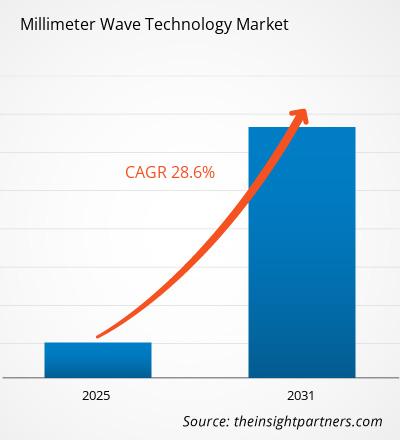
The millimeter wave technology market was valued at US$ 5.42 Billion in 2025 and is projected to reach US$ 16.71 Billion by 2034, registering a CAGR of 15.12% during 2026–2034. The market is witnessing accelerated adoption due to increasing demand for high-frequency communication systems, advanced radar applications, next-generation wireless networks, and precision imaging solutions across telecommunications, automotive, aerospace, and defense sectors.
The millimeter wave technology market size is expanding across North America due to rising investments in 5G infrastructure, automotive radar deployment, and defense modernization programs. The region is expected to register a CAGR range of 14–17% during 2026–2034, supported by strong semiconductor capabilities, enterprise connectivity initiatives, and increasing utilization of high-frequency technologies in commercial and industrial applications.
Millimeter Wave Technology Market Assessment and Insights
- North America The region represents a significant technology adoption hub, accounting for an estimated 32–36% share in 2025 and growing at a CAGR range of 14–17% between 2026–2034. Strong telecom investments, defense applications, and automotive innovation support expansion.
- US The country holds a leading position within North America, contributing approximately 75–80% of regional revenue in 2025 and advancing at a CAGR range of 14–17% during 2026–2034 due to 5G rollout and radar demand.
- Europe Europe accounted for an estimated 24–28% share in 2025 and is projected to grow at a CAGR range of 13–16% between 2026–2034. Germany, the UK, France, and Italy support adoption through automotive electronics and aerospace initiatives.
- Asia Pacific Asia Pacific captured an estimated 28–32% share in 2025 and is anticipated to expand at a CAGR range of 16–19% during 2026–2034. China, Japan, South Korea, and India are driving deployment through telecom expansion and industrial automation.
- Largest Segment: Telecommunication Equipment represented the largest segment with an estimated 35–39% market share in 2025 and is expected to grow at a CAGR range of 15–18% during 2026–2034.
- High Growth Segment: Automotive and Transportation application segment held an estimated 14–18% share in 2025 and is projected to register a CAGR range of 17–20% through 2026–2034.
- Key companies analyzed in detail: REMEC Broadband Wireless Networks LLC, Ducommun Incorporated, E-Band Communications, LLC., an Axxcss Wireless Solutions, Inc. company, Farran, Keysight Technologies, Millimeter Wave Products Inc., Smiths Interconnect, NEC Corporation, Eravant, Siklu Communication Ltd., Rohde & Schwarz, Analog Devices Inc., and SAGE Millimeter Inc.
Source: The Insight Partners' analysis based on proprietary research, government publications, company annual reports, investor presentations, industry databases, and expert interviews.
Advancements in semiconductor manufacturing, antenna design, and high-frequency signal processing have transformed market dynamics. Earlier applications were concentrated in defense and satellite communication, while recent developments have expanded adoption into 5G networks, autonomous mobility, industrial sensing, and healthcare imaging. Improved component reliability, reduced production costs, and integration of compact modules have enabled broader commercialization across multiple industries.
Future expansion of the Millimeter Wave Technology Market report will be influenced by increasing investments in next-generation connectivity infrastructure, smart transportation systems, and advanced security solutions. Emerging economies in the Asia Pacific and the Middle East are creating new opportunities through digital infrastructure programs and industrial modernization. Regulatory support for spectrum allocation and growing demand for ultra-high-speed communication systems are expected to strengthen long-term technology deployment.
Millimeter Wave Technology Market Report Scope
| Report Attribute | Details |
|---|---|
| Market size in 2025 | US$ 5.42 Billion |
| Market Size by 2034 | US$ 16.71 Billion |
| Global CAGR (2026 - 2034) | 15.12% |
| Historical Data | 2021-2024 |
| Forecast period | 2026-2034 |
Millimeter Wave Technology Market Analysis
The market growth is supported by increasing demand for high-bandwidth communication networks, advanced sensing capabilities, and real-time data transmission requirements. The telecommunications companies have begun deploying millimeter-wave frequency bands into their networks in order to increase the capacity and to facilitate new services like fixed wireless access, private networks, and connected infrastructure. The value chain consists of semiconductor companies, component makers, system integrators, telecom operators, and the end-use industries.
Supply drivers include developments in RF components, antennas, packaging, and test & measurement equipment. The companies have become keen on increasing efficiency, tackling thermal issues, and improving reliability in order to deploy them commercially. The ecosystem is constantly evolving due to the increasing demand for small radars, satellite communications equipment, and industrial automation.
Competitive positioning within the industry is influenced by technological expertise, product innovation, and application-specific solutions. Companies such as Keysight Technologies, NEC Corporation, Smiths Interconnect, Siklu Communication Ltd., and Eravant are strengthening their capabilities through advanced testing platforms, communication solutions, and specialized components. The Millimeter Wave Technology Market forecast is further shaped by strategic collaborations and product development initiatives aimed at expanding market presence.
Funding in investments is now being channeled into the development of wireless networks, automotive sensing technology, and military communications. REMEC Broadband Wireless Networks LLC, Ducommun Incorporated, E-Band Communications, LLC, which is a subsidiary of Axxcss Wireless Solutions, Inc., Farran, and Millimeter Wave Products Inc. keep on providing solutions using high-frequency technologies in special applications. Competition shows that there is an increasing need for custom-made systems.
● REPORT CUSTOMIZATION
Tailor This Report To Align With Your Specific Business Requirements
This report can be customized to align precisely with your business objectives, scope, and target markets. Customization options include tailored segmentation, geography, competitive analysis, and strategic insights to support informed decision-making.
Customize This Report →WHAT YOU CAN ADJUST
- ● Segmentations
- ● Geography
- ● Competitive Analysis
- ● Language Preferences
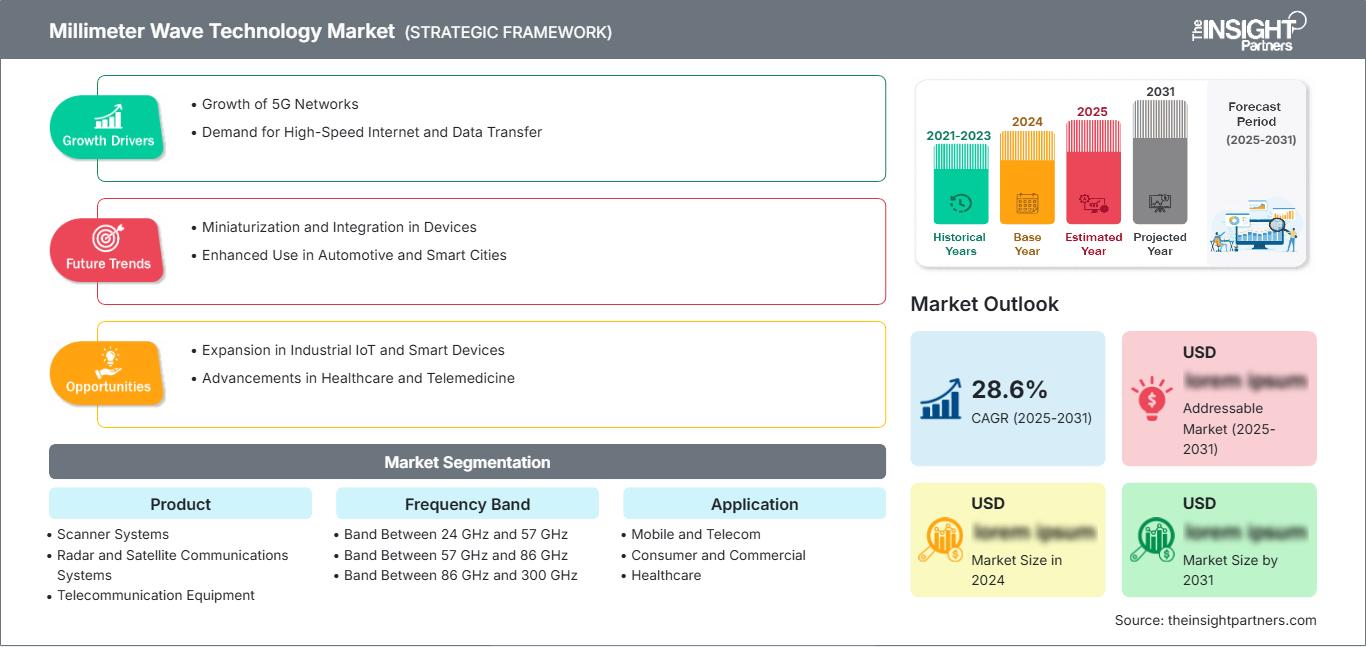
Millimeter Wave Technology Market: Strategic Insights
Regional Insights
North America Millimeter Wave Technology Market
North America accounted for an estimated 32–36% share of the global market in 2025 and is expected to expand at a CAGR range of 14–17% during 2026–2034. Millimeter Wave Technology Market trends are supported by strong telecommunications infrastructure, defense spending, automotive innovation, and advanced research capabilities. The US remains the dominant contributor due to extensive 5G investments and technology adoption.
The regional ecosystem includes leading technology developers, communication equipment providers, and defense contractors. Increasing deployment of high-frequency networks, autonomous vehicle testing, and satellite communication systems is supporting demand. Government initiatives related to spectrum management and secure communications are further strengthening adoption across commercial and strategic applications.
U.S. Millimeter Wave Technology Market
The U.S. market contributes approximately 75–80% of North America's revenue in 2025 and is projected to grow at a CAGR range of 14–17% during 2026–2034. Significant presence of firms related to tech, defense, and wireless sectors encourages constant investments in high-frequency technologies.
There are many firms, such as Keysight Technologies, NEC Corporation, Smiths Interconnect, and component manufacturers operating in the country. There are growing applications in telecommunication, aerospace and defense, radar for the automotive industry, and advanced imaging systems.
Europe Millimeter Wave Technology Market
Europe represented an estimated 24–28% of the Millimeter Wave Technology Market share in 2025 and is forecast to grow at a CAGR range of 13–16% during 2026–2034. Germany leads regional adoption due to its automotive engineering strength and industrial automation initiatives. The UK contributes through aerospace, defense, and communication research programs.
Germany is strengthening deployment through connected vehicle technologies, factory automation, and advanced sensing systems. The UK continues to support development through defense modernization and communication infrastructure projects. France, Italy, and Spain are adopting high-frequency technologies across transportation, industrial applications, and telecommunications networks.
APAC Millimeter Wave Technology Market
APAC accounted for approximately 28–32% share in 2025 and is expected to record a CAGR range of 16–19% during 2026–2034. China represents the leading country due to extensive telecom infrastructure expansion and industrial technology adoption.
Japan, South Korea, India, and Australia are contributing through 5G deployment, automotive electronics, smart manufacturing, and defense applications. Government-led digital transformation programs and industrial modernization strategies are creating favorable conditions for wider adoption across multiple sectors.
Middle East & Africa Millimeter Wave Technology Market
The Middle East & Africa held an estimated emerging share in 2025 and is expected to grow at a CAGR range of 12–15% during 2026–2034. Saudi Arabia leads regional adoption through infrastructure modernization and communication investments, while the UAE focuses on smart city technologies.
South Africa and other MEA countries are exploring applications in energy infrastructure, security systems, and telecommunications. Increasing investments in digital connectivity and industrial development are supporting the gradual adoption of high-frequency technologies across the region.
Segmentation Analysis
Product
The product segment is projected to expand at a CAGR range of 14–17% during 2026–2034. The segment includes specialized systems designed for communication, sensing, scanning, and measurement applications. Increasing demand for accurate detection, high-speed connectivity, and advanced radar capabilities is supporting product innovation. Manufacturers are focusing on compact designs, improved frequency performance, and integration with emerging technologies across telecommunications, automotive, and defense sectors.
- Scanner Systems are gaining adoption for security screening, industrial inspection, and imaging applications. These systems provide accurate detection capabilities and support applications requiring high-resolution analysis, non-invasive monitoring, and enhanced operational efficiency across multiple sectors.
- Radar and Satellite Communications Systems maintain strong demand due to aerospace, defense, navigation, and communication requirements. These systems enable reliable transmission and sensing capabilities where high-frequency performance and precision are essential.
- Telecommunication Equipment represents a critical product category driven by wireless infrastructure expansion, fixed wireless access deployment, and next-generation communication networks. The segment supports increasing requirements for higher bandwidth and reduced latency.
Frequency Band
The frequency band segment is expected to register a CAGR range of 15–18% between 2026–2034. Different frequency ranges support diverse applications, from telecom networks to advanced imaging and radar systems. Demand is increasing for efficient spectrum utilization, improved signal quality, and enhanced transmission capabilities. Technology developers are optimizing components to address challenges associated with higher frequencies, including propagation losses and integration complexity.
- Band Between 24 GHz and 57 GHz supports broad commercial deployment due to compatibility with communication networks, automotive radar, and industrial applications. Its balance between performance and implementation complexity supports widespread adoption.
- Band Between 57 GHz and 86 GHz is increasingly used in high-capacity wireless communication and short-range sensing applications. The frequency range enables enhanced data transmission performance and supports advanced connectivity requirements.
- Band Between 86 GHz and 300 GHz serves specialized applications requiring extremely high-frequency capabilities, including scientific research, imaging, security, and advanced communication systems.
Application
The application segment is estimated to grow at a CAGR range of 16–19% during 2026–2034. Rising deployment across communication, transportation, healthcare, and defense sectors is accelerating adoption. The millimeter wave technology market scope is expanding as organizations utilize high-frequency solutions for improved connectivity, sensing accuracy, and automation capabilities. Diverse application requirements are encouraging manufacturers to develop customized solutions for specific industrial environments.
- Mobile and Telecom applications are expanding due to 5G infrastructure development, fixed wireless access, and demand for high-capacity networks. Telecom operators are adopting millimeter wave solutions to enhance coverage, speed, and network efficiency.
- Consumer and Commercial applications include connectivity devices, security systems, and advanced electronics. Growing demand for faster communication and improved sensing technologies is supporting adoption in commercial environments.
- Healthcare applications benefit from advanced imaging and diagnostic capabilities. Millimeter wave-based systems support non-invasive analysis, precision monitoring, and emerging medical technology solutions.
- Industrial applications are increasing through automation, inspection, and sensing systems. Manufacturers are integrating high-frequency technologies to improve accuracy, productivity, and process monitoring.
- Automotive and Transportation applications are driven by radar-based safety systems, autonomous mobility development, and intelligent transportation infrastructure. High-frequency sensing supports collision avoidance, navigation, and vehicle automation.
- Aerospace and Defense applications rely on advanced communication, surveillance, and radar systems. Growing modernization programs and demand for secure connectivity are supporting technology deployment.
- Imaging applications utilize high-resolution sensing capabilities for security, inspection, and scientific purposes. Increasing demand for accurate detection solutions is strengthening adoption across specialized industries.
Opportunity Snapshot
| Application | Revenue Contribution (High/Medium/Low) | Trend Tag | Adoption Stage |
| Mobile and Telecom | High | 5G Expansion | Scaling |
| Consumer and Commercial | Medium | Smart Devices | Scaling |
| Healthcare | Medium | Medical Imaging | Emerging |
| Industrial | Medium | Smart Automation | Scaling |
| Automotive and Transportation | High | Radar Systems | Scaling |
| Aerospace and Defense | High | Secure Communication | Mature |
| Imaging | Medium | Precision Detection | Emerging |
Millimeter Wave Technology Market Growth Drivers and Impact Analysis
Expansion of 5G and Advanced Wireless Infrastructure
The increasing adoption of 5G networks is generating significant demand for high-frequency communication technologies that can cater to the increased need for higher bandwidth and low latency. Millimeter waves enable telecommunications providers with the ability to handle the growing volume of data traffic generated by connected devices, enterprise, and fixed wireless access systems. Telecom companies have been working on enhancing capacity in urban areas with the help of investment in advanced infrastructure, antennas, and network equipment. The effect will be experienced by telecommunications companies, equipment manufacturers, and semiconductor suppliers with the creation of demand for specialized components and solutions.
Rising Adoption of Automotive Radar and Intelligent Mobility Systems
Automotive manufacturers are making use of modern radar technology in order to enhance driver assistance systems and other functionalities for autonomous vehicles and intelligent transportation systems. Through the use of high-frequency sensors, object detection, distance measurements and environmental sensing become possible. With the rise in safety vehicle regulations as well as automated driving features, the trend towards radar modules and components is gaining popularity. This trend is impacting manufacturers within the automotive industry, ranging from sensor manufacturers to vehicle makers. Technology providers working together with automotive manufacturers are developing smaller and more affordable radar modules for passenger and freight vehicles.
Increasing Defense and Aerospace Communication Requirements
The defense and aerospace companies are increasingly making investments in communication, surveillance, and sensing systems that work effectively at high frequencies. The millimeter wave products cater to the demands of such systems as secure communications, radar systems, satellite communications, and detection systems. There are several modernization programs running in various countries that are encouraging the adoption of advanced electronic systems that work in tough environments. One can notice the effect on defense companies, electronics parts makers, and technology companies that are designing high-performance products.
Millimeter Wave Technology Market Future Trends
Integration With Artificial Intelligence-Based Sensing Platforms
Going forward, it is anticipated that the integration of artificial intelligence with millimeter wave sensors will become increasingly important for improving interpretation, automation, and decision-making. AI-enabled systems could provide increased capability in terms of object identification, signal processing, and prediction in several industries. Companies are researching smart systems that would use sophisticated sensors and machine learning technology for better performance. This is expected to present opportunities for technology companies that develop hardware and software systems for these applications. With increasing focus on automation and real-time analysis, smart millimeter wave systems are expected to become increasingly important.
Development of Terahertz and Higher Frequency Applications
Increasingly, research and development have become more centered on enhancing capabilities into high frequencies for specific uses. New technological approaches are being developed for ultrafast communications, high-quality imaging, scientific studies, and future sensing systems. Enhanced semiconductor materials and designs are helping in the advancement of high-frequency technologies. This could create potential in fields that require high resolution and transmission efficiency. With further advances in technology, high-frequency technologies will be able to complement existing applications and expand into other areas outside of communications and radar systems.
Millimeter Wave Technology Market Opportunities
Growth Potential in Emerging Wireless Connectivity Markets
Developing countries are creating investment opportunities through rapid infrastructure buildout, enhanced broadband penetration, and increased need for fast connectivity. Nations building smart cities, industrializing, and digitizing communications network infrastructure are expected to create further demand for mmWave technology. Technology providers will have an opportunity to create affordable technology tailored for regional needs. Market development can be achieved through collaborations with telecom service providers, infrastructure players, and government programs. This investment opportunity is especially suitable for companies looking for growth opportunities through communication solutions and applications.
Expansion of Industrial Automation and Smart Manufacturing Applications
Transformation efforts in the industry sector are providing new opportunities for the usage of millimeter waves in such fields as automation, testing, and process optimization. Smart manufacturing requires precise sensors, good communications, and the ability to monitor operations in real-time for increasing efficiency and control. Such a need can be met by technology providers through creating systems specifically designed for manufacturing facilities, logistic facilities, and industrial infrastructures. The use of connected equipment and automated processes is stimulating development in sensor technologies. Companies working in such domains will definitely see new opportunities arising for them.
Frequently Asked Questions

- Comprehensive Market Sizing and Forecast Analysis
- Detailed Segmentation Analysis
- In-Depth Market Dynamics Assessment
- Regional and Country-Level Insights
- Competitive Landscape and Company Benchmarking
- Strategic Business Intelligence
Recent Reports
Testimonials

The Insight Partners provided valuable market intelligence that supported our global go-to-market strategy. Their team was professional, responsive, and attentive to our feedback, providing thoughtful analysis and helpful methodological clarifications throughout the project.
Junmo Kim Chief Financial Officer (CFO), Enertech Co., Ltd.
The Insight Partners' SCADA System Market report is comprehensive, with valuable insights on current trends and future forecasts. The team was highly professional, responsive, and supportive throughout. We are very satisfied and highly recommend their services.
RAN KEDEM Partner, Reali Technologies LTDs
I requested a report on a very specific software market and the team produced the report in a few days. The information was very relevant and well presented. I then requested some changes and additions to the report. The team was again very responsive and I got the final report in less than a week.
JEAN-HERVE JENN Chairman, Future Analytica
We worked with The Insight Partners for an important market study and forecast. They gave us clear insights into opportunities and risks, which helped shape our plans. Their research was easy to use and based on solid data. It helped us make smart, confident decisions. We highly recommend them.
PIYUSH NAGPAL Sr. Vice President, High Beam Global
The Insight Partners delivered insightful, well-structured market research with strong domain expertise. Their team was professional and responsive throughout. The user-friendly website made accessing industry reports seamless. We highly recommend them for reliable, high-quality research services
YUKIHIKO ADACHI CEO, Deep Blue, LLC.
This is the first time I have purchased a market report from The Insight Partners.While I was unsure at first, I visited their web site and felt more comfortable to take the risk and purchase a market report.I am completely satisfied with the quality of the report and customer service. I had several questions and comments with the initial report, but after a couple of dialogs over email with their analyst I believe I have a report that I can use as input to our strategic planning process.Thank you so much for taking the extra time and making this a positive experience.I will definitely recommend your service to others and you will be my first call when we need further market data.
JOHN SUZUKI President and Chief Executive Officer, Board Director, BK Technologies
I wish to appreciate your support and the professionalism you displayed in the course of attending to my request for information regarding to infectious disease IVD market in Nigeria. I appreciate your patience, your guidance, and the fact that you were willing to offer a discount, which eventually made it possible for us to close a deal. I look forward to engaging The Insight Partners in the future, all thanks to the impression you have created in me as a result of this first encounter.
DR CHIJIOKE ONYIA MANAGING DIRECTOR, PineCrest Healthcare Ltd.Reason to Buy
- Informed Decision-Making
- Understanding Market Dynamics
- Competitive Analysis
- Identifying Emerging Markets
- Customer Insights
- Market Forecasts
- Risk Mitigation
- Boosting Operational Efficiency
- Strategic Planning
- Investment Justification
- Tracking Industry Innovations
- Aligning with Regulatory Trends





 Get Free Sample for