
MulteFire Market Trends, Share & Demand by 2034
Coverage: by Device (Small Cells, Controllers, Switches); Application (Industrial Manufacturing, Commercial, Transportation, Healthcare, Oil and Gas and Mining, Power Generation, Hospitality, Others) , and Geography (North America, Europe, Asia Pacific, and South and Central America)
- Status : Data Released
- Report Code : TIPRE00010769
- Category : Electronics and Semiconductor
- No. of Pages : 150
- Available Report Formats :


- Last update date : October 15, 2026


2025 Market Size
US$ 1.93 Bn
Base year value
2034 Forecast
US$ 9.39 Bn
Projected by 2034
CAGR 2026-2034
19.22 %
Growth rate
Addressable Market
US$ 46.28 Bn
(2026-2034)
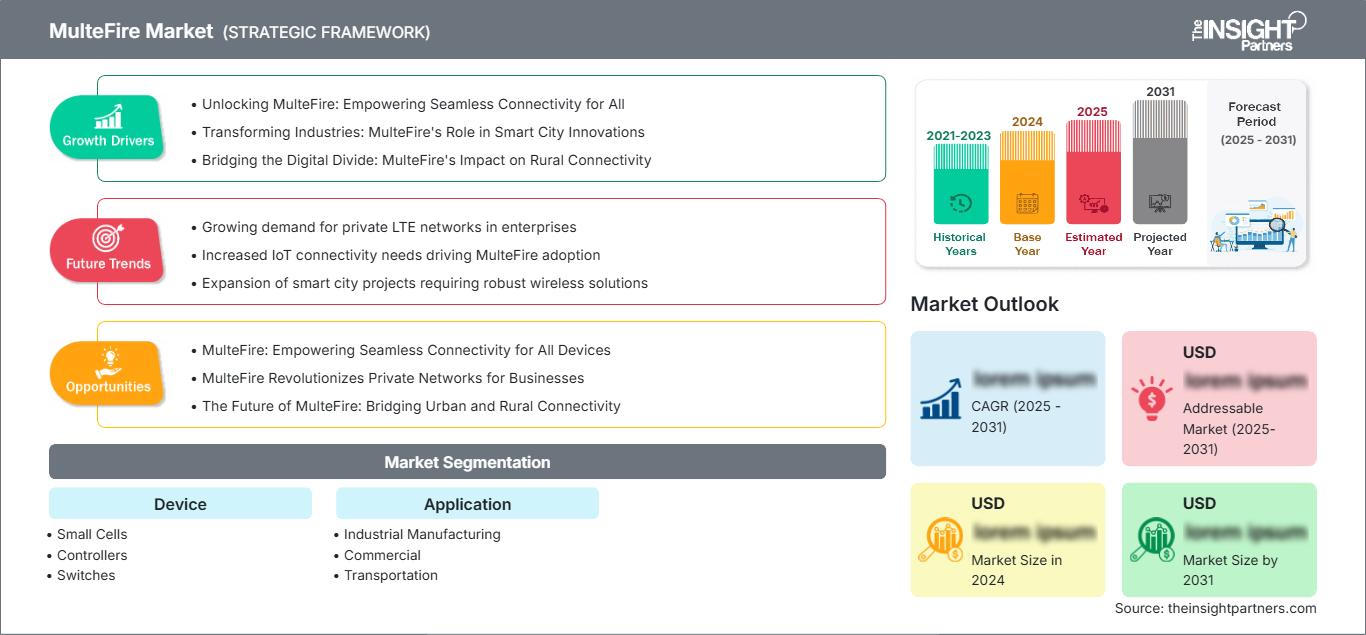
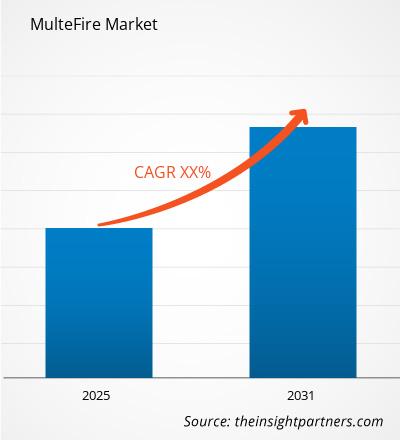
The MulteFire Market is valued at US$ 1.93 Billion in 2025 and is projected to reach US$ 9.39 Billion by 2034, registering a CAGR of 19.22% during 2026–2034. The market reflects increasing deployment of LTE-based private wireless connectivity across industrial and enterprise environments where controlled coverage, mobility, reliability, and spectrum flexibility are important for connected operations, automation, and mission-critical communications.
North American demand is supported by private cellular deployments, CBRS ecosystem maturity, and enterprise digitization. The regional outlook in the MulteFire Market size indicates a CAGR of 18–20% during 2026–2034, supported by manufacturing modernization, logistics automation, utility connectivity, and growing demand for localized wireless networks that complement Wi-Fi and public cellular infrastructure.
MulteFire Market Assessment and Insights
- North America: North America is expected to account for a 34–38% share in 2025 and expand at a CAGR of 18–20% during 2026–2034, supported by CBRS adoption, private cellular deployments, industrial automation, and enterprise networking requirements.
- US: The US is expected to represent 68–72% of North America's 2025 market and grow at a CAGR of 18–20%, led by CBRS availability and private LTE deployments.
- Europe: Europe is projected to hold a 22–26% share in 2025 and grow at a CAGR of 18–20%, with Germany, the UK, France, Italy, and Spain supporting industrial connectivity, spectrum modernization, and Industry 4.0 initiatives.
- Asia Pacific: Asia Pacific is expected to capture a 27–31% share in 2025 and register a CAGR of 21–23%, with China, Japan, South Korea, India, and Australia benefiting from manufacturing digitization and private wireless adoption.
- Largest Segment: Small Cells are expected to hold a 58–62% market share in 2025 and grow at a CAGR of 20–22%, reflecting localized coverage and capacity requirements.
- High Growth Segment: Industrial Manufacturing is expected to command a 30–34% market share in 2025 and expand at a CAGR of 21–23%, driven by automation and connected production.
- Key companies analyzed in detail: Baicells Technologies Co., Ltd.; Casa Systems, Inc.; Ericsson; Huawei Technologies Co., Ltd.; Nokia Corporation; Qualcomm Technologies, Inc.; Redline Communications; Ruckus Networks; Samsung Electronics Co., Ltd.; SpiderCloud Wireless.
Source: The Insight Partners' analysis based on proprietary research, government publications, company annual reports, investor presentations, industry databases, and expert interviews.
The marketplace shifted from experimentation with various concepts to private wireless networks operating on licensed spectrum by means of LTE, then to more realistic concepts for wireless private networks based on small cells, controllers, switching and enterprise applications. The evolution in coordination of radios, interference handling, device interoperability and edge computing makes it possible to implement wireless private networks realistically. Trends in production are increasingly turning to modular hardware and software-controlled approaches to interfacing.
Expansion in the future would most probably go beyond proven North American and European deployments to include manufacturing-oriented Asia and infrastructure projects in the Middle East. Policy on spectrum sharing, private networks, and digitalization would help attract investment. In general, there are also developments that would allow hybrid solutions in terms of LTE and 5G private wireless network architecture. This would allow enterprises to leverage their legacy equipment while incorporating better radio performance.
MulteFire Market Report Scope
| Report Attribute | Details |
|---|---|
| Market size in 2025 | US$ 1.93 Billion |
| Market Size by 2034 | US$ 9.39 Billion |
| Global CAGR (2026 - 2034) | 19.22% |
| Historical Data | 2021-2024 |
| Forecast period | 2026-2034 |
MulteFire Market Analysis
MulteFire Market development is linked to demand for robust wireless connections within the premises where Wi-Fi connections could experience some difficulties in terms of coverage, interference, mobility, and traffic management. For instance, industrial automation, connected machines, autonomous vehicles, video surveillance, asset tracking, and employee communication need predictable performance of the network. The supply chain includes chip providers, radio and small cell makers, controllers, switches, network integrators, spectrum managers, software developers, and business end-users.
The supply factors include availability of LTE-compatible modules and possibility to integrate radio access, core, orchestration, and security components into a compact system. Suppliers have become increasingly competitive in terms of interoperability, deployment capabilities, lifecycle support, and private network compatibility. These factors give opportunities for equipment providers that can offer modular systems yet perform reliably at densely populated indoor buildings, expansive outdoor campuses, and scattered operational sites.
MulteFire market report reveals that the competitive environment comprises well-known telecommunications companies and experts in small cells, private LTE, and enterprise connectivity. Ericsson, Huawei Technologies Co., Ltd., Nokia Corporation, and Samsung Electronics Co., Ltd. are capable of offering considerable radio and private networking capabilities, while Qualcomm Technologies, Inc. improves the capabilities in chipset and technology ecosystem. Baicells Technologies Co., Ltd., Ruckus Networks, Redline Communications, Casa Systems, Inc., and SpiderCloud Wireless offer extra capabilities in access and enterprise networking.
The areas of investment interest increasingly include software-defined systems, private cellular integration, edge computing, network management, and convergence with industrial applications. This way, competitive advantages do not lie in radio hardware but in comprehensive cost effectiveness, compatibility, security, service, and upgrade opportunities. Companies with a solid base in the enterprise segment will be able to promote their offerings in this field by incorporating cellular connectivity into existing operational technology systems.
● REPORT CUSTOMIZATION
Tailor This Report To Align With Your Specific Business Requirements
This report can be customized to align precisely with your business objectives, scope, and target markets. Customization options include tailored segmentation, geography, competitive analysis, and strategic insights to support informed decision-making.
Customize This Report →WHAT YOU CAN ADJUST
- ● Segmentations
- ● Geography
- ● Competitive Analysis
- ● Language Preferences
MulteFire Market: Strategic Insights
Regional Insights
North America MulteFire Market
The North American region is forecasted to have 34–38% of the share by 2025 with a CAGR of 18–20% up until 2034. The reasons include a developed private cellular environment, experience in CBRS implementation, digitalization of industries, as well as needs for wireless and secure connectivity in manufacturing, logistics, utilities, healthcare, and corporate campuses. In this case, the United States is a major market, and Canada acts through industrial, energy, and public sector connectivity programs.
In this respect, regional implementation economics tend towards localized solutions, which are able to co-exist with public Wi-Fi networks and cellular services while providing more control over the process for enterprises. In particular, manufacturing sites are implementing private wireless networks for connected machines and movable assets, whereas utilities and transportation companies need resilient connectivity over widespread environments.
U.S. MulteFire Market
North America holds a share of 68%–72% of the market in the United States by 2025, and there is an estimated growth rate of 18%–20% CAGR between 2025 and 2034. Maturity of the CBRS Ecosystem, access to spectrum for enterprises, industrial automation, and private LTE experience favor the deployment environment. The major technology providers possess capabilities in the areas of radio equipment, chipset, private network platform, and enterprise integration.
Application need is highest where organizations need localized coverage, reliable connectivity, and control over operations. Manufacturing facilities leverage private wireless networks for automation and mobility of assets, and utilities, healthcare centers, warehouse centers, campus, and transport facilities are increasingly considering cellular solutions as an alternative to traditional wireless networks. Ericsson, Nokia Corporation, Qualcomm Technologies, Inc., Samsung Electronics Co., Ltd., Baicells Technologies Co., Ltd., and Ruckus Networks increase the supplier ecosystem in the region.
Europe MulteFire Market
The region will occupy 22–26% of the market in 2025 and grow at 18–20% CAGR during the forecast period. Germany leads in the region due to the high demands for controlled wireless communications as a result of industrial automation and the connected factory initiative. Other countries that contribute to growth in Europe include UK, France, Italy, and Spain through enterprise digitalization and modern transport and private wireless network testing.
UK's growth comes as a result of enterprise connectivity projects and highly technology-dependent enterprises demanding security in wireless connectivity. Germany's industrial sector creates a constant need for reliable connectivity for robotic devices and machines and mobile production devices. France will benefit from industrial and transport digitization initiatives, whereas Italy and Spain will provide opportunities in manufacturing, logistics, utilities, hospitality and other large commercial sites.
APAC MulteFire Market
According to forecasts, APAC will be the leader in growth with 27–31% MulteFire Market share and 21–23% CAGR in 2025. As for APAC region, China is leading in demand followed by Japan, South Korea, India, and Australia. Presence of manufacturing industry, smart-factory initiatives, infrastructure investments, and digital industrial policies foster adoption in the region.
The presence of industrial applications is evident in China and Japan, advanced manufacturing and connected factories in South Korea. Industrial digitization and infrastructure development create chances for India, whereas Australia has mining and energy needs.
Middle East & Africa MulteFire Market
It is anticipated that Middle East and Africa will grow at a CAGR of 16-18% led by adoption in Saudi Arabia. The UAE and South Africa will offer additional demand for smart infrastructure, digitized industry, energy projects, logistics, and business establishments with connectivity needs. Extensive development programs provide opportunities for deployment of wireless connectivity.
The energy and infrastructure application space are particularly applicable for Saudi Arabia and the UAE, whereas South Africa will present opportunities in mining, utilities, transport, and industrial establishments. Rest of MEA presents an opportunity space where the wireless network can solve issues of connectivity among scattered assets and operations. It is expected that adoption would be inclined towards architectures with minimal physical infrastructures.
Segmentation Analysis
Devic
Device demand is centered on network equipment required to deliver reliable access, traffic management, and local connectivity. The segment is projected to expand at a CAGR of 19–21% during 2026–2034. Enterprises increasingly favor modular architectures that simplify deployment, scaling, monitoring, and integration with existing network infrastructure.
- Small Cells: Small Cells represent the principal device category because localized radio coverage supports dense industrial environments, campuses, warehouses, and commercial sites requiring controlled capacity and mobility.
- Controllers: Controllers provide centralized coordination, policy enforcement, configuration, and network management, making them strategically important as deployments become more distributed and operational requirements become increasingly complex.
- Switches: Switches connect radio equipment with enterprise and core-network infrastructure, supporting traffic aggregation, segmentation, and dependable data movement across industrial and commercial environments.
Applications
Application demand is increasingly shaped by digital transformation programs requiring dependable wireless connectivity for mobile equipment, sensors, automation, and operational communications. The segment is projected to grow at a CAGR of 20–22% during 2026–2034, with industrial use cases providing the strongest deployment foundation.
- Industrial Manufacturing: Industrial Manufacturing remains strategically important because connected production lines, robotics, automated vehicles, and real-time monitoring require predictable wireless connectivity across complex facilities.
- Commercial: Commercial deployments emphasize reliable connectivity across offices, campuses, retail environments, and mixed-use facilities where cellular networks can complement existing Wi-Fi infrastructure.
- Transportation: Transportation applications benefit from mobility, broad-area coverage, asset tracking, and communications across airports, ports, rail facilities, logistics centers, and connected fleets.
- Healthcare: Healthcare demand is supported by connected medical equipment, asset tracking, operational communications, and requirements for dependable connectivity in hospitals and clinical environments.
- Oil and Gas and Mining: Oil and Gas and Mining applications require resilient connectivity across remote, hazardous, and geographically dispersed sites supporting monitoring, worker communications, automation, and asset management.
- Power Generation: Power Generation deployments support monitoring, maintenance, worker safety, and communications across generating facilities and associated operational infrastructure.
- Hospitality: Hospitality applications include guest services, workforce communications, smart-building functions, connected security, and operational systems requiring consistent indoor connectivity.
Opportunity Snapshot
| Application | Revenue Contribution | Trend Tag | Adoption Stage |
|---|---|---|---|
| Industrial Manufacturing | High | Factory Automation | Scaling |
| Commercial | Medium | Campus Connectivity | Scaling |
| Transportation | Medium | Fleet Connectivity | Scaling |
| Healthcare | Medium | Connected Care | Emerging |
| Oil and Gas and Mining | Medium | Remote Operations | Scaling |
| Power Generation | Medium | Grid Monitoring | Scaling |
| Hospitality | Low | Smart Hospitality | Emerging |
MulteFire Market Growth Drivers and Impact Analysis
Machines and mobile robots, sensors, cameras, and automated vehicles are increasingly connected in industrial settings, thereby driving the requirement for a wireless connectivity solution that enables mobility and continued connectivity. Private architecture based on cellular connectivity offers an option that can replace the existing Wi-Fi solutions that could potentially have issues related to large coverage area, interference, roaming, or high device density. This drives the potential equipment base in small cells, controllers, and switches. Additionally, localized connectivity can help in segregating traffic for operation from other enterprise traffic, providing better network management. The effect is felt in the automobile, electronics, machinery, food processing, and warehousing industries. As manufacturing processes increasingly become software-defined, connectivity will be an enabler for analytics, maintenance, visioning, and material movement automation.
Spectrum-sharing models have been revolutionizing the way companies assess their private cellular systems because of the decreasing dependency on licensed exclusive spectrum. The CBRS spectrum ecosystem within the United States serves as an appropriate example for localized spectrum availability, and other regions have been developing strategies for spectrum availability for enterprises and industry. Such a scenario allows more companies to deploy their own cellular systems for particular sites or zones. Such low barriers of entry in terms of spectrum can positively affect the economics of the projects, especially when enterprises need their own coverage without constructing an operator-size system. Device manufacturers benefit from such small-scale implementations that can be scaled later to several sites. Such scenarios are particularly useful for logistics, healthcare, utilities, campuses, and manufacturing industries that need more control over connectivity, prioritizations, and performance of networks.
The private wireless infrastructure is now increasingly being considered on a level equal to edge computing, artificial intelligence, industrial analytics, and connected device platforms. This means that the data collected by cameras, machines, sensors, and mobile assets can be sent to local computing facilities with certain latency and security controls. Thus, an infrastructure is created that will make it possible to use applications for machine vision, autonomous machines, predictive maintenance, digital workflow management, and remote operation control. As for suppliers, competition has to shift away from merely the performance of the radio towards an ecosystem of connectivity and computing solutions. There will be a number of advantages for businesses since all of these infrastructure solutions can now be integrated together. With increasing deployments of edge solutions, the demand for equipment will extend to other elements including not only access points but also controllers, switches, orchestration software, etc.
MulteFire Market Future Trends
MulteFire Market trends are expected to increasingly reflect convergence between LTE-based private wireless and 5G architectures. Enterprises are unlikely to replace established LTE infrastructure immediately when existing devices and operational applications remain productive. Instead, suppliers are likely to support staged migration models where LTE provides dependable connectivity while 5G is introduced for higher-bandwidth, lower-latency, or advanced automation applications. This approach can reduce technology-transition risk and improve capital utilization. Future architectures may therefore emphasize common management layers, shared transport, interoperable device ecosystems, and flexible radio configurations. Such convergence will be particularly relevant to industrial manufacturers, utilities, transportation operators, and large campuses managing mixed generations of equipment. The resulting market structure should favor vendors capable of supporting lifecycle evolution rather than single-generation deployments.
Future deployments are likely to incorporate more automated configuration, predictive network management, policy optimization, and AI-assisted operational monitoring. As private wireless networks connect larger numbers of devices and applications, manual management becomes less practical, particularly across geographically distributed sites. Intelligent controllers can increasingly analyze traffic patterns, device behavior, interference conditions, and service requirements to optimize network resources. Automation may also improve fault detection and simplify software updates, reducing operational burden for enterprises with limited telecommunications expertise. Vendors that combine radio infrastructure with cloud-based orchestration, analytics, cybersecurity, and lifecycle management should therefore gain strategic relevance. This transition will encourage a shift from equipment-centric purchasing toward managed connectivity platforms, where enterprises evaluate network intelligence, integration capability, security, and operational simplicity alongside conventional coverage and capacity considerations.
MulteFire Market Opportunities
MulteFire Market Opportunities are emerging as manufacturers, logistics operators, utilities, and infrastructure owners modernize facilities with connected machines and mobile operational assets. Suppliers can target organizations operating multiple plants, warehouses, depots, or remote facilities where standardized wireless architectures can be replicated across sites. Investment opportunities include compact radio equipment, centralized controllers, switching platforms, network orchestration, security, and lifecycle services. A modular deployment strategy can allow customers to begin with one operational area before extending connectivity across broader facilities. Vendors can also create value by integrating wireless infrastructure with industrial applications and edge platforms rather than selling standalone hardware. The most attractive projects are likely to combine measurable operational outcomes, such as reduced downtime, improved asset visibility, faster maintenance response, or safer workforce communications, with clear pathways for phased expansion.
MulteFire Market Forecasts indicate attractive opportunities in sectors where wired infrastructure is costly to extend and public networks cannot guarantee operational control. Utilities, energy operators, mining companies, transportation networks, and infrastructure providers manage assets distributed across challenging environments, creating demand for flexible connectivity. Vendors can address this opportunity through ruggedized access equipment, centralized management, secure switching, and hybrid network architectures that combine wireless, fiber, and public cellular services. Investment priorities should focus on applications with direct operational value, including remote monitoring, worker communications, mobile maintenance, surveillance, and asset automation. Regional strategies can be tailored to energy-intensive economies and infrastructure programs where network resilience is a priority. Suppliers that demonstrate interoperability with existing operational technology and clear upgrade paths should be better positioned to secure multi-site deployments.
Frequently Asked Questions

- Comprehensive Market Sizing and Forecast Analysis
- Detailed Segmentation Analysis
- In-Depth Market Dynamics Assessment
- Regional and Country-Level Insights
- Competitive Landscape and Company Benchmarking
- Strategic Business Intelligence
Recent Reports
Testimonials

The Insight Partners provided valuable market intelligence that supported our global go-to-market strategy. Their team was professional, responsive, and attentive to our feedback, providing thoughtful analysis and helpful methodological clarifications throughout the project.
Junmo Kim Chief Financial Officer (CFO), Enertech Co., Ltd.
The Insight Partners' SCADA System Market report is comprehensive, with valuable insights on current trends and future forecasts. The team was highly professional, responsive, and supportive throughout. We are very satisfied and highly recommend their services.
RAN KEDEM Partner, Reali Technologies LTDs
I requested a report on a very specific software market and the team produced the report in a few days. The information was very relevant and well presented. I then requested some changes and additions to the report. The team was again very responsive and I got the final report in less than a week.
JEAN-HERVE JENN Chairman, Future Analytica
We worked with The Insight Partners for an important market study and forecast. They gave us clear insights into opportunities and risks, which helped shape our plans. Their research was easy to use and based on solid data. It helped us make smart, confident decisions. We highly recommend them.
PIYUSH NAGPAL Sr. Vice President, High Beam Global
The Insight Partners delivered insightful, well-structured market research with strong domain expertise. Their team was professional and responsive throughout. The user-friendly website made accessing industry reports seamless. We highly recommend them for reliable, high-quality research services
YUKIHIKO ADACHI CEO, Deep Blue, LLC.
This is the first time I have purchased a market report from The Insight Partners.While I was unsure at first, I visited their web site and felt more comfortable to take the risk and purchase a market report.I am completely satisfied with the quality of the report and customer service. I had several questions and comments with the initial report, but after a couple of dialogs over email with their analyst I believe I have a report that I can use as input to our strategic planning process.Thank you so much for taking the extra time and making this a positive experience.I will definitely recommend your service to others and you will be my first call when we need further market data.
JOHN SUZUKI President and Chief Executive Officer, Board Director, BK Technologies
I wish to appreciate your support and the professionalism you displayed in the course of attending to my request for information regarding to infectious disease IVD market in Nigeria. I appreciate your patience, your guidance, and the fact that you were willing to offer a discount, which eventually made it possible for us to close a deal. I look forward to engaging The Insight Partners in the future, all thanks to the impression you have created in me as a result of this first encounter.
DR CHIJIOKE ONYIA MANAGING DIRECTOR, PineCrest Healthcare Ltd.Reason to Buy
- Informed Decision-Making
- Understanding Market Dynamics
- Competitive Analysis
- Identifying Emerging Markets
- Customer Insights
- Market Forecasts
- Risk Mitigation
- Boosting Operational Efficiency
- Strategic Planning
- Investment Justification
- Tracking Industry Innovations
- Aligning with Regulatory Trends





 Get Free Sample for