
Navigation Signal Simulator Market Demand, Trends & Forecast by 2034
Coverage: by Component (Hardware, Software); End User (Aerospace, Automotive, Electronics, Military, Others) , and Geography (North America, Europe, Asia Pacific, and South and Central America)
- Status : Data Released
- Report Code : TIPRE00009143
- Category : Electronics and Semiconductor
- No. of Pages : 150
- Available Report Formats :


- Last update date : October 13, 2026


2025 Market Size
US$ 268.8 Mn
Base year value
2034 Forecast
US$ 615.37 Mn
Projected by 2034
CAGR 2026-2034
9.64 %
Growth rate
Addressable Market
US$ 3,941.92 Mn
(2026-2034)
The Navigation Signal Simulator Market growth is supported by precision testing requirements across defense, aerospace, and automotive positioning systems, with the market valued at US$ 268.8 Million in 2025 and projected to reach US$ 615.37 Million by 2034, expanding at a CAGR of 9.64% between 2026 and 2034. Growing satellite navigation dependency across autonomous systems reinforces sustained demand for hardware and software simulation solutions worldwide.
North America is estimated to grow at a CAGR of 9.0-9.5% through 2034, reflecting the navigation signal simulator market size expansion driven by sustained defense modernization spending and expanding autonomous vehicle testing infrastructure requirements. Growing commercial aerospace certification demand further reinforces steady regional consumption across military and civilian positioning system validation applications.
Navigation Signal Simulator Market Assessment and Insights
- North America: The region holds an estimated 34-38% share in 2025, growing at a CAGR of 9.0-9.5% between 2026-2034, driven by defense modernization programs, autonomous vehicle testing, and aerospace certification requirements.
- US: The United States represents the majority of regional demand in 2025, expanding at a CAGR of 8.9-9.4% through 2034, backed by strong defense procurement and aerospace testing infrastructure.
- Europe: Europe accounts for roughly 24-27% share in 2025 and is projected to grow at a CAGR of 9.2-9.7% through 2034, led by Germany, the UK, and France through defense and automotive validation demand.
- Asia Pacific: Asia Pacific holds an estimated 24-28% share in 2025, expanding at a CAGR of 10.5-11.0% between 2026-2034, led by China, Japan, and India through expanding satellite navigation and defense modernization programs.
- Largest Segment: The Hardware segment holds the largest share at 58-62% in 2025, growing at a CAGR of 9.3-9.8% through 2034, favored for high-fidelity signal generation across military and aerospace testing applications.
- High Growth Segment: The Automotive end-user segment registers the fastest growth at a CAGR of 12.5-13.0% through 2034, propelled by expanding autonomous vehicle testing and advanced driver assistance system validation requirements.
- Key companies analyzed in detail: CAST Navigation LLC, Digilogic Systems Pvt. Ltd., IFEN GmbH, iP-Solutions, Orolia SAS, Rohde & Schwarz Benelux B.V., Racelogic Ltd., Spirent Communications plc, Syntony SAS, WORK Microwave GmbH, Safran Electronics & Defense.
Source: The Insight Partners' analysis based on proprietary research, government publications, company annual reports, investor presentations, industry databases, and expert interviews.
The market has grown through technological iterations from simulating single-constellation Global Positioning System to multi-constellation simulators that simulate signals for GPS, Galileo, GLONASS, and BeiDou all at once. Software-defined radio architecture used by manufacturers in their products has been improved in successive iterations to offer higher fidelity and complexity in test scenarios for autonomous vehicles. The manufacturing process has changed to involve modular hardware platforms for scalable channel configuration to allow testing laboratories cope with increasingly complex requirements of defense and commercial positioning system tests.
Going forward, manufacturers will develop their simulation infrastructures in the emerging markets of Asia and the Middle East in terms of achieving independence in their satellite navigation systems. Adoption of standards for testing autonomy of vehicles by transportation safety authorities would further fuel the adoption of simulators. Investments in robust positioning, navigation, and timing testing solutions would create consistent opportunities for both military and commercial applications over the forecast period.
Navigation Signal Simulator Market Report Scope
| Report Attribute | Details |
|---|---|
| Market size in 2025 | US$ 268.8 Million |
| Market Size by 2034 | US$ 615.37 Million |
| Global CAGR (2026 - 2034) | 9.64% |
| Historical Data | 2021-2024 |
| Forecast period | 2026-2034 |
Navigation Signal Simulator Market Analysis
The growth of the market is supported by the increased demand for controllable and consistent testing environments of positioning system performance under simulated jamming, spoofing, and multipath interference scenarios. The supply chain covers radio frequency component production, software algorithm development, integration, and calibration, with signal fidelity considerations and multi-constellation support being among the key factors affecting the product differentiation among suppliers at all levels.
Factors impacting the supply dynamics continue to include the procurement of specialized radio frequency components and software license negotiation processes, especially for the equipment utilized for the simulation of the classified scenarios used by defense agencies. The suppliers have been increasingly implementing software-hardware packages, which provide ready-made solutions for testing platforms deployment within the research and production test laboratories.
Based on the market analysis, a highly competitive industry structure is evident where companies providing simulation technology cater to testing needs in defense and commerce. Spirent Communications plc and Orolia SAS have developed simulation technology of multiple constellations, whereas CAST Navigation LLC and Rohde & Schwarz Benelux B.V. rely on their established contacts in the defense industry for military positioning system test purposes.
IFEN GmbH and Syntony SAS keep developing software-defined simulations used for research and automotive tests, whereas Racelogic Ltd. and WORK Microwave GmbH offer compact and portable simulation systems for field tests. Digilogic Systems Pvt. Ltd. and iP-Solutions develop testing services for defense and commercial customers in various regions.
● REPORT CUSTOMIZATION
Tailor This Report To Align With Your Specific Business Requirements
This report can be customized to align precisely with your business objectives, scope, and target markets. Customization options include tailored segmentation, geography, competitive analysis, and strategic insights to support informed decision-making.
Customize This Report →WHAT YOU CAN ADJUST
- ● Segmentations
- ● Geography
- ● Competitive Analysis
- ● Language Preferences
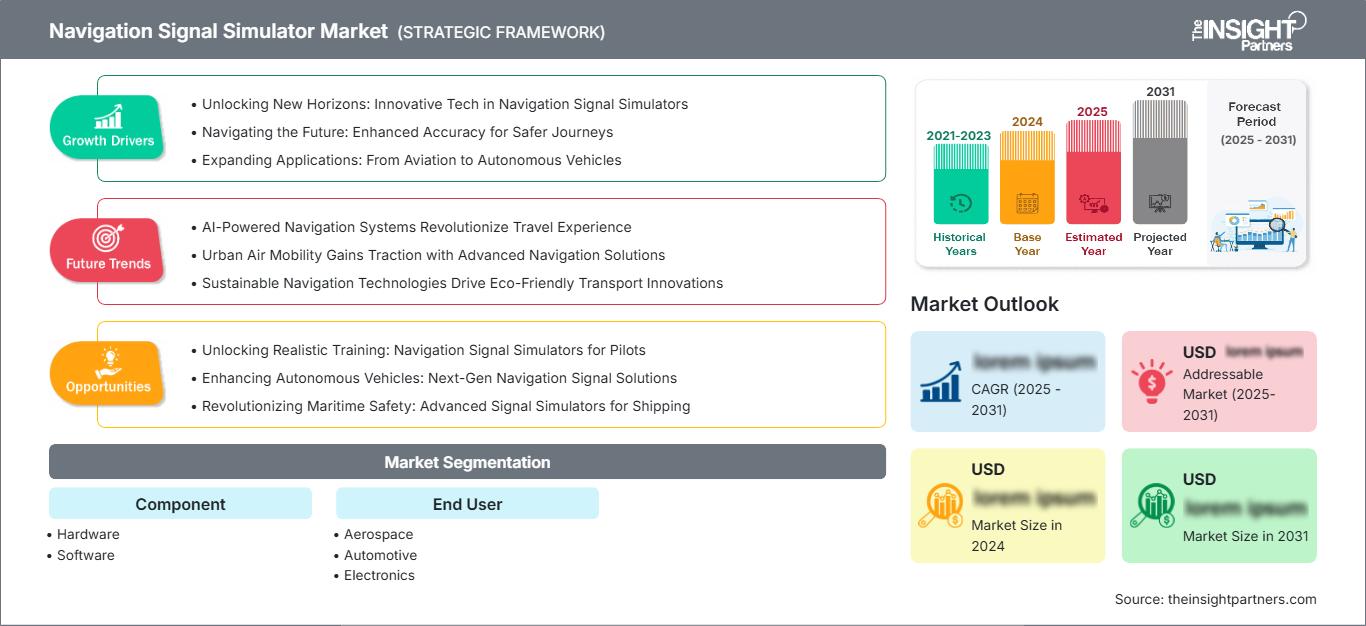
Navigation Signal Simulator Market: Strategic Insights
Regional Insights
North America Navigation Signal Simulator Market
North America holds an estimated 34-38% share of the global market in 2025, expanding at a CAGR of 9.0-9.5% through 2034. Growth is anchored by sustained defense modernization spending requiring resilient positioning system testing, alongside expanding autonomous vehicle and advanced driver assistance system validation infrastructure across commercial automotive testing facilities.
Structural drivers include growing commercial aerospace certification demand for navigation equipment testing, alongside expanding research investment in anti-jamming and anti-spoofing simulation capabilities supporting national security requirements. Canada contributes through aerospace testing collaboration initiatives, while Mexico's expanding automotive manufacturing base supports incremental regional demand for positioning validation infrastructure across supplier testing facilities.
U.S. Navigation Signal Simulator Market
The United States accounts for an estimated 83-87% share of the North American market in 2025, growing at a CAGR of 8.9-9.4% through 2034. Substantial defense procurement budgets, coupled with expanding commercial aerospace and automotive testing infrastructure, continue to anchor demand for hardware and software simulation platforms nationwide.
CAST Navigation LLC and Orolia SAS maintain significant domestic manufacturing and defense contracting presence, supporting rapid deployment for military testing programs. Application trends indicate rising preference for multi-constellation hardware simulators in defense applications, while automotive and electronics sectors increasingly favor software-based simulation platforms for scalable, cost-efficient advanced driver assistance system validation testing.
Europe Navigation Signal Simulator Market
Europe commands an estimated 24-27% share of the global market in 2025, growing at a CAGR of 9.2-9.7% through 2034, with Germany identified as the leading contributor given its extensive automotive and defense electronics manufacturing base requiring positioning system validation.
Germany represents the region's largest market, driven by automotive OEM demand for advanced driver assistance system testing alongside defense sector procurement. The UK contributes through aerospace and defense testing infrastructure investment, while France, Italy, and Spain register steady demand from defense modernization programs and automotive component suppliers validating positioning systems across expanding regional manufacturing operations.
APAC Navigation Signal Simulator Market
Asia Pacific holds an estimated 24-28% of the Navigation Signal Simulator Market share in 2025, expanding at the fastest regional CAGR of 10.5-11.0% through 2034. China leads, given its expanding BeiDou satellite navigation ecosystem, followed by Japan, India, South Korea, and Australia.
Industrial policy support for domestic satellite navigation independence, particularly across China and India, alongside Japan's established aerospace testing ecosystem, continues driving demand for multi-constellation simulation platforms supporting defense modernization and expanding automotive positioning system validation requirements region-wide.
Middle East & Africa Navigation Signal Simulator Market
The Middle East & Africa navigation signal simulator market is projected to grow at a CAGR of 8.5-9.0% through 2034, with Saudi Arabia leading regional demand through defense modernization and infrastructure digitization initiatives tied to national diversification strategies.
The UAE contributes through defense and aerospace testing infrastructure projects, while South Africa and the Rest of MEA register gradual uptake driven by expanding telecommunications infrastructure and defense sector investment requiring reliable positioning system validation capabilities.
Segmentation Analysis
Component
The Component segment of the navigation signal simulator market scope encompasses Hardware and Software categories, collectively growing at a CAGR of 9.5-10.0% between 2026 and 2034. Demand distribution reflects diverging customer requirements, with software solutions gaining share as automotive and electronics customers prioritize scalable, cost-efficient testing over dedicated hardware platforms required for high-fidelity defense applications.
- Hardware: Hardware simulators dominate defense and aerospace applications, requiring high-fidelity signal generation, valued for precise radio frequency output and multi-constellation support suited to mission-critical testing scenarios.
- Software: Software simulators gain rapid traction across automotive and electronics testing applications, offering scalable, cost-efficient validation capabilities suited to advanced driver assistance system development environments.
End User
The End User segment records a combined CAGR of 10.0-10.5% between 2026 and 2034, led by automotive and military adoption. Aerospace applications maintain steady demand tied to certification requirements, while electronics manufacturers increasingly integrate simulation testing into consumer positioning device development, reflecting broadening cross-sector reliance on navigation validation technology.
- Aerospace: Aerospace applications rely on navigation signal simulators for avionics certification and satellite navigation system validation, supporting stringent regulatory compliance requirements across commercial and military aircraft programs.
- Automotive: Automotive manufacturers increasingly deploy simulators for advanced driver assistance systems and autonomous vehicle positioning validation, supporting safety certification requirements across expanding electric and autonomous vehicle platforms.
- Electronics: Electronics manufacturers utilize simulators for consumer positioning device testing, ensuring reliable performance across smartphones, wearables, and Internet of Things devices requiring accurate location services.
- Military: Military applications depend on simulators for resilient positioning, navigation and timing testing under simulated jamming and spoofing conditions, supporting mission-critical defense system validation requirements.
Opportunity Snapshot
| End User | Revenue Contribution | Trend Tag | Adoption Stage |
| Aerospace | High | Avionics Certification | Mature |
| Automotive | High | ADAS Validation | Scaling |
| Electronics | Medium | Consumer Positioning | Scaling |
| Military | High | Anti Jamming Testing | Mature |
Navigation Signal Simulator Market Growth Drivers and Impact Analysis
Rising Autonomous Vehicle Testing Requirements Driving Simulator Adoption
Increased autonomous vehicle development projects are driving up the demand for navigation signal simulators that can help validate the functionality of the advanced driver assistance systems under various positioning environments. The automotive companies need a consistent test environment to assess the behavior of the systems during simulated signal degradation, urban canyon effect, and multipath interference environments. Such a need for simulation is becoming even more evident as the certification authorities continue demanding stringent validation of the positioning systems before approving any autonomous features. Software simulation tools provide scalable and cost-effective options for automotive testing laboratories that conduct numerous validation runs during automotive development programs. The suppliers who have experience in automotive testing, such as Racelogic Ltd. and Syntony SAS, are poised to benefit from the increased demand.
Defense Modernization Programs Sustaining Resilient Positioning Testing Demand
Ongoing efforts for modernization of defense in countries around the world continue to create the need for the acquisition of navigation signal simulators for the purpose of testing military positioning systems in scenarios that are simulated using electronic warfare tactics such as jamming and spoofing. The importance of resilient positioning, navigation, and timing capabilities by defense agencies is increasing due to the increased sophistication of the electronic warfare threats to satellite navigation. This trend is prevalent in testing of ground vehicles, aircraft, and weapon guidance system tests requiring multi-constellation capabilities. CAST Navigation LLC and Rohde & Schwarz Benelux B.V. continue to enhance their portfolio of defense-related simulations. Due to ongoing geopolitical tensions and high defense expenditures in many regions, demand for high-fidelity hardware simulations of high fidelity continues.
Commercial Aerospace Certification Requirements Expanding Testing Infrastructure
Increased aircraft manufacturing and avionics technology upgrade projects keep creating persistent demand for navigation signal simulation solutions that would help test the compliance of satellite-based navigation systems with applicable standards. Such certification is necessary for flight safety purposes, and therefore, aviation agencies insist on thorough examination of navigation equipment performance in a variety of situations before its commercial release. It is pertinent to note that certification tests are also needed for unmanned aerial vehicle projects that find their application in commercial operations. Companies such as Orolia SAS and Spirent Communications PLC keep developing simulation systems tailored specifically for the needs of the aerospace industry.
Navigation Signal Simulator Market Future Trends
Integration of Multi-Domain Simulation Supporting Space and Terrestrial Testing
Simulator manufacturers are increasingly developing platforms capable of simultaneously testing satellite and terrestrial-based positioning technologies, reflecting emerging navigation signal simulator market trends toward comprehensive multi-domain validation capabilities. The integration of these components responds to the emerging trend where there is dependence on a hybrid positioning system that integrates satellite-based signals along with terrestrial beacon and inertial navigation technologies. With the increasing autonomy of such systems, there is a need for testing platforms that will enable a test of the technology integration. These trends are likely to change the direction of simulator product development, favoring manufacturers who will be able to offer integrated testing solutions for different positioning technologies.
Growing Adoption of Cloud-Based Simulation Services for Scalable Testing
With advancements in simulation technology, more cloud-based testing facilities that allow access to simulations remotely without the need for investment in costly and dedicated on-site hardware have been introduced. This provides smaller players within the automotive and electronics industries access to simulation services without significant investments in testing infrastructure. Furthermore, cloud-based testing tools allow collaboration of test engineers from various locations. In terms of developments in software-based simulation technology architecture, it can be anticipated that a growing number of simulation service providers will offer subscription-based models that are particularly favorable to automotive and electronics clients.
Navigation Signal Simulator Market Opportunities
Development of Resilient Positioning Testing Solutions for Critical Infrastructure
Growing recognition of satellite navigation vulnerability to jamming and spoofing threats presents a substantial opportunity for simulator manufacturers developing specialized testing solutions supporting critical infrastructure resilience validation, including power grid timing synchronization and financial network positioning dependencies. Companies expanding product portfolios addressing resilient positioning, navigation and timing requirements beyond traditional defense and automotive applications can capture emerging demand from telecommunications and energy sector customers. This opportunity extends to partnerships with critical infrastructure operators seeking comprehensive vulnerability assessment capabilities. Navigation signal simulator market forecasts indicate sustained investment interest in resilient positioning testing infrastructure will continue strengthening through 2034 as regulatory bodies increasingly mandate infrastructure protection against positioning system disruption across expanding critical sector applications.
Strategic Investment in Multi-Constellation Testing Capacity Expansion
Increased diversity in the global satellite navigation constellation landscape offers substantial value for companies that manufacture simulators and choose to invest in multi-constellation testing facilities that would allow them to perform comprehensive tests of their products within GPS, Galileo, GLONASS, and BeiDou signal landscapes. Companies that are willing to devote specific research and development resources to emerging constellation testing needs are likely to gain a competitive advantage by virtue of their ability to provide a full testing scope that would meet the needs of their global customer base. This opportunity is also available for partnerships between simulation technology vendors and defense contractors for multinational positioning systems testing purposes.
Frequently Asked Questions

- Comprehensive Market Sizing and Forecast Analysis
- Detailed Segmentation Analysis
- In-Depth Market Dynamics Assessment
- Regional and Country-Level Insights
- Competitive Landscape and Company Benchmarking
- Strategic Business Intelligence
Recent Reports
Testimonials

The Insight Partners provided valuable market intelligence that supported our global go-to-market strategy. Their team was professional, responsive, and attentive to our feedback, providing thoughtful analysis and helpful methodological clarifications throughout the project.
Junmo Kim Chief Financial Officer (CFO), Enertech Co., Ltd.
The Insight Partners' SCADA System Market report is comprehensive, with valuable insights on current trends and future forecasts. The team was highly professional, responsive, and supportive throughout. We are very satisfied and highly recommend their services.
RAN KEDEM Partner, Reali Technologies LTDs
I requested a report on a very specific software market and the team produced the report in a few days. The information was very relevant and well presented. I then requested some changes and additions to the report. The team was again very responsive and I got the final report in less than a week.
JEAN-HERVE JENN Chairman, Future Analytica
We worked with The Insight Partners for an important market study and forecast. They gave us clear insights into opportunities and risks, which helped shape our plans. Their research was easy to use and based on solid data. It helped us make smart, confident decisions. We highly recommend them.
PIYUSH NAGPAL Sr. Vice President, High Beam Global
The Insight Partners delivered insightful, well-structured market research with strong domain expertise. Their team was professional and responsive throughout. The user-friendly website made accessing industry reports seamless. We highly recommend them for reliable, high-quality research services
YUKIHIKO ADACHI CEO, Deep Blue, LLC.
This is the first time I have purchased a market report from The Insight Partners.While I was unsure at first, I visited their web site and felt more comfortable to take the risk and purchase a market report.I am completely satisfied with the quality of the report and customer service. I had several questions and comments with the initial report, but after a couple of dialogs over email with their analyst I believe I have a report that I can use as input to our strategic planning process.Thank you so much for taking the extra time and making this a positive experience.I will definitely recommend your service to others and you will be my first call when we need further market data.
JOHN SUZUKI President and Chief Executive Officer, Board Director, BK Technologies
I wish to appreciate your support and the professionalism you displayed in the course of attending to my request for information regarding to infectious disease IVD market in Nigeria. I appreciate your patience, your guidance, and the fact that you were willing to offer a discount, which eventually made it possible for us to close a deal. I look forward to engaging The Insight Partners in the future, all thanks to the impression you have created in me as a result of this first encounter.
DR CHIJIOKE ONYIA MANAGING DIRECTOR, PineCrest Healthcare Ltd.Reason to Buy
- Informed Decision-Making
- Understanding Market Dynamics
- Competitive Analysis
- Identifying Emerging Markets
- Customer Insights
- Market Forecasts
- Risk Mitigation
- Boosting Operational Efficiency
- Strategic Planning
- Investment Justification
- Tracking Industry Innovations
- Aligning with Regulatory Trends





 Get Free Sample for