
Network Packet Broker Market Size, Share & Forecast by 2034
Coverage: by Bandwidth (1 Gbps to 40 Gbps, 41 Gbps to 80 Gbps, 81 Gbps to 100 Gbps, Above 100 Gbps); End Use (Government Organizations, Enterprises, Others) , and Geography (North America, Europe, Asia Pacific, and South and Central America)
- Status : Data Released
- Report Code : TIPRE00010558
- Category : Electronics and Semiconductor
- No. of Pages : 150
- Available Report Formats :


- Last update date : October 13, 2026


2025 Market Size
US$ 871.03 Mn
Base year value
2034 Forecast
US$ 1,904.54 Mn
Projected by 2034
CAGR 2026-2034
9.08 %
Growth rate
Addressable Market
US$ 12,413.10 Mn
(2026-2034)
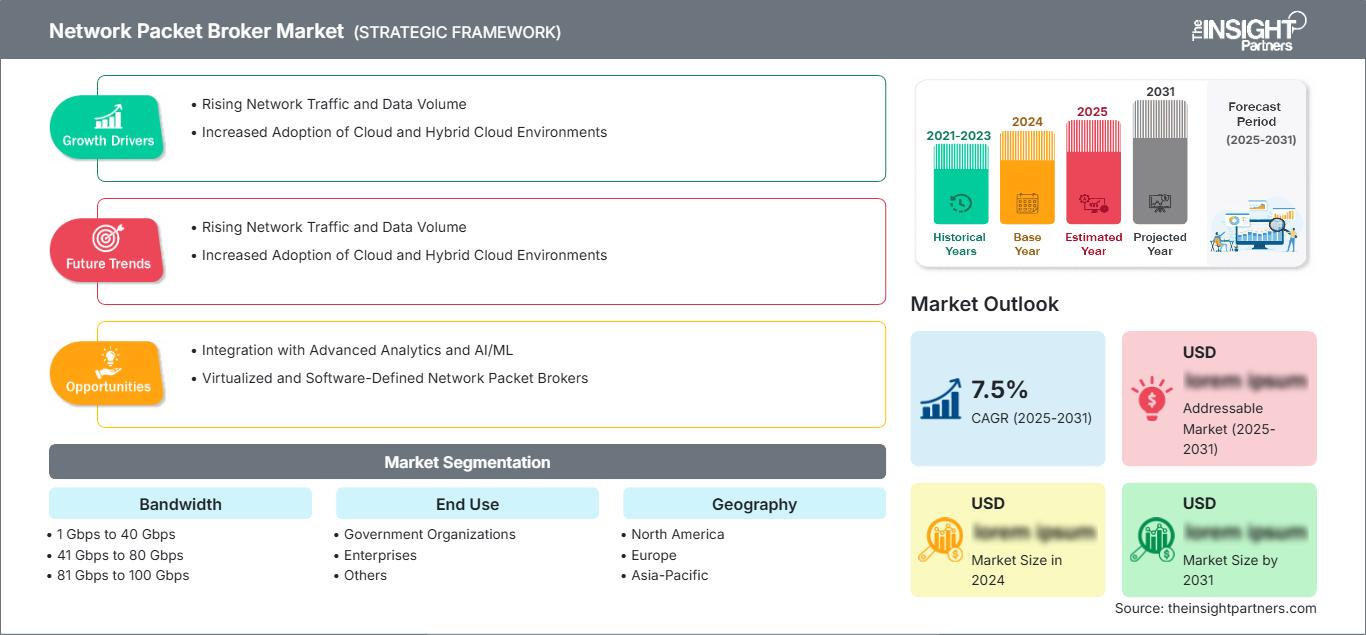
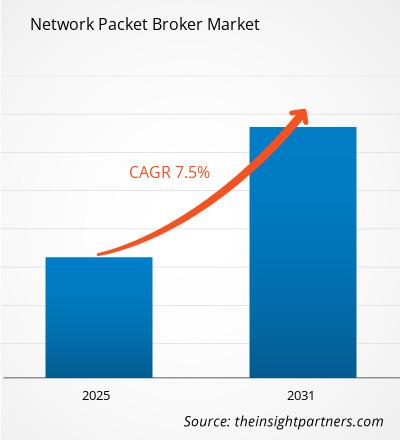
The network packet broker market was valued at US$ 871.03 Million in 2025 and is projected to reach US$ 1,904.54 Million by 2034, expanding at a CAGR of 9.08% during 2026–2034. The market continues to gain strategic importance as enterprises, government organizations, and communication service providers strengthen network visibility, cybersecurity, and traffic optimization capabilities. Growing adoption of cloud computing, software-defined networking, artificial intelligence-enabled monitoring, and encrypted traffic inspection is accelerating deployment across complex IT infrastructures.
Across North America, demand remains supported by advanced digital infrastructure, increasing investments in cybersecurity modernization, and widespread deployment of high-speed data center networks. The network packet broker market size continues to expand as organizations upgrade network monitoring architectures to manage rising east-west traffic and encrypted data flows. Government cybersecurity initiatives, large-scale cloud adoption, and increasing investments in 100G and higher bandwidth infrastructure are expected to support regional growth at an estimated CAGR ranging between 8.5% and 9.5% through 2034.
Network Packet Broker Market Assessment and Insights
- North America: The region benefits from mature cloud infrastructure, early adoption of network automation, and strong cybersecurity investments. Share in 2025: 36–40%. CAGR between 2026–2034: 8.5–9.5%.
- US: The country remains the primary revenue contributor due to extensive enterprise digitalization and hyperscale data center expansion. Share in 2025: 74–78% of North America. CAGR between 2026–2034: 8.7–9.7%.
- Europe: Digital sovereignty initiatives, expanding enterprise security investments, and modernization of telecom infrastructure support steady adoption across Germany, the UK, and France. Share in 2025: 24–28%. CAGR between 2026–2034: 8.2–9.2%.
- Asia Pacific: Rapid cloud deployment, increasing internet traffic, and government-led digital transformation programs drive demand across China, Japan, South Korea, and India. Share in 2025: 25–29%. CAGR between 2026–2034: 10.0–11.0%.
- Largest Segment: End Use – Enterprises remains the leading segment as organizations strengthen network visibility across hybrid and multi-cloud environments. Market share in 2025: 61–65%. CAGR between 2026–2034: 8.8–9.8%.
- High Growth Segment: Bandwidth – Above 100 Gbps is expected to record the strongest expansion, supported by hyperscale data centers, AI workloads, and next-generation enterprise networks. Market share in 2025: 14–18%. CAGR between 2026–2034: 12.5–13.5%.
- Key companies analyzed in detail: Big Switch Networks, Broadcom Inc., Calient Technologies, Cisco Systems, Inc., Garland Technology, Gigamon Inc., Keysight Technologies, Inc. (Ixia), NETGEAR, Inc., NETSCOUT Systems, Inc., Zenoss Inc.
Source: The Insight Partners' analysis based on proprietary research, government publications, company annual reports, investor presentations, industry databases, and expert interviews.
Network packet broker market evolution has been shaped by the transition from traditional network monitoring architectures toward intelligent traffic management platforms capable of handling complex enterprise environments. With rising network speed, virtualization, cloud migration, and software-defined networking, there has been a change in the visibility needs of packets. New tools now combine features like packet filtering, aggregation, deduplication, and traffic steering to enhance monitoring efficiency, as well as simplify infrastructural complexity. There is a move by vendors to support high bandwidths, including the most advanced Ethernet speeds, to tackle the growing amount of data generated by applications, cybersecurity, and digital services.
The growth to come will be shaped by new digital economies, investments made in data centers, and regulation with regard to cybersecurity resilience. Network visibility architectures will evolve in the Asia Pacific, the Middle East, and other developing nations. According to the Network Packet Broker Market report, investments in artificial intelligence-driven operations, automated threat detection, and scalable infrastructure management are likely to create new deployment opportunities. The market growth trajectory will also benefit from continued demand for efficient network performance monitoring across hybrid IT environments.
Network Packet Broker Market Report Scope
| Report Attribute | Details |
|---|---|
| Market size in 2025 | US$ 871.03 Million |
| Market Size by 2034 | US$ 1,904.54 Million |
| Global CAGR (2026 - 2034) | 9.08% |
| Historical Data | 2021-2024 |
| Forecast period | 2026-2034 |
Network Packet Broker Market Analysis
The network packet broker market growth is primarily driven by rising requirements for network visibility, cybersecurity monitoring, and efficient management of increasing data traffic volumes. Packet brokers are being used by firms to manage network traffic towards security and performance monitoring applications without generating any excess load. This market consists of vendors providing hardware and software solutions in addition to telecom providers, cloud providers, and cybersecurity solution providers who contribute towards advanced traffic analysis solutions. Adoption of high-speed networks and distributed computing systems is increasing the demand in many sectors.
The supply dynamics in the industry are driven by innovations in bandwidth solutions, security platform integrations, and cloud-based solutions for monitoring applications. Vendors are making investments in scaling their architecture based on evolving network demands. Competitive landscape comprises of well-established vendors in the networking segment and visibility solution vendors creating innovative solutions.
The competitive landscape is made up of established networking solution providers and specialized vendors focusing on visibility solutions.
The competitive landscape of the network packet broker market includes global technology companies focused on network infrastructure, cybersecurity, and traffic management solutions. Cisco Systems, Inc., Broadcom Inc., and Gigamon Inc. continue to strengthen their positions through advanced networking portfolios and visibility technologies. Garland Technology and Keysight Technologies, Inc. (Ixia) focus on specialized monitoring solutions, while NETSCOUT Systems, Inc. emphasizes performance management and security analytics capabilities. Big Switch Networks, Calient Technologies, NETGEAR, Inc., and Zenoss Inc. contribute through networking platforms and monitoring solutions.
Investment trends indicate increasing attention toward solutions that support higher bandwidth networks, automation, and integration with security operations. Vendors are strategically positioning their offerings around cloud adoption, artificial intelligence-enabled analytics, and next-generation data center requirements. Network Packet Broker Market trends highlight growing enterprise focus on operational efficiency and cybersecurity readiness, encouraging solution providers to expand capabilities across diverse deployment scenarios involving government organizations, large enterprises, and other end users. The market analysis reflects a shift toward intelligent visibility platforms supporting modern digital infrastructure.
● REPORT CUSTOMIZATION
Tailor This Report To Align With Your Specific Business Requirements
This report can be customized to align precisely with your business objectives, scope, and target markets. Customization options include tailored segmentation, geography, competitive analysis, and strategic insights to support informed decision-making.
Customize This Report →WHAT YOU CAN ADJUST
- ● Segmentations
- ● Geography
- ● Competitive Analysis
- ● Language Preferences
Network Packet Broker Market: Strategic Insights
Regional Insights
North America Network Packet Broker Market
North America represents one of the most established regions for network visibility solutions due to extensive enterprise networking infrastructure, advanced cybersecurity adoption, and large-scale data center deployments. The region accounted for an estimated 36–40% of the Network Packet Broker Market share in 2025 and is projected to expand at a CAGR of 8.5–9.5% during 2026–2034. The US remains the largest contributor, supported by hyperscale cloud providers, technology enterprises, and government investments in secure digital infrastructure.
Organizations across the region are increasingly adopting packet visibility solutions to manage complex hybrid environments, encrypted traffic, and high-volume data flows. Demand is supported by the modernization of enterprise networks, expansion of 5G infrastructure, and increasing focus on threat detection capabilities. Canada also contributes through investments in cloud services, financial technology infrastructure, and digital transformation programs. Vendors are strengthening regional presence through partnerships, advanced product launches, and integration with cybersecurity platforms.
U.S. Network Packet Broker Market
The U.S. market remains the dominant contributor within North America, representing an estimated 74–78% share of the regional market in 2025. The country is expected to register a CAGR of 8.7–9.7% during 2026–2034, supported by strong enterprise adoption, extensive data center capacity, and growing requirements for network monitoring and security operations.
Leading technology companies, cloud service providers, and government agencies are investing in advanced network visibility architectures to improve operational resilience. The presence of major solution providers, including Cisco Systems, Inc., Broadcom Inc., Gigamon Inc., and NETSCOUT Systems, Inc., strengthens the ecosystem. Increasing deployment of artificial intelligence workloads, high-performance computing environments, and cloud-native applications is further driving demand for scalable packet management solutions.
Europe Network Packet Broker Market
Europe accounted for an estimated 24–28% share in 2025 and is expected to grow at a CAGR of 8.2–9.2% between 2026 and 2034. The region’s adoption is supported by cybersecurity regulations, enterprise digital transformation, and the modernization of telecommunications infrastructure. Germany, the UK, and France represent key markets due to strong industrial networks and expanding cloud adoption.
The UK market benefits from increasing investments in financial services technology, data protection initiatives, and enterprise security infrastructure. Germany is supported by industrial automation, manufacturing digitalization, and Industry 4.0 deployments requiring enhanced network visibility. France, Italy, and Spain are expanding adoption through telecom modernization, public sector digitization, and enterprise infrastructure upgrades. Across Europe, organizations are prioritizing secure and efficient data traffic management.
APAC Network Packet Broker Market
APAC accounted for an estimated 25–29% share in 2025 and is projected to expand at a CAGR of 10.0–11.0% during 2026–2034. China can be considered a dominant market owing to massive growth in data centers, telecommunication services, and enterprise digitization efforts.
There is also an increasing adoption in Japan, South Korea, India, and Australia as companies invest in upgrading their network infrastructure and implementing advanced cyber security systems. Industrial automation, cloud computing, and government digital initiatives are driving demand for the technology. The rising demand for the efficient monitoring of high-speed networks is fueling adoption by APAC enterprises.
Middle East & Africa Network Packet Broker Market
The Middle East & Africa region is expected to record steady expansion, supported by digital infrastructure investments, smart city initiatives, and increasing cybersecurity requirements. Saudi Arabia and the UAE are leading contributors due to national digital transformation programs and investments in advanced communication infrastructure.
South Africa and other MEA markets are adopting network visibility solutions as enterprises modernize IT environments and expand cloud connectivity. The region is estimated to grow at a CAGR of 7.5–8.5% during 2026–2034, supported by energy sector digitization, government technology programs, and infrastructure development. Demand is increasing for scalable solutions capable of supporting secure and efficient data traffic management.
Segmentation Analysis
Bandwidth
The bandwidth segment is a critical component of the network packet broker market, with a projected CAGR of 9.5–10.5% during 2026–2034. Increasing data volumes, cloud workloads, and demand for real-time analytics are encouraging organizations to deploy solutions capable of supporting higher network speeds. Enterprises are transitioning toward advanced packet brokers that can manage increasing traffic complexity while maintaining monitoring efficiency.
- 1 Gbps to 40 Gbps: This sub-segment continues to support small and medium enterprise environments where moderate network traffic monitoring requirements remain important. It is widely used for conventional infrastructure monitoring and security applications.
- 41 Gbps to 80 Gbps: Adoption is increasing among organizations upgrading network capacity and requiring improved visibility across enterprise applications, cloud connections, and distributed computing environments.
- 81 Gbps to 100 Gbps: This range supports high-performance networks where organizations require efficient traffic inspection, aggregation, and monitoring capabilities for growing digital workloads.
- Above 100 Gbps: This sub-segment is gaining importance with hyperscale data centers, artificial intelligence workloads, and advanced networking environments requiring ultra-high-speed packet processing capabilities.
End Use
The end use segment is projected to grow at a CAGR of 8.8–9.8% during 2026–2034, driven by increasing adoption among enterprises, government organizations, and other users requiring enhanced network visibility. Organizations are deploying packet brokers to optimize monitoring infrastructure, improve security operations, and manage complex network environments.
- Government Organizations: Government entities are adopting packet visibility solutions to strengthen cybersecurity frameworks, improve infrastructure monitoring, and support secure communication networks across public sector operations.
- Enterprises: Enterprises represent the largest adoption base due to increasing cloud usage, cybersecurity requirements, and demand for efficient management of distributed network environments.
- Others: Other users include specialized organizations requiring network monitoring capabilities for operational efficiency, security analysis, and infrastructure management.
Opportunity Snapshot
| End Users | Revenue Contribution (High/Medium/Low) | Trend Tag | Adoption Stage |
|---|---|---|---|
| Government Organizations | Medium | Cyber Security | Scaling |
| Enterprises | High | Cloud Visibility | Mature |
| Others | Low | Network Monitoring | Emerging |
Network Packet Broker Market Growth Drivers and Impact Analysis
Increasing Complexity of Enterprise Network Infrastructure
The fast-paced development of hybrid cloud environments, distributed applications, and device connectivity increases the complexity of enterprise networks. There is a need for sophisticated visibility tools to monitor traffic, detect performance bottlenecks, and enhance the efficiency of security management at different levels of infrastructure. Network packet brokers help perform efficient traffic aggregation, filtering, and distribution, thus allowing monitoring solutions to work only with the necessary amount of data without excessive load. Moreover, the rising popularity of software-defined networks and virtualization solutions makes visibility solutions more in demand. Enterprises implement the strategy of infrastructure modernization that calls for network intelligence; hence, there is a consistent opportunity for adoption within various industries, including banking, telecommunications, healthcare, and government sectors.
Rising Demand for Advanced Cybersecurity Monitoring Capabilities
Increasing cyber threats and sophisticated attack methods are encouraging organizations to improve their security monitoring frameworks. Network packet broker market expansion is supported by the growing requirement to deliver accurate traffic data to intrusion prevention systems, security information and event management platforms, and other cybersecurity tools. The use of packet brokers assists security personnel in dealing with increased network traffic by removing unnecessary packets from the stream so that only the best packets reach the monitoring devices. Companies are also solving issues associated with encryption through improved visibility systems that will enable threat detection and management. Government agencies and regulated industries are concentrating on enhancing their cybersecurity preparedness, adding to the growing requirement for network monitoring solutions.
Expansion of High-Speed Data Center and Cloud Networks
The ongoing increase in demand for cloud computing, artificial intelligence computing, and hyperscale data centers is spurring the need for high-performance network monitoring systems. Contemporary data centers create heavy traffic loads that necessitate effective packet management to ensure visibility and efficiency. Companies tend to deploy sophisticated infrastructure that allows meeting growing bandwidth needs and simplifying the process of monitoring. Packet brokers facilitate the optimization of the usage of various security and performance monitoring products through the delivery of appropriate traffic flows. The growth of edge computing and distributed computing environments is increasing the need for flexible visibility solutions. With more companies moving workloads to cloud environments, investments in scalable network architectures are anticipated to continue impacting the market evolution.
Network Packet Broker Market Future Trends
Artificial Intelligence Integration in Network Visibility Platforms
Artificial intelligence will drive innovations in the visibility solutions through providing tools for automated traffic analysis, anomaly detection, and predictions for monitoring. Future packet brokers will employ machine learning techniques in order to automate decision-making and minimize network management tasks. AI-powered analytics will allow organizations to detect abnormal traffic patterns, monitor their network more effectively, and improve cybersecurity procedures. Companies are currently developing intelligent solutions that will offer enhanced insights into operations within a network. Artificial intelligence, combined with automation and analytics, will contribute to the development of more flexible network management environments. With the growing interconnectedness of digital ecosystems, the use of AI-powered visibility platforms will become a crucial part of network management processes.
Growth of Cloud-Native and Software-Based Visibility Solutions
Cloud native approaches will affect the future development of the network visibility platforms. There is a need for scalable and easily manageable solutions that can work in all types of infrastructure without imposing any limits on the infrastructure itself. Software-based packet broker solutions will attract the attention of many organizations in the context of their search for scalable, automated, and easy-to-manage options. They will be able to provide dynamic capabilities and manage distributed applications with minimal dependence on the hardware-based deployment. Vendors will have to improve the compatibility of solutions with cloud platforms, cybersecurity systems, and network automation tools. Multi-cloud strategies will add value to the demand for such solutions.
Network Packet Broker Market Opportunities
Expansion Across Emerging Digital Economies
Developing nations represent major growth potential as companies and governments step up their digital transformation initiatives. Growing spending on telecommunication infrastructures, cloud computing, and intelligent technology initiatives is leading to growing demands for network monitoring solutions. Nations located in the Asia Pacific, the Middle East, and Africa regions are working on increasing their data center capabilities and connectivity infrastructure, resulting in new deployment opportunities. Solution providers have an opportunity to come up with products designed to cater to regional needs. The network packet broker market forecasts indicate that growing digital ecosystems in developing regions will create opportunities for solution providers focused on secure, efficient, and high-performance network visibility technologies.
Integration with Security Operations and Automation Platforms
Compatibility with security analytics platforms, cloud monitoring applications, and automated network management systems is one more business opportunity area worth exploring. With organizations searching for integrated solutions that include visibility, monitoring, and security intelligence functions, packet brokers can increase their market share through integration of their products with the aforementioned solutions. In light of growing amounts of network data, traffic management has become an important component for preserving network performance. Vendors that deliver flexible integration options and meet changing security needs are likely to benefit from the opportunities offered by such an approach. Cooperation with other technology vendors can contribute to the development of a robust ecosystem as well.
Frequently Asked Questions

- Comprehensive Market Sizing and Forecast Analysis
- Detailed Segmentation Analysis
- In-Depth Market Dynamics Assessment
- Regional and Country-Level Insights
- Competitive Landscape and Company Benchmarking
- Strategic Business Intelligence
Recent Reports
Testimonials

The Insight Partners provided valuable market intelligence that supported our global go-to-market strategy. Their team was professional, responsive, and attentive to our feedback, providing thoughtful analysis and helpful methodological clarifications throughout the project.
Junmo Kim Chief Financial Officer (CFO), Enertech Co., Ltd.
The Insight Partners' SCADA System Market report is comprehensive, with valuable insights on current trends and future forecasts. The team was highly professional, responsive, and supportive throughout. We are very satisfied and highly recommend their services.
RAN KEDEM Partner, Reali Technologies LTDs
I requested a report on a very specific software market and the team produced the report in a few days. The information was very relevant and well presented. I then requested some changes and additions to the report. The team was again very responsive and I got the final report in less than a week.
JEAN-HERVE JENN Chairman, Future Analytica
We worked with The Insight Partners for an important market study and forecast. They gave us clear insights into opportunities and risks, which helped shape our plans. Their research was easy to use and based on solid data. It helped us make smart, confident decisions. We highly recommend them.
PIYUSH NAGPAL Sr. Vice President, High Beam Global
The Insight Partners delivered insightful, well-structured market research with strong domain expertise. Their team was professional and responsive throughout. The user-friendly website made accessing industry reports seamless. We highly recommend them for reliable, high-quality research services
YUKIHIKO ADACHI CEO, Deep Blue, LLC.
This is the first time I have purchased a market report from The Insight Partners.While I was unsure at first, I visited their web site and felt more comfortable to take the risk and purchase a market report.I am completely satisfied with the quality of the report and customer service. I had several questions and comments with the initial report, but after a couple of dialogs over email with their analyst I believe I have a report that I can use as input to our strategic planning process.Thank you so much for taking the extra time and making this a positive experience.I will definitely recommend your service to others and you will be my first call when we need further market data.
JOHN SUZUKI President and Chief Executive Officer, Board Director, BK Technologies
I wish to appreciate your support and the professionalism you displayed in the course of attending to my request for information regarding to infectious disease IVD market in Nigeria. I appreciate your patience, your guidance, and the fact that you were willing to offer a discount, which eventually made it possible for us to close a deal. I look forward to engaging The Insight Partners in the future, all thanks to the impression you have created in me as a result of this first encounter.
DR CHIJIOKE ONYIA MANAGING DIRECTOR, PineCrest Healthcare Ltd.Reason to Buy
- Informed Decision-Making
- Understanding Market Dynamics
- Competitive Analysis
- Identifying Emerging Markets
- Customer Insights
- Market Forecasts
- Risk Mitigation
- Boosting Operational Efficiency
- Strategic Planning
- Investment Justification
- Tracking Industry Innovations
- Aligning with Regulatory Trends





 Get Free Sample for