
No-Code AI Platforms Market Size, Share & Growth by 2034
No-Code AI Platforms Market Size and Forecasts (2021–2034), Global and Regional Share, Trends, and Growth Opportunity Analysis Report Coverage : By Component (Platform, Services); Deployment (Cloud, On premises); Organization Size (Large Enterprises, SMEs); End Users (IT and Telecom, Healthcare, Manufacturing, Retail and E-commerce, Government, BFSI, Others)
- Status : Data Released
- Report Code : TIPRE00039561
- Category : Technology, Media and Telecommunications
- No. of Pages : 150
- Available Report Formats :


- Last update date : August 04, 2026


2025 Market Size
US$ 5.69 Bn
Base year value
2034 Forecast
US$ 33.53 Bn
Projected by 2034
CAGR 2026-2034
21.79 %
Growth rate
Addressable Market
US$ 155.68 Bn
(2026-2034)
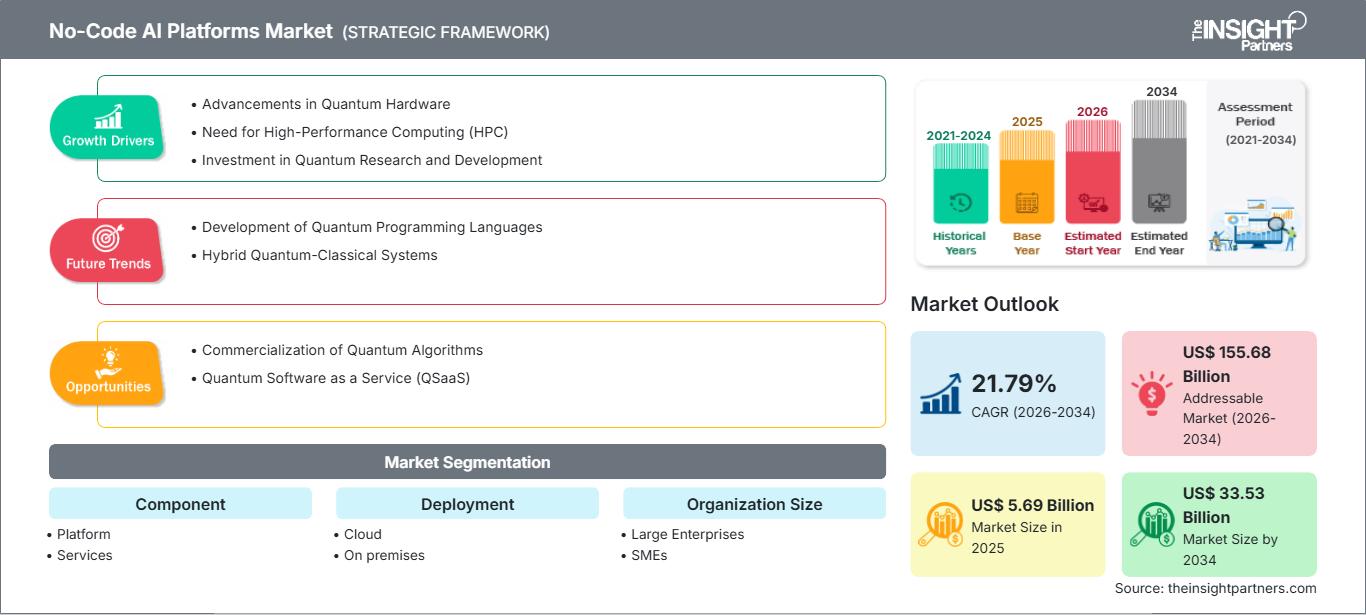
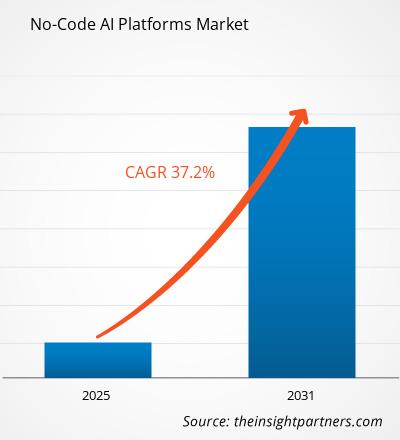
The no-code AI platforms market was valued at US$ 5.69 Billion in 2025 and projected to reach US$ 33.53 Billion by 2034, registering a CAGR of 21.79% between 2026 and 2034. Enterprises seeking faster AI deployment without specialized engineering teams are fueling the expansion of the market.
North America is estimated to grow at a CAGR of 20–22% between 2026 and 2034, propelled by widespread cloud infrastructure maturity and an acute shortage of skilled data science talent. Enterprises across the region are prioritizing visual model-building interfaces to compress deployment timelines and reduce dependency on scarce specialized technical resources.
No-Code AI Platforms Market Assessment and Insights
- North America: Held an estimated 36–40% share in 2025 and is projected to grow at a CAGR of 20–22% between 2026 and 2034, supported by dense enterprise software adoption and cloud maturity.
- US: Contributes the dominant regional share, growing at a CAGR of 20–23% between 2026 and 2034, driven by widespread citizen developer initiatives across mid-market enterprises.
- Europe: Commands an estimated 24–27% share in 2025, expanding at a CAGR of 19–21% between 2026 and 2034, led by Germany, the UK, and France amid digital sovereignty and SME digitalization priorities.
- Asia Pacific: Captured nearly 19–23% share in 2025 and is projected to grow fastest at a CAGR of 23–26% between 2026 and 2034, led by China, India, and Japan through expanding SME digitalization programs.
- Largest Segment: Platform holds an estimated 64–68% share in 2025, growing at a CAGR of 21–23% between 2026 and 2034, reflecting sustained licensing demand across enterprise deployments.
- High Growth Segment: Cloud deployment is projected to grow at a CAGR of 23–25% between 2026 and 2034, driven by scalability preferences and reduced infrastructure ownership costs.
- Key companies analyzed in detail: Amazon.com, Inc., Microsoft Corporation, Google LLC, Apple Inc., Caspio, Inc., DataRobot, Inc., Clarifai, Inc., Quickbase, Inc., Levity AI GmbH, Akkio Inc.
Source: The Insight Partners' analysis based on proprietary research, government publications, company annual reports, investor presentations, industry databases, and expert interviews.
Early no-code AI tools centered on simple workflow automation and basic predictive modeling accessible to business analysts without programming expertise. Production dynamics have since evolved toward sophisticated visual interfaces supporting natural language processing, computer vision, and generative AI model integration, contributing to the growth of the No-Code AI Platforms Market size. Vendors have progressively embedded pre-trained models and drag-and-drop pipeline builders, enabling non-technical users to deploy production-grade applications, fundamentally reshaping how enterprises approach application development and internal automation initiatives across departments.
Prospects for future adoption include an increasing adoption base not only within North America and Western Europe but also in Southeast Asia, Latin America, and the Gulf region as well as increased speed of digitalization of SMEs. There is a focus on AI explainability, which will drive suppliers to develop products that can achieve this. Inflows of investments into platforms for citizen development are healthy, suggesting continued innovation.
No-Code AI Platforms Market Report Scope
| Report Attribute | Details |
|---|---|
| Market size in 2025 | US$ 5.69 Billion |
| Market Size by 2034 | US$ 33.53 Billion |
| Global CAGR (2026 - 2034) | 21.79% |
| Historical Data | 2021-2024 |
| Forecast period | 2026-2034 |
No-Code AI Platforms Market Analysis
No-code AI platforms market growth is closely tied to persistent shortages of skilled AI engineering talent, compelling enterprises to empower business users with visual development tools. Retail, healthcare, and finance organizations are utilizing no-code platforms to develop predictive models, bots, and document processing systems to reduce reliance on centralized data science teams and speed up deployment time for automation projects.
The environment comprises cloud hyperscalers embedding AI builder no-code features in their entire platform suite, providers who offer services only around citizen development, and application platforms expanding their existing low-code platforms by adding AI features. The supply side benefits those who offer pre-configured templates and specific connectors, given that businesses need a quicker deployment time than customized solutions.
The competitive landscape has been upped as Amazon.com, Microsoft, and Google have been integrating no-code AI building features directly within their cloud ecosystem, whereas DataRobot and Clarifai are expanding their ML automation platforms toward greater enterprise adoption. This no-code AI platforms market analysis underscores the differentiation of Caspio, Quickbase, Levity AI, and Akkio through vertical-specific templates and simplified onboarding processes for their SME clients.
There remains a significant presence of specialized companies that continue to expand the integration of their solutions within enterprises. The ability to compete in the market is reliant on having the right template libraries, compliance and governance tools, and pricing schemes that are flexible enough to serve both enterprises and SMEs.
● REPORT CUSTOMIZATION
Tailor This Report To Align With Your Specific Business Requirements
This report can be customized to align precisely with your business objectives, scope, and target markets. Customization options include tailored segmentation, geography, competitive analysis, and strategic insights to support informed decision-making.
Customize This Report →WHAT YOU CAN ADJUST
- ● Segmentations
- ● Geography
- ● Competitive Analysis
- ● Language Preferences
No-Code AI Platforms Market: Strategic Insights
Regional Insights
North America No-Code AI Platforms Market
North America held an estimated 36–40% share of the global no-code AI platforms market in 2025, supported by mature cloud infrastructure, high enterprise software spending, and a dense concentration of both hyperscale providers and specialized citizen development vendors headquartered across the region.
The region is projected to expand at a CAGR of 20–22% between 2026 and 2034, driven by persistent technical talent shortages, growing SME adoption of automation tools, and expanding integration of no-code AI builders within customer service, marketing, and internal operations workflows across the United States and Canada.
U.S. No-Code AI Platforms Market
The United States represents the dominant contributor to North American revenue, estimated at 84–87% of the regional total in 2025, reflecting concentrated enterprise software adoption, extensive hyperscale cloud presence, and a dense base of specialized vendors headquartered domestically across major technology hubs, supporting growth in the No-Code AI Platforms Market share.
Growth is projected at a CAGR of 20–23% between 2026 and 2034, propelled by expanding citizen developer programs across mid-market enterprises. Company presence remains strong, with Amazon.com, Microsoft, Google, and DataRobot maintaining significant domestic engineering operations, while application trends increasingly favor embedded generative AI capabilities within existing business software suites.
Europe No-Code AI Platforms Market
Europe accounted for an estimated 24–27% share of the global no-code AI platforms market in 2025, with adoption shaped by SME digitalization initiatives and enterprise modernization programs spanning manufacturing, retail, and financial services across the continent.
Germany led regional adoption, contributing an estimated 27–30% share within Europe in 2025, supported by strong manufacturing automation investment. The UK followed closely, driven by financial services innovation and fintech ecosystem expansion. France, Italy, and Spain collectively contributed a growing share, reflecting expanding cloud adoption among mid-sized enterprises. The region is projected to grow at a CAGR of 19–21% between 2026 and 2034, with Germany remaining the leading national market.
APAC No-Code AI Platforms Market
Asia Pacific held an estimated 19–23% share of the global no-code AI platforms market in 2025 and is projected to expand at the fastest regional CAGR of 23–26% between 2026 and 2034, led by China through large-scale SME digitalization and government-backed technology adoption programs.
While India came up as the high-growth performer backed by increased use of IT services, Japan and South Korea were responsible for stable enterprise demand due to manufacturing modernization. Australia made incremental demand contribution owing to digitalization in its financial services, with China holding the top spot among countries.
Middle East & Africa No-Code AI Platforms Market
The Middle East and Africa region is projected to expand at a CAGR of 19–21% between 2026 and 2034, with Saudi Arabia and the UAE leading adoption through national innovation strategies, sovereign digital investment funds, and expanding enterprise cloud migration supporting government and financial sector modernization, according to the No-Code AI Platforms Market report.
South Africa contributed steady demand through financial services and retail digitalization, while the Rest of the MEA region reflected early-stage adoption tied to telecommunications and public sector modernization initiatives. Saudi Arabia remained the leading national contributor, supported by sustained infrastructure and economic diversification investment programs.
Segmentation Analysis
Component
Component segmentation is projected to grow at a CAGR of 21–23% between 2026 and 2034, reflecting the no-code AI platforms market scope extending across platform licensing and professional services. Platform revenue dominates given sustained subscription-based adoption, while services demand rises as enterprises require onboarding support, custom template development, and integration assistance for production deployments.
- Platform: Core visual development environments remain the primary revenue contributor, favored for accessibility, pre-built templates, and direct integration with enterprise business applications and data systems.
- Services: Implementation, training, and consulting services support enterprises navigating onboarding, workflow customization, and integration with existing operational technology stacks.
Deployment
The Deployment segment in the No-Code AI Platforms Market is estimated to expand at a CAGR of 22–24% between 2026 and 2034, with cloud deployment emerging as the dominant and fastest-growing mode. On-premises deployment persists among regulated industries requiring stringent data control, though cloud adoption continues capturing incremental share across enterprise and SME segments alike.
- Cloud: Cloud-hosted platforms dominate new deployments, favored for scalability, reduced infrastructure ownership, and faster implementation timelines across enterprise and SME customers.
- On premises: On-premises deployment remains relevant among regulated industries requiring strict data residency control, particularly within government and financial services environments.
Organization Size
Organization Size segmentation is projected to grow at a CAGR of 21–23% between 2026 and 2034, with SMEs representing the faster-growing category as accessible pricing models lower adoption barriers. Large Enterprises continue contributing substantial revenue through broad platform deployments spanning multiple departments and use cases requiring governance controls.
- Large Enterprises: Large organizations deploy platforms across multiple departments, prioritizing governance, security controls, and integration with existing enterprise resource planning systems.
- SMEs: Small and medium enterprises increasingly adopt no-code platforms due to accessible pricing, rapid deployment, and reduced dependency on specialized technical staff.
End Users
End Users segmentation is estimated to expand at a CAGR of 21–24% between 2026 and 2034, with Retail and E-commerce and BFSI verticals driving substantial deployment volumes. Healthcare adoption is accelerating fastest as diagnostic support and administrative automation use cases scale across provider networks and payer organizations.
- IT and Telecom: Technology and telecom providers integrate no-code AI into internal operations and customer-facing service automation, supporting scalable deployment across large user bases.
- Healthcare: Providers and payers leverage no-code platforms for administrative automation, patient triage support, and diagnostic workflow assistance requiring minimal technical overhead.
- Manufacturing: Manufacturers apply no-code AI for quality inspection, predictive maintenance, and supply chain forecasting without dedicated data science teams.
- Retail and E-commerce: Retailers deploy no-code platforms for demand forecasting, personalization, and inventory optimization across omnichannel operations.
- Government: Public sector agencies utilize no-code AI for citizen service automation and administrative process streamlining under constrained technical budgets.
- BFSI: Financial institutions apply no-code platforms for fraud detection, customer service automation, and credit risk scoring within compliance-constrained environments.
Opportunity Snapshot
| End Users | Revenue Contribution | Trend Tag | Adoption Stage |
| IT and Telecom | High | Service Automation | Mature |
| Healthcare | Medium | Diagnostic Support | Emerging |
| Manufacturing | Medium | Predictive Maintenance | Scaling |
| Retail and E-commerce | High | Demand Forecasting | Scaling |
| Government | Low | Citizen Services | Emerging |
| BFSI | High | Fraud Detection | Mature |
No-Code AI Platforms Market Growth Drivers and Impact Analysis
Persistent Shortage of Skilled AI Development Talent
The worldwide shortage of skilled data scientists and machine learning engineers keeps pushing companies towards visual, user-friendly development platforms that allow business professionals to develop AI solutions regardless of their lack of programming skills. Companies operating in the retail sector, in manufacturing, and in financial services are adopting no-code solutions to cope with backlogs in the development of applications, allowing their business analysts and operational employees to develop predictive models, chatbots, and automation processes. By doing so, these companies become less reliant on central technical teams, shorten the time frame required for deployment from months to weeks, and enable them to scale up automation efforts in multiple departments at once. In view of ongoing shortages in tech workforces around the world, demand for accessible AI development platforms remains robust among different company segments.
Rising Enterprise Automation and Efficiency Mandates
Enterprises experience increasing pressure to reduce operating costs and become more efficient in their processes, which results in the increased adoption of no-code automation platforms that are able to automate repetitive processes in such areas as customer service, document processing, and administrative work. Enterprises recognize the need to have no-code AI platforms that would make it possible to scale up automation efforts without increasing the number of technical employees proportionally. It is especially relevant for medium market enterprises that do not have any data science capabilities. As competition becomes fiercer in various industries, enterprises that pay attention to the efficiency of automation enjoy certain competitive advantages.
Expanding Integration with Enterprise Software Ecosystems
Incorporation of no-code AI platforms into the current ERP, CRM, and collaboration platforms is becoming common, minimizing obstacles for companies that want to implement AI technologies in their usual business operations environment. Adoption of no-code AI solutions by businesses unwilling to purchase standalone AI technologies has increased due to the incorporation of intelligent automation into the tools already used on a daily basis. Providers offering an expansion of connector libraries and integration with various platforms, like customer service systems and data warehouses, have gained much attention from enterprises. The more integration becomes available, the more benefits can be obtained from implementation, which increases the case for no-code AI platform adoption.
No-Code AI Platforms Market Future Trends
Generative AI Embedded Within No-Code Interfaces
Emerging no-code AI platforms market trends indicate accelerating integration of generative AI capabilities directly within visual development environments, enabling users to build applications leveraging large language models without technical configuration. Vendors are increasingly embedding natural language prompting interfaces that translate plain-language descriptions into functional automation workflows. This trend simplifies application development further, extending accessibility beyond current citizen developer audiences toward general business users. Over the coming years, expect deeper integration between foundation model providers and no-code platform vendors, reshaping competitive differentiation around generative capability depth, prompt engineering assistance, and output quality control mechanisms embedded within platform interfaces.
Governance and Compliance Automation Becomes Standard
With growing adoption of no-code AI within highly regulated industries, there is an increasing trend towards incorporating automated governance capabilities such as audit logs, bias identification, and compliance reports within the development platforms themselves. These developments help mitigate rising enterprise-level concerns about unregulated usage of AI by business personnel who do not have any proper governance. It can be anticipated that there will be increasing incorporation of compliance capabilities within no-code AI platforms to address data protection laws and accountability norms within financial services, healthcare, and governmental domains.
No-Code AI Platforms Market Opportunities
Vertical-Specific Template Libraries
Substantial opportunity exists for vendors developing pre-configured, industry-specific template libraries tailored to healthcare, financial services, and manufacturing workflows requiring specialized compliance and domain expertise. Current no-code AI platforms market forecasts suggest accelerating demand for ready-to-deploy solutions addressing sector-specific regulatory requirements and operational patterns. The vendors who are offering solutions on healthcare diagnosis templates and BFSI fraud detection templates can get high-end enterprise contracts that have specific certification requirements for their solutions. This situation is best for those vendors who are offering solutions with both their core no-code solution capability and specific knowledge about the industry to which their solution is being sold.
SME Market Expansion Through Accessible Pricing Models
An excellent opportunity arises for the adoption of no-code AI platforms by SMEs via pricing simplification and lower requirements for technical onboarding. Vendors offering easy access options can generate substantial revenues from the latent demand of firms that were unable to adopt AI because of cost and complexity issues. The opportunity is especially relevant in emerging markets of Southeast Asia and Latin America where government policies supporting SME digitalization have been put into place. Early moves towards simpler pricing and region-specific pricing strategies will enable vendors to earn outsize revenues in the future when enterprise adoption of AI becomes more widespread than just in large firms.
Frequently Asked Questions

- Comprehensive Market Sizing and Forecast Analysis
- Detailed Segmentation Analysis
- In-Depth Market Dynamics Assessment
- Regional and Country-Level Insights
- Competitive Landscape and Company Benchmarking
- Strategic Business Intelligence
Recent Reports
Testimonials

The Insight Partners' SCADA System Market report is comprehensive, with valuable insights on current trends and future forecasts. The team was highly professional, responsive, and supportive throughout. We are very satisfied and highly recommend their services.
RAN KEDEM Partner, Reali Technologies LTDs
I requested a report on a very specific software market and the team produced the report in a few days. The information was very relevant and well presented. I then requested some changes and additions to the report. The team was again very responsive and I got the final report in less than a week.
JEAN-HERVE JENN Chairman, Future Analytica
We worked with The Insight Partners for an important market study and forecast. They gave us clear insights into opportunities and risks, which helped shape our plans. Their research was easy to use and based on solid data. It helped us make smart, confident decisions. We highly recommend them.
PIYUSH NAGPAL Sr. Vice President, High Beam Global
The Insight Partners delivered insightful, well-structured market research with strong domain expertise. Their team was professional and responsive throughout. The user-friendly website made accessing industry reports seamless. We highly recommend them for reliable, high-quality research services
YUKIHIKO ADACHI CEO, Deep Blue, LLC.
This is the first time I have purchased a market report from The Insight Partners.While I was unsure at first, I visited their web site and felt more comfortable to take the risk and purchase a market report.I am completely satisfied with the quality of the report and customer service. I had several questions and comments with the initial report, but after a couple of dialogs over email with their analyst I believe I have a report that I can use as input to our strategic planning process.Thank you so much for taking the extra time and making this a positive experience.I will definitely recommend your service to others and you will be my first call when we need further market data.
JOHN SUZUKI President and Chief Executive Officer, Board Director, BK Technologies
I wish to appreciate your support and the professionalism you displayed in the course of attending to my request for information regarding to infectious disease IVD market in Nigeria. I appreciate your patience, your guidance, and the fact that you were willing to offer a discount, which eventually made it possible for us to close a deal. I look forward to engaging The Insight Partners in the future, all thanks to the impression you have created in me as a result of this first encounter.
DR CHIJIOKE ONYIA MANAGING DIRECTOR, PineCrest Healthcare Ltd.Reason to Buy
- Informed Decision-Making
- Understanding Market Dynamics
- Competitive Analysis
- Identifying Emerging Markets
- Customer Insights
- Market Forecasts
- Risk Mitigation
- Boosting Operational Efficiency
- Strategic Planning
- Investment Justification
- Tracking Industry Innovations
- Aligning with Regulatory Trends





 Get Free Sample for