
North America Electronically Commutated (EC) Fan Market Growth & Forecast by 2034
Coverage: By Product Type (EC Axial Fans and EC Centrifugal Fans), EC Axial Fans Size (400–630 mm, 631–800 mm, 801–1,000 mm,1,001–1,250 mm, and 1,251–1,500 mm), EC Centrifugal Fans Size (280–355 mm, 356–450 mm, 451–560 mm, and 561–710 mm), End-Use Industry (HVAC and Commercial Buildings, Data Centers, Industrial Manufacturing, Refrigeration and Cold Chain, Energy and Utilities, Transportation, Agriculture and Controlled Environment Agriculture, and Others) and Country
- Status : Published
- Report Code : TIPRE00043636
- Category : Electronics and Semiconductor
- No. of Pages : 154
- Available Report Formats :


- Last update date : August 17, 2026


2025 Market Size
US$ 575.06 Mn
Base year value
2034 Forecast
US$ 948.48 Mn
Projected by 2034
CAGR 2026-2034
5.7 %
Growth rate
Addressable Market
US$ 6,898.74 Mn
(2026-2034)
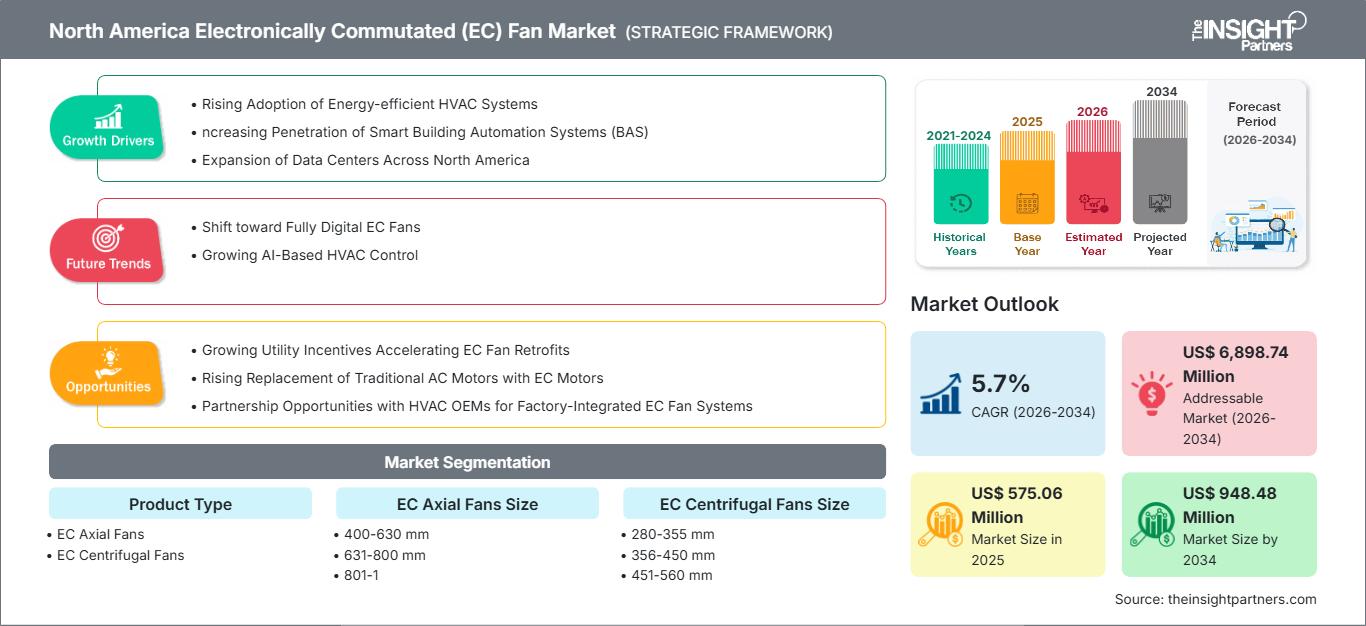
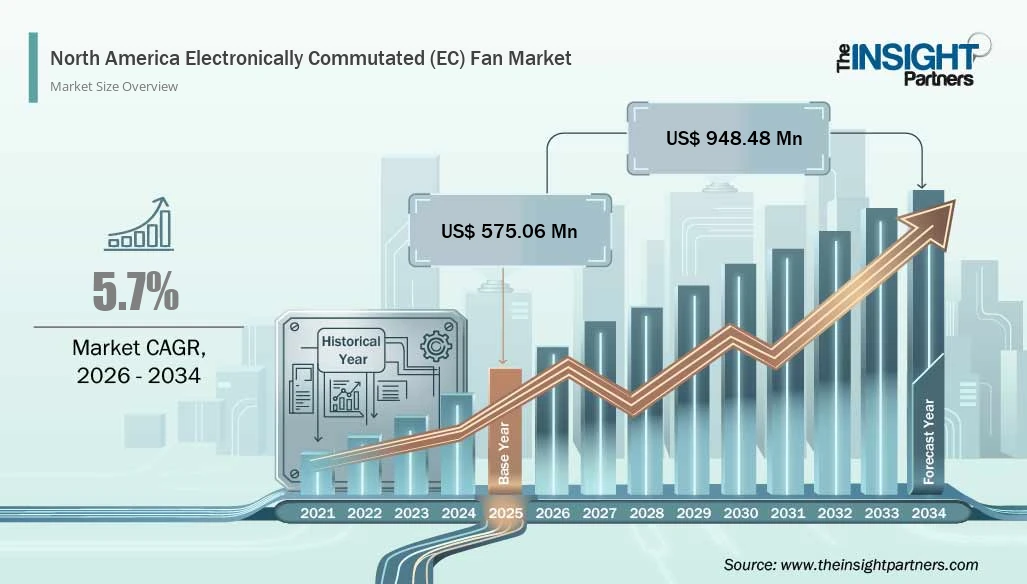
North America Electronically Commutated (EC) Fan Market was valued at US$ 575.06 Million in 2025 and is projected to reach US$ 948.48 Million by 2034, expanding at a CAGR of 5.7% during 2026–2034. The market reflects demand for brushless motor-driven airflow systems that combine variable speed control, lower energy use, quieter operation, and digital monitoring across HVAC, data centers, refrigeration, industrial ventilation, utilities, transportation, and controlled environment agriculture.
Across the region, North America Electronically Commutated (EC) Fan Market size is supported by commercial building efficiency upgrades, hyperscale data center cooling demand, and tighter lifecycle cost evaluation by facility operators.
North America Electronically Commutated (EC) Fan Market Assessment and Insights
- US accounted for 61.2% share of North America in 2025 and is growing at a CAGR range of 6.3% between 2026–2034, supported by commercial HVAC retrofits, data center construction, and cold chain modernization.
- Canada represented 13.6% of North America in 2025 and is growing at a CAGR range of 4.1% between 2026–2034, led by hyperscale cooling, warehouses, and healthcare buildings.
- Mexico captured 25.1% share in 2025 and is growing at a CAGR range of 5.2% between 2026–2034.
- Largest Segment EC Centrifugal Fans held 65.8% market share in 2025 and is growing at a CAGR range of 5.4% between 2026–2034.
- High Growth Segment Data Centers held 20.8% market share in 2025 and is growing at a CAGR range of 7.2% between 2026–2034.
- Key companies analyzed in detail: ebm-papst Group, ZIEHL-ABEGG SE, Rosenberger Hochfrequenztechnik GmbH & Co. KG, Systemair AB, Delta Electronics, Inc., Twin City Fan Companies, Ltd., Multi-Wing Group A/S, FläktGroup Holding GmbH, Continental Fan Manufacturing Inc., and Regal Rexnord Corporation.
Source: The Insight Partners' analysis based on proprietary research, government publications, company annual reports, investor presentations, industry databases, and expert interviews.
Technology migration in the North America Electronically Commutated (EC) Fan Market is moving airflow equipment from fixed-speed AC motors toward integrated EC motor, impeller, and controller assemblies. Commercial air handlers, condensers, fan coils, and refrigeration cabinets increasingly require Modbus, 0–10 V, PWM, and building management connectivity. Production dynamics favor compact radial and axial designs, corrosion-resistant materials, higher ingress protection, and factory-balanced fan modules that reduce installation time while improving airflow repeatability.
Forward demand will be shaped by AI-ready data centers, electrified cold chain assets, low-GWP refrigeration, and building decarbonization programs. Investment in U.S. manufacturing, warehouse automation, and controlled environment agriculture is expanding the installed base for variable speed ventilation. Regulatory tailwinds from energy performance codes and utility efficiency programs will reinforce replacement of inefficient fans, while Mexico and Canada add demand through manufacturing corridors and commercial infrastructure upgrades.
North America Electronically Commutated (EC) Fan Market Report Scope
| Report Attribute | Details |
|---|---|
| Market size in 2025 | US$ 575.06 Million |
| Market Size by 2034 | US$ 948.48 Million |
| CAGR (2026 - 2034) | 5.7% |
| Historical Data | 2021-2024 |
| Forecast period | 2026-2034 |
North America Electronically Commutated (EC) Fan Market Analysis
Demand drivers in the North America Electronically Commutated (EC) Fan Market growth profile are tied to electricity reduction, thermal reliability, and controllable airflow. EC fans can lower fan energy use materially versus legacy AC motors because they operate efficiently at partial load. Buildings remain a major electricity-consuming asset class, and cooling-intensive facilities are prioritizing fan upgrades to reduce operating expense, noise, and maintenance exposure.
The ecosystem includes motor electronics, impeller engineering, power semiconductors, sensors, air handling OEMs, refrigeration cabinet manufacturers, and retrofit contractors. Supply dynamics are moving toward preconfigured fan grids and digitally addressable modules that simplify commissioning. Buyers increasingly compare lifecycle cost, harmonic performance, service access, and compliance readiness rather than only first cost, which supports premium positioning for validated EC axial and centrifugal fan assemblies.
Competitive intensity is high because the North America Electronically Commutated (EC) Fan Market analysis spans global motor specialists, HVAC fan manufacturers, and thermal management suppliers. ebm-papst Group and ZIEHL-ABEGG SE compete on aerodynamics, EC motor efficiency, and digital controls, while Delta Electronics, Inc. addresses data center thermal management. Systemair AB, FläktGroup Holding GmbH, and Continental Fan Manufacturing Inc. strengthen HVAC channel reach.
Investment trends favor compact high-static-pressure fans, active power factor correction, vibration monitoring, and cloud-enabled predictive maintenance. Twin City Fan Companies, Ltd., Multi-Wing Group A/S, Regal Rexnord Corporation, and Rosenberger Hochfrequenztechnik GmbH & Co. KG support the broader value chain through engineered fans, impellers, power transmission, and connectivity components. Strategic positioning depends on validated reliability, North American distribution, fast customization, and compliance with customer procurement standards.
● REPORT CUSTOMIZATION
Tailor This Report To Align With Your Specific Business Requirements
This report can be customized to align precisely with your business objectives, scope, and target markets. Customization options include tailored segmentation, geography, competitive analysis, and strategic insights to support informed decision-making.
Customize This Report →WHAT YOU CAN ADJUST
- ● Segmentations
- ● Geography
- ● Competitive Analysis
- ● Language Preferences
North America Electronically Commutated (EC) Fan Market: Strategic Insights
Regional Insights
North America Electronically Commutated (EC) Fan Market Country Insights
U.S. Electronically Commutated (EC) Fan Market
The U.S. accounted for 61.2% of North America in 2025 and is projected to grow at a CAGR range of 6.3% from 2026–2034. Demand is concentrated in hyperscale data centers, hospitals, laboratories, supermarkets, cold warehouses, and high-efficiency office buildings. Large installed bases of air handling units and rooftop systems create recurring retrofit opportunities for EC axial and centrifugal fans.
Company presence is strongest through U.S. sales, engineering, and distribution networks supporting rapid replacement and OEM integration. ebm-papst Group, Delta Electronics, Inc., Twin City Fan Companies, Ltd., Continental Fan Manufacturing Inc., and Regal Rexnord Corporation address applications from data center fan walls to commercial ventilation. Application trends include modular cooling, demand-controlled ventilation, lower-noise fan arrays, and predictive maintenance in mission-critical facilities.
Canada Electronically Commutated (EC) Fan Market
Canada held an estimated 13.6% share in 2025 and is forecast to grow at a CAGR range of 4.1% through 2034. The country’s market expansion is supported by rising demand for energy-efficient HVAC systems, data center infrastructure, commercial building upgrades, and industrial ventilation solutions. Ontario and Quebec lead adoption due to strong construction activity, manufacturing presence, and increasing investments in green buildings and electrification-focused HVAC modernization.
Canada’s stringent energy efficiency standards and climate conditions also encourage the adoption of high-performance airflow systems for heating, cooling, and refrigeration applications.
The food processing, warehouse, and retail refrigeration sectors contribute significantly through cold storage modernization and demand for efficient air movement solutions. Canadian manufacturers and distributors increasingly align with North American OEM platforms, with companies such as Regal Rexnord Corporation, Greenheck Fan Corporation, ebm-papst Group, and Systemair AB serving as important reference points for EC fan efficiency, reliability, and acoustic performance in Canadian HVAC and industrial applications.
Mexico Electronically Commutated (EC) Fan Market
Mexico held an estimated 25.1% share in 2025 and is forecast to grow at a CAGR range of 5.2% through 2034. The country’s market growth is driven by expanding manufacturing activity, nearshoring investments, automotive and electronics production, and increasing demand for energy-efficient HVAC and industrial ventilation systems. Northern industrial hubs such as Nuevo León, Coahuila, and Baja California are key contributors due to large-scale factories, warehouses, and logistics facilities requiring advanced airflow management solutions.
Mexico is advancing through data center development, commercial construction, and modernization of industrial facilities that favor electronically commutated (EC) fan technologies for improved energy efficiency and operational control. The food and beverage sector, cold chain expansion, and supermarket refrigeration upgrades are also supporting adoption of high-performance ventilation and air movement systems.
Growing energy efficiency regulations and sustainability initiatives are encouraging businesses to replace conventional motor-driven fans with intelligent, variable-speed solutions. Mexico’s integration with North American manufacturing networks further strengthens demand for globally standardized HVAC components, with companies such as Regal Rexnord Corporation, Greenheck Fan Corporation, ebm-papst Group, Systemair AB, and Ziehl-Abegg SE providing important engineering benchmarks for EC fan efficiency, reliability, and acoustic performance across industrial, commercial, and refrigeration applications.
Segmentation Analysis
Product Type
The North America Electronically Commutated (EC) Fan Market scope across product categories is widening as EC axial fans support high-volume airflow in condensers, chillers, agriculture, and data center fan walls, while EC centrifugal fans serve air handling units, filtration systems, and high-static-pressure commercial ventilation.
- EC Axial Fans remain the largest product type because they deliver high airflow at moderate pressure, making them strategically important for condensers, chillers, fan walls, agriculture, and large ventilation systems.
- EC Centrifugal Fans show strong demand in air handling units, filtration, rooftop systems, and precision cooling where compact size, pressure capability, and controllable airflow improve system design flexibility.
EC Axial Fans Size
Size selection depends on airflow volume, acoustic limits, installation space, and redundancy needs. Larger diameters are favored in chillers, condensers, agriculture, and fan walls, while mid-sized models serve rooftop units, heat pumps, and modular HVAC equipment.
- 400–630 mm fans serve compact HVAC equipment, refrigeration condensers, and modular ventilation units where manageable size, controllable speed, and lower noise support broad replacement demand.
- 631–800 mm fans occupy a balanced position in commercial condensers, rooftop systems, and medium fan arrays, offering strong airflow without excessive installation footprint.
- 801–1,000 mm fans are important in chillers, air-cooled condensers, and data center fan walls where higher airflow, efficiency, and redundancy influence specification decisions.
- 1,001–1,250 mm fans address large industrial ventilation, agriculture, and high-capacity cooling equipment, where direct-drive EC control improves energy use at variable operating loads.
- 1,251–1,500 mm fans remain strategically relevant for very large airflow systems, including controlled environment agriculture and infrastructure ventilation requiring durable impellers and low-speed efficiency.
EC Centrifugal Fans Size
Demand is strongest where systems require higher static pressure, compact depth, and precise airflow modulation. Air handling units, cleanrooms, filtration-heavy HVAC, refrigeration cabinets, and data center CRAH systems increasingly adopt EC centrifugal fans for controllability and lower maintenance.
- 280–355 mm models are used in compact air handlers, refrigeration equipment, and cabinet cooling where space constraints and low-noise operation influence procurement.
- 356–450 mm fans support mid-capacity HVAC systems, laboratory ventilation, and commercial refrigeration, balancing pressure capability, efficiency, and serviceability.
- 451–560 mm fans are important for larger air handling units, filtration systems, and precision cooling applications requiring reliable pressure performance and digital control integration.
- 561–710 mm fans address higher-capacity AHUs and data center cooling systems where modular fan arrays improve redundancy, maintenance access, and airflow balancing.
End-Use Industry
Adoption is led by applications with long operating hours, high energy sensitivity, and demand for predictable airflow. HVAC and commercial buildings provide broad volume, while data centers and refrigeration create premium requirements for redundancy, monitoring, and thermal stability.
- HVAC and Commercial Buildings generate mature demand through rooftop units, air handlers, fan coils, and retrofits where energy savings, acoustics, and building automation compatibility shape replacement decisions.
- Data Centers are scaling rapidly as AI workloads raise cooling density, making EC fans important for fan walls, CRAH units, chillers, and precision airflow management.
- Industrial Manufacturing uses EC fans in process ventilation, equipment cooling, and filtered air systems where uptime, dust tolerance, and controlled airflow support production continuity.
- Refrigeration and Cold Chain depends on EC fans for evaporators, condensers, display cases, and warehouses where electricity cost and product temperature stability directly affect margins.
- Energy and Utilities apply EC fans in power electronics cooling, battery energy storage, substations, and renewable infrastructure where reliability and remote monitoring are strategic.
- Transportation demand comes from rail, electric buses, charging equipment, and transit facilities requiring compact airflow systems, lower noise, and dependable operation.
- Agriculture and Controlled Environment Agriculture uses EC fans for greenhouse, vertical farming, livestock, and storage ventilation where airflow uniformity, humidity control, and electricity savings influence economics.
Opportunity Snapshot
| End-Use Industry | Revenue Contribution | Trend Tag | Adoption Stage |
| HVAC and Commercial Buildings | High | Building Retrofit | Mature |
| Data Centers | High | AI Cooling | Scaling |
| Industrial Manufacturing | Medium | Process Air | Scaling |
| Refrigeration and Cold Chain | High | Cold Storage | Mature |
| Energy and Utilities | Medium | Power Cooling | Scaling |
| Transportation | Medium | Transit HVAC | Emerging |
| Agriculture and Controlled Environment Agriculture | Medium | Greenhouse Air | Scaling |
| Others | Low | Specialty Vent | Emerging |
North America Electronically Commutated (EC) Fan Market Growth Drivers and Impact Analysis
Commercial building efficiency retrofits accelerate replacement
Commercial buildings run ventilation and cooling systems for long operating hours, making fan energy consumption a visible operating cost. EC fans improve part-load efficiency because integrated electronics adjust speed to actual airflow requirements instead of forcing dampers or belts to absorb inefficiency. Facility managers also value quieter operation, lower belt maintenance, and easier commissioning through building automation systems. In the North America Electronically Commutated (EC) Fan Market, this driver shifts replacement decisions from emergency repair toward planned energy retrofit programs. The real-world impact is higher demand for EC axial fans in condensers and rooftops, and EC centrifugal fans in air handlers where pressure, filtration, and comfort control matter.
Data center density raises airflow reliability requirements
AI servers, accelerators, and denser racks are increasing the penalty of unstable airflow. EC fan arrays give operators redundancy, variable speed control, and digital monitoring that help maintain thermal margins without oversizing every cooling component. Data Center Frontier notes that EC fan technology can consume up to 50% less energy than comparable AC fan systems in suitable applications, strengthening the business case for retrofits and new builds. In mission-critical facilities, the driver is not only energy savings but also predictable uptime. The market impact is faster adoption of fan walls, high-static centrifugal blowers, and connected axial fans in CRAH units, chillers, and air handling systems.
Cold chain modernization favors controllable refrigeration airflow
Refrigerated warehouses, supermarkets, food processing plants, and pharmaceutical logistics sites depend on stable temperature distribution. EC fans support these requirements by matching airflow to refrigeration load, reducing heat gain from inefficient motors, and allowing system-level controls to minimize defrost and compressor stress. Low-GWP refrigerants and tighter food safety expectations also increase the value of precise air movement inside evaporators, condensers, and display cases. For the North America Electronically Commutated (EC) Fan Market, this driver expands demand beyond traditional HVAC contractors into refrigeration OEMs and cold chain service networks. The measurable impact is recurring specification of compact EC fans where energy cost, product loss, and uptime are financially linked.
North America Electronically Commutated (EC) Fan Market Future Trends
Connected fan arrays become default in critical cooling
North America Electronically Commutated (EC) Fan Market trends will increasingly center on connected fan arrays that combine airflow redundancy, onboard diagnostics, and remote commissioning. Operators of data centers, laboratories, hospitals, and cold warehouses will prefer modules that report vibration, temperature, speed, pressure, and fault codes before failure affects operations. This trend changes procurement language from fan horsepower toward availability, serviceability, and integration with building or data center infrastructure management systems. Suppliers that package EC fans with communication protocols, cybersecurity-ready controllers, and documented reliability data can move from component selling to system-level thermal performance partnerships.
Active power quality features enter mainstream EC designs
Future EC fan designs will place greater emphasis on power quality, harmonic reduction, and grid compatibility as facilities install larger fan arrays. Active power factor correction, electromagnetic compatibility filtering, and surge protection will become more important in data centers, hospitals, and industrial campuses where electrical stability affects uptime. These features also reduce the need for oversized infrastructure and support cleaner integration with backup power systems. As buyers compare total installed cost, suppliers that combine aerodynamic efficiency with electrical discipline will gain preference in engineered cooling projects.
North America Electronically Commutated (EC) Fan Market Opportunities
Retrofit kits for air handling and refrigeration equipment
Retrofit kits offer a practical investment route because many commercial buildings and refrigeration assets still operate with legacy motors, belts, and fixed-speed fans. Suppliers can create value by packaging EC fans with mounting hardware, controllers, documentation, and commissioning support that reduces contractor risk. The strongest opportunities sit in supermarkets, hospitals, schools, warehouses, and older office buildings where equipment replacement cycles are constrained by capital budgets. For the North America Electronically Commutated (EC) Fan Market, standardized retrofit bundles can shorten payback discussions and convert fragmented replacement demand into repeatable programs across multi-site portfolios.
Data center thermal partnerships with OEMs and operators
Data center cooling creates an opportunity for fan suppliers to work earlier with cooling OEMs, engineering firms, and operators. Rather than selling replacement parts, suppliers can co-design fan walls, EC centrifugal modules, and axial airflow packages around rack density, service access, acoustics, and power quality. Delta Electronics, Inc. has showcased next-generation EC fan cooling solutions for data centers, illustrating how thermal management providers are positioning around high-density workloads. North America Electronically Commutated (EC) Fan Market participants that provide validated airflow data, rapid customization, and digital diagnostics can capture higher-margin specification wins.
Recent Developments
- June 2026: Ziehl-Abegg is investing an additional €90 million in machinery, tooling, and production capacity across Europe, North America, and Asia. The investment is driven by growing global demand for fans used in AI data centers, as well as continued expansion in building ventilation, heat pump, and refrigeration applications. The company is continuing its growth trajectory with one of the largest investment programs in its history. In addition to the capital expenditure already planned, a further €90 million will be allocated to expanding manufacturing capacity worldwide. The additional funding will be used for new machinery, tooling, and production equipment at sites in Europe, the United States, and Asia. The objective is to ensure that the rising demand for energy-efficient fans and drive systems can be met reliably over the long term.
- April 2026: Systemair participates in Nordbygg 2026, showcasing the breadth of its market-leading ventilation portfolio. With product innovations across all areas, the company meets the entire value chain with proven innovation and limitless flexibility — from individual products to complete ventilation solutions. The booth showcases several innovative products designed to simplify system design, installation, and operation while ensuring high reliability and performance. Key highlights include MiniByter, a new renovation unit developed as a direct 1:1 replacement for the existing Bahco Minimaster; advanced remote support through Systemair Access, which enables safer commissioning, optimized operation, and reduced service time; new backflow protection solutions for operating fans to enhance safety and operational stability; axial fans with EC motors that deliver improved energy efficiency, advanced control capabilities, and enhanced performance; and the inclusion of garage fans in the portfolio to address the requirements of infrastructure projects. Together, these innovations demonstrate Systemair’s ability to provide comprehensive ventilation solutions, ranging from individual components to fully integrated systems.
- March 2026: Delta, a global leader in power management and smart green solutions, presents its latest EC axial fan and centrifugal blower offerings at MCE 2026, to be held on 24 - 27 March at Fiera Milano, Italy. Delta’s EC fans enable data center manufacturers to optimize their thermal management and reduce energy consumption while maintaining the highest standards of operational continuity. Compliant with the latest European eco-design rules (ErP 2026), the EC fans further optimize energy efficiency and improve sustainability. Their compliance enables data centers to deploy Delta’s EC fan solutions to underpin the highly efficient architecture needed to meet the demands of energy-hungry technologies such as AI and quantum computing.
Frequently Asked Questions
North America Electronically Commutated (EC) Fan Market: Statistics
MetricValueMarket Size 2025US$ 575.06 MillionMarket Size 2034US$ 948.48 MillionGlobal CAGR (2026–2034)5.7%U.S. Share 202561.2%U.S. CAGR6.3%Canada Share 202513.6%Canada CAGR4.1 %Mexico Share 202525.1%Mexico CAGR5.2 %Largest Segment Share and CAGREC Centrifugal Fans: 65.8% share, 5.5 % CAGRHigh Growth Segment Share and CAGRData Centers: 20.8% share, 7.2% CAGR

- Comprehensive Market Sizing and Forecast Analysis
- Detailed Segmentation Analysis
- In-Depth Market Dynamics Assessment
- Regional and Country-Level Insights
- Competitive Landscape and Company Benchmarking
- Strategic Business Intelligence
Recent Reports
Testimonials

The Insight Partners' SCADA System Market report is comprehensive, with valuable insights on current trends and future forecasts. The team was highly professional, responsive, and supportive throughout. We are very satisfied and highly recommend their services.
RAN KEDEM Partner, Reali Technologies LTDs
I requested a report on a very specific software market and the team produced the report in a few days. The information was very relevant and well presented. I then requested some changes and additions to the report. The team was again very responsive and I got the final report in less than a week.
JEAN-HERVE JENN Chairman, Future Analytica
We worked with The Insight Partners for an important market study and forecast. They gave us clear insights into opportunities and risks, which helped shape our plans. Their research was easy to use and based on solid data. It helped us make smart, confident decisions. We highly recommend them.
PIYUSH NAGPAL Sr. Vice President, High Beam Global
The Insight Partners delivered insightful, well-structured market research with strong domain expertise. Their team was professional and responsive throughout. The user-friendly website made accessing industry reports seamless. We highly recommend them for reliable, high-quality research services
YUKIHIKO ADACHI CEO, Deep Blue, LLC.
This is the first time I have purchased a market report from The Insight Partners.While I was unsure at first, I visited their web site and felt more comfortable to take the risk and purchase a market report.I am completely satisfied with the quality of the report and customer service. I had several questions and comments with the initial report, but after a couple of dialogs over email with their analyst I believe I have a report that I can use as input to our strategic planning process.Thank you so much for taking the extra time and making this a positive experience.I will definitely recommend your service to others and you will be my first call when we need further market data.
JOHN SUZUKI President and Chief Executive Officer, Board Director, BK Technologies
I wish to appreciate your support and the professionalism you displayed in the course of attending to my request for information regarding to infectious disease IVD market in Nigeria. I appreciate your patience, your guidance, and the fact that you were willing to offer a discount, which eventually made it possible for us to close a deal. I look forward to engaging The Insight Partners in the future, all thanks to the impression you have created in me as a result of this first encounter.
DR CHIJIOKE ONYIA MANAGING DIRECTOR, PineCrest Healthcare Ltd.Reason to Buy
- Informed Decision-Making
- Understanding Market Dynamics
- Competitive Analysis
- Identifying Emerging Markets
- Customer Insights
- Market Forecasts
- Risk Mitigation
- Boosting Operational Efficiency
- Strategic Planning
- Investment Justification
- Tracking Industry Innovations
- Aligning with Regulatory Trends





 Get Free Sample for