
NVH Testing Market Growth, Trends & Demand by 2034
Coverage: by Component (Hardware, Software); Application (Environmental Noise, Pass-By-Noise, Noise Mapping, Telecom Testing, Sound Quality, Building Acoustics, Product Vibration, Others); End-User (Automotive and Transportation, Aerospace and Defense, Power Generation, Consumer Electronics, Industrial Equipment, Mining and Metallurgy, Others) , and Geography (North America, Europe, Asia Pacific, and South and Central America)
- Status : Data Released
- Report Code : TIPRE00008031
- Category : Electronics and Semiconductor
- No. of Pages : 150
- Available Report Formats :


- Last update date : October 13, 2026


2025 Market Size
US$ 2.54 Bn
Base year value
2034 Forecast
US$ 4.58 Bn
Projected by 2034
CAGR 2026-2034
6.76 %
Growth rate
Addressable Market
US$ 32.16 Bn
(2026-2034)
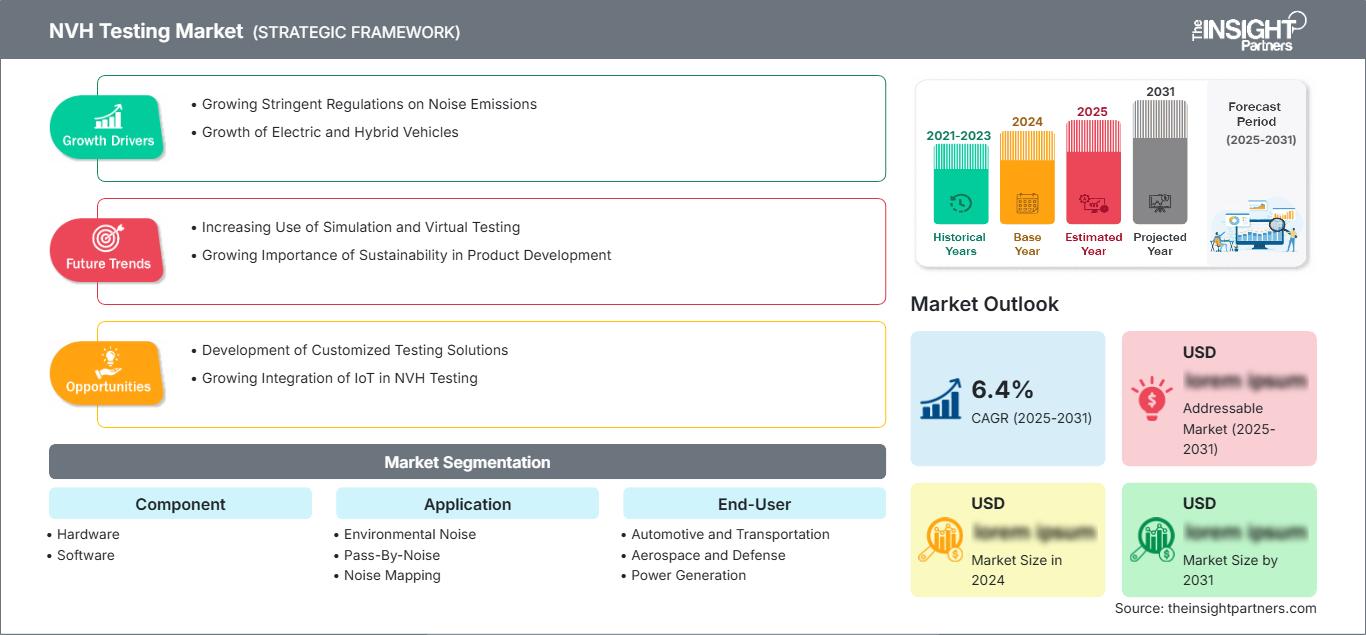
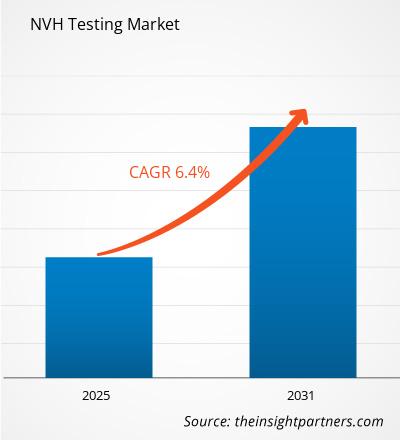
The nvh testing market is projected to expand from US$ 2.54 Billion in 2025 to US$ 4.58 Billion by 2034, registering a CAGR of 6.76% during 2026–2034. The expansion reflects rising requirements for measurable acoustic quality, vibration control, product durability, and regulatory conformity across automotive, aerospace, industrial, electronics, and infrastructure applications. Increasing product complexity is also broadening the role of structured NVH validation throughout development cycles.
Across North America, nvh testing market size is supported by established automotive and aerospace validation programs, expanding electric vehicle development, and sophisticated laboratory infrastructure. A modeled regional CAGR of 6.8–7.4% through 2034 reflects continued spending on automated data acquisition, simulation-linked testing, and higher-frequency measurement for electric drivetrains, aircraft structures, industrial machinery, and connected electronic systems.
NVH Testing Market Assessment and Insights
- North America: The region is expected to hold a 25–28% nvh testing market share in 2025 and grow at a CAGR of 6.8–7.4% between 2026–2034, supported by mature automotive, aerospace, defense, and industrial validation ecosystems.
- US: The US is estimated to represent 75–82% of North American revenue in 2025, expanding at a CAGR of 6.9–7.5% through 2034 through EV, aerospace, and industrial testing programs.
- Europe: Europe is estimated at a 27–30% share in 2025, with a CAGR of 6.0–6.6% through 2034. Germany, the UK, France, Italy, and Spain sustain demand through vehicle acoustics and regulatory testing.
- Asia Pacific: Asia Pacific is estimated at a 37–40% share in 2025 and a CAGR of 7.2–8.0% through 2034, led by China, Japan, South Korea, and India through vehicle production and electronics manufacturing.
- Largest Segment: Automotive and Transportation is estimated at a 45–49% market share in 2025, with a CAGR of 6.7–7.2% through 2034 due to extensive vehicle validation requirements.
- High Growth Segment: Software is estimated at a 32–36% market share in 2025, with a CAGR of 7.0–7.8% through 2034 as simulation and analytics become increasingly integrated.
- Key companies analyzed in detail: AB Dynamics; Brüel & Kjær; Dewesoft d.o.o.; ESI Group; HEAD acoustics GmbH; IMV Corporation; National Instruments; Siemens PLM Software; Signal.X; The Burke Porter Group.
Source: The Insight Partners' analysis based on proprietary research, government publications, company annual reports, investor presentations, industry databases, and expert interviews.
The NVH testing market has seen evolution from separate laboratory testing towards an engineering process which integrates sensors, data collection, analysis, simulations, and automatic validation tools. Whereas hardware continues to be critical for measuring physical phenomena, software is becoming more critical for linking test data to digital engineering frameworks. Electric drive technologies have impacted testing priorities by limiting masking effects of traditional engines, revealing tonal noise of motors, gear whine, electromagnetics, vibration effects, and acoustic interactions that need better understanding.
Future expansion in the nvh testing market is anticipated in new manufacturing hubs like India and Southeast Asia in addition to China, Japan, South Korea, Europe, and North America where investments continue to be made. Requirements for vehicle noise, workplace acoustics, and product safety should keep laboratory expenditures strong, while cloud capabilities and automation of test processes may help decrease complexities involved. Companies that are able to offer solutions that combine measurement, simulation, automation, and industry-specific interpretation will be well-positioned.
NVH Testing Market Report Scope
| Report Attribute | Details |
|---|---|
| Market size in 2025 | US$ 2.54 Billion |
| Market Size by 2034 | US$ 4.58 Billion |
| Global CAGR (2026 - 2034) | 6.76% |
| Historical Data | 2021-2024 |
| Forecast period | 2026-2034 |
NVH Testing Market Analysis
The nvh testing market demand will grow due to stricter acoustic standards, increased electrification, miniaturization, and defect detection needs before mass production. Value chain components include microphones, accelerometers, vibration sensors, signal conditioners, data acquisition units, analysis software, simulators, chambers, test tracks, integration services, and engineering services. The hardware captures the physical response, whereas software transforms the measurement data into engineering decisions. Original equipment manufacturers, tier one suppliers, laboratories, and industrial manufacturers require synchronization of testing in several channels and operation modes. It increases recurrent demand for equipment updates, licensing, calibration, and specialized engineering services.
The supply structure is influenced by the production of specialized sensors, high performance computing, software, and engineering. Differentiation among products is increasingly determined by the number of channels, measurement precision, automation, interoperability, and analysis speed as compared to simple instruments. Thus, the procurement process will shift from isolated instruments to platforms capable of operating both in laboratory and production environment while providing traceability. Vendors with well-developed service capabilities will be able to provide not only equipment but also installation, calibration, training, and application-related engineering services.
Nvh Testing Market Analysis depicts that the market has moderate levels of competition where competitors compete in terms of hardware, software solutions, simulation services, and application skills. AB Dynamics, Brüel & Kjær, Dewesoft d.o.o., and IMV Corporation have dominant market positions in areas such as testing and measurement solutions whereas ESI Group and Siemens PLM Software compete with simulation-based solutions.
The nvh testing market report shows that strategic investments are made by companies to invest in EV motor testing, end of line validations, digital workflow processes, and synchronized measurements. National Instruments provides solutions for test architecture designs and software solutions whereas The Burke Porter Group is engaged in automation of manufacturing tests. Competitors’ positioning trends show the movement towards systems that can shorten development cycles and improve repeatability.
● REPORT CUSTOMIZATION
Tailor This Report To Align With Your Specific Business Requirements
This report can be customized to align precisely with your business objectives, scope, and target markets. Customization options include tailored segmentation, geography, competitive analysis, and strategic insights to support informed decision-making.
Customize This Report →WHAT YOU CAN ADJUST
- ● Segmentations
- ● Geography
- ● Competitive Analysis
- ● Language Preferences
NVH Testing Market: Strategic Insights
Regional Insights
North America nvh testing market
North America is estimated to represent 25–28% of 2025 revenue, with a CAGR of 6.8–7.4% through 2034. Regional demand is largely driven by the U.S., aided by its well-established automotive engineering expertise, aerospace projects, defense acquisitions, automation, and acoustic labs. The growth of electric vehicles is raising the need for high-frequency analysis.
Canada makes its contribution via aerospace, transportation, energy, and industrial equipment testing; and Mexico reaps the benefits of increased automotive production. Procurement in the region shows preference towards systems that integrate measurement equipment with software and validation routines. Engineering competence also allows for premium testing services where traceability, calibration, and documentation are key considerations.
U.S. nvh testing Market
The U.S. represents an estimated 75–82% of North American revenue in 2025 and is projected to grow at a CAGR of 6.9–7.5% through 2034. Demands include those for automotive, aerospace, defense, electronics, power systems, and industrial machinery, with significant suppliers providing extensive validation facilities.
Automobile companies are using NVH in relation to electric vehicles with respect to their motors, drivetrain, cabin, tires, and electronics. Aerospace programs need structural vibrations and acoustics validation in both controlled and operating environments. National Instruments, AB Dynamics, Bruel & Kjaer, Signal.X, and The Burke Porter Group are involved in different parts of the process.
Europe nvh testing Market
According to the nvh testing market forecast, Europe is estimated to account for 27–30% of 2025 revenue and expand at a CAGR of 6.0–6.6% through 2034. Germany is the leader, being enabled by automotive engineering, high-end vehicles development, industrial machines, and acoustic laboratories. The European regulatory structure keeps making noise and vibration validation a key engineering practice.
The United Kingdom continues creating demand for acoustic testing due to aerospace, automotive, rail and manufacturing applications. Germany focuses on car refinement, electric powertrain testing, and production validation. France, Italy and Spain make contributions in automotive, aerospace, transportation and industrial equipment applications. European manufacturers are increasingly adopting the combination of physical testing and simulation for reducing prototype iterations and dealing with vehicle acoustic needs.
APAC nvh testing Market
APAC is estimated at 37–40% of 2025 revenue and is projected to grow at a CAGR of 7.2–8.0%. China is the regional leader in manufacturing automobiles, electric vehicles, electronics, and industrial machinery. Japan and South Korea have advanced engineering ecosystems, and India is developing validation capacity for vehicles and industrial machinery.
Australia is contributing through mining, infrastructure, aviation, and industrial uses. The regional government’s support for electrification and advanced manufacturing is driving more testing requirements. This combination of large-scale manufacturing, increasing R&D spending, and advancing engineering skills in the region make APAC the regional growth engine.
Middle East & Africa nvh testing Market
Middle East and Africa is expected to expand at a modeled CAGR of 5.5–6.3% through 2034. Saudi Arabia and the UAE lead regional investment through transportation infrastructure, industrial diversification, aerospace, energy, and advanced manufacturing initiatives. Demand is increasingly connected with asset reliability and environmental noise assessment.
South Africa remains important for mining, automotive, and industrial applications, while the rest of MEA is developing gradually through infrastructure and energy projects. Testing demand should increase as local production, engineering services, and regulatory capabilities mature, although specialized equipment imports remain significant.
Segmentation Analysis
Component
Component adoption is expected to expand at a CAGR of 6.7–7.4% during 2026–2034. Hardware remains fundamental because sensors and acquisition systems generate the physical measurements required for analysis. Software is gaining strategic importance as manufacturers seek automated interpretation, simulation integration, digital traceability, and faster engineering feedback across complex testing programs.
- Hardware: Hardware remains essential for microphones, accelerometers, signal conditioners, analyzers, shakers, and data acquisition. Demand is strongest where measurement accuracy, channel synchronization, ruggedness, and repeatability directly affect validation quality.
- Software: Software adoption is increasing as engineers integrate simulation, signal processing, automated reporting, visualization, and digital workflows. Its strategic role is expanding because analytical capabilities can reduce physical prototype iterations.
Application
Application demand is projected to develop at a CAGR of 6.4–7.3% during 2026–2034. Application diversity protects demand from dependence on a single industry, while electrification, connected equipment, acoustic regulations, and product reliability requirements increase testing intensity across physical and operational environments.
- Environmental Noise: Environmental noise testing supports compliance, community impact assessment, infrastructure planning, and industrial site evaluation, making standardized measurement and mapping capabilities strategically important for regulated projects.
- Pass-By-Noise: Pass-by-noise testing remains important for vehicle certification and development, requiring controlled tracks, synchronized measurements, repeatable operating conditions, and analysis aligned with changing acoustic requirements.
- Noise Mapping: Noise mapping supports transportation, industrial, urban, and infrastructure planning by converting distributed measurements into spatial acoustic information for mitigation and compliance decisions.
- Telecom Testing: Telecom testing increasingly addresses acoustic performance, device interaction, and communications equipment behavior, supporting reliable audio transmission and performance validation across increasingly compact electronic platforms.
- Sound Quality: Sound quality testing evaluates perceived acoustic characteristics rather than only sound pressure, helping manufacturers distinguish desirable product signatures from unwanted tonal, transient, or broadband noise.
- Building Acoustics: Building acoustics applications assess airborne and structural sound transmission, supporting construction quality, occupant comfort, regulatory compliance, and performance verification across commercial and residential environments.
- Product Vibration: Product vibration testing evaluates structural response, durability, resonance, and operational behavior, supporting design optimization across electronics, machinery, transportation equipment, and engineered products.
End-User
End-User demand is anticipated to grow at a CAGR of 6.5–7.3% during 2026–2034. Automotive and Transportation remains the principal revenue contributor, while aerospace, electronics, industrial equipment, and power generation provide diversified demand. Increasing automation also extends NVH validation closer to manufacturing environments.
- Automotive and Transportation: This segment remains the principal user because vehicle manufacturers require comprehensive acoustic and vibration validation across propulsion systems, cabins, structures, tires, and components throughout development.
- Aerospace and Defense: Aerospace and defense programs require highly controlled structural, propulsion, cabin, and equipment vibration assessment where reliability, fatigue resistance, and acoustic performance directly influence mission and passenger requirements.
- Power Generation: Power generation uses vibration and acoustic testing to identify rotating-equipment abnormalities, resonance, imbalance, and mechanical degradation, supporting reliability and maintenance planning across critical assets.
- Consumer Electronics: Compact electronics increasingly require acoustic characterization for speakers, cooling systems, motors, haptics, and mechanical assemblies, making NVH assessment relevant to perceived product quality and reliability.
- Industrial Equipment: Industrial equipment manufacturers use NVH measurements to validate motors, pumps, compressors, gearboxes, and machinery, combining development testing with condition monitoring and production quality controls.
- Mining and Metallurgy: Mining and metallurgy applications use vibration and acoustic measurements around heavy machinery, crushers, conveyors, mills, and processing equipment, where reliability and structural integrity influence operating continuity.
Opportunity Snapshot
| End-User | Revenue Contribution | Trend Tag | Adoption Stage |
|---|---|---|---|
| Automotive and Transportation | High | EV Acoustics | Mature |
| Aerospace and Defense | Medium | Flight Validation | Mature |
| Power Generation | Medium | Asset Diagnostics | Scaling |
| Consumer Electronics | Medium | Device Acoustics | Scaling |
| Industrial Equipment | Medium | Machine Reliability | Mature |
| Mining and Metallurgy | Low | Heavy Equipment | Scaling |
| Others | Low | Specialized Testing | Emerging |
NVH Testing Market Growth Drivers and Impact Analysis
Electrification Creates New Acoustic and Vibration Validation Requirements
Electric and hybrid propulsion systems change the frequency profile and sources of vehicle noise, creating requirements that differ from conventional engine testing. Reduced engine masking can make motor whine, gear noise, inverter effects, electromagnetic excitation, cooling systems, and tire interaction more noticeable. This increases the need for high-resolution microphones, accelerometers, synchronized acquisition, order analysis, and psychoacoustic evaluation. Manufacturers are therefore expanding testing beyond traditional powertrain measurements toward integrated vehicle sound quality. The commercial impact extends to software providers because larger datasets require faster analysis and repeatable workflows. Suppliers that support multi-domain measurements can capture spending from both development laboratories and production validation. The effect is especially significant for manufacturers introducing multiple electric platforms simultaneously, where standardized testing architectures can improve consistency across vehicle programs.
Stricter Noise Requirements Increase Demand for Traceable Validation
Noise regulations are increasing the importance of repeatable measurements across transportation, industrial equipment, construction, and infrastructure applications. Manufacturers must demonstrate that products remain within prescribed acoustic limits under defined operating conditions, making calibrated equipment and documented testing procedures essential. Pass-by measurements, environmental noise assessments, building acoustics, and source mapping consequently require dependable acquisition and analysis. The commercial impact extends beyond equipment sales because laboratories need calibration, maintenance, software updates, engineering interpretation, and periodic system modernization. Suppliers with established application knowledge can therefore generate recurring revenue from installed systems. Regulatory complexity also favors automated reporting and standardized workflows, particularly when companies operate across multiple countries with different certification processes. This strengthens demand for platforms that combine measurement integrity with efficient compliance documentation.
Integration of Testing and Simulation Shortens Product Development Cycles
Manufacturers increasingly connect physical NVH measurements with simulation environments to identify potential problems earlier in product development. The approach allows engineers to compare modeled behavior with measured responses, investigate transfer paths, and evaluate design alternatives before committing to additional physical prototypes. Its impact is strongest where products involve multiple interacting structures, materials, motors, electronics, and control systems. Integrated workflows can also improve knowledge retention by linking test configurations, measurement data, analysis results, and engineering decisions. Software suppliers therefore gain opportunities to expand from individual analysis applications into broader engineering platforms. Hardware vendors can benefit when their acquisition systems provide reliable interfaces with simulation and automation environments. Over time, this integration should shift purchasing criteria toward interoperability, data management, automation, and analytical depth rather than isolated instrument specifications.
NVH Testing Market Future Trends
AI-Assisted Interpretation Will Reshape NVH Engineering Workflows
The nvh testing market trends indicate that AI-assisted interpretation is likely to become increasingly relevant as NVH systems generate larger multichannel datasets from vehicles, machines, laboratories, and production lines. Future platforms can classify recurring signatures, identify abnormal frequencies, prioritize likely sources, and automate portions of reporting while retaining engineering oversight. The strongest commercial opportunity will come from explainable tools that show why a result was flagged and connect observations with measurable physical conditions. Integration with existing acquisition systems will matter because manufacturers will prefer technologies that improve established workflows rather than require complete laboratory replacement. AI can also support knowledge transfer where experienced acoustic specialists are scarce. Providers that combine signal processing, machine learning, visualization, and engineering context may therefore gain stronger differentiation as customers seek faster decisions without compromising measurement traceability.
Virtual NVH Validation Will Become More Closely Linked With Physical Testing
Virtual validation is expected to become more deeply embedded in development programs as computational models improve and digital engineering environments mature. Rather than replacing physical testing, simulation will increasingly determine which configurations require laboratory confirmation and which can be screened digitally. This can reduce prototype requirements while allowing engineers to investigate a wider design space. Future systems may combine finite-element models, acoustic boundary conditions, experimental modal data, and operational measurements within unified workflows. Cloud-enabled collaboration can further allow geographically distributed engineering teams to access common datasets and test results. The resulting opportunity is particularly relevant for complex products with frequent design revisions, including electric vehicles, aircraft systems, industrial machinery, and consumer electronics. Suppliers that bridge simulation and measurement can strengthen their position in strategic engineering accounts.
NVH Testing Market Opportunities
Customized Testing Platforms for Specialized Product Architectures
Customized testing platforms represent an attractive opportunity because different products generate distinct acoustic and vibration signatures. EV motors, aircraft structures, industrial compressors, electronic cooling systems, and heavy machinery require different sensors, frequency ranges, test conditions, and analysis methods. Providers can capture additional value by configuring modular systems around specific customer workflows rather than selling standardized instruments alone. Engineering services, calibration, application development, and integration can be bundled with hardware and software to create longer customer relationships. The opportunity is particularly relevant for Tier suppliers and specialized manufacturers that may not maintain large internal acoustic engineering teams. Flexible platforms can also support gradual expansion, allowing customers to add channels, sensors, automation, or software capabilities as programs mature. This approach lowers adoption barriers while creating opportunities for recurring upgrades and services.
IoT-Connected Monitoring Can Extend NVH Beyond Development Laboratories
Connected monitoring creates an opportunity to extend NVH technologies from controlled development environments into operating assets. Sensors installed on machinery, transportation systems, production equipment, or infrastructure can collect vibration and acoustic information continuously, enabling manufacturers to identify emerging abnormalities before they become failures. The commercial model can expand from one-time testing toward monitoring subscriptions, analytics services, remote diagnostics, and predictive maintenance support. Integration with industrial IoT platforms is important because customers increasingly expect measurement information to connect with broader asset-management systems. Providers can differentiate through low-noise sensors, edge processing, secure communications, and analytics capable of separating normal operating signatures from developing faults. This opportunity is particularly relevant to industrial equipment, power generation, mining, transportation, and large manufacturing facilities where unplanned downtime can carry substantial operational consequences.
Frequently Asked Questions

- Comprehensive Market Sizing and Forecast Analysis
- Detailed Segmentation Analysis
- In-Depth Market Dynamics Assessment
- Regional and Country-Level Insights
- Competitive Landscape and Company Benchmarking
- Strategic Business Intelligence
Recent Reports
Testimonials

The Insight Partners provided valuable market intelligence that supported our global go-to-market strategy. Their team was professional, responsive, and attentive to our feedback, providing thoughtful analysis and helpful methodological clarifications throughout the project.
Junmo Kim Chief Financial Officer (CFO), Enertech Co., Ltd.
The Insight Partners' SCADA System Market report is comprehensive, with valuable insights on current trends and future forecasts. The team was highly professional, responsive, and supportive throughout. We are very satisfied and highly recommend their services.
RAN KEDEM Partner, Reali Technologies LTDs
I requested a report on a very specific software market and the team produced the report in a few days. The information was very relevant and well presented. I then requested some changes and additions to the report. The team was again very responsive and I got the final report in less than a week.
JEAN-HERVE JENN Chairman, Future Analytica
We worked with The Insight Partners for an important market study and forecast. They gave us clear insights into opportunities and risks, which helped shape our plans. Their research was easy to use and based on solid data. It helped us make smart, confident decisions. We highly recommend them.
PIYUSH NAGPAL Sr. Vice President, High Beam Global
The Insight Partners delivered insightful, well-structured market research with strong domain expertise. Their team was professional and responsive throughout. The user-friendly website made accessing industry reports seamless. We highly recommend them for reliable, high-quality research services
YUKIHIKO ADACHI CEO, Deep Blue, LLC.
This is the first time I have purchased a market report from The Insight Partners.While I was unsure at first, I visited their web site and felt more comfortable to take the risk and purchase a market report.I am completely satisfied with the quality of the report and customer service. I had several questions and comments with the initial report, but after a couple of dialogs over email with their analyst I believe I have a report that I can use as input to our strategic planning process.Thank you so much for taking the extra time and making this a positive experience.I will definitely recommend your service to others and you will be my first call when we need further market data.
JOHN SUZUKI President and Chief Executive Officer, Board Director, BK Technologies
I wish to appreciate your support and the professionalism you displayed in the course of attending to my request for information regarding to infectious disease IVD market in Nigeria. I appreciate your patience, your guidance, and the fact that you were willing to offer a discount, which eventually made it possible for us to close a deal. I look forward to engaging The Insight Partners in the future, all thanks to the impression you have created in me as a result of this first encounter.
DR CHIJIOKE ONYIA MANAGING DIRECTOR, PineCrest Healthcare Ltd.Reason to Buy
- Informed Decision-Making
- Understanding Market Dynamics
- Competitive Analysis
- Identifying Emerging Markets
- Customer Insights
- Market Forecasts
- Risk Mitigation
- Boosting Operational Efficiency
- Strategic Planning
- Investment Justification
- Tracking Industry Innovations
- Aligning with Regulatory Trends





 Get Free Sample for