
Offset Printing Market Size, Growth & Demand by 2034
Coverage: By Product Type (Sheet-fed Offset Printing Press, Web-fed Offset Printing Press); Application (Newspapers, Magazines, Banknotes, Packaging, Marketing Material, Stationary, Others); End User (Commercial Offset Printing Press, Industrial Offset Printing Press, Others) , and Geography (North America, Europe, Asia Pacific, and South and Central America)
- Status : Data Released
- Report Code : TIPRE00023910
- Category : Electronics and Semiconductor
- No. of Pages : 150
- Available Report Formats :


- Last update date : October 13, 2026


2025 Market Size
US$ 2.87 Bn
Base year value
2034 Forecast
US$ 4.31 Bn
Projected by 2034
CAGR 2026-2034
4.62 %
Growth rate
Addressable Market
US$ 32.59 Bn
(2026-2034)
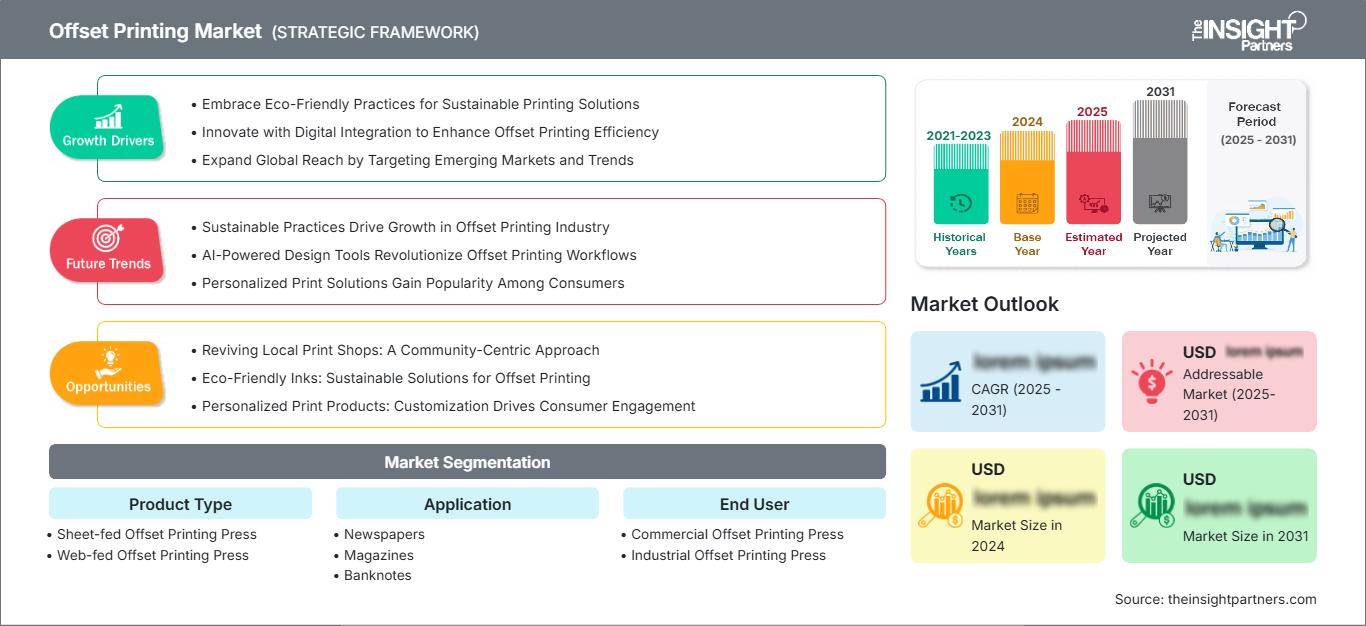
The offset printing market was valued at US$ 2.87 Billion in 2025 and is projected to reach US$ 4.31 Billion by 2034, registering a CAGR of 4.62% during 2026–2034. The market continues to play a significant role in commercial and industrial printing by delivering consistent print quality, cost efficiency for high-volume production, and compatibility with a broad range of substrates. Continued demand from packaging, publishing, and security printing applications supports stable market expansion despite the increasing adoption of digital printing technologies.
Across North America, the industry benefits from sustained investments in packaging production, premium commercial printing, and modernization of print infrastructure. The offset printing market size in the region continues to expand as manufacturers adopt automated press technologies, AI-enabled workflow management, and energy-efficient production systems. The regional market is estimated to grow at a CAGR of 3.8–4.5% during 2026–2034, supported by rising demand for high-quality folding cartons, labels, and marketing materials across the United States and Canada.
Offset Printing Market Assessment and Insights
- North America: Accounted for an estimated 32–36% share in 2025 and is projected to grow at a CAGR of 3.8–4.5% during 2026–2034. Growth is supported by advanced printing infrastructure, automation investments, and increasing demand for premium packaging and commercial print applications.
- US: Represented approximately 74–78% of the North American market in 2025 and is expected to register a CAGR of 3.9–4.6% during 2026–2034, driven by strong packaging production, publishing activities, and continued investment in automated offset printing equipment.
- Europe: Held an estimated 28–31% share in 2025 and is anticipated to expand at a CAGR of 3.7–4.3% during 2026–2034. Germany, the UK, Italy, and France remain major contributors owing to their established printing industries and advanced manufacturing capabilities.
- Asia Pacific: Accounted for approximately 25–29% share in 2025 and is forecast to record the highest CAGR of 5.4–6.1% during 2026–2034. China, Japan, India, and South Korea continue to invest in packaging production and commercial printing modernization.
- Largest Segment: Packaging accounted for an estimated 37–41% market share in 2025 and is projected to grow at a CAGR of 5.0–5.7% during 2026–2034, supported by expanding consumer goods, food and beverage, and pharmaceutical packaging requirements.
- High Growth Segment: Sheet-fed Offset Printing Press represented approximately 54–58% market share in 2025 and is expected to expand at a CAGR of 5.3–6.0% during 2026–2034, driven by increasing adoption for premium packaging, commercial graphics, and short-to-medium production runs requiring superior print quality.
- Key companies analyzed in detail: Autoprint Machinery Manufacturers Pvt. Ltd., Haverer Group, Heidelberger Druckmaschinen AG, KOMORI Corporation, Mitsubishi Heavy Industries, Ltd., Ronald Web Offset, Rotatek, Ryobi Limited, Webtech Engineering Private Limited, Zhejiang Zhongte Machinery Technology Co., Ltd.
Source: The Insight Partners' analysis based on proprietary research, government publications, company annual reports, investor presentations, industry databases, and expert interviews.
Growing demand for premium-quality printed materials, sustainable packaging, and automated production has reshaped the competitive landscape of the offset printing industry over the past decade. Manufacturers have responded by integrating digital workflow management, AI-assisted color calibration, predictive maintenance, and energy-efficient press technologies into conventional offset systems. Packaging applications have increasingly compensated for declining newspaper circulation, while improvements in press speed, waste reduction, and substrate flexibility have enhanced production efficiency. These developments continue to strengthen the offset printing market growth trajectory across commercial, industrial, and specialty printing applications despite increasing competition from digital printing technologies.
In terms of future trends, investments will continue to be made in high-growth economies of Asia Pacific, the Middle East, and certain Latin American countries due to growth in manufacturing activity and consumer packaging requirements, which drive print volume increases. Regulations that favor the use of low-VOC inks, recyclable materials, and energy-efficient processes will affect capital investments in printing service companies. Technology such as automation, cloud-enabled production management systems, and smart factory concepts will drive efficiency.
Offset Printing Market Report Scope
| Report Attribute | Details |
|---|---|
| Market size in 2025 | US$ 2.87 Billion |
| Market Size by 2034 | US$ 4.31 Billion |
| Global CAGR (2026 - 2034) | 4.62% |
| Historical Data | 2021-2024 |
| Forecast period | 2026-2034 |
Offset Printing Market Analysis
The market continues to benefit from stable demand across packaging, security printing, and commercial printing applications where high-volume production and consistent image quality remain essential. The offset printing market analysis indicates that packaging converters increasingly prefer offset technology for folding cartons, labels, and premium retail packaging because of its excellent color consistency, broad substrate compatibility, and competitive operating costs for medium- to long-run production. Advancements in plate technology, UV curing technology, and press control systems have contributed more to productivity while at the same time cutting down on the time needed for setup and wastage of materials.
Those who operate in the supply chain are increasingly concentrating on local manufacturing, after-market services, consumable products, and digitized processes in order to build stronger ties with the clients and improve equipment productivity. The suppliers of raw materials are also working on developing environmentally friendly inks, coatings, and printing plates that would meet the requirements of sustainable development.
Competition will be marked by the constant development of new products, collaboration, geographical expansion, and the use of automation. Top firms such as Heidelberger Druckmaschinen AG, KOMORI Corporation, Mitsubishi Heavy Industries, Ltd., Rotatek, Ryobi Limited, Ronald Web Offset, Zhejiang Zhongte Machinery Technology Co., Ltd., and Autoprint Machinery Manufacturers Pvt. Ltd. are expanding their product ranges by developing state-of-the-art presses that will support packaging and commercial printing applications. The focus of these companies on increased efficiency and energy savings makes them stand out in this mature industry.
Capital investment increasingly targets automation, hybrid production environments, and sustainable manufacturing capabilities. Equipment suppliers are expanding service networks, training programs, and lifecycle support to improve customer retention while enabling print service providers to maximize return on investment. Strategic collaborations between machinery manufacturers, software developers, and consumable suppliers are fostering integrated production ecosystems capable of delivering higher productivity, improved quality control, and reduced environmental impact across diverse printing applications.
● REPORT CUSTOMIZATION
Tailor This Report To Align With Your Specific Business Requirements
This report can be customized to align precisely with your business objectives, scope, and target markets. Customization options include tailored segmentation, geography, competitive analysis, and strategic insights to support informed decision-making.
Customize This Report →WHAT YOU CAN ADJUST
- ● Segmentations
- ● Geography
- ● Competitive Analysis
- ● Language Preferences
Offset Printing Market: Strategic Insights
Regional Insights
North America Offset Printing Market
North America accounted for an estimated 32–36% of the offset printing market share in 2025 and continues to represent one of the most technologically advanced printing equipment markets globally. Demand is supported by the strong presence of packaging converters, commercial printing companies, and security printing facilities. Investments in automation, AI-enabled workflow software, and sustainable printing solutions are encouraging the replacement of aging presses with high-productivity offset systems. The region is expected to register a CAGR of 3.8–4.5% during 2026–2034, supported by stable packaging demand and modernization across commercial printing operations.
Growth is also supported by rising demand for premium folding cartons, pharmaceutical packaging, and high-quality promotional materials. Print manufacturers continue to adopt energy-efficient equipment, low-VOC inks, and automated inspection systems to comply with environmental regulations while improving productivity. Increasing investment in smart manufacturing technologies and digital production planning further strengthens the long-term competitiveness of offset printing facilities throughout North America.
U.S. Offset Printing Market
The United States represented approximately 74–78% of the North American Offset Printing Market in 2025 and remains the region's largest production and consumption center for offset printing equipment. The market is projected to grow at a CAGR of 3.9–4.6% during 2026–2034, supported by large-scale commercial printing operations, packaging manufacturers, and security document production. Strong adoption of automated press technologies and workflow optimization continues to improve operational efficiency across the industry.
Packaging remains the dominant application due to expanding food, beverage, pharmaceutical, and consumer goods manufacturing. Commercial printers are increasingly investing in hybrid production environments that combine offset and digital printing capabilities to improve flexibility and reduce turnaround time. The presence of leading technology suppliers, established distribution networks, and continuous capital investment reinforces the country's leadership within the regional market.
Europe Offset Printing Market
Europe accounted for an estimated 28–31% of the Offset Printing Market share in 2025 and is expected to expand at a CAGR of 3.7–4.3% during 2026–2034. Germany continues to lead the regional market owing to its globally recognized printing machinery manufacturing industry and strong adoption of automated production technologies. The United Kingdom maintains significant demand for commercial publishing, premium packaging, and marketing materials, while sustainability initiatives continue influencing equipment upgrades and ink selection across printing companies.
France, Italy, and Spain collectively contribute substantial demand through food packaging, luxury product packaging, publishing, and industrial printing applications. Italian manufacturers remain recognized for specialized printing equipment, while Spain continues investing in packaging production driven by food exports. Regional companies increasingly prioritize energy-efficient machinery, recyclable substrates, and environmentally compliant printing processes, supporting steady modernization throughout the European printing industry.
APAC Offset Printing Market
Asia Pacific accounted for approximately 25–29% of the global Offset Printing Market in 2025 and is projected to record the highest regional CAGR of 5.4–6.1% during 2026–2034. China leads regional demand owing to its extensive packaging manufacturing base, while Japan continues investing in advanced printing technologies and precision manufacturing.
India, South Korea, and Australia are experiencing rising investments in commercial printing and consumer packaging production. Government support for manufacturing expansion, increasing retail consumption, and growing exports of packaged products continues to encourage the adoption of modern offset printing equipment throughout the region.
Middle East & Africa Offset Printing Market
The Middle East & Africa Offset Printing Market is expected to register a CAGR of 4.2–4.8% during 2026–2034. Saudi Arabia and the United Arab Emirates continue investing in packaging, publishing, and commercial printing capacity as industrial diversification initiatives stimulate demand for locally produced printed materials and packaging solutions.
South Africa remains the largest printing market in Sub-Saharan Africa, supported by commercial publishing and packaging production. The rest of the region is gradually adopting automated printing technologies as investments in manufacturing infrastructure, logistics, and consumer goods industries continue to expand demand for high-quality printed packaging and commercial applications.
Segmentation Analysis
Product Type
The Product Type segment is projected to expand at a CAGR of 4.8–5.4% during 2026–2034. The offset printing market scope continues to broaden as printing companies invest in equipment capable of improving productivity, minimizing waste, and supporting diverse substrate requirements. Technological innovation, automation, and higher operational efficiency remain the primary factors influencing purchasing decisions across commercial and industrial printing facilities.
- Sheet-fed Offset Printing Press – Widely adopted for premium packaging, brochures, catalogs, and marketing materials because of excellent print quality, production flexibility, and efficient operation across short- and medium-volume print runs.
- Web-fed Offset Printing Press – Preferred for newspapers, magazines, books, and other high-volume applications where continuous paper feeding enables high-speed production and lower operating costs per printed unit.
Application
The Application segment is expected to grow at a CAGR of 4.9–5.5% during 2026–2034. Packaging remains the dominant application due to expanding global demand for consumer goods, pharmaceutical products, and premium retail packaging. Commercial publishing and security printing continue supporting consistent equipment utilization despite the gradual digital transformation across selected publishing categories.
- Newspapers – Demand remains concentrated in regions where printed newspapers continue serving local communities, although gradual digital migration continues influencing long-term production volumes.
- Magazines – Premium lifestyle, fashion, and specialty publications continue utilizing offset printing for superior image reproduction and cost-efficient large-volume production.
- Banknotes – High-security offset printing remains essential for currency production because of its precision, consistency, and compatibility with advanced anti-counterfeiting technologies.
- Packaging – The leading application segment, driven by growing consumption of folding cartons, food packaging, pharmaceutical packaging, cosmetics, and premium consumer goods requiring superior print quality.
- Marketing Material – Commercial printers continue producing brochures, catalogs, direct mail, posters, and promotional materials using offset technology for high-quality color consistency.
- Stationary – Educational institutions, government organizations, and corporate enterprises continue generating demand for printed notebooks, forms, envelopes, business stationery, and office documentation.
End User
The End User segment is anticipated to record a CAGR of 4.5–5.1% during 2026–2034. Growing investment in automation, workflow optimization, and sustainable production practices encourages both commercial and industrial printing facilities to modernize existing equipment while improving productivity and reducing operational costs.
- Commercial Offset Printing Press – Continues serving advertising agencies, publishers, retailers, and corporate clients requiring high-quality commercial print products across diverse production volumes.
- Industrial Offset Printing Press – Supports specialized manufacturing applications including packaging production, security printing, labels, and industrial documentation where durability, consistency, and precision remain essential.
Opportunity Snapshot
| Application | Revenue Contribution | Trend Tag | Adoption Stage |
| Newspapers | Low | Print Legacy | Mature |
| Magazines | Medium | Premium Publishing | Mature |
| Banknotes | Medium | Security Print | Mature |
| Packaging | High | Folding Cartons | Scaling |
| Marketing Material | Medium | Brand Promotion | Scaling |
| Stationary | Low | Institutional Print | Mature |
Offset Printing Market Growth Drivers and Impact Analysis
Expansion of Global Packaging Production Supports Equipment Investments
Rising demand in packaging production will remain the dominant factor driving the demand for offset printing machinery within developed and developing countries. The rising demand for packaged foods, drugs, cosmetics, and personal care items has led to increased demand for better quality printing with higher production efficiency from converters. Sheet-fed offset machinery is increasingly being used in folding cartons and premium packaging because of its consistency in color accuracy, high-resolution imaging, and efficient cost of production in medium to long production runs. Sustainable practices are also compelling printers to use energy-efficient printing machines, recyclable substrates, and eco-friendly ink technologies. These trends are leading commercial and industrial printers to upgrade their production facilities, generating consistent investment opportunities for machinery producers and technology vendors.
Automation and Smart Printing Technologies Improve Production Efficiency
Automation, artificial intelligence, cloud-based workflow management, and predictive maintenance are being integrated rapidly in today’s offset printing industry. The adoption of more intelligent press controls allows for shorter set-up times, reduced material wastage, improved color matching, and faster scheduling of production. Remote diagnostic tools and real-time equipment monitoring add to machine utilization and help cut down on maintenance expenses. Increasingly, printers are adopting robots, automatic plate changing, inspection systems, and digital quality management systems in their new presses. Such technology not only helps in improving efficiency but also counters the problem of manpower shortage faced by developed printing industries. As the demand for efficient printing solutions grows and competes with that of digital printing due to technological advancements, demand for offset printing solutions will continue to stay robust throughout the forecast period.
Growing Security Printing Requirements Sustain High-Value Applications
Demand for secure printing solutions has continued to bring about steady prospects for manufacturers of offset printing machines. The government and banks have the need for sophisticated printing systems in the production of bank notes, certificates, passports, tax stamps and other sensitive documents that need image clarity and counterfeit prevention. The offset printing system is one of the vital systems of production since it allows for complex security measures to be included during production, while ensuring high consistency throughout the process, even as volume production takes place. Investment in modern facilities for producing currency and secure documents ensures that equipment replacement cycles are maintained. In addition, manufacturers are designing special presses that allow various printing systems to be included.
Offset Printing Market Future Trends
Greater Adoption of Sustainable Printing Technologies
Environmental sustainability is becoming a defining priority across the global printing industry. The offset printing market trends increasingly reflect demand for presses designed to reduce energy consumption, minimize paper waste, and support low-VOC inks and recyclable substrates. Equipment manufacturers are introducing automated ink management systems, efficient drying technologies, and waste reduction capabilities that improve environmental performance without compromising productivity. Regulatory requirements related to emissions and resource efficiency are encouraging printing companies to modernize production facilities while adopting environmentally responsible manufacturing practices. As corporate sustainability goals become more stringent, investments in eco-friendly offset printing technologies are expected to accelerate across commercial and packaging printing operations throughout the forecast period.
Integration of Hybrid Digital and Offset Production Environments
Modern commercial printing firms are now combining both digital and offset technologies in their processes to facilitate flexible operations as well as respond to the evolving needs of customers. Using hybrid processes allows businesses to leverage digital printing for customized products or short print runs, while using offset presses for higher volume prints that require cost effectiveness and accurate color matching. Workflow automation through software solutions, job management over the cloud, and intelligent production scheduling have improved the integration of various printing technologies into one process. Thus, equipment manufacturers are concentrating on systems that can facilitate a smooth transition in production processes.
Offset Printing Market Opportunities
Modernization of Commercial Printing Infrastructure in Emerging Economies
Rapid industrialization and expanding consumer markets are encouraging printing companies across the Asia Pacific, the Middle East, Africa, and selected Latin American countries to upgrade aging production facilities. The offset printing market forecasts indicate sustained investment opportunities for equipment manufacturers offering automated, energy-efficient, and high-productivity printing systems suited to expanding packaging and commercial printing industries. Government initiatives supporting manufacturing development, combined with increasing retail activity and packaged product consumption, are creating favorable conditions for new press installations. Companies capable of providing localized technical support, operator training, and comprehensive after-sales services are expected to strengthen their competitive position while expanding long-term market penetration across emerging economies.
Advanced Packaging Applications Create Premium Equipment Demand
Increasing demand for attractive and sustainable packaging has been prompting converters to adopt cutting-edge offset printing technologies. There is an increasing need among brand owners for graphics of high quality, coating of a specialty type, better consistency of colors, and sustainable manufacturing processes to ensure product differentiation in retail shops. These changing customer demands provide room for growth to equipment providers who are developing machines that have the ability to work on different substrates, automated quality inspection, and quick changeover. Connecting the equipment with digital workflow, maintenance management system, and production analytics would also add to the operational efficiency of packaging converters. Growth in demand for premium packaging from sectors like food, pharma, cosmetics, and luxury goods has led to investment in offset printing equipment.
Frequently Asked Questions

- Comprehensive Market Sizing and Forecast Analysis
- Detailed Segmentation Analysis
- In-Depth Market Dynamics Assessment
- Regional and Country-Level Insights
- Competitive Landscape and Company Benchmarking
- Strategic Business Intelligence
Recent Reports
Testimonials

The Insight Partners provided valuable market intelligence that supported our global go-to-market strategy. Their team was professional, responsive, and attentive to our feedback, providing thoughtful analysis and helpful methodological clarifications throughout the project.
Junmo Kim Chief Financial Officer (CFO), Enertech Co., Ltd.
The Insight Partners' SCADA System Market report is comprehensive, with valuable insights on current trends and future forecasts. The team was highly professional, responsive, and supportive throughout. We are very satisfied and highly recommend their services.
RAN KEDEM Partner, Reali Technologies LTDs
I requested a report on a very specific software market and the team produced the report in a few days. The information was very relevant and well presented. I then requested some changes and additions to the report. The team was again very responsive and I got the final report in less than a week.
JEAN-HERVE JENN Chairman, Future Analytica
We worked with The Insight Partners for an important market study and forecast. They gave us clear insights into opportunities and risks, which helped shape our plans. Their research was easy to use and based on solid data. It helped us make smart, confident decisions. We highly recommend them.
PIYUSH NAGPAL Sr. Vice President, High Beam Global
The Insight Partners delivered insightful, well-structured market research with strong domain expertise. Their team was professional and responsive throughout. The user-friendly website made accessing industry reports seamless. We highly recommend them for reliable, high-quality research services
YUKIHIKO ADACHI CEO, Deep Blue, LLC.
This is the first time I have purchased a market report from The Insight Partners.While I was unsure at first, I visited their web site and felt more comfortable to take the risk and purchase a market report.I am completely satisfied with the quality of the report and customer service. I had several questions and comments with the initial report, but after a couple of dialogs over email with their analyst I believe I have a report that I can use as input to our strategic planning process.Thank you so much for taking the extra time and making this a positive experience.I will definitely recommend your service to others and you will be my first call when we need further market data.
JOHN SUZUKI President and Chief Executive Officer, Board Director, BK Technologies
I wish to appreciate your support and the professionalism you displayed in the course of attending to my request for information regarding to infectious disease IVD market in Nigeria. I appreciate your patience, your guidance, and the fact that you were willing to offer a discount, which eventually made it possible for us to close a deal. I look forward to engaging The Insight Partners in the future, all thanks to the impression you have created in me as a result of this first encounter.
DR CHIJIOKE ONYIA MANAGING DIRECTOR, PineCrest Healthcare Ltd.Reason to Buy
- Informed Decision-Making
- Understanding Market Dynamics
- Competitive Analysis
- Identifying Emerging Markets
- Customer Insights
- Market Forecasts
- Risk Mitigation
- Boosting Operational Efficiency
- Strategic Planning
- Investment Justification
- Tracking Industry Innovations
- Aligning with Regulatory Trends





 Get Free Sample for