
Operational Amplifiers Market Size, Share & Growth by 2034
Coverage: by Type (General Purpose, High-Precision, Low Noise, Low-Power, Low Voltage ); Application (Automatic Control System, Medical, Test and Measurement, Vehicle Electronics, Others) , and Geography (North America, Europe, Asia Pacific, and South and Central America)
- Status : Data Released
- Report Code : TIPRE00011818
- Category : Electronics and Semiconductor
- No. of Pages : 150
- Available Report Formats :


- Last update date : October 13, 2026


2025 Market Size
US$ 2.99 Bn
Base year value
2034 Forecast
US$ 5.07 Bn
Projected by 2034
CAGR 2026-2034
6.85 %
Growth rate
Addressable Market
US$ 38.03 Bn
(2026-2034)
The global Operational Amplifiers Market was valued at US$ 2.99 Billion in 2025 and is projected to reach US$ 5.07 Billion by 2034, expanding at a CAGR of 6.85% between 2026 and 2034. Rising integration of analog signal-processing components across automotive, medical, and industrial automation systems is reshaping demand patterns, as manufacturers prioritize precision, energy efficiency, and miniaturization to support next-generation electronic architectures worldwide.
Regional Operational Amplifiers Market size expansion in North America is being driven by robust semiconductor manufacturing investment and accelerating adoption in automotive electrification programs. The region is estimated to grow at a CAGR ranging between 6.2% and 6.6% from 2026 to 2034, supported by strong domestic fabrication capacity, defense-grade precision analog demand, and expanding test and measurement applications across aerospace and industrial automation sectors.
Operational Amplifiers Market Assessment and Insights
- North America: North America commanded a market share of 28–32% in 2025, backed by dense semiconductor fabrication infrastructure, defense electronics programs, and mature test and measurement industries, growing at a CAGR of 6.2–6.6% through 2034.
- US: The U.S. accounted for 62–66% of North America's revenue in 2025, driven by strong automotive and industrial automation demand, advancing at a CAGR of 6.0–6.4%.
- Europe: Europe held 22–26% share in 2025, led by Germany and the UK, where automotive electrification and industrial automation investment support steady expansion, advancing at a CAGR of 6.4–6.8% through 2034.
- Asia Pacific: Asia Pacific led with a 36–40% share in 2025, propelled by China, Japan, and South Korea's dominant semiconductor manufacturing base, forecast to grow fastest at a CAGR of 7.4–7.8% through 2034.
- Largest Segment: General Purpose held the largest segment share at 36–40% in 2025, favored for its versatility across control systems and consumer electronics, growing at a CAGR of 6.2–6.6%.
- High Growth Segment: Vehicle Electronics is the fastest-growing application, holding 20–24% share in 2025 amid rising ADAS and EV powertrain integration, expanding at a CAGR of 8.0–8.4%.
- Key companies analyzed in detail: ABLIC Inc., Analog Devices, Inc., Maxim Integrated, Microchip Technology Inc., NXP Semiconductors N.V., ON Semiconductor, Renesas Electronics Corporation, STMicroelectronics, Texas Instruments Incorporated, and Toshiba Corporation.
Source: The Insight Partners' analysis based on proprietary research, government publications, company annual reports, investor presentations, industry databases, and expert interviews.
The changes within the market show an ongoing shift from distinct bipolar technologies to more advanced CMOS and BiCMOS structures capable of providing lower power consumption and improved accuracy. Wafer production facilities have significantly progressed, moving towards the application of more sophisticated geometries to allow multiple channel designs and rail to rail outputs. The dynamics within the production sphere are shifting towards automatic testing and calibration solutions to allow for reduction in the variation at the unit level in order to be able to provide products which will satisfy tolerance conditions required in medical instruments, industrial and automotive electronics.
Going forward, growth in Southeast Asia and India is anticipated to increase diversity in the global supply chain by allowing for the development of the supply chain outside of the established manufacturing centers in East Asia and North America. Increased investments in the development of the analog semiconductor production, due to government support programs, will lead to the improvement of localized production processes. Vehicle safety standards and precision of medical devices will accelerate the qualification process.
Operational Amplifiers Market Report Scope
| Report Attribute | Details |
|---|---|
| Market size in 2025 | US$ 2.99 Billion |
| Market Size by 2034 | US$ 5.07 Billion |
| Global CAGR (2026 - 2034) | 6.85% |
| Historical Data | 2021-2024 |
| Forecast period | 2026-2034 |
Operational Amplifiers Market Analysis
Operational Amplifiers Market growth is supported mainly by growing use of automatic control systems in industrial automation applications, which require high levels of precision in signal conditioning. Rising demand from medical equipment such as diagnosis devices and imaging systems further fuels the market as there is increasing emphasis on noise-free, highly linear operational amplifiers. Vehicle electronics, especially for advanced driver assistance systems and battery management systems, continue to be sources of demand increments for operational amplifiers as electrification initiatives gain traction globally.
The value chain covers wafer manufacturing facilities, IC design firms, and packagers and testers; in recent years, fabless manufacturers have become more dependent on contract manufacturers in Taiwan and South East Asia. The supply chain is vulnerable to silicon wafer shortages and delays in substrates, which is why many manufacturers have been diversifying their sources as well as developing internal testing capabilities.
Competitive Operational Amplifiers Market Competitive Operational Amplifiers Market Analysis reveals that the semiconductor giants, including Texas Instruments Incorporated, Analog Devices, Inc. and STMicroelectronics, have broad lineups ranging from general purpose to precision op-amps, while NXP Semiconductors N.V., Renesas Electronics Corporation, and Microchip Technology Inc. consolidate their positions with automotive qualified product ranges. ON Semiconductor and Toshiba Corporation keep adding more low power products for battery operated and portable instrumentation applications.
ABLIC Inc. and Maxim Integrated keep investing in low voltage and precision analog technologies in order to cater to wearable consumer electronics and sensing solutions for industry application. Collaboration of fabless designers with foundries is speeding up the process of capacity allocation for advanced packaging solutions, and mergers & acquisitions continues to be an integral part of portfolio consolidation among the leading analog semiconductor players.
● REPORT CUSTOMIZATION
Tailor This Report To Align With Your Specific Business Requirements
This report can be customized to align precisely with your business objectives, scope, and target markets. Customization options include tailored segmentation, geography, competitive analysis, and strategic insights to support informed decision-making.
Customize This Report →WHAT YOU CAN ADJUST
- ● Segmentations
- ● Geography
- ● Competitive Analysis
- ● Language Preferences
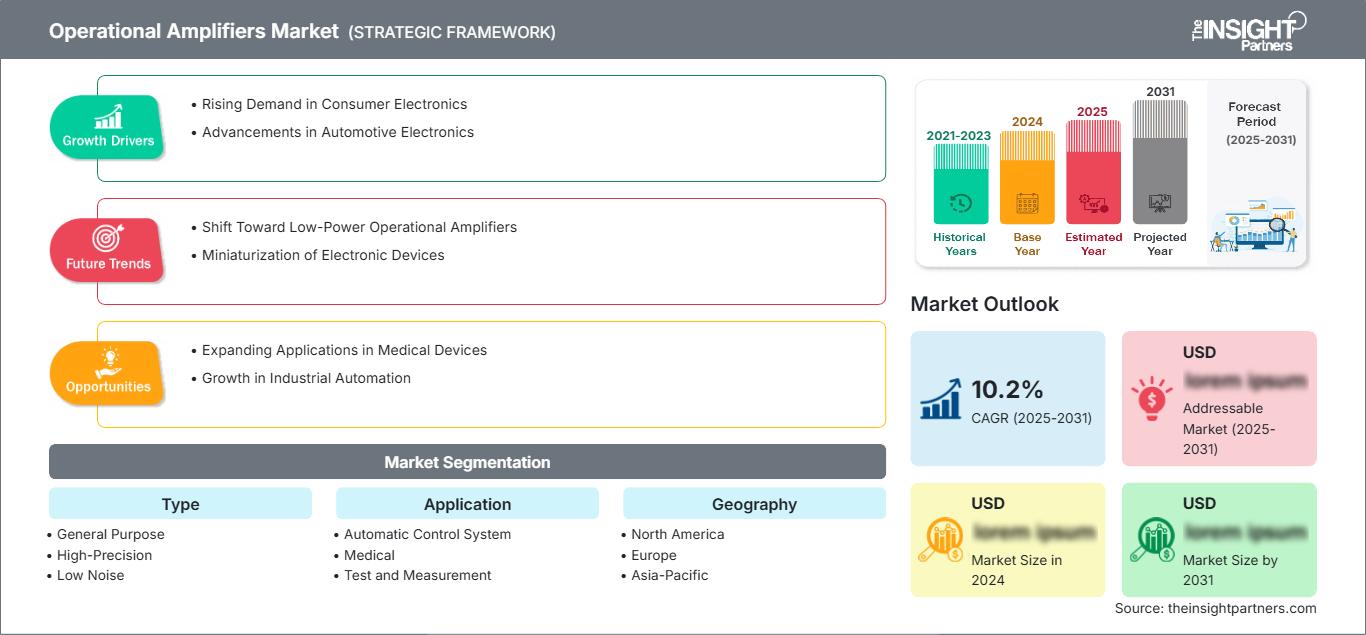
Operational Amplifiers Market: Strategic Insights
Regional Insights
North America Operational Amplifiers Market
North America represents a mature and technologically advanced segment of the market, anchored by extensive semiconductor design and fabrication infrastructure across the United States and Canada. The region's Operational Amplifiers Market share stood at 28–32% in 2025, reflecting strong institutional demand from aerospace, defense, and industrial automation sectors. The structural factors driving growth include continuous investments in semiconductor chip manufacturing within the country due to the federal semiconductor incentive schemes and increased use of precision analog parts within the testing and measuring instruments.
Growth in the region will be driven by an increase in the production of electric vehicles and the use of battery management systems, which would necessitate the use of high precision operational amplifiers in order to monitor the voltage and thermal levels. The North American market is forecast to grow at a CAGR of 6.2%-6.6% during the period from 2026 to 2034, aided by continued R&D investments from domestic semiconductor firms.
U.S. Operational Amplifiers Market
The United States accounted for approximately 62–66% of North America's market in 2025, underpinned by dense concentration of analog semiconductor design centers in Texas, California, and Arizona. Key vendors such as Texas Instruments Incorporated and Analog Devices, Inc. conduct substantial local design and testing processes, creating an elaborate network for the design and development of precision analog components used in the automobile, medical, and military industries throughout the nation.
Application patterns in the domestic industry show a growing inclination towards the use of low noise and high precision amplifier products for medical diagnostic instruments and industrial measurement instruments due to the stringent regulations set by the FDA and ANSI. It is expected that the U.S. Operational Amplifiers Market will witness a CAGR of 6.0-6.4% between 2026 and 2034.
Europe Operational Amplifiers Market
Europe accounted for 22–26% share of the global market in 2025, with demand concentrated across automotive electronics, industrial automation, and medical device manufacturing. Germany is the top consumer in the region, while the UK comes second, with each region being home to already established systems in terms of analog semiconductor design and auto supplies. The British market gains from an abundant availability of test and measurement equipment producers, as well as developing medical devices located in Cambridge and London, which create demand for the low-noise and high-accuracy amplifier variations.
Germany continues being the greatest contributor due to the predominance of the automobile production industry in Germany, as well as due to the industry of industrial automation, located in Bavaria and Baden-Württemberg. France, Italy, and Spain make up a moderate yet growing market contribution because of aerospace projects, machinery updates, and EV production facilities. Europe's Operational Amplifiers Market is projected to grow at a CAGR of 6.4–6.8% between 2026 and 2034, with Germany remaining the leading country throughout the forecast period.
APAC Operational Amplifiers Market
Asia Pacific led the global market with a 36–40% share in 2025, driven by China's extensive semiconductor manufacturing base, Japan's precision electronics industry, and South Korea's strong analog and memory fabrication capacity. India and Australia are emerging as secondary growth centers supported by expanding electronics assembly and renewable energy infrastructure investment.
China remains the leading country, benefiting from national semiconductor self-sufficiency policies and large-scale industrial automation deployment. The region is projected to grow at a CAGR of 7.4–7.8% through 2034, the fastest among all regions, supported by sustained government-backed chip manufacturing incentives.
Middle East & Africa Operational Amplifiers Market
The Middle East and Africa hold a comparatively modest but growing position within the global market, led by Saudi Arabia and the UAE, where diversification programs are driving investment in industrial automation, smart infrastructure, and renewable energy monitoring systems requiring precision analog components.
South Africa and the Rest of MEA contribute steadily through industrial and mining automation upgrades. Saudi Arabia leads the region, and the market is projected to grow at a CAGR of 6.0–6.4% through 2034, supported by energy infrastructure modernization and digital transformation initiatives.
Segmentation Analysis
Type
The Operational Amplifiers Market scope by type spans general purpose, high-precision, low noise, low-power, and low voltage variants, each addressing distinct performance requirements across industrial, medical, and consumer applications. Demand is shifting toward low-power and low-voltage designs as portable devices proliferate, while high-precision variants retain strong traction in test and measurement instrumentation. The Type segment is projected to grow at a CAGR of 6.7–7.1% between 2026 and 2034.
- General Purpose: Widely adopted across consumer electronics and general industrial circuits, remaining the standard choice for cost-sensitive applications requiring balanced performance and straightforward design integration across diverse end markets.
- High-Precision: Serves applications demanding minimal offset voltage and drift, including instrumentation, medical diagnostics, and calibration systems, where measurement accuracy directly influences reliability, compliance, and safety outcomes.
- Low Noise: Essential in audio processing, sensor signal conditioning, and precision measurement equipment, where minimizing electrical interference preserves signal integrity across sensitive analog front-end designs.
- Low-Power: Addresses the rising need for energy-efficient designs in portable, battery-operated, and wearable devices, supporting extended operational life across IoT and consumer applications.
- Low Voltage: Caters to compact, battery-powered electronics requiring stable operation at reduced supply levels, increasingly deployed within medical wearables and space-constrained industrial modules.
Application
By application, the market encompasses automatic control systems, medical devices, test and measurement equipment, vehicle electronics, and other specialized uses. Vehicle electronics is gaining share rapidly as electrification and driver assistance systems expand, while medical applications benefit from rising diagnostic equipment deployment. The Application segment is projected to grow at a CAGR of 6.6–7.0% between 2026 and 2034, reflecting broadening end-use diversification.
- Automatic Control System: Relies heavily on operational amplifiers for feedback loop stability and signal processing, remaining a core application across industrial manufacturing, process automation, and robotics.
- Medical: Demands ultra-precise, low-noise amplifiers for patient monitoring, imaging systems, and diagnostic instrumentation, where signal fidelity directly affects accuracy and regulatory compliance.
- Test and Measurement: Requires high-accuracy amplification for calibration equipment, oscilloscopes, and laboratory instrumentation, supporting research, quality assurance, and compliance verification.
- Vehicle Electronics: Expanding rapidly with growing adoption of driver assistance systems, battery management units, and infotainment platforms, positioning this segment as a key growth driver.
Opportunity Snapshot
| Application | Revenue Contribution | Trend Tag | Adoption Stage |
|---|---|---|---|
| Automatic Control System | High | Process Automation | Mature |
| Medical | Medium | Patient Monitoring | Scaling |
| Test and Measurement | Medium | Calibration Systems | Mature |
| Vehicle Electronics | High | ADAS Integration | Scaling |
| Others | Low | Niche Instrumentation | Emerging |
Operational Amplifiers Market Growth Drivers and Impact Analysis
Expanding Industrial Automation and Process Control Deployment
Rapid deployment of automated manufacturing equipment in discrete and process sectors is driving greater demand for operational amplifiers for feedback control loops, sensor signal conditioning and programmable logic controller interfacing applications. With factories implementing closed-loop control systems for measuring temperature, pressure and flow parameters, the need for high-fidelity amplification becomes critical for accurate measurement and stable system operation. Investments in automation in facilities located in manufacturing centers of North America, Europe and Asia Pacific have continued to grow, with modernization efforts focused on acquiring real-time data and predictive maintenance. This ongoing trend is creating steady demand for reliable analog semiconductors, providing visibility into future revenues.
Rising Integration of Precision Analog Components in Medical Devices
The evolution of healthcare technology is leading to high demand for precision and low noise operational amplifiers in applications of medical diagnostics and monitoring. Increasing stringent accuracy and safety requirements from regulatory agencies for medical devices have forced manufacturers to incorporate operational amplifiers with higher precision and better temperature stability into their products. The rise in chronic diseases and the increasing use of home-based health care facilities is resulting in the greater utilization of portable diagnostic tools, monitors, and POC (point of care) diagnostic instruments, all of which need signal amplification. This scenario is especially true in aging populations in North America, Europe, and some parts of Asia, where investments in health care infrastructure are growing.
Accelerating Vehicle Electrification and Advanced Safety System Adoption
Automotive electrification is fundamentally reshaping demand for operational amplifiers, as electric and hybrid vehicles require extensive analog signal conditioning for battery management, motor control, and power inverter monitoring. Advanced driver assistance systems, including radar, lidar, and camera-based sensing modules, depend on precision amplification to process sensor signals reliably under varying environmental conditions. Global vehicle safety regulations are tightening, with authorities in North America, Europe, and Asia mandating expanded adoption of collision avoidance and stability control technologies. As automakers scale electric vehicle production and integrate increasingly sophisticated electronic architectures, component suppliers are experiencing sustained order growth for automotive-grade amplifiers engineered to withstand extended temperature ranges and stringent qualification standards.
Operational Amplifiers Market Future Trends
Migration Toward Nanopower and Ultra-Low Voltage Amplifier Architectures
Emerging Operational Amplifiers Market trends point toward accelerating adoption of nanopower and ultra-low voltage amplifier architectures designed to extend battery life in IoT sensors, wearable devices, and remote monitoring equipment. Semiconductor manufacturers are increasingly optimizing quiescent current consumption without compromising bandwidth or noise performance, enabling deployment in energy-harvesting and always-on sensing applications. As edge computing and distributed sensor networks expand across industrial and consumer environments, demand for amplifiers operating reliably at sub-1.8V supply rails is expected to intensify, positioning ultra-low-power design as a defining engineering priority. This shift is particularly relevant for implantable and wearable medical sensors requiring years of unattended operation.
Integration of Operational Amplifiers into System-in-Package and Multi-Chip Modules
Advancing miniaturization trends are pushing semiconductor suppliers to integrate operational amplifiers within system-in-package and multi-chip module designs, combining amplification, filtering, and power management functions into compact footprints. This approach reduces board space requirements and simplifies design complexity for compact devices, while enhancing signal integrity through shorter interconnect paths. As electronic devices continue shrinking across wearables, medical implants, and portable instrumentation, package-level integration is expected to become a standard design approach, reducing bill-of-materials costs while improving thermal and electrical performance. Leading suppliers are collaborating with foundry partners to standardize package formats compatible with automotive and medical qualification requirements.
Operational Amplifiers Market Opportunities
Capacity Expansion in Emerging Semiconductor Manufacturing Hubs
Operational Amplifiers Market Forecasts point to substantial opportunity in capacity expansion across emerging semiconductor manufacturing hubs in India, Vietnam, and Southeast Asia, where government incentive programs are attracting foundry and packaging investment. Suppliers establishing localized production and testing facilities in these regions stand to benefit from lower operating costs, proximity to expanding electronics assembly clusters, and preferential access to regional trade agreements. Companies that invest early in qualifying regional supply chains for automotive and medical-grade components are positioned to capture disproportionate share as global manufacturers diversify sourcing away from concentrated East Asian production bases, reducing geopolitical and logistics risk while strengthening long-term delivery reliability.
Development of Application-Specific Amplifiers for Renewable Energy Systems
Expanding renewable energy infrastructure, including solar inverters, wind turbine control systems, and battery energy storage installations, presents an opportunity for suppliers to develop application-specific amplifiers optimized for high-voltage sensing and thermal monitoring in harsh outdoor environments. Investment in grid modernization and distributed energy resource management is increasing demand for precision analog components capable of reliable operation across wide temperature ranges and extended service lifespans. Suppliers that develop ruggedized, industrial-grade amplifier families tailored to renewable energy applications can establish differentiated positioning in a segment where component reliability directly affects system uptime and lifecycle cost, creating durable revenue streams tied to global clean energy transition investment.
Frequently Asked Questions

- Comprehensive Market Sizing and Forecast Analysis
- Detailed Segmentation Analysis
- In-Depth Market Dynamics Assessment
- Regional and Country-Level Insights
- Competitive Landscape and Company Benchmarking
- Strategic Business Intelligence
Recent Reports
Testimonials

The Insight Partners provided valuable market intelligence that supported our global go-to-market strategy. Their team was professional, responsive, and attentive to our feedback, providing thoughtful analysis and helpful methodological clarifications throughout the project.
Junmo Kim Chief Financial Officer (CFO), Enertech Co., Ltd.
The Insight Partners' SCADA System Market report is comprehensive, with valuable insights on current trends and future forecasts. The team was highly professional, responsive, and supportive throughout. We are very satisfied and highly recommend their services.
RAN KEDEM Partner, Reali Technologies LTDs
I requested a report on a very specific software market and the team produced the report in a few days. The information was very relevant and well presented. I then requested some changes and additions to the report. The team was again very responsive and I got the final report in less than a week.
JEAN-HERVE JENN Chairman, Future Analytica
We worked with The Insight Partners for an important market study and forecast. They gave us clear insights into opportunities and risks, which helped shape our plans. Their research was easy to use and based on solid data. It helped us make smart, confident decisions. We highly recommend them.
PIYUSH NAGPAL Sr. Vice President, High Beam Global
The Insight Partners delivered insightful, well-structured market research with strong domain expertise. Their team was professional and responsive throughout. The user-friendly website made accessing industry reports seamless. We highly recommend them for reliable, high-quality research services
YUKIHIKO ADACHI CEO, Deep Blue, LLC.
This is the first time I have purchased a market report from The Insight Partners.While I was unsure at first, I visited their web site and felt more comfortable to take the risk and purchase a market report.I am completely satisfied with the quality of the report and customer service. I had several questions and comments with the initial report, but after a couple of dialogs over email with their analyst I believe I have a report that I can use as input to our strategic planning process.Thank you so much for taking the extra time and making this a positive experience.I will definitely recommend your service to others and you will be my first call when we need further market data.
JOHN SUZUKI President and Chief Executive Officer, Board Director, BK Technologies
I wish to appreciate your support and the professionalism you displayed in the course of attending to my request for information regarding to infectious disease IVD market in Nigeria. I appreciate your patience, your guidance, and the fact that you were willing to offer a discount, which eventually made it possible for us to close a deal. I look forward to engaging The Insight Partners in the future, all thanks to the impression you have created in me as a result of this first encounter.
DR CHIJIOKE ONYIA MANAGING DIRECTOR, PineCrest Healthcare Ltd.Reason to Buy
- Informed Decision-Making
- Understanding Market Dynamics
- Competitive Analysis
- Identifying Emerging Markets
- Customer Insights
- Market Forecasts
- Risk Mitigation
- Boosting Operational Efficiency
- Strategic Planning
- Investment Justification
- Tracking Industry Innovations
- Aligning with Regulatory Trends





 Get Free Sample for