
Optical Communication and Networking Equipment Market Share, Growth & Forecast by 2034
Coverage: by Component (Optical Fibers, Optical Transceivers, Optical Amplifiers, Optical Switches, Optical Splitters, Optical Circulators, Others); Technology (Sonet/SDH, WDM, CWDM, DWDM, Fiber Channel); Application (Telecom, Data Center, Enterprise); Industry (BFSI, Healthcare, Energy and Utilities, Others) , and Geography (North America, Europe, Asia Pacific, and South and Central America)
- Status : Data Released
- Report Code : TIPRE00009190
- Category : Electronics and Semiconductor
- No. of Pages : 150
- Available Report Formats :


- Last update date : September 30, 2026


2025 Market Size
US$ 52.84 Bn
Base year value
2034 Forecast
US$ 195.55 Bn
Projected by 2034
CAGR 2026-2034
15.65 %
Growth rate
Addressable Market
US$ 1,054.65 Bn
(2026-2034)
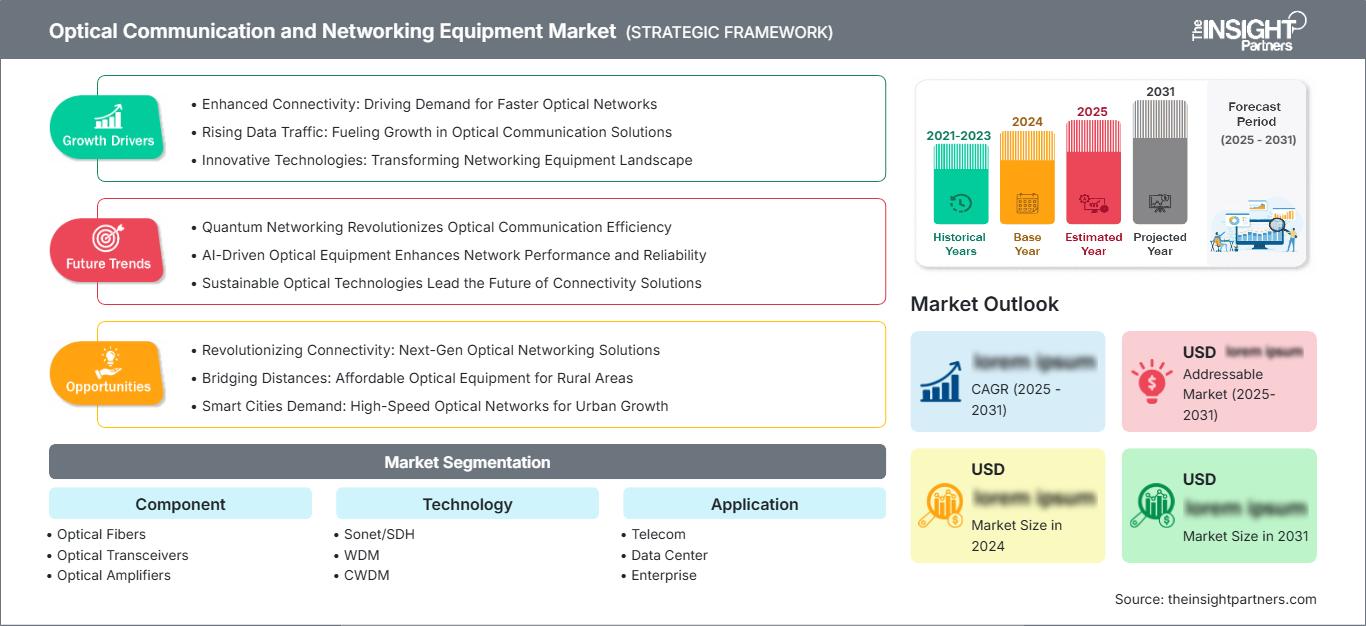
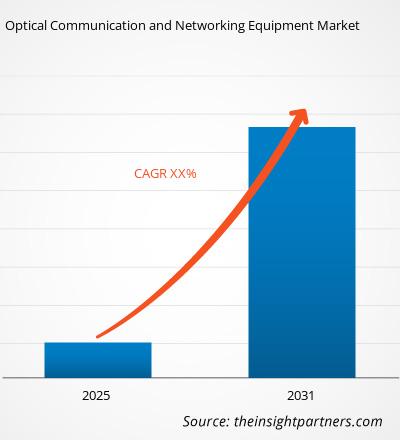
The optical communication and networking equipment market size is valued at US$ 52.84 Billion in 2025 and is projected to reach US$ 195.55 Billion by 2034, expanding at a CAGR of 15.65% during 2026–2034. The market encompasses optical infrastructure supporting high-capacity data transmission across telecom networks, data centers, and enterprise environments, with adoption increasingly shaped by bandwidth requirements, fiber densification, cloud workloads, and advanced wavelength management.
Demand conditions across North America remain favorable as operators, hyperscale data centers, and enterprises prioritize higher-capacity optical infrastructure. The region is estimated to register a CAGR of 14–16% during 2026–2034, supported by AI-oriented data center construction, fiber network modernization, 5G transport requirements, and continued investment in high-speed interconnection architectures. The United States remains the principal contributor, while Canada and Mexico add incremental opportunities through broadband and network infrastructure programs.
Optical Communication and Networking Equipment Market Assessment and Insights
- North America: North America represented an estimated 32–34% optical communication and networking equipment market share in 2025 and is projected to grow at a CAGR of 14–16% during 2026–2034, supported by hyperscale data centers, fiber upgrades, and advanced coherent networking.
- US: The US accounted for approximately 72–76% of North American demand in 2025 and is expected to expand at a CAGR of 14–16% during 2026–2034.
- Europe: Europe held an estimated 20–22% share in 2025 and is projected to grow at a CAGR of 13–15% through 2034, led by Germany, the UK, France, Italy, and Spain.
- Asia Pacific: Asia Pacific captured approximately 32–34% share in 2025 and is forecast to register a CAGR of 16–18% through 2034, with China, Japan, South Korea, and India supporting expansion.
- Largest Segment: Optical transceivers held an estimated 28–32% market share in 2025 and are projected to expand at a CAGR of 17–19% during 2026–2034.
- High Growth Segment: Optical switches represented approximately 8–11% market share in 2025 and are expected to grow at a CAGR of 18–21% during 2026–2034.
- Key companies analyzed in detail: ADTRAN, Inc.; ADVA Optical Networking SE; Ciena Corporation; Cisco Systems, Inc.; Finisar Corporation; Fujitsu Limited; Huawei Technologies Co., Ltd.; Infinera Corporation; Nokia Corporation; ZTE Corporation.
Source: The Insight Partners' analysis based on proprietary research, government publications, company annual reports, investor presentations, industry databases, and expert interviews.
The network architecture is evolving from traditional transport systems to more software-programmable, wavelength-controlled, and software-defined optical networks. Though SONET and SDH networks play an important role in the existing infrastructure, it is WDM, CWDM, and DWDM that increasingly dictate the way of capacity expansion today. The production of optical solutions is being oriented towards compact optics, high-speed transceivers, photonics and modularity, and thus the suppliers must balance the issues of components, optical engine performance, cooling, and interoperability.
Investments are expected to diversify into the emerging connectivity corridors in Asia, Middle East, and some Latin American countries in the coming several years. Government encouragement of broadband access and infrastructure, cloud services, and power-efficient data centers will stimulate the demand for optical transport systems. In addition, operators are assessing architectures of automated high capacity coherent transmission. It should create advantages for those manufacturers who are able to offer not individual hardware but interoperable and scalable systems.
Optical Communication and Networking Equipment Market Report Scope
| Report Attribute | Details |
|---|---|
| Market size in 2025 | US$ 52.84 Billion |
| Market Size by 2034 | US$ 195.55 Billion |
| Global CAGR (2026 - 2034) | 15.65% |
| Historical Data | 2021-2024 |
| Forecast period | 2026-2034 |
Optical Communication and Networking Equipment Market Analysis
Optical Communication and Networking Equipment Market is experiencing a continued rise in data traffic, cloud services, video streaming, 5G transport, and AI processing. The industry ecosystem includes fiber suppliers, components, modules, and system suppliers, integrators, network operators, cloud service providers, and corporate customers. Increasing value is created through optical excellence, software integration, energy efficiency, and flexibility of deployment. In terms of supply, high density and interoperable architectures are key to meeting capacity demands without growing footprint, energy consumption, and complexity of maintenance proportionally.
The supply chain is becoming more integrated and specialized at the same time. Optical transceivers, amplifiers, switching, and wavelength management components require increasing levels of integration between photonic, electronic, firmware, and network management elements. Such conditions are favorable for players with wide product lines and strong customer qualification processes. The Optical Communication and Networking Equipment Market is, therefore, characterized not only by volume growth but also by technology upgrades, where the replacement cycle is defined by bandwidth limits rather than equipment aging.
The optical communication and networking equipment market report shows that positioning within the competitive landscape will be impacted by portfolio breadth, optics competence, production scale, geographical presence, and partnership with telecom operators and hyperscale customers. The companies such as Ciena Corporation and Nokia Corporation focus on high-capacity optical transport and programmable architectures, whereas Cisco Systems, Inc. combines optical capability with networking platforms. Meanwhile, Huawei Technologies Co., Ltd. and ZTE Corporation have large telecommunication portfolios, whereas Fujitsu Limited and ADTRAN, Inc. are active players in specific requirements of network infrastructures. Differentiation is becoming increasingly focused on interoperability, automation, energy efficiency, and faster deployments.
There is a shift towards AI-driven networks, fast data center connectivity, and photonic integration among investments as well. ADVA Optical Networking SE provides the industry with optical transport, whereas Infinera Corporation is known for high-capacity optical networking and photonic integration. Meanwhile, Finisar Corporation remains relevant through its optical components and transceiver technologies. Overall, there is an increasing focus on positioning based on architecture of infrastructure, ecosystem compatibility, and technology roadmap that will help with multiple generations of network capacities.
● REPORT CUSTOMIZATION
Tailor This Report To Align With Your Specific Business Requirements
This report can be customized to align precisely with your business objectives, scope, and target markets. Customization options include tailored segmentation, geography, competitive analysis, and strategic insights to support informed decision-making.
Customize This Report →WHAT YOU CAN ADJUST
- ● Segmentations
- ● Geography
- ● Competitive Analysis
- ● Language Preferences
Optical Communication and Networking Equipment Market: Strategic Insights
Regional Insights
North America Optical Communication and Networking Equipment Market
According to the optical communication and networking equipment market forecast, North America accounted for an estimated 32–34% share of global demand in 2025 and is projected to expand at a CAGR of 14–16% through 2034. The US is dominant in regional consumption due to the need for constant upgrades in hyperscale data centers, cloud infrastructure, telecommunications operators, and enterprises’ networks. Fiber densification and increased speed of interconnections are boosting the level of replacement demand.
Canada’s contribution comes from broadband upgrade, data center construction, and investment in resilient digital infrastructure. Mexico presents further demand potential since enterprises are building cloud interconnections and nearshore IT services. The preference in regional purchases shifts towards coherent transmission, high-speed optical transceivers, programmable optical systems, and automated platforms. AI infrastructure is a major catalyst of incremental demand due to the need for high bandwidth connections among computing clusters within server racks and remote sites. Network operators and vendors in North America benefit from fiber infrastructure, advanced procurement practices, and broad adoption of network management technologies.
U.S. Optical Communication and Networking Equipment Market
The U.S. represented approximately 72–76% of North American demand in 2025 and is forecast to grow at a CAGR of 14–16% through 2034. The company’s leadership is characterized by hyperscale data centers, telecom backbone upgrades, cloud expansion, and fast implementation of artificial intelligence computing infrastructure. Cisco Systems, Inc., Ciena Corporation, ADTRAN, Inc., and Infinera Corporation have a strong technology footprint in the relevant networks.
In terms of application, high demands are observed in data centers, telecom transport, and enterprise networking. High-speed optical transceivers, DWDM systems, and programmable optical platforms are widely deployed to increase bandwidth efficiency and to eliminate any limitations. Power consumption, rack density, network automation, and Ethernet compatibility are the factors influencing investment decisions. The United States continues being an environment where advanced optical technologies get commercially implemented prior to the wider regional deployment.
Europe Optical Communication and Networking Equipment Market
Europe held approximately 20–22% share in 2025 and is projected to grow at a CAGR of 13–15% through 2034. Germany emerges as the top national contributor owing to industrial digitization and enterprise networking, along with the UK, France, Italy, and Spain adding to the demand.
Germany and the UK are major technology markets. In the UK, there is the advantage of broadband proliferation, data center connections, and enterprise cloud migrations, and in Germany, industrial automation needs are combined with telecom infrastructure modernizations. France remains an investor in digital connectivity and data centers. For Italy and Spain, it is fiber expansions and cloud adoption along with enterprise digitization. Energy efficiency and interoperability are being increasingly considered during European procurement, which creates good opportunities for vendors with scalable optical platforms and services.
APAC Optical Communication and Networking Equipment Market
APAC accounted for approximately 32–34% share in 2025 and is expected to register a CAGR of 16–18% through 2034. China dominates regional demand, with Japan, South Korea, India, and Australia following. Large telecommunication networks, data center expansion, 5G transport, and digitalization programs in each country help maintain a consistent flow of equipment deployment.
China offers extensive fiber optics infrastructure coupled with massive investments in telecommunications networks, while Japan and South Korea focus on advanced communications and high data infrastructure. Fiber optics expansion and digitalization take place in India, while Australia focuses on its broadband and data center capabilities. The industrial digitization and cloud computing policies are expected to promote optical infrastructure investments.
Middle East & Africa Optical Communication and Networking Equipment Market
Middle East and Africa represents a smaller regional base but offers substantial infrastructure-led opportunities. Region is expected to grow at a CAGR of 13% - 15% till 2034. Demand from Saudi Arabia and UAE is fueled by initiatives such as digital transformation, cloud computing, smart cities, and telecommunication modernization.
South Africa is the key African hub for corporate connectivity and data center infrastructure. The drivers of demand in RoMEA include submarine cable connectivity, national broadband initiatives, and digital economy investments. Infrastructure modernization in energy sector also involves communications network that spans over dispersed infrastructure. In the Gulf, large scale data centers and cloud computing increase the demand for high capacity optical networking equipment whereas the African market is moving gradually towards enterprise and carrier connectivity solutions.
Segmentation Analysis
Component
Component remains central to infrastructure performance because optical fibers, transceivers, amplifiers, switches, splitters, and circulators determine capacity, reach, reliability, and flexibility. The segment is estimated to grow at a CAGR of 16–18% during 2026–2034, with demand shifting toward higher-density and energy-efficient components.
- Optical Fibers: Optical fibers remain foundational for backbone, access, data center interconnect, and metro deployments, with demand supported by fiber densification and increasing bandwidth requirements across communications infrastructure.
- Optical Transceivers: Optical transceivers occupy a leading position because higher-speed connectivity increasingly requires compact modules supporting data centers, telecom networks, enterprise systems, and evolving coherent architectures.
- Optical Amplifiers: Optical amplifiers support long-distance and high-capacity transmission by maintaining signal strength, making them strategically important for backbone, submarine, metro, and wavelength-division infrastructure.
- Optical Switches: Optical switches enable flexible routing and reconfiguration, gaining strategic relevance as networks require greater automation, dynamic capacity allocation, and lower-latency connectivity for distributed workloads.
- Optical Splitters: Optical splitters support passive network architectures and remain important in access infrastructure where operators require scalable distribution of optical signals across multiple endpoints.
- Optical Circulators: Optical circulators provide directional signal management in specialized optical systems and remain relevant for advanced transport, sensing, and network architectures requiring controlled optical paths.
Technology
Technology is estimated to expand at a CAGR of 15–17% during 2026–2034 as operators migrate toward higher spectral efficiency and programmable transport. WDM architectures increasingly support scalable capacity while legacy SONET and SDH systems remain relevant within established installations.
- Sonet/SDH: SONET and SDH continue serving installed carrier infrastructure, particularly where replacement costs and network continuity considerations encourage gradual migration toward newer optical transport architectures.
- WDM: WDM remains strategically important because multiplexing multiple wavelengths over fiber improves capacity utilization and supports scalable backbone and data center interconnect deployments.
- CWDM: CWDM provides cost-effective wavelength expansion for metro and access applications, especially where moderate capacity requirements make simpler wavelength architectures economically attractive.
- DWDM: DWDM addresses high-capacity long-haul and metro requirements, enabling dense wavelength utilization and supporting increasingly demanding traffic loads across carrier and data center networks.
- Fiber Channel: Fiber Channel remains important for storage networking environments where predictable performance, low latency, and reliable connectivity are required between storage systems and computing infrastructure.
Application
Application is projected to grow at a CAGR of 16–18% during 2026–2034. Telecom remains a major deployment environment, while data centers are becoming increasingly influential as cloud computing, AI infrastructure, and distributed workloads raise interconnection requirements.
- Telecom: Telecom applications maintain strong demand for fiber transport, wavelength systems, amplifiers, and high-capacity optical modules supporting mobile backhaul, broadband, metro, and long-haul networks.
- Data Center: Data centers are strategically important as hyperscale and AI infrastructure requires progressively faster links between servers, racks, clusters, and geographically distributed facilities.
- Enterprise: Enterprise deployments are shifting toward higher-speed optical connectivity as organizations modernize campus networks, private data centers, cloud connections, and latency-sensitive digital applications.
Industry
Industry is estimated to register a CAGR of 15–17% during 2026–2034. BFSI requires resilient, low-latency connectivity, healthcare increasingly depends on data-intensive applications, and energy and utilities require dependable communications across distributed operational assets.
- BFSI: BFSI organizations prioritize resilient optical connectivity for financial transactions, cloud workloads, data replication, cybersecurity infrastructure, and geographically distributed operations requiring dependable network performance.
- Healthcare: Healthcare institutions are increasing network capacity to support imaging, electronic systems, telemedicine, cloud applications, and data exchange across hospitals, laboratories, and connected facilities.
- Energy and Utilities: Energy and utilities use optical networks for operational communications, remote monitoring, grid management, and secure data transfer across geographically dispersed generation and transmission assets.
Opportunity Snapshot
| Application | Revenue Contribution | Trend Tag | Adoption Stage |
| Telecom | High | 5G Transport | Mature |
| Data Center | High | AI Interconnect | Scaling |
| Enterprise | Medium | Cloud Connectivity | Scaling |
Optical Communication and Networking Equipment Market Growth Drivers and Impact Analysis
AI-driven bandwidth requirements are accelerating optical capacity upgrades
AI infrastructure is disrupting the economics of network capacity through increased traffic flows between clusters of computing nodes, storage, and remote data centers. Optical transport networks deliver the needed capacity density and efficient transmission for this environment, motivating operators to deploy higher speed transceivers, coherent optics, and enhanced switch architectures. This shift affects not only hyperscale data centers, but enterprise data centers and regional clouds that are building out AI capabilities. With traffic concentration increasing and latency constraints tightening, capacity planning is happening at an earlier stage in asset life cycles. This drives incremental demand for upgrades, new modules, and programmable optical systems. Companies that can deliver high performance along with lower power utilization have the potential to succeed, as operators look to manage costs amid growing compute workloads.
Fiber densification is strengthening demand across telecom and access networks
Growing bandwidth needs and increasing densification drive demand for optical fibers, amplifiers, splitters, transceivers, and equipment for wavelength management. Growing needs for capacity from the existing fiber paths become an essential requirement due to increasing traffic loads, video offerings, cloud services, and wireless connectivity among subscribers. Rather than using only new fiber paths, operators tend to use WDM techniques along with fiber upgrading to utilize fiber paths better. It makes optical equipment more relevant within metropolitan and backbone infrastructures. Fiber deployment for connectivity markets will also assist in digitizing enterprises and development of public infrastructures. The generated demand is not restricted to greenfields as existing networks need upgrading from time to time to increase speeds and services.
Cloud and 5G convergence is expanding high-capacity transport requirements
Cloud computing and 5G networks increasingly depend on common transport infrastructure capable of moving large volumes of data with predictable latency. Mobile operators require optical systems for backhaul and transport, while cloud providers require scalable connections between data centers and network access points. This convergence increases demand for coherent transmission, DWDM platforms, optical amplification, and high-speed modules. Network operators are also seeking more flexible architectures because traffic patterns can change rapidly as applications migrate between centralized and distributed computing environments. The commercial impact is a broader equipment opportunity across telecom and data center applications rather than a narrow replacement cycle. Suppliers that integrate optical transport with automation and network management can improve operational visibility and reduce configuration complexity, making software-enabled optical infrastructure increasingly relevant to long-term modernization programs.
Optical Communication and Networking Equipment Market Future Trends
Co-packaged and near-packaged photonics will reshape network architectures
The optical communication and networking equipment market trends show that the next phase of optical networking is likely to involve deeper integration between photonic engines and switching or computing platforms. Co-packaged and near-packaged optics can shorten electrical interconnect distances, potentially improving signal integrity, power efficiency, and system density. This architecture is particularly relevant to AI clusters where electrical connectivity can become a constraint as bandwidth scales. Over time, the transition could influence procurement strategies, component qualification, thermal design, and system manufacturing. Vendors are expected to compete on photonic integration, packaging efficiency, manufacturability, and interoperability rather than optical transmission performance alone. The trend may also encourage partnerships between optical component specialists, switch manufacturers, and computing infrastructure suppliers, creating a more integrated ecosystem around next-generation high-density data center architectures.
Programmable optical infrastructure will support autonomous network operations
Optical networks are expected to become increasingly programmable as operators seek faster provisioning, automated fault management, and dynamic capacity allocation. Software-defined control can enable network resources to respond to changing traffic patterns without extensive manual intervention. The trend will be particularly relevant to distributed cloud, 5G, and AI environments where demand can vary rapidly between locations and applications. Automation may also improve utilization of wavelengths and reduce operational expenditure by integrating optical systems with broader network management platforms. Future deployments are therefore likely to emphasize telemetry, open interfaces, intent-based configuration, and analytics alongside hardware performance. Vendors with strong software ecosystems may gain an advantage because customers increasingly evaluate optical infrastructure as part of an end-to-end network architecture rather than as isolated transmission equipment.
Optical Communication and Networking Equipment Market Opportunities
AI data center interconnect creates a high-value equipment opportunity
AI-oriented data center expansion presents an opportunity for suppliers to develop specialized optical solutions around high-density interconnect requirements. Investors and equipment manufacturers can target coherent modules, high-speed transceivers, optical switching, and compact transport platforms designed for large computing clusters. The opportunity extends beyond individual data centers because AI infrastructure increasingly requires connectivity between facilities, cloud regions, and specialized computing sites. Vendors can differentiate through power efficiency, thermal management, deployment simplicity, and interoperability with existing Ethernet ecosystems. Strategic partnerships with data center operators and system integrators may accelerate qualification cycles and provide access to recurring infrastructure programs. Companies that establish technology roadmaps spanning successive optical speeds can also improve customer retention as network capacity requirements continue to rise.
Emerging digital corridors offer opportunities for scalable optical deployment
Emerging connectivity corridors across Asia, the Middle East, Africa, and other developing regions provide opportunities for modular optical infrastructure. Investments in broadband, cloud localization, submarine connectivity, smart cities, industrial digitization, and energy modernization are increasing requirements for dependable high-capacity networks. Suppliers can address these markets with scalable platforms that allow operators to expand capacity in stages rather than undertaking large upfront infrastructure changes. Local partnerships, regional service capabilities, and financing flexibility may become important competitive differentiators where procurement environments differ from mature markets. Equipment manufacturers can also pursue opportunities around metro networks and data center interconnects, where traffic growth may outpace legacy transport capacity. A modular approach can reduce deployment risk while enabling operators to align optical investment with subscriber, enterprise, and cloud demand.
Frequently Asked Questions

- Comprehensive Market Sizing and Forecast Analysis
- Detailed Segmentation Analysis
- In-Depth Market Dynamics Assessment
- Regional and Country-Level Insights
- Competitive Landscape and Company Benchmarking
- Strategic Business Intelligence
Recent Reports
Testimonials

The Insight Partners provided valuable market intelligence that supported our global go-to-market strategy. Their team was professional, responsive, and attentive to our feedback, providing thoughtful analysis and helpful methodological clarifications throughout the project.
Junmo Kim Chief Financial Officer (CFO), Enertech Co., Ltd.
The Insight Partners' SCADA System Market report is comprehensive, with valuable insights on current trends and future forecasts. The team was highly professional, responsive, and supportive throughout. We are very satisfied and highly recommend their services.
RAN KEDEM Partner, Reali Technologies LTDs
I requested a report on a very specific software market and the team produced the report in a few days. The information was very relevant and well presented. I then requested some changes and additions to the report. The team was again very responsive and I got the final report in less than a week.
JEAN-HERVE JENN Chairman, Future Analytica
We worked with The Insight Partners for an important market study and forecast. They gave us clear insights into opportunities and risks, which helped shape our plans. Their research was easy to use and based on solid data. It helped us make smart, confident decisions. We highly recommend them.
PIYUSH NAGPAL Sr. Vice President, High Beam Global
The Insight Partners delivered insightful, well-structured market research with strong domain expertise. Their team was professional and responsive throughout. The user-friendly website made accessing industry reports seamless. We highly recommend them for reliable, high-quality research services
YUKIHIKO ADACHI CEO, Deep Blue, LLC.
This is the first time I have purchased a market report from The Insight Partners.While I was unsure at first, I visited their web site and felt more comfortable to take the risk and purchase a market report.I am completely satisfied with the quality of the report and customer service. I had several questions and comments with the initial report, but after a couple of dialogs over email with their analyst I believe I have a report that I can use as input to our strategic planning process.Thank you so much for taking the extra time and making this a positive experience.I will definitely recommend your service to others and you will be my first call when we need further market data.
JOHN SUZUKI President and Chief Executive Officer, Board Director, BK Technologies
I wish to appreciate your support and the professionalism you displayed in the course of attending to my request for information regarding to infectious disease IVD market in Nigeria. I appreciate your patience, your guidance, and the fact that you were willing to offer a discount, which eventually made it possible for us to close a deal. I look forward to engaging The Insight Partners in the future, all thanks to the impression you have created in me as a result of this first encounter.
DR CHIJIOKE ONYIA MANAGING DIRECTOR, PineCrest Healthcare Ltd.Reason to Buy
- Informed Decision-Making
- Understanding Market Dynamics
- Competitive Analysis
- Identifying Emerging Markets
- Customer Insights
- Market Forecasts
- Risk Mitigation
- Boosting Operational Efficiency
- Strategic Planning
- Investment Justification
- Tracking Industry Innovations
- Aligning with Regulatory Trends





 Get Free Sample for