
Optical Encoders Market Size, Share & Trends by 2034
Coverage: by Types (Incremental, Absolute, Linear, Magnetic Rotatory); Components (Light Source, Mask, Photo Detector Assembly, Electronics Board, Code Disk and Housing Assembly); and Application (Automotive, Medical Equipment, Communication System, Semiconductor & Robotics, Construction, Textiles, Metal & Petro-Chemical and Packaging), and Geography (North America, Europe, Asia Pacific, and South and Central America)
- Status : Data Released
- Report Code : TIPTE100001067
- Category : Electronics and Semiconductor
- No. of Pages : 150
- Available Report Formats :


- Last update date : October 15, 2026


2025 Market Size
US$ 3.59 Bn
Base year value
2034 Forecast
US$ 8.09 Bn
Projected by 2034
CAGR 2026-2034
9.45 %
Growth rate
Addressable Market
US$ 52.14 Bn
(2026-2034)
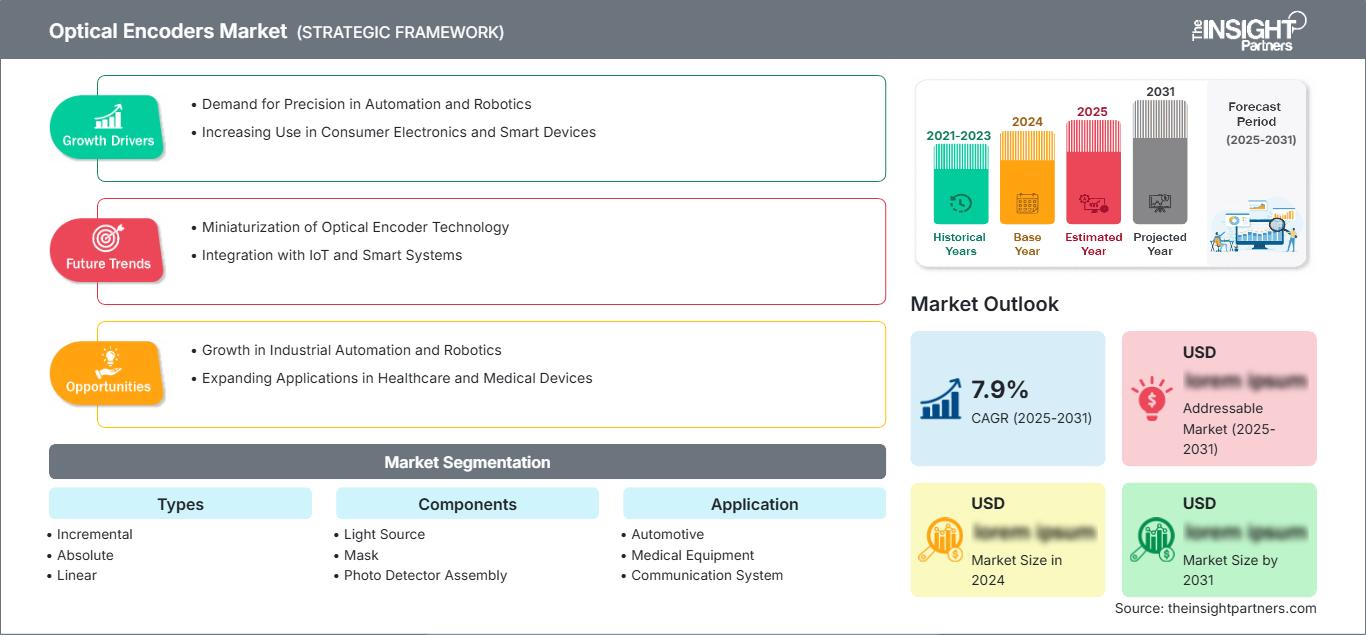
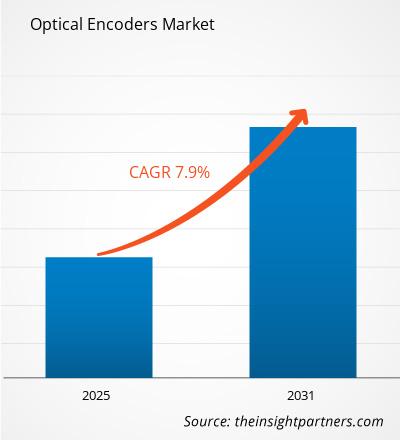
The Optical Encoders Market was valued at US$ 3.59 Billion in 2025 and is projected to reach US$ 8.09 Billion by 2034, registering a CAGR of 9.45% during 2026–2034. Rising automation across manufacturing, robotics, semiconductor production, and advanced motion control systems continues to strengthen demand for high-precision position sensing technologies. Continuous innovation in encoder accuracy, durability, and digital connectivity is further supporting widespread deployment across industrial and commercial applications.
Across North America, the Optical Encoders Market size continues to expand due to sustained investments in smart manufacturing, industrial automation, and high-value semiconductor fabrication. The region is expected to register a CAGR in the range of 8.8–9.6% during 2026–2034, supported by the increasing adoption of Industry 4.0 technologies, growing deployment of collaborative robots, and modernization of production facilities requiring reliable motion feedback and precision control systems.
Optical Encoders Market Assessment and Insights
- North America: North America accounted for an estimated 33–37% share in 2025 and is projected to expand at a CAGR of 8.8–9.6% during 2026–2034. Strong industrial automation investments, advanced robotics deployment, semiconductor manufacturing, and digital factory initiatives continue to reinforce the Optical Encoders Market share across the region.
- US: The U.S. represented approximately 76–80% of the North American market in 2025 and is expected to record a CAGR of 8.9–9.7% during 2026–2034, supported by expanding robotics adoption, aerospace manufacturing, factory modernization, and precision motion control applications.
- Europe: Europe captured an estimated 26–30% share in 2025 and is anticipated to grow at a CAGR of 8.4–9.2% during 2026–2034. Germany, the UK, France, Italy, and Spain continue to lead regional demand through advanced manufacturing, industrial automation, and automotive production investments.
- Asia Pacific: Asia Pacific held approximately 29–33% share in 2025 and is forecast to register the fastest CAGR of 10.4–11.2% during 2026–2034. China, Japan, South Korea, and India remain key contributors owing to expanding electronics manufacturing, robotics integration, semiconductor fabrication, and smart factory initiatives.
- Largest Segment: Application – Semiconductor & Robotics accounted for an estimated 28–32% market share in 2025 and is expected to grow at a CAGR of 10.2–11.0% during 2026–2034, driven by increasing demand for ultra-precise motion feedback in automated production environments.
- High Growth Segment: Types – Absolute is projected to witness the highest expansion, with an estimated 22–26% market share in 2025 and a CAGR of 10.8–11.6% during 2026–2034, supported by rising adoption in high-accuracy positioning systems, robotics, and digitally connected industrial equipment.
- Key companies analyzed in detail: BEI Sensors, Dynapar, Renishaw plc, Allied Motion Technologies Inc., Grayhill, Inc., Dr. Fritz Faulhaber GmbH & Co. KG (FAULHABER), Baumer Holding AG, Codechamp, Bourns, Inc., Hengstler GmbH.
Source: The Insight Partners' analysis based on proprietary research, government publications, company annual reports, investor presentations, industry databases, and expert interviews.
The optical encoder market has seen a considerable change as companies focus on high resolution, small-size design, and digital connectivity in optical encoders owing to the demand for automation. Advances in precision technology have helped optical encoders offer better precision of positioning, rapid data acquisition, and reliability during operation. The use of industrial robots, computer numerical control machines, semiconductor equipment, and automated material handling system has provided increased scope of usage. While producers are boosting the efficiency of their products using small-sized designs, advanced optical sensing devices, and ability to communicate over industrial Ethernet networks.
Further, investments in smart factories, robotics, electric mobility, and semiconductor manufacturing will drive the demand for motion control technologies over the years to come. Rising industrial economies of Asia Pacific, the Middle East, and Eastern Europe regions are bolstering the capacity to automate by way of favorable manufacturing policies and infrastructure development. The growing importance of predictive maintenance, energy-efficient production facilities, and digitally-enabled equipment will drive the Optical Encoders Market, while continuous innovation in the performance, durability, and industrial IoT connectivity of encoders will boost sales opportunities.
Optical Encoders Market Report Scope
| Report Attribute | Details |
|---|---|
| Market size in 2025 | US$ 3.59 Billion |
| Market Size by 2034 | US$ 8.09 Billion |
| Global CAGR (2026 - 2034) | 9.45% |
| Historical Data | 2021-2024 |
| Forecast period | 2026-2034 |
Optical Encoders Market Analysis
Ongoing increases in industrial automation are driving the outlook on demand for optical encoders in many industries. The development of smart factories, automated production lines, and robotics requires the use of highly accurate position sensing devices that can function in harsh industrial conditions. With increasing efforts by manufacturers to enhance their operations in terms of increased efficiency, quality improvement, and decreased machine downtime, optical encoder devices become critical elements in modern motion control systems. According to the Optical Encoders Market report, increased demand in semiconductor manufacturing, medical devices, automotive assembly, and packaging machines will be one of the key drivers of market growth over the forecast period.
The industry continues evolving through increasing collaboration between manufacturers of optical components, semiconductors, optical encoders, automation solutions, OEMs, and industrial system integrators. Increased miniaturization of sensors, advanced digital interfaces, and fast data transfers allow suppliers to produce advanced products meeting the demands of modern industrial needs.
Competitive landscape in the global market is still marked by product innovation, partnerships, expansion into new geographical locations, and investments into production capacity based on cutting-edge technologies. Companies such as Renishaw plc, Dynapar, BEI Sensors, Baumer Holding AG, and Hengstler GmbH are continuing their efforts to build up portfolios using high-resolution encoder products aimed at robotics, aerospace, medical industry, and precision engineering. At the same time, Allied Motion Technologies Inc., Grayhill, Inc., Bourns, Inc., Dr. Fritz Faulhaber GmbH & Co. KG (FAULHABER), and Codechamp are increasing their efforts in developing dedicated products to meet new customer needs for industrial automation applications.
Current investments are increasingly made in R&D projects that will result in high accuracy, miniature, connectivity and environmental resistance of encoders. Also, production capacity is increasing regionally to ensure higher supply chain efficiency and reduced delivery times. Competitive advantages are being created by the ability to provide custom motion sensing products, compatibility with Industry 4.0 architecture and technical support. Thus, suppliers can take advantage of increasing automation in manufacturing industries around the globe.
● REPORT CUSTOMIZATION
Tailor This Report To Align With Your Specific Business Requirements
This report can be customized to align precisely with your business objectives, scope, and target markets. Customization options include tailored segmentation, geography, competitive analysis, and strategic insights to support informed decision-making.
Customize This Report →WHAT YOU CAN ADJUST
- ● Segmentations
- ● Geography
- ● Competitive Analysis
- ● Language Preferences
Optical Encoders Market: Strategic Insights
Regional Insights
North America Optical Encoders Market
In 2025, the North American region held around 33–37% of the worldwide market share and is projected to exhibit a CAGR of 8.8-9.6% during the forecast period 2026-2034. The region experiences widespread use of industrial automation and robotics, semiconductors and their manufacturing, as well as digital integration of manufacturing facilities. The significant investment made by the manufacturers in the field of precision manufacturing, aerospace and medical equipment is expected to drive the demand for optical encoders in the coming years.
The integration of high resolution motion control technology in CNC machines and packaging systems is expected to drive the demand for optical encoder technology. In addition, the growing investment in the fabrication of semiconductor and the modernization of manufacturing infrastructure are expected to boost the demand for optical encoders in the coming years.
U.S. Optical Encoders Market
In 2025, the United States held about 76-80% of the North American market share and was expected to expand at a CAGR of 8.9-9.7% over 2026-2034. Being a leader in aerospace engineering, industrial robots, semiconductor fabrication, and medical advancements, there are plenty of opportunities for precision motion control systems development. More and more investments in intelligent manufacturing plants and automated manufacturing environments contribute to the demand growth of high-quality encoder solutions in various industries.
The availability of global leaders in automation technologies, OEMs, and research centers is promoting the development of innovative encoder solutions. The growing popularity of electric cars, warehouse automation, and high-speed packaging equipment increases market potential even further. The focus on the use of predictive maintenance and digital manufacturing technologies and industrial Internet-of-things will promote the implementation of high-accuracy optical encoders in process and discrete manufacturing industries.
Europe Optical Encoders Market
Europe held around 26–30% Optical Encoders Market share in 2025 and is forecasted to grow with a CAGR of 8.4–9.2% in 2026–2034. Germany is the leading country in the region due to high levels of development of industrial automation industry, manufacture of machine tools, and automobile production. Stable investments in smart factories, precision engineering, and digital manufacturing technologies provide stable demand for high-end encoders in various industrial sectors.
The United Kingdom boosts implementation in aerospace manufacturing, manufacture of pharmaceutical equipment, and automation projects targeted at productivity improvement. Growing investments in robotics research and digital transformation projects boost sustainable growth of the market. Germany leads in the region due to huge machinery manufacturers, industrial robotics suppliers, and automation technology developers working on the local and foreign markets. France, Italy, and Spain progressively boost installation of encoders in packaging machinery, food processing machinery, renewable energy facilities, and precision manufacturing industries due to modernization projects and investments in advanced production technologies.
APAC Optical Encoders Market
The share of the Asia Pacific region in the global market was estimated at about 29-33% in 2025, and the region is expected to have the highest CAGR of 10.4-11.2% during 2026-2034. China is leading in the region due to its electronic manufacturing, robotics, and semiconductors manufacturing capabilities, whereas Japan and South Korea are making heavy investments in advanced automation and precision engineering technology.
Industrial automation is gaining more acceptance in India on account of manufacturing expansion and industrial development initiatives by the Indian government, while Australia's contributions come from mining automation and applications of industrial machinery. Increasing investments in smart manufacturing are helping to make Asia Pacific the fastest-growing regional market.
Middle East & Africa Optical Encoders Market
The Middle East & Africa market is estimated to witness a growth rate of 7.4–8.2% CAGR over 2026–2034 due to growing industry diversification and infrastructural upgradation efforts. The Middle Eastern region is driven by Saudi Arabia due to increased investments in its manufacturing, energy infrastructure, and industrial automation sectors, while the UAE is driving the market through its efforts in logistics and manufacturing automation technologies.
South Africa continues to be an integral part of the market on account of mining automation and industrialization efforts, while the Rest of the Middle East & Africa is witnessing rising adoption in food processing, packaging, and material handling sectors.
Segmentation Analysis
Types
The Types segment is projected to expand at a CAGR of 9.6–10.4% during 2026–2034 as manufacturers increasingly demand highly accurate position sensing technologies for industrial automation, robotics, semiconductor equipment, and precision machinery. Product innovation focusing on enhanced resolution, compact design, environmental resistance, and digital communication capabilities continues to support market expansion. The Optical Encoders Market scope is further broadened by increasing adoption across intelligent manufacturing systems requiring reliable real-time motion feedback and high operational efficiency.
- Incremental – Widely adopted across industrial automation and conveyor systems due to cost efficiency, simple integration, and reliable speed monitoring. The segment remains essential for general-purpose motion control applications requiring continuous position tracking.
- Absolute – Increasingly preferred for high-precision positioning applications where exact location data must be retained after power interruptions. Strong demand originates from robotics, semiconductor manufacturing, aerospace equipment, and advanced CNC machinery.
- Linear – Utilized extensively in machine tools, precision inspection systems, medical equipment, and semiconductor production lines where highly accurate linear displacement measurement directly influences manufacturing quality and operational consistency.
- Magnetic Rotatory – Selected for applications operating under vibration, dust, moisture, and harsh industrial environments. Growing deployment in heavy machinery, material handling equipment, and process automation supports continued market relevance.
Application
The Application segment is anticipated to register a CAGR of 9.9–10.7% during 2026–2034, supported by rising investments in factory automation, intelligent manufacturing, and advanced motion control systems. Expanding deployment of precision sensing technologies across multiple industries continues to create significant opportunities for encoder manufacturers as operational accuracy, productivity, and predictive maintenance become strategic priorities.
- Automotive – Optical encoders support robotic welding, automated assembly, electric vehicle manufacturing, and precision quality inspection systems, improving production efficiency while ensuring consistent positioning accuracy throughout complex manufacturing operations.
- Medical Equipment – High-resolution motion control is increasingly required in diagnostic imaging, surgical robotics, laboratory automation, and patient positioning systems where reliability, precision, and repeatable movement remain essential performance requirements.
- Communication System – Optical encoders contribute to antenna positioning, satellite communication equipment, and network infrastructure by enabling accurate rotational control, improving signal alignment, and supporting high-performance communication networks.
- Semiconductor & Robotics – The leading application area benefits from expanding semiconductor fabrication facilities and accelerating industrial robot deployment. High-precision encoder technologies ensure accurate positioning, faster cycle times, and improved manufacturing productivity across advanced production environments.
- Construction – Growing adoption of automated construction equipment, surveying instruments, and intelligent lifting systems increases demand for reliable motion feedback solutions capable of operating under challenging environmental conditions.
- Textiles – Textile machinery manufacturers utilize optical encoders to improve fabric handling accuracy, machine synchronization, and production consistency while reducing operational errors during high-speed manufacturing processes.
- Metal & Petro-Chemical – Heavy industrial operations depend on durable encoder solutions for process automation, rolling mills, drilling equipment, and material handling systems where continuous positioning accuracy enhances production efficiency and equipment reliability.
- Packaging – Automated packaging machinery increasingly integrates optical encoders to achieve precise labeling, filling, sealing, cutting, and material handling operations, supporting higher throughput and improved product quality in consumer and industrial packaging applications.
Opportunity Snapshot
| Application | Revenue Contribution | Trend Tag | Adoption Stage |
|---|---|---|---|
| Automotive | High | EV Automation | Mature |
| Medical Equipment | Medium | Surgical Robotics | Scaling |
| Communication System | Medium | Network Precision | Scaling |
| Semiconductor & Robotics | High | Smart Factories | Mature |
| Construction | Medium | Intelligent Equipment | Emerging |
| Textiles | Low | Digital Weaving | Scaling |
| Metal & Petro-Chemical | High | Process Automation | Mature |
| Packaging | High | High-Speed Packaging | Mature |
Optical Encoders Market Growth Drivers and Impact Analysis
Expansion of Industrial Automation and Smart Manufacturing
The accelerating adoption of Industry 4.0 technologies is significantly increasing demand for advanced motion control components across manufacturing industries. Automated production lines, collaborative robots, CNC machining centers, and intelligent assembly systems require highly accurate position feedback to maximize productivity and maintain product quality. Manufacturers are investing in precision sensing technologies to reduce downtime, improve process consistency, and support predictive maintenance strategies. Optical encoders enable reliable real-time positioning information that enhances machine performance while minimizing operational errors. As factories become increasingly digitized and interconnected, demand for high-resolution encoder solutions is expected to strengthen across automotive, electronics, pharmaceuticals, and industrial machinery manufacturing, supporting long-term market expansion globally.
Growing Investments in Semiconductor Manufacturing
The rapid expansion of semiconductor fabrication capacity is creating sustained opportunities for precision encoder manufacturers. Modern wafer fabrication equipment requires exceptionally accurate positioning systems capable of supporting nanoscale manufacturing tolerances. Optical encoders provide highly reliable feedback for lithography, wafer inspection, material handling, and robotic positioning applications throughout semiconductor production facilities. Government incentives supporting domestic semiconductor manufacturing, combined with increasing global demand for advanced electronic devices, are encouraging substantial capital investment in fabrication plants. Continued technology advancement within semiconductor production equipment is expected to drive consistent adoption of next-generation optical encoder solutions over the forecast period.
Increasing Adoption of Robotics Across Industrial Applications
Industrial robots continue to transform manufacturing by improving operational efficiency, production flexibility, and workplace safety. High-performance robotic systems depend on optical encoders for accurate positioning, speed monitoring, and synchronized movement across multiple axes. Demand is expanding across automotive assembly, logistics automation, electronics manufacturing, food processing, and pharmaceutical production facilities. Rising labor shortages and increasing emphasis on manufacturing productivity encourage companies to automate repetitive and precision-intensive tasks. As robotic systems become more sophisticated through artificial intelligence and machine vision integration, the requirement for advanced encoder technologies with superior accuracy, durability, and digital connectivity is expected to increase steadily.
Optical Encoders Market Future Trends
Integration of AI-Enabled Predictive Maintenance Platforms
The convergence of artificial intelligence, Industrial Internet of Things (IIoT), and advanced motion control systems is reshaping the future of encoder deployment. Manufacturers are increasingly embedding optical encoders into intelligent maintenance ecosystems capable of continuously monitoring equipment performance and detecting anomalies before mechanical failures occur. Real-time operational data generated by high-resolution encoders enables predictive maintenance algorithms to optimize machine utilization, reduce unplanned downtime, and improve production efficiency. The Optical Encoders Market trends indicate growing demand for encoders supporting digital diagnostics, Ethernet-based industrial communication, and cloud-enabled monitoring. As factories continue adopting autonomous operations and data-driven asset management strategies, smart encoder technologies with integrated health monitoring capabilities are expected to witness accelerated commercialization across multiple industrial sectors.
Miniaturization and High-Resolution Motion Sensing
Equipment manufacturers are increasingly demanding compact encoder solutions capable of delivering exceptional accuracy without increasing equipment footprint. Continuous advancements in optical sensing components, semiconductor integration, and digital signal processing are enabling the development of miniature encoders with enhanced resolution and faster response times. These innovations are particularly valuable in collaborative robots, medical equipment, semiconductor fabrication systems, and precision laboratory instruments where installation space is limited. Future product development is expected to focus on improving environmental resistance, reducing power consumption, and supporting high-speed industrial communication protocols. This trend will encourage broader deployment across next-generation manufacturing systems requiring precision motion feedback within increasingly compact mechanical architectures.
Optical Encoders Market Opportunities
Expansion of Semiconductor Manufacturing Investments
Governments and private manufacturers worldwide are significantly increasing investments in semiconductor fabrication facilities to strengthen supply chain resilience and domestic production capabilities. These advanced manufacturing environments require ultra-precise motion control solutions throughout wafer handling, lithography, inspection, and automated transport systems. The Optical Encoders Market Forecasts suggest substantial opportunities for manufacturers capable of delivering high-resolution, contamination-resistant encoder technologies that satisfy stringent semiconductor production requirements. Companies investing in customized encoder platforms, advanced digital interfaces, and precision calibration capabilities are expected to strengthen competitive positioning while addressing the evolving performance requirements of next-generation semiconductor manufacturing equipment across North America, Europe, and Asia Pacific.
Growing Demand for Automation in Emerging Manufacturing Economies
Rapid industrialization across emerging economies is creating favorable conditions for large-scale automation investments. Manufacturing sectors including automotive, food processing, packaging, pharmaceuticals, electronics, and heavy machinery are increasingly modernizing production facilities to improve productivity and international competitiveness. Optical encoder manufacturers have opportunities to expand regional manufacturing operations, establish technical partnerships with automation integrators, and develop cost-effective product portfolios tailored to local industrial requirements. Increased government support for smart manufacturing initiatives and digital industrial transformation further strengthens long-term business potential. Suppliers capable of combining affordability, reliability, and advanced motion control performance will be well positioned to capitalize on expanding automation adoption throughout developing industrial markets.
Frequently Asked Questions

- Comprehensive Market Sizing and Forecast Analysis
- Detailed Segmentation Analysis
- In-Depth Market Dynamics Assessment
- Regional and Country-Level Insights
- Competitive Landscape and Company Benchmarking
- Strategic Business Intelligence
Recent Reports
Testimonials

The Insight Partners provided valuable market intelligence that supported our global go-to-market strategy. Their team was professional, responsive, and attentive to our feedback, providing thoughtful analysis and helpful methodological clarifications throughout the project.
Junmo Kim Chief Financial Officer (CFO), Enertech Co., Ltd.
The Insight Partners' SCADA System Market report is comprehensive, with valuable insights on current trends and future forecasts. The team was highly professional, responsive, and supportive throughout. We are very satisfied and highly recommend their services.
RAN KEDEM Partner, Reali Technologies LTDs
I requested a report on a very specific software market and the team produced the report in a few days. The information was very relevant and well presented. I then requested some changes and additions to the report. The team was again very responsive and I got the final report in less than a week.
JEAN-HERVE JENN Chairman, Future Analytica
We worked with The Insight Partners for an important market study and forecast. They gave us clear insights into opportunities and risks, which helped shape our plans. Their research was easy to use and based on solid data. It helped us make smart, confident decisions. We highly recommend them.
PIYUSH NAGPAL Sr. Vice President, High Beam Global
The Insight Partners delivered insightful, well-structured market research with strong domain expertise. Their team was professional and responsive throughout. The user-friendly website made accessing industry reports seamless. We highly recommend them for reliable, high-quality research services
YUKIHIKO ADACHI CEO, Deep Blue, LLC.
This is the first time I have purchased a market report from The Insight Partners.While I was unsure at first, I visited their web site and felt more comfortable to take the risk and purchase a market report.I am completely satisfied with the quality of the report and customer service. I had several questions and comments with the initial report, but after a couple of dialogs over email with their analyst I believe I have a report that I can use as input to our strategic planning process.Thank you so much for taking the extra time and making this a positive experience.I will definitely recommend your service to others and you will be my first call when we need further market data.
JOHN SUZUKI President and Chief Executive Officer, Board Director, BK Technologies
I wish to appreciate your support and the professionalism you displayed in the course of attending to my request for information regarding to infectious disease IVD market in Nigeria. I appreciate your patience, your guidance, and the fact that you were willing to offer a discount, which eventually made it possible for us to close a deal. I look forward to engaging The Insight Partners in the future, all thanks to the impression you have created in me as a result of this first encounter.
DR CHIJIOKE ONYIA MANAGING DIRECTOR, PineCrest Healthcare Ltd.Reason to Buy
- Informed Decision-Making
- Understanding Market Dynamics
- Competitive Analysis
- Identifying Emerging Markets
- Customer Insights
- Market Forecasts
- Risk Mitigation
- Boosting Operational Efficiency
- Strategic Planning
- Investment Justification
- Tracking Industry Innovations
- Aligning with Regulatory Trends





 Get Free Sample for