
Organic Dyes Market Growth, Size & Forecast by 2034
Coverage: By Source (Animals, Plants, Others); By Product Type (Azo Dyes, Anthraquinone Dyes, Reactive Dyes, Sulfur Dyes, Disperse Dyes, Acid Dyes, Others); By End-User Industry (Agriculture, Paints and Coatings, Textiles, Detergents and Soaps, Pulp and Paper, Inks, Plastics, Food, Drug and Cosmetics, Others); and Geography (North America, Europe, Asia Pacific, South & Central America, and Middle East & Africa)
- Status : Data Released
- Report Code : TIPRE00016544
- Category : Chemicals and Materials
- No. of Pages : 150
- Available Report Formats :


- Last update date : September 24, 2026


2025 Market Size
US$ 728.79 Mn
Base year value
2034 Forecast
US$ 1205.38 Mn
Projected by 2034
CAGR 2026-2034
5.7 %
Growth rate
Addressable Market
US$ 8,742.97 Mn
(2026-2034)
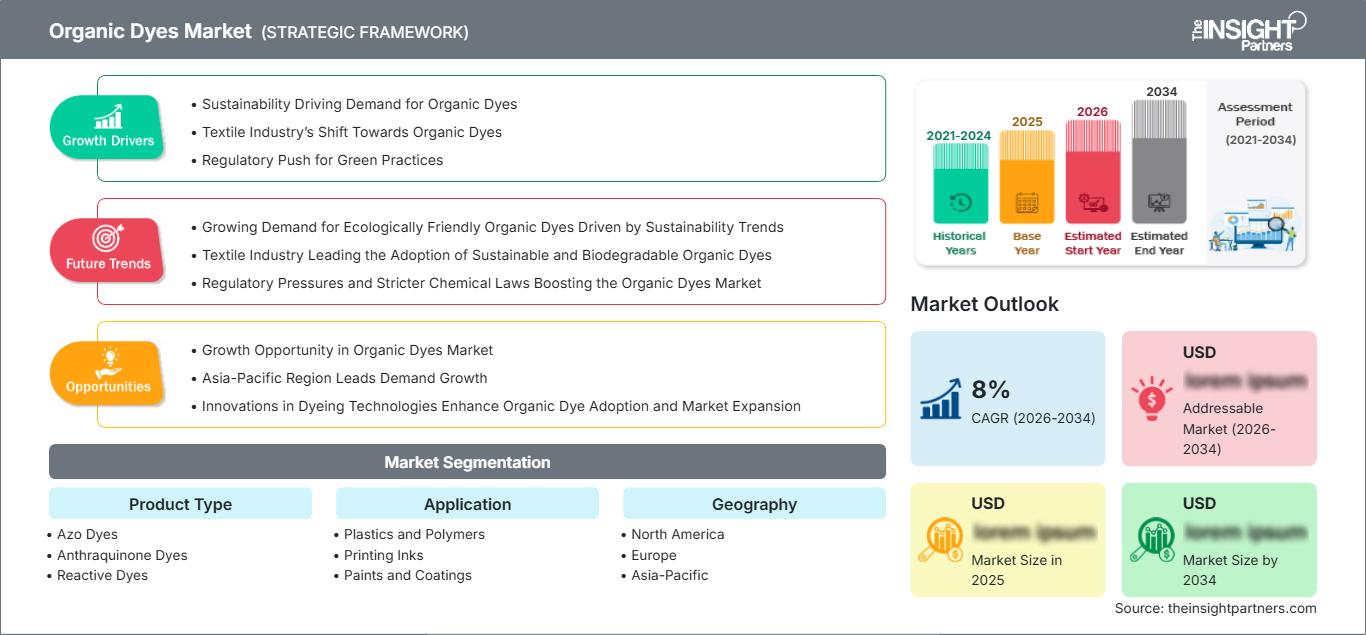
The organic dyes market was valued at US$ 728.79 Million in 2025 and is projected to reach US$ 1205.38 Million by 2034, expanding at a CAGR of 5.7% during 2026-2034. The market covers carbon-based colorants classified by source as Animals, Plants, and Others; by Product Type as Azo Dyes, Anthraquinone Dyes, Reactive Dyes, Sulfur Dyes, Disperse Dyes, Acid Dyes, and Others; and by End-User Industry as Agriculture, Paints and Coatings, Textiles, Detergents and Soaps, Pulp and Paper, Inks, Plastics, Food, Drug and Cosmetics, and Others. The scope includes dyes used to impart coloration where organic dye chemistry, application performance, regulatory compliance, and source characteristics influence purchasing decisions.
North America is expected to account for a ~17% share of the global market in 2025 and register a ~5.0% CAGR through 2034. The region benefits from stringent chemical and product-safety requirements, established textile and specialty chemical value chains, and growing demand for traceable colorants. The organic dyes market size in North America is also influenced by the shift toward naturally derived colorants in food and consumer products. In the US, regulatory scrutiny of color additives has intensified, including federal measures announced in 2025 to reduce petroleum-based food dyes and encourage alternatives from natural sources.
Organic Dyes Market Assessment and Insights
- North America: The region represents ~17% of the global market in 2025 and is projected to grow at a ~5.0% CAGR. Mature specialty chemical infrastructure and high compliance requirements support premium dye demand, while natural-source colorants create incremental applications. The implication is a market increasingly centered on certified, traceable, and application-specific products.
- U.S.: The US represents ~83% of the North American market in 2025 and is expected to expand at a ~4.9% CAGR. Food, drug, cosmetics, plastics, and specialty applications benefit from strict premarket color-additive controls, while recent federal action encouraging replacement of petroleum-based food dyes is increasing attention toward alternative color sources.
- Europe: Europe accounts for ~20% of the global market in 2025 and is forecast to grow at a ~4.8% CAGR. Germany, Italy, France, and the UK remain important because of textile processing, specialty chemicals, printing, coatings, and high-value consumer applications. The principal differentiator is regulatory and retailer pressure for safer chemistry, restricted-substance compliance, traceability, and lower-impact production.
- Asia Pacific: APAC holds ~49% of the global market in 2025 and is projected to grow at a ~6.2% CAGR. China, India, Japan, and South Korea combine large downstream manufacturing bases with extensive dye production and formulation capabilities. Textile manufacturing concentration, export-oriented dye production, and expanding local demand make the region the principal supply and consumption center.
- Largest Segment: Textiles is the largest main segment by End-User Industry and is expected to register a ~6.0% CAGR. Its position reflects the extensive use of reactive, disperse, sulfur, acid, and azo-based chemistries across cotton, polyester, polyamide, wool, and blended fabrics. Increasing demand for low-impact processing and high-fastness coloration supports continued expansion.
- High Growth Segment: Reactive Dyes is the high-growth main segment within Product Type, with a ~6.8% CAGR. Its growth is supported by cotton and cellulosic-fiber coloration, improved fixation technologies, lower-salt formulations, digitalized recipe management, and increasing demand for reproducible shades with lower water and effluent burdens.
- Key companies analyzed in detail: Archroma; DyStar; Kiri Industries; Colourtex Industries Pvt. Ltd.; BASF SE; Sumitomo Chemical Co., Ltd.; Zhejiang Longsheng Group Co., Ltd.; Tianyuan Group; Atul Ltd.; Everlight Chemical Industrial Corporation.
Source: The Insight Partners' analysis based on proprietary research, government publications, company annual reports, investor presentations, industry databases, and expert interviews.
The organic dyes market is transitioning from shade-and-price buying to performance, compliance, resource efficiency, and traceability. Increasingly, textile dyes companies will compete in terms of dye chemistry along with process technology, with emphasis on low salt reactive systems, pre-reduced indigo, resource efficient sulfur dyes, digital printing technology, and applications focused auxiliaries. The DyStar company combines textile dyes with resource efficiency initiatives, compliance support, and application technology, whereas the Archroma Company has increasingly tied coloration with reduced impact pretreat and finishing processes.
The supply base is also becoming more vertically integrated. Companies which have captive dye intermediates are better able to control their feedstock supply, shade consistency, environmental compliance, and production economics compared to companies which do not have captive dye intermediates. Indian producers like Kiri Industries and Atul are examples of the advantages offered by captive dye intermediates. Atul has its Colors division, comprising dye stuffs, pigments, intermediates, and application laboratories, while Kiri possesses manufacturing capacity for dyes as well as key intermediates.
The Organic Dyes Market Forecast will be determined by localization of compliant production, bio-feedstocks, waste-based colorants, and greater control over substances of concern. Regulations are especially important in Europe and North America, where increasing regulation and buyer preference based on other parameters than the color itself will determine the choice of products. Restrictions related to REACH and changing chemical management standards lead manufacturers to reformulate their products before the restrictions start impacting sales.
Commercial success is also shifting to circular feedstocks. The EarthColors technology of Archroma uses waste from agriculture and herbs for production of dye precursors. Its new technology FiberColors is an extension of the idea into waste-based colorants. This clearly demonstrates that future differentiation will be based not only on molecular performance, but on origin of the raw material as well.
Organic Dyes Market Report Scope
| Report Attribute | Details |
|---|---|
| Market size in 2025 | US$ 728.79 Million |
| Market Size by 2034 | US$ 1205.38 Million |
| Global CAGR (2026 - 2034) | 5.7% |
| Historical Data | 2021-2024 |
| Forecast period | 2026-2034 |
Organic Dyes Market Analysis
The demand/value chain revolves around the linkages of the downstream coloration needs and the availability of chemicals in the upstream sector. The organic dyes industry is fueled initially by the demands for dyed materials such as fabrics, ink, plastics, paper, coatings, and other products; it thus results in the requirements of shading, fastness, purification, efficiency, and fixation. Organic dye producers optimize the intermediate, synthesis, formulation, and technical services according to application requirements, resulting in the value being provided increasingly not only in dyes but rather in coloration systems that reduce the need for reprocessing, waste effluents, water usage, and compliance risks.
Supply dynamics are very crucial for azo, reactive, disperse, and sulfur dye chemistries owing to the dependence of production economics on intermediates, energy, environmental processing, and manufacturing scale. China remains critical for the global dye supply, whereas India is gaining strength due to its integrated production, exports, and development of compliant facilities. It thus leads to the competitive scenario wherein Asian suppliers possess strong scale efficiencies, while the multinationals gain competitive advantage increasingly via specialization in formulations, compliance, laboratories, and environmentally friendly product lines.
The organic dyes market report also reflects increased differentiation between commodity and specialty demand. Commodity textile dyes are still price-sensitive to raw material prices, textile consumption and inventories. Specialty textile dyes are more qualified dyes for technical textiles, high-performance polymers, food, cosmetics, digital printing, and regulated applications and hence more reliant on technical support and documentation. This allows suppliers to take advantage of opportunities to combine production scale with chemistry tailored to applications.
Competitive positioning is evolving through consolidation and portfolio integration. DyStar became wholly owned by Zhejiang Longsheng Group in 2026, reinforcing the link between one of the Asian dyestuff manufacturers and a global textile dye platform. The DyStar portfolio includes textile dyes, food-grade dyes, personal care pigments, inks, and technical dyes, which offers exposure to multiple end-user markets.
Archroma offers differentiated positioning through specialty textile coloration, sustainability-focused chemistry, and technical service. Its strategy increasingly emphasizes the connection between dyes and pretreatment technology. Colourtex and Atul also show competitive strength of India through R&D and production capabilities in reactive, disperse, acid, sulfur, direct, and other families of colorants. Atul's Colors offers textile, paints & coatings, plastics, printing inks, pulp & paper, food, and leather applications.
● REPORT CUSTOMIZATION
Tailor This Report To Align With Your Specific Business Requirements
This report can be customized to align precisely with your business objectives, scope, and target markets. Customization options include tailored segmentation, geography, competitive analysis, and strategic insights to support informed decision-making.
Customize This Report →WHAT YOU CAN ADJUST
- ● Segmentations
- ● Geography
- ● Competitive Analysis
- ● Language Preferences
Organic Dyes Market: Strategic Insights
Regional Insights
North America organic dyes market
North America is estimated to represent ~17% of the Organic Dyes Market Share in 2025 and is expected to grow at a ~5.0% CAGR. Market dynamics cover diverse end-user demands such as textiles, plastics, inks, coatings, food, pharmaceuticals, and cosmetics; however, regulation compliance plays an important role in product choice. More stringent product documentation, especially with respect to composition, authorized application, restricted substances, purity, and traceability is increasingly demanded by consumers.
U.S. organic dyes Market
The US accounts for ~83% of North American consumption and will grow at a ~4.9% CAGR. This market consists of a substantial consumer products sector and advanced specialty chemicals industry. Applications in food, drugs, and cosmetics have to follow approved application guidelines, whereas plastics and coatings demand improved thermal resistance and migration performance. The FDA moves against the use of petroleum derived food coloring has strengthened the business case for natural source dye and colorant systems.
Europe organic dyes market
Europe constitutes approximately 20% of the world’s market share and is estimated to have a CAGR of ~4.8%. The significance of Europe lies in its specialty chemicals, textile machinery, automotive materials, coatings, and technical uses. The significance of Italy lies in its fashion manufacturing and textile manufacturing and the demand that it creates for compliant and high performance coloration. France and the UK are significant for the fashion, cosmetics, packaging, printing, and consumer product applications that they create. European demand stands out in restricted substances management, chemical transparency, circularity demands, and scrutiny of hazardous inputs.
APAC Organic Dyes Market
The APAC region accounts for ~49% of the global demand and is expected to have a CAGR of ~6.2%, making it the largest regional market segment. China leads the way due to its complete dye and intermediate manufacturing facility as well as its extensive textile processing. India is becoming increasingly significant through its integrated dye manufacturing capability, exporting capacity, and environmentally compliant manufacturing facilities. Japan is significant due to its high-performance and specialized applications where purity, reliability, and technical compliance is demanded.
Middle East & Africa organic dyes market
The Middle East & Africa organic dyes market is supported by textile processing, construction-related coatings, plastics, packaging, detergents, and selected food and cosmetics applications. The region is estimated to account for ~7% of global demand in 2025 and is expected to expand at a ~5.5% CAGR through 2034. The market is influenced by the development of local manufacturing, import dependence for specialty dye chemistries, and investment in downstream processing.
The UAE and Saudi Arabia are strategically significant due to their existing infrastructure for importing chemical substances and geographical proximity to suppliers in Asia. While Türkiye is a country that lies both in Europe and Asia, it plays a special role in terms of the regional dye chain due to the textile production and exporting-oriented processing of fabric industry there. South Africa has a diverse industrial base, where demand is associated with textiles, coatings, plastic, paper, and specialized uses of dyes. Suppliers in the region enjoying strong technical support and imported supplies may find relatively low local production of complex dye systems advantageous.
South & Central America organic dyes market
The South & Central America organic dyes market is supported primarily by textile manufacturing, food and beverage processing, packaging, printing inks, plastics, paints and coatings, and consumer-product applications. The region is estimated to represent ~7% of global demand in 2025 and is projected to grow at a ~5.8% CAGR through 2034. Demand is closely linked to industrial production, consumer-goods manufacturing, and the development of value-added textile and packaging applications.
Brazil will be the main customer due to the wide variety of industrial activities and the presence of textile, food, cosmetic, plastic, paint, and packaging industries there. Mexico will also have strategic importance in terms of the supply chain because of its proximity to North American manufacturing hubs and the presence of the automotive, plastics, packaging, and textiles industries there. Argentina and Colombia will also represent customers for us due to food processing, consumer goods, coating, and textile uses. The region continues to rely on specialty dye imports, thus providing potential for our business.
Segmentation Analysis
Source
The Source segment distinguishes colorants according to Animals, Plants, and Others. Plant-derived inputs benefit from demand for renewable and recognizable raw materials, particularly in food, cosmetics, textiles, and premium consumer products. Animal-derived sources remain relevant in specific applications where established natural colorants provide distinctive shades or functional performance. Others include alternative biological and non-plant natural sources. Source-related differentiation is increasingly linked to traceability, certification, raw-material availability, and consumer acceptance. The segment is expected to expand at different rates as buyers balance natural origin against consistency, scalability, and cost.
- Animals: Supports established natural colorants where strong shade identity and traditional application performance are important. Its strategic position depends on source availability, ethical considerations, and application-specific acceptance.
- Plants: Benefits from interest in renewable and waste-derived feedstocks, especially in food, cosmetics, textiles, and premium products. Plant sourcing is increasingly connected with traceability and circularity.
- Others: Covers alternative organic sources and emerging feedstock routes. Adoption depends on reproducibility, regulatory acceptance, and the ability to achieve industrial-scale supply.
Product Type
Product Type is differentiated by chemical functionality, substrate compatibility, fixation mechanism, fastness, and process requirements. Reactive Dyes are expected to grow at a ~6.8% CAGR, supported by cellulosic textiles and process-efficiency improvements. Azo Dyes remain a major category because of their broad shade range and cost-performance characteristics, while Disperse Dyes benefit from polyester coloration. Anthraquinone, Sulfur, Acid, and other dye families maintain specialized positions based on fiber, fastness, and application requirements.
- Azo Dyes: Broadly used for their strong coloration and shade versatility. Demand is influenced by regulatory control of specific aromatic amines and substitution toward compliant structures.
- Anthraquinone Dyes: Valued for strong coloration and selected high-performance applications where light and chemical stability are important.
- Reactive Dyes: Strongly linked to cotton and cellulosic fibers, with adoption supported by improved fixation, wash-off, and lower-resource processing.
- Sulfur Dyes: Particularly relevant to economical dark shades, denim, cotton, paper, and selected industrial applications, with cleaner sulfur chemistry becoming increasingly important.
- Disperse Dyes: Closely associated with polyester and synthetic-fiber coloration, where dispersion quality, sublimation resistance, and fastness determine purchasing decisions.
- Acid Dyes: Used primarily where affinity toward protein and polyamide substrates is required, with leather, wool, nylon, and specialty applications supporting demand.
- Others: Covers additional organic dye chemistries used for specialized coloration requirements and applications outside the dominant product families.
End-User Industry
Textiles is the largest End-User Industry segment and is projected to grow at a ~6.0% CAGR because of high coloration intensity across apparel, home textiles, denim, sportswear, technical textiles, and synthetic fibers. Food, Drug and Cosmetics is another strategically important segment because regulatory approval and source transparency can support premium pricing and supplier differentiation. Inks and Plastics benefit from digital printing, packaging, polymer coloration, and demand for stable colorants.
- Agriculture: Includes colorants used in seed treatments, agricultural formulations, and identification systems. Demand is linked to formulation visibility and product differentiation.
- Paints and Coatings: Requires compatibility, dispersion, weatherability, and shade stability. Decorative and industrial coatings provide distinct technical requirements.
- Textiles: The principal application base, spanning natural and synthetic fibers. Fastness, reproducibility, resource efficiency, and restricted-substance compliance drive supplier selection.
- Detergents and Soaps: Uses colorants to support product identity and visual differentiation. Compatibility, stability, and controlled coloration are important purchasing criteria.
- Pulp and Paper: Requires dyes that provide strong coloration and process compatibility across paper grades, packaging, and specialty papers.
- Inks: Benefits from digital printing, packaging, and specialty printing. Purity, solubility, stability, and print performance are central adoption factors.
- Plastics: Demand is linked to polymer compatibility, thermal stability, migration control, and consistent coloration during processing.
- Food, Drug and Cosmetics: Highly regulated applications where permitted-use status, purity, labeling, safety, and source characteristics determine adoption.
- Others: Includes specialized applications where performance requirements differ from the principal end-use industries and where technical qualification can create niche opportunities.
Opportunity Snapshot
| End-User Industry | Revenue Contribution | Trend Tag | Adoption Stage |
| Agriculture | Medium | Seed marking | Scaling |
| Paints and Coatings | Medium | Durable color | Mature |
| Textiles | High | Low-impact dyeing | Mature |
| Detergents and Soaps | Low | Stable shades | Mature |
| Pulp and Paper | Medium | Fiber coloration | Mature |
| Inks | Medium | Digital printing | Scaling |
| Plastics | Medium | Heat stability | Scaling |
| Food, Drug and Cosmetics | High | Natural substitution | Scaling |
| Others | Low | Specialty uses | Emerging |
Organic Dyes Market Growth Drivers and Impact Analysis
Expansion of lower-impact textile coloration
Textile mills face simultaneous pressure to reduce water, energy, chemical consumption, and effluent while preserving shade depth and fastness. This encourages adoption of reactive, sulfur, indigo, and disperse systems designed around improved exhaustion, washing, or processing efficiency. Suppliers that combine dye chemistry with recipe optimization and technical support can capture more value because mills increasingly evaluate total processing performance rather than dye price alone.
Regulatory pressure on hazardous colorants
Restrictions on specific aromatic amines, restricted substances, and other chemical inputs are accelerating substitution toward compliant dye structures. The mechanism is direct: tighter regulations increase testing and qualification requirements, which raises the cost of maintaining legacy products and favors suppliers with strong analytical capabilities. This supports specialty formulations and encourages manufacturers to design new molecules around anticipated regulatory requirements.
Demand for natural and renewable color sources
Natural-source colorants are gaining attention in food, cosmetics, textiles, and premium consumer goods because source transparency increasingly affects purchasing. The US regulatory direction toward reducing petroleum-based food dyes strengthens this driver. In textiles, waste-derived technologies provide an alternative route by converting agricultural or biological residues into performance-oriented dyes rather than relying exclusively on conventionally extracted natural materials.
Growth of polyester and synthetic-fiber coloration
Expansion of polyester and blended fabrics sustains demand for disperse and specialty dye systems. Synthetic fibers require controlled particle size, dispersion stability, high-temperature processing performance, and resistance to sublimation and washing. Consequently, the market is moving toward formulations optimized for specific fiber and machine conditions, increasing the role of application laboratories and technical service.
Organic Dyes Market Future Trends
Traceable feedstock becomes part of colorant qualification
The organic dyes market trends increasingly connect color performance with raw-material provenance. Buyers in textiles, food, and cosmetics are becoming more interested in where colorant inputs originate, whether they contain restricted substances, and whether claims such as renewable or waste-derived can be substantiated. This creates a structural shift from product-level certification toward supply-chain transparency.
Waste-derived dyes move toward commercial scale
Agricultural residues, food-processing waste, and other biological streams are moving beyond experimental use into branded coloration systems. Archroma's EarthColors platform demonstrates how waste-derived feedstocks can be converted into commercial textile dyes, while FiberColors extends the concept to wool waste. The implication is that future dye innovation can combine circular feedstocks with conventional performance expectations rather than positioning natural coloration solely as a niche aesthetic proposition.
Digital printing changes dye formulation requirements
Growth in digital textile printing is increasing demand for purified, reproducible, highly stable dyes that can pass through precision printheads. This changes supplier economics because performance depends not only on color strength but also on particle control, solubility, filtration, storage stability, and substrate compatibility. Suppliers with digital-printing expertise can therefore build differentiated positions within otherwise mature dye categories.
Compliance shifts from documentation to design
Chemical compliance is increasingly incorporated during molecular and formulation development rather than handled after commercialization. Producers are removing problematic substances, designing cleaner synthesis routes, and aligning products with retailer restricted-substance lists and certification systems. This trend raises R&D requirements but can shorten customer qualification cycles and protect products against future regulatory disruption.
Organic Dyes Market Opportunities
Waste-derived colorants for premium textiles and consumer brands
A major opportunity lies in converting agricultural, food-processing, and other biological waste into traceable dye feedstocks for textile brands seeking circularity credentials. The target customers include premium apparel companies, denim producers, and mills serving sustainability-focused brands. The principal barrier is maintaining shade consistency, scalable feedstock supply, and industrial reproducibility. Suppliers that establish standardized waste streams and integrated synthesis routes can differentiate beyond conventional natural dyes.
Compliant specialty dyes for regulated consumer applications
Food, drug, and cosmetics manufacturers in the Organic Dyes Market Forecast offer an attractive opportunity for suppliers able to provide colorants with strong purity control, regulatory documentation, and reliable global supply. The US shift toward natural-source colorants creates additional space for plant-derived and other approved alternatives. Beneficiaries include integrated colorant manufacturers, formulation specialists, and producers capable of supporting customers through approval, qualification, and scale-up requirements.
Recent Developments
- April 2026: Archroma - Archroma presented sustainable textile coloration technologies at China Interdye 2026, highlighting resource-efficient dyeing, cleaner chemistries, and integrated textile-processing systems. The event strengthened Archroma's engagement with China's large textile manufacturing ecosystem and demonstrated how dye suppliers are competing through combined coloration, process efficiency, and regulatory compliance rather than through dye products alone.
- June 2025: BASF SE - BASF introduced Ultramid Advanced N3U42G6 for high-voltage electrical and electronic applications, emphasizing color stability and compatibility with organic and inorganic colorants. The development illustrates the expansion of high-performance organic colorants into engineered plastics, where thermal stability, long-term color retention, and material compatibility are increasingly important selection criteria.
Frequently Asked Questions

- Comprehensive Market Sizing and Forecast Analysis
- Detailed Segmentation Analysis
- In-Depth Market Dynamics Assessment
- Regional and Country-Level Insights
- Competitive Landscape and Company Benchmarking
- Strategic Business Intelligence
Recent Reports
Testimonials

The Insight Partners provided valuable market intelligence that supported our global go-to-market strategy. Their team was professional, responsive, and attentive to our feedback, providing thoughtful analysis and helpful methodological clarifications throughout the project.
Junmo Kim Chief Financial Officer (CFO), Enertech Co., Ltd.
The Insight Partners' SCADA System Market report is comprehensive, with valuable insights on current trends and future forecasts. The team was highly professional, responsive, and supportive throughout. We are very satisfied and highly recommend their services.
RAN KEDEM Partner, Reali Technologies LTDs
I requested a report on a very specific software market and the team produced the report in a few days. The information was very relevant and well presented. I then requested some changes and additions to the report. The team was again very responsive and I got the final report in less than a week.
JEAN-HERVE JENN Chairman, Future Analytica
We worked with The Insight Partners for an important market study and forecast. They gave us clear insights into opportunities and risks, which helped shape our plans. Their research was easy to use and based on solid data. It helped us make smart, confident decisions. We highly recommend them.
PIYUSH NAGPAL Sr. Vice President, High Beam Global
The Insight Partners delivered insightful, well-structured market research with strong domain expertise. Their team was professional and responsive throughout. The user-friendly website made accessing industry reports seamless. We highly recommend them for reliable, high-quality research services
YUKIHIKO ADACHI CEO, Deep Blue, LLC.
This is the first time I have purchased a market report from The Insight Partners.While I was unsure at first, I visited their web site and felt more comfortable to take the risk and purchase a market report.I am completely satisfied with the quality of the report and customer service. I had several questions and comments with the initial report, but after a couple of dialogs over email with their analyst I believe I have a report that I can use as input to our strategic planning process.Thank you so much for taking the extra time and making this a positive experience.I will definitely recommend your service to others and you will be my first call when we need further market data.
JOHN SUZUKI President and Chief Executive Officer, Board Director, BK Technologies
I wish to appreciate your support and the professionalism you displayed in the course of attending to my request for information regarding to infectious disease IVD market in Nigeria. I appreciate your patience, your guidance, and the fact that you were willing to offer a discount, which eventually made it possible for us to close a deal. I look forward to engaging The Insight Partners in the future, all thanks to the impression you have created in me as a result of this first encounter.
DR CHIJIOKE ONYIA MANAGING DIRECTOR, PineCrest Healthcare Ltd.Reason to Buy
- Informed Decision-Making
- Understanding Market Dynamics
- Competitive Analysis
- Identifying Emerging Markets
- Customer Insights
- Market Forecasts
- Risk Mitigation
- Boosting Operational Efficiency
- Strategic Planning
- Investment Justification
- Tracking Industry Innovations
- Aligning with Regulatory Trends





 Get Free Sample for