
Outdoor Air Quality Monitors Market Share, Growth & Forecast by 2034
Coverage: By Type (Fixed Monitors, Portable Monitors); Application (Environmental Impact Assessments, Personal Exposure Studies, Mobile Air Quality Surveys, Others) , and Geography (North America, Europe, Asia Pacific, and South and Central America)
- Status : Data Released
- Report Code : TIPRE00017731
- Category : Electronics and Semiconductor
- No. of Pages : 150
- Available Report Formats :


- Last update date : October 15, 2026


2025 Market Size
US$ 393.37 Mn
Base year value
2034 Forecast
US$ 625.17 Mn
Projected by 2034
CAGR 2026-2034
5.28 %
Growth rate
Addressable Market
US$ 4,619.54 Mn
(2026-2034)
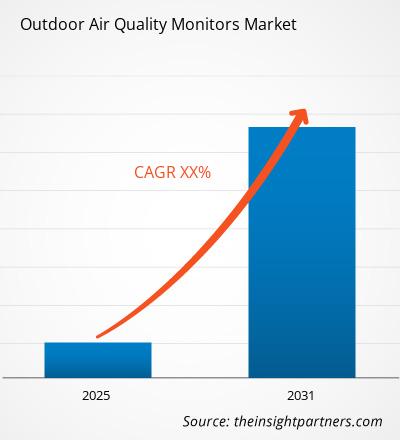
The outdoor Air Quality Monitors Market growth is being shaped by increasing global regulatory emphasis on pollution surveillance and environmental compliance. The market, valued at US$ 393.37 Million in 2025, is forecast to reach US$ 625.17 Million by 2034, advancing at a CAGR of 5.28% between 2026 and 2034. Expanding municipal air-quality monitoring networks, stricter industrial emissions compliance, and rising public health awareness collectively sustain steady procurement of fixed and portable sensing instrumentation worldwide.
North America is estimated to expand at a CAGR ranging between 4.5% and 5.5% through 2034, supported by stringent Environmental Protection Agency compliance mandates and expanding smart-city environmental sensing infrastructure. Continued municipal investment in real-time pollution tracking networks, combined with growing wildfire-related air quality monitoring needs, reinforces structural demand across state and federal agency procurement channels throughout the forecast period.
Outdoor Air Quality Monitors Market Assessment and Insights
- North America: The region held an estimated 30-33% share in 2025, growing at a CAGR of 4.5-5.5% between 2026 and 2034, supported by regulatory compliance mandates and expanding municipal pollution-monitoring network deployments.
- US: The United States contributes roughly 84-87% of North America's revenue in 2025, growing at a CAGR of 4.5-5.3% from 2026 to 2034, led by federal agency procurement.
- Europe: Europe held around 26-29% share in 2025 and is projected to grow at a CAGR of 5-6% through 2034, with Germany, the UK, and France leading regional deployment through stringent emissions directives.
- Asia Pacific: APAC accounted for approximately 27-30% share in 2025, forecast to expand at a CAGR of 6.5-7.5% between 2026 and 2034, led by China, India, and South Korea through industrial pollution-control programs.
- Largest Segment: Fixed Monitors, under Type, held an estimated 62-66% share in 2025 and are projected to grow at a CAGR of 4.8-5.5% between 2026 and 2034, owing to widespread regulatory network installations.
- High Growth Segment: Mobile Air Quality Surveys, under Application, held roughly 18-21% share in 2025 and is expected to expand at a CAGR of 7-8% between 2026 and 2034, driven by rising mobile-sensing deployment.
- Key companies analyzed in detail: 3M Company, Emerson Electric Co., Horiba, Ltd., Merck KGaA, Siemens AG, Spectris plc, Teledyne Technologies Incorporated, Testo SE & Co. KGaA, Thermo Fisher Scientific Inc., TSI Incorporated.
Source: The Insight Partners' analysis based on proprietary research, government publications, company annual reports, investor presentations, industry databases, and expert interviews.
The evolution of outdoor air quality monitoring instruments has moved from big reference equipment to small and connected sensor nodes, which can transmit data remotely on a continuous basis. The production process for such devices is moving towards modular electrochemical and optical sensors that will be able to reduce the need for regular calibration and cut down on the cost of implementing such monitoring devices.
In the future, the emerging economies of Southeast Asia, Latin America, and Africa are going to see growing investments in monitoring infrastructure due to rising particulate and gaseous pollution caused by increasing urbanization. In addition to regulatory support in the form of growing national air quality monitoring standards corresponding to the ones set by WHO, investments in an affordable sensor network will grow in the next ten years.
Outdoor Air Quality Monitors Market Report Scope
| Report Attribute | Details |
|---|---|
| Market size in 2025 | US$ 393.37 Million |
| Market Size by 2034 | US$ 625.17 Million |
| Global CAGR (2026 - 2034) | 5.28% |
| Historical Data | 2021-2024 |
| Forecast period | 2026-2034 |
Outdoor Air Quality Monitors Market Analysis
Outdoor air quality monitors market growth is fundamentally anchored in escalating regulatory pressure requiring continuous ambient pollution surveillance across urban, industrial, and rural environments. The value chain covers sensor component suppliers, instrument assembly firms, and calibrating services firms that work together towards efficient monitoring. Public concerns about health consequences arising from particulate matter and ozone continue to increase the target market for stationary as well as portable monitoring systems.
There is moderate consolidation in the supply chain, with respect to analytical instruments firms, resulting in efficient calibration and service support, along with eventual price competition from emerging players in the sensors technology space. Instrument firms are now including data platform services along with their hardware in order to establish an edge in analytics. Personal exposure studies and mobile air quality measurement represent new sources of demand for the firm.
This outdoor air quality monitors market analysis reveals a moderately consolidated competitive landscape shaped by continuous sensor-precision differentiation. Thermo Fisher Scientific Inc. and Teledyne Technologies Incorporated maintain leadership through reference-grade regulatory monitoring instrumentation, while Horiba, Ltd. and Siemens AG compete through integrated industrial emissions and ambient monitoring platforms serving compliance-driven clients across multiple end-use verticals globally.
The Outdoor Air Quality Monitors Market size continues to expand as investment activity intensifies around low-cost sensor networks and data analytics integration. TSI Incorporated and Testo SE & Co. KGaA are expanding portable monitoring portfolios targeting research and occupational-exposure applications. 3M Company and Emerson Electric Co. continue strengthening industrial emissions-monitoring capabilities, while Merck KGaA and Spectris plc reinforce their analytical instrumentation positioning through calibration-service expansion and strategic acquisitions across environmental monitoring technology segments.
● REPORT CUSTOMIZATION
Tailor This Report To Align With Your Specific Business Requirements
This report can be customized to align precisely with your business objectives, scope, and target markets. Customization options include tailored segmentation, geography, competitive analysis, and strategic insights to support informed decision-making.
Customize This Report →WHAT YOU CAN ADJUST
- ● Segmentations
- ● Geography
- ● Competitive Analysis
- ● Language Preferences
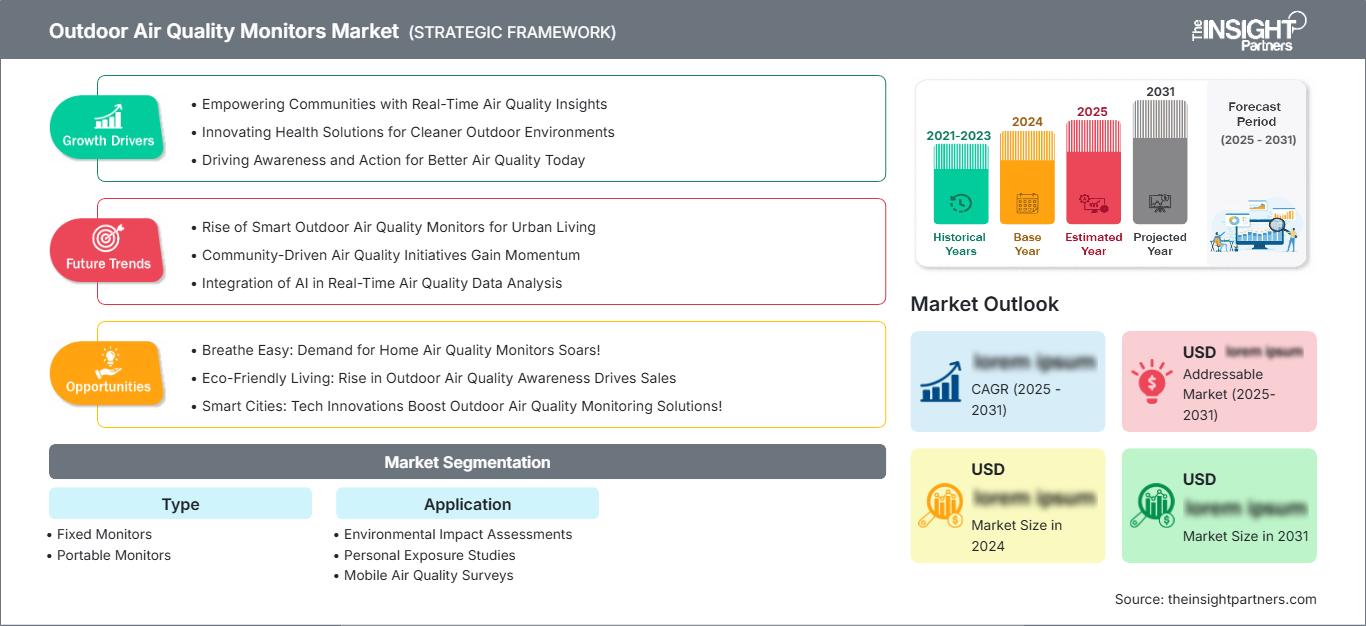
Outdoor Air Quality Monitors Market: Strategic Insights
Regional Insights
North America Outdoor Air Quality Monitors Market
North America's outdoor air quality monitors market share stood at an estimated 30-33% in 2025, supported by established Environmental Protection Agency compliance frameworks and expanding municipal pollution-monitoring networks. The region is forecast to grow at a CAGR of 4.5-5.5% between 2026 and 2034. Sustained federal and state agency procurement continues reinforcing steady demand for regulatory-grade fixed monitoring instrumentation across metropolitan air-quality districts nationwide throughout the forecast period.
Structural drivers include tightening national ambient air-quality standards, rising wildfire-smoke monitoring requirements across western states, and growing industrial emissions compliance obligations. Canada contributes a smaller yet steadily expanding share, supported by federal environmental monitoring modernization initiatives. Overall, the region's growth trajectory remains anchored in network densification and instrument replacement cycles rather than first-time monitoring infrastructure establishment, distinguishing it from faster-growing emerging markets across Asia Pacific.
U.S. Outdoor Air Quality Monitors Market
The United States commands approximately 84-87% of North America's total revenue in 2025, growing at a CAGR of 4.5-5.3% through 2034. Widespread availability of top instrumentation makers like Thermo Fisher Scientific Inc. and Teledyne Technologies Incorporated strengthens supply and calibration services locally, as national air quality monitoring regulations continue to increase instrument acquisition among state environmental agencies.
Deployment of the technology in environmental impact assessment due to industrial permitting needs, as well as increased adoption in personal exposure studies at research institutes and academic organizations, is becoming more prevalent. Increased frequency of wildfires in Western states is leading to an increase in mobile air quality monitoring systems acquisition. Portable instrumentation is seeing increased adoption among occupational health programs, with increasing compliance needs in workplaces.
Europe Outdoor Air Quality Monitors Market
Europe Outdoor Air Quality Monitors Market Trends indicate steady expansion, with the region accounting for an estimated 26–29% share of the global market in 2025 and projected to grow at a CAGR of 5–6% between 2026 and 2034. Key trends include expanding ambient air quality monitoring networks, stricter industrial emissions compliance, growing adoption of real-time pollution sensing technologies, and increasing deployment of connected monitoring platforms. Germany remains a major demand center, supported by stringent environmental regulations, substantial manufacturing activity, and government investment in metropolitan air quality monitoring networks.
The United Kingdom is not far behind owing to its air-quality improvement plans and growing requirements for low-emission zone monitoring in cities. Demand in Germany increases owing to industrial emissions permits and automotive sector monitoring. France, Italy, and Spain combined provide consistent demand due to EU ambient air quality directive compliance, urban pollution mapping, and increasing use of portable monitors in research and city bodies in southern Europe.
APAC Outdoor Air Quality Monitors Market
Asia Pacific held an estimated 27-30% share in 2025 and is projected to expand at a CAGR of 6.5-7.5% through 2034, the fastest among all regions. Leading regional demand is from China, backed up by industrial pollution control systems and urban monitoring networks deployed extensively. India and South Korea provide support with their growing air quality monitoring programs in the country, while Japan contributes steadily with its well-established infrastructure of industrial compliance. Australia demonstrates increasing wildfire monitoring needs. Policy backing for national clean air programs and industrial emissions control is continuously helping the region grow in terms of monitoring networks and instrument acquisition.
Middle East & Africa Outdoor Air Quality Monitors Market
The Middle East and Africa region is forecast to grow at a CAGR of 5.5-6.5% between 2026 and 2034, led by Saudi Arabia and the United Arab Emirates through national environmental monitoring and smart-city infrastructure programs. Government-backed industrial emissions compliance initiatives continue driving instrumentation procurement across major petrochemical and construction development projects regionwide.
South Africa contributes through mining-sector and industrial emissions monitoring adoption, while the Rest of MEA shows gradual uptake tied to urbanization-driven pollution concerns. Infrastructure investment linked to energy-sector diversification programs across Gulf economies is increasingly incorporating ambient air-quality monitoring within smart-city and industrial-facility environmental frameworks.
Segmentation Analysis
Type
The Type segment is projected to grow at a CAGR of 4.8-5.8% between 2026 and 2034. This outdoor air quality monitors market scope reflects sustained regulatory reliance on fixed reference-grade stations alongside rising portable instrumentation adoption for flexible, localized monitoring campaigns. Type selection increasingly balances measurement precision against deployment flexibility requirements across government, industrial, and research end-use environments, shaping procurement strategies industrywide considerably.
- Fixed Monitors: This dominant instrumentation type anchors regulatory compliance networks, offering continuous reference-grade measurement favored by government agencies operating permanent ambient air-quality monitoring stations across urban and industrial zones.
- Portable Monitors: This flexible instrumentation type supports localized and mobile monitoring campaigns, favored across research institutions and occupational-exposure programs requiring adaptable, field-deployable pollution measurement capability.
Application
The Application segment is estimated to expand at a CAGR of 5.5-6.5% between 2026 and 2034. Environmental impact assessments remain the largest contributor given regulatory permitting requirements, while personal exposure studies and mobile air quality surveys are emerging as incremental growth pools. Rising research funding continues to reinforce steady procurement, collectively diversifying demand beyond traditional government-network deployment into academic and specialized field-monitoring environments.
- Environmental Impact Assessments: This segment leads application demand through regulatory permitting compliance for industrial and infrastructure projects, supported by continuous environmental review requirements across construction and manufacturing development activities.
- Personal Exposure Studies: This segment reflects steady demand from academic and public-health research institutions studying pollutant exposure patterns, supported by sustained government and institutional research-funding allocations worldwide.
- Mobile Air Quality Surveys: This segment is expanding rapidly through vehicle-mounted and drone-based monitoring campaigns, supported by rising demand for granular spatial pollution mapping across dense urban corridors.
Opportunity Snapshot
| Application | Revenue Contribution | Trend Tag | Adoption Stage |
| Environmental Impact Assessments | High | Permitting Compliance | Mature |
| Personal Exposure Studies | Medium | Research Funding | Scaling |
| Mobile Air Quality Surveys | Medium | Drone Mapping | Emerging |
Outdoor Air Quality Monitors Market Growth Drivers and Impact Analysis
Tightening National Ambient Air Quality Regulatory Standards
Governments worldwide continue tightening ambient air-quality standards aligned with World Health Organization exposure guidelines, directly compelling environmental agencies to expand ground-level monitoring network density. This regulatory tightening requires additional fixed-station deployment and more frequent instrument calibration cycles, sustaining consistent procurement demand from public-sector environmental bodies. Industrial facilities operating under revised emissions permits must correspondingly upgrade compliance monitoring equipment to satisfy updated reporting thresholds. Regulatory bodies across North America, Europe, and increasingly Asia Pacific are mandating real-time public data disclosure, requiring networked instrumentation capable of continuous transmission. This structural regulatory momentum provides instrumentation manufacturers with predictable, non-discretionary demand less exposed to broader economic cyclicality, positioning compliance-driven procurement as one of the most stable revenue foundations supporting long-term market expansion across developed and developing regulatory jurisdictions alike.
Rising Urban Pollution Awareness Driving Municipal Monitoring Investment
Growing public awareness of health impacts associated with particulate matter, ground-level ozone, and nitrogen dioxide exposure is prompting municipal governments to expand dense urban monitoring grids beyond traditional single-station regulatory networks. Citizens and advocacy organizations increasingly demand transparent, real-time pollution data access, pushing city administrations toward networked low-cost sensor deployment, supplementing reference-grade instrumentation. Smart-city development programs across major metropolitan regions are integrating air-quality sensing within broader environmental infrastructure investment, creating bundled procurement opportunities for instrumentation suppliers. This awareness-driven demand extends beyond regulatory minimums, as municipalities pursue granular neighborhood-level pollution mapping to inform urban planning, traffic management, and public health advisories, reinforcing sustained instrumentation procurement across both developed and rapidly urbanizing metropolitan centers globally.
Industrial Emissions Compliance Across Expanding Manufacturing Sectors
Industrial expansion and growth in manufacturing operations within emerging economies have created a consistent need for outdoor emissions monitoring equipment, where operators need to meet certain levels of compliance in order to obtain permits and operate their facilities. The petrochemical, cement, steel, and power generation industries constitute particularly instrument-focused industries because of the high level of emissions reporting required under the environmental regulations of each country or region. The use of continuous emission monitoring equipment in tandem with ambient boundary monitoring is increasingly being adopted by facility operators in an effort to exhibit their environmental responsibilities to regulators and nearby communities. This creates an industrial compliance channel for instrument makers that provides ongoing calibration services along with the sale of new equipment.
Outdoor Air Quality Monitors Market Future Trends
Integration of Low-Cost Sensor Networks with Reference-Grade Validation
The emerging trends in outdoor air quality monitors have begun showing signs of hybrid monitoring systems that combine dense networks of inexpensive sensors along with reference-grade calibration verification done periodically. This helps the cities to get the spatially dense measurements, which were not possible earlier owing to their high costs under the conventional fixed station system, but the accuracy can be maintained with algorithmic corrections using the reference grade instrument. The instrument makers are working on a calibration as a service product that would help them generate ongoing revenue streams in addition to the one-off hardware sales.
Satellite and Ground-Based Monitoring Data Convergence
It can be forecasted that the growing convergence of satellite data on atmospheric composition and ground monitoring systems will affect how pollution mapping methods are used in the coming decade. Growing use by environmental organizations of satellite observations in conjunction with ground truth instruments is aiding the validation of regional pollution models, as well as discovering any gaps in monitoring networks that necessitate new stations being added. The growing trend of convergence allows for more intelligent placement of instruments, enabling better allocation of capital to those regions that require the most validation of data.
Outdoor Air Quality Monitors Market Opportunities
Expansion into Emerging Market Municipal Monitoring Networks
Fast-urbanizing economies in Southeast Asia, Latin America, and Africa represent a significant unpenetrated market opportunity for instrumentation that can monitor outdoors, as municipalities in these countries start building their base ambient air-quality monitoring systems. Increased health concerns caused by worsening urban pollution, together with the financial aid from development programs targeted at environmental infrastructure, provide a new sales channel for the providers of affordable fixed and mobile monitoring devices. Providers of rugged instrumentation capable of scaling up according to the needs of constrained municipal budgets have an opportunity to establish themselves early in these nascent monitoring markets. Partnering with development agencies and multilaterals, which finance and assist technically with these programs, provides a viable way to enter these markets, as the specific financing and technical assistance needs distinguish emerging-market municipal procurement from existing regulatory markets. The market opportunity is not yet tapped as much as in the mature North American and European markets.
Data Analytics and Software Platform Investment
The investment in cloud-based data analytics platforms, combined with monitoring equipment, offers a significant opportunity for diversifying sources of income since customers are looking to get more insights from pollution rather than just monitoring devices. The need exists for an all-in-one dashboard that will help automate regulatory reporting, make data available to the public, and forecast future trends in pollution. In this case, instrument manufacturers who develop their own ecosystems can generate recurring subscriptions. This opportunity, outdoor air quality monitors market forecasts suggest, will accelerate particularly among enterprise and government customers managing multi-site monitoring networks requiring centralized data aggregation, positioning software-integrated instrumentation suppliers favorably against hardware-only competitors through the coming decade of digital environmental-management adoption.
Frequently Asked Questions

- Comprehensive Market Sizing and Forecast Analysis
- Detailed Segmentation Analysis
- In-Depth Market Dynamics Assessment
- Regional and Country-Level Insights
- Competitive Landscape and Company Benchmarking
- Strategic Business Intelligence
Recent Reports
Testimonials

The Insight Partners provided valuable market intelligence that supported our global go-to-market strategy. Their team was professional, responsive, and attentive to our feedback, providing thoughtful analysis and helpful methodological clarifications throughout the project.
Junmo Kim Chief Financial Officer (CFO), Enertech Co., Ltd.
The Insight Partners' SCADA System Market report is comprehensive, with valuable insights on current trends and future forecasts. The team was highly professional, responsive, and supportive throughout. We are very satisfied and highly recommend their services.
RAN KEDEM Partner, Reali Technologies LTDs
I requested a report on a very specific software market and the team produced the report in a few days. The information was very relevant and well presented. I then requested some changes and additions to the report. The team was again very responsive and I got the final report in less than a week.
JEAN-HERVE JENN Chairman, Future Analytica
We worked with The Insight Partners for an important market study and forecast. They gave us clear insights into opportunities and risks, which helped shape our plans. Their research was easy to use and based on solid data. It helped us make smart, confident decisions. We highly recommend them.
PIYUSH NAGPAL Sr. Vice President, High Beam Global
The Insight Partners delivered insightful, well-structured market research with strong domain expertise. Their team was professional and responsive throughout. The user-friendly website made accessing industry reports seamless. We highly recommend them for reliable, high-quality research services
YUKIHIKO ADACHI CEO, Deep Blue, LLC.
This is the first time I have purchased a market report from The Insight Partners.While I was unsure at first, I visited their web site and felt more comfortable to take the risk and purchase a market report.I am completely satisfied with the quality of the report and customer service. I had several questions and comments with the initial report, but after a couple of dialogs over email with their analyst I believe I have a report that I can use as input to our strategic planning process.Thank you so much for taking the extra time and making this a positive experience.I will definitely recommend your service to others and you will be my first call when we need further market data.
JOHN SUZUKI President and Chief Executive Officer, Board Director, BK Technologies
I wish to appreciate your support and the professionalism you displayed in the course of attending to my request for information regarding to infectious disease IVD market in Nigeria. I appreciate your patience, your guidance, and the fact that you were willing to offer a discount, which eventually made it possible for us to close a deal. I look forward to engaging The Insight Partners in the future, all thanks to the impression you have created in me as a result of this first encounter.
DR CHIJIOKE ONYIA MANAGING DIRECTOR, PineCrest Healthcare Ltd.Reason to Buy
- Informed Decision-Making
- Understanding Market Dynamics
- Competitive Analysis
- Identifying Emerging Markets
- Customer Insights
- Market Forecasts
- Risk Mitigation
- Boosting Operational Efficiency
- Strategic Planning
- Investment Justification
- Tracking Industry Innovations
- Aligning with Regulatory Trends





 Get Free Sample for