
Paper and Paperboard Market Size, Growth & Trends by 2034
Coverage: By Grade (Solid Bleached Sulfate, Coated Unbleached Kraft Paperboard, Folding Box Board, Glassine and Greaseproof Paper, Others); End-User Industry (Food and Beverage, Healthcare, Consumer Goods, Others) , and Geography (North America, Europe, Asia Pacific, and South and Central America)
- Status : Data Released
- Report Code : TIPRE00018686
- Category : Chemicals and Materials
- No. of Pages : 150
- Available Report Formats :


- Last update date : September 17, 2026


2025 Market Size
US$ 385.2 Bn
Base year value
2034 Forecast
US$ 519.78 Bn
Projected by 2034
CAGR 2026-2034
3.39 %
Growth rate
Addressable Market
US$ 4,110.83 Bn
(2026-2034)
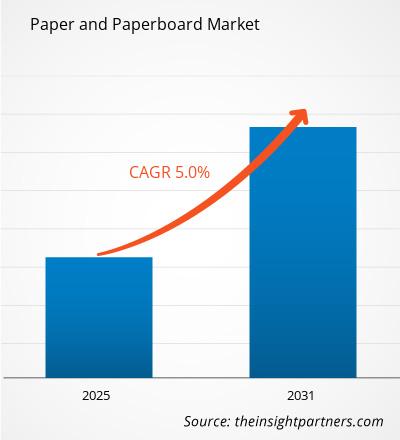
The Paper and Paperboard Market is positioned for steady expansion as food packaging, healthcare formats, consumer goods packaging, and retail applications continue shifting toward recyclable fiber-based materials. The market is valued at US$ 385.2 Billion in 2025 and is projected to reach US$ 519.78 Billion by 2034, advancing at a CAGR of 3.39% from 2026 to 2034. Growth is supported by packaging substitution, product innovation, and increasing emphasis on circular material systems.
North America remains an important production and consumption center, supported by established recycling infrastructure, food and beverage packaging demand, and investments in lightweight grades. The region is estimated to expand at a 3.1–3.6% CAGR from 2026 to 2034. The Paper and Paperboard Market size outlook also benefits from e-commerce fulfillment, healthcare packaging, and continued demand for high-performance folding and corrugated formats.
Paper and Paperboard Market Assessment and Insights
- North America: North America is estimated to account for a 24–27% Paper and Paperboard Market share in 2025 and grow at a 3.1–3.6% CAGR between 2026–2034, supported by mature converting capacity, food packaging demand, recycling infrastructure, and lightweighting initiatives.
- U.S.: The U.S. represents approximately 20–23% of the North American market in 2025, with a growth of 3.0–3.5% CAGR between 2026 and 2034, supported by foodservice, e-commerce, healthcare, and retail packaging.
- Europe: Europe holds an estimated 22–25% share in 2025 and is expected to grow at 2.8–3.4% CAGR between 2026–2034, led by Germany, Italy, France, the UK, and Spain, where recyclability and packaging regulations influence material selection.
- Asia Pacific: Asia Pacific commands approximately 38–42% share in 2025 and is projected to expand at 3.7–4.3% CAGR between 2026–2034, led by China, Japan, India, South Korea, and Southeast Asian packaging manufacturing hubs.
- Largest Segment: Folding Box Board is estimated to hold a 22–26% market share in 2025 and grow at 3.4–3.9% CAGR between 2026 and 2034, supported by food, beverage, and consumer packaging.
- High Growth Segment: Healthcare within end use is estimated at a 9–12% share in 2025, with 4.1–4.7% CAGR between 2026–2034, reflecting pharmaceutical and medical packaging requirements.
- Key companies analyzed in detail: Amcor plc, Cascades Inc., Clearwater Paper Corporation, DS Smith Plc, International Paper Company, Mondi plc, Nippon Paper Industries Co., Ltd., Oji Holdings Corporation, Smurfit Westrock plc, Stora Enso Oyj.
Source: The Insight Partners' analysis based on proprietary research, government publications, company annual reports, investor presentations, industry databases, and expert interviews.
The Paper and Paperboard market has developed further with a focus on lightweighting, barrier properties, recycled fiber content, and converting. Paper manufacturers are optimizing fiber composition, coating technologies, surface treatments, and production efficiency in order to enhance the functionality of the product, as well as lower the intensity of the material. The integrated manufacturers have been building up downstream capabilities, which enable them to coordinate pulp, paperboard, converting, and distribution operations in an efficient manner and respond quicker to the new packaging specifications.
In the future, the Paper and Paperboard industry will be developing in terms of investing into recyclable coatings, high-performance barrier grades, recovered fiber processing, and converting technologies. Emerging Asian countries will be significant for further capacity investments because of growing food consumption and production in the region. European regulations will promote investments into packaging design with recycling in mind, while North American manufacturers will focus on optimizing their assets and energy efficiency.
Paper and Paperboard Market Report Scope
| Report Attribute | Details |
|---|---|
| Market size in 2025 | US$ 385.2 Billion |
| Market Size by 2034 | US$ 519.78 Billion |
| Global CAGR (2026 - 2034) | 3.39% |
| Historical Data | 2021-2024 |
| Forecast period | 2026-2034 |
Paper and Paperboard Market Analysis
Increasingly, demand in the Paper & Paperboard market growth arena is linked to packaged foods, beverages, pharmaceuticals, personal care, and e-commerce applications. The value chain includes recovered fiber collection, pulp manufacturing, integrated paper mills, coating specialists, converters, packaging converters, brand owners, retailers, and recyclers. Supply dynamics are still sensitive to fiber supply issues, energy costs, transportation costs, pulp costs, capacity utilization rates, and balance of production by region.
Grade choice will depend largely on the need for barriers, stiffness, printability, foldability, grease resistance, and package protection. Food/beverage packaging is geared toward grades that provide both machinability and moisture/grease resistance, whereas healthcare packaging requires quality consistency and controlling converting performance. Companies with integrated forestry, pulp, paper, and converting capabilities can better cope with input volatility than companies with specialist mills.
Positioning in the Paper and Paperboard market report has started to revolve around asset integration, geographical coverage, special grades, and sustainable credentials. Amcor plc integrates packaging design with paper-based packaging, whereas Cascades Inc. and Clearwater Paper Corporation retain a good position in fiber-based packaging and paper. DS Smith Plc and International Paper Company focus on integrated packaging solutions, whereas Mondi plc and Stora Enso Oyj have an emphasis on renewable packaging and board solutions.
Diversification approaches vary based on the demands of different regions and economic benefits associated with investments in assets. For example, Nippon Paper Industries Co., Ltd. and Oji Holdings Corporation have benefitted from a good manufacturing base in Asia, whereas Smurfit Westrock plc has a strong base of converting and packaging networks across all major regions. High-value grades, asset modernization, automation, efficiency in using fibers, and recyclable barrier technologies have gained importance over volume growth.
● REPORT CUSTOMIZATION
Tailor This Report To Align With Your Specific Business Requirements
This report can be customized to align precisely with your business objectives, scope, and target markets. Customization options include tailored segmentation, geography, competitive analysis, and strategic insights to support informed decision-making.
Customize This Report →WHAT YOU CAN ADJUST
- ● Segmentations
- ● Geography
- ● Competitive Analysis
- ● Language Preferences
Paper and Paperboard Market: Strategic Insights

Regional Insights
North America Paper and Paperboard Market
North America is estimated to represent 24–27% of the Paper and Paperboard market in 2025, with a 3.1–3.6% CAGR through 2034. It is characterized by existing pulp and papermaking capabilities, extensive recovery fiber collection system, highly developed converting facilities, and solid demand from the food, beverages, healthcare and packaging for e-commerce industries. Local production and consumption are dominated by companies based in the U.S., while Canada supplies fiber feedstocks and mills to the region.
Growing demand is shifting towards packaging products in lieu of traditional graphic papers. There is an increasing emphasis on lightweight containerboards, folding boxes, foodservice paperboards, and recyclable barriers. Local producers focus on efficiency improvement, automation, recyclable fiber processing, and specialty papers. Mature state of the industry prevents growth acceleration, but replacement demand, packaging modification, and high value-added applications serve as a reliable base for development.
U.S. Paper and Paperboard Market
The U.S. represents approximately 82–86% of North America's Paper and Paperboard market in 2025, with a 3.0–3.5% CAGR through 2034. The demand centers on food and beverages packaging, consumer goods, healthcare, retail, and e-commerce segments. The companies such as International Paper Company, Clearwater Paper Corporation, Amcor plc, and Smurfit Westrock plc have considerable market relevance through their packaging and converting operations.
The growth in the Paper and Paperboard Market will be more related to redesigning of packages rather than just increase in the consumption. The lightweight grades, recyclable packaging, folding box board, and containerboard are still relevant because the brands require lesser amounts of material in their packaging without reducing strength. There is enough recycling infrastructure and converting capability for using recovered fiber.
Europe Paper and Paperboard Market
Europe is estimated to hold 22–25% of the Paper and Paperboard market share in 2025, expanding at a 2.8–3.4% CAGR. Germany has been identified as the most dominant national market due to its manufacturing, food packaging, converting, and recycling systems. The UK continues to be a major market because of food, retail and e-commerce packaging, whereas France and Italy have demand generated from consumer goods and industrial packaging applications.
Germany has been recognized for its board production, converting, and recycling abilities, which result in the need for effective lightweight materials. The UK has now increasingly become concerned about recyclable packaging and optimizing of materials. France, Italy and Spain generate demand from food, beverage, pharmaceutical, fashion and consumer products packaging. Demand is being generated by regulatory concerns especially recyclability by design of the packaging.
APAC Paper and Paperboard Market
APAC represents approximately 38–42% of the Paper and Paperboard market in 2025 and is expected to grow at a 3.7–4.3% CAGR. China remains the leading market, followed by Japan, India, South Korea, and Australia. Expanding packaged-food consumption, manufacturing output, retail penetration, and e-commerce are supporting demand for packaging grades and specialty boards.
While China offers scale, India boasts relatively quick structural demand growth. Japan and South Korea focus on high-grade products and efficient manufacturing, while Australia gets an advantage from the demand for food and drink packaging. Policies promoting recycling and resource efficiency in the region drive investments in recycled fiber processing and recyclable packaging. Companies also become more automated and localize their operations due to logistical and commodity price volatility.
Middle East & Africa Paper and Paperboard Market
The Middle East & Africa is projected to expand at a 3.0–3.6% CAGR through 2034. Saudi Arabia is one of the major markets, facilitated by diversified industry, food processing, and infrastructure development. Logistics, retailing, hospitality, and re-export are the factors facilitating the UAE’s market growth potential, while South Africa is a major market due to its existing packaging and recycling facilities.
Demand from the region is driven by increasing populations, food processing, retail modernization, and infrastructure development. Saudi Arabia and the UAE are establishing industrial ecosystems that drive packaging material consumption, while South Africa will remain a major market for recycled fibers and converting. Other MEA markets represent long-term market growth prospects, driven by retail development, packaged food consumption, pharmaceutical distribution, and manufacturing.
Segmentation Analysis
Grade
The Grade segment is expected to expand at a 3.2–3.7% CAGR from 2026 to 2034. Grade selection increasingly depends on packaging performance, recyclability, printing requirements, stiffness, barrier characteristics, and converting efficiency. The Paper and Paperboard scope, therefore, extends beyond basic volume demand toward technically differentiated grades that satisfy increasingly specific end-use requirements.
- Solid Bleached Sulfate: This grade remains important for premium folding cartons, healthcare packaging, and consumer goods because of its smooth surface, printability, stiffness, and clean appearance. Its value proposition supports high-quality packaging applications.
- Coated Unbleached Kraft Paperboard: This grade serves applications requiring strength and natural-fiber aesthetics. Its performance profile supports beverage carriers, industrial packaging, and selected food applications where structural integrity is important.
- Folding Box Board: Folding Box Board has strong relevance across food, beverage, confectionery, personal care, and consumer products. Its combination of printability, stiffness, folding performance, and surface quality supports broad converting applications.
- Glassine and Greaseproof Paper: These grades serve applications requiring resistance to grease and controlled product contact. Demand is supported by bakery, confectionery, food wrapping, release applications, and specialty packaging requiring functional paper surfaces.
End Use
The End Use segment is projected to grow at 3.5–4.0% CAGR from 2026 to 2034, supported by packaging intensity across food, beverages, healthcare, and consumer goods. Changes in retail formats, pharmaceutical distribution, food delivery, and sustainability expectations are influencing specifications. The Paper and Paperboard market trends increasingly favor recyclable structures, lightweighting, functional coatings, and packaging designs that balance protection with lower material intensity.
- Food and Beverage: Food and beverage represents the broadest packaging application base, supported by processed foods, beverages, frozen products, snacks, bakery items, and takeaway formats requiring printability, protection, and efficient converting.
- Healthcare: Healthcare applications require consistent quality, dimensional stability, print performance, and controlled packaging characteristics. Pharmaceutical cartons, medical-product packaging, and secondary packs support demand for specialized paperboard grades.
- Consumer Goods: Consumer goods packaging spans personal care, household products, electronics, toys, and general retail. Folding cartons and specialty boards provide branding surfaces while supporting product protection, shelf presentation, and efficient logistics.
Opportunity Snapshot
| End Use | Revenue Contribution | Trend Tag | Adoption Stage |
|---|---|---|---|
| Food and Beverage | High | Fiber Substitution | Mature |
| Healthcare | Medium | Pharma Cartons | Scaling |
| Consumer Goods | High | Retail Cartons | Mature |
Paper and Paperboard Market Growth Drivers and Impact Analysis
Expansion of Fiber-Based Packaging in Food and Beverage
Food and beverage manufacturers continue redesigning primary and secondary packaging to reduce material complexity while maintaining product protection. Folding cartons, beverage carriers, foodservice packages, and coatings help facilitate this trend through paperboard. The trend especially applies where the brand is able to switch from rigid plastic or multiple layers without reducing shelf life. This impacts the industry through mills, converters, coatings, and machinery since new designs require an integrated change to materials and processes. The need for light-weight boards further motivates producers to increase the strength to weight ratio by fiber modification and surface modification. Since retailers are increasingly favoring recyclable packaging formats, the producer who provides better performance in less basis weight will receive more value contracts.
Stronger Regulatory Preference for Recyclable Packaging Structures
Regulatory developments are strengthening the business case for recyclable packaging design. The European Union's Packaging and Packaging Waste Regulation entered into force in February 2025 and generally applies from August 2026, creating requirements covering packaging composition, recyclability, and waste management. These requirements encourage converters and brand owners to reassess material combinations, coatings, and packaging formats. For paperboard suppliers, the impact is strongest where fiber-based structures can meet performance requirements while remaining compatible with existing recycling streams. Producers are therefore increasing technical collaboration with converters and customers. The regulatory direction also encourages investment in barrier papers, recyclable coatings, fiber-based alternatives, and packaging designs that reduce dependence on difficult-to-recycle material combinations.
Growth of E-Commerce and Organized Retail Packaging
E-commerce and organized retail continue increasing the need for protective, printable, and efficiently sized packaging. Online distribution requires packaging that withstands automated handling, transportation, sorting, and repeated movement through fulfillment networks. Paperboard and corrugated formats can be engineered for these requirements while providing strong branding and recycling attributes. The effect is particularly important in the Asia Pacific, where digital commerce and packaged consumer-product distribution continue expanding. Producers are responding through lightweighting, stronger fiber structures, improved compression performance, and digitally enabled converting. The opportunity is not limited to shipping boxes because folding cartons, inserts, protective components, and retail-ready packaging can also capture value. Suppliers with integrated converting and logistics capabilities are positioned to respond rapidly to changing order profiles and shorter product cycles.
Paper and Paperboard Market Future Trends
Advanced Recyclable Barrier Technologies
The next stage of Paper and Paperboard development will increasingly involve functional barriers that allow fiber-based packaging to handle moisture, oxygen, grease, and other demanding conditions. Producers are moving toward coatings and surface treatments designed to preserve recyclability while improving packaging performance. This trend can expand paperboard applications into food, beverage, healthcare, and consumer products previously dependent on more complex material structures. Development priorities will include lower coating weights, improved repulpability, water-based systems, and compatibility with existing recycling infrastructure. As brand owners seek credible environmental claims, material suppliers will need to demonstrate performance through measurable technical characteristics rather than relying solely on fiber content. This transition should increase the strategic importance of specialty grades and technical collaboration between mills, coating suppliers, converters, and packaging designers.
Data-Driven Mill and Converting Optimization
Digitalization will increasingly influence production economics through predictive maintenance, machine-vision inspection, process controls, and real-time quality monitoring. Paper mills can use process data to stabilize basis weight, moisture, coating uniformity, and energy consumption, while converters can improve cutting, folding, printing, and material utilization. These technologies are particularly valuable in mature regions where incremental productivity improvements can generate better returns than large greenfield investments. Artificial intelligence and advanced analytics may also support demand forecasting, inventory management, fiber procurement, and production scheduling. Over time, digital integration across mills and converting facilities should reduce quality variation and shorten response times for customized orders. Companies with broad production networks can gain additional benefits by transferring process-learning insights across facilities and standardizing operating practices.
Paper and Paperboard Market Opportunities
Premium Healthcare and Pharmaceutical Cartons
Healthcare packaging offers an attractive opportunity for producers that can combine high print quality, dimensional consistency, security features, and controlled material performance. Pharmaceutical companies increasingly require packaging that supports traceability, product information, tamper evidence, and reliable automated converting. Paperboard suppliers can capture additional value by developing grades optimized for folding, printing, serialization, and specialized finishing. The opportunity extends beyond conventional cartons into diagnostic packaging, medical-device packs, and secondary healthcare formats. Producers should prioritize partnerships with converters and pharmaceutical packaging specialists to understand validation requirements and production constraints. Investments in clean production environments, quality systems, advanced coating, and high-resolution printing compatibility can differentiate suppliers from commodity-grade competitors and create longer-term customer relationships.
Expansion of Recyclable High-Barrier Paper Packaging
The Paper and Paperboard Market Forecasts indicate an opportunity to move into applications where conventional paperboard requires additional functional protection. High-barrier grades can address oxygen, moisture, aroma, and grease requirements while retaining a fiber-based structure. Investment should focus on coating technologies, repulpability, heat sealing, and compatibility with existing filling and packaging equipment. Commercial success will depend on demonstrating that performance remains stable throughout distribution and consumer use. Suppliers can accelerate adoption by working directly with food, beverage, and consumer-goods brands during packaging qualification rather than offering materials as standalone commodities. Companies able to combine paper production, coating, converting expertise, and application testing can shorten development cycles and build differentiated positions in premium packaging segments.
Recent Developments
- August 2026: ITC Limited completed the acquisition of Century Pulp and Paper from Aditya Birla Real Estate Limited for approximately ₹3,500 crore. The transaction increased ITC's paper and paperboard capacity by more than 50% to approximately 1.5 million tonnes annually, making it India's largest integrated paperboard and paper business. The acquisition strengthens ITC's scale across paperboards and specialty papers.
- January 2026: Foundation Investment Partners acquired Paper Converters, Inc. through its Sustainable Packaging platform. Paper Converters manufactures spiral-wound paper tubes, edge board, and sheeting, with products described as biodegradable and recyclable. The acquisition is intended to improve supply-chain continuity, operational coordination, and collaboration with sister company Amspak, strengthening the platform's presence in sustainable paper packaging.
- July 2025: Hammond Paper Company Limited acquired Industries Paulymark Inc., a Canadian specialist in recycled paperboard transformation and specialty packaging. Paulymark serves binding, rigid-box, sampling, and food-packaging applications across North America. The transaction expands Hammond's product portfolio and operating capacity while creating opportunities to combine resources, broaden market reach, and strengthen customer service across paperboard converting operations.
Frequently Asked Questions

- Comprehensive Market Sizing and Forecast Analysis
- Detailed Segmentation Analysis
- In-Depth Market Dynamics Assessment
- Regional and Country-Level Insights
- Competitive Landscape and Company Benchmarking
- Strategic Business Intelligence
Recent Reports
Testimonials

The Insight Partners' SCADA System Market report is comprehensive, with valuable insights on current trends and future forecasts. The team was highly professional, responsive, and supportive throughout. We are very satisfied and highly recommend their services.
RAN KEDEM Partner, Reali Technologies LTDs
I requested a report on a very specific software market and the team produced the report in a few days. The information was very relevant and well presented. I then requested some changes and additions to the report. The team was again very responsive and I got the final report in less than a week.
JEAN-HERVE JENN Chairman, Future Analytica
We worked with The Insight Partners for an important market study and forecast. They gave us clear insights into opportunities and risks, which helped shape our plans. Their research was easy to use and based on solid data. It helped us make smart, confident decisions. We highly recommend them.
PIYUSH NAGPAL Sr. Vice President, High Beam Global
The Insight Partners delivered insightful, well-structured market research with strong domain expertise. Their team was professional and responsive throughout. The user-friendly website made accessing industry reports seamless. We highly recommend them for reliable, high-quality research services
YUKIHIKO ADACHI CEO, Deep Blue, LLC.
This is the first time I have purchased a market report from The Insight Partners.While I was unsure at first, I visited their web site and felt more comfortable to take the risk and purchase a market report.I am completely satisfied with the quality of the report and customer service. I had several questions and comments with the initial report, but after a couple of dialogs over email with their analyst I believe I have a report that I can use as input to our strategic planning process.Thank you so much for taking the extra time and making this a positive experience.I will definitely recommend your service to others and you will be my first call when we need further market data.
JOHN SUZUKI President and Chief Executive Officer, Board Director, BK Technologies
I wish to appreciate your support and the professionalism you displayed in the course of attending to my request for information regarding to infectious disease IVD market in Nigeria. I appreciate your patience, your guidance, and the fact that you were willing to offer a discount, which eventually made it possible for us to close a deal. I look forward to engaging The Insight Partners in the future, all thanks to the impression you have created in me as a result of this first encounter.
DR CHIJIOKE ONYIA MANAGING DIRECTOR, PineCrest Healthcare Ltd.Reason to Buy
- Informed Decision-Making
- Understanding Market Dynamics
- Competitive Analysis
- Identifying Emerging Markets
- Customer Insights
- Market Forecasts
- Risk Mitigation
- Boosting Operational Efficiency
- Strategic Planning
- Investment Justification
- Tracking Industry Innovations
- Aligning with Regulatory Trends





 Get Free Sample for