
Paper Dyes Market Trends, Share & Demand by 2034
Coverage: By Form (Liquid Paper Dyes, Powder Paper Dyes); Type (Sulfur Dyes, Direct Dyes, Basic Dyes, Acid Dyes); Application (Packaging And Board, Coated Paper Writing And Printing, Tissues, Others) And , and by Geography (North America, Europe, Asia Pacific, and South and Central America)
- Status : Data Released
- Report Code : TIPRE00005111
- Category : Chemicals and Materials
- No. of Pages : 150
- Available Report Formats :


- Last update date : September 17, 2026


2025 Market Size
US$ 1.20 Bn
Base year value
2034 Forecast
US$ 1.55 Bn
Projected by 2034
CAGR 2026-2034
2.88 %
Growth rate
Addressable Market
US$ 12.48 Bn
(2026-2034)
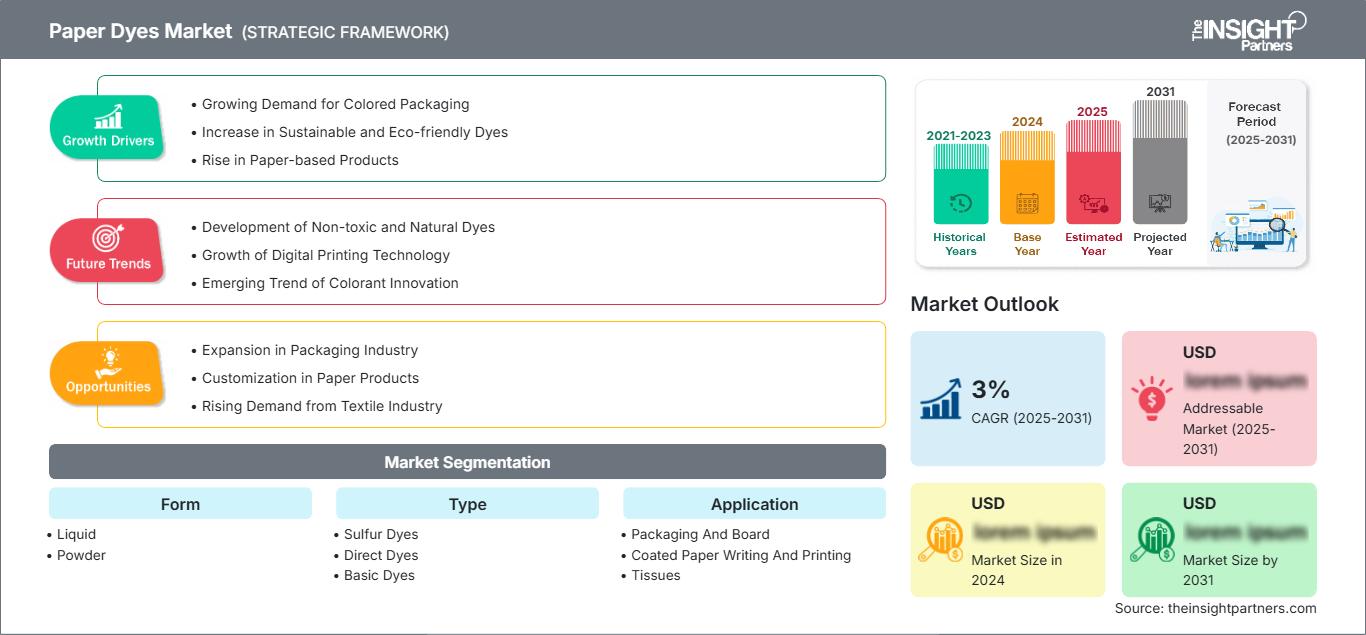
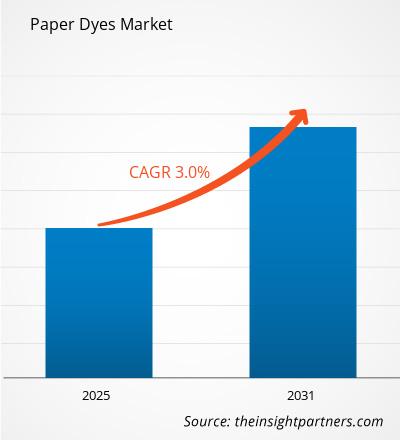
The Paper Dyes market was valued at US$ 1.20 Billion in 2025 and is projected to reach US$ 1.55 Billion by 2034, registering a CAGR of 2.88% during 2026–2034. Demand will be influenced by paper conversion, color uniformity, recycled fiber content, and regulations. The Market has emerged as one of the key categories of specialty chemicals catering to coloring needs in packaging papers, coated paper, writing & printing papers, and tissues.
North America continues to be a technically mature demand region on the back of premium packaging, tissue production, and efforts towards the use of recycled fiber-based materials. The regional Paper Dyes market size is anticipated to grow at a 2.6-3.0% CAGR between 2026 and 2034, with suppliers offering low-effluent, high fix, food contact and color uniformity across recycled fiber furnish products.
Paper Dyes Market Assessment and Insights
- North America: North America is estimated to hold a 30–34% share in 2025 and grow at a 2.6–3.0% CAGR between 2026–2034, supported by packaging conversion, tissue demand, specialty paper production, and regulatory emphasis on safer chemistries.
- U.S.: The U.S. accounts for approximately 82–86% of North America's 2025 share and is projected to grow at a 2.5–2.9% CAGR during 2026–2034, led by packaging and tissue applications.
- Europe: Europe is estimated at a 26–30% share in 2025, expanding at a 2.3–2.7% CAGR between 2026 and 2034. Germany, Italy, France, the UK, and Spain support demand through specialty papers, packaging, and sustainability-oriented production.
- Asia Pacific: Asia Pacific represents approximately 29–33% share in 2025 and is expected to register a 3.2–3.7% CAGR during 2026–2034, led by China, India, Japan, South Korea, and Southeast Asian paper manufacturing.
- Largest Segment: Packaging and Board represents an estimated 40–44% market share in 2025, with a 3.0–3.4% CAGR during 2026–2034, reflecting strong colored-board and packaging conversion.
- High Growth Segment: Liquid represents approximately 57–61% market share in 2025 and is expected to grow at a 3.1–3.5% CAGR during 2026–2034, supported by dosing automation and handling efficiency.
- Key companies analyzed in detail: Archroma Management GmbH, Atul Ltd., Axyntis Group, Cromatos S.r.l., DyStar Singapore Pte Ltd, Kemira Oyj, Keystone Aniline Corporation, Organic Dyes and Pigments LLC, Standard Colors, Inc., Synthesia, a.s.
Source: The Insight Partners' analysis based on proprietary research, government publications, company annual reports, investor presentations, industry databases, and expert interviews.
The industry has moved away from traditional powdered pigments towards specialized liquid systems, advanced fixation techniques, and pigment formulations suitable for recycled pulp. Pigment suppliers are increasingly focusing on improving substantivity, bleed control, light-fastness, backwater clarity, and dosing accuracy. The use of cationic or anionic chemistry depends on the state of the fibers used, whereas sulfur dyes are still valid choices for dark colors. Digital color management practices have further helped in enhancing shade reproducibility.
Future product development will be more aligned to compostability, food contact safety, wastewater minimization, and circular fiber systems. New emerging Asian manufacturing hubs are witnessing growing investments, whereas European converters prefer transparency of chemical formulations. Suppliers of colorants who provide process chemical expertise along with pigment formulations will be able to tackle more complicated furnish issues and qualify more quickly with packaging and tissue converters.
Paper Dyes Market Report Scope
| Report Attribute | Details |
|---|---|
| Market size in 2025 | US$ 1.20 Billion |
| Market Size by 2034 | US$ 1.55 Billion |
| Global CAGR (2026 - 2034) | 2.88% |
| Historical Data | 2021-2024 |
| Forecast period | 2026-2034 |
Paper Dyes Market Analysis
The future growth drivers for the Paper Dyes Market include the various types of paperboard, tissue, recycled papers, and specialty printing papers. The demand chain operates within an ecosystem consisting of the dye manufacturers, intermediates manufacturers, formulators, distributors, paper mills, converters, and packaging powered by brands. The dyes must function in changing pH levels, furnish conditions, retention, and speed, indicating that processability and fixation play crucial roles as factors affecting purchasing decisions.
Regarding supply drivers, the emphasis is placed on the development of liquid concentrates as the most effective way of optimizing automation of dosing and adjusting shades of color at mills. Powder forms remain significant in applications that require strong dyes as well as in countries in which economics of storage becomes essential. In case of using recycled fiber, dyes face some technical challenges due to anionic trash, dissolved organic matter, and other impurities reducing retention of dyes.
The Paper Dyes Market report provides evidence of differentiated competition among diversified specialty chemical firms and dedicated colorant firms. Archroma Management GmbH has a wide array of paper coloration, while Atul Ltd. integrates their paper dyestuffs into a broader range of colors. DyStar Singapore Pte Ltd addresses paper applications along with technical and textile colorants. Synthesia, a.s. provides organic paper dyes in liquid and powder form for bulk and specialty coloration.
Areas of importance for investments change from sustainability in chemistry, application laboratory, documentation, and manufacturing besides the dye capacity alone. The competitive advantage lies in the shade, technical services, customer qualification, dependable availability, and solving problems concerning the use of recycled fiber. Small businesses such as Standard Colors, Inc., Keystone Aniline Corporation, and Organic Dyes and Pigments LLC can compete with the help of custom-made products. The geographical spread and technical services are helpful for large businesses.
● REPORT CUSTOMIZATION
Tailor This Report To Align With Your Specific Business Requirements
This report can be customized to align precisely with your business objectives, scope, and target markets. Customization options include tailored segmentation, geography, competitive analysis, and strategic insights to support informed decision-making.
Customize This Report →WHAT YOU CAN ADJUST
- ● Segmentations
- ● Geography
- ● Competitive Analysis
- ● Language Preferences
Paper Dyes Market: Strategic Insights
Regional Insights
North America Paper Dyes Market
North America is forecast to have a 30–34% Paper Dyes market share in 2025 and grow at a 2.6–3.0% CAGR to 2034. Consumption in the region is driven by the United States with foodservice packaging, corrugated and specialty board, tissue, and commercial printing segments. Canada makes contributions via packaging, publishing, and tissue production. Increased demand will be for pigments that fix well on recycled fiber without any impact on wastewater coloring or chemical loss.
Regionally, purchasing is affected by food contact requirements, sustainability goals, and mill efficiency. Pigment suppliers who can offer application facilities and technical services will have the edge since differences can make a real difference in achieving a good shade with proper retention. Automated liquid dosing systems will help with liquid products, while powdered products will continue to play a role in concentrated applications.
U.S. Paper Dyes Market
The US accounts for around 82-86% of North America’s 2025 share and is estimated to expand at a CAGR of 2.5-2.9% through 2034. The demand for the product remains confined to packaging & board, tissue, coated papers, and selected specialty papers. Competitors in the space differentiate themselves on the basis of formulation, compliance documents, rapid shade matching, and dependable supply chain as opposed to just pricing.
The application needs differ significantly from those of recycled board papers to high-end printing papers. The packaging industry is highly concerned about bleed resistance, food-safe nature, and uniform shade. In contrast, the tissue industry focuses on fixation, softness compatibility, and reduced color migration. Archroma Management GmbH, Atul Ltd., DyStar Singapore Pte Ltd, Standard Colors, Inc., and several other companies possess competence within the paper colorants as well as specialty chemicals.
Europe Paper Dyes Market
In 2025, Europe is forecast to have a 26-30% share, growing at a CAGR of 2.3-2.7% until 2034. The top countries are Germany, followed by the UK, Italy, France, and Spain. Buyers in Europe give importance to chemical compliance, recyclability, food packaging, and eco performance documentation.
The UK and Germany are advanced packaging and specialty paper industries, driving the need for good color uniformity and low migration in formulations. France, Italy, and Spain derive benefit from the presence of food packaging, tissues, luxury packaging, and converting operations. In Europe, there is increasing evaluation of dyes together with fixatives, optical brighteners, and processing agents to achieve better resource utilization. The drive for REACH compliance, eco-label, and packaging chemistry regulations makes suppliers come up with better environmental credentials and regulation.
APAC Paper Dyes Market
The APAC region accounts for around 29–33% in 2025 and is anticipated to register growth at a CAGR of 3.2–3.7% up to 2034. China continues to dominate, whereas India, Japan, South Korea, and Australia participate via packaging, tissue, specialty papers, and printing applications.
Growing industrialization, increasing consumption of packaged goods, and investments in advanced paper machines boost regional demand. The volume growth opportunities are the highest in China and India, whereas Japan and South Korea focus on quality and precision of processes. Stricter regulations and water-saving practices motivate mills to use retention-aids of better performance and dosing management.
Middle East & Africa Paper Dyes Market
MEA and Africa’s demand may be comparatively smaller but more diverse in packaging, tissue, printing, and converting. This region is projected to experience a 2.2-2.6% CAGR till 2034, wherein Saudi Arabia and UAE will get their momentum from industrial investments and packaging conversions, whereas South Africa will serve as a backbone for paper and tissue demand in the region.
MEA and UAE can derive their benefits from infrastructural development, consumer goods packaging, and diversification of industries. South Africa has a strong converting and paper base, whereas Rest of MEA has some select opportunities related to imports of paper, tissue, and converters. Availability of water and energy costs play role in making purchase decisions in these regions, hence formulations offering color efficiency and fixation become desirable.
Segmentation Analysis
Form
The Form segment is projected to grow at a 3.0–3.4% CAGR during 2026–2034. Liquid systems benefit from automated dosing, lower handling complexity, and rapid shade adjustment, while powders remain important where concentrated formulations and lower transportation costs influence purchasing decisions. The Paper Dyes Market scope, therefore, encompasses both established powder applications and increasingly automated liquid coloration systems.
- Liquid: Liquid dyes support automated metering, rapid incorporation, and consistent dosing in high-throughput mills. Their handling advantages make them strategically relevant for packaging, board, and tissue producers seeking tighter process control.
- Powder: Powder dyes remain important for concentrated coloration and applications requiring strong shade depth. Their comparatively favorable storage economics support usage where mills prioritize formulation flexibility and transport efficiency.
Type
The Type segment is expected to register a 2.7–3.1% CAGR during 2026–2034, reflecting different coloration requirements across fiber furnish, paper grade, shade intensity, and end-use performance. Direct dyes remain broadly relevant, while sulfur, basic, and acid chemistries address specialized coloration requirements.
- Sulfur Dyes: Sulfur dyes are particularly relevant for deep black and dark shades in packaging and board. Their strong coloration and fastness characteristics support applications where depth and durability are essential.
- Direct Dyes: Direct dyes provide broad applicability across paper and board grades because of their affinity for cellulose. They support economical coloration and remain important for packaging, writing, printing, and specialty papers.
- Basic Dyes: Basic dyes provide bright coloration and strong affinity for selected fiber systems. They are strategically useful for wood-containing grades, molded fiber, packaging components, and applications where vivid shades outweigh maximum lightfastness.
- Acid Dyes: Acid dyes serve selected paper formulations requiring specific shade characteristics and application conditions. Their role remains more specialized, with demand influenced by furnish chemistry, process pH, and targeted performance requirements.
Application
The Application segment is projected to expand at a 2.9–3.3% CAGR during 2026–2034. Packaging and board remain the principal demand center because coloration supports differentiation, premium appearance, and product identification. Coated writing and printing grades require precise shade development, while tissues prioritize clean coloration and low migration.
- Packaging And Board: Packaging and board represent the largest application because colored cartons, specialty boards, molded fiber, and premium packaging require consistent shades and strong fixation. Sustainability and food-contact requirements increasingly shape supplier selection.
- Coated Paper Writing And Printing: Coated papers require precise coloration that remains compatible with surface treatments, printing processes, and optical properties. Shade uniformity and controlled interaction with coating formulations are critical purchasing considerations.
- Tissues: Tissue applications require dyes that provide stable coloration without compromising softness, absorbency, or converting performance. Low bleed, strong fixation, and compatibility with high-speed production remain important technical criteria.
Opportunity Snapshot
| Application | Revenue Contribution | Trend Tag | Adoption Stage |
|---|---|---|---|
| Packaging And Board | High | Premium Packaging | Scaling |
| Coated Paper Writing And Printing | Medium | Shade Precision | Mature |
| Tissues | Medium | Low Migration | Scaling |
Paper Dyes Market Growth Drivers and Impact Analysis
Expansion of Fiber-Based Packaging and Specialty Boards
The trend towards fiber-based packaging has continued to drive structural demand for colored boards, cartons, molded fiber, and specialty packaging papers. The brand owners have been incorporating colors into packaging in order to distinguish between the packaging forms while using paper packaging in line with the objectives of recyclability. This makes the need for dyes that have good fixation, reproducible shade, food contact, and resistance to bleeding during the converting process to be required. The packaging mills run at higher levels of recycled fibers, thus complicating color management since the furnish contamination makes it hard to fix the dye. For the suppliers who combine the dyes with the fixative and process chemicals, this is a source of added value.
Growing Use of Recycled Fiber in Paper Manufacturing
Higher usage of recycled fiber is causing changes in the requirements for dyeing of paper. The presence of dissolved organic compounds, anionic contaminants, remnant inks, and other impurities in the recycled pulp may decrease dye uptake ability and cause problems of unevenness in shades. Colorants with higher substantivity and better compatibility with the retention aids are therefore required. In addition, the use of fixatives is recommended because these products help increase dye retention, prevent dye migration, and decrease contamination of the back water. Such changes in requirements will make the customers consider total costs of coloring, not just the cost of dyes. Having application labs will be helpful in qualifying by suppliers since the performance of the product will be tested under different conditions of furnish.
Stricter Chemical Compliance and Environmental Requirements
Chemical compliance is increasingly influencing colorant selection across major paper-producing regions. Packaging applications require attention to food-contact requirements, while European customers also assess REACH status, eco-label compatibility, and chemical transparency. Environmental expectations extend beyond product composition to wastewater cleanliness, dye retention, and production efficiency. High-substantivity formulations can reduce colorant losses into process water, supporting cleaner backwater and potentially lowering treatment requirements. Suppliers responding with certified, compostability-oriented, or lower-impact chemistries can improve access to customers with demanding sustainability specifications. The commercial impact is gradual because mills must qualify new formulations without compromising shade consistency or machine performance. Nevertheless, regulatory and customer requirements are shifting purchasing decisions from simple color matching toward documented performance, compliance, and environmental attributes, strengthening the position of technically differentiated suppliers.
Paper Dyes Market Future Trends
Digitalized Color Management and Automated Dosing
Digital color management is expected to become increasingly integrated with automated dye dosing as paper mills pursue tighter shade control and lower material losses. Online measurement systems can identify color deviations earlier, while automated dosing can adjust formulations with greater precision than manual addition. This Paper Dyes market trend should reduce batch-to-batch variability and improve machine utilization, particularly in packaging and specialty-paper operations with frequent shade changes. Suppliers will increasingly need to provide digital shade libraries, formulation databases, and technical data compatible with mill control systems. Paper Dyes trends are therefore moving beyond chemistry toward integrated process optimization. Adoption will be strongest among larger mills where automation investments can be justified through reduced waste, faster grade changes, and improved quality consistency. Smaller producers may adopt simplified systems as equipment costs decline and customers increasingly demand repeatable color specifications.
Low-Impact Coloration for Circular Paper Systems
Future formulations are likely to emphasize compatibility with recycling, compostability, food-contact requirements, and lower environmental loading. Colorants must perform without creating excessive problems during repulping or generating difficult-to-treat colored wastewater. Suppliers are therefore developing systems that combine high fixation with improved environmental profiles. This direction should favor direct and cationic chemistries engineered for paper applications, alongside specialized sulfur and basic formulations where deep or bright shades are required. Qualification will increasingly consider the complete paper lifecycle rather than only coloration performance at the mill. Paper Dyes Market trends will consequently favor products supported by regulatory documentation, environmental certifications, and evidence of compatibility with recycling or composting processes. Packaging applications should lead this transition because brand owners increasingly connect material choices with circularity and sustainability targets.
Paper Dyes Market Opportunities
Localized Formulation and Technical Service Centers in Asia
Asia offers an opportunity for suppliers to establish localized application laboratories and technical service centers close to major paper-producing clusters. China and India provide substantial manufacturing bases, while Southeast Asia is expanding packaging and tissue capacity. Local technical support can shorten formulation qualification, address variable recycled-fiber furnish, and improve response times for customers. Suppliers can combine regional inventories with application expertise to reduce delivery uncertainty and provide customized shade development. The Paper Dyes Market Forecast supports investment in scalable technical infrastructure rather than only additional manufacturing capacity. Companies can prioritize centers near packaging and tissue clusters where frequent formulation adjustments generate recurring service requirements. Partnerships with local distributors, paper mills, and converting groups can further accelerate adoption while limiting initial capital requirements and improving market intelligence.
Integrated Coloration Packages for High-Recycled-Content Mills
A second opportunity involves selling integrated coloration packages combining dyes, fixatives, retention aids, and process guidance. High recycled-fiber content can create complex interactions that reduce dye efficiency and increase backwater coloration. A coordinated system can address fixation, shade consistency, wastewater cleanliness, and machine stability simultaneously. Suppliers can differentiate through application trials, performance guarantees, and customized formulations instead of competing solely on dye price. This approach is particularly attractive for packaging and tissue mills seeking higher recycled content without sacrificing visual quality. Investment can focus on application laboratories, pilot-scale testing, and digital formulation tools. Customers benefit from fewer qualification cycles and more predictable production, while suppliers gain opportunities for recurring sales across multiple chemical categories. Integrated packages can therefore strengthen account retention and raise the technical barriers to competitive substitution.
Recent Developments
- August 2026: ITC Limited completed the acquisition of Century Pulp and Paper from Aditya Birla Real Estate Limited for approximately ₹3,500 crore. The transaction increased ITC's paper and paperboard capacity by more than 50% to approximately 1.5 million tonnes annually, making it India's largest integrated paperboard and paper business. The acquisition strengthens ITC's scale across paperboards and specialty papers.
- January 2026: Foundation Investment Partners acquired Paper Converters, Inc. through its Sustainable Packaging platform. Paper Converters manufactures spiral-wound paper tubes, edge board, and sheeting, with products described as biodegradable and recyclable. The acquisition is intended to improve supply-chain continuity, operational coordination, and collaboration with sister company Amspak, strengthening the platform's presence in sustainable paper packaging.
Frequently Asked Questions

- Comprehensive Market Sizing and Forecast Analysis
- Detailed Segmentation Analysis
- In-Depth Market Dynamics Assessment
- Regional and Country-Level Insights
- Competitive Landscape and Company Benchmarking
- Strategic Business Intelligence
Recent Reports
Testimonials

The Insight Partners' SCADA System Market report is comprehensive, with valuable insights on current trends and future forecasts. The team was highly professional, responsive, and supportive throughout. We are very satisfied and highly recommend their services.
RAN KEDEM Partner, Reali Technologies LTDs
I requested a report on a very specific software market and the team produced the report in a few days. The information was very relevant and well presented. I then requested some changes and additions to the report. The team was again very responsive and I got the final report in less than a week.
JEAN-HERVE JENN Chairman, Future Analytica
We worked with The Insight Partners for an important market study and forecast. They gave us clear insights into opportunities and risks, which helped shape our plans. Their research was easy to use and based on solid data. It helped us make smart, confident decisions. We highly recommend them.
PIYUSH NAGPAL Sr. Vice President, High Beam Global
The Insight Partners delivered insightful, well-structured market research with strong domain expertise. Their team was professional and responsive throughout. The user-friendly website made accessing industry reports seamless. We highly recommend them for reliable, high-quality research services
YUKIHIKO ADACHI CEO, Deep Blue, LLC.
This is the first time I have purchased a market report from The Insight Partners.While I was unsure at first, I visited their web site and felt more comfortable to take the risk and purchase a market report.I am completely satisfied with the quality of the report and customer service. I had several questions and comments with the initial report, but after a couple of dialogs over email with their analyst I believe I have a report that I can use as input to our strategic planning process.Thank you so much for taking the extra time and making this a positive experience.I will definitely recommend your service to others and you will be my first call when we need further market data.
JOHN SUZUKI President and Chief Executive Officer, Board Director, BK Technologies
I wish to appreciate your support and the professionalism you displayed in the course of attending to my request for information regarding to infectious disease IVD market in Nigeria. I appreciate your patience, your guidance, and the fact that you were willing to offer a discount, which eventually made it possible for us to close a deal. I look forward to engaging The Insight Partners in the future, all thanks to the impression you have created in me as a result of this first encounter.
DR CHIJIOKE ONYIA MANAGING DIRECTOR, PineCrest Healthcare Ltd.Reason to Buy
- Informed Decision-Making
- Understanding Market Dynamics
- Competitive Analysis
- Identifying Emerging Markets
- Customer Insights
- Market Forecasts
- Risk Mitigation
- Boosting Operational Efficiency
- Strategic Planning
- Investment Justification
- Tracking Industry Innovations
- Aligning with Regulatory Trends





 Get Free Sample for