
Passive Optical Component Market Growth, Share & Trends by 2034
Coverage: by Component (Optical Network Terminal (ONT), Optical Power Splitters, Optical Cables, Optical Line Terminal (OLT), Fixed and Variable optical attenuators, and Others); Application(FTTH Networks, Interoffice, Fiber In The Loop (FITL), Loop feeder, Hybrid Fiber-Coaxial Cable (HFC), Synchronous Optical Network (SONET), and Synchronous Digital Hierarchy (SDH) systems), and Geography (North America, Europe, Asia Pacific, and South and Central America)
- Status : Data Released
- Report Code : TIPRE00002915
- Category : Electronics and Semiconductor
- No. of Pages : 150
- Available Report Formats :


- Last update date : October 16, 2026


2025 Market Size
US$ 26.79 Bn
Base year value
2034 Forecast
US$ 50.5 Bn
Projected by 2034
CAGR 2026-2034
7.30 %
Growth rate
Addressable Market
US$ 348.64 Bn
(2026-2034)
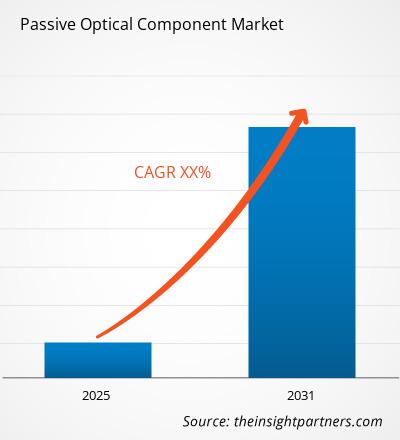
The Passive Optical Component Market continues to expand as fiber-optic network deployment accelerates across telecommunications infrastructure. The market stood at US$ 26.79 Billion in 2025 and is forecast to reach US$ 50.5 Billion by 2034, advancing at a CAGR of 7.30% between 2026 and 2034. Rising fiber-to-the-home rollouts, data-center interconnect expansion, and broadband modernization programs collectively sustain robust demand for splitters, terminals, and cabling components worldwide.
Passive Optical Component Market size in North America is estimated to expand at a CAGR ranging between 6.5% and 7.5% through 2034, supported by extensive federal broadband-equity funding programs and accelerating fiber-to-the-home network densification. Continued telecom operator investment in rural connectivity expansion, combined with rising data-center interconnection demand, reinforces structural procurement momentum across carrier and enterprise network-infrastructure channels throughout the forecast period.
Passive Optical Component Market Assessment and Insights
- North America: The region held an estimated 28-31% share in 2025, growing at a CAGR of 6.5-7.5% between 2026 and 2034, supported by federal broadband funding and accelerating fiber-to-the-home network expansion.
- US: The United States contributes roughly 86-89% of North America's revenue in 2025, growing at a CAGR of 6.5-7.3% from 2026 to 2034, led by carrier network investment.
- Europe: Europe held around 22-25% share in 2025 and is projected to grow at a CAGR of 6.8-7.8% through 2034, with Germany, the UK, and France leading regional fiber-broadband deployment.
- Asia Pacific: APAC accounted for approximately 33-36% share in 2025, forecast to expand at a CAGR of 8-9% between 2026 and 2034, led by China, India, and Japan through large-scale fiber-network buildouts.
- Largest Segment: Optical Cables, under Component, held an estimated 26-29% share in 2025 and are projected to grow at a CAGR of 7-8% between 2026 and 2034, owing to widespread network deployment demand.
- High Growth Segment: FTTH Networks, under Application, held roughly 30-33% share in 2025 and is expected to expand at a CAGR of 8.5-9.5% between 2026 and 2034, driven by accelerating residential fiber rollouts.
- Key companies analyzed in detail: ADTRAN, Inc., Alcatel-Lucent S.A., Alliance Fiber Optic Products, Inc., Broadcom Inc., Calix, Inc., Cortina Systems Inc., ECI Telecom, Ltd., Telefonaktiebolaget LM Ericsson, Freescale Semiconductor, Inc., Hitachi Communication Technologies, Inc.
Source: The Insight Partners' analysis based on proprietary research, government publications, company annual reports, investor presentations, industry databases, and expert interviews.
The manufacture of passive optical components has moved from separately packaged connector and splitter elements to highly integrated planar lightwave circuits that support much denser, more compact network enclosures. Production processes have become increasingly automated through fiber splicing and wafer fabrication of splitters, leading to a significant reduction in unit costs and improved insertion loss uniformity. This has facilitated telecom providers to expand fiber-to-the-home deployment on a more cost-effective basis.
Going forward, emerging countries in regions such as Southeast Asia, Latin America, and parts of Africa are projected to receive higher fiber infrastructure investments driven by broadband strategies focusing on digital inclusion objectives. Favorable regulatory trends in terms of government subsidy initiatives for last-mile fiber rollout, along with increased capital spending on data center interconnects, should lead to significant expansion in the scale of component purchases over the next decade.
Passive Optical Component Market Report Scope
| Report Attribute | Details |
|---|---|
| Market size in 2025 | US$ 26.79 Billion |
| Market Size by 2034 | US$ 50.5 Billion |
| Global CAGR (2026 - 2034) | 7.30% |
| Historical Data | 2021-2024 |
| Forecast period | 2026-2034 |
Passive Optical Component Market Analysis
Passive optical component market growth is fundamentally anchored in accelerating global fiber-to-the-home rollouts and expanding data-center interconnect requirements driven by rising bandwidth consumption. The value chain covers the raw material fiber suppliers and glass-substrate suppliers, component manufacturers, and network equipment integration providers, who all form an integrated optical infrastructure ecosystem. The enterprise cloud usage increase and 5G backhaul densification further grow the market potential for splitters, terminals, and attenuator components through carrier networks and hyperscale networks.
The supply dynamics remain somewhat concentrated among incumbent component manufacturers who have efficient manufacturing operations based in Asia, with some material availability and glass fiber constraints. There is an increased effort towards vertical integration for splitters and connectors to maintain costs. Simultaneously, HFC and SONET use cases maintain consistent replacement needs for the legacy infrastructures, thus generating revenue outside the fiber-to-the-home acquisition cycles that now characterize new networks' construction.
This passive optical component market analysis reveals a moderately fragmented competitive landscape shaped by continuous component miniaturization differentiation. Telefonaktiebolaget LM Ericsson and Alcatel-Lucent S.A. maintain leadership through integrated network-equipment portfolios bundling passive components with active transmission systems, while Calix, Inc. and ADTRAN, Inc. compete through fiber-access platform specialization serving regional and rural broadband operators across North America.
Investment activity in the Passive Optical Component Market forecast is expected to remain focused on splitter miniaturization, higher connector density, and manufacturing capacity expansion to support rising fiber-to-the-home deployment volumes. Alliance Fiber Optic Products, Inc. and Hitachi Communication Technologies, Inc. are positioned to strengthen production capabilities, while Broadcom Inc. and Cortina Systems Inc. are expected to advance semiconductor-integrated optical component technologies. Meanwhile, ECI Telecom, Ltd. and Freescale Semiconductor, Inc. are anticipated to reinforce their strategic positioning across synchronous digital hierarchy and interoffice network applications.
● REPORT CUSTOMIZATION
Tailor This Report To Align With Your Specific Business Requirements
This report can be customized to align precisely with your business objectives, scope, and target markets. Customization options include tailored segmentation, geography, competitive analysis, and strategic insights to support informed decision-making.
Customize This Report →WHAT YOU CAN ADJUST
- ● Segmentations
- ● Geography
- ● Competitive Analysis
- ● Language Preferences
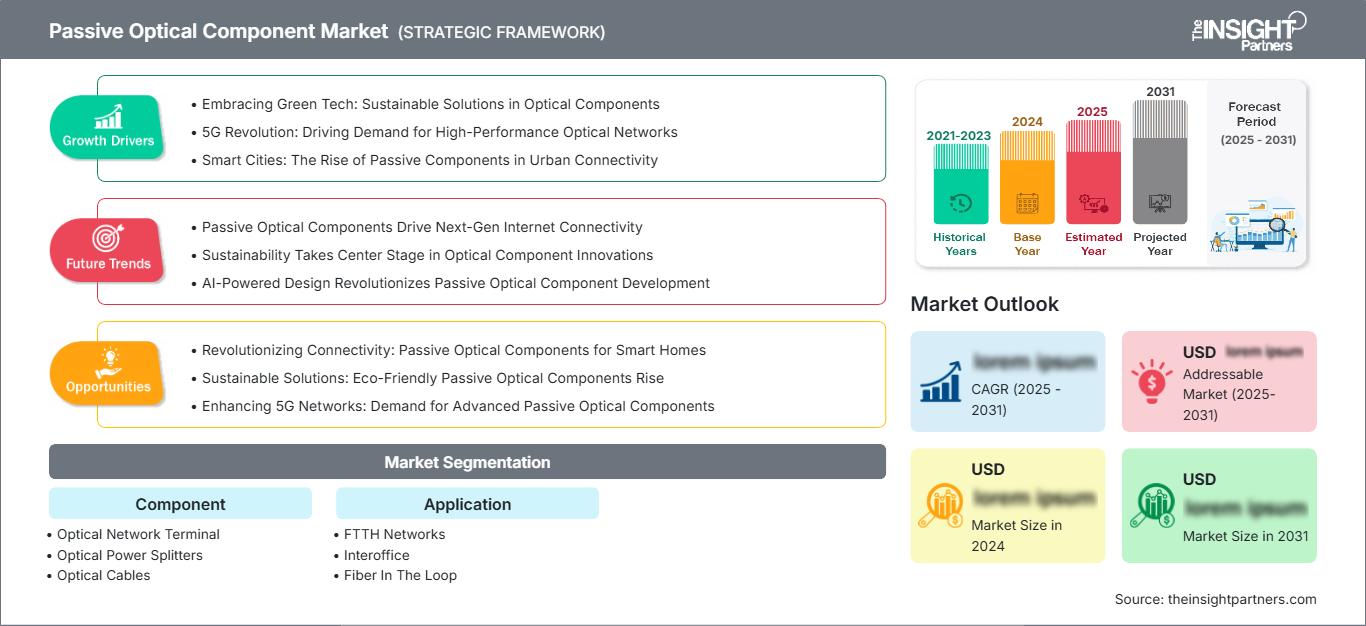
Passive Optical Component Market: Strategic Insights
Regional Insights
North America Passive Optical Component Market
North America's passive optical component market share stood at an estimated 28-31% in 2025, supported by extensive federal broadband-equity funding and accelerating fiber-to-the-home network densification. The region is forecast to grow at a CAGR of 6.5-7.5% between 2026 and 2034. Carrier investments in increasing rural connectivity continue to drive strong demand for splitters, terminals, and cabling systems within urban as well as non-urban network segments throughout the forecast period.
The underlying factors are government-sponsored rural broadband subsidies, growing data center interconnect bandwidth needs, and increased 5G backhaul fiber deployments within carriers' networks. Canada is playing an increasingly important role, albeit small, driven by connectivity modernization programs. The overall growth profile of the region will be built around last-mile expansion and the transition from copper-based networks to fiber networks, rather than greenfield infrastructures like Asia Pacific.
U.S. Passive Optical Component Market
The United States commands approximately 86-89% of North America's total Passive Optical Component Market revenue in 2025, growing at a CAGR of 6.5-7.3% through 2034. Extensive presence of leading network-equipment providers, including Calix, Inc. and ADTRAN, Inc., reinforces domestic supply and component-integration capacity, while federal broadband funding programs continue expanding procurement volumes across regional and rural telecom operators nationwide.
Application trends favor fiber-to-the-home network deployment tied to federal connectivity subsidy programs, alongside sustained interoffice and loop-feeder infrastructure upgrades among established carriers. Hybrid fiber-coaxial network operators are gradually transitioning toward passive optical infrastructure to support rising bandwidth demand. Data-center interconnect procurement is expanding rapidly, supported by hyperscale cloud-provider capacity investment across major metropolitan data-center corridors nationwide.
Europe Passive Optical Component Market
Europe accounted for an estimated 22-25% share of the global Passive Optical Component Market in 2025, expanding at a CAGR of 6.8-7.8% between 2026 and 2034. Germany leads regional demand through robust fiber-broadband rollout programs and strong industrial-network modernization, supported by government digital-infrastructure funding and expanding carrier investment across major metropolitan and industrial corridors nationwide.
The United Kingdom follows closely, driven by national gigabit-broadband targets and expanding fiber-to-the-home coverage across urban and semi-rural areas. Germany's growth stems from federal fiber-rollout subsidies and enterprise network modernization. France, Italy, and Spain collectively contribute steady incremental demand, led by European Union digital-connectivity directives, national broadband-expansion programs, and gradually rising data-center interconnect investment across southern European metropolitan technology hubs.
APAC Passive Optical Component Market
Asia Pacific held an estimated 33-36% share in 2025 and is projected to expand at a CAGR of 8-9% through 2034, the fastest among all regions. China leads regional demand, supported by large-scale national fiber-to-the-home rollouts and dense manufacturing ecosystems supplying components across domestic and export markets nationwide.
India and South Korea contribute through expanding national broadband and 5G-backhaul infrastructure programs, while Japan sustains steady demand through established fiber-network replacement cycles. Australia shows growing regional connectivity investment. Policy support for national digital-infrastructure targets and manufacturing localization continues to reinforce regional component production and deployment momentum.
Middle East & Africa Passive Optical Component Market
The Middle East and Africa Passive Optical Component Market is forecast to grow at a CAGR of 7.2-8.2% between 2026 and 2034, led by Saudi Arabia and the United Arab Emirates through national digital-transformation and smart-city fiber-infrastructure programs. Government-backed broadband modernization initiatives continue driving component procurement across major urban development and telecommunications projects regionwide.
South Africa contributes through expanding fiber-to-the-home rollout among private telecom operators, while the Rest of MEA shows gradual uptake tied to urbanization-driven connectivity demand. Infrastructure investment linked to energy-sector diversification programs across Gulf economies is increasingly incorporating fiber-optic network deployment within smart-city and industrial-facility connectivity frameworks.
Segmentation Analysis
Component
The Component segment is projected to grow at a CAGR of 7-8% between 2026 and 2034. This passive optical component market scope reflects sustained demand for cabling and splitting infrastructure supporting expanding fiber-to-the-home and enterprise network deployment. Component selection increasingly balances insertion-loss performance against cost efficiency requirements across carrier, enterprise, and data-center end-use environments, shaping procurement strategies industrywide considerably.
- Optical Network Terminal: This customer-premises component enables fiber-to-the-home service termination, favored by residential broadband operators deploying gigabit-capable last-mile connectivity across expanding subscriber networks.
- Optical Power Splitters: This widely deployed component enables signal distribution across passive optical network architectures, favored for cost-efficient multi-subscriber fiber-to-the-home network fan-out configurations.
- Optical Cables: This foundational infrastructure component anchors network deployment across all application segments, favored for its scalability across metropolitan, rural, and data-center interconnect installations.
- Optical Line Terminal: This central-office component manages upstream and downstream signal distribution, favored by carriers operating large-scale passive optical network access infrastructure across metropolitan service areas.
- Fixed and Variable Optical Attenuators: This signal-management component ensures optimal power-level calibration across network links, favored for maintaining transmission quality across variable-distance fiber-network deployments.
Application
The Application segment is estimated to expand at a CAGR of 7.5-8.5% between 2026 and 2034. Fiber-to-the-home networks remain the largest contributor, given accelerating residential broadband rollouts, while interoffice and data-center interconnect applications sustain steady enterprise demand. Legacy synchronous network applications continue generating replacement-driven procurement, collectively diversifying demand across both greenfield and infrastructure-modernization deployment environments globally.
- FTTH Networks: This segment leads application demand through accelerating residential fiber-broadband rollouts, supported by government subsidy programs and rising consumer bandwidth requirements across urban and rural markets.
- Interoffice: This segment reflects steady demand from carrier central-office interconnection requirements, supported by sustained network-capacity expansion across metropolitan telecommunications infrastructure serving enterprise and residential subscribers.
- Fiber In The Loop: This segment supports last-mile access network modernization, favored by regional operators transitioning legacy copper infrastructure toward fiber-based residential and small-business connectivity solutions.
- Loop Feeder: This segment enables distribution-network connectivity between central offices and access points, supporting carrier infrastructure serving broad geographic service areas across suburban and rural regions.
- Hybrid Fiber-Coaxial Cable: This segment reflects legacy cable-operator infrastructure gradually incorporating passive optical components, supporting bandwidth-capacity upgrades across established residential broadband service territories.
- Synchronous Optical Network: This segment serves established carrier backbone infrastructure, supporting high-capacity data transmission requirements across enterprise and telecommunications network backbone architecture nationwide.
- Synchronous Digital Hierarchy Systems: This segment supports legacy international carrier infrastructure, maintaining relevance across regions with established transmission-network architecture requiring continued component replacement and maintenance.
Opportunity Snapshot
| Application | Revenue Contribution | Trend Tag | Adoption Stage |
| FTTH Networks | High | Residential Fiber | Scaling |
| Interoffice | Medium | Backbone Interconnect | Mature |
| Fiber In The Loop | Medium | Copper Replacement | Scaling |
| Loop Feeder | Low | Distribution Access | Mature |
| Hybrid Fiber-Coaxial Cable | Medium | Cable Upgrade | Mature |
| Synchronous Optical Network | Low | Backbone Transmission | Mature |
| Synchronous Digital Hierarchy Systems | Low | Legacy Transmission | Mature |
Passive Optical Component Market Growth Drivers and Impact Analysis
Accelerating Global Fiber-to-the-Home Broadband Deployment Programs
National broadband strategies underpinned by government initiatives in North America, Europe, and the Asia Pacific region remain focused on providing fiber-to-the-home coverage as a digital inclusion strategy, which is having a direct impact on continued demand for splitters, terminals, and cabling components. Government funding programs are reducing the cost obstacles that have made fiber rollout projects nonviable for regional and rural telecommunication operators in the past. This trend is reducing deployment lead times, and, therefore, making it necessary for component manufacturers to ramp up their production capacity to meet the new timelines set by carriers. Broadband connectivity goals established by the International Telecommunication Union are further reinforcing this demand trend in developing countries seeking digital infrastructure parity. This demand driver offers component manufacturers multiyear visibility into their procurement plans due to the phased and multidecade approach taken by many national fiber deployment programs.
Expanding Data Center Interconnect Capacity Requirements
Increased demands for hyperscale cloud computing and AI workloads are resulting in significant growth in data center interconnect infrastructure build-outs, which require high-density passive optical components that can deliver increased bandwidth performance between sites. Increasing use of dense wavelength division multiplexing architectures by enterprise and colocation data center operators is leading to demand for dedicated split and attenuator components. In contrast to residential fiber-to-the-home procurement dynamics, this demand pool favors the need for higher-margin engineered components over cost-optimized mass-market components. For component makers servicing this pool, the opportunity lies in working closely with hyperscale operators and building design-in relationships. With growing infrastructure investments in AI infrastructure around the world, data center interconnect procurements are expected to continue supporting premium segment component demand pools.
Enterprise 5G Backhaul Network Densification Requirements
Carriers rolling out high-density small cell-based 5G networks will need significant fiber optic backhaul networks to connect various dispersed radio access nodes with their core network sites, resulting in considerable procurement of passive components for both inter-office and loop feeder applications. The densification needs in urban areas will call for many times more fiber connections than those in traditional 4G networks, resulting in increased component consumption on a per-area basis. More carriers are opting for passive optical splitters than active splitters as a means to lower backhaul operating expenses and ensure scalability of their network architecture. The denser network architecture trend is expected to help drive component procurement volume growth as 5G networks continue to roll out in urban and suburban markets.
Passive Optical Component Market Future Trends
Migration Toward Higher-Split-Ratio Passive Network Architectures
Passive optical component market trends increasingly point toward the adoption of higher-split-ratio architectures, enabling carriers to serve more subscribers per optical line terminal port, improving network economics substantially. This migration toward denser splitting configurations is driving component manufacturers to develop precision-engineered splitters maintaining acceptable signal-loss thresholds across expanded subscriber counts. Carriers pursuing this approach can reduce central-office equipment footprint while extending service reach into previously uneconomical low-density areas. This trend is expected to reshape component specification requirements over the coming years, favoring suppliers capable of delivering consistent performance across higher-density splitting configurations for future network capacity-optimization deployment decisions across expanding fiber-broadband markets.
Convergence of Fixed and Mobile Network Infrastructure Investment
The increasing trend of convergence between the investments made in the fixed fiber-broadband and mobile 5G backhaul networks over the next few years will change the procurement policies of carriers as they start deploying passive optical infrastructures that are shared by both fixed line and mobile networks. In doing so, convergence allows the carriers to save on cost through optimal capital budgeting by using the same pathways for different services, thereby reducing unnecessary spending on deploying redundant infrastructure. The companies that are able to provide such multi-application products would be in great demand among carriers.
Passive Optical Component Market Opportunities
Rural and Underserved Market Fiber Infrastructure Expansion
North American and European broadband equity funding initiatives by government authorities provide significant opportunities for component vendors looking to provide services in rural areas where the economics of providing fiber connections were once thought not viable. Increased availability of subsidies is helping telecom companies reach rural areas with fiber connections to homes through their fiber-to-the-home networks, providing a new procurement avenue for splitters and other components that are suitable for longer distance deployment. There is a significant market opportunity for those suppliers who have weatherproof equipment that can be used in rural areas. Partnering with rural broadband cooperatives and rural telecom companies could be a viable means of gaining entry into the market because of the specific requirements of deploying equipment in rural locations.
Data Center Interconnect Component Portfolio Expansion
Investment in specialized high-density passive optical components tailored for hyperscale data-center interconnect applications presents a meaningful revenue-diversification opportunity as artificial-intelligence infrastructure investment accelerates globally. Component manufacturers developing precision-engineered attenuators and splitters optimized for dense wavelength-division multiplexing architectures can capture premium-margin procurement from hyperscale cloud operators expanding interconnect capacity. This opportunity favors suppliers capable of close technical collaboration with data-center operators, given the specialized performance requirements distinguishing this segment from mass-market residential component procurement. Component manufacturers pursuing early positioning within this expanding segment stand to benefit from durable design-in relationships and premium pricing, positioning data-center interconnect specialization as a strategically valuable diversification pathway beyond traditional fiber-to-the-home volume-driven component sales through the coming decade.
Frequently Asked Questions

- Comprehensive Market Sizing and Forecast Analysis
- Detailed Segmentation Analysis
- In-Depth Market Dynamics Assessment
- Regional and Country-Level Insights
- Competitive Landscape and Company Benchmarking
- Strategic Business Intelligence
Recent Reports
Testimonials

The Insight Partners provided valuable market intelligence that supported our global go-to-market strategy. Their team was professional, responsive, and attentive to our feedback, providing thoughtful analysis and helpful methodological clarifications throughout the project.
Junmo Kim Chief Financial Officer (CFO), Enertech Co., Ltd.
The Insight Partners' SCADA System Market report is comprehensive, with valuable insights on current trends and future forecasts. The team was highly professional, responsive, and supportive throughout. We are very satisfied and highly recommend their services.
RAN KEDEM Partner, Reali Technologies LTDs
I requested a report on a very specific software market and the team produced the report in a few days. The information was very relevant and well presented. I then requested some changes and additions to the report. The team was again very responsive and I got the final report in less than a week.
JEAN-HERVE JENN Chairman, Future Analytica
We worked with The Insight Partners for an important market study and forecast. They gave us clear insights into opportunities and risks, which helped shape our plans. Their research was easy to use and based on solid data. It helped us make smart, confident decisions. We highly recommend them.
PIYUSH NAGPAL Sr. Vice President, High Beam Global
The Insight Partners delivered insightful, well-structured market research with strong domain expertise. Their team was professional and responsive throughout. The user-friendly website made accessing industry reports seamless. We highly recommend them for reliable, high-quality research services
YUKIHIKO ADACHI CEO, Deep Blue, LLC.
This is the first time I have purchased a market report from The Insight Partners.While I was unsure at first, I visited their web site and felt more comfortable to take the risk and purchase a market report.I am completely satisfied with the quality of the report and customer service. I had several questions and comments with the initial report, but after a couple of dialogs over email with their analyst I believe I have a report that I can use as input to our strategic planning process.Thank you so much for taking the extra time and making this a positive experience.I will definitely recommend your service to others and you will be my first call when we need further market data.
JOHN SUZUKI President and Chief Executive Officer, Board Director, BK Technologies
I wish to appreciate your support and the professionalism you displayed in the course of attending to my request for information regarding to infectious disease IVD market in Nigeria. I appreciate your patience, your guidance, and the fact that you were willing to offer a discount, which eventually made it possible for us to close a deal. I look forward to engaging The Insight Partners in the future, all thanks to the impression you have created in me as a result of this first encounter.
DR CHIJIOKE ONYIA MANAGING DIRECTOR, PineCrest Healthcare Ltd.Reason to Buy
- Informed Decision-Making
- Understanding Market Dynamics
- Competitive Analysis
- Identifying Emerging Markets
- Customer Insights
- Market Forecasts
- Risk Mitigation
- Boosting Operational Efficiency
- Strategic Planning
- Investment Justification
- Tracking Industry Innovations
- Aligning with Regulatory Trends





 Get Free Sample for