The global Phase Shifters market was valued at US$ 3.21 billion in 2025 and is expected to reach US$ 4.9 billion by 2034; it is estimated to record a CAGR of 4.81% during 2026-2034.
The report is segmented by Type (Analog Phase Shifter, Digital Phase Shifter); Application (Satellites, Radar, Telecommunication, Others). The global analysis is further broken-down at regional level and major countries. The Report Offers the Value in USD for the above analysis and segments.
Purpose of the Report
The report Phase Shifters Market by The Insight Partners aims to describe the present landscape and future growth, top driving factors, challenges, and opportunities. This will provide insights to various business stakeholders, such as:
- Technology Providers/Manufacturers: To understand the evolving market dynamics and know the potential growth opportunities, enabling them to make informed strategic decisions.
- Investors: To conduct a comprehensive trend analysis regarding the market growth rate, market financial projections, and opportunities that exist across the value chain.
- Regulatory bodies: To regulate policies and police activities in the market with the aim of minimizing abuse, preserving investor trust and confidence, and upholding the integrity and stability of the market.
Phase Shifters Market Segmentation
Type
- Analog Phase Shifter
- Digital Phase Shifter
Application
- Satellites
- Radar
- Telecommunication
- Others
Market Research Highlights
- Global market for Phase Shifters was valued at US$ 3.21 Billion in 2025
- Annual market size is expected to reach US$ 4.90 Billion by 2034
- Total addressable market (TAM) during 2026-2034 is projected to reach approximately US$ 36.81 Billion
- Market is anticipated to register a CAGR of 4.81% during the forecast period
- The United States represents a key market, supported by Rising Demand for Advanced Communication Systems, Advancements in Radar and Remote Sensing Technologies, as well as evolving industry dynamics
- Market analysis covers North America, Europe, Asia-Pacific, South and Central America, Middle East and Africa, with growth evaluated across the forecast period
- Market opportunities such as Expansion in 5G Infrastructure, Increase in Space and Satellite Communication Systems are expected to influence market dynamics and addressable market
- Report profiles industry participants, including Analog Devices, Inc., Arrow Electronics, Inc., G.T. Microwave, Inc., Kratos Defense and Security Solutions, Inc, MACOM, Mercury Systems, Inc., Microwave Solutions, Inc, Pasternack Enterprises, Planar Monolithics Industries, Inc., Qorvo, while analyzing competitive strategies and innovation developments
-
Source: The Insight Partners' analysis based on proprietary research, government publications, company annual reports, investor presentations, industry databases, and expert interviews.
● REPORT CUSTOMIZATION
Tailor This Report To Align With Your Specific Business Requirements
This report can be customized to align precisely with your business objectives, scope, and target markets. Customization options include tailored segmentation, geography, competitive analysis, and strategic insights to support informed decision-making.
Customize This Report →WHAT YOU CAN ADJUST
- ● Segmentations
- ● Geography
- ● Competitive Analysis
- ● Language Preferences
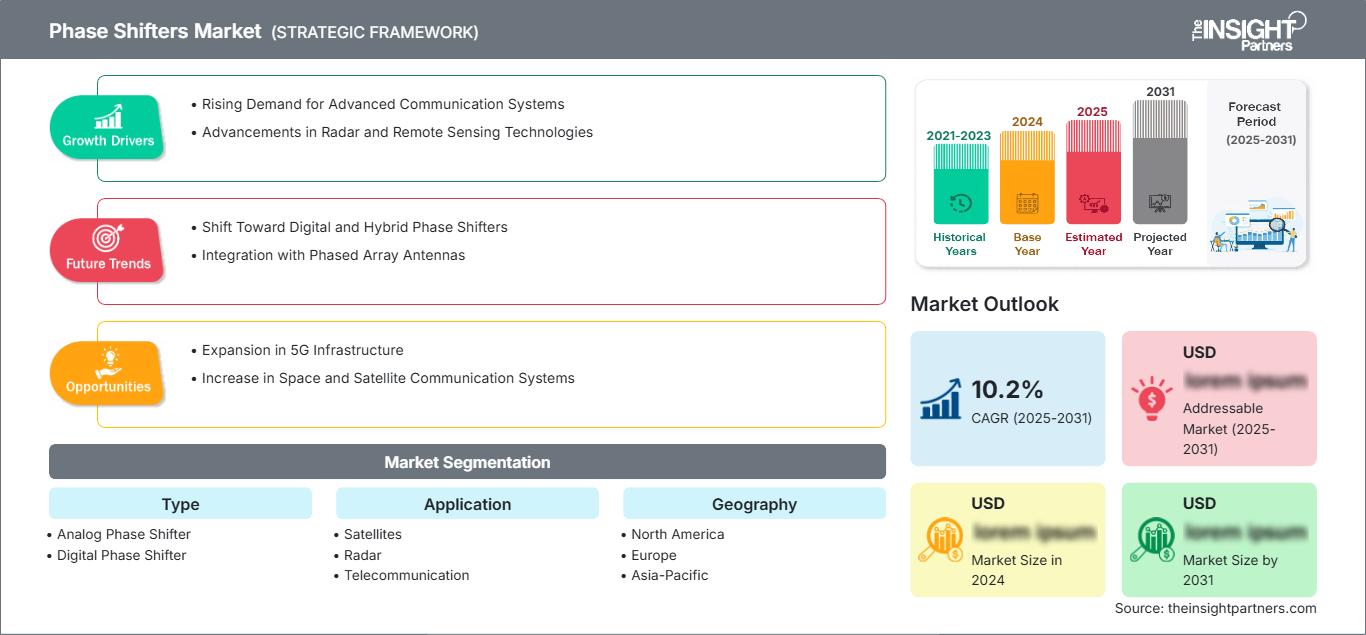
Phase Shifters Market: Strategic Insights
-
Get Top Key Market Trends of this report.This FREE sample will include data analysis, ranging from market trends to estimates and forecasts.
Phase Shifters Market Growth Drivers
- Rising Demand for Advanced Communication Systems: The growing demand for advanced communication technologies, including 5G networks, is driving the need for phase shifters. These components are crucial for controlling the phase of signals in beamforming applications, which are key to enabling high-speed, high-frequency wireless communication systems. As the need for faster, more efficient communication increases, phase shifters play an essential role in supporting these next-generation networks.
- Advancements in Radar and Remote Sensing Technologies: Phase shifters are essential in radar systems used for defense, security, and remote sensing. The increasing investment in radar and sonar systems, especially in defense and aviation, drives the phase shifter market. Phase shifters help control the radar beam's direction and focus, enhancing the accuracy and effectiveness of detection systems in applications ranging from weather monitoring to military surveillance.
Phase Shifters Market Future Trends
- Shift Toward Digital and Hybrid Phase Shifters: A significant trend is the shift from traditional analog phase shifters to digital and hybrid models. Digital phase shifters offer greater precision, flexibility, and scalability, enabling better performance in complex systems like 5G networks and radar. Hybrid models, combining both analog and digital technologies, are becoming increasingly popular for high-frequency applications due to their versatility.
- Integration with Phased Array Antennas: Phase shifters are being increasingly integrated with phased array antennas for high-performance applications. Phased array technology enables the rapid steering of the antenna beam without moving parts, improving the efficiency and reliability of radar, communication, and satellite systems. This integration allows for faster, more accurate signal processing, contributing to the rise of phase shifters in a variety of sectors, including defense and telecommunications.
Phase Shifters Market Opportunities
- Expansion in 5G Infrastructure: The global deployment of 5G networks presents a major opportunity for the phase shifter market. Phase shifters play a vital role in beamforming, which is key for enabling the higher data rates and lower latencies required by 5G systems. As telecom operators continue to invest in 5G infrastructure, the demand for phase shifters for beamforming antennas and related applications will grow significantly.
- Increase in Space and Satellite Communication Systems: The rise in satellite constellations and advanced space exploration systems offers substantial opportunities for phase shifters. Satellites, including low Earth orbit (LEO) constellations for broadband communication, require sophisticated phased array antennas for signal transmission. Phase shifters are critical for these systems, making space communications a growing market segment for phase shifter applications.
Phase Shifters Market Report Scope
| Report Attribute | Details |
|---|---|
| Market size in 2025 | US$ 3.21 Billion |
| Market Size by 2034 | US$ 4.9 Billion |
| Global CAGR (2026 - 2034) | 4.81% |
| Historical Data | 2021-2024 |
| Forecast period | 2026-2034 |
| Segments Covered |
By Type
|
| Regions and Countries Covered |
North America
|
| Market leaders and key company profiles |
|
Phase Shifters Market Players Density: Understanding Its Impact on Business Dynamics
The Phase Shifters Market is growing rapidly, driven by increasing end-user demand due to factors such as evolving consumer preferences, technological advancements, and greater awareness of the product's benefits. As demand rises, businesses are expanding their offerings, innovating to meet consumer needs, and capitalizing on emerging trends, which further fuels market growth.
Key Selling Points
- Comprehensive Coverage: The report comprehensively covers the analysis of products, services, types, and end users of the Phase Shifters Market, providing a holistic landscape.
- Expert Analysis: The report is compiled based on the in-depth understanding of industry experts and analysts.
- Up-to-date Information: The report assures business relevance due to its coverage of recent information and data trends.
- Customization Options: This report can be customized to cater to specific client requirements and suit the business strategies aptly.
The research report on the Phase Shifters Market can, therefore, help spearhead the trail of decoding and understanding the industry scenario and growth prospects. Although there can be a few valid concerns, the overall benefits of this report tend to outweigh the disadvantages.
Frequently Asked Questions

Recent Reports






