
Power Monitoring Market Trends, Size & Growth by 2034
Coverage: by Component (Hardware, Software, Services); End User (Manufacturing Industry, Process Industry, Data Centres, Utilities and Renewables, Electric Vehicle Charging Stations, Public Infrastructure) , and Geography (North America, Europe, Asia Pacific, and South and Central America)
- Status : Data Released
- Report Code : TIPRE00008857
- Category : Electronics and Semiconductor
- No. of Pages : 150
- Available Report Formats :


- Last update date : October 13, 2026


2025 Market Size
US$ 6.21 Bn
Base year value
2034 Forecast
US$ 11.77 Bn
Projected by 2034
CAGR 2026-2034
7.36 %
Growth rate
Addressable Market
US$ 81.06 Bn
(2026-2034)
The power monitoring market is valued at US$ 6.21 Billion in 2025 and is projected to reach US$ 11.77 Billion by 2034, registering a CAGR of 7.36% during 2026–2034. Expansion is supported by increasing electrification, digitalization of industrial facilities, deployment of connected electrical infrastructure, and rising requirements for reliable power quality across energy-intensive operations.
In North America, the power monitoring market size is supported by data center expansion, industrial automation, grid modernization, and increasing deployment of distributed energy resources. The regional outlook indicates a CAGR of approximately 7.0–7.8% during 2026–2034, with demand strengthened by high electricity consumption, critical infrastructure requirements, and investments in resilient electrical systems.
Power Monitoring Market Assessment and Insights
- North America: North America is expected to retain a leading position, accounting for approximately 38–42% power monitoring market share in 2025 and expanding at a 7.0–7.8% CAGR between 2026–2034, supported by data centers, manufacturing, grid resilience, and distributed energy adoption.
- US: The US represents approximately 72–76% of North America's 2025 share and is projected to grow at a 7.1–7.9% CAGR between 2026–2034, driven by data centers, industrial electrification, and grid investment.
- Europe: Europe is estimated to represent 20–24% share in 2025 and grow at a 6.6–7.4% CAGR between 2026–2034, led by Germany, the UK, France, Italy, and Spain through efficiency policies and renewable integration.
- Asia Pacific: Asia Pacific is estimated at 24–28% share in 2025, with a 7.8–8.6% CAGR between 2026–2034. China, Japan, South Korea, and India lead demand through industrial expansion, electrification, and smart-grid investment.
- Largest Segment: Hardware is estimated to hold a 43–47% market share in 2025, with a 6.9–7.5% CAGR during 2026–2034, reflecting continuing deployment of meters, sensors, and monitoring devices.
- High Growth Segment: Services are projected to hold a 17–21% market share in 2025, with an 8.2–9.0% CAGR during 2026–2034, supported by integration, analytics, maintenance, and lifecycle optimization.
- Key companies analyzed in detail: ABB Ltd.; Eaton Corporation plc; Emerson Electric Co.; General Electric Company; Mitsubishi Electric Corporation; OMRON Corporation; Rockwell Automation, Inc.; Schneider Electric SE; Siemens AG; Yokogawa Electric Corporation; Honeywell International Inc.
Source: The Insight Partners' analysis based on proprietary research, government publications, company annual reports, investor presentations, industry databases, and expert interviews.
Electric power metering has been advanced from single electrical meters to more comprehensive systems integrating smart meters with communications infrastructure, supervisory software, analysis, and services. Industrial facilities have begun to monitor such parameters as voltage, current, harmonic measurements, demand, energy use, and power quality events in real time, rather than performing periodic audits. Such development contributes to predictive maintenance and energy efficiency and allows facility managers to integrate electrical data into automation and enterprise systems.
Future developments in the power monitoring market will be influenced by distributed generation, battery storage, electric vehicle charging, and dynamic loads. New deployments in Southeast Asia, India, the Middle East, and some Latin American countries will expand the potential customer pool. Energy efficiency and CO2 reporting regulations may also stimulate spending on energy performance measurement, whereas cybersecurity concerns and interoperability considerations will be increasingly important for buying decisions.
Power Monitoring Market Report Scope
| Report Attribute | Details |
|---|---|
| Market size in 2025 | US$ 6.21 Billion |
| Market Size by 2034 | US$ 11.77 Billion |
| Global CAGR (2026 - 2034) | 7.36% |
| Historical Data | 2021-2024 |
| Forecast period | 2026-2034 |
Power Monitoring Market Analysis
The power monitoring market growth is closely linked with the need to measure increasingly complex electrical loads. The value chain begins with current and voltage sensing components, meters, intelligent devices, gateways, and communications infrastructure, followed by software platforms, analytics, system integration, commissioning, and lifecycle services. Demand is strongest where downtime or inefficient energy use carries significant operational consequences.
Supply dynamics in the power monitoring market become more affected by the degree of integration compared to hardware. Integrating monitoring systems with power distribution, automation, building management, and asset-management solutions helps provide more data consistency. For instance, Power Monitoring Expert of Schneider Electric offers visualization, power quality analysis, alarms, energy modeling, reporting, and integrations in regard to industrial and critical facility applications.
According to the power monitoring market analysis, competitive forces are dominated by diversified electrical, automation, and industrial technology firms. Companies such as ABB Ltd., Eaton Corporation plc, Emerson Electric Co., General Electric Company, Mitsubishi Electric Corporation, OMRON Corporation, and Rockwell Automation, Inc. compete through combinations of sensing hardware, industrial controls, software, and services. Their competitive positioning involves more emphasis on interoperability and integration with operational technology.
Competitors in the power monitoring market, such as Schneider Electric SE, Siemens AG, Yokogawa Electric Corporation, and Honeywell International Inc. increase competitive rivalry by providing energy management, industrial automation, power quality analysis, and digital platform services. Investments are made into data center infrastructure, artificial intelligence analytics, distributed energy, and predictive maintenance. Priority becomes more focused not on the sale of monitoring devices but on integrated electrical intelligence that could affect reliability, efficiency, compliance, and asset management decisions.
● REPORT CUSTOMIZATION
Tailor This Report To Align With Your Specific Business Requirements
This report can be customized to align precisely with your business objectives, scope, and target markets. Customization options include tailored segmentation, geography, competitive analysis, and strategic insights to support informed decision-making.
Customize This Report →WHAT YOU CAN ADJUST
- ● Segmentations
- ● Geography
- ● Competitive Analysis
- ● Language Preferences
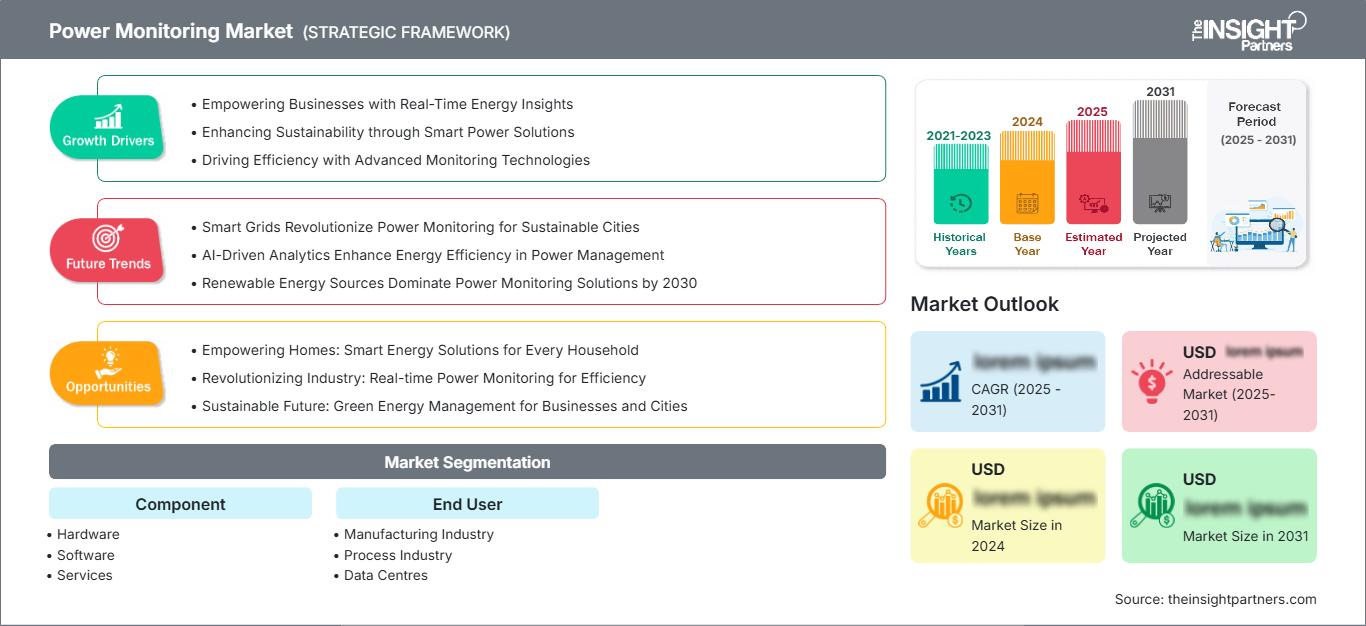
Power Monitoring Market: Strategic Insights
Regional Insights
North America power monitoring market
The power monitoring market report shows that North America is estimated to account for 38–42% share in 2025, with a regional CAGR of 7.0–7.8% during 2026–2034. The US and Canada remain important demand centers because manufacturing facilities, utilities, commercial buildings, and data centers require continuous visibility into electrical performance. Data-center electricity demand is particularly significant as AI and cloud infrastructure expand, increasing the value of power-quality monitoring, load analysis, and resilience-oriented systems.
Moreover, modernization of the grid and the rise in the use of distributed energy sources is another strength of the region. Monitoring data is utilized by industrial users to detect any abnormality in consumption patterns, any problem with power quality, and stress on machines in order to avoid breakdowns. Schneider Electric SE, Eaton Corporation plc, Siemens AG, ABB Ltd., and Rockwell Automation, Inc. have robust regional presence in both electrical equipment and automation systems. The adoption rate in North America should be relatively mature, focusing on software aspects.
U.S. power monitoring market Market
The U.S. represents approximately 72–76% of North America's 2025 share and is expected to expand at a 7.1–7.9% CAGR during 2026–2034. Growth is supported by hyperscale data centers, semiconductor manufacturing, advanced industrial facilities, and grid resilience programs. Eaton Corporation plc, ABB Ltd., Schneider Electric SE, Siemens AG, and Rockwell Automation, Inc. maintain substantial application exposure across these environments.
There are four key application developments in this regard – continuous monitoring of power quality, digital twin modeling, automated alarm generation, and preventive maintenance. Moreover, there is an additional complexity introduced by AI due to the electricity demand that results from the high-density computing load. According to the International Energy Agency, the electricity generation for powering data centers is expected to grow from 460 TWh in 2024 to more than 1,000 TWh in 2030 in their base scenario.
Europe power monitoring market Market
According to the power monitoring market forecast Europe is estimated to represent 20–24% share in 2025, with a 6.6–7.4% CAGR during 2026–2034. Germany is the leading country, followed by the UK, France, Italy, and Spain. Demand is supported by industrial energy efficiency, renewable integration, electrification, and requirements for better measurement of energy performance.
The United Kingdom and Germany are especially important due to their substantial industrial sectors, data center construction, and investments in energy transition programs. France, Italy, and Spain are becoming more stringent with their monitoring standards, due to increasing renewable energy production, electrification of transportation, and distributed energy resources. Buyers across the region are becoming more concerned with interoperable systems, power quality information, and energy management capabilities. The European market is thus conducive to providers capable of offering both monitoring and automation capabilities.
APAC power monitoring market Market
APAC is estimated at 24–28% share in 2025, with a 7.8–8.6% CAGR during 2026–2034. The key player here is China, with Japan, South Korea, India, and Australia being other major markets. The application areas include automation of industrial processes, chip fabrication, renewables installation, and increased power grids.
Policy-led electrification and infrastructure upgrades are crucial drivers of demand. China benefits from high industrial demand for electricity and heavy investments in grid infrastructure. Meanwhile, India is seeing a rise in manufacturing and digital infrastructure. Reliability and high-end industrial systems are priorities in Japan and South Korea, while Australia is focusing on combining renewables and new grid needs. These factors make APAC the fastest growing major regional market opportunity, especially in the realm of connected products and services.
Middle East & Africa power monitoring market Market
Middle East & Africa is projected to expand at approximately 6.8–7.6% CAGR during 2026–2034. Saudi Arabia and the UAE lead regional activity through infrastructure development, energy diversification, industrial projects, and large-scale digital facilities. South Africa represents an important market for industrial and utility applications.
The region's monitoring requirements are increasingly linked to renewable integration, critical infrastructure reliability, and large construction projects. Saudi Arabia's diversification programs and the UAE's smart infrastructure investments support digital electrical systems, while South Africa's power reliability challenges encourage greater visibility into electrical assets. Opportunities are also developing across the rest of MEA as utilities, industrial operators, and public infrastructure owners modernize electrical networks and seek better control over energy consumption.
Segmentation Analysis
Component
Component is projected to register a 6.8–7.5% CAGR during 2026–2034. Demand remains anchored by intelligent meters, sensors, gateways, monitoring platforms, and associated services required to create complete electrical visibility. Hardware remains essential for collecting reliable field data, while software and services increasingly determine the analytical value of those measurements.
- Hardware: Hardware provides the measurement foundation through meters, sensors, analyzers, and communication-enabled devices. Demand is strongest in industrial plants, utilities, data centers, and facilities requiring continuous power-quality visibility.
- Software: Software converts electrical measurements into dashboards, alarms, reports, analytics, and operational insights. Its strategic importance is increasing as customers seek centralized monitoring, automated diagnostics, and integration with enterprise or building systems.
- Services: Services cover system design, integration, commissioning, maintenance, upgrades, and analytics support. Customers increasingly use specialized services to connect heterogeneous equipment and sustain monitoring performance throughout the asset lifecycle.
End User
End User is expected to expand at a 7.3–8.1% CAGR during 2026–2034 as electricity-intensive operations prioritize reliability, efficiency, and digital control. Adoption varies according to load complexity, operational criticality, regulatory requirements, and the degree of automation already installed.
- Manufacturing Industry: Manufacturing plants use monitoring to identify energy-intensive processes, abnormal loads, and power-quality disturbances. Integration with industrial automation supports production continuity and enables more granular energy-management decisions.
- Process Industry: Process facilities require stable electrical conditions for continuous operations. Monitoring supports early identification of disturbances, equipment stress, and inefficient consumption across complex electrical and mechanical processes.
- Data Centres: Data centers require continuous electrical visibility because power disturbances can affect high-value computing infrastructure. Monitoring supports uptime, capacity planning, power-quality management, and coordination with backup and distributed energy systems.
- Utilities and Renewables: Utilities and renewable operators use monitoring to assess electrical flows, grid conditions, distributed resources, and generation performance. The segment gains strategic importance as variable renewable generation increases system complexity.
- Electric Vehicle Charging Stations: Charging infrastructure requires monitoring of demand, voltage, current, load balancing, and equipment condition. Connected monitoring supports reliable charging operations while helping operators manage increasingly concentrated electrical loads.
- Public Infrastructure: Airports, rail networks, hospitals, municipal facilities, and other public assets use monitoring to maintain reliable electricity and control operating costs. Long asset lifecycles make scalable monitoring platforms particularly valuable.
Opportunity Snapshot
| End User | Revenue Contribution (High/Medium/Low) | Trend Tag (MAX 2 words) | Adoption Stage (Emerging/Scaling/Mature) |
| Manufacturing Industry | High | Smart Factories | Mature |
| Process Industry | High | Process Reliability | Mature |
| Data Centres | High | AI Power | Scaling |
| Utilities and Renewables | High | Grid Flexibility | Scaling |
| Electric Vehicle Charging Stations | Medium | Fast Charging | Emerging |
| Public Infrastructure | Medium | Asset Resilience | Scaling |
Power Monitoring Market Growth Drivers and Impact Analysis
Rising Electricity Complexity in Industrial and Digital Facilities
Industrial electrification, automation, and high-density computing are increasing the complexity of electrical loads, making continuous measurement more valuable than periodic inspection. Manufacturers need to distinguish normal consumption from abnormal behavior, while data centers require detailed visibility across power distribution paths. The IEA expects electricity demand to continue rising through 2027 as buildings, transport, industry, air conditioning, and data centers increase consumption. This structural change expands the need for meters, sensors, analytics, and integration services. Vendors that combine power-quality measurement with asset diagnostics can address both efficiency and reliability requirements. The impact is strongest where interruptions create material financial losses, encouraging customers to prioritize monitoring as part of core electrical infrastructure rather than as an optional energy-management tool.
Expansion of Distributed Energy and Renewable Integration
Solar generation, battery storage, microgrids, and other distributed resources are creating more variable power flows across industrial, commercial, and utility networks. Monitoring systems provide the measurement layer needed to understand bidirectional flows, voltage behavior, load changes, and equipment conditions. The IEA notes that renewables are expected to meet nearly half of additional electricity demand from data centers through 2030, illustrating how clean generation and digital infrastructure are becoming increasingly interconnected. This creates demand for monitoring solutions capable of operating across conventional and distributed electrical architectures. Suppliers with strong interoperability, communications, and analytics capabilities can benefit as customers seek coordinated visibility across generation, storage, charging infrastructure, and consumption assets.
Increasing Focus on Electrical Resilience and Predictive Maintenance
Reliability requirements are shifting procurement toward systems capable of identifying developing electrical faults before they become outages. Continuous monitoring can capture abnormal voltage, current, harmonics, temperature-related effects, and insulation conditions, allowing operators to investigate problems earlier. ABB Ltd.'s agreement to acquire IPEC illustrates this strategic direction, as IPEC's technology focuses on continuous electrical diagnostics and early detection of failures in critical infrastructure. Such capabilities can change maintenance from reactive replacement to condition-based intervention. For operators of data centers, utilities, manufacturing plants, and other critical facilities, the commercial value lies not only in reducing energy consumption but also in protecting production schedules, service continuity, equipment life, and safety.
Power Monitoring Market Future Trends
AI-Assisted Electrical Intelligence
The power monitoring market trends show that AI-assisted monitoring is likely to evolve from descriptive dashboards toward systems that automatically identify patterns, classify anomalies, forecast electrical events, and recommend operational responses. Future platforms will increasingly combine historical measurements with contextual information from automation, weather, occupancy, production schedules, and distributed energy assets. This approach can reduce the analytical burden on facility teams while improving consistency in identifying abnormal conditions. AI will also encourage greater use of edge analytics because critical electrical decisions often require low latency and local resilience. Over time, the competitive distinction will move from the quantity of measured parameters toward the quality of models, explainability of recommendations, cybersecurity controls, and ability to integrate AI outputs into established operational workflows without compromising human oversight.
Digital Twins and Cross-System Energy Orchestration
Digital twins are expected to become more influential as operators seek to simulate electrical behavior before making changes to physical infrastructure. A mature digital-twin environment can combine power monitoring, equipment specifications, building information, production conditions, and historical performance to evaluate capacity constraints and potential interventions. Eaton's 2025 collaboration with Autodesk demonstrates the direction of this development, combining energy-management capabilities with digital-twin technology for building and data-center applications. Future solutions should increasingly connect monitoring data with design, commissioning, maintenance, and optimization processes, allowing operators to evaluate electrical infrastructure throughout its lifecycle instead of treating monitoring as a standalone operational activity.
Power Monitoring Market Opportunities
Monitoring for AI Data Center Power Architectures
AI infrastructure creates an opportunity for suppliers that can monitor rapid load changes across high-density computing environments. As data centers adopt higher-power racks, advanced cooling, backup generation, and new electrical architectures, operators need precise information about capacity, power quality, thermal conditions, and transient behavior. Eaton's work with NVIDIA on 800 V HVDC infrastructure illustrates the industry's movement toward higher-density electrical architectures for AI data centers. Vendors can capture value by offering integrated monitoring across the grid connection, distribution equipment, power conversion systems, and computing loads. Solutions that combine real-time measurement with predictive analytics and commissioning services should be particularly relevant to hyperscale and colocation operators.
Integrated Monitoring for Electrification and Distributed Assets
Electrification across transport, buildings, industry, and utilities creates opportunities for monitoring platforms that unify conventional loads with charging stations, solar systems, batteries, and microgrids. Customers increasingly need a common view of assets that previously operated independently. This favors open communication architectures, scalable software, and services capable of integrating equipment from multiple vendors. The strongest opportunity lies in deployments where distributed resources affect local capacity, power quality, or operating costs. Providers can strengthen their position by combining monitoring with load management, forecasting, maintenance, and energy optimization. Such offerings can also help customers establish more consistent performance baselines as electrification expands and electrical networks become more dynamic.
Frequently Asked Questions

- Comprehensive Market Sizing and Forecast Analysis
- Detailed Segmentation Analysis
- In-Depth Market Dynamics Assessment
- Regional and Country-Level Insights
- Competitive Landscape and Company Benchmarking
- Strategic Business Intelligence
Recent Reports
Testimonials

The Insight Partners provided valuable market intelligence that supported our global go-to-market strategy. Their team was professional, responsive, and attentive to our feedback, providing thoughtful analysis and helpful methodological clarifications throughout the project.
Junmo Kim Chief Financial Officer (CFO), Enertech Co., Ltd.
The Insight Partners' SCADA System Market report is comprehensive, with valuable insights on current trends and future forecasts. The team was highly professional, responsive, and supportive throughout. We are very satisfied and highly recommend their services.
RAN KEDEM Partner, Reali Technologies LTDs
I requested a report on a very specific software market and the team produced the report in a few days. The information was very relevant and well presented. I then requested some changes and additions to the report. The team was again very responsive and I got the final report in less than a week.
JEAN-HERVE JENN Chairman, Future Analytica
We worked with The Insight Partners for an important market study and forecast. They gave us clear insights into opportunities and risks, which helped shape our plans. Their research was easy to use and based on solid data. It helped us make smart, confident decisions. We highly recommend them.
PIYUSH NAGPAL Sr. Vice President, High Beam Global
The Insight Partners delivered insightful, well-structured market research with strong domain expertise. Their team was professional and responsive throughout. The user-friendly website made accessing industry reports seamless. We highly recommend them for reliable, high-quality research services
YUKIHIKO ADACHI CEO, Deep Blue, LLC.
This is the first time I have purchased a market report from The Insight Partners.While I was unsure at first, I visited their web site and felt more comfortable to take the risk and purchase a market report.I am completely satisfied with the quality of the report and customer service. I had several questions and comments with the initial report, but after a couple of dialogs over email with their analyst I believe I have a report that I can use as input to our strategic planning process.Thank you so much for taking the extra time and making this a positive experience.I will definitely recommend your service to others and you will be my first call when we need further market data.
JOHN SUZUKI President and Chief Executive Officer, Board Director, BK Technologies
I wish to appreciate your support and the professionalism you displayed in the course of attending to my request for information regarding to infectious disease IVD market in Nigeria. I appreciate your patience, your guidance, and the fact that you were willing to offer a discount, which eventually made it possible for us to close a deal. I look forward to engaging The Insight Partners in the future, all thanks to the impression you have created in me as a result of this first encounter.
DR CHIJIOKE ONYIA MANAGING DIRECTOR, PineCrest Healthcare Ltd.Reason to Buy
- Informed Decision-Making
- Understanding Market Dynamics
- Competitive Analysis
- Identifying Emerging Markets
- Customer Insights
- Market Forecasts
- Risk Mitigation
- Boosting Operational Efficiency
- Strategic Planning
- Investment Justification
- Tracking Industry Innovations
- Aligning with Regulatory Trends





 Get Free Sample for