
Power Transmission Lines and Towers Market Size, Demand & Growth by 2034
Coverage: by Product (Transmission Lines, Transmission Towers); Current (HVAC, HVDC); Voltage (69 kV to 130 kV, 131 kV to 220 kV, 221 kV to 660 kV, >660 kV); Application (High Tension, Extra High Tension, Ultra High Tension) , and Geography (North America, Europe, Asia Pacific, and South and Central America)
- Status : Data Released
- Report Code : TIPRE00010560
- Category : Electronics and Semiconductor
- No. of Pages : 150
- Available Report Formats :


- Last update date : October 13, 2026


2025 Market Size
US$ 17.95 Bn
Base year value
2034 Forecast
US$ 29.19 Bn
Projected by 2034
CAGR 2026-2034
5.55 %
Growth rate
Addressable Market
US$ 213.70 Bn
(2026-2034)
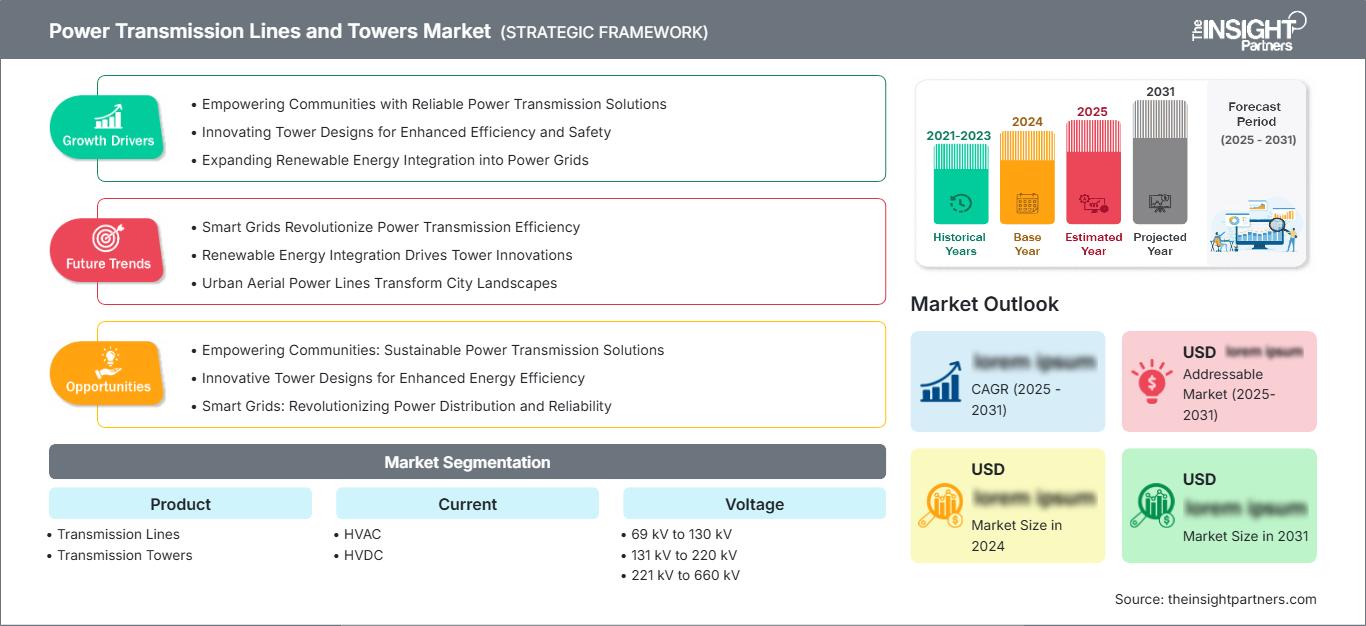
The power transmission lines and towers market was valued at US$ 17.95 Billion in 2025 and is projected to reach US$ 29.19 Billion by 2034; it is expected to register a CAGR of 5.55% from 2026–2034. The market reflects continued investment in grid modernization, transmission expansion, renewable energy integration, and replacement of aging electricity infrastructure across developed and emerging economies.
North America is expected to witness steady expansion, supported by grid resilience programs, renewable power interconnection projects, and increasing electricity demand from data centers and industrial facilities. The power transmission lines and towers market size in the region is influenced by infrastructure upgrades, regulatory initiatives, and investments in high-voltage transmission networks, with growth estimated within a CAGR range of 4.5–6.0% during 2026–2034.
Power Transmission Lines and Towers Market Assessment and Insights
- North America accounted for an estimated share of 24–28% in 2025 and is projected to grow at a CAGR of 4.5–6.0% between 2026–2034. Modernization initiatives and renewable transmission corridors are supporting regional expansion.
- US represented approximately 18–22% share in 2025 and is anticipated to expand at a CAGR of 4.8–6.2% during 2026–2034, driven by grid reliability investments and long-distance transmission development.
- Europe held an estimated 22–26% share in 2025 and is expected to grow at a CAGR of 4.2–5.8% during 2026–2034, with Germany, the UK, France, Italy, and Spain supporting transmission upgrades.
- Asia Pacific captured around 34–38% share in 2025 and is forecast to record a CAGR of 6.0–7.5% between 2026–2034, led by China, India, Japan, and Southeast Asian infrastructure expansion.
- Largest Segment: Transmission Lines held a market share of 55–60% in 2025 and is estimated to grow at a CAGR of 5.0–6.2% during 2026–2034 due to network expansion requirements.
- High Growth Segment: HVDC current systems represented a 20–25% market share in 2025 and are projected to grow at a CAGR of 7.0–8.5% during 2026–2034 due to renewable energy transmission needs.
- Key companies analyzed in detail: ARTECHE, General Electric, KEC International Ltd., MasTec, Prysmian Group, Sterling and Wilson Pvt. Ltd., Sumitomo Electric Industries, Ltd., Southwire Company, LLC, Siemens Gas and Power GmbH and Co. KG (Siemens AG), Skipper Limited.
Source: The Insight Partners' analysis based on proprietary research, government publications, company annual reports, investor presentations, industry databases, and expert interviews.
The market has evolved with advancements in conductor technology, tower engineering, digital monitoring systems, and high-voltage transmission solutions. Utilities are increasingly adopting advanced materials, automated inspection methods, and efficient grid planning approaches to improve reliability. The transition toward renewable energy generation has accelerated the requirement for expanded transmission infrastructure, especially for connecting remote solar and wind projects with consumption centers.
Future expansion is expected to be influenced by emerging electricity markets, cross-border grid initiatives, and investments in energy security. Governments are focusing on resilient power networks, while transmission operators are prioritizing capacity enhancement and loss reduction. Increasing deployment of HVDC networks, offshore wind transmission systems, and smart grid technologies is creating additional opportunities for infrastructure developers and equipment manufacturers.
Power Transmission Lines and Towers Market Report Scope
| Report Attribute | Details |
|---|---|
| Market size in 2025 | US$ 17.95 Billion |
| Market Size by 2034 | US$ 29.19 Billion |
| Global CAGR (2026 - 2034) | 5.55% |
| Historical Data | 2021-2024 |
| Forecast period | 2026-2034 |
Power Transmission Lines and Towers Market Analysis
The market growth is supported by rising electricity consumption, renewable energy integration, and the need to strengthen aging transmission assets. The value chain includes raw material suppliers, transmission equipment manufacturers, engineering service providers, utilities, and infrastructure operators. Demand for advanced conductors, high-strength towers, and efficient transmission technologies continues to increase as countries expand electricity networks.
Transmission infrastructure development depends on steel availability, engineering capabilities, regulatory approvals, and project financing. Supply dynamics are influenced by commodity price fluctuations, manufacturing capacity, and regional procurement strategies. Utilities are increasingly adopting optimized designs that reduce construction timelines while improving operational efficiency across long-distance transmission networks.
The market analysis highlights competitive positioning through technology innovation, project execution capabilities, and geographic expansion. Companies such as Siemens Gas and Power GmbH and Co. KG (Siemens AG), General Electric, Prysmian Group, and Sumitomo Electric Industries, Ltd. are strengthening their roles through advanced transmission solutions and grid modernization offerings.
Investment trends indicate increasing collaboration between utilities, governments, and technology providers. ARTECHE, KEC International Ltd., MasTec, Southwire Company, LLC, Sterling and Wilson Pvt. Ltd., and Skipper Limited are focusing on transmission infrastructure opportunities through specialized engineering capabilities, regional projects, and product development strategies. Competitive differentiation is shaped by reliability, lifecycle performance, and integration of digital monitoring systems.
● REPORT CUSTOMIZATION
Tailor This Report To Align With Your Specific Business Requirements
This report can be customized to align precisely with your business objectives, scope, and target markets. Customization options include tailored segmentation, geography, competitive analysis, and strategic insights to support informed decision-making.
Customize This Report →WHAT YOU CAN ADJUST
- ● Segmentations
- ● Geography
- ● Competitive Analysis
- ● Language Preferences
Power Transmission Lines and Towers Market: Strategic Insights
Regional Insights
North America power transmission lines and towers market
North America accounted for an estimated 24–28% of the power transmission lines and towers market share in 2025, supported by transmission modernization initiatives across the US and Canada. The region is projected to expand at a CAGR of 4.5–6.0% from 2026–2034 due to renewable energy integration, grid resilience investments, and increasing electricity demand from industrial users.
Utilities across the region are upgrading transmission corridors with advanced conductors, improved tower structures, and digital monitoring solutions. The US remains the leading contributor, while Canada is expanding infrastructure to support renewable generation and interregional electricity exchange. Policy emphasis on reliable power delivery continues to influence investment priorities.
U.S. power transmission lines and towers market
The U.S. accounted for approximately 18–22% share of North America in 2025 and is expected to register a CAGR of 4.8–6.2% through 2034. Grid modernization programs, renewable power connections, and infrastructure replacement initiatives are major contributors to market expansion.
Companies including General Electric, MasTec, and Southwire Company, LLC participate in transmission development through equipment supply, engineering services, and infrastructure solutions. Increasing deployment of renewable energy facilities is driving demand for high-capacity transmission networks. Applications across utilities, industrial facilities, and energy infrastructure projects are creating sustained opportunities for advanced transmission systems.
Europe power transmission lines and towers market
Europe represented an estimated 22–26% share in 2025 and is forecast to grow at a CAGR of 4.2–5.8% during 2026–2034. The region is supported by energy transition targets, offshore wind development, and cross-border electricity connectivity initiatives.
The UK is investing in transmission reinforcement to support renewable generation integration and offshore wind projects. Germany is a leading market due to grid expansion requirements associated with renewable energy distribution. France, Italy, and Spain are also upgrading networks through modernization programs and interconnection projects. Germany remains a significant contributor due to its renewable energy transition and industrial electricity requirements.
APAC power transmission lines and towers market
APAC accounted for approximately 34–38% share in 2025 and is expected to grow at a CAGR of 6.0–7.5% through 2034. China leads regional development through large-scale grid investments and ultra-high-voltage transmission projects.
Japan, South Korea, India, and Australia are advancing transmission infrastructure through renewable integration and industrial electrification programs. Government-led energy initiatives, urbanization, and manufacturing growth are strengthening demand for reliable transmission systems across the region.
Middle East & Africa power transmission lines and towers market
The Middle East & Africa is projected to experience growth supported by electricity infrastructure expansion, renewable energy projects, and industrial development. The region is estimated to grow at a CAGR of 5.0–6.5% during 2026–2034.
Saudi Arabia and the UAE are investing in grid upgrades and renewable energy connectivity, while South Africa continues improving electricity transmission reliability. Infrastructure development across the Rest of MEA is influenced by energy diversification strategies and increasing power demand from expanding urban and industrial centers.
Segmentation Analysis
Product
The Product segment in the power transmission lines and towers market is projected to grow at a CAGR of 5.0–6.2% during 2026–2034. Infrastructure expansion, replacement of aging networks, and increasing demand for efficient electricity transfer systems are driving the adoption of advanced transmission components. The segment reflects the importance of reliable physical infrastructure for supporting renewable integration and grid modernization. The power transmission lines and towers market scope continues expanding as utilities prioritize durable and efficient transmission assets.
- Transmission Lines remain a critical infrastructure component, supporting long-distance electricity transfer across utility networks. Demand is influenced by renewable power connections, grid expansion projects, and the requirement for improved transmission efficiency.
- Transmission Towers support overhead transmission systems by enabling stable electricity corridors. Increasing investments in high-voltage networks and the replacement of conventional structures are strengthening demand for advanced tower designs.
Current
The Current segment is expected to expand at a CAGR of 5.8–7.0% between 2026–2034. Growing renewable energy deployment and the requirement to transmit electricity over longer distances are encouraging the adoption of advanced current technologies. The segment includes solutions designed for different transmission requirements, with utilities evaluating efficiency, reliability, and operational flexibility.
- HVAC remains widely adopted due to established infrastructure, compatibility with existing grids, and suitability for regional transmission applications. Utilities continue upgrading HVAC networks to improve reliability and capacity.
- HVDC is gaining importance for long-distance transmission, offshore renewable projects, and interregional power transfer. Its efficiency advantages support increasing adoption in large-scale energy infrastructure developments.
Voltage
The Voltage segment is anticipated to register a CAGR of 5.2–6.5% from 2026–2034. Increasing electricity demand and renewable energy integration require transmission systems capable of handling higher capacities. Voltage optimization helps utilities improve network performance, reduce losses, and enhance reliability across expanding power systems.
- 69 kV to 130 kV systems support regional distribution and medium-capacity transmission requirements. They remain important for utility networks requiring dependable electricity delivery across shorter distances.
- 131 kV to 220 kV solutions are used in regional transmission applications where increased capacity and improved network stability are required for growing electricity demand.
- 221 kV to 660 kV systems support major transmission corridors and renewable energy integration projects requiring efficient high-capacity electricity transfer capabilities.
- >660 kV transmission solutions are strategically important for ultra-long-distance electricity movement and large-scale renewable power evacuation projects.
Application
The Application segment in the power transmission lines and towers market is projected to grow at a CAGR of 5.5–6.8% during 2026–2034. Increasing electrification, industrial expansion, and renewable power deployment are supporting demand across different transmission applications. The segment demonstrates the diverse requirements of modern electricity networks and highlights the role of transmission infrastructure in energy security.
- High Tension applications support regional electricity transmission and industrial power requirements. Their established use across utility networks maintains a consistent demand for reliable transmission infrastructure.
- Extra High-Tension applications enable efficient power movement over extended distances and support renewable energy integration projects requiring higher transmission capacity.
- Ultra-High-Tension applications are important for large-scale power corridors and cross-region electricity transfer, particularly in countries developing extensive grid infrastructure.
Opportunity Snapshot
| Application | Revenue Contribution (High/Medium/Low) | Trend Tag | Adoption Stage |
| Space Vehicle | Low | Aerospace Power | Emerging |
| Automated Guided Vehicles | Medium | Smart Mobility | Scaling |
| Unmanned Aerial Vehicle | Medium | Drone Infrastructure | Scaling |
| Industrial Robot | High | Factory Automation | Mature |
Power Transmission Lines and Towers Market Growth Drivers and Impact Analysis
Renewable energy integration requiring expanded transmission capacity
The rising number of renewable energy facilities is prompting the need for the expansion of the transmission system that will be able to integrate the distributed energy generators with the consumption points. Since solar and wind energy projects are usually situated in distant places, there is a need to build new transmission lines and high-capacity infrastructure. It is affecting the way utilities make investments in the transmission sector and promoting the use of innovative solutions. International initiatives aimed at the transformation of the energy sector are prompting countries to pay attention to their grids and electricity access.
Grid modernization and replacement of aging infrastructure
The aging nature of the electricity system is prompting utilities to make investments in modernization programs aimed at improving the performance of their electricity network in terms of efficiency, reliability, and resilience. There are many transmission networks that need to be modernized so as to cope with the ever-growing load of electricity and the new methods of electricity generation. This kind of modern system includes better materials, monitoring technology, and engineered design that help improve the performance of the system. The increased emphasis on resilient electricity networks is offering a market to the transmission equipment industry and engineering firms.
Increasing electricity demand from industrial expansion
Growth in industries, urbanization, and programs related to electrification are increasing demands on the electricity grids around the world. Factories, server farms, and transport electrification projects have high demands for an efficient power delivery system with increased capacity needs. Transmission investment projects are growing in response to new ways of consuming energy. There is an increasing need for efficiency in power transmission, which is encouraging the use of technologies for high-voltage transmission and better planning methods. Developing countries are increasingly paying attention to electricity infrastructure improvement due to economic development needs.
Power Transmission Lines and Towers Market Future Trends
Digital monitoring integration in transmission networks
Future power transmission lines and towers market trends indicate increasing adoption of digital monitoring technologies that improve asset visibility and operational decision-making. The application of sensors, predictive maintenance, and automation of inspection systems could become prevalent within the transmission network infrastructure. Such innovations will assist companies in detecting any potential problems with the equipment in advance and in developing more effective maintenance plans. The use of digital solutions in conjunction with infrastructure could affect the future approaches to the development of transmission infrastructure. It is anticipated that companies will favor those systems that can deliver operational data, ensure safety, and manage expanded electricity networks effectively.
Growth of cross-border electricity transmission projects
Projects involving cross-border electricity trading are likely to affect future developments in infrastructure development through the creation of a need for interconnected transmission networks. Countries are seeking collaboration in electricity in order to increase security of energy supplies, optimize renewable energy sources utilization and ensure balancing of supply levels. Such projects call for the development of sophisticated technology that can facilitate the transportation of electricity over long distances. The trend is likely to provide opportunities for high-capacity transmission networks, such as HVDC technology.
Power Transmission Lines and Towers Market Opportunities
Expansion of renewable energy transmission corridors
The power transmission lines and towers market forecasts indicate significant opportunities from renewable energy transmission corridor development. The investors and infrastructure companies can also take advantage of projects that aim to link remote facilities producing renewable power with the demand centers. The focus on the deployment of clean energy has made it mandatory for companies to have a good transmission system. The firms with experience in high-voltage solutions, engineering, and infrastructure development can take advantage of such projects. Investing in advanced transmission technology and management will enable the firm to remain in the market. Integration of renewable power is going to be a key opportunity area in the coming years.
Modernization partnerships with utilities and governments
Modernization efforts on the utility front offer an opportunity for businesses providing transmission equipment, engineering, and digital monitoring technology. Reliable electricity infrastructure is becoming a priority for governments in their efforts to stimulate economic development and ensure energy security. The cooperation of technology providers, utility businesses, and public infrastructure organizations could speed up the process of upgrading electricity networks. Businesses can look for ways of involvement in the process using the means of lifecycle services, asset management services, and innovative transmission designs. The changing infrastructure environment offers opportunities for businesses that can solve the problem of reliability and increase efficiency.
Frequently Asked Questions

- Comprehensive Market Sizing and Forecast Analysis
- Detailed Segmentation Analysis
- In-Depth Market Dynamics Assessment
- Regional and Country-Level Insights
- Competitive Landscape and Company Benchmarking
- Strategic Business Intelligence
Recent Reports
Testimonials

The Insight Partners provided valuable market intelligence that supported our global go-to-market strategy. Their team was professional, responsive, and attentive to our feedback, providing thoughtful analysis and helpful methodological clarifications throughout the project.
Junmo Kim Chief Financial Officer (CFO), Enertech Co., Ltd.
The Insight Partners' SCADA System Market report is comprehensive, with valuable insights on current trends and future forecasts. The team was highly professional, responsive, and supportive throughout. We are very satisfied and highly recommend their services.
RAN KEDEM Partner, Reali Technologies LTDs
I requested a report on a very specific software market and the team produced the report in a few days. The information was very relevant and well presented. I then requested some changes and additions to the report. The team was again very responsive and I got the final report in less than a week.
JEAN-HERVE JENN Chairman, Future Analytica
We worked with The Insight Partners for an important market study and forecast. They gave us clear insights into opportunities and risks, which helped shape our plans. Their research was easy to use and based on solid data. It helped us make smart, confident decisions. We highly recommend them.
PIYUSH NAGPAL Sr. Vice President, High Beam Global
The Insight Partners delivered insightful, well-structured market research with strong domain expertise. Their team was professional and responsive throughout. The user-friendly website made accessing industry reports seamless. We highly recommend them for reliable, high-quality research services
YUKIHIKO ADACHI CEO, Deep Blue, LLC.
This is the first time I have purchased a market report from The Insight Partners.While I was unsure at first, I visited their web site and felt more comfortable to take the risk and purchase a market report.I am completely satisfied with the quality of the report and customer service. I had several questions and comments with the initial report, but after a couple of dialogs over email with their analyst I believe I have a report that I can use as input to our strategic planning process.Thank you so much for taking the extra time and making this a positive experience.I will definitely recommend your service to others and you will be my first call when we need further market data.
JOHN SUZUKI President and Chief Executive Officer, Board Director, BK Technologies
I wish to appreciate your support and the professionalism you displayed in the course of attending to my request for information regarding to infectious disease IVD market in Nigeria. I appreciate your patience, your guidance, and the fact that you were willing to offer a discount, which eventually made it possible for us to close a deal. I look forward to engaging The Insight Partners in the future, all thanks to the impression you have created in me as a result of this first encounter.
DR CHIJIOKE ONYIA MANAGING DIRECTOR, PineCrest Healthcare Ltd.Reason to Buy
- Informed Decision-Making
- Understanding Market Dynamics
- Competitive Analysis
- Identifying Emerging Markets
- Customer Insights
- Market Forecasts
- Risk Mitigation
- Boosting Operational Efficiency
- Strategic Planning
- Investment Justification
- Tracking Industry Innovations
- Aligning with Regulatory Trends





 Get Free Sample for