
Precision Viticulture Market Share, Size & Demand by 2034
Coverage: by Component (Hardware, Software, Services); Application (Field Mapping, Crop Scouting, Yield Monitoring, Weather Tracking & Forecasting, Irrigation Management, Inventory Management, Farm Labor Management), and Geography (North America, Europe, Asia Pacific, and South and Central America)
- Status : Data Released
- Report Code : TIPRE00004287
- Category : Electronics and Semiconductor
- No. of Pages : 150
- Available Report Formats :


- Last update date : October 16, 2026


2025 Market Size
US$ 2.07 Bn
Base year value
2034 Forecast
US$ 8.13 Bn
Projected by 2034
CAGR 2026-2034
16.43 %
Growth rate
Addressable Market
US$ 43.01 Bn
(2026-2034)
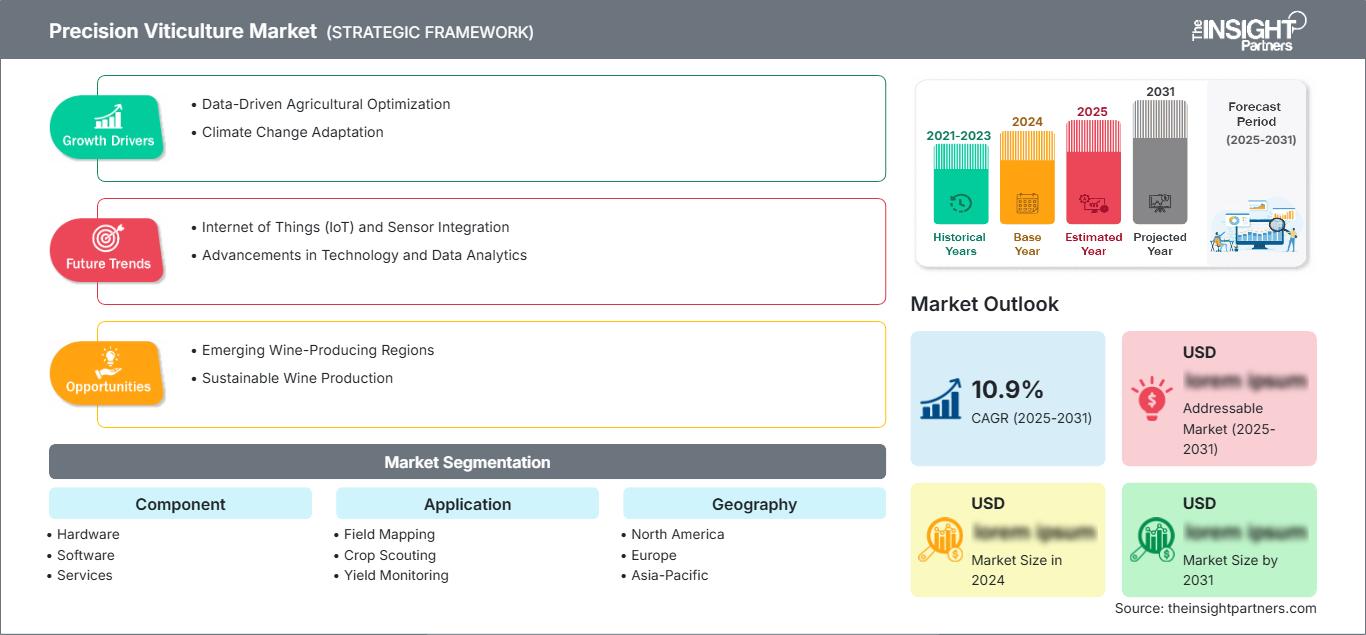
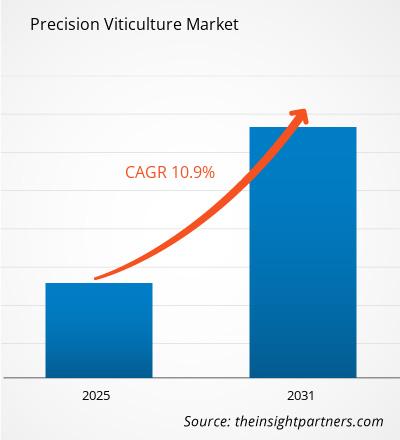
The Precision Viticulture Market was valued at US$ 2.07 Billion in 2025 and is projected to reach US$ 8.13 Billion by 2034, registering a CAGR of 16.43% during 2026–2034. The market is expanding as vineyard operators increasingly integrate digital agriculture technologies to improve grape quality, optimize resource utilization, and strengthen production resilience. Advanced sensing technologies, satellite imagery, artificial intelligence, connected farm equipment, and data-driven vineyard management platforms continue to transform cultivation practices across both commercial and premium wine-producing regions.
Across mature wine-producing economies, the Precision Viticulture Market size continues to benefit from investments in digital farming infrastructure, automation, and vineyard modernization initiatives. North America represents one of the leading regional markets and is projected to expand at a CAGR ranging between 15.5% and 16.5% during 2026–2034. Increasing adoption of GPS-enabled machinery, drone-assisted crop monitoring, and precision irrigation systems, combined with growing labor shortages and sustainability objectives, continues to encourage technology deployment among vineyard operators throughout the region.
Precision Viticulture Market Assessment and Insights
- North America: Accounted for 34–36% share in 2025 and is anticipated to grow at a CAGR of 15.5–16.5% during 2026–2034. Strong technology adoption, established vineyard infrastructure, high mechanization levels, and supportive digital agriculture initiatives continue to strengthen regional market expansion.
- US: Represented 72–76% of the North American market in 2025 and is expected to register a CAGR of 15.8–16.8% during 2026–2034. California-based vineyards remain the primary adopters of precision farming technologies, supported by advanced equipment manufacturers and software providers.
- Europe: Held 30–32% share in 2025 and is projected to expand at a CAGR of 15.0–16.0% during 2026–2034. France, Italy, and Spain continue to lead regional deployment owing to their extensive wine industries and increasing investments in sustainable vineyard management.
- Asia Pacific: Accounted for 20–22% share in 2025 and is forecast to record the highest CAGR of 17.5–18.5% during 2026–2034. China, Australia, Japan, and India are witnessing greater investments in precision agriculture technologies to improve vineyard productivity and product quality.
- Largest Segment: Hardware accounted for 44–46% market share in 2025 and is expected to expand at a CAGR of 15.5–16.5% during 2026–2034, supported by continued deployment of sensors, GPS devices, drones, weather stations, and connected agricultural machinery.
- High Growth Segment: Weather Tracking & Forecasting is projected to grow at a CAGR of 18.5–19.5% during 2026–2034, with an estimated 12–14% market share in 2025, driven by increasing climate variability and demand for predictive vineyard decision-making.
- Key companies analyzed in detail: Aha Viticulture, Ateknea Solutions, Deere & Company, Deveron UAS Corp., Groupe ICV, TeeJet Technologies, TerraNIS, Topcon Corporation, TracMap Limited, Trimble Inc.
Source: The Insight Partners' analysis based on proprietary research, government publications, company annual reports, investor presentations, industry databases, and expert interviews.
Continuous advances in precision agriculture technologies have significantly reshaped vineyard management over the past decade. Improvements in satellite positioning, unmanned aerial vehicles, multispectral imaging, Internet of Things-enabled field sensors, and cloud-based analytics have enabled growers to monitor vine health with greater accuracy than conventional inspection methods. The Precision Viticulture Market growth is further supported by increasing pressure to improve grape quality while reducing water consumption, fertilizer application, and labor dependency. Moreover, vineyard managers are applying predictive analytics together with weather intelligence in order to prevent disease outbreaks and enhance the timing of harvesting, thus achieving noticeable enhancements in productivity, efficiency, and sustainability of vineyards in both the high and low-end wine production segments.
In the coming years, it is anticipated that there will be growth in the market in emerging wine producers, where the adoption of digital agriculture technology is still in its initial stages. Government efforts in promoting climate-smart agriculture, in addition to growing broadband connectivity and precision farming incentives, are contributing to making these technologies more accessible to medium-scale vineyards. Cooperation between equipment makers, software vendors, agronomists, and research institutions is also expected to become stronger. Furthermore, the emphasis on sustainable agriculture, water conservation, and chemical-free agriculture is anticipated to contribute to the adoption of these technologies.
Precision Viticulture Market Report Scope
| Report Attribute | Details |
|---|---|
| Market size in 2025 | US$ 2.07 Billion |
| Market Size by 2034 | US$ 8.13 Billion |
| Global CAGR (2026 - 2034) | 16.43% |
| Historical Data | 2021-2024 |
| Forecast period | 2026-2034 |
Precision Viticulture Market Analysis
Growing climate variability, increasing production costs, and rising expectations for premium grape quality continue to influence investment across the global vineyard industry. The Precision Viticulture Market is benefiting from the convergence of automation, artificial intelligence, remote sensing, and advanced farm analytics that enable growers to make informed operational decisions. Digital systems gather information about the sensors, drones, weather stations, and satellite images that can be used to determine the ideal timing of the irrigation, nutrition, and harvesting while reducing unnecessary interventions in the field.
The value chain is constantly changing due to more effective cooperation between the producers of hardware and software, agronomists, geospatial data providers, and vineyards. Equipment providers include cloud services that allow constant monitoring and preventive maintenance of machinery. Interoperability of machinery and mobile applications becomes a critical factor when vineyards purchase equipment and other solutions.
Competitive intensity continues to increase as technology providers expand integrated product portfolios and strengthen regional partnerships. The Precision Viticulture Market analysis indicates that established agricultural technology companies are emphasizing complete vineyard management ecosystems rather than standalone equipment. Deere & Company, Trimble Inc., Topcon Corporation, and TeeJet Technologies persist with advancements in precision guidance, mapping, and connected farming technology, whereas dedicated vendors Aha Viticulture, TerraNIS, Groupe ICV, Ateknea Solutions, TracMap Limited, and Deveron UAS Corp. continue developing their analytics, aerial intelligence, and decision support tools for vineyards.
The trend of investments becomes more oriented toward AI, digital twins, machine vision, and autonomous operations, which are able to increase the efficiency of vineyards depending on changing climate conditions. Strategic cooperation between machinery manufacturers and software developers speeds up platforms' integration, whereas cloud-based subscription models allow making the solution more available for smaller and medium-sized vineyards. The innovations in disease prediction modeling, irrigation management, and remote crop monitoring can become additional sources of competitive advantage and market expansion.
● REPORT CUSTOMIZATION
Tailor This Report To Align With Your Specific Business Requirements
This report can be customized to align precisely with your business objectives, scope, and target markets. Customization options include tailored segmentation, geography, competitive analysis, and strategic insights to support informed decision-making.
Customize This Report →WHAT YOU CAN ADJUST
- ● Segmentations
- ● Geography
- ● Competitive Analysis
- ● Language Preferences
Precision Viticulture Market: Strategic Insights
Regional Insights
North America Precision Viticulture Market
North America accounted for 34–36% of the Precision Viticulture Market share in 2025 and is projected to register a CAGR of 15.5–16.5% during 2026–2034. Commercialized vineyards, the use of technology for precision agriculture and abundant availability of the digital infrastructure for agriculture are the main advantages of this region. Producers of wine keep investing in such technologies as automated irrigation, multispectral imaging, GPS-enabled technologies and cloud-based vineyard management services in order to improve efficiency of operations in view of staff shortages and variable climate.
Technology adoption will be facilitated by cooperation between manufacturers of agricultural machinery, software developers and research organizations concerned with increasing vineyard productivity and sustainability. Growing attention paid to water-use efficiency, disease prediction and data-based harvest management is likely to contribute to investments in high-tech precision viticulture solutions. Sustainable agriculture and digitalization programs launched by governments are expected to increase demand in the region during the forecast period, supporting North America's leadership in the global market.
U.S. Precision Viticulture Market
The United States represented 72–76% of the North American Precision Viticulture Market in 2025 and is expected to grow at a CAGR of 15.8–16.8% during 2026–2034. The leading wine producer state of California continues to dominate in the wine industry by possessing the largest percentage of commercial vineyards, whereas the states of Oregon and Washington have continued increasing their commitment to adopting precise farming techniques. The existence of technology companies in agriculture, together with innovation hubs, helps in the commercialization of sophisticated vineyard management systems.
Vineyard operators are increasingly using drones, satellite images, connected weather stations, artificial intelligence analysis of crops, and automated irrigation systems in order to ensure that quality grapes are produced while at the same time minimizing the cost of production. Good representation by technology providers such as Deere & Company, Trimble Inc. and Topcon Corporation continues to help in the development of the product and services.
Europe Precision Viticulture Market
Europe accounted for 30–32% of the global Precision Viticulture Market in 2025 and is forecast to expand at a CAGR of 15.0–16.0% during 2026–2034. The region's established wine industry, combined with stringent environmental regulations and strong emphasis on sustainable agriculture, continues to encourage adoption of precision vineyard technologies. France remains the regional leader, supported by extensive premium wine production and widespread implementation of digital monitoring systems that improve grape quality and resource efficiency.
There is consistent growth of investment in precision agriculture, digital mapping, and intelligent farm machines in Germany and the UK. German vineyards have been known to favor mechanization and sensor-based farming, while there has been expansion in the vineyards of the UK, with assistance from climate adaptation techniques and remote monitoring technology. Together, France, Italy, and Spain account for a considerable proportion of vineyard production in Europe, leading to increased need for remote sensing, irrigation management, and vineyard analysis.
APAC Precision Viticulture Market
Asia Pacific accounted for 20–22% of the global Precision Viticulture Market in 2025 and is anticipated to register the highest CAGR of 17.5–18.5% during 2026–2034. Australia and China lead regional adoption through investments in digital agriculture, vineyard modernization, and water-efficient cultivation technologies.
Japan, South Korea, and India are gradually expanding precision farming capabilities through smart agriculture initiatives and research partnerships. Australia remains the leading regional market due to its mature wine industry, while supportive government programs and increasing technology awareness continue accelerating adoption across emerging vineyard regions.
Middle East & Africa Precision Viticulture Market
The Middle East & Africa market is projected to expand at a CAGR of 14.0–15.0% during 2026–2034, supported by increasing investments in climate-resilient agriculture and efficient water management. South Africa remains the largest regional wine producer, while Saudi Arabia and the United Arab Emirates continue investing in advanced agricultural technologies suitable for controlled cultivation environments.
Growing emphasis on resource optimization, irrigation efficiency, and digital farm management is encouraging adoption across commercial agricultural projects. Although vineyard cultivation remains comparatively limited across several countries, ongoing infrastructure development, agricultural innovation programs, and sustainability initiatives are expected to create new opportunities for precision viticulture technologies throughout the region.
Segmentation Analysis
Component
The Component segment is projected to expand at a CAGR of 16.2–17.2% during 2026–2034. The Precision Viticulture Market scope continues to broaden as vineyard operators adopt integrated technology ecosystems that combine connected hardware, intelligent software, and specialized service offerings. Increasing focus on real-time vineyard monitoring, predictive analytics, and automation is encouraging investment across all component categories. Technology interoperability, cloud connectivity, and scalable deployment models are becoming important purchasing considerations as growers seek comprehensive digital solutions that improve productivity, sustainability, and operational decision-making.
- Hardware – Hardware remains the foundation of precision vineyard operations, including GPS receivers, drones, weather stations, field sensors, cameras, and automated irrigation controllers. These technologies generate real-time operational data that supports accurate vineyard management decisions.
- Software – Vineyard management software integrates satellite imagery, sensor information, machine data, and weather intelligence into centralized dashboards. Cloud-based platforms help growers optimize irrigation scheduling, disease forecasting, harvest planning, and resource allocation through advanced analytics.
- Services – Professional services include system integration, equipment installation, technical support, agronomic consulting, software implementation, training, and maintenance. Increasing demand for customized digital agriculture solutions continues to strengthen service revenues across commercial vineyard operations.
Application
The Application segment is anticipated to record a CAGR of 16.8–17.8% during 2026–2034 as vineyard operators increasingly rely on data-driven management practices throughout the cultivation cycle. Advanced applications support precision decision-making by improving crop visibility, optimizing field activities, reducing production risks, and enhancing grape quality. Continued integration of artificial intelligence, satellite monitoring, and connected sensing technologies is expected to expand application capabilities across vineyards of varying sizes.
- Field Mapping – Field mapping technologies provide accurate vineyard zoning, terrain assessment, and spatial variability analysis. These capabilities enable growers to implement location-specific cultivation practices that improve resource utilization and long-term vineyard productivity.
- Crop Scouting – Digital crop scouting combines drones, multispectral imaging, and mobile applications to identify plant stress, pest infestations, and disease symptoms earlier than conventional manual inspections, enabling faster agronomic intervention and reduced production losses.
- Yield Monitoring – Yield monitoring solutions collect and analyze production data throughout harvesting operations, allowing vineyard managers to evaluate productivity variations, optimize harvesting strategies, and improve future vineyard planning using historical performance trends.
- Weather Tracking & Forecasting – Connected weather stations and predictive forecasting platforms deliver localized climate intelligence that supports irrigation scheduling, frost protection, disease prevention, and harvest timing while minimizing weather-related production risks.
- Irrigation Management – Precision irrigation systems utilize soil moisture sensors, evapotranspiration models, and automated controls to optimize water distribution. These solutions improve water-use efficiency while supporting sustainable vineyard management under changing climatic conditions.
- Inventory Management – Inventory management applications provide digital visibility into agricultural inputs, equipment availability, spare parts, and harvested produce. Improved inventory control reduces operational delays and enhances procurement planning throughout vineyard operations.
- Farm Labor Management – Farm labor management platforms enable workforce scheduling, task allocation, productivity monitoring, and compliance tracking. Digital workforce management supports operational efficiency while addressing seasonal labor shortages experienced across commercial vineyards.
Opportunity Snapshot
| Application | Revenue Contribution | Trend Tag | Adoption Stage |
| Field Mapping | High | Spatial Analytics | Mature |
| Crop Scouting | High | Drone Imaging | Scaling |
| Yield Monitoring | High | Smart Harvest | Scaling |
| Weather Tracking & Forecasting | High | Climate Intelligence | Scaling |
| Irrigation Management | High | Water Optimization | Mature |
| Inventory Management | Medium | Digital Inventory | Emerging |
| Farm Labor Management | Medium | Workforce Digitalization | Emerging |
Precision Viticulture Market Growth Drivers and Impact Analysis
Growing adoption of precision agriculture technologies in commercial vineyards
Vineyards in the commercial sector are becoming more inclined towards using digital agriculture to boost production efficiency, lower operating costs, and ensure that grapes have similar quality irrespective of changes in the environment. The incorporation of GPS-enabled equipment, drones, remote sensing, connected weather stations, and AI allows them to take data-backed decisions through all stages of the growing process. The benefits include better scheduling of irrigation, fertilization, canopy management, and harvesting while eliminating unnecessary field activities. Moreover, there is an increasing shortage of labor in major wine-producing countries that makes it necessary to adopt automation measures. With the cost of the technology continuously falling and interoperability improving, vineyards of varying sizes in both established and new wine-producing countries will drive the adoption of digital agriculture.
Climate variability increasing demand for predictive vineyard management
The alterations in weather conditions, droughts, irregular rains, heat waves, and epidemics of diseases have made operations in the vineyard quite risky. Precision viticulture technology helps growers to monitor the weather conditions and use the data for predicting changes so that they can make necessary arrangements for facing them. With the help of sensors and satellite images, the vineyard owners will be able to detect the stress on the crops and plan for watering and disease management. With this technology, the consistency of wine production is improved while keeping down the water use and chemicals required for production.
Advancements in artificial intelligence and connected vineyard ecosystems
Innovations in artificial intelligence, cloud computing, Internet of Things, and analytics are revolutionizing the management of vineyards from reactive management to predictive operations. Digital platforms aggregate data from sensors, equipment, drones, satellites, and weather stations and deliver insights and recommendations for action. The accuracy of the prediction of diseases, yields, and irrigation through machine learning algorithms is getting better, and decreasing the need for analysis. The availability of compatible platforms from equipment and software providers increases their implementation in commercial vineyards. Further investments in intelligent automation and connected agriculture are expected to increase productivity, sustainability, and profitability of the precision viticulture sector around the world.
Precision Viticulture Market Future Trends
Artificial intelligence becoming central to vineyard decision support
Artificial intelligence is expected to become a core component of next-generation vineyard management platforms as growers seek higher operational efficiency and improved production quality. The Precision Viticulture Market trends indicate increasing deployment of machine learning algorithms capable of integrating weather forecasts, multispectral imagery, soil conditions, and historical production records into predictive recommendations. AI-powered platforms will increasingly automate irrigation scheduling, disease identification, harvest planning, and vineyard performance analysis. Continued improvements in cloud computing and edge processing are expected to make intelligent decision-support systems more accessible for vineyards of varying operational scales, strengthening long-term digital transformation across the industry.
Expansion of autonomous monitoring and robotics across vineyards
Autonomous technologies are expected to play a larger role in vineyard operations as labor shortages and operational efficiency requirements continue to intensify. Robotic platforms equipped with computer vision, autonomous navigation, and advanced sensing capabilities are increasingly being evaluated for crop inspection, precision spraying, canopy assessment, and selective harvesting support. Combined with drone-based monitoring and connected machinery, autonomous systems can improve operational consistency while reducing manual intervention. Continued technological improvements, declining hardware costs, and supportive agricultural innovation programs are likely to accelerate commercial deployment throughout the forecast period.
Precision Viticulture Market Opportunities
Expansion into emerging wine-producing economies
Emerging vineyard industries across Asia Pacific, Latin America, Eastern Europe, and selected Middle Eastern countries present attractive investment opportunities for technology providers. Precision Viticulture Market Forecasts indicate that increasing commercialization of wine production, combined with government support for climate-smart agriculture, will encourage greater adoption of digital vineyard management solutions. Equipment manufacturers, software developers, and agronomic service providers can establish long-term partnerships with regional growers by offering scalable platforms, localized analytics, and technical support. Early market entry and customized deployment strategies are expected to strengthen competitive positioning while supporting sustainable expansion across developing viticulture regions.
Integrated subscription-based digital vineyard platforms
Technology providers have significant opportunities to expand recurring revenue through cloud-based subscription platforms that combine hardware connectivity, agronomic intelligence, predictive analytics, and ongoing technical support. Software-as-a-service business models reduce upfront investment requirements for vineyard operators while enabling continuous feature updates and remote system management. Integration with mobile applications, satellite monitoring, automated irrigation controls, and artificial intelligence can further enhance customer value. As interoperability between agricultural equipment and digital management systems improves, comprehensive subscription ecosystems are expected to become a preferred deployment model for commercial vineyards seeking long-term operational efficiency and measurable return on investment.
Frequently Asked Questions

- Comprehensive Market Sizing and Forecast Analysis
- Detailed Segmentation Analysis
- In-Depth Market Dynamics Assessment
- Regional and Country-Level Insights
- Competitive Landscape and Company Benchmarking
- Strategic Business Intelligence
Recent Reports
Testimonials

The Insight Partners provided valuable market intelligence that supported our global go-to-market strategy. Their team was professional, responsive, and attentive to our feedback, providing thoughtful analysis and helpful methodological clarifications throughout the project.
Junmo Kim Chief Financial Officer (CFO), Enertech Co., Ltd.
The Insight Partners' SCADA System Market report is comprehensive, with valuable insights on current trends and future forecasts. The team was highly professional, responsive, and supportive throughout. We are very satisfied and highly recommend their services.
RAN KEDEM Partner, Reali Technologies LTDs
I requested a report on a very specific software market and the team produced the report in a few days. The information was very relevant and well presented. I then requested some changes and additions to the report. The team was again very responsive and I got the final report in less than a week.
JEAN-HERVE JENN Chairman, Future Analytica
We worked with The Insight Partners for an important market study and forecast. They gave us clear insights into opportunities and risks, which helped shape our plans. Their research was easy to use and based on solid data. It helped us make smart, confident decisions. We highly recommend them.
PIYUSH NAGPAL Sr. Vice President, High Beam Global
The Insight Partners delivered insightful, well-structured market research with strong domain expertise. Their team was professional and responsive throughout. The user-friendly website made accessing industry reports seamless. We highly recommend them for reliable, high-quality research services
YUKIHIKO ADACHI CEO, Deep Blue, LLC.
This is the first time I have purchased a market report from The Insight Partners.While I was unsure at first, I visited their web site and felt more comfortable to take the risk and purchase a market report.I am completely satisfied with the quality of the report and customer service. I had several questions and comments with the initial report, but after a couple of dialogs over email with their analyst I believe I have a report that I can use as input to our strategic planning process.Thank you so much for taking the extra time and making this a positive experience.I will definitely recommend your service to others and you will be my first call when we need further market data.
JOHN SUZUKI President and Chief Executive Officer, Board Director, BK Technologies
I wish to appreciate your support and the professionalism you displayed in the course of attending to my request for information regarding to infectious disease IVD market in Nigeria. I appreciate your patience, your guidance, and the fact that you were willing to offer a discount, which eventually made it possible for us to close a deal. I look forward to engaging The Insight Partners in the future, all thanks to the impression you have created in me as a result of this first encounter.
DR CHIJIOKE ONYIA MANAGING DIRECTOR, PineCrest Healthcare Ltd.Reason to Buy
- Informed Decision-Making
- Understanding Market Dynamics
- Competitive Analysis
- Identifying Emerging Markets
- Customer Insights
- Market Forecasts
- Risk Mitigation
- Boosting Operational Efficiency
- Strategic Planning
- Investment Justification
- Tracking Industry Innovations
- Aligning with Regulatory Trends





 Get Free Sample for