
Prepared Food Equipment Market Size, Share & Forecast by 2034
Coverage: by Basis mode of operation (Automatic, Semi-automatic, Manual); Type (Pre-processing, Processing, Packaging); Application (Dairy and Refrigerated products, Bakery and Confectionery products, Meat and Seafood products, Snacks and Savory products, Sauces dressings and Condiments, Ready-to-eat products) , and Geography (North America, Europe, Asia Pacific, and South and Central America)
- Status : Data Released
- Report Code : TIPRE00004539
- Category : Manufacturing and Construction
- No. of Pages : 150
- Available Report Formats :


- Last update date : September 07, 2026


2025 Market Size
US$ 14.92 Bn
Base year value
2034 Forecast
US$ 27.49 Bn
Projected by 2034
CAGR 2026-2034
7.02 %
Growth rate
Addressable Market
US$ 191.42 Bn
(2026-2034)
The prepared food equipment market is valued at US$ 14.92 Billion in 2025 and is projected to reach US$ 27.49 Billion by 2034, expanding at a CAGR of 7.02% during 2026–2034. The market covers machinery used for pre-processing, processing, and packaging prepared foods, with equipment configurations ranging from manual systems to highly integrated automatic production lines serving processors seeking throughput, consistency, hygiene, and resource efficiency.
North America remains a technologically mature arena, supported by replacement demand, labor constraints, convenience-food production, and investment in automated lines. The prepared food equipment market size is reinforced by processors upgrading equipment for sanitation, traceability, flexible batch production, and lower operating costs. Regional growth is expected around 6.2–7.0% CAGR between 2026–2034, with prepared meals, snacks, bakery products, and protein processing supporting equipment demand.
Prepared Food Equipment Market Assessment and Insights
- North America: North America is estimated to hold a 24–28% share in 2025 and expand at a 6.2–7.0% CAGR between 2026–2034, supported by automation investment, labor availability pressures, replacement cycles, and established prepared-food manufacturing infrastructure.
- US: The US accounts for an estimated 82–86% of North American demand in 2025 and is expected to grow at a 6.3–7.1% CAGR between 2026–2034, led by automated processing and packaging.
- Europe: Europe represents about 22–26% share in 2025 and is projected to expand at a 6.0–6.8% CAGR between 2026–2034, with Germany, Italy, France, Spain, and the UK benefiting from equipment modernization, hygiene requirements, and energy-efficiency investments.
- Asia Pacific: Asia Pacific holds an estimated 36–40% share in 2025 and is expected to grow at an 8.0–8.8% CAGR between 2026–2034, led by China, India, Japan, South Korea, and Australia as packaged-food capacity and automation adoption increase.
- Largest Segment: Automatic mode of operation is estimated at a 48–54% market share in 2025, with a 7.5–8.3% CAGR during 2026–2034, reflecting throughput and labor-efficiency priorities.
- High Growth Segment: Packaging is estimated at a 28–33% market share in 2025 and is projected to grow at an 8.0–8.8% CAGR during 2026–2034, driven by convenience formats and automation.
- Key companies analyzed in detail: GEA Group Aktiengesellschaft, Alfa Laval AB, Bühler AG, Marel hf., The Middleby Corporation, Welbilt, Hughes Equipment Company, LLC., Heat and Control, Inc., Bigtem Makine A.Ş., Hup Sheng Machinery and Industry Sdn Bhd.
Source: The Insight Partners' analysis based on proprietary research, government publications, company annual reports, investor presentations, industry databases, and expert interviews.
Manufacturing systems have moved from single machines to systems incorporating preparation, formation, cooking, transportation, inspection, and packing stages. Hygienic engineering, servo-mechanics, sensing, programmable controls, and electronic monitoring have become more important in specifying systems. Equipment manufacturers are also creating modular systems capable of handling changing recipes, pack styles, and batches without mechanical modification. This change enhances the importance of systems integration along with machine performance.
Future trends in demand will focus on flexible automation, efficient thermal processing, and equipment capable of handling short-term product cycles. Emerging centers for manufacturing foods in Asia and the Middle East will be seeing investment in capacities, while existing markets will see investments in replacements and retrofits of existing equipment. Food safety, traceability, sanitation, energy consumption, and waste reduction regulations will make process control and cleaning efficiency of equipment more important.
Prepared Food Equipment Market Report Scope
| Report Attribute | Details |
|---|---|
| Market size in 2025 | US$ 14.92 Billion |
| Market Size by 2034 | US$ 27.49 Billion |
| Global CAGR (2026 - 2034) | 7.02% |
| Historical Data | 2021-2024 |
| Forecast period | 2026-2034 |
Prepared Food Equipment Market Analysis
Demand across the prepared food equipment market growth landscape is shaped by convenience-food consumption, product diversification, labor constraints, and processors’ need to maintain consistent output. The system encompasses the handling of raw materials, cutting, mixing, shaping, heat treating, conveying, inspecting, and packaging processes. Thereby, it presents possibilities for suppliers that combine several process steps. Buyers tend to consider cost of ownership rather than just the acquisition cost and take into account downtime, setup time, sanitation, energy, and servicing aspects.
The supply environment depends on such factors as stainless steel manufacturing, control systems, drive systems, sensors, sanitary components, and specific engineering. Long qualification periods make experienced suppliers preserve the application knowledge and service base. At the same time, the modular design makes small processing plants automate only certain bottlenecks rather than whole production lines. The outcome is a diverse procurement situation where new factories prefer integrated systems, whereas old plants tend to apply selective retrofitting.
Competitive positioning combines broad portfolios with specialized processing capabilities. GEA Group Aktiengesellschaft offers preparation and further-processing equipment spanning individual machines to automated lines, while Alfa Laval AB emphasizes hygienic processing, heat transfer, separation, and resource efficiency. Bühler AG maintains strength in processing technologies and digitalized production, while Marel hf. brings specialized food-processing automation. These positions allow suppliers to compete through application knowledge, integration, and lifecycle support rather than equipment hardware alone. This supports prepared food equipment market analysis across technology and supplier positioning.
Investments for strategy are now more focused on automation, hygiene, online services, and efficient processing through energy. The Middleby Corporation is moving its food processing activity to become an independent business, whereas Welbilt works in the broader range of equipment that Ali Group provides. There are also other companies, such as Heat and Control, Inc., Bigtem Makine A.Ş., Hughes Equipment Company, LLC., and Hup Sheng Machinery and Industry Sdn Bhd, which contribute their expertise to the market.
● REPORT CUSTOMIZATION
Tailor This Report To Align With Your Specific Business Requirements
This report can be customized to align precisely with your business objectives, scope, and target markets. Customization options include tailored segmentation, geography, competitive analysis, and strategic insights to support informed decision-making.
Customize This Report →WHAT YOU CAN ADJUST
- ● Segmentations
- ● Geography
- ● Competitive Analysis
- ● Language Preferences
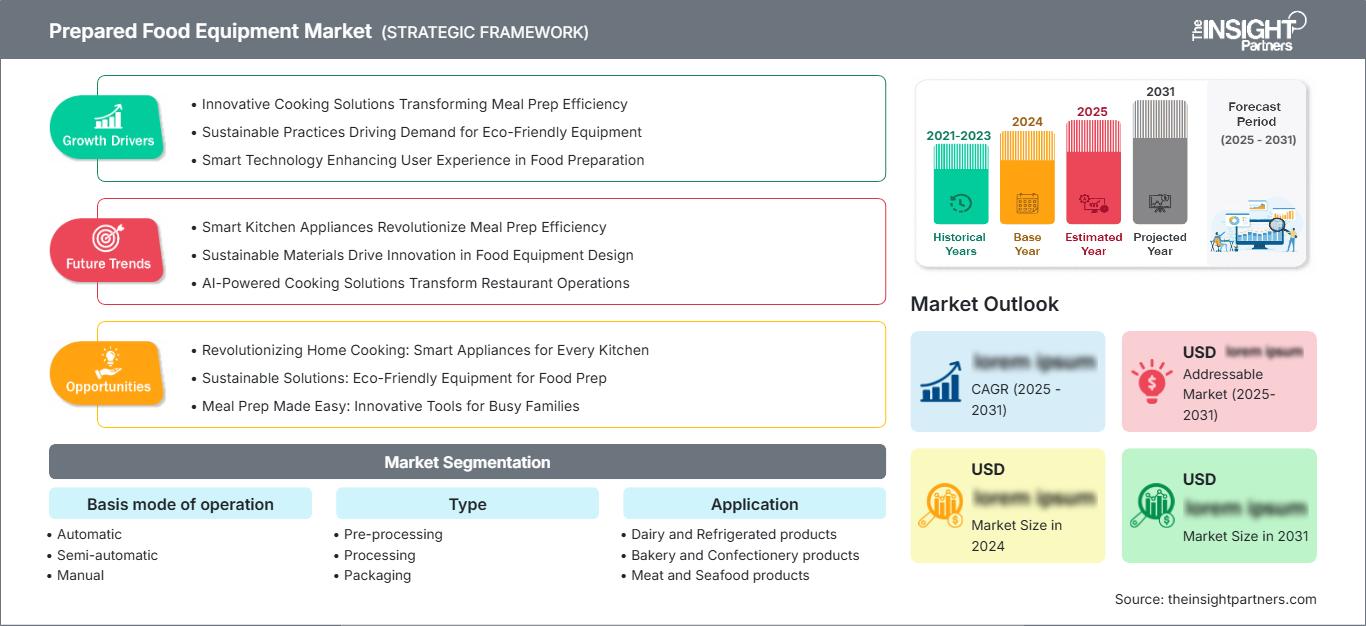
Prepared Food Equipment Market: Strategic Insights
Regional Insights
North America prepared food equipment market
North America is projected to retain a 24–28% share in 2025 and expand at a 6.2–7.0% CAGR through 2034. The United States dominates regional demand, supported by large prepared-food processors, sophisticated retail distribution, and high penetration of automated production. Canada adds demand through meat, bakery, frozen-food, and prepared-meal manufacturing. Replacement of aging machinery is an important purchasing mechanism, sustaining the prepared food equipment market share of the region.
Manufacturers are also concerned with sanitation, changeover efficiency, inspection and labor savings. Automation equipment is becoming more integrated in preparation, cooking, conveying, and packaging processes, which helps in standardizing the production process in different factories. The energy and water efficiencies become an important factor in selecting equipment when cleaning and thermal operations form a major portion of the cost structure.
U.S. prepared food equipment Market
The US represents approximately 82–86% of North American demand in 2025 and is expected to grow at a 6.3–7.1% CAGR through 2034. Demand centers around major food producers, co-packers, baked goods producers, protein manufacturers, and meal manufacturers. The competition among machinery providers focuses on output, reliability, hygiene, and compatibility with plant control systems.
Technology development is driven by automated portioning, forming, cooking, inspection, and end-of-line packaging. Availability of labor and rising wages add to arguments for automation, and flexible machines help manufacturers cope with changing products and packaging. GEA Group Aktiengesellschaft, The Middleby Corporation, Welbilt, Heat and Control, Inc., and other foreign providers participate in the US market with their equipment, distribution, service networks, or applications.
Europe prepared food equipment market
Europe accounts for about 22–26% share in 2025 and is expected to grow at a 6.0–6.8% CAGR, with Germany leading regional demand. Germany combines advanced machinery manufacturing with large food-processing clusters. The UK emphasizes prepared meals, bakery, and convenience foods, while France has strong dairy, meat, and processed-food production. Italy and Spain add demand through bakery, pasta, sauces, meat, and packaged food manufacturing. Across Europe, energy efficiency, hygienic design, traceability, and water reduction increasingly shape capital-equipment decisions. Suppliers with modular lines and retrofit capabilities are well-positioned as processors balance sustainability requirements with productivity and cost discipline.
APAC prepared food equipment market
APAC is estimated to hold 36–40% share of the prepared food equipment market in 2025 and grow at an 8.0–8.8% CAGR, making it the leading regional growth engine. China remains the largest market, while Japan and South Korea emphasize automation and precision. India and Australia are expanding prepared-food capacity, supported by organized retail and processing investment. Policy support for food manufacturing, export-oriented production, and modernization encourages equipment adoption. Rising packaged-food penetration further supports processing and packaging investments.
Middle East & Africa prepared food equipment Market
The Middle East and Africa prepared food equipment market is projected to expand at a 6.8–7.6% CAGR through 2034, with Saudi Arabia and the UAE leading regional investment. Food-security strategies, import substitution, hospitality development, and new processing capacity are supporting demand for automated preparation and packaging systems. South Africa remains an important manufacturing base with established food-processing capabilities.
Energy availability, water efficiency, and temperature management are significant equipment considerations. Gulf processors increasingly seek high-throughput systems for prepared foods and institutional supply, while the rest of the region includes smaller plants where modular automation can address labor and consistency constraints. Supplier service networks remain critical for equipment uptime and technical support.
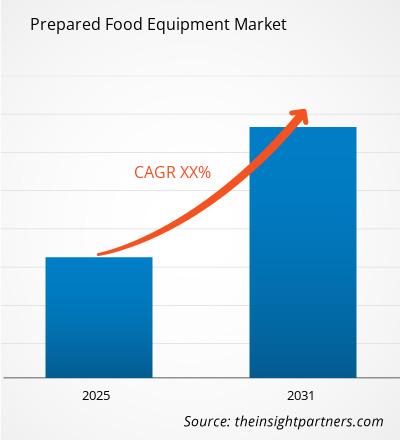
Segmentation Analysis
Basis mode of operation
Automatic systems are estimated to register a 7.5–8.3% CAGR during 2026–2034 and remain the leading operating mode. Processors favor integrated automation because it improves repeatability, reduces manual handling, supports centralized monitoring, and helps synchronize multiple stages. Semi-automatic systems remain relevant where product variation or capital constraints make full automation impractical, while manual systems retain importance in smaller facilities and specialized production. The prepared food equipment market scope therefore, includes both high-throughput automated plants and incremental modernization projects.
- Automatic: Automatic equipment supports high-throughput plants requiring synchronized preparation, processing, conveying, inspection, and packaging. Its strategic value increases when processors prioritize labor productivity, consistent quality, recipe control, and scalable production across multiple shifts.
- Semi-automatic: Semi-automatic equipment provides a compromise between labor involvement and mechanized consistency. It suits medium-scale processors, variable production environments, and facilities upgrading individual bottlenecks without committing to fully integrated automation.
- Manual: Manual systems remain relevant for small processors, specialty foods, low-volume batches, and operations where product handling requires operator judgment. Their lower capital requirements can support incremental modernization strategies.
Type
Packaging is estimated to achieve an 8.0–8.8% CAGR during 2026–2034, making it the high-growth type. As highlighted in the prepared food equipment market report, prepared-food manufacturers increasingly require flexible packaging formats, precise dosing, sealing, inspection, and coding. Pre-processing remains essential for raw material preparation, while processing equipment determines product quality and consistency. Investment decisions increasingly emphasize line synchronization across all three stages.
- Pre-processing: Pre-processing equipment prepares ingredients through activities such as sorting, cutting, washing, weighing, mixing, and handling. Reliable front-end performance reduces downstream variability and improves material utilization across prepared-food lines.
- Processing: Processing equipment performs core transformation steps including cooking, forming, frying, baking, cooling, or related treatments. It is strategically important because process control directly affects texture, safety, yield, and finished-product consistency.
- Packaging: Packaging equipment handles filling, sealing, wrapping, inspection, coding, and related end-of-line functions. Flexible systems support retail-ready formats, portion control, product protection, traceability, and rapid changeovers across diverse prepared-food portfolios.
Opportunity Snapshot
| Basis mode of operation | Revenue Contribution (High/Medium/Low) | Trend Tag (MAX 2 words) | Adoption Stage (Emerging/Scaling/Mature) |
| Automatic | High | Line Integration | Mature |
| Semi-automatic | Medium | Flexible Cells | Scaling |
| Manual | Low | Artisan Handling | Mature |
Prepared Food Equipment Market Growth Drivers and Impact Analysis
Labor constraints accelerate automation investment
The prepared food equipment market forecast indicates that persistent difficulty in recruiting and retaining production workers is encouraging food manufacturers to automate repetitive, high-volume tasks. Preparation, portioning, transport, inspection, and packaging can be orchestrated by automated systems that lessen reliance on human input and increase repeatability. There is more than just a saving of labor involved in the market effects, as automation can also help provide stability in scheduling and handling, as well as facilitate multi-shift production. Machine manufacturers who can offer equipment featuring robotics, controls, sensing, and hygienic engineering capabilities will be able to serve a larger share of the process line. Processors find themselves increasingly driven by throughput, availability, changeover efficiency, and maintenance considerations in their investments.
Convenience foods broaden equipment application requirements
Packaged prepared food products, frozen food products, snack items, baked goods, and ready-to-cook products require the manufacturer to handle an increased variety while maintaining efficient manufacturing. This leads to the requirement of equipment that can quickly change recipes, accurately portioning, handle the product gently, and accommodate multiple types of packaging. The outcome is a trend towards flexible equipment as opposed to equipment that handles one type of product only. Other features sought after by manufacturers include reduced giveaway, minimizing damage to the products, and a uniform appearance even at high throughput levels. Equipment suppliers with extensive application engineering capability can capitalize on this situation by incorporating several process steps into their offering as opposed to offering just individual pieces of equipment.
Hygiene and resource efficiency reshape equipment specifications
Requirements for food safety have raised the significance of hygiene engineering, cleanliness, contamination prevention, and the ability to document operating conditions. In addition, there is increased demand for conservation of water, energy, chemicals, and products. All this has resulted in equipment specifications that emphasize easily cleaned surfaces, better heat transfer capabilities, automated cleaning routines, enhanced insulation properties, and process monitoring. Alfa Laval AB, for example, has pointed out those technologies that have been devised to minimize cleaning inputs and improve hygienic capabilities. Such an approach shows how the goals of sustainability can lead to equipment procurement criteria. This has led to a focus on lifecycle costs instead of acquisition costs in the marketplace.
Prepared Food Equipment Market Future Trends
Digital twins and AI-enabled process optimization
There is an expectation for digitalization to progress from monitoring to prediction and prescription of processes. Future solutions will leverage machine data, production recipes, quality measurements, and maintenance data to detect process variations that might cause waste and/or downtime before they occur. Artificial intelligence could assist operators to optimize temperature settings, cycle time settings, product flow settings, and sanitation schedules within defined safety boundaries. The benefit for prepared food processing companies is the ability to leverage fragmented machine data for production insights. Digital suppliers who offer integrated controls, secure connections, and relevant analytics will be better poised to serve multiple lines. Eventually, digital twins will make it possible to do line design testing and virtual commissioning of different production scenarios. These developments are central to prepared food equipment market trends.
Low-resource processing becomes a design benchmark
Future equipment designs are expected to pay more attention to water, energy, and materials efficiency without neglecting food safety or processing capacity. Energy savings can be achieved via heat recovery, more efficient motors, improved heating profiles, advanced cleaning mechanisms, and better insulation. Packaging equipment is also expected to become better at managing materials and dispensing precise amounts of product to minimize losses. This trend has implications for procurement as suppliers increasingly assess their equipment not only on productivity but also from the standpoint of sustainability criteria. Suppliers can distinguish themselves by offering specific data on their products' resource performance and remote monitoring services. Retrofits to prolong the lifespan of existing equipment can also play an important role.
Prepared Food Equipment Market Opportunities
Retrofit programs for mature processing plants
A substantial opportunity exists in upgrading installed equipment rather than replacing complete production lines. Many mature plants can improve throughput and reliability through new controls, sensors, conveyors, inspection systems, energy-efficient drives, automated cleaning, or upgraded packaging modules. Retrofit projects can also address specific bottlenecks with lower capital intensity than greenfield installations. Suppliers can create recurring revenue by combining equipment upgrades with maintenance, spare parts, software, and performance services. The prepared food equipment market scope therefore, extends beyond new machinery sales into lifecycle modernization. Vendors that can integrate new modules with legacy equipment while minimizing production interruptions may gain an advantage among established processors. This model also supports customers seeking measurable improvements without undertaking extensive facility reconstruction.
Flexible lines for emerging prepared-food hubs
Emerging food-manufacturing centers in Asia, the Middle East, and selected African markets offer opportunities for suppliers that can deliver scalable, modular production systems. New plants increasingly need equipment capable of supporting multiple products, package sizes, and production volumes as domestic consumption and export requirements evolve. Vendors can target this opportunity with standardized modules that reduce engineering lead times while preserving application-specific configuration. Local service partnerships, training, spare parts availability, and remote diagnostics can strengthen adoption because technical support is often as important as machine capability. The prepared food equipment forecasts indicate stronger investment where food-security policies, organized retail expansion, and processing infrastructure encourage local value addition. Suppliers that combine flexible technology with regional support can improve project conversion and long-term customer retention.
Frequently Asked Questions

- Comprehensive Market Sizing and Forecast Analysis
- Detailed Segmentation Analysis
- In-Depth Market Dynamics Assessment
- Regional and Country-Level Insights
- Competitive Landscape and Company Benchmarking
- Strategic Business Intelligence
Recent Reports
Testimonials

The Insight Partners' SCADA System Market report is comprehensive, with valuable insights on current trends and future forecasts. The team was highly professional, responsive, and supportive throughout. We are very satisfied and highly recommend their services.
RAN KEDEM Partner, Reali Technologies LTDs
I requested a report on a very specific software market and the team produced the report in a few days. The information was very relevant and well presented. I then requested some changes and additions to the report. The team was again very responsive and I got the final report in less than a week.
JEAN-HERVE JENN Chairman, Future Analytica
We worked with The Insight Partners for an important market study and forecast. They gave us clear insights into opportunities and risks, which helped shape our plans. Their research was easy to use and based on solid data. It helped us make smart, confident decisions. We highly recommend them.
PIYUSH NAGPAL Sr. Vice President, High Beam Global
The Insight Partners delivered insightful, well-structured market research with strong domain expertise. Their team was professional and responsive throughout. The user-friendly website made accessing industry reports seamless. We highly recommend them for reliable, high-quality research services
YUKIHIKO ADACHI CEO, Deep Blue, LLC.
This is the first time I have purchased a market report from The Insight Partners.While I was unsure at first, I visited their web site and felt more comfortable to take the risk and purchase a market report.I am completely satisfied with the quality of the report and customer service. I had several questions and comments with the initial report, but after a couple of dialogs over email with their analyst I believe I have a report that I can use as input to our strategic planning process.Thank you so much for taking the extra time and making this a positive experience.I will definitely recommend your service to others and you will be my first call when we need further market data.
JOHN SUZUKI President and Chief Executive Officer, Board Director, BK Technologies
I wish to appreciate your support and the professionalism you displayed in the course of attending to my request for information regarding to infectious disease IVD market in Nigeria. I appreciate your patience, your guidance, and the fact that you were willing to offer a discount, which eventually made it possible for us to close a deal. I look forward to engaging The Insight Partners in the future, all thanks to the impression you have created in me as a result of this first encounter.
DR CHIJIOKE ONYIA MANAGING DIRECTOR, PineCrest Healthcare Ltd.Reason to Buy
- Informed Decision-Making
- Understanding Market Dynamics
- Competitive Analysis
- Identifying Emerging Markets
- Customer Insights
- Market Forecasts
- Risk Mitigation
- Boosting Operational Efficiency
- Strategic Planning
- Investment Justification
- Tracking Industry Innovations
- Aligning with Regulatory Trends





 Get Free Sample for