
Pressure Transmitter Market Demand, Trends & Forecast by 2034
Coverage: by Type (Absolute Pressure Transmitter, Gauge Pressure Transmitter, Differential Pressure Transmitter and Multivariable Pressure Transmitter), Fluid Type (Liquid, Steam and Gas), Technology (Piezoresistive, Piezoelectric, Strain Gauge, Capacitive and Others); End User (Metal & Mining, Oil & Gas, Chemicals, Food & Beverage, Pulp & Paper, Energy & Power and Others), and Geography (North America, Europe, Asia Pacific, and South and Central America)
- Status : Data Released
- Report Code : TIPEL00002428
- Category : Electronics and Semiconductor
- No. of Pages : 150
- Available Report Formats :


- Last update date : October 15, 2026


2025 Market Size
US$ 2.55 Bn
Base year value
2034 Forecast
US$ 3.73 Bn
Projected by 2034
CAGR 2026-2034
4.33 %
Growth rate
Addressable Market
US$ 28.54 Bn
(2026-2034)
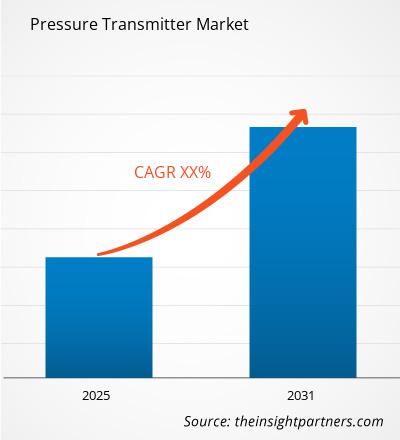
The global Pressure Transmitter Market reached US$ 2.55 Billion in 2025 and is projected to advance to US$ 3.73 Billion by 2034, expanding at a CAGR of 4.33% between 2026 and 2034. This trajectory reflects sustained investment in process automation, industrial digitization, and precision instrumentation across oil and gas, chemicals, and power sectors. Rising demand for real-time pressure monitoring in critical infrastructure reinforces steady, technology-driven expansion worldwide.
Within this landscape, the North America Pressure Transmitter Market size is estimated to expand at a CAGR of 3.8-4.2% through 2034, supported by modernization of aging oil and gas infrastructure and expanding renewable energy integration. Stringent process safety regulations enforced by federal and state agencies further compel operators across the region to upgrade legacy instrumentation with digitally enabled, high-accuracy pressure transmitters for continuous compliance monitoring.
Pressure Transmitter Market Assessment and Insights
- North America: North America accounted for 30-34% Pressure Transmitter Market share in 2025, growing at a CAGR of 3.8-4.2% during 2026-2034, driven by refinery modernization, chemical processing upgrades, and safety compliance mandates.
- US: The US dominates the regional landscape with 70-74% of North America in 2025, expanding at a CAGR of 3.7-4.1% through 2034.
- Europe: Europe held 24-28% market share in 2025, expanding at a CAGR of 4.0-4.4% between 2026 and 2034, led by Germany, the UK, and France amid strong automation investment.
- Asia Pacific: Asia Pacific captured 26-30% market share in 2025, projected to grow at a CAGR of 5.0-5.4% during 2026-2034, led by China, India, and Japan through industrial capacity expansion.
- Largest Segment: Differential Pressure Transmitter led the Type segment with a 38-42% share in 2025, growing at a CAGR of 4.0-4.4% between 2026 and 2034, owing to widespread flow measurement applications.
- High Growth Segment: Multivariable Pressure Transmitter is the fastest-growing segment, holding a 12-16% share in 2025 and advancing at a CAGR of 5.5-5.9% between 2026 and 2034 on multi-parameter adoption.
- Key companies analyzed in detail: TE Connectivity, Coulton Instrumentation Ltd., Honeywell International Inc., Transcat, Inc., Setra Systems, Yokogawa Electric Corporation, Baumer Holding AG, Bronkhorst High-Tech B.V., Omicron Sensing Pvt Ltd., and Ashcroft Inc.
Source: The Insight Partners' analysis based on proprietary research, government publications, company annual reports, investor presentations, industry databases, and expert interviews.
Advancements in pressure transmitter technology have gone from mechanical instruments to intelligent transmitters which use advanced microprocessors and employ field communication protocols such as HART, Foundation Fieldbus, and Profibus. Suppliers have adopted the integration of piezoresistive sensors and capacitors in order to increase the precision of measurements and minimize long-term drifts. The trend towards modular construction is also observed due to the increased demand for predictive maintenance which forces suppliers to include diagnostic functions in the transmitter itself.
In the future, new centers of manufacturing will emerge in Southeast Asia and the Middle East as suppliers attempt to localize their operations in response to growing infrastructures in the energy and power industry. Favorable regulatory changes, such as emissions control and safety requirements in the European Union and North America, will also lead to an increased turnover of pressure transmitters.
Pressure Transmitter Market Report Scope
| Report Attribute | Details |
|---|---|
| Market size in 2025 | US$ 2.55 Billion |
| Market Size by 2034 | US$ 3.73 Billion |
| Global CAGR (2026 - 2034) | 4.33% |
| Historical Data | 2021-2024 |
| Forecast period | 2026-2034 |
Pressure Transmitter Market Analysis
The growth in the demand side of the pressure transmitters market derives mainly from consistent investment in process industries, where precise pressure measurement is crucial for safety and productivity. The oil & gas producers, chemical processors, and power generation utilities have started employing pressure transmitters for pipeline, reactor, and boiler monitoring operations, driving the market across developed and emerging nations. Growing investments in LNG terminal and petrochemical facilities further drive the purchase of high precision measuring instruments.
The value chain consists of sensor part manufacturers, transmitter assembly firms, system integration companies, and end user entities, while the supply chain is becoming more and more dependent on semiconductor and ceramic diaphragm manufacturers. The supply is highly influenced by the availability of raw materials, especially specialty metals for wetted parts.
The level of competition is still strong, with market leaders competing with specialized regional players in terms of accuracy, certification, and after sales calibration services. While Honeywell International Inc. and Yokogawa Electric Corporation offer diversified product lines covering various types of sensors, TE Connectivity and Baumer Holding AG have sensor-level technological developments to incorporate into their OEM offerings. The above mentioned Pressure Transmitter Market report suggests that the competitive advantage depends upon digital connectivity and functional safety certifications such as IEC 61508.
Strategic positioning is apparent from investment choices: Bronkhorst High-Tech B.V. and Setra Systems develop niche competencies in flow and low pressure sensing, Transcat, Inc. develops services in calibration and asset management areas, Ashcroft Inc. and Coulton Instrumentation Ltd. offer customized solutions for industrial customers, and Omicron Sensing Pvt Ltd. increases production capacity for regional needs.
● REPORT CUSTOMIZATION
Tailor This Report To Align With Your Specific Business Requirements
This report can be customized to align precisely with your business objectives, scope, and target markets. Customization options include tailored segmentation, geography, competitive analysis, and strategic insights to support informed decision-making.
Customize This Report →WHAT YOU CAN ADJUST
- ● Segmentations
- ● Geography
- ● Competitive Analysis
- ● Language Preferences
Pressure Transmitter Market: Strategic Insights

Regional Insights
North America Pressure Transmitter Market
In 2025, North America was valued at 30-34% of the market due to the presence of robust oil and gas processing facilities and established chemical manufacturing hubs. Growth in the region is estimated to be around 3.8-4.2%, CAGR, during 2026-2034 due to refinery upgradation and pipeline inspection. Authorities such as OSHA and EPA mandate strict safety protocols that oblige operators to upgrade their existing analog instruments.
Factors driving growth include increased integration of renewables like hydrogen and carbon capture projects that need accurate pressure measurement. Operations in Canada’s oil sands region and an increasing number of petrochemical facilities in Mexico offer regional diversification, while increased usage of wireless transmitters further solidifies growth potential.
U.S. Pressure Transmitter Market
The United States captured about 70-74% share of the North America Pressure Transmitter Market in 2025, owing to the large refining facilities, chemical manufacturing units, and power infrastructure. It is expected to witness a CAGR of 3.7-4.1% during the forecast period from 2026 to 2034 owing to investments in shale gas refining facilities. Honeywell International Inc., Ashcroft Inc., Setra Systems, and Transcat, Inc. hold a strong foothold in the market.
There are some trends seen in applications which involve the preference for smart multivariable pressure transmitters to minimize installation issues. Hygienic capacitive sensor transmitters have become popular amongst food & beverages and pharmaceutical companies. Investments in LNG export terminals in the Gulf Coast region support the purchase of high-pressure differential transmitters.
Europe Pressure Transmitter Market
Europe held a 24-28% regional share in 2025, led by Germany, the United Kingdom, and France, projected to grow at a CAGR of 4.0-4.4% between 2026 and 2034. Germany remains the regional leader, underpinned by its chemical processing and automotive base, while the UK benefits from North Sea maintenance activity and offshore wind infrastructure.
France continues modernizing nuclear and energy infrastructure, while Italy and Spain see steady uptake across food processing and renewable installations, including solar and green hydrogen projects. Baumer Holding AG and Bronkhorst High-Tech B.V., both headquartered regionally, maintain strong manufacturing and distribution networks across Western and Central Europe.
APAC Pressure Transmitter Market
Asia Pacific accounted for 26-30% regional share in 2025, expanding at the fastest CAGR of 5.0-5.4% between 2026 and 2034, led by China's chemical and power generation capacity additions. Japan and South Korea contribute steady demand through semiconductor manufacturing.
India's expanding refining investment, supported by national manufacturing policy, and Australia's mining and LNG projects further strengthen regional demand, positioning Asia Pacific as the primary long-term growth engine.
Middle East & Africa Pressure Transmitter Market
The Middle East and Africa market is projected to grow at a CAGR of 4.5-4.9% between 2026 and 2034, led by Saudi Arabia's expanding petrochemical capacity under industrial diversification programs. The UAE follows closely, driven by downstream refining expansion and desalination investment.
South Africa contributes through mining and power sector modernization, while the Rest of MEA benefits from gradual oilfield development, reinforcing steady regional instrumentation demand tied to energy security.
Segmentation Analysis
Type
The Type segment, growing at a CAGR of 4.0-4.4% between 2026 and 2034, defines much of the Pressure Transmitter Market scope through its alignment with process measurement needs. Differential Pressure Transmitter leads adoption in flow and level measurement, while Multivariable Pressure Transmitter gains traction for consolidated, multi-parameter monitoring in space-constrained installations.
- Absolute Pressure Transmitter: Supports vacuum and altitude-referenced applications independent of atmospheric variation, finding demand in aerospace testing, meteorological stations, and laboratory instrumentation requiring consistent absolute reference readings.
- Gauge Pressure Transmitter: Measures pressure relative to ambient atmosphere, offering cost-effective reliability for tank monitoring, hydraulic systems, and everyday process control across manufacturing facilities.
- Differential Pressure Transmitter: The leading type, measuring pressure variance between two points, enabling flow, level, and filtration monitoring across oil and gas, chemical, and water treatment infrastructure.
- Multivariable Pressure Transmitter: Combines flow, pressure, and temperature sensing in one device, reducing installation complexity and total cost, gaining preference in space-limited brownfield upgrades.
Fluid Type
Fluid Type segmentation, advancing at a CAGR of 4.1-4.5% between 2026 and 2034, reflects varying measurement complexity across liquid, steam, and gas media. Liquid applications dominate through water treatment and chemical processing, while steam monitoring remains critical for power generation, and gas measurement expands alongside LNG infrastructure investment.
- Liquid: Representing the largest category, liquid pressure measurement supports water treatment, chemical processing, and hydraulic applications, benefiting from consistent demand across mature and developing economies.
- Steam: Steam pressure monitoring remains essential for power generation and boiler management, requiring robust, high-temperature-rated transmitters capable of withstanding demanding thermal cycling.
- Gas: Gas pressure transmitters serve natural gas distribution and LNG processing, with demand tied to expanding energy infrastructure investment and leak detection safety requirements.
Technology
The Technology segment is expanding at a CAGR of 4.3-4.7% between 2026 and 2034, led by strain gauge and piezoresistive designs favored for cost efficiency and measurement stability. Capacitive technology gains preference in high-accuracy environments, while piezoelectric sensing supports dynamic pressure measurement in specialized applications.
- Piezoresistive: Offers high sensitivity and compact design, suitable for automotive, medical, and industrial applications requiring reliable performance under moderate pressure and temperature variation.
- Piezoelectric: Excels in dynamic pressure measurement, commonly applied in combustion analysis and hydraulic testing requiring rapid response to fluctuating conditions.
- Strain Gauge: The most widely adopted technology, valued for proven reliability, cost efficiency, and compatibility across general industrial process control applications.
- Capacitive: Delivers high accuracy and stability, favored in pharmaceuticals, food and beverage, and semiconductor manufacturing requiring stringent measurement consistency.
End User
The End User segment is projected to grow at a CAGR of 4.2-4.6% between 2026 and 2034, with oil and gas and chemicals remaining dominant consumers due to extensive process monitoring needs. Energy and power utilities and metal and mining operators continue upgrading instrumentation for safety, while food and beverage and pulp and paper industries adopt hygienic, corrosion-resistant transmitters.
- Metal & Mining: Relies on rugged pressure transmitters for slurry processing, ventilation, and hydraulic equipment monitoring, prioritizing durability under harsh, abrasive environments.
- Oil & Gas: The largest category, depending on pressure transmitters for pipeline integrity, refining, and offshore platform safety systems across upstream and downstream segments.
- Chemicals: Requires corrosion-resistant, high-precision transmitters for reactor monitoring and batch process control, supporting product quality and regulatory compliance.
- Food & Beverage: Hygienic, sanitary-grade transmitters ensure compliance with contamination control standards during pasteurization, filling, and packaging operations.
- Pulp & Paper: Facilities utilize pressure transmitters for pulping, bleaching, and drying process monitoring, supporting consistent output quality.
- Energy & Power: Generation facilities depend on pressure transmitters for boiler, turbine, and emissions monitoring, supporting efficiency and regulatory compliance.
Opportunity Snapshot
Market Opportunity Snapshot
| End User | Revenue Contribution | Trend Tag | Adoption Stage |
|---|---|---|---|
| Metal & Mining | Medium | Slurry Monitoring | Mature |
| Oil & Gas | High | Pipeline Integrity | Mature |
| Chemicals | High | Reactor Monitoring | Mature |
| Food & Beverage | Medium | Hygienic Sensors | Scaling |
| Pulp & Paper | Low | Process Digitization | Scaling |
| Energy & Power | Medium | Emissions Monitoring | Scaling |
Pressure Transmitter Market Growth Drivers and Impact Analysis
Rising Automation Investment Across Process Industries
Continuous investment in process automation plays an important role in boosting growth prospects for the market, as oil and gas, chemicals, and power plants have been replacing conventional pressure gauges with digitalized transmitters. The use of Industrial IoT platforms facilitates constant remote monitoring of pressure, minimizes unplanned downtime, and enhances safety in hazardous processes. Process safety regulations are continuously getting stricter in order to make operators employ calibrated instrumentation with diagnostic capabilities. Increased spending on capital in LNG facilities, petrochemical plants, and water treatment facilities results in stable purchase requests throughout mature and emerging markets.
Expanding Renewable Energy and Hydrogen Infrastructure
Growing global investment in renewable energy, including offshore wind, solar-linked hydrogen production, and carbon capture projects, is generating fresh demand for pressure transmitters capable of operating reliably under variable and often extreme conditions. The equipment for compressing and storing hydrogen will demand precise differential and gauge transmitters in order to provide margins of safety during the processes of pressurization and transportation. Utilities that are adopting low-carbon sources for their power generation will be updating their existing instrumentation for boilers and turbines at the same time. Programs for clean energy backed by government across Europe, North America, and Asia Pacific help speed up this process.
Increasing Adoption of Predictive Maintenance Practices
In recent times, manufacturers and plant owners are adopting the use of predictive maintenance to reduce unplanned downtime and increase equipment serviceability, hence improving the need for intelligent transmitters that have diagnostic capabilities. Such transmitters constantly monitor drift, thermal history, and calibration, and provide the data for asset management systems which raise alarm signals before any failure occurs. This feature is very vital in process plants working with hazardous substances like chemicals and oil and gas.
Pressure Transmitter Market Future Trends
Proliferation of Wireless and IIoT-Enabled Transmitters
Among the most notable Pressure Transmitter Market trends is the accelerating shift toward wireless, battery-powered transmitters that eliminate complex cabling requirements in retrofit and remote monitoring applications. Low power technologies such as WirelessHART and others make it possible to place sensors in places which have been hard to access before without spending much on infrastructure setup. Such cases are especially visible in the case of oil and gas operations upstream and major water networks where cabling costs used to limit the density of installations. With improvements in battery technology, there is going to be steady increase in wireless installations.
Integration of Edge Analytics and Self-Diagnostic Capabilities
Instrumentation equipment manufacturers have begun integrating edge computing abilities in pressure transmitters, allowing the devices to carry out data analysis, anomaly detection, and diagnostics locally, without relying on any centralized system to process the data. The ability ensures that less data is transmitted and speeds up reactions when there are emergencies. Manufacturers have also begun equipping their products with security mechanisms to safeguard connected instrumentation networks. As manufacturing plants explore the use of digital twins and automation concepts, the transmitters will form the core of future process control architecture.
Pressure Transmitter Market Opportunities
Expansion into Emerging Water and Wastewater Infrastructure
Rapid urbanization across developing economies is creating substantial opportunity for suppliers to support new water treatment and wastewater management infrastructure. Government-funded programs across Asia Pacific, the Middle East, and Latin America are allocating capital toward desalination, sewage treatment, and municipal water distribution upgrades, all requiring reliable pressure monitoring instrumentation. Current Pressure Transmitter Market Forecasts indicate this segment will outpace several traditional industrial verticals in incremental unit demand through 2034, favoring suppliers offering cost-effective, corrosion-resistant transmitters tailored to municipal budgets.
Localized Manufacturing and Service Partnerships in Growth Markets
Establishing localized manufacturing and calibration service centers within high-growth regions presents a meaningful opportunity for instrumentation suppliers seeking to reduce lead times and strengthen customer relationships. Partnering with regional distributors and integrators enables faster response to project-specific customization while lowering delivered cost for clients. This approach also mitigates currency and tariff exposure from cross-border shipments. Companies investing early in local calibration labs and field service teams build durable advantages as capacity shifts toward emerging hubs.
Frequently Asked Questions

- Comprehensive Market Sizing and Forecast Analysis
- Detailed Segmentation Analysis
- In-Depth Market Dynamics Assessment
- Regional and Country-Level Insights
- Competitive Landscape and Company Benchmarking
- Strategic Business Intelligence
Recent Reports
Testimonials

The Insight Partners provided valuable market intelligence that supported our global go-to-market strategy. Their team was professional, responsive, and attentive to our feedback, providing thoughtful analysis and helpful methodological clarifications throughout the project.
Junmo Kim Chief Financial Officer (CFO), Enertech Co., Ltd.
The Insight Partners' SCADA System Market report is comprehensive, with valuable insights on current trends and future forecasts. The team was highly professional, responsive, and supportive throughout. We are very satisfied and highly recommend their services.
RAN KEDEM Partner, Reali Technologies LTDs
I requested a report on a very specific software market and the team produced the report in a few days. The information was very relevant and well presented. I then requested some changes and additions to the report. The team was again very responsive and I got the final report in less than a week.
JEAN-HERVE JENN Chairman, Future Analytica
We worked with The Insight Partners for an important market study and forecast. They gave us clear insights into opportunities and risks, which helped shape our plans. Their research was easy to use and based on solid data. It helped us make smart, confident decisions. We highly recommend them.
PIYUSH NAGPAL Sr. Vice President, High Beam Global
The Insight Partners delivered insightful, well-structured market research with strong domain expertise. Their team was professional and responsive throughout. The user-friendly website made accessing industry reports seamless. We highly recommend them for reliable, high-quality research services
YUKIHIKO ADACHI CEO, Deep Blue, LLC.
This is the first time I have purchased a market report from The Insight Partners.While I was unsure at first, I visited their web site and felt more comfortable to take the risk and purchase a market report.I am completely satisfied with the quality of the report and customer service. I had several questions and comments with the initial report, but after a couple of dialogs over email with their analyst I believe I have a report that I can use as input to our strategic planning process.Thank you so much for taking the extra time and making this a positive experience.I will definitely recommend your service to others and you will be my first call when we need further market data.
JOHN SUZUKI President and Chief Executive Officer, Board Director, BK Technologies
I wish to appreciate your support and the professionalism you displayed in the course of attending to my request for information regarding to infectious disease IVD market in Nigeria. I appreciate your patience, your guidance, and the fact that you were willing to offer a discount, which eventually made it possible for us to close a deal. I look forward to engaging The Insight Partners in the future, all thanks to the impression you have created in me as a result of this first encounter.
DR CHIJIOKE ONYIA MANAGING DIRECTOR, PineCrest Healthcare Ltd.Reason to Buy
- Informed Decision-Making
- Understanding Market Dynamics
- Competitive Analysis
- Identifying Emerging Markets
- Customer Insights
- Market Forecasts
- Risk Mitigation
- Boosting Operational Efficiency
- Strategic Planning
- Investment Justification
- Tracking Industry Innovations
- Aligning with Regulatory Trends





 Get Free Sample for