
Radiant Electric Flooring Market Growth, Size & Forecast by 2034
Coverage: by Type (Electric, Hydronic, Others); Application (Commercial, Residential) , and Geography (North America, Europe, Asia Pacific, and South and Central America)
- Status : Data Released
- Report Code : TIPRE00029448
- Category : Electronics and Semiconductor
- No. of Pages : 150
- Available Report Formats :


- Last update date : September 30, 2026


2025 Market Size
US$ 1.45 Bn
Base year value
2034 Forecast
US$ 3.15 Bn
Projected by 2034
CAGR 2026-2034
8.99 %
Growth rate
Addressable Market
US$ 20.57 Bn
(2026-2034)
The radiant electric flooring market size was valued at US$ 1.45 Billion in 2025 and is projected to reach US$ 3.15 Billion by 2034, expanding at a CAGR of 8.99% from 2026 to 2034. Growth reflects increasing adoption of electrically heated floor systems across renovation and new-build projects, supported by demand for controllable indoor comfort, low-profile installation, and integration with modern flooring assemblies.
North America is expected to remain a strategically important regional market, supported by renovation activity, demand for zone-based heating, and the availability of established installer networks. The regional outlook is reinforced by wider adoption of smart thermostats and thin heating mats that simplify retrofit installations while limiting changes to finished floor height.
Radiant Electric Flooring Market Assessment and Insights
- North America: North America is estimated to account for 30–34% radiant electric flooring market share in 2025, with the region expected to expand at a 7.8–8.6% CAGR between 2026–2034, supported by renovation and smart-home adoption.
- US: The US is estimated to represent 78–82% of North America in 2025, growing at a 7.7–8.5% CAGR between 2026–2034, driven by residential refurbishment and premium flooring installations.
- Europe: Europe is estimated at 27–31% share in 2025, with a 8.4–9.2% CAGR between 2026–2034. Germany, the UK, France, Italy, and Spain are key demand centers, supported by energy-efficiency priorities and renovation.
- Asia Pacific: Asia Pacific is estimated at 23–27% share in 2025, expanding at a 9.6–10.5% CAGR between 2026–2034. China, Japan, South Korea, and India are important contributors as construction standards and consumer preferences evolve.
- Largest Segment: Residential application is estimated to hold 58–62% market share in 2025, with a 8.4–9.1% CAGR from 2026–2034, reflecting strong renovation and comfort-heating demand.
- High Growth Segment: Electric type is estimated at 64–68% market share in 2025, expanding at a 9.2–10.0% CAGR from 2026–2034, supported by retrofit-friendly installation and precise zoning.
- Key companies analyzed in detail: nVent Electric plc (Nuheat), SunTouch, Warmup, Watts Water Technologies, Inc. (Watts Radiant), Warmboard, Heavenly Heat, Warmtech, Honeywell International Inc., MyHeat, Nexans.
Source: The Insight Partners' analysis based on proprietary research, government publications, company annual reports, investor presentations, industry databases, and expert interviews.
The technology evolution in the radiant electric flooring market has evolved from manually arranged heating tapes to mats manufactured at the factory with spaces, thin film assembly, smart thermostats, and uncoupling technologies. Current technology developments have become more installation and height conscious. nVent NUHEAT, for example, produces mats that have minimized manual arrangement of wires. Warmup provides its consumers with thin films for use on many types of floors.
During the forecast period, producers in the radiant electric flooring market are expected to place emphasis on digital controls, monitoring of energy consumption, renewable electricity compatibility, and ease of retrofitted installation. Demand from Asia Pacific and some Middle Eastern construction centers will help to expand the opportunity size. Efficient construction policies can provide an environment for adoption of the technology. Digital zoning of the heating areas will increase the role of the thermostats and control platforms in the system architecture.
Radiant Electric Flooring Market Report Scope
| Report Attribute | Details |
|---|---|
| Market size in 2025 | US$ 1.45 Billion |
| Market Size by 2034 | US$ 3.15 Billion |
| Global CAGR (2026 - 2034) | 8.99% |
| Historical Data | 2021-2024 |
| Forecast period | 2026-2034 |
Radiant Electric Flooring Market Analysis
Market opportunities of radiant electric flooring lie in the need for localized heat, increased comfort, and flexible installation. Renovation is especially important since the installation of mats or cables does not entail changing the whole heating system but merely involves installing an alternative system in certain rooms. Heating elements can be used in bathrooms, kitchens, entrances, bedrooms, and basements where comfortable warm floors add extra comfort and utility value.
A value chain in the radiant electric flooring market includes manufacturers of heating elements, suppliers of membranes and insulation materials, manufacturers of thermostats, distributors of flooring products, electrical contractors, installers of tiles, builders, and distributors of heating systems. It becomes increasingly difficult to compete due to growing advantages of pre-engineered solutions. The examples of pre-engineered solutions include Nuheat mats and Warmup factory-spaced systems.
There is a high fragmentation among competitors within the radiant electric flooring market. Known heating experts compete with each other based on their range of products, installer, controls, warranty, and compatibility of their products with flooring systems. nVent Electric plc uses Nuheat to offer mats, cables, membranes, and connected thermostats; Warmup offers heating solutions that include products and smart controls along with installation support. SunTouch offers a wide range of products.
Funding in the radiant electric flooring market is now being directed towards integration of products and not individual heating products. The heating companies are integrating the heating cables with membranes, insulation, thermostats, and digital controls. Watts Water Technologies, Warmboard, Nexans, Honeywell International Inc., MyHeat, Heavenly Heat, and Warmtech are among the participants in the market from complementary product and technology perspectives.
● REPORT CUSTOMIZATION
Tailor This Report To Align With Your Specific Business Requirements
This report can be customized to align precisely with your business objectives, scope, and target markets. Customization options include tailored segmentation, geography, competitive analysis, and strategic insights to support informed decision-making.
Customize This Report →WHAT YOU CAN ADJUST
- ● Segmentations
- ● Geography
- ● Competitive Analysis
- ● Language Preferences
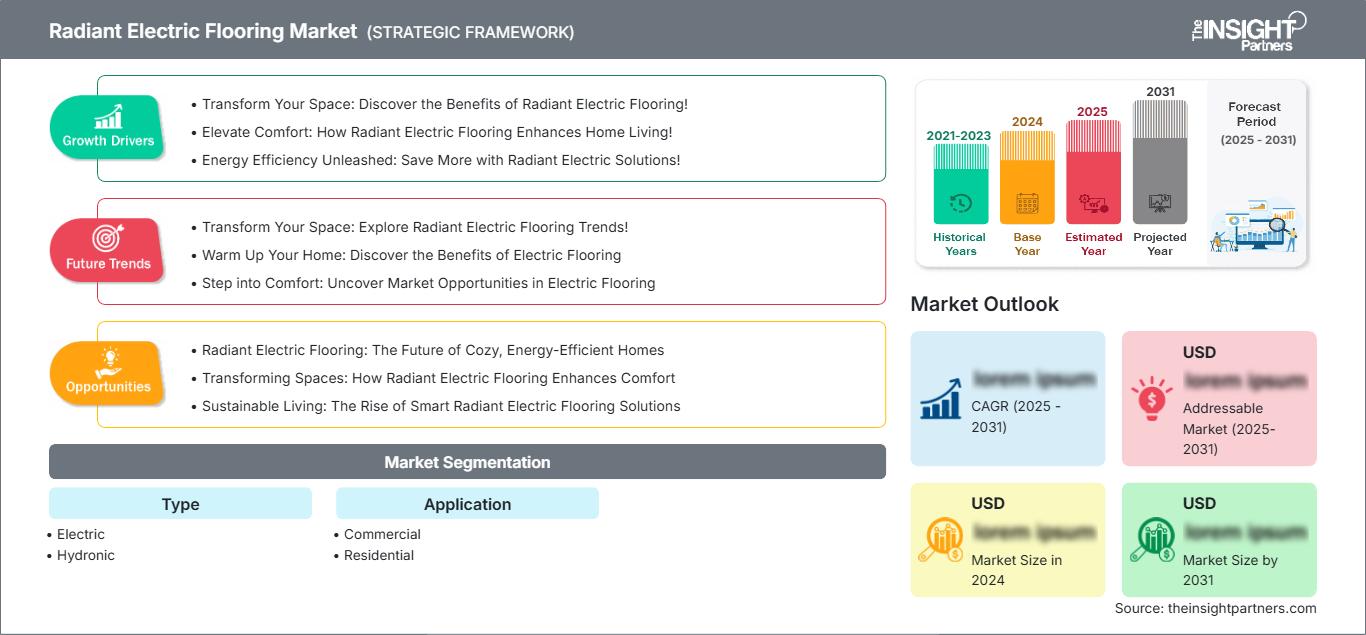
Radiant Electric Flooring Market: Strategic Insights
Regional Insights
North America radiant electric flooring market
North America is estimated to hold 30–34% share in 2025 and is projected to expand at a 7.8–8.6% CAGR from 2026–2034. The US constitutes the primary source of demand, while Canada comes second; renovations, upgrades to bathrooms, basement conversions, and high-end residential constructions drive installations. Electrical solutions prove especially favorable where the extension of hydronic solutions would become impractical or unprofitable. Additionally, thin mats and flexible cables help to implement renovations where height restrictions exist in place at the finished floor level.
Regional adoption is favored by existing electrical contracting networks and abundant supply of specific products. Smart thermostats have become a growing necessity as homeowners will be able to program heating in individual rooms and measure energy use. Nuheat offers wireless controls along with different system configurations, while SunTouch produces solutions for residential and light commercial use.
U.S. radiant electric flooring market Market
The radiant electric flooring market report shows that the US represents approximately 78–82% of North America in 2025 and is expected to grow at a 7.7–8.5% CAGR from 2026–2034. The demand for the technology is highest in residential remodeling, especially bathroom, kitchen, entrance areas, and extensions, where comfort heating can be utilized. High-end construction and design-based remodels will also aid in driving the acceptance of concealed heating systems.
The commercial demand for such a heating system will also be more selective and includes hotels, healthcare facilities, office buildings, and unique places of work where comfort and appearance of the floor determine building construction. NuHeat’s product has a strong domestic footprint in mats, cables, membrane, and thermostats, while SunTouch and Warmup cater to a larger installer network.
Europe radiant electric flooring market Market
Europe is estimated at 27–31% share in 2025, with a projected 8.4–9.2% CAGR from 2026–2034. There are benefits due to energy-efficiency standards, renovation schemes, heating electrification and high consumer awareness about UFH systems. UK, Germany, France, Italy and Spain are the key national market demand centers and installation approaches are determined by type of housing stock, climatic factors, economics of electricity and floor structure.
The UK demonstrates a high level of popularity of retrofit electric systems as thin mats allow solving problems related to floor height limitations and separate heating of rooms. Germany is characterized by the combination of renovation needs and energy efficiency trends as well as increasing demand for controlled heating zones. France, Italy and Spain are attractive markets through residential renovation projects, hospitality sector projects and warmer climate areas where it is more efficient to warm some floors rather than entire building.
APAC radiant electric flooring market Market
The radiant electric flooring market forecast shows that Asia Pacific is estimated to account for 23–27% share in 2025 and is projected to expand at a 9.6–10.5% CAGR from 2026–2034. China leads regional scale, followed by Japan, South Korea, India, and Australia. Demand is supported by urban residential construction, premium housing, hospitality development, and modernization of building systems.
China and India provide substantial long-term construction potential, while Japan and South Korea have stronger demand for compact, controlled indoor heating solutions. Australia offers opportunities in residential renovation and premium housing. Regional policy emphasis on building efficiency, electrification, and improved thermal performance should encourage adoption, particularly where electric systems can be deployed selectively without major changes to existing heating infrastructure.
Middle East & Africa radiant electric flooring market Market
Middle East and Africa represents a smaller regional opportunity but is expected to expand at a 7.0–7.8% CAGR from 2026–2034. Saudi Arabia and the UAE lead regional potential, supported by premium residential developments, hospitality projects, commercial construction, and high-end interior specifications. South Africa provides a distinct residential and commercial renovation opportunity.
Saudi Arabia and the UAE benefit from large-scale construction programs and demand for high-comfort building interiors, while South Africa offers selective adoption where colder seasonal conditions create a need for targeted floor warming. The rest of MEA remains fragmented, with purchasing decisions strongly influenced by project economics, imported product availability, installer capability, and electricity infrastructure. Energy-conscious building design should gradually support specialized applications.
Segmentation Analysis
Type
Type determines system architecture, installation method, heat-transfer characteristics, and project economics. The Type segment is projected to expand at a 8.8–9.7% CAGR from 2026–2034. Electric systems remain favored for targeted renovation because they can be installed without extensive plumbing, while hydronic systems retain relevance in larger projects where centralized heating infrastructure and continuous space heating justify greater installation complexity.
- Electric: Electric systems hold the stronger position because mats and cables can be installed room by room, require limited structural intervention, and integrate readily with programmable thermostats. Their suitability for renovations and smaller heated areas supports broad adoption.
- Hydronic: Hydronic systems remain strategically important for new construction and larger floor areas where water-based heating can be integrated into the building envelope. Their installed infrastructure makes them more suitable for projects designed around centralized thermal systems.
Application
Application shapes demand according to installation scale, comfort expectations, construction schedules, and ownership economics. The segment is forecast to expand at a 8.5–9.2% CAGR from 2026–2034. Residential projects provide the broadest installation base, while commercial projects offer higher-value opportunities where comfort, aesthetics, and zoning requirements influence building specifications.
- Commercial: Commercial adoption is concentrated in hospitality, offices, healthcare, retail, and premium developments where concealed heating supports interior design and occupant comfort. Project specifications typically emphasize durability, controllability, installation coordination, and lifecycle performance.
- Residential: Residential applications represent the largest demand pool, particularly in bathrooms, kitchens, bedrooms, entryways, basements, and renovation projects. Room-level control, low-profile products, and compatibility with multiple floor finishes strengthen adoption among homeowners and remodeling contractors.
Opportunity Snapshot
| Application | Revenue Contribution | Trend Tag | Adoption Stage |
| Commercial | Medium | Zoned Comfort | Scaling |
| Residential | High | Retrofit Heating | Mature |
Radiant Electric Flooring Market Growth Drivers and Impact Analysis
Expansion of renovation-led heating upgrades
Renovation activity is an important structural driver because electric floor systems can be deployed selectively without replacing an entire building heating network. This makes bathrooms, kitchens, converted basements, and extensions practical entry points for adoption. Thin mats and preconfigured systems further reduce installation complexity and can limit changes to floor elevation. Nuheat states that its standard mats are only 1/8 inch thick, while Warmup positions electric mats as renovation-oriented products with rapid installation characteristics. The commercial impact is significant because simplified installation expands the contractor pool and reduces coordination requirements between flooring and heating trades. Manufacturers that combine heating elements with membranes, insulation, and controls can therefore capture a larger portion of project value.
Integration of smart controls and energy management
Smart control capability is changing the purchasing criteria for electrically heated floors by moving systems beyond basic temperature regulation. Programmable thermostats, smartphone applications, energy monitoring, and smart-home compatibility enable users to operate heating according to occupancy and room schedules. Nuheat’s Signature thermostat provides Wi-Fi connectivity, mobile control, programmable operation, and energy-use monitoring, demonstrating how controls are becoming integral to system differentiation. This evolution creates opportunities for recurring software-enabled services, data-driven maintenance, and integration with wider home-management platforms. It also supports more efficient room-level operation because users can avoid continuously heating unoccupied areas. Suppliers with established thermostat ecosystems are therefore positioned to strengthen customer retention and increase the value of complete system packages.
Growth of low-profile and application-specific heating architectures
Installation constraints are encouraging manufacturers to engineer thinner, more adaptable heating assemblies. Renovation projects often have limited tolerance for additional floor buildup, while different floor coverings require distinct thermal and installation characteristics. Suppliers are responding with pre-built mats, flexible cables, membrane-integrated systems, and foil solutions designed for wood, laminate, carpet, tile, and stone. Warmup’s current portfolio includes StickyMat, Foil Heater, DCM-PRO, and In-Slab Cable systems, while Nuheat offers standard, custom, mesh, cable, and membrane configurations. Greater product specialization can shorten installation cycles, reduce field errors, and improve compatibility with architectural specifications. This driver should favor suppliers capable of providing multiple system formats rather than a single standardized heating element.
Radiant Electric Flooring Market Future Trends
Predictive and connected zone heating
Connected floor heating is likely to progress from remote control toward more automated zone management. Future thermostats can increasingly combine schedules, occupancy information, weather inputs, floor temperature sensing, and energy-use data to determine when heating should operate. The commercial value will come from reducing unnecessary runtime while preserving comfort in occupied spaces. Open integrations will also become more relevant as homeowners connect heating with broader smart-home platforms. Product development is therefore likely to emphasize interoperability, intuitive commissioning, and analytics rather than hardware alone. Suppliers that treat the thermostat as a central control layer can differentiate systems through software functionality and service capabilities. This trend may also support retrofit demand because intelligent control can improve the usability of room-specific heating without requiring a major change to the underlying electrical heating installation.
Compatibility with renewable electricity and efficient building envelopes
The radiant electric flooring market trends indicate that the relationship between radiant electric floors, insulation, solar generation, and efficient building envelopes is expected to become increasingly important. Electrified heating can provide greater operational flexibility when buildings have improved thermal performance and electricity supply is increasingly decarbonized. Future systems are likely to emphasize load scheduling, temperature optimization, and coordination with household energy-management platforms. Insulation will remain central because heat loss can undermine the performance of any radiant system, particularly over concrete slabs. Warmup notes that insulation can substantially reduce downward heat loss and improve system response. Consequently, heating manufacturers may increasingly sell complete assemblies combining heating elements, insulation, controls, and installation accessories, shifting competition toward integrated building-performance solutions.
Radiant Electric Flooring Market Opportunities
Integrated retrofit packages for contractors
A major commercial opportunity lies in standardized retrofit packages that combine heating mats or cables, insulation, membranes, thermostats, electrical accessories, and installation guidance. Such packages can reduce product-selection complexity for contractors and improve project predictability. Suppliers can also develop room-specific kits for bathrooms, kitchens, bedrooms, and renovation extensions, enabling distributors to stock repeatable configurations. The opportunity is particularly attractive where flooring installers and electricians coordinate frequently but lack dedicated heating expertise. Digital quoting tools, installation calculators, certification programs, and technical support can strengthen channel relationships without requiring significant changes to the underlying heating technology. Companies that simplify procurement and installation may increase conversion rates among smaller contractors and create stronger brand preference within renovation-oriented distribution networks.
Premium commercial projects and specification-led construction
Commercial buildings offer an opportunity to move beyond commodity floor warming into specification-driven systems with integrated controls, monitoring, and application-specific engineering. Hospitality developments, wellness facilities, healthcare environments, premium offices, and high-end residential complexes can value concealed heating because it preserves interior design flexibility while supporting occupant comfort. Suppliers can target architects, mechanical consultants, electrical contractors, and flooring specialists earlier in the project cycle to secure system specifications. Custom mats and specialized membrane systems are particularly relevant where room geometry or floor assemblies create installation constraints. The opportunity also extends to regional construction markets with rapidly expanding premium developments, including selected Gulf states and Asian metropolitan areas. Strategic partnerships with flooring manufacturers and construction distributors can improve project access and reduce customer-acquisition costs.
Frequently Asked Questions

- Comprehensive Market Sizing and Forecast Analysis
- Detailed Segmentation Analysis
- In-Depth Market Dynamics Assessment
- Regional and Country-Level Insights
- Competitive Landscape and Company Benchmarking
- Strategic Business Intelligence
Recent Reports
Testimonials

The Insight Partners provided valuable market intelligence that supported our global go-to-market strategy. Their team was professional, responsive, and attentive to our feedback, providing thoughtful analysis and helpful methodological clarifications throughout the project.
Junmo Kim Chief Financial Officer (CFO), Enertech Co., Ltd.
The Insight Partners' SCADA System Market report is comprehensive, with valuable insights on current trends and future forecasts. The team was highly professional, responsive, and supportive throughout. We are very satisfied and highly recommend their services.
RAN KEDEM Partner, Reali Technologies LTDs
I requested a report on a very specific software market and the team produced the report in a few days. The information was very relevant and well presented. I then requested some changes and additions to the report. The team was again very responsive and I got the final report in less than a week.
JEAN-HERVE JENN Chairman, Future Analytica
We worked with The Insight Partners for an important market study and forecast. They gave us clear insights into opportunities and risks, which helped shape our plans. Their research was easy to use and based on solid data. It helped us make smart, confident decisions. We highly recommend them.
PIYUSH NAGPAL Sr. Vice President, High Beam Global
The Insight Partners delivered insightful, well-structured market research with strong domain expertise. Their team was professional and responsive throughout. The user-friendly website made accessing industry reports seamless. We highly recommend them for reliable, high-quality research services
YUKIHIKO ADACHI CEO, Deep Blue, LLC.
This is the first time I have purchased a market report from The Insight Partners.While I was unsure at first, I visited their web site and felt more comfortable to take the risk and purchase a market report.I am completely satisfied with the quality of the report and customer service. I had several questions and comments with the initial report, but after a couple of dialogs over email with their analyst I believe I have a report that I can use as input to our strategic planning process.Thank you so much for taking the extra time and making this a positive experience.I will definitely recommend your service to others and you will be my first call when we need further market data.
JOHN SUZUKI President and Chief Executive Officer, Board Director, BK Technologies
I wish to appreciate your support and the professionalism you displayed in the course of attending to my request for information regarding to infectious disease IVD market in Nigeria. I appreciate your patience, your guidance, and the fact that you were willing to offer a discount, which eventually made it possible for us to close a deal. I look forward to engaging The Insight Partners in the future, all thanks to the impression you have created in me as a result of this first encounter.
DR CHIJIOKE ONYIA MANAGING DIRECTOR, PineCrest Healthcare Ltd.Reason to Buy
- Informed Decision-Making
- Understanding Market Dynamics
- Competitive Analysis
- Identifying Emerging Markets
- Customer Insights
- Market Forecasts
- Risk Mitigation
- Boosting Operational Efficiency
- Strategic Planning
- Investment Justification
- Tracking Industry Innovations
- Aligning with Regulatory Trends





 Get Free Sample for