
Rapid Liquid Printing Market Share, Demand & Growth by 2034
Coverage: By Offering (Printers, Services, Materials, Software); Application (Prototyping, Functional/End-Use Part Manufacturing, Tooling); Vertical (Consumer Products, Fashion, Automotive, Healthcare, Aerospace and Defense, Utility, Construction, Others) , and Geography (North America, Europe, Asia Pacific, and South and Central America)
- Status : Data Released
- Report Code : TIPRE00013806
- Category : Electronics and Semiconductor
- No. of Pages : 150
- Available Report Formats :


- Last update date : October 13, 2026


2025 Market Size
US$ 201.17 Mn
Base year value
2034 Forecast
US$ 1,824.84 Mn
Projected by 2034
CAGR 2026-2034
27.76 %
Growth rate
Addressable Market
US$ 7,470.55 Mn
(2026-2034)
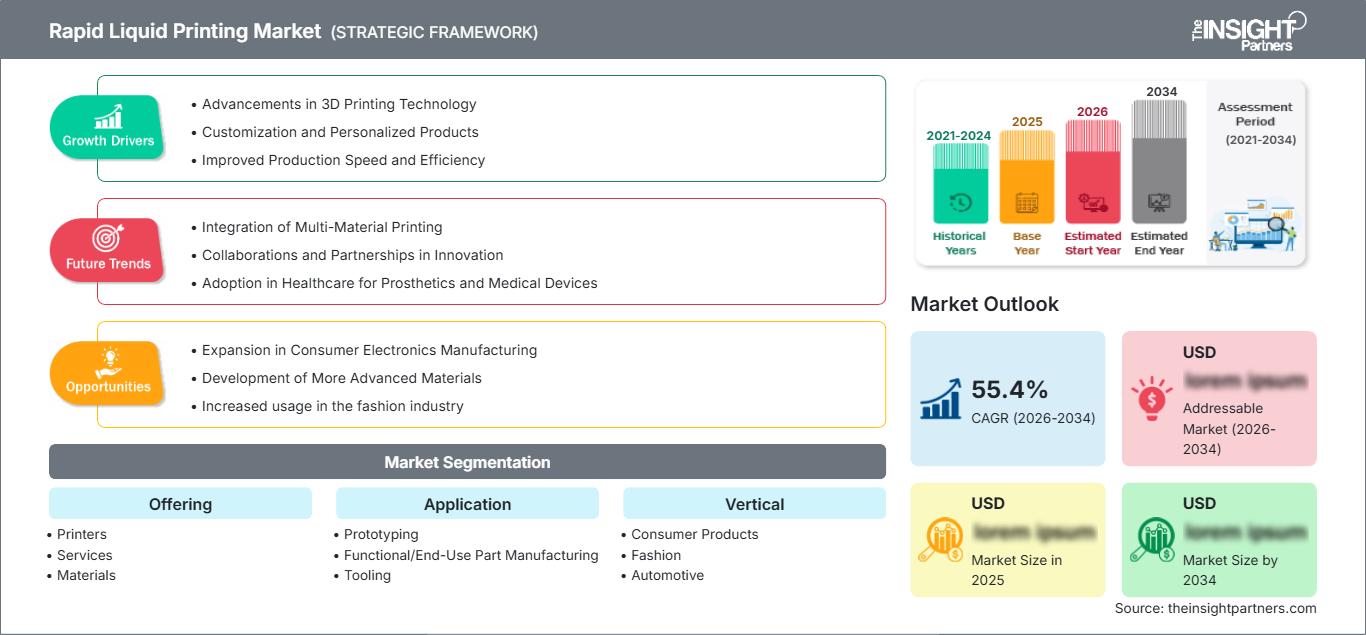
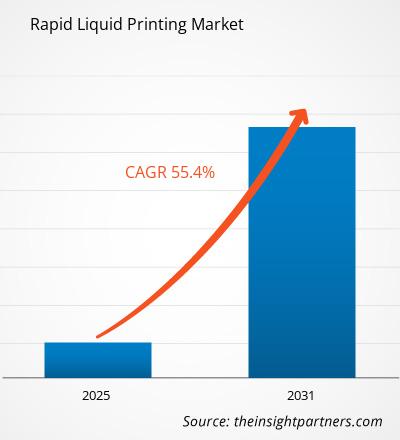
The rapid liquid printing market is projected to expand from US$ 201.17 Million in 2025 to US$ 1,824.84 Million by 2034, registering a CAGR of 27.76% during 2026–2034. The technology enables digitally driven production of complex parts by depositing liquid materials within a supporting medium, reducing tooling requirements while enabling geometric freedom, rapid iteration, and customized manufacturing across industrial applications.
North America is positioned as a leading regional adoption center, supported by advanced manufacturing infrastructure, strong additive manufacturing capabilities, and established automotive, aerospace, healthcare, and consumer product ecosystems. Increasing investment in digitally integrated production, demand for shorter development cycles, and broader commercialization of polymer-based additive processes are expected to support regional expansion at an estimated 25–28% CAGR during 2026–2034.
Rapid Liquid Printing Market Assessment and Insights
- North America: North America is expected to maintain a leading position, accounting for a 43–46% rapid liquid printing market share in 2025 and growing at a 25–28% CAGR between 2026–2034, supported by industrial adoption, R&D activity, and established additive manufacturing infrastructure.
- US: The US represents approximately 82–86% of North America's share in 2025, with adoption expanding at a 25–28% CAGR between 2026–2034 through aerospace, automotive, healthcare, and industrial applications.
- Europe: Europe is estimated to hold a 29–32% share in 2025 and expand at a 24–27% CAGR between 2026–2034, with Germany, France, Italy, and the UK supporting adoption through advanced manufacturing and engineering capabilities.
- Asia Pacific: Asia Pacific is estimated to represent a 19–22% share in 2025 and record a 28–31% CAGR between 2026–2034, led by China, Japan, South Korea, and India as industrial digitization accelerates.
- Largest Segment: Printers are estimated to hold a 38–42% market share in 2025, expanding at a 26–29% CAGR during 2026–2034, supported by equipment demand for industrial production and prototyping.
- High Growth Segment: Tooling is estimated to represent a 14–18% market share in 2025, with a 30–34% CAGR during 2026–2034, driven by faster mold, fixture, and production-aid development.
- Key companies analyzed in detail: 3D Systems, Inc.; Autodesk Inc.; Dassault Systèmes SE; EOS GmbH; ExOne Operating LLC; HP Development Company, L.P.; Materialise NV; Meltio; Steelcase Inc.; Stratasys Ltd.
Source: The Insight Partners' analysis based on proprietary research, government publications, company annual reports, investor presentations, industry databases, and expert interviews.
The technology environment has evolved from experimental gel-supported manufacturing methods to digitally controlled manufacturing processes capable of producing advanced elastomers and polymers. Non-planar tool paths, robotic printing, optimized materials, and digital process control are changing the economics of manufacturing. One such technology is rapid liquid print technology that utilizes a reusable suspension medium without using any conventional support structure, demonstrating the importance of process architecture in reducing post-manufacturing and achieving greater geometric freedom.
Future research needs in the rapid liquid printing market will shift towards manufacturing qualification, repeatibility, material certification and integration into factory software systems. The automotive and aerospace industries could be interested in the technology for manufacturing light weight components, tooling and customized parts whereas healthcare industry will need higher validation efforts. Investments need to be made towards scalable hardware, optimized materials, automated inspection and design software capable of generating production ready workflows.
Rapid Liquid Printing Market Report Scope
| Report Attribute | Details |
|---|---|
| Market size in 2025 | US$ 201.17 Million |
| Market Size by 2034 | US$ 1,824.84 Million |
| Global CAGR (2026 - 2034) | 27.76% |
| Historical Data | 2021-2024 |
| Forecast period | 2026-2034 |
Rapid Liquid Printing Market Analysis
The rapid growth of the liquid printing market will be driven by the manufacturers' need for shorter development cycles, lower reliance on tooling, and increased design flexibility. The value chain includes printer makers, material producers, software vendors, engineering service companies, and customers. The need is highest in cases where complex geometries and product iterations create high costs associated with traditional molds and fixturing tools. Manufacturing economics get better when digital data can be transferred from the design environment into manufacturing directly, avoiding time-consuming tooling setup.
The supply side in the rapid liquid printing market still requires technological solutions because the printers, materials, suspending medium, robots, software, and know-how should function together. Consistency of the material will affect repeatability of mechanical performance. As a result, the suppliers are offering the closed-loop solution that includes machine control, digital manufacturing software, process control, and application engineering services.
Today, the competitive positioning in the rapid liquid printing market relies significantly on the ability of companies to link hardware with software, material and applications. The companies that include 3D Systems, Stratasys Ltd., HP Development Company, L.P., EOS GmbH and ExOne Operating LLC provide presence across different additive manufacturing technologies and production settings, while Autodesk Inc., Dassault Systèmes SE and Materialise NV provide expertise in the digital design and software domain. Steelcase Inc. provides a significant application-oriented perspective through advanced manufacturing and customized product development.
The investment approach in the rapid liquid printing market is increasingly being directed towards increasing throughput, automation, production repeatability and application-oriented qualification. The recent product offerings clearly highlight the investment trends, including HP’s small-scale industrial platform and 3D Systems’ large-scale hardware and factory software programs. Companies with expertise in customer engineering can distinguish themselves through workflow solutions, whereas software companies can create value through improvements in design, simulation and production data management.
● REPORT CUSTOMIZATION
Tailor This Report To Align With Your Specific Business Requirements
This report can be customized to align precisely with your business objectives, scope, and target markets. Customization options include tailored segmentation, geography, competitive analysis, and strategic insights to support informed decision-making.
Customize This Report →WHAT YOU CAN ADJUST
- ● Segmentations
- ● Geography
- ● Competitive Analysis
- ● Language Preferences
Rapid Liquid Printing Market: Strategic Insights
Regional Insights
North America rapid liquid printing market
North America is estimated to command a 43–46% share in 2025, making it the largest regional contributor. The region benefits from advanced manufacturing clusters, extensive aerospace and automotive production, and established additive manufacturing service networks. The United States accounts for the majority of regional demand, while Canada contributes through aerospace, industrial design, and specialized manufacturing applications. Regional growth is estimated at a 25–28% CAGR during 2026–2034.
More and more industrial buyers in the rapid liquid printing market are exploring liquid additive processes for tools, prototypes, customized parts, and other manufacturing aids. A good level of university-industry partnership, venture funding, and digital manufacturing expertise offer a proven route to commercialization. Moreover, the presence of big technology providers in the area ensures that the necessary equipment, materials, software, and processes can be developed and qualified. This is expected to maintain the region’s dominance while the applications shift from prototypes to production.
U.S. rapid liquid printing market Market
The United States is estimated to represent 82–86% of North America's 2025 share, with regional growth expected at a 25–28% CAGR during 2026–2034. This is due to the large presence of aerospace, defense, automotive, healthcare, and consumer product manufacturing industries. Additive manufacturing is backed by firms such as 3D Systems, HP Development Company, L.P., and Stratasys Ltd., among others.
Application development in the rapid liquid printing market is shifting from purely aesthetic prototypes towards functional parts, tooling, fixtures, and custom components. Manufacturing policies of the federal government, research and development from the private sector, as well as reshoring efforts, provide the impetus for investments in flexible digital manufacturing. The auto manufacturers may benefit from rapid prototyping through shortened design cycles, while the aerospace manufacturers find benefits in the production of light-weighted parts with complicated geometry.
Europe rapid liquid printing market Market
Europe is expected to account for a 29–32% share in 2025 and grow at a 24–27% CAGR during 2026–2034. Germany is the leading country, supported by engineering-intensive manufacturing, industrial automation, automotive production, and strong additive manufacturing research. France, Italy, Spain, and the UK provide additional demand through aerospace, automotive, healthcare, fashion, and industrial applications.
The United Kingdom is one such country since the aerospace, automotive, medical devices, and advanced manufacturing industries there increasingly rely on digital fabrication processes. Germany is well placed for additive manufacturing processes due to the presence of industrial robots, engineering know-how, and car manufacturing processes. The French have chances in aerospace and transport sectors, whereas the Italians and Spaniards could benefit from industrial machinery, fashion, automotive parts, and customization.
APAC rapid liquid printing market Market
The rapid liquid printing market report shows that Asia Pacific is estimated to hold a 19–22% share in 2025 and expand at a 28–31% CAGR during 2026–2034, with China leading regional adoption. Japan, South Korea, India, and Australia contribute through precision manufacturing, electronics, automotive production, aerospace development, and industrial digitization.
China benefits from a large manufacturing base and increasing adoption of advanced production technologies. Japan emphasizes robotics and precision engineering, while South Korea has strong electronics and automotive capabilities. India offers opportunities through expanding industrial digitization and engineering services, while Australia provides specialized aerospace, mining, healthcare, and industrial applications. Policy support for advanced manufacturing and domestic production capabilities should strengthen regional investment.
Middle East & Africa rapid liquid printing market Market
Middle East and Africa represents a smaller adoption base, with Saudi Arabia, the UAE, and South Africa providing the strongest opportunities. Regional growth is estimated at a 20–24% CAGR during 2026–2034, supported by infrastructure development, industrial diversification, and advanced manufacturing initiatives.
The UAE and Saudi Arabia are developing technology-oriented manufacturing ecosystems alongside major infrastructure and energy projects. South Africa contributes through automotive, mining, healthcare, and industrial engineering applications. The broader Middle East can benefit from localized production of specialized components, while African markets offer opportunities where distributed manufacturing can reduce dependence on imported tooling and replacement parts.
Segmentation Analysis
Offering
The Offering segment covers Printers, Services, Materials, and Software. Printers are expected to remain the largest component because commercial deployment requires dedicated equipment, while services and software increasingly support adoption among organizations without extensive internal expertise. The segment is estimated to expand at a 26–29% CAGR during 2026–2034, supported by integrated hardware and digital workflows.
- Printers: Industrial and professional systems provide the primary production infrastructure, with demand concentrated among organizations requiring repeatable prototyping, tooling, and functional part fabrication.
- Services: Contract manufacturing and application engineering reduce adoption barriers for companies seeking specialized production without purchasing dedicated equipment.
- Materials: Elastomers, polymers, and specialized liquid formulations determine mechanical performance, surface characteristics, durability, and application suitability.
- Software: Design preparation, simulation, toolpath generation, monitoring, and workflow integration improve production repeatability and enable complex geometries.
Application
The Application segment includes Prototyping, Functional/End-Use Part Manufacturing, and Tooling. Functional production is increasingly important because manufacturers are evaluating additive processes against conventional production economics. This segment is expected to grow at a 28–31% CAGR during 2026–2034, reflecting movement toward production-ready applications.
- Prototyping: Rapid design iteration supports engineering validation, appearance evaluation, ergonomic testing, and early-stage product refinement before conventional production commitments.
- Functional/End-Use Part Manufacturing: Direct production of usable components increases the addressable application base and supports customization, lightweight structures, and low-volume manufacturing.
- Tooling: Digitally produced molds, fixtures, jigs, and production aids can shorten development schedules and reduce tooling modifications during product launches.
Vertical
The Vertical segment comprises Consumer Products, Fashion, Automotive, Healthcare, Aerospace and Defense, Utility, and Construction. It is expected to expand at a 27–30% CAGR during 2026–2034, as industry-specific use cases develop around customization, complex geometry, and localized production.
- Consumer Products: Customized products and rapid design iteration create opportunities for digitally manufactured components and differentiated product architectures.
- Fashion: Complex forms, customized structures, and experimental materials support digitally enabled footwear, accessories, and design-led manufacturing.
- Automotive: Prototyping, tooling, lightweight components, and customized production aids provide practical adoption pathways across vehicle development.
- Healthcare: Patient-specific products, anatomical models, and customized devices can benefit from digital manufacturing and flexible production.
- Aerospace and Defense: Complex geometries, lightweight structures, replacement parts, and low-volume production support technology evaluation.
- Utility: Specialized components and maintenance-oriented manufacturing can benefit from localized digital production and reduced tooling dependency.
- Construction: Large-format and customized components provide opportunities where conventional tooling is costly or difficult to modify.
Opportunity Snapshot
| Application | Revenue Contribution | Trend Tag | Adoption Stage |
|---|---|---|---|
| Prototyping | High | Design Iteration | Mature |
| Functional/End-Use Part Manufacturing | High | Direct Production | Scaling |
| Tooling | Medium | Digital Tooling | Scaling |
Rapid Liquid Printing Market Growth Drivers and Impact Analysis
Demand for Faster Product Development and Design Iteration
The rapid liquid printing market report shows that shorter product development cycles are increasing the value of manufacturing methods that can translate digital designs into physical components without conventional tooling. Rapid liquid printing can support iterative development by reducing dependencies on molds, fixtures, and support structures. This is particularly relevant for automotive, aerospace, consumer products, and industrial design programs where multiple design revisions may occur before production approval. The commercial impact extends beyond printing speed because manufacturers can defer tooling expenditure until product geometry is validated. Engineering teams can also test complex forms earlier, reducing redesign risk. As organizations increasingly manage product portfolios with shorter innovation cycles, the ability to manufacture customized or low-volume parts directly from digital files can improve resource utilization and production flexibility across development programs.
Growing Adoption of Digital Manufacturing and Distributed Production
Manufacturers are investing in digital workflows that connect design, simulation, production, inspection, and inventory management. Liquid-based additive processes fit this model because digital files can be transmitted and manufactured close to the point of need. Distributed production can reduce reliance on centralized tooling inventories and support localized manufacturing of specialized components. This model is relevant for maintenance-intensive industries, where replacement parts may have low annual demand but high operational importance. It also supports regional production strategies when supply chains face transportation constraints or extended lead times. The resulting impact is a shift from inventory ownership toward digital inventories, where validated part files can be retained and reproduced when required. Software integration and process certification will determine how quickly this operating model becomes commercially viable.
Advances in Materials and Process Automation
Material development is becoming a central factor in expanding application suitability. Improved liquid formulations, elastomers, polymers, and suspension media can enable better mechanical properties, surface quality, durability, and processing consistency. At the same time, automation can reduce operator intervention during material preparation, deposition, curing, extraction, and quality inspection. These improvements address two major barriers to industrial adoption: repeatability and process complexity. Automation also allows manufacturers to standardize production parameters across multiple machines or facilities. As material portfolios become more application-specific, suppliers can target automotive, healthcare, aerospace, consumer, and industrial requirements rather than relying on general-purpose formulations. This combination of material specialization and process automation can increase the number of parts that meet engineering specifications and therefore expand the commercial use of the technology.
Rapid Liquid Printing Market Future Trends
AI-Enabled Design and Autonomous Process Optimization
The rapid liquid printing market trends show that artificial intelligence is expected to become more deeply embedded in additive manufacturing workflows, particularly in design generation, toolpath optimization, defect detection, and production monitoring. Future systems could evaluate geometry, material behavior, and process conditions simultaneously before fabrication begins. Machine-learning models may also compare production data across builds to identify parameters associated with improved surface quality or dimensional consistency. This could reduce engineering time and improve repeatability for complex structures. Another important direction is generative design, where software proposes geometries optimized for weight, strength, material usage, and manufacturing constraints. Integration with digital twins could allow manufacturers to simulate process outcomes before committing materials and machine capacity. As these capabilities mature, software may become an increasingly important differentiator alongside printer performance.
Multi-Material and Application-Specific Production Platforms
Future platforms are likely to move beyond single-material fabrication toward structures combining different material properties within one component. Variable stiffness, localized flexibility, integrated cushioning, and embedded functional characteristics could expand applications in consumer products, healthcare, automotive interiors, and industrial equipment. Such capability requires precise control over deposition, material compatibility, curing, and interface quality. Development will therefore depend on coordinated advances in hardware, chemistry, software, and quality assurance. Application-specific platforms may emerge around particular verticals rather than serving every manufacturing requirement equally. This specialization can help suppliers optimize process parameters and materials for defined performance requirements. Over time, validated multi-material workflows could enable product architectures that are difficult to manufacture using machining, molding, or conventional layered printing processes.
Rapid Liquid Printing Market Opportunities
Expansion of Contract Manufacturing and Production-as-a-Service
Contract manufacturing offers an important pathway for organizations that want access to rapid liquid printing without committing capital to specialized equipment. Service providers can aggregate demand across customers, improving machine utilization while providing application engineering, material selection, design optimization, and post-processing. This model is particularly attractive for SMEs, product developers, and companies testing new production concepts. Investors can target service networks located near automotive, aerospace, healthcare, and consumer manufacturing clusters. Providers that establish validated material and process libraries can build stronger differentiation than companies competing solely on equipment availability. Production-as-a-service can also accelerate technology adoption by shifting purchasing decisions from capital expenditure toward variable manufacturing costs. Over time, successful providers may develop recurring relationships around design updates, replacement parts, and low-volume production programs.
Application-Specific Materials and Certified Production Workflows
A significant opportunity exists in developing materials and production workflows designed for clearly defined performance requirements. Instead of offering broad material catalogs, suppliers can formulate systems for automotive durability, aerospace weight reduction, healthcare compatibility, consumer product flexibility, or construction performance. Certification and traceability can strengthen these opportunities by giving manufacturers confidence that digitally reproduced parts meet predetermined specifications. Investment can therefore extend beyond chemistry into process validation, testing laboratories, digital quality records, and automated inspection. Partnerships among material developers, equipment manufacturers, software providers, and end users can shorten qualification cycles. The resulting ecosystems could create higher switching costs because customers become dependent on validated combinations of materials, printer settings, software parameters, and inspection procedures. This approach can support sustained commercialization across regulated and performance-critical applications.
Frequently Asked Questions

- Comprehensive Market Sizing and Forecast Analysis
- Detailed Segmentation Analysis
- In-Depth Market Dynamics Assessment
- Regional and Country-Level Insights
- Competitive Landscape and Company Benchmarking
- Strategic Business Intelligence
Recent Reports
Testimonials

The Insight Partners provided valuable market intelligence that supported our global go-to-market strategy. Their team was professional, responsive, and attentive to our feedback, providing thoughtful analysis and helpful methodological clarifications throughout the project.
Junmo Kim Chief Financial Officer (CFO), Enertech Co., Ltd.
The Insight Partners' SCADA System Market report is comprehensive, with valuable insights on current trends and future forecasts. The team was highly professional, responsive, and supportive throughout. We are very satisfied and highly recommend their services.
RAN KEDEM Partner, Reali Technologies LTDs
I requested a report on a very specific software market and the team produced the report in a few days. The information was very relevant and well presented. I then requested some changes and additions to the report. The team was again very responsive and I got the final report in less than a week.
JEAN-HERVE JENN Chairman, Future Analytica
We worked with The Insight Partners for an important market study and forecast. They gave us clear insights into opportunities and risks, which helped shape our plans. Their research was easy to use and based on solid data. It helped us make smart, confident decisions. We highly recommend them.
PIYUSH NAGPAL Sr. Vice President, High Beam Global
The Insight Partners delivered insightful, well-structured market research with strong domain expertise. Their team was professional and responsive throughout. The user-friendly website made accessing industry reports seamless. We highly recommend them for reliable, high-quality research services
YUKIHIKO ADACHI CEO, Deep Blue, LLC.
This is the first time I have purchased a market report from The Insight Partners.While I was unsure at first, I visited their web site and felt more comfortable to take the risk and purchase a market report.I am completely satisfied with the quality of the report and customer service. I had several questions and comments with the initial report, but after a couple of dialogs over email with their analyst I believe I have a report that I can use as input to our strategic planning process.Thank you so much for taking the extra time and making this a positive experience.I will definitely recommend your service to others and you will be my first call when we need further market data.
JOHN SUZUKI President and Chief Executive Officer, Board Director, BK Technologies
I wish to appreciate your support and the professionalism you displayed in the course of attending to my request for information regarding to infectious disease IVD market in Nigeria. I appreciate your patience, your guidance, and the fact that you were willing to offer a discount, which eventually made it possible for us to close a deal. I look forward to engaging The Insight Partners in the future, all thanks to the impression you have created in me as a result of this first encounter.
DR CHIJIOKE ONYIA MANAGING DIRECTOR, PineCrest Healthcare Ltd.Reason to Buy
- Informed Decision-Making
- Understanding Market Dynamics
- Competitive Analysis
- Identifying Emerging Markets
- Customer Insights
- Market Forecasts
- Risk Mitigation
- Boosting Operational Efficiency
- Strategic Planning
- Investment Justification
- Tracking Industry Innovations
- Aligning with Regulatory Trends





 Get Free Sample for