
Recloser Control Market Demand, Trends & Forecast by 2034
Coverage: by Type (Electric Control, Hydraulic Control); Phase (Three-Phase, Single-Phase, Triple-Single Phase); Voltage Rating (Up to 15 Kv, 16-27 Kv, 28-38 Kv) , and Geography (North America, Europe, Asia Pacific, and South and Central America)
- Status : Data Released
- Report Code : TIPRE00009075
- Category : Electronics and Semiconductor
- No. of Pages : 150
- Available Report Formats :


- Last update date : September 01, 2026


2025 Market Size
US$ 1.29 Bn
Base year value
2034 Forecast
US$ 2.33 Bn
Projected by 2034
CAGR 2026-2034
6.81 %
Growth rate
Addressable Market
US$ 16.37 Bn
(2026-2034)
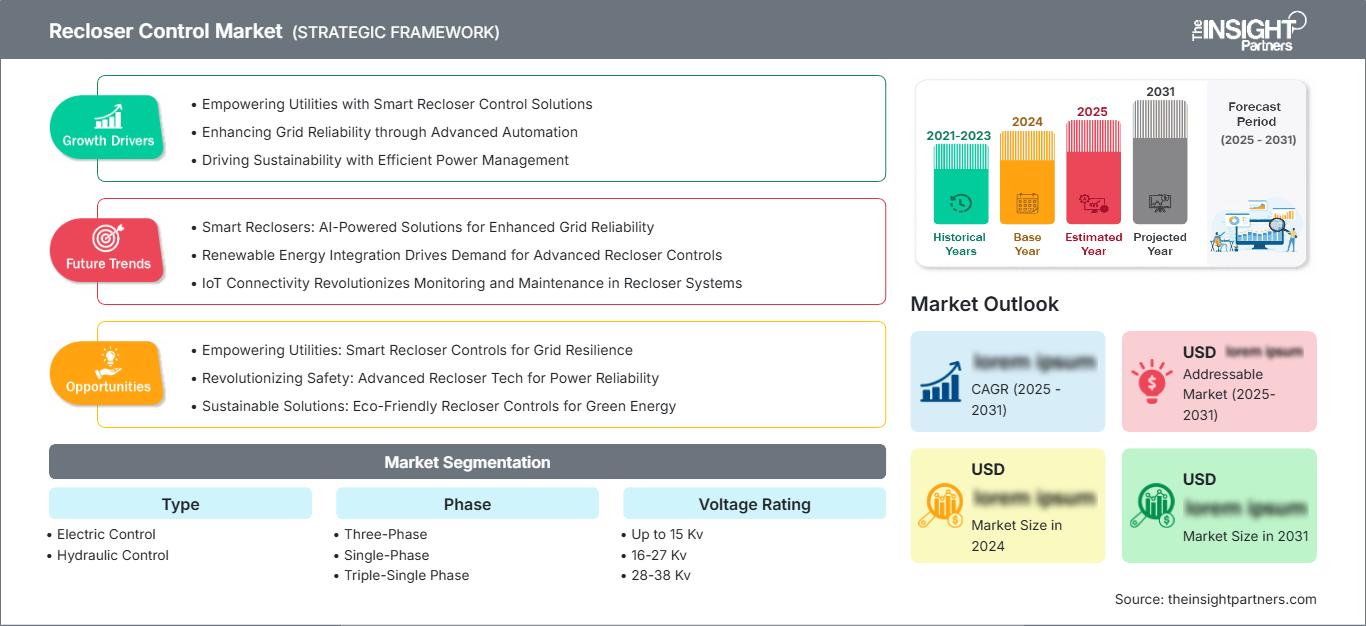
The recloser control market was valued at US$ 1.29 Billion in 2025 and is projected to reach US$ 2.33 Billion by 2034, expanding at a CAGR of 6.81% from 2026 to 2034. Growth reflects utilities' continuing investment in automated medium-voltage distribution protection, remote switching, feeder automation, and digital control architectures. Increasing deployment of distributed energy resources is also raising requirements for faster fault isolation, coordinated protection, operational visibility, and flexible restoration across increasingly dynamic distribution networks.
North America remains a structurally important market, supported by feeder modernization, wildfire mitigation, reliability programs, and replacement of aging control equipment, contributing significantly to Recloser Control Market Size. The regional outlook is strengthened by utilities integrating intelligent controls with SCADA, FLISR, communications networks, and advanced protection functions. Rising adoption of modular controllers also enables utilities to upgrade installed reclosers without replacing complete field assemblies, improving lifecycle economics and accelerating modernization programs.
Recloser Control Market Assessment and Insights
- North America: The region is estimated to account for 38–42% share in 2025 and expand at a CAGR of 6.3–7.0% between 2026–2034, supported by distribution automation, grid hardening, and wildfire-related protection investments.
- US: The US represents approximately 31–35% share of the global market in 2025, growing at a CAGR of 6.4–7.1% between 2026–2034, led by utility modernization and resilience programs.
- Europe: Europe is estimated at 24–28% share in 2025 with a CAGR of 6.1–6.8% between 2026–2034, led by Germany, the UK, France, Italy, and Spain as utilities modernize overhead and mixed distribution networks.
- Asia Pacific: Asia Pacific represents approximately 21–25% share in 2025 and is projected to grow at a CAGR of 7.0–7.8% between 2026–2034, driven by China, Japan, India, South Korea, and Australia.
- Largest Segment: Three-Phase controls hold an estimated 58–62% market share in 2025, expanding at a CAGR of 6.5–7.1% between 2026–2034 because of feeder automation requirements.
- High Growth Segment: Electric Control is estimated at 69–73% share in 2025, with a CAGR of 7.0–7.7% between 2026–2034, supported by digital protection and remote monitoring.
- Key companies analyzed in detail: ABB Ltd., Eaton Corporation plc, Entec Engineering Company, GW Electric Co., General Electric Company, Hubbell Incorporated, NOJA Power Switchgear Pty Ltd, Schneider Electric SE, Schweitzer Engineering Laboratories, Inc., Siemens AG.
Source: The Insight Partners' analysis based on proprietary research, government publications, company annual reports, investor presentations, industry databases, and expert interviews.
Industry trends have been moving from electromechanical protection to digital control technology, which combines sensing, programming of protection logic, communication, logging of events, and remote operations. The latest industry architectures are incorporating IEC communication capability, SCADA connectivity, automated feeder restoration capabilities, and interoperability with the utility’s distribution management systems. This has moved the focus of purchase from basic fault interruption to flexible system design, cybersecurity capabilities, easy access to data, and the ability to integrate with the utility’s automation infrastructure.
During the forecast period, investments are projected to move from established North American and European utility distribution grids to growing Asian, Middle Eastern, and Latin American utility distribution grids. Utility upgrades will favor modularity, solid dielectric switchgear, communication-capable controllers, and automation solutions for distributed energy. Regulatory emphasis on reliability, resilience, emissions reduction, and cybersecurity should reinforce demand for digitally managed medium-voltage protection assets, supporting growth in the Recloser Control Market Share.
Recloser Control Market Report Scope
| Report Attribute | Details |
|---|---|
| Market size in 2025 | US$ 1.29 Billion |
| Market Size by 2034 | US$ 2.33 Billion |
| Global CAGR (2026 - 2034) | 6.81% |
| Historical Data | 2021-2024 |
| Forecast period | 2026-2034 |
Recloser Control Market Analysis
Demand is anchored by the need to isolate temporary faults without prolonged feeder outages and to restore service rapidly after permanent faults. Utilities increasingly deploy controllers as part of coordinated feeder automation architectures rather than as standalone protection devices. The ecosystem spans recloser manufacturers, controller suppliers, protection-relay specialists, utilities, engineering contractors, communications providers, and grid-management software vendors. Supply dynamics therefore favor modular platforms with standardized interfaces, retrofit compatibility, and configurable protection functions, as discussed in the Recloser Control Market Report.
The recloser control market is also benefiting from replacement cycles for legacy controls whose communications, processing, and cybersecurity capabilities are no longer aligned with modern utility requirements. Vendors are responding with scalable processors, integrated communications, remote configuration, and advanced event analysis. Electric control has increasingly become the backbone for these operations, with hydraulics still holding ground in processes requiring straightforward and traditional procedures.
Competitive positioning is increasingly becoming dependent upon interconnectivity, installed base compatibility, cybersecurity, and the capability of supporting multiple automation systems. ABB Ltd., Eaton Corporation plc, Schneider Electric SE, Siemens AG, and General Electric Company have benefited from diversified grid systems, whereas Schweitzer Engineering Laboratories, Inc. thrives on its expertise in protection and control. NOJA Power Switchgear Pty Ltd has managed to carve out a niche by developing unique controller platforms.
Investment strategies increasingly emphasize software-enabled differentiation rather than only electromechanical performance in the Recloser Control Market. Eaton Corporation plc has incorporated cybersecurity and advanced protection into newer control architectures, while ABB Ltd. and Schneider Electric SE integrate reclosers with broader distribution automation portfolios. NOJA Power Switchgear Pty Ltd has pursued web-based configuration, fleet management, and enhanced data capabilities. These strategies indicate that recurring software functionality, retrofit pathways, and communications interoperability are becoming important competitive factors.
● REPORT CUSTOMIZATION
Tailor This Report To Align With Your Specific Business Requirements
This report can be customized to align precisely with your business objectives, scope, and target markets. Customization options include tailored segmentation, geography, competitive analysis, and strategic insights to support informed decision-making.
Customize This Report →WHAT YOU CAN ADJUST
- ● Segmentations
- ● Geography
- ● Competitive Analysis
- ● Language Preferences
Recloser Control Market: Strategic Insights
Regional Insights
North America recloser control market
North America is estimated to hold 38–42% share in 2025, with a 6.3–7.0% CAGR from 2026–2034, according to the Recloser Control Market Forecast. This region is helped out by the presence of a lot of overhead distribution networks, older control devices, mandatory reliability, and investments by utilities in automated feeder protection. Utilities in the United States are also improving their network resilience against risks like wildfires, extreme weather conditions, and equipment failures, thus raising the need for intelligent protection and remote operation.
Canada helps the region out by investing in the modernization of rural and remote distribution networks, which will benefit from sectionalizing automation and thus minimize the need to restore operations. More and more utility companies are purchasing devices that work with reclosers and SCADA systems, thus making it possible to update parts of equipment without having to change them all.
U.S. recloser control Market
The US accounts for approximately 31–35% of global recloser control market share in 2025 and represents about 80–84% of North American demand, expanding at a 6.4–7.1% CAGR. Utility investment focuses on wildfire mitigation, feeder automation, storm resilience, and replacement of legacy protection controls.
Major suppliers include ABB Ltd., Eaton Corporation plc, General Electric Company, Hubbell Incorporated, Schweitzer Engineering Laboratories, Inc., and Schneider Electric SE. Applications increasingly combine reclosers with SCADA, FLISR, fault recording, and remote switching. Demand is particularly strong where utilities seek higher reliability without rebuilding complete feeder infrastructure.
Europe recloser control Market
Europe is estimated at 24–28% share of the in 2025, with a 6.1–6.8% CAGR through 2034. Germany represents a strong market due to the need for reinforcement of its grid due to the emergence of distributed generation and industrial electrification. The United Kingdom is looking at the advancement of its network automation due to issues concerning reliability, distributed generation, and changing load curves. France is making efforts to modernize its existing distribution grid as well as meet the requirements of digital monitoring.
Italy and Spain create more demand for the integration of renewable generation and the modernization of their medium voltage grid. In Europe, the need is growing for maintenance-free equipment, solid insulation, remote diagnostics, interoperability, and environmental performance. Such needs tend to give an edge to digital control that allows coordination of its protection with automatic restoration plans.
APAC recloser control Market
APAC represents approximately 21–25% share of the recloser control market in 2025 and is expected to expand at a 7.0–7.8% CAGR. China provides substantial infrastructure-driven demand, while Japan emphasizes resilience and advanced distribution management. South Korea continues modernization, and India is expanding automation across urban and rural networks.
Australia combines renewable integration with advanced distribution automation, making it an important technology market. India and China provide the strongest volume opportunities as utilities expand and modernize medium-voltage feeders. Industrial electrification, renewable generation, reliability programs, and smart-grid policies support the deployment of communications-enabled electric controls. China is expected to remain the leading APAC market.
Middle East & Africa recloser control Market
The Middle East and Africa recloser control market demand is supported by grid expansion, industrial projects, renewable generation, and reliability requirements. Saudi Arabia and the UAE are investing in increasingly automated electricity networks, while South Africa requires modernization of aging distribution infrastructure. The regional market is estimated to grow at a 6.0–6.7% CAGR through 2034.
Saudi Arabia is positioned as the leading market, supported by utility modernization and large infrastructure programs. UAE projects emphasize intelligent distribution and reliable power for rapidly expanding urban and industrial loads. South Africa represents an important replacement opportunity, while the rest of MEA offers demand through rural electrification and renewable projects. Remote monitoring and reduced maintenance requirements are particularly valuable where field access is difficult.
Segmentation Analysis
Type
Electric Control is the dominant technology category, supported by programmable protection, communications, event recording, remote operation, and integration with modern distribution automation. The segment is projected to expand at a 7.0–7.7% CAGR from 2026–2034. Hydraulic Control remains relevant where utilities prioritize established designs, straightforward operation, and specific legacy-system compatibility.
- Electric Control: Provides programmable protection and communications functionality, making it strategically important for SCADA integration, automated restoration, remote diagnostics, cybersecurity, and modernization of installed medium-voltage networks.
- Hydraulic Control: Maintains demand in established networks where proven mechanical operating characteristics, simpler architectures, and compatibility with legacy equipment influence procurement and maintenance decisions.
Phase
Three-Phase solutions represent the largest phase category and are projected to grow at a 6.5–7.1% CAGR from 2026–2034. Their broad suitability for feeder protection and automation supports sustained adoption. Single-Phase solutions address selected overhead applications, while Triple-Single Phase architectures provide independent phase operation and flexible protection coordination.
- Three-Phase: Supports major distribution feeders and automated network protection, making it strategically important for utilities seeking coordinated switching, fault isolation, load management, and standardized automation architectures.
- Single-Phase: Serves selected overhead distribution applications where phase-specific protection, lower installation complexity, and localized fault management make independent equipment economically and operationally appropriate.
- Triple-Single Phase: Enables independent phase control and flexible fault response, supporting advanced overhead distribution applications where phase-level monitoring and switching improve network operating flexibility.
Voltage Rating
16-27 Kv equipment is expected to remain strategically significant and is projected to grow at a 6.6–7.2% CAGR from 2026–2034, reflecting its broad medium-voltage distribution applicability. Up to 15 Kv supports established networks, while 28-38 Kv serves higher-voltage overhead distribution requirements.
- Up to 15 Kv: Addresses established medium-voltage feeders and utility networks, with demand sustained by replacement cycles, compact installations, and modernization of existing protection infrastructure.
- 16-27 Kv: Serves a broad range of distribution networks and automation applications, supporting standardized procurement, remote monitoring, feeder protection, and integration with utility control systems.
- 28-38 Kv: Targets higher-voltage overhead networks where greater insulation and interruption capability are required, supporting industrial, utility, renewable, and long-distance distribution applications.
Opportunity Snapshot
| Electric Control | Revenue Contribution (High/Medium/Low) | Trend Tag | Adoption Stage |
| Electric Control | High | Digital Protection | Mature |
| Hydraulic Control | Medium | Legacy Retrofit | Mature |
| Three-Phase | High | Feeder Automation | Mature |
| Single-Phase | Medium | Rural Protection | Scaling |
| Triple-Single Phase | Medium | Phase Automation | Scaling |
| Up to 15 Kv | Medium | Legacy Modernization | Mature |
| 16-27 Kv | High | Smart Distribution | Scaling |
| 28-38 Kv | Medium | High-Voltage Feeder | Scaling |
Recloser Control Market Growth Drivers and Impact Analysis
Distribution Grid Automation and Reliability Requirements
Utilities are moving from manual fault isolation toward automated feeder management because outage duration, restoration costs, and customer reliability increasingly influence capital allocation, reflecting key Recloser Control Market Trends. Intelligent controllers enable coordinated protection, fault indication, remote switching, and automated restoration without requiring crews to visit every switching location. This will lead to an architecture that can reduce reliance on manual intervention in the operation process and enhance visibility of feeder conditions. For manufacturers of such equipment, this means the shift towards performance in processing, communication, cybersecurity, and interoperability. In the case of the utilities, the value that they derive is in combining controllers with reclosers, sensors, communication infrastructure, and distribution management platforms. The purchasing decision becomes one that looks at total life-cycle performance instead of just equipment price.
Distributed Energy Resources Increase Protection Complexity
Solar generation, batteries, distributed generation, and variable load profiles result in bidirectional power flow that poses challenges to conventional feeder protection coordination. Control systems will become increasingly challenged with dynamic operating conditions, voltage differences, directionally based protection, and co-ordination of switching activities. There will be a requirement for platforms with multi-settings capacity, adaptable logic, communication capabilities, and the ability to configure quickly. Utilities may rely on digital control systems to make changes to their protection system as their topology changes without needing to deploy new equipment in the field. The implications of the problem extend beyond engineering and procurement, as utilities need more interoperable systems that interact well with their renewable interconnection and distribution management systems. Suppliers that offer flexible settings, event capture capability, communications, and distributed resources integration can solve a broader array of modernization projects.
Grid Resilience and Cybersecurity Investment
Extreme weather, wildfires, threats to physical infrastructure, and digital connectivity are increasing the significance of resilience among the distribution network components. Controllers in today’s world help to provide remote control, event logging, access control, encryption, and faster fault isolation, allowing utilities to deal with both types of threats. Cybersecurity is especially significant in today’s controllers since they interact with the SCADA and enterprise networks. The need for authenticated access, firmware security, auditing, and configuration management will be necessary when upgrading existing systems and will affect replacement decisions since the old controllers might lack the current cybersecurity architecture. Utilities will invest in equipment that will still have enough lifetime to undergo further software and communications upgrades.
Recloser Control Market Future Trends
Software-Defined Fleet Management
The future architecture of controllers is likely to favor the following: centralized configuration, remote secure updates, automated inventory, and diagnostics throughout the fleet. Utilities, which have several hundred or even thousands of field devices, can save engineering resources by using standard configurations, standard firmware, and configuration templates among groups of devices. Web interfaces and APIs based on open standards will become more popular as utilities connect their field devices to engineering and asset management systems. In the process, software lifecycle management will become an increasingly critical purchase criterion. Competitiveness will be based on configuration management and traceability, validation, and interoperability, and protection hardware. The business consequence will be the move towards controller systems combining field intelligence and centralized management functionality.
Synchrophasor and Edge Analytics Integration
Recloser controllers are likely to evolve into distributed measurement and analytics nodes as utilities seek more granular visibility across medium-voltage feeders. Higher-resolution measurements, synchronized data, edge processing, and event analytics can help utilities identify disturbances, assess network conditions, and support predictive maintenance. Integration with standardized communications will allow controller data to move into broader grid-management environments without extensive proprietary interfaces. This trend is particularly relevant to networks with high renewable penetration, where rapid changes in power flow can challenge conventional operating assumptions. Edge analytics may also reduce communications latency by enabling selected decisions locally. Over time, the controller's role can therefore expand from protection execution toward localized intelligence, creating opportunities for suppliers with strong software, communications, and data-management capabilities.
Recloser Control Market Opportunities
Retrofit Programs for Legacy Distribution Fleets
Large installed populations of legacy reclosers create an opportunity for modular controller replacement rather than full equipment substitution. Utilities can extend the useful life of existing switching assets while adding communications, programmable protection, event recording, cybersecurity, and remote management capabilities. Retrofit solutions can shorten installation periods and reduce civil, pole, and equipment costs compared with complete replacement programs. Suppliers that maintain compatibility with multiple generations of field equipment can address utilities with heterogeneous fleets and limited standardization. The opportunity is particularly strong where capital budgets prioritize reliability improvements but do not support wholesale feeder reconstruction. Controller vendors can further increase value by offering migration tools, configuration conversion, commissioning support, and lifecycle software services. Such offerings can transform one-time equipment replacement into broader modernization programs.
Smart Distribution Expansion in Emerging Economies
Emerging electricity systems offer substantial opportunities in the Recloser Control Market, where utilities are simultaneously expanding networks and introducing modern automation practices. New medium-voltage feeders can be designed with communications-enabled protection from the outset, avoiding some limitations associated with legacy installations. India, Southeast Asia, the Middle East, and selected African markets provide opportunities where electrification, renewable generation, industrial development, and reliability improvements are occurring together. Suppliers can tailor solutions around harsh environmental conditions, remote monitoring, simplified commissioning, and local service availability. Partnerships with utilities, engineering contractors, and regional system integrators can improve project execution and support technology localization. The strongest opportunities are likely to emerge where procurement programs combine reliability targets with smart-grid requirements, allowing intelligent controllers to become an integral part of new feeder architecture rather than a later retrofit.
Frequently Asked Questions

- Comprehensive Market Sizing and Forecast Analysis
- Detailed Segmentation Analysis
- In-Depth Market Dynamics Assessment
- Regional and Country-Level Insights
- Competitive Landscape and Company Benchmarking
- Strategic Business Intelligence
Recent Reports
Testimonials

The Insight Partners' SCADA System Market report is comprehensive, with valuable insights on current trends and future forecasts. The team was highly professional, responsive, and supportive throughout. We are very satisfied and highly recommend their services.
RAN KEDEM Partner, Reali Technologies LTDs
I requested a report on a very specific software market and the team produced the report in a few days. The information was very relevant and well presented. I then requested some changes and additions to the report. The team was again very responsive and I got the final report in less than a week.
JEAN-HERVE JENN Chairman, Future Analytica
We worked with The Insight Partners for an important market study and forecast. They gave us clear insights into opportunities and risks, which helped shape our plans. Their research was easy to use and based on solid data. It helped us make smart, confident decisions. We highly recommend them.
PIYUSH NAGPAL Sr. Vice President, High Beam Global
The Insight Partners delivered insightful, well-structured market research with strong domain expertise. Their team was professional and responsive throughout. The user-friendly website made accessing industry reports seamless. We highly recommend them for reliable, high-quality research services
YUKIHIKO ADACHI CEO, Deep Blue, LLC.
This is the first time I have purchased a market report from The Insight Partners.While I was unsure at first, I visited their web site and felt more comfortable to take the risk and purchase a market report.I am completely satisfied with the quality of the report and customer service. I had several questions and comments with the initial report, but after a couple of dialogs over email with their analyst I believe I have a report that I can use as input to our strategic planning process.Thank you so much for taking the extra time and making this a positive experience.I will definitely recommend your service to others and you will be my first call when we need further market data.
JOHN SUZUKI President and Chief Executive Officer, Board Director, BK Technologies
I wish to appreciate your support and the professionalism you displayed in the course of attending to my request for information regarding to infectious disease IVD market in Nigeria. I appreciate your patience, your guidance, and the fact that you were willing to offer a discount, which eventually made it possible for us to close a deal. I look forward to engaging The Insight Partners in the future, all thanks to the impression you have created in me as a result of this first encounter.
DR CHIJIOKE ONYIA MANAGING DIRECTOR, PineCrest Healthcare Ltd.Reason to Buy
- Informed Decision-Making
- Understanding Market Dynamics
- Competitive Analysis
- Identifying Emerging Markets
- Customer Insights
- Market Forecasts
- Risk Mitigation
- Boosting Operational Efficiency
- Strategic Planning
- Investment Justification
- Tracking Industry Innovations
- Aligning with Regulatory Trends





 Get Free Sample for